Best

PHOTOS: Tickhill Psalter’s Jesse Tree shines in Morgan Library’s Advent exhibit #Catholic 
 
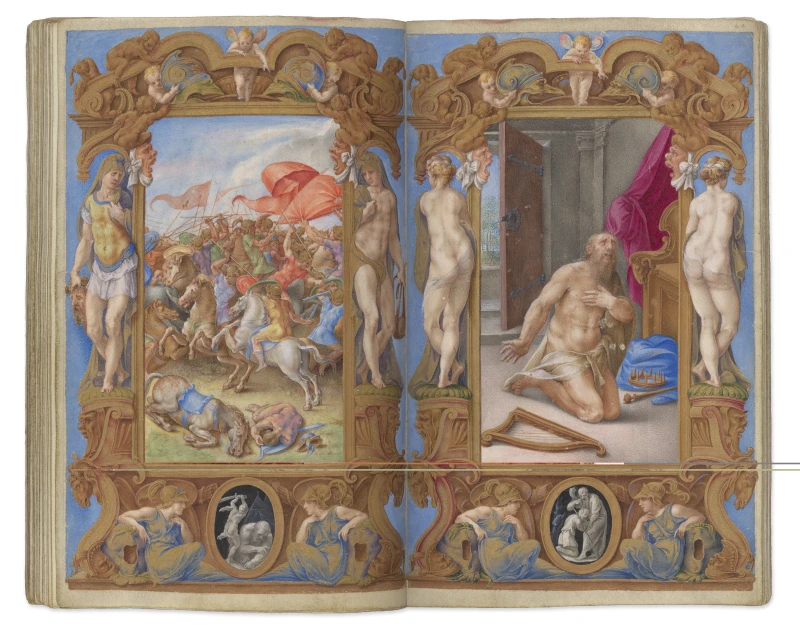
 Death of Uriah; David in Penance, from the Morgan’s famed Farnese Hours, demonstrates the enduring appeal of the penitential Psalms of David as seen in this early Renaissance book of hours. Italy, Rome, 1546. The Morgan Library & Museum, New York, MS M.69, fols, 63v-63r. Photography by Janny Chiu. / Credit: Courtesy of the New York Library

New York City, New York, Nov 30, 2025 / 08:00 am (CNA).
Part of the New York Public Library’s Spencer Collection, the Tickhill Psalter is on view throughout Advent and Christmas at The Morgan Library & Museum in its exhibit “Sing a New Song: The Psalms in Medieval Art and Life.” A full-page Jesse Tree introduces the Psalms in the Tickhill Psalter, a 14th-century illuminated manuscript from the Augustinian Worksop Priory in Nottinghamshire, England. Tree of Jesse (Psalm 1), from the Tickhill Psalter, England, Nottinghamshire, Worksop Priory, 1303-14, New York Public Library, Spencer 26. fol. 6v. The Medieval manuscript is on display in Morgan Library’s Advent exhibit. Credit: Courtesy of the Morgan LibraryDavid appears in the historiated B of Psalm 1, providing a conceptual link to scenes from his life in the Jesse Tree on the facing page. “Beatus vir,” or “Blessed is the man,” the first stanza opens in celebration of the one who delights in God’s law, concluding: “That person is like a tree planted by streams of water, which yields its fruit in season and whose leaf does not wither, — what they do prospers.” These words and their historiated B, with its visual link to the facing page, highlight David as key author of the Psalms and their prefiguration of Christ, the good fruit of the Jesse Tree, a theme common to medieval illuminated manuscripts.King David as Psalmist, from Florence, Italy, ca. 1408-10, by Lorenzo Monaco, who was born Piero di Giovanni but took the name Lorenzo Monaco, or Lorenzo the Monk, upon joining the monastery of Santa Maria degli Angeli, where he became a skilled illuminator and translated themes common to illuminated manuscripts into panel paintings, like this tempera on wood with gold ground depicting David seated on a stone bench tuning a psaltery, lips parted, prepared to sing, with a halo backing the crown he wears to signify the divine inspiration of his compositions. The Metropolitan Museum of Art, New York, 65.14.4. November 2025. Credit: Courtesy of the Metropolitan Museum of Art, New YorkProphets stand in architectural niches on either side of the Tickhill Psalter’s Jesse Tree, heralding the Psalms as prophecy. Credit: Courtesy of the New York LibraryThe central panel of a 1490 Flemish triptych with scenes from the life of Saint Augustine contextualizes the exhibit. This five-by-five-foot oil on wood painting references Augustine’s use of allegory, essential to his understanding of scripture and interpretation of the psalms as prophecy. One scene captures Augustine’s realization of the Trinity as boundless mystery that dwarfs human understanding, allegorized by a child trying to pour the sea into a hole in the sand. Scenes from the life of St. Augustine of Hippo, 1490, Bruges, Belgium, by the unnamed master of St. Augustine, amplifies the Church’s leading theologian on the allegorical interpretation of Psalms. At center, his installation as bishop of Hippo highlights his teaching authority, flanked by scenes of ordination and preaching on the left. On the right, he engages in scholarly discourse and converses with a child trying to pour the sea into a hole in the sand, illustrating the importance of allegory in Augustinian thought. Credit: Courtesy of the New York Public LibraryLate 12th-century book comprised of Augustine’s Gradual Psalms and his Enchiridion (Greek for “handbook”). The well-worn and annotated pages reflect the proliferation of Augustinian influence on interpretation of Scripture. Spain, Santa Maria de Benevivere, near Palencia. Free Library of Philadelphia, Lewis E22, fols. 68v-69r. Credit: Courtesy of the New York Public LibraryIn the book accompanying the exhibit, Morgan curator Deirdre Jackson extends the psalms’ significance to this triptych through a reference to a surviving panel housed in Ireland that shows Augustine on his deathbed. It’s a scene described by contemporary bishop Possidius of Calama, who said that Augustine “ordered those psalms of David which are especially penitential to be copied out and, when he was very weak, used to lie in bed, facing the wall where the written sheets were put up, gazing at them and reading them, and copiously and continuously weeping as he read.”Death of Uriah; David in Penance, from the Morgan’s famed Farnese Hours, demonstrates the enduring appeal of the penitential Psalms of David as seen in this early Renaissance book of hours. Italy, Rome, 1546. The Morgan Library & Museum, New York, MS M.69, fols, 63v-63r. Photography by Janny Chiu. Credit: Courtesy of the New York Public LibraryScenes from the Life of David, depicting the story of David and Goliath, exemplifies the significance attached to the figure of David in medieval illuminated manuscripts. Winchester Bible, England, Winchester, ca. 1160-80. The Morgan Library & Museum, New York, MS M.619v. Photography by Graham S. Haber. Credit: Courtesy of the New York LibraryIn his book “The Tickhill Psalter and Related Manuscripts,” 20th-century art historian Donald Drew Egbert speculates that the Tickhill Psalter was decorated by highly skilled illuminators working for Augustinian monasteries and patrons of Augustinian houses during a high point of book arts in England.St. Thomas More, “in tribulation vehementi et in carcere” (annotation), from the Prayer Book of Thomas More, France, Paris, 1522 (Psalter) and 1530 (Book of Hours), Beinecke Rare Book & Manuscript Library, Yale University, New Haven, MS Vault More, fol. 68v (Psalter section). Credit: Courtesy of the New York LibraryThis high point inspired a trend of books as personalized treasures, best exemplified in this exhibit by St. Thomas More’s prayer book. Containing much of his own writing in the margins, it consists of a Book of Hours and a Psalter and was with him in the Tower of London while he awaited execution. More’s notes during that time show his preoccupation with the psalms of David’s tribulations. Beside Psalm 87:5-10, “a man without help … in the dark places, and in the shadow of death,” More writes, “in severe tribulation and in prison.”The Prayer Book of Thomas More is backed by a wall-sized image of Hans Holbein’s “Sir Thomas More,” positioned to look like More is gazing intently across the gallery at an image of David from the Crusader Bible. Engelhard Gallery, Photography by Janny Chiu, October 2025. Credit: Courtesy of the New York LibraryMore’s thoughts in distress demonstrate the appeal of David’s story to the human heart, a reality repeatedly expressed throughout the treasures of this exhibit. In the Tickhill Psalter’s Jesse Tree, David is encircled by branches springing from a tree that grows out of his father, Jesse, sprawled in an active sleep, his elbow supporting a hand planted against his head as though dreaming of all that is to come. A crop of the enter of Tickhill Psalter showing the Virgin and Child and the figure of David playing a harp. Credit: Courtesy of the New York LibraryThe branches of the tree wind around David and directly overhead to encircle the Virgin and Child, tracing Christ’s lineage through Mary to the House of David. At the top, the branches surround Christ enthroned in majesty, fulfilling the promise of victory over sin and death foreshadowed in the psalms.David strikes a joyous pose and plays a harp in celebration, and foliage on either side of the main branch wraps around prophets who unfurl scrolls to hint at mysteries about to be foretold in the reading of the psalms.Beneath the figure of Jesse, two separate depictions of David protecting his sheep from wild animals cast his actions as allegory in the fight against evil, segueing to his likeness in the historiated B, dancing and singing his story into the Psalms to animate their prefiguration of Christ.

PHOTOS: Tickhill Psalter’s Jesse Tree shines in Morgan Library’s Advent exhibit #Catholic Death of Uriah; David in Penance, from the Morgan’s famed Farnese Hours, demonstrates the enduring appeal of the penitential Psalms of David as seen in this early Renaissance book of hours. Italy, Rome, 1546. The Morgan Library & Museum, New York, MS M.69, fols, 63v-63r. Photography by Janny Chiu. / Credit: Courtesy of the New York Library New York City, New York, Nov 30, 2025 / 08:00 am (CNA). Part of the New York Public Library’s Spencer Collection, the Tickhill Psalter is on view throughout Advent and Christmas at The Morgan Library & Museum in its exhibit “Sing a New Song: The Psalms in Medieval Art and Life.” A full-page Jesse Tree introduces the Psalms in the Tickhill Psalter, a 14th-century illuminated manuscript from the Augustinian Worksop Priory in Nottinghamshire, England. Tree of Jesse (Psalm 1), from the Tickhill Psalter, England, Nottinghamshire, Worksop Priory, 1303-14, New York Public Library, Spencer 26. fol. 6v. The Medieval manuscript is on display in Morgan Library’s Advent exhibit. Credit: Courtesy of the Morgan LibraryDavid appears in the historiated B of Psalm 1, providing a conceptual link to scenes from his life in the Jesse Tree on the facing page. “Beatus vir,” or “Blessed is the man,” the first stanza opens in celebration of the one who delights in God’s law, concluding: “That person is like a tree planted by streams of water, which yields its fruit in season and whose leaf does not wither, — what they do prospers.” These words and their historiated B, with its visual link to the facing page, highlight David as key author of the Psalms and their prefiguration of Christ, the good fruit of the Jesse Tree, a theme common to medieval illuminated manuscripts.King David as Psalmist, from Florence, Italy, ca. 1408-10, by Lorenzo Monaco, who was born Piero di Giovanni but took the name Lorenzo Monaco, or Lorenzo the Monk, upon joining the monastery of Santa Maria degli Angeli, where he became a skilled illuminator and translated themes common to illuminated manuscripts into panel paintings, like this tempera on wood with gold ground depicting David seated on a stone bench tuning a psaltery, lips parted, prepared to sing, with a halo backing the crown he wears to signify the divine inspiration of his compositions. The Metropolitan Museum of Art, New York, 65.14.4. November 2025. Credit: Courtesy of the Metropolitan Museum of Art, New YorkProphets stand in architectural niches on either side of the Tickhill Psalter’s Jesse Tree, heralding the Psalms as prophecy. Credit: Courtesy of the New York LibraryThe central panel of a 1490 Flemish triptych with scenes from the life of Saint Augustine contextualizes the exhibit. This five-by-five-foot oil on wood painting references Augustine’s use of allegory, essential to his understanding of scripture and interpretation of the psalms as prophecy. One scene captures Augustine’s realization of the Trinity as boundless mystery that dwarfs human understanding, allegorized by a child trying to pour the sea into a hole in the sand. Scenes from the life of St. Augustine of Hippo, 1490, Bruges, Belgium, by the unnamed master of St. Augustine, amplifies the Church’s leading theologian on the allegorical interpretation of Psalms. At center, his installation as bishop of Hippo highlights his teaching authority, flanked by scenes of ordination and preaching on the left. On the right, he engages in scholarly discourse and converses with a child trying to pour the sea into a hole in the sand, illustrating the importance of allegory in Augustinian thought. Credit: Courtesy of the New York Public LibraryLate 12th-century book comprised of Augustine’s Gradual Psalms and his Enchiridion (Greek for “handbook”). The well-worn and annotated pages reflect the proliferation of Augustinian influence on interpretation of Scripture. Spain, Santa Maria de Benevivere, near Palencia. Free Library of Philadelphia, Lewis E22, fols. 68v-69r. Credit: Courtesy of the New York Public LibraryIn the book accompanying the exhibit, Morgan curator Deirdre Jackson extends the psalms’ significance to this triptych through a reference to a surviving panel housed in Ireland that shows Augustine on his deathbed. It’s a scene described by contemporary bishop Possidius of Calama, who said that Augustine “ordered those psalms of David which are especially penitential to be copied out and, when he was very weak, used to lie in bed, facing the wall where the written sheets were put up, gazing at them and reading them, and copiously and continuously weeping as he read.”Death of Uriah; David in Penance, from the Morgan’s famed Farnese Hours, demonstrates the enduring appeal of the penitential Psalms of David as seen in this early Renaissance book of hours. Italy, Rome, 1546. The Morgan Library & Museum, New York, MS M.69, fols, 63v-63r. Photography by Janny Chiu. Credit: Courtesy of the New York Public LibraryScenes from the Life of David, depicting the story of David and Goliath, exemplifies the significance attached to the figure of David in medieval illuminated manuscripts. Winchester Bible, England, Winchester, ca. 1160-80. The Morgan Library & Museum, New York, MS M.619v. Photography by Graham S. Haber. Credit: Courtesy of the New York LibraryIn his book “The Tickhill Psalter and Related Manuscripts,” 20th-century art historian Donald Drew Egbert speculates that the Tickhill Psalter was decorated by highly skilled illuminators working for Augustinian monasteries and patrons of Augustinian houses during a high point of book arts in England.St. Thomas More, “in tribulation vehementi et in carcere” (annotation), from the Prayer Book of Thomas More, France, Paris, 1522 (Psalter) and 1530 (Book of Hours), Beinecke Rare Book & Manuscript Library, Yale University, New Haven, MS Vault More, fol. 68v (Psalter section). Credit: Courtesy of the New York LibraryThis high point inspired a trend of books as personalized treasures, best exemplified in this exhibit by St. Thomas More’s prayer book. Containing much of his own writing in the margins, it consists of a Book of Hours and a Psalter and was with him in the Tower of London while he awaited execution. More’s notes during that time show his preoccupation with the psalms of David’s tribulations. Beside Psalm 87:5-10, “a man without help … in the dark places, and in the shadow of death,” More writes, “in severe tribulation and in prison.”The Prayer Book of Thomas More is backed by a wall-sized image of Hans Holbein’s “Sir Thomas More,” positioned to look like More is gazing intently across the gallery at an image of David from the Crusader Bible. Engelhard Gallery, Photography by Janny Chiu, October 2025. Credit: Courtesy of the New York LibraryMore’s thoughts in distress demonstrate the appeal of David’s story to the human heart, a reality repeatedly expressed throughout the treasures of this exhibit. In the Tickhill Psalter’s Jesse Tree, David is encircled by branches springing from a tree that grows out of his father, Jesse, sprawled in an active sleep, his elbow supporting a hand planted against his head as though dreaming of all that is to come. A crop of the enter of Tickhill Psalter showing the Virgin and Child and the figure of David playing a harp. Credit: Courtesy of the New York LibraryThe branches of the tree wind around David and directly overhead to encircle the Virgin and Child, tracing Christ’s lineage through Mary to the House of David. At the top, the branches surround Christ enthroned in majesty, fulfilling the promise of victory over sin and death foreshadowed in the psalms.David strikes a joyous pose and plays a harp in celebration, and foliage on either side of the main branch wraps around prophets who unfurl scrolls to hint at mysteries about to be foretold in the reading of the psalms.Beneath the figure of Jesse, two separate depictions of David protecting his sheep from wild animals cast his actions as allegory in the fight against evil, segueing to his likeness in the historiated B, dancing and singing his story into the Psalms to animate their prefiguration of Christ.


Death of Uriah; David in Penance, from the Morgan’s famed Farnese Hours, demonstrates the enduring appeal of the penitential Psalms of David as seen in this early Renaissance book of hours. Italy, Rome, 1546. The Morgan Library & Museum, New York, MS M.69, fols, 63v-63r. Photography by Janny Chiu. / Credit: Courtesy of the New York Library

New York City, New York, Nov 30, 2025 / 08:00 am (CNA).

Part of the New York Public Library’s Spencer Collection, the Tickhill Psalter is on view throughout Advent and Christmas at The Morgan Library & Museum in its exhibit “Sing a New Song: The Psalms in Medieval Art and Life.” A full-page Jesse Tree introduces the Psalms in the Tickhill Psalter, a 14th-century illuminated manuscript from the Augustinian Worksop Priory in Nottinghamshire, England.

Tree of Jesse (Psalm 1), from the Tickhill Psalter, England, Nottinghamshire, Worksop Priory, 1303-14, New York Public Library, Spencer 26. fol. 6v. The Medieval manuscript is on display in Morgan Library’s Advent exhibit. Credit: Courtesy of the Morgan Library

David appears in the historiated B of Psalm 1, providing a conceptual link to scenes from his life in the Jesse Tree on the facing page. “Beatus vir,” or “Blessed is the man,” the first stanza opens in celebration of the one who delights in God’s law, concluding: “That person is like a tree planted by streams of water, which yields its fruit in season and whose leaf does not wither, — what they do prospers.” 

These words and their historiated B, with its visual link to the facing page, highlight David as key author of the Psalms and their prefiguration of Christ, the good fruit of the Jesse Tree, a theme common to medieval illuminated manuscripts.

King David as Psalmist, from Florence, Italy, ca. 1408-10, by Lorenzo Monaco, who was born Piero di Giovanni but took the name Lorenzo Monaco, or Lorenzo the Monk, upon joining the monastery of Santa Maria degli Angeli, where he became a skilled illuminator and translated themes common to illuminated manuscripts into panel paintings, like this tempera on wood with gold ground depicting David seated on a stone bench tuning a psaltery, lips parted, prepared to sing, with a halo backing the crown he wears to signify the divine inspiration of his compositions. The Metropolitan Museum of Art, New York, 65.14.4. November 2025. Credit: Courtesy of the Metropolitan Museum of Art, New York
Prophets stand in architectural niches on either side of the Tickhill Psalter’s Jesse Tree, heralding the Psalms as prophecy. Credit: Courtesy of the New York Library

The central panel of a 1490 Flemish triptych with scenes from the life of Saint Augustine contextualizes the exhibit. This five-by-five-foot oil on wood painting references Augustine’s use of allegory, essential to his understanding of scripture and interpretation of the psalms as prophecy. One scene captures Augustine’s realization of the Trinity as boundless mystery that dwarfs human understanding, allegorized by a child trying to pour the sea into a hole in the sand. 

Scenes from the life of St. Augustine of Hippo, 1490, Bruges, Belgium, by the unnamed master of St. Augustine, amplifies the Church’s leading theologian on the allegorical interpretation of Psalms. At center, his installation as bishop of Hippo highlights his teaching authority, flanked by scenes of ordination and preaching on the left. On the right, he engages in scholarly discourse and converses with a child trying to pour the sea into a hole in the sand, illustrating the importance of allegory in Augustinian thought. Credit: Courtesy of the New York Public Library
Late 12th-century book comprised of Augustine’s Gradual Psalms and his Enchiridion (Greek for “handbook”). The well-worn and annotated pages reflect the proliferation of Augustinian influence on interpretation of Scripture. Spain, Santa Maria de Benevivere, near Palencia. Free Library of Philadelphia, Lewis E22, fols. 68v-69r. Credit: Courtesy of the New York Public Library

In the book accompanying the exhibit, Morgan curator Deirdre Jackson extends the psalms’ significance to this triptych through a reference to a surviving panel housed in Ireland that shows Augustine on his deathbed. It’s a scene described by contemporary bishop Possidius of Calama, who said that Augustine “ordered those psalms of David which are especially penitential to be copied out and, when he was very weak, used to lie in bed, facing the wall where the written sheets were put up, gazing at them and reading them, and copiously and continuously weeping as he read.”

Death of Uriah; David in Penance, from the Morgan’s famed Farnese Hours, demonstrates the enduring appeal of the penitential Psalms of David as seen in this early Renaissance book of hours. Italy, Rome, 1546. The Morgan Library & Museum, New York, MS M.69, fols, 63v-63r. Photography by Janny Chiu. Credit: Courtesy of the New York Public Library
Scenes from the Life of David, depicting the story of David and Goliath, exemplifies the significance attached to the figure of David in medieval illuminated manuscripts. Winchester Bible, England, Winchester, ca. 1160-80. The Morgan Library & Museum, New York, MS M.619v. Photography by Graham S. Haber. Credit: Courtesy of the New York Library

In his book “The Tickhill Psalter and Related Manuscripts,” 20th-century art historian Donald Drew Egbert speculates that the Tickhill Psalter was decorated by highly skilled illuminators working for Augustinian monasteries and patrons of Augustinian houses during a high point of book arts in England.

St. Thomas More, “in tribulation vehementi et in carcere” (annotation), from the Prayer Book of Thomas More, France, Paris, 1522 (Psalter) and 1530 (Book of Hours), Beinecke Rare Book & Manuscript Library, Yale University, New Haven, MS Vault More, fol. 68v (Psalter section). Credit: Courtesy of the New York Library

This high point inspired a trend of books as personalized treasures, best exemplified in this exhibit by St. Thomas More’s prayer book. Containing much of his own writing in the margins, it consists of a Book of Hours and a Psalter and was with him in the Tower of London while he awaited execution. More’s notes during that time show his preoccupation with the psalms of David’s tribulations. Beside Psalm 87:5-10, “a man without help … in the dark places, and in the shadow of death,” More writes, “in severe tribulation and in prison.”

The Prayer Book of Thomas More is backed by a wall-sized image of Hans Holbein’s "Sir Thomas More," positioned to look like More is gazing intently across the gallery at an image of David from the Crusader Bible. Engelhard Gallery, Photography by Janny Chiu, October 2025. Credit: Courtesy of the New York Library
The Prayer Book of Thomas More is backed by a wall-sized image of Hans Holbein’s “Sir Thomas More,” positioned to look like More is gazing intently across the gallery at an image of David from the Crusader Bible. Engelhard Gallery, Photography by Janny Chiu, October 2025. Credit: Courtesy of the New York Library

More’s thoughts in distress demonstrate the appeal of David’s story to the human heart, a reality repeatedly expressed throughout the treasures of this exhibit. In the Tickhill Psalter’s Jesse Tree, David is encircled by branches springing from a tree that grows out of his father, Jesse, sprawled in an active sleep, his elbow supporting a hand planted against his head as though dreaming of all that is to come. 

A crop of the enter of Tickhill Psalter showing the Virgin and Child and the figure of David playing a harp. Credit: Courtesy of the New York Library

The branches of the tree wind around David and directly overhead to encircle the Virgin and Child, tracing Christ’s lineage through Mary to the House of David. At the top, the branches surround Christ enthroned in majesty, fulfilling the promise of victory over sin and death foreshadowed in the psalms.

David strikes a joyous pose and plays a harp in celebration, and foliage on either side of the main branch wraps around prophets who unfurl scrolls to hint at mysteries about to be foretold in the reading of the psalms.

Beneath the figure of Jesse, two separate depictions of David protecting his sheep from wild animals cast his actions as allegory in the fight against evil, segueing to his likeness in the historiated B, dancing and singing his story into the Psalms to animate their prefiguration of Christ.

Read More
Giving people hope is greatest challenge, custos of Holy Land says in U.S. visit #Catholic 
 
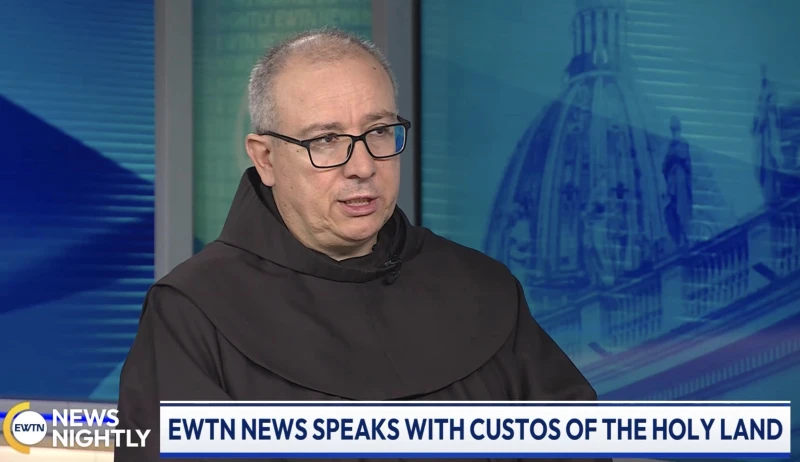
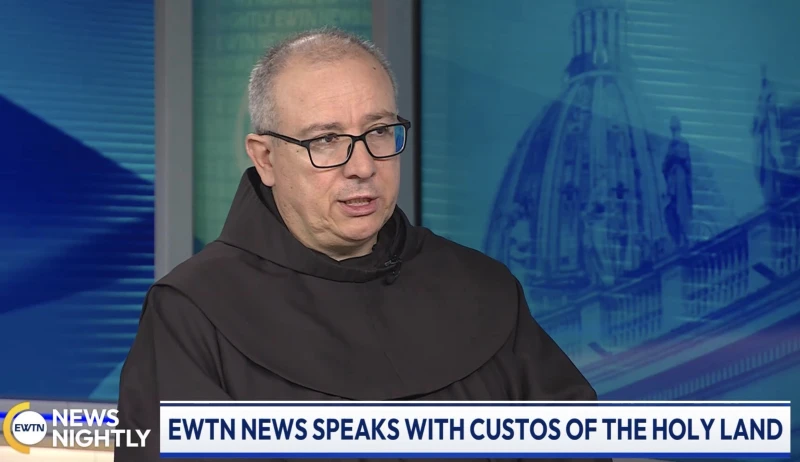
 Custos of the Holy Land Father Franceso Ielpo speaks with EWTN News in a two-part interview that began airing on “EWTN News Nightly” on Nov. 24, 2025. / Credit: “EWTN News Nightly”/Screenshot

Washington, D.C. Newsroom, Nov 25, 2025 / 09:00 am (CNA).
The custos of the Holy Land said in an interview with EWTN News that the “greatest challenge” is to be a source of hope amid perpetual devastation due to conflict. “The greatest challenge is to always be able to give people hope. One can have food, one can have a home, one can have medicine, one can have the best schools, but to live, we all need hope. And this hope always arises when you see, when you feel the presence of God through the presence of the Church beside you,” Father Franceso Ielpo told EWTN News’ Matthew Bunson in a two-part interview that began airing Nov. 24 on “EWTN News Nightly.” Ielpo has served as custos of the Holy Land since his appointment by Pope Leo XIV in June, when he succeeded Father Francesdo Patton. It is Ielpo’s first visit to the United States as custos, a Latin term for “guardian” associated with the Franciscan order’s special responsibility to oversee and care for holy sites in the Holy Land.Ielpo explained this challenge confronts the Christian community not only in Israel and Palestine but also in Lebanon and Syria. Custodians in these countries, he said, are faced with having “to grow and continue to live in a context of tension, in a context of perpetual conflict.” The Custody of the Holy Land is made up of 325 friars from over 40 countries. Ielpo said the latest conflict in Israel “has had very serious consequences” for “all communities in the Holy Land,” particularly in the employment sphere due to a lack of pilgrims to the region, which depends on religious tourism to generate income. He further emphasized the “tension of uncertainty about the future, especially for one’s children.” “The custody continues first and foremost to support and sustain the salaries of all our employees, of all our Christians, and also seeks to continue the educational work that is the schools,” Ielpo said. “We currently have 18 schools with about 10,000 students, both Christian and Muslim. Even for families who can no longer pay for school, we continue to guarantee education because we are convinced that the future is built in the classroom.” The work of the custody is not limited to the Christian community alone, he said, noting that 90% of the student population attending the Franciscan school in Jericho are Muslim. “They understand and appreciate that the service we offer is for everyone and is of high quality,” he said. At Magnificat, a music school that just celebrated its 30th anniversary, students and teachers are Christian, Muslim, and Jewish, he added.“The thing that gives me the most hope is that God’s timing is not our timing, that history is carried forward despite all its contradictions by someone else,” he said. Even amid conflict, he continued, “hope always arises from the fact that God is the true protagonist of history, even in storms, even when it seems that he is on the boat and sleeping.” Concretely, the custos emphasized the need for pilgrims to return, not only for economic reasons, but to demonstrate to residents of the Holy Land that they are “seen, recognized, wanted, loved.” “The invitation is to return to the Holy Land,” he said. “The shrines are safe — come back, visit, and don’t just visit the shrines. Always ask to meet the communities, even if only for a prayer together … even if only for a greeting, because it is good for everyone.”

Giving people hope is greatest challenge, custos of Holy Land says in U.S. visit #Catholic Custos of the Holy Land Father Franceso Ielpo speaks with EWTN News in a two-part interview that began airing on “EWTN News Nightly” on Nov. 24, 2025. / Credit: “EWTN News Nightly”/Screenshot Washington, D.C. Newsroom, Nov 25, 2025 / 09:00 am (CNA). The custos of the Holy Land said in an interview with EWTN News that the “greatest challenge” is to be a source of hope amid perpetual devastation due to conflict. “The greatest challenge is to always be able to give people hope. One can have food, one can have a home, one can have medicine, one can have the best schools, but to live, we all need hope. And this hope always arises when you see, when you feel the presence of God through the presence of the Church beside you,” Father Franceso Ielpo told EWTN News’ Matthew Bunson in a two-part interview that began airing Nov. 24 on “EWTN News Nightly.” Ielpo has served as custos of the Holy Land since his appointment by Pope Leo XIV in June, when he succeeded Father Francesdo Patton. It is Ielpo’s first visit to the United States as custos, a Latin term for “guardian” associated with the Franciscan order’s special responsibility to oversee and care for holy sites in the Holy Land.Ielpo explained this challenge confronts the Christian community not only in Israel and Palestine but also in Lebanon and Syria. Custodians in these countries, he said, are faced with having “to grow and continue to live in a context of tension, in a context of perpetual conflict.” The Custody of the Holy Land is made up of 325 friars from over 40 countries. Ielpo said the latest conflict in Israel “has had very serious consequences” for “all communities in the Holy Land,” particularly in the employment sphere due to a lack of pilgrims to the region, which depends on religious tourism to generate income. He further emphasized the “tension of uncertainty about the future, especially for one’s children.” “The custody continues first and foremost to support and sustain the salaries of all our employees, of all our Christians, and also seeks to continue the educational work that is the schools,” Ielpo said. “We currently have 18 schools with about 10,000 students, both Christian and Muslim. Even for families who can no longer pay for school, we continue to guarantee education because we are convinced that the future is built in the classroom.” The work of the custody is not limited to the Christian community alone, he said, noting that 90% of the student population attending the Franciscan school in Jericho are Muslim. “They understand and appreciate that the service we offer is for everyone and is of high quality,” he said. At Magnificat, a music school that just celebrated its 30th anniversary, students and teachers are Christian, Muslim, and Jewish, he added.“The thing that gives me the most hope is that God’s timing is not our timing, that history is carried forward despite all its contradictions by someone else,” he said. Even amid conflict, he continued, “hope always arises from the fact that God is the true protagonist of history, even in storms, even when it seems that he is on the boat and sleeping.” Concretely, the custos emphasized the need for pilgrims to return, not only for economic reasons, but to demonstrate to residents of the Holy Land that they are “seen, recognized, wanted, loved.” “The invitation is to return to the Holy Land,” he said. “The shrines are safe — come back, visit, and don’t just visit the shrines. Always ask to meet the communities, even if only for a prayer together … even if only for a greeting, because it is good for everyone.”


Custos of the Holy Land Father Franceso Ielpo speaks with EWTN News in a two-part interview that began airing on “EWTN News Nightly” on Nov. 24, 2025. / Credit: “EWTN News Nightly”/Screenshot

Washington, D.C. Newsroom, Nov 25, 2025 / 09:00 am (CNA).

The custos of the Holy Land said in an interview with EWTN News that the “greatest challenge” is to be a source of hope amid perpetual devastation due to conflict. 

“The greatest challenge is to always be able to give people hope. One can have food, one can have a home, one can have medicine, one can have the best schools, but to live, we all need hope. And this hope always arises when you see, when you feel the presence of God through the presence of the Church beside you,” Father Franceso Ielpo told EWTN News’ Matthew Bunson in a two-part interview that began airing Nov. 24 on “EWTN News Nightly.” 

Ielpo has served as custos of the Holy Land since his appointment by Pope Leo XIV in June, when he succeeded Father Francesdo Patton. It is Ielpo’s first visit to the United States as custos, a Latin term for “guardian” associated with the Franciscan order’s special responsibility to oversee and care for holy sites in the Holy Land.

Ielpo explained this challenge confronts the Christian community not only in Israel and Palestine but also in Lebanon and Syria. Custodians in these countries, he said, are faced with having “to grow and continue to live in a context of tension, in a context of perpetual conflict.” The Custody of the Holy Land is made up of 325 friars from over 40 countries. 

Ielpo said the latest conflict in Israel “has had very serious consequences” for “all communities in the Holy Land,” particularly in the employment sphere due to a lack of pilgrims to the region, which depends on religious tourism to generate income. He further emphasized the “tension of uncertainty about the future, especially for one’s children.” 

“The custody continues first and foremost to support and sustain the salaries of all our employees, of all our Christians, and also seeks to continue the educational work that is the schools,” Ielpo said. “We currently have 18 schools with about 10,000 students, both Christian and Muslim. Even for families who can no longer pay for school, we continue to guarantee education because we are convinced that the future is built in the classroom.” 

The work of the custody is not limited to the Christian community alone, he said, noting that 90% of the student population attending the Franciscan school in Jericho are Muslim. “They understand and appreciate that the service we offer is for everyone and is of high quality,” he said. At Magnificat, a music school that just celebrated its 30th anniversary, students and teachers are Christian, Muslim, and Jewish, he added.

“The thing that gives me the most hope is that God’s timing is not our timing, that history is carried forward despite all its contradictions by someone else,” he said. Even amid conflict, he continued, “hope always arises from the fact that God is the true protagonist of history, even in storms, even when it seems that he is on the boat and sleeping.” 

Concretely, the custos emphasized the need for pilgrims to return, not only for economic reasons, but to demonstrate to residents of the Holy Land that they are “seen, recognized, wanted, loved.” 

“The invitation is to return to the Holy Land,” he said. “The shrines are safe — come back, visit, and don’t just visit the shrines. Always ask to meet the communities, even if only for a prayer together … even if only for a greeting, because it is good for everyone.”

Read More
Kids Catholic prayer app aims to bring 1 million children together for Advent campaign #Catholic 
 
 Theo is a free Catholic prayer and meditation app for children and their parents. / Credit: Theo

CNA Staff, Nov 23, 2025 / 08:00 am (CNA).
Theo, a free Catholic prayer and meditation app for children and their parents, plans to host the largest Advent celebration for children to help them discover the true meaning of the season.From Nov. 30 to Dec. 24, more than 1 million children are expected to take part in a 25-day journey filled with stories, songs, activities, and reflections.The Advent campaign will be led by Theodore, a cheerful animated donkey who is described as a direct descendant of the donkey that carried the Blessed Virgin Mary to Bethlehem. It will also feature several special guests including Catholic actor David Henrie and Father Ambrose Criste, among others.Participants will read through the first two chapters of Luke, which will be accompanied by some meditations and reflection questions for children to do with their parents as well as hearing the stories of several saints, listening to songs, and explaining activities that both parent and child can do together.Theo, a free Catholic prayer and meditation app for children and their parents, plans to host the largest Advent celebration for children to help them discover the true meaning of the season. Credit: TheoFrancisco Cornejo, CEO of Theo, told CNA in an interview that this campaign will help children “hear the word of God” and “prepare their hearts for the birth of Jesus.”“We prepared these four weeks in a way that is engaging; it’s fun, but it’s also educational,” he added.While Theo can be used for children of all ages, Cornejo pointed out that the Advent campaign is best suited for children between the ages of 4 and 12.“The content tends to be on the more mature side of things, I would say, meaning 6 to 8 and older, but again this is the beauty of creating an app that is for the parent and the child — if the theme or the topic is a little hard to grasp or we want to go deeper in the learning, you have your parent by your side,” Cornejo said. “So you can discuss that and we’ll provide those discussion points and all the guidance there.”Theo launched seven months ago and already has over 2 million users. Cornejo attributes the app’s success first and foremost to God but also to the need among Catholics families for a tool like this.“We’ve seen over the last few years how families and how parents specifically wanted to have something like Theo because it’s not enough to take kids to Mass every Sunday or to get them through holy Communion preparation or confirmation preparation,” he said. “What happens every other day of the year or of their lives? So we really wanted to create a tool that makes faith accessible and teachings accessible for everyday kids and families regardless of where they are in their faith journey.”He added: “It’s not meant to replace all the good things that we parents have to do, but it’s meant to help make faith an everyday thing. Something that kids want to hear more because it’s packed in a way that it’s accessible for them.”The content on Theo includes daily Scripture readings, prayers, bedtime stories, faith-based affirmations, meditations, novenas, stories of the saints, the rosary, and much more. Cornejo also highlighted the importance of having both child and parent involved in using the app because “education needs to be done together.”“You need to exemplify what you want to try to teach and you have to do it with your kids — that’s the domestic Church. That’s what we are meant to do as parents,” he added. As for what he hopes children and their parents will take away from participating in the Advent campaign, Cornejo said: “I think the main thing is remembering and living the actual meaning of Advent — the waiting for Jesus’ birth, preparing our hearts as the manger to welcome Jesus into our hearts” and that participants “forget about the fluff and the gifts and the ‘me me me’ and start thinking about what this actually represents.”

Kids Catholic prayer app aims to bring 1 million children together for Advent campaign #Catholic Theo is a free Catholic prayer and meditation app for children and their parents. / Credit: Theo CNA Staff, Nov 23, 2025 / 08:00 am (CNA). Theo, a free Catholic prayer and meditation app for children and their parents, plans to host the largest Advent celebration for children to help them discover the true meaning of the season.From Nov. 30 to Dec. 24, more than 1 million children are expected to take part in a 25-day journey filled with stories, songs, activities, and reflections.The Advent campaign will be led by Theodore, a cheerful animated donkey who is described as a direct descendant of the donkey that carried the Blessed Virgin Mary to Bethlehem. It will also feature several special guests including Catholic actor David Henrie and Father Ambrose Criste, among others.Participants will read through the first two chapters of Luke, which will be accompanied by some meditations and reflection questions for children to do with their parents as well as hearing the stories of several saints, listening to songs, and explaining activities that both parent and child can do together.Theo, a free Catholic prayer and meditation app for children and their parents, plans to host the largest Advent celebration for children to help them discover the true meaning of the season. Credit: TheoFrancisco Cornejo, CEO of Theo, told CNA in an interview that this campaign will help children “hear the word of God” and “prepare their hearts for the birth of Jesus.”“We prepared these four weeks in a way that is engaging; it’s fun, but it’s also educational,” he added.While Theo can be used for children of all ages, Cornejo pointed out that the Advent campaign is best suited for children between the ages of 4 and 12.“The content tends to be on the more mature side of things, I would say, meaning 6 to 8 and older, but again this is the beauty of creating an app that is for the parent and the child — if the theme or the topic is a little hard to grasp or we want to go deeper in the learning, you have your parent by your side,” Cornejo said. “So you can discuss that and we’ll provide those discussion points and all the guidance there.”Theo launched seven months ago and already has over 2 million users. Cornejo attributes the app’s success first and foremost to God but also to the need among Catholics families for a tool like this.“We’ve seen over the last few years how families and how parents specifically wanted to have something like Theo because it’s not enough to take kids to Mass every Sunday or to get them through holy Communion preparation or confirmation preparation,” he said. “What happens every other day of the year or of their lives? So we really wanted to create a tool that makes faith accessible and teachings accessible for everyday kids and families regardless of where they are in their faith journey.”He added: “It’s not meant to replace all the good things that we parents have to do, but it’s meant to help make faith an everyday thing. Something that kids want to hear more because it’s packed in a way that it’s accessible for them.”The content on Theo includes daily Scripture readings, prayers, bedtime stories, faith-based affirmations, meditations, novenas, stories of the saints, the rosary, and much more. Cornejo also highlighted the importance of having both child and parent involved in using the app because “education needs to be done together.”“You need to exemplify what you want to try to teach and you have to do it with your kids — that’s the domestic Church. That’s what we are meant to do as parents,” he added. As for what he hopes children and their parents will take away from participating in the Advent campaign, Cornejo said: “I think the main thing is remembering and living the actual meaning of Advent — the waiting for Jesus’ birth, preparing our hearts as the manger to welcome Jesus into our hearts” and that participants “forget about the fluff and the gifts and the ‘me me me’ and start thinking about what this actually represents.”


Theo is a free Catholic prayer and meditation app for children and their parents. / Credit: Theo

CNA Staff, Nov 23, 2025 / 08:00 am (CNA).

Theo, a free Catholic prayer and meditation app for children and their parents, plans to host the largest Advent celebration for children to help them discover the true meaning of the season.

From Nov. 30 to Dec. 24, more than 1 million children are expected to take part in a 25-day journey filled with stories, songs, activities, and reflections.

The Advent campaign will be led by Theodore, a cheerful animated donkey who is described as a direct descendant of the donkey that carried the Blessed Virgin Mary to Bethlehem. It will also feature several special guests including Catholic actor David Henrie and Father Ambrose Criste, among others.

Participants will read through the first two chapters of Luke, which will be accompanied by some meditations and reflection questions for children to do with their parents as well as hearing the stories of several saints, listening to songs, and explaining activities that both parent and child can do together.

Theo, a free Catholic prayer and meditation app for children and their parents, plans to host the largest Advent celebration for children to help them discover the true meaning of the season. Credit: Theo

Francisco Cornejo, CEO of Theo, told CNA in an interview that this campaign will help children “hear the word of God” and “prepare their hearts for the birth of Jesus.”

“We prepared these four weeks in a way that is engaging; it’s fun, but it’s also educational,” he added.

While Theo can be used for children of all ages, Cornejo pointed out that the Advent campaign is best suited for children between the ages of 4 and 12.

“The content tends to be on the more mature side of things, I would say, meaning 6 to 8 and older, but again this is the beauty of creating an app that is for the parent and the child — if the theme or the topic is a little hard to grasp or we want to go deeper in the learning, you have your parent by your side,” Cornejo said. “So you can discuss that and we’ll provide those discussion points and all the guidance there.”

Theo launched seven months ago and already has over 2 million users. Cornejo attributes the app’s success first and foremost to God but also to the need among Catholics families for a tool like this.

“We’ve seen over the last few years how families and how parents specifically wanted to have something like Theo because it’s not enough to take kids to Mass every Sunday or to get them through holy Communion preparation or confirmation preparation,” he said. “What happens every other day of the year or of their lives? So we really wanted to create a tool that makes faith accessible and teachings accessible for everyday kids and families regardless of where they are in their faith journey.”

He added: “It’s not meant to replace all the good things that we parents have to do, but it’s meant to help make faith an everyday thing. Something that kids want to hear more because it’s packed in a way that it’s accessible for them.”

The content on Theo includes daily Scripture readings, prayers, bedtime stories, faith-based affirmations, meditations, novenas, stories of the saints, the rosary, and much more. 

Cornejo also highlighted the importance of having both child and parent involved in using the app because “education needs to be done together.”

“You need to exemplify what you want to try to teach and you have to do it with your kids — that’s the domestic Church. That’s what we are meant to do as parents,” he added. 

As for what he hopes children and their parents will take away from participating in the Advent campaign, Cornejo said: “I think the main thing is remembering and living the actual meaning of Advent — the waiting for Jesus’ birth, preparing our hearts as the manger to welcome Jesus into our hearts” and that participants “forget about the fluff and the gifts and the ‘me me me’ and start thinking about what this actually represents.”

Read More
Notre Dame returns ‘Catholic Mission’ to its core values after ‘confusion’  #Catholic 
 
 Notre Dame President Robert A. Dowd, CSC, said he is reinstating “Catholic Mission” among staff values on Nov. 21, 2025. / Credit: Matt Cashore/University of Notre Dame

Washington, D.C. Newsroom, Nov 21, 2025 / 18:30 pm (CNA).
The University of Notre Dame has reinstated “Catholic Mission” among its staff values after it opted to drop the language in an effort to reprogram the school’s Catholic identity as overarching. In a Nov. 21 staff announcement, Notre Dame President Robert A. Dowd, CSC, said commitment to the school’s Catholic mission was referenced in the preamble to the new four staff values announced at a town hall meeting last week “as a way to show its overarching importance.” “Thanks to some constructive feedback we received, we now realize that placement is causing confusion and that some could interpret that not as elevating our mission as we intended but as a sign of diminishing commitment,” he said. “To avoid any further confusion, we have now included the language on Catholic mission as the first of our five core values.”“Catholic Mission” is now listed first in the university’s staff values, with the description: “Be a force for good and help to advance Notre Dame’s mission to be the leading global Catholic research university.” Dowd emphasized that the school’s Catholic mission “guides and informs all that we do and how we work together,” adding: “Our Catholic mission has animated our common work from the university’s founding, and it will always be our guiding force.”“I could not be more grateful for the many ways you embody the very best of Notre Dame,” he concluded, addressing Notre Dame staff. “As I have said on many occasions, you inspire me with your generosity, kindness, and dedication to Our Lady’s university.”

Notre Dame returns ‘Catholic Mission’ to its core values after ‘confusion’  #Catholic Notre Dame President Robert A. Dowd, CSC, said he is reinstating “Catholic Mission” among staff values on Nov. 21, 2025. / Credit: Matt Cashore/University of Notre Dame Washington, D.C. Newsroom, Nov 21, 2025 / 18:30 pm (CNA). The University of Notre Dame has reinstated “Catholic Mission” among its staff values after it opted to drop the language in an effort to reprogram the school’s Catholic identity as overarching. In a Nov. 21 staff announcement, Notre Dame President Robert A. Dowd, CSC, said commitment to the school’s Catholic mission was referenced in the preamble to the new four staff values announced at a town hall meeting last week “as a way to show its overarching importance.” “Thanks to some constructive feedback we received, we now realize that placement is causing confusion and that some could interpret that not as elevating our mission as we intended but as a sign of diminishing commitment,” he said. “To avoid any further confusion, we have now included the language on Catholic mission as the first of our five core values.”“Catholic Mission” is now listed first in the university’s staff values, with the description: “Be a force for good and help to advance Notre Dame’s mission to be the leading global Catholic research university.” Dowd emphasized that the school’s Catholic mission “guides and informs all that we do and how we work together,” adding: “Our Catholic mission has animated our common work from the university’s founding, and it will always be our guiding force.”“I could not be more grateful for the many ways you embody the very best of Notre Dame,” he concluded, addressing Notre Dame staff. “As I have said on many occasions, you inspire me with your generosity, kindness, and dedication to Our Lady’s university.”


Notre Dame President Robert A. Dowd, CSC, said he is reinstating “Catholic Mission” among staff values on Nov. 21, 2025. / Credit: Matt Cashore/University of Notre Dame

Washington, D.C. Newsroom, Nov 21, 2025 / 18:30 pm (CNA).

The University of Notre Dame has reinstated “Catholic Mission” among its staff values after it opted to drop the language in an effort to reprogram the school’s Catholic identity as overarching. 

In a Nov. 21 staff announcement, Notre Dame President Robert A. Dowd, CSC, said commitment to the school’s Catholic mission was referenced in the preamble to the new four staff values announced at a town hall meeting last week “as a way to show its overarching importance.” 

“Thanks to some constructive feedback we received, we now realize that placement is causing confusion and that some could interpret that not as elevating our mission as we intended but as a sign of diminishing commitment,” he said. “To avoid any further confusion, we have now included the language on Catholic mission as the first of our five core values.”

“Catholic Mission” is now listed first in the university’s staff values, with the description: “Be a force for good and help to advance Notre Dame’s mission to be the leading global Catholic research university.” 

Dowd emphasized that the school’s Catholic mission “guides and informs all that we do and how we work together,” adding: “Our Catholic mission has animated our common work from the university’s founding, and it will always be our guiding force.”

“I could not be more grateful for the many ways you embody the very best of Notre Dame,” he concluded, addressing Notre Dame staff. “As I have said on many occasions, you inspire me with your generosity, kindness, and dedication to Our Lady’s university.”

Read More
Trump signs executive order prioritizing faith-based participation in foster care #Catholic 
 
 President Donald Trump signs an executive order related to foster care and foster parents on Nov. 13, 2025. / Credit: Alliance Defending Freedom

CNA Staff, Nov 15, 2025 / 10:00 am (CNA).
U.S. President Donald Trump signed an executive order Thursday that aims to improve the nation’s foster care system, including the modernization of the current child welfare system, the development of partnerships with private sector organizations, and prioritizing the participation of those with sincerely held religious beliefs.The executive order issued Nov. 13 states that the Trump administration is “dedicated to empowering mothers and fathers to raise their children in safe and loving homes.”The order says current problems with the foster care system include overworked caseworkers, antiquated information systems, and policies that “prohibit qualified families from serving children in need as foster and adoptive parents because of their sincerely-held religious beliefs or adherence to basic biological truths.”The legal group Alliance Defending Freedom (ADF) has represented Christian families who were barred from serving as foster parents because of their faith, suing on behalf of Brian and Katy Wuoti and Bryan and Rebecca Gantt after the Vermont Department for Children and Families informed the two families that their belief that persons cannot change biological sex and that marriage is only between a man and a woman precluded them from serving as foster parents in the state.Despite describing the Wuotis and the Gantts as “amazing,” “wonderful,” and “welcoming,” state officials revoked the couples’ foster care licenses after they expressed those beliefs. The state said these beliefs made them “unqualified” to parent any child, regardless of the child’s age, beliefs, or identity. ADF Senior Counsel Johannes Widmalm-Delphonse, who represents the Wuotis, Gantts, and other Christian families who are prohibited from fostering in lawsuits in Massachusetts, Oregon, Vermont, and Washington, told CNA that he hopes the executive order will lead to the states “prioritizing the best interests of children rather than ideological agendas.”In the face of shortages of foster families, he said the states should be “pursuing a big tent, welcoming as many loving families as possible. But they’re doing the opposite while children who need foster care are sleeping in unlicensed  group homes, police stations, and hospitals.” Trump’s executive order directs the department of Health and Human Services, the White House Faith Office, and the Office of Intergovernmental Affairs to “take appropriate action to address state and local policies and practices that inappropriately prohibit participation in federally-funded child-welfare programs by qualified individuals or organizations based upon their sincerely-held religious beliefs or moral convictions.” It also directs those agencies to “increase partnerships between agencies and faith-based organizations and houses of worship to serve families” involved with the foster care system. Widmalm-Delphonse told CNA it is “difficult to say how the states will respond” to the executive order, indicating that he hopes either the order or the pending lawsuits will lead to changes in their “discriminatory” policies against families of faith.  “The path the states should take is obvious: It’s a win-win when you open up foster care to people of faith and put the interests of children first,” he said.

Trump signs executive order prioritizing faith-based participation in foster care #Catholic President Donald Trump signs an executive order related to foster care and foster parents on Nov. 13, 2025. / Credit: Alliance Defending Freedom CNA Staff, Nov 15, 2025 / 10:00 am (CNA). U.S. President Donald Trump signed an executive order Thursday that aims to improve the nation’s foster care system, including the modernization of the current child welfare system, the development of partnerships with private sector organizations, and prioritizing the participation of those with sincerely held religious beliefs.The executive order issued Nov. 13 states that the Trump administration is “dedicated to empowering mothers and fathers to raise their children in safe and loving homes.”The order says current problems with the foster care system include overworked caseworkers, antiquated information systems, and policies that “prohibit qualified families from serving children in need as foster and adoptive parents because of their sincerely-held religious beliefs or adherence to basic biological truths.”The legal group Alliance Defending Freedom (ADF) has represented Christian families who were barred from serving as foster parents because of their faith, suing on behalf of Brian and Katy Wuoti and Bryan and Rebecca Gantt after the Vermont Department for Children and Families informed the two families that their belief that persons cannot change biological sex and that marriage is only between a man and a woman precluded them from serving as foster parents in the state.Despite describing the Wuotis and the Gantts as “amazing,” “wonderful,” and “welcoming,” state officials revoked the couples’ foster care licenses after they expressed those beliefs. The state said these beliefs made them “unqualified” to parent any child, regardless of the child’s age, beliefs, or identity. ADF Senior Counsel Johannes Widmalm-Delphonse, who represents the Wuotis, Gantts, and other Christian families who are prohibited from fostering in lawsuits in Massachusetts, Oregon, Vermont, and Washington, told CNA that he hopes the executive order will lead to the states “prioritizing the best interests of children rather than ideological agendas.”In the face of shortages of foster families, he said the states should be “pursuing a big tent, welcoming as many loving families as possible. But they’re doing the opposite while children who need foster care are sleeping in unlicensed  group homes, police stations, and hospitals.” Trump’s executive order directs the department of Health and Human Services, the White House Faith Office, and the Office of Intergovernmental Affairs to “take appropriate action to address state and local policies and practices that inappropriately prohibit participation in federally-funded child-welfare programs by qualified individuals or organizations based upon their sincerely-held religious beliefs or moral convictions.” It also directs those agencies to “increase partnerships between agencies and faith-based organizations and houses of worship to serve families” involved with the foster care system. Widmalm-Delphonse told CNA it is “difficult to say how the states will respond” to the executive order, indicating that he hopes either the order or the pending lawsuits will lead to changes in their “discriminatory” policies against families of faith.  “The path the states should take is obvious: It’s a win-win when you open up foster care to people of faith and put the interests of children first,” he said.


President Donald Trump signs an executive order related to foster care and foster parents on Nov. 13, 2025. / Credit: Alliance Defending Freedom

CNA Staff, Nov 15, 2025 / 10:00 am (CNA).

U.S. President Donald Trump signed an executive order Thursday that aims to improve the nation’s foster care system, including the modernization of the current child welfare system, the development of partnerships with private sector organizations, and prioritizing the participation of those with sincerely held religious beliefs.

The executive order issued Nov. 13 states that the Trump administration is “dedicated to empowering mothers and fathers to raise their children in safe and loving homes.”

The order says current problems with the foster care system include overworked caseworkers, antiquated information systems, and policies that “prohibit qualified families from serving children in need as foster and adoptive parents because of their sincerely-held religious beliefs or adherence to basic biological truths.”

The legal group Alliance Defending Freedom (ADF) has represented Christian families who were barred from serving as foster parents because of their faith, suing on behalf of Brian and Katy Wuoti and Bryan and Rebecca Gantt after the Vermont Department for Children and Families informed the two families that their belief that persons cannot change biological sex and that marriage is only between a man and a woman precluded them from serving as foster parents in the state.

Despite describing the Wuotis and the Gantts as “amazing,” “wonderful,” and “welcoming,” state officials revoked the couples’ foster care licenses after they expressed those beliefs. The state said these beliefs made them “unqualified” to parent any child, regardless of the child’s age, beliefs, or identity. 

ADF Senior Counsel Johannes Widmalm-Delphonse, who represents the Wuotis, Gantts, and other Christian families who are prohibited from fostering in lawsuits in Massachusetts, Oregon, Vermont, and Washington, told CNA that he hopes the executive order will lead to the states “prioritizing the best interests of children rather than ideological agendas.”

In the face of shortages of foster families, he said the states should be “pursuing a big tent, welcoming as many loving families as possible. But they’re doing the opposite while children who need foster care are sleeping in unlicensed  group homes, police stations, and hospitals.” 

Trump’s executive order directs the department of Health and Human Services, the White House Faith Office, and the Office of Intergovernmental Affairs to “take appropriate action to address state and local policies and practices that inappropriately prohibit participation in federally-funded child-welfare programs by qualified individuals or organizations based upon their sincerely-held religious beliefs or moral convictions.” 

It also directs those agencies to “increase partnerships between agencies and faith-based organizations and houses of worship to serve families” involved with the foster care system. 

Widmalm-Delphonse told CNA it is “difficult to say how the states will respond” to the executive order, indicating that he hopes either the order or the pending lawsuits will lead to changes in their “discriminatory” policies against families of faith.  

“The path the states should take is obvious: It’s a win-win when you open up foster care to people of faith and put the interests of children first,” he said.

Read More
Numbers down but engagement up among youngest U.S. Catholic adults, survey finds #Catholic 
 
 null / Credit: Wirestock Creators/Shutterstock

CNA Staff, Nov 13, 2025 / 07:00 am (CNA).
According to a new survey, engagement among U.S. adults who identify as Catholic is strong, especially among the youngest adults, and there is growing trust in the Church after the fallout of the clergy sexual abuse crisis of the early 2000s.In July, Leadership Roundtable commissioned a polling firm to conduct a national survey of Catholics in the U.S. in order to inform Church leaders of problems as well as strengths within the Catholic Church since the sexual abuse crisis came to national attention in 2002 and the Charter for the Protection of Children and Young People was composed to address it.Researchers composed a 72-question survey and divided respondents into three groups: the Faithful (1,541 respondents), the Occasional (472 respondents), and the Disengaged (1,020). The Faithful said they attend Mass at least monthly, the Occasional said they go a few times a year, and the Disengaged said they go “seldom” or “never.”Although the Catholic Church in the U.S. has shrunk from 65 million to 50 million people in the more than two decades since the sexual abuse crisis and engagement is “at an all-time low,” the survey’s findings are cause for hope, the authors say.In a reversal from the organization’s 2003 survey, adults between the ages of 18–29 are now the most likely group (84%) to attend Mass regularly and to be active in their parishes in addition to Mass (attending Eucharistic adoration, social events, and confession), the survey found. The group’s 2003 survey of 1,004 Catholics found that Mass attendance increased with age. The 2025 survey found the opposite to be true: Two-thirds of young adults (65%) said they attend Mass at least monthly now, compared with 43% of adults aged 45–64 and 42% of those over 65 years old. In 2003, 83% of adults 45–64 and 85% of those over 65 attended monthly. Trust in the ChurchThe survey found that Catholics trust their pastor and other parish staff more than they trust the Church as an institution. Nearly 80% of respondents said they trust parish staff and volunteers to protect children, and 77% said they trust their pastor and other clergy. “Building a transparent and accountable leadership culture” was one of the highest priorities across all age groups, according to the survey. For 77% of respondents, it was among their top two priorities, with 45% giving it the highest possible rating of “extremely important.”In 2003, 70% of respondents said they had high confidence in their bishops as doctrinal authorities but low confidence in them (44%) as listeners of the opinions of laity or parish priests.That low confidence has not changed much in two decades. In the recent survey, just 49% said they think their bishops involve the laity in solving Church issues. Fewer, 47%, believe bishops “lead with financial transparency,” and 45% worry that their donations will go to paying legal fees and abuse settlements.Catholics who donate regularly to their parishes (61%) say they would give more if they thought the Church was more transparent about financial matters. Nearly three-quarters of them (72%) said they would give less if there was a scandal in their parish or diocese. Of Catholics who go to Mass sometimes, 58% donate financially to their parish at least once a year. Of the 42% who never give, 39% cited a lack of financial transparency as their reason.Regarding education, of U.S. Catholics whose parishes have a parish school, only 53% said they think the school is thriving. This was the lowest rating of all youth formation activities surveyed.  According to its website, Leadership Roundtable, founded in 2003 in the aftermath of the clergy sexual abuse crisis, is a nonprofit organization composed of clergy, laity, and religious “working together to promote best practices and accountability in the management, finances, communications, and human resource development of the Catholic Church in the U.S., including greater incorporation of the expertise of the laity.”

Numbers down but engagement up among youngest U.S. Catholic adults, survey finds #Catholic null / Credit: Wirestock Creators/Shutterstock CNA Staff, Nov 13, 2025 / 07:00 am (CNA). According to a new survey, engagement among U.S. adults who identify as Catholic is strong, especially among the youngest adults, and there is growing trust in the Church after the fallout of the clergy sexual abuse crisis of the early 2000s.In July, Leadership Roundtable commissioned a polling firm to conduct a national survey of Catholics in the U.S. in order to inform Church leaders of problems as well as strengths within the Catholic Church since the sexual abuse crisis came to national attention in 2002 and the Charter for the Protection of Children and Young People was composed to address it.Researchers composed a 72-question survey and divided respondents into three groups: the Faithful (1,541 respondents), the Occasional (472 respondents), and the Disengaged (1,020). The Faithful said they attend Mass at least monthly, the Occasional said they go a few times a year, and the Disengaged said they go “seldom” or “never.”Although the Catholic Church in the U.S. has shrunk from 65 million to 50 million people in the more than two decades since the sexual abuse crisis and engagement is “at an all-time low,” the survey’s findings are cause for hope, the authors say.In a reversal from the organization’s 2003 survey, adults between the ages of 18–29 are now the most likely group (84%) to attend Mass regularly and to be active in their parishes in addition to Mass (attending Eucharistic adoration, social events, and confession), the survey found. The group’s 2003 survey of 1,004 Catholics found that Mass attendance increased with age. The 2025 survey found the opposite to be true: Two-thirds of young adults (65%) said they attend Mass at least monthly now, compared with 43% of adults aged 45–64 and 42% of those over 65 years old. In 2003, 83% of adults 45–64 and 85% of those over 65 attended monthly. Trust in the ChurchThe survey found that Catholics trust their pastor and other parish staff more than they trust the Church as an institution. Nearly 80% of respondents said they trust parish staff and volunteers to protect children, and 77% said they trust their pastor and other clergy. “Building a transparent and accountable leadership culture” was one of the highest priorities across all age groups, according to the survey. For 77% of respondents, it was among their top two priorities, with 45% giving it the highest possible rating of “extremely important.”In 2003, 70% of respondents said they had high confidence in their bishops as doctrinal authorities but low confidence in them (44%) as listeners of the opinions of laity or parish priests.That low confidence has not changed much in two decades. In the recent survey, just 49% said they think their bishops involve the laity in solving Church issues. Fewer, 47%, believe bishops “lead with financial transparency,” and 45% worry that their donations will go to paying legal fees and abuse settlements.Catholics who donate regularly to their parishes (61%) say they would give more if they thought the Church was more transparent about financial matters. Nearly three-quarters of them (72%) said they would give less if there was a scandal in their parish or diocese. Of Catholics who go to Mass sometimes, 58% donate financially to their parish at least once a year. Of the 42% who never give, 39% cited a lack of financial transparency as their reason.Regarding education, of U.S. Catholics whose parishes have a parish school, only 53% said they think the school is thriving. This was the lowest rating of all youth formation activities surveyed.  According to its website, Leadership Roundtable, founded in 2003 in the aftermath of the clergy sexual abuse crisis, is a nonprofit organization composed of clergy, laity, and religious “working together to promote best practices and accountability in the management, finances, communications, and human resource development of the Catholic Church in the U.S., including greater incorporation of the expertise of the laity.”


null / Credit: Wirestock Creators/Shutterstock

CNA Staff, Nov 13, 2025 / 07:00 am (CNA).

According to a new survey, engagement among U.S. adults who identify as Catholic is strong, especially among the youngest adults, and there is growing trust in the Church after the fallout of the clergy sexual abuse crisis of the early 2000s.

In July, Leadership Roundtable commissioned a polling firm to conduct a national survey of Catholics in the U.S. in order to inform Church leaders of problems as well as strengths within the Catholic Church since the sexual abuse crisis came to national attention in 2002 and the Charter for the Protection of Children and Young People was composed to address it.

Researchers composed a 72-question survey and divided respondents into three groups: the Faithful (1,541 respondents), the Occasional (472 respondents), and the Disengaged (1,020). The Faithful said they attend Mass at least monthly, the Occasional said they go a few times a year, and the Disengaged said they go “seldom” or “never.”

Although the Catholic Church in the U.S. has shrunk from 65 million to 50 million people in the more than two decades since the sexual abuse crisis and engagement is “at an all-time low,” the survey’s findings are cause for hope, the authors say.

In a reversal from the organization’s 2003 survey, adults between the ages of 18–29 are now the most likely group (84%) to attend Mass regularly and to be active in their parishes in addition to Mass (attending Eucharistic adoration, social events, and confession), the survey found. 

The group’s 2003 survey of 1,004 Catholics found that Mass attendance increased with age. The 2025 survey found the opposite to be true: Two-thirds of young adults (65%) said they attend Mass at least monthly now, compared with 43% of adults aged 45–64 and 42% of those over 65 years old. In 2003, 83% of adults 45–64 and 85% of those over 65 attended monthly. 

Trust in the Church

The survey found that Catholics trust their pastor and other parish staff more than they trust the Church as an institution. 

Nearly 80% of respondents said they trust parish staff and volunteers to protect children, and 77% said they trust their pastor and other clergy. 

“Building a transparent and accountable leadership culture” was one of the highest priorities across all age groups, according to the survey. For 77% of respondents, it was among their top two priorities, with 45% giving it the highest possible rating of “extremely important.”

In 2003, 70% of respondents said they had high confidence in their bishops as doctrinal authorities but low confidence in them (44%) as listeners of the opinions of laity or parish priests.

That low confidence has not changed much in two decades. In the recent survey, just 49% said they think their bishops involve the laity in solving Church issues. Fewer, 47%, believe bishops “lead with financial transparency,” and 45% worry that their donations will go to paying legal fees and abuse settlements.

Catholics who donate regularly to their parishes (61%) say they would give more if they thought the Church was more transparent about financial matters. Nearly three-quarters of them (72%) said they would give less if there was a scandal in their parish or diocese. 

Of Catholics who go to Mass sometimes, 58% donate financially to their parish at least once a year. Of the 42% who never give, 39% cited a lack of financial transparency as their reason.

Regarding education, of U.S. Catholics whose parishes have a parish school, only 53% said they think the school is thriving. This was the lowest rating of all youth formation activities surveyed.  

According to its website, Leadership Roundtable, founded in 2003 in the aftermath of the clergy sexual abuse crisis, is a nonprofit organization composed of clergy, laity, and religious “working together to promote best practices and accountability in the management, finances, communications, and human resource development of the Catholic Church in the U.S., including greater incorporation of the expertise of the laity.”

Read More
Amid clown protesters, Boston men’s march for life remains ‘prayerful’ #Catholic 
 
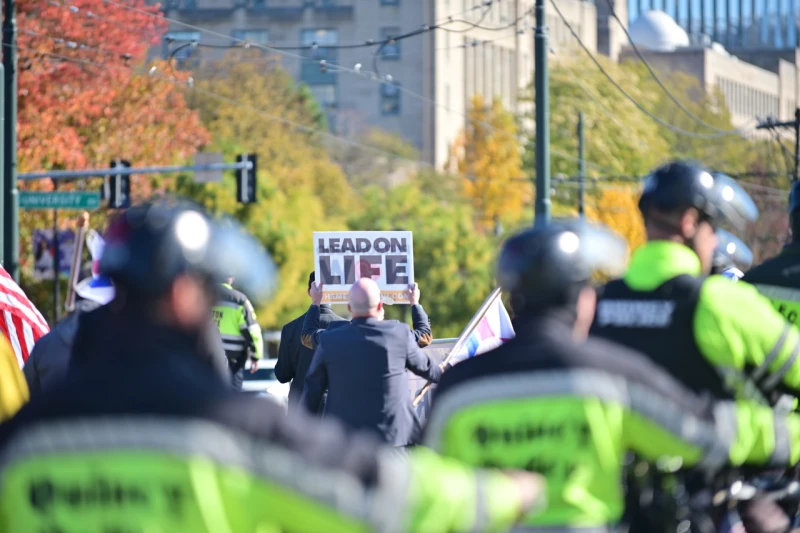
 Police protect marchers at the fourth annual National Men’s March to Abolish Abortion and Rally for Personhood in Boston on Nov. 1, 2025. / Credit: Brother Anthony Marie MICM

CNA Staff, Nov 8, 2025 / 09:00 am (CNA).
Here is a roundup of recent pro-life and abortion-related news:Amid clown protesters, Boston men’s march for life remains ‘prayerful’Hundreds gathered in Boston last Saturday for a men’s march for life, which drew a rambunctious crowd of protesters dressed as clowns and inflatable dinosaurs. The fourth annual National Men’s March to Abolish Abortion and Rally for Personhood began at Boston Planned Parenthood and concluded about three miles away at Boston Common.While counterprotesters — some dressed as clowns or wearing inflatable dinosaur costumes — played instruments and yelled on the sidelines, marchers carried on in a “prayerful and well-composed” manner, said march co-founder and president Jim Havens, who called the event “outstanding.” At the rallying point at Boston Common, an estimated 50 Antifa members also showed up. Another counterprotester wore a pony costume and carried a megaphone. Though the event sees protesters every year, Havens told CNA that the marchers have a good relationship with local law enforcement, so the event is “safe and secure.” “In our current culture of death, when we publicly stand for the least among us and for the abolition of the ongoing daily mass murder of our littlest brothers and sisters, protesters are to be expected,” Havens said. “We strive to incorporate the protesters into those for whom we pray as we march.” A marching band from the American Society for the Defense of Tradition, Family, and Property also participated to counterbalance the noise of the counterprotesters. The march invites men “to step forward to protect the women and children,” Havens explained. The idea that abortion is not a men’s issue is “nonsense,” Havens said. “As men, we have a moral responsibility to protect and defend vulnerable women and children, and it’s time we all get off the sidelines and do so,” Havens said. Speakers included Sister Deirdre Byrne, pro-life activist Will Goodman, and Bishop Joseph Strickland, among others.“As we marched, there was a sense among the men that we were simply being true to who we are as men,” Havens said.“Now active in the urgent fight for abolition, these men will not be going back to the sidelines,” he said. “Instead, they are now asking, ‘What more can I do?’”South Carolina man arrested for threatening pro-lifers with grenade A group was gathered outside a South Carolina church on a Sunday morning to protest board members’ involvement with abortion funds when a man threatened them with a grenade. Video footage shows Richard Lovelace, 79, holding up a grenade, saying: “I have a grenade for y’all, a gift for you protesters.”  After Lovelace was arrested, police found that the grenade was hollowed out.Lovelace, a member of St. Anne Episcopal Church, is a retired lawyer whose wife is on the church’s board and is a judge in South Carolina. The Survivors of the Abortion Holocaust group was protesting the board’s involvement with the Palmetto State Abortion Fund, a group that partners with Planned Parenthood to bring illegal abortion pills into the state and helps women travel out of state for abortions.Police charged Lovelace with four counts of having a hoax device and threatening to use it. On Monday, he was released from the J. Reuben Long Detention Center on a ,000 bond. Nebraska governor signs order barring abortion providers from state fundingNebraska Gov. Jim Pillen on Nov. 6  issued an executive order preventing abortion providers from receiving taxpayer funding in Nebraska. While the federal law and some state laws prevent taxpayer funding from going directly to abortion, state governments often subsidize providers for other services, therefore indirectly funding abortion. In Nebraska in 2025, more than 0,000 went to abortion providers, according to the governor’s office. President Donald Trump’s One Big Beautiful Bill Act recently prohibited federal funds from going toward abortion providers for one year. Pillen said he is “proud that we can take this bold step in halting funding to abortion providers that receive Medicaid funding.” “Nebraskans have made clear they support a culture of love and life in our state — one that provides protections for the unborn,” he said in a press release. Attorney General Mike Hilgers said the issue has “been in the background for a long time for a lot of people.”“In fact, the desire of Nebraska taxpayers to not have their funds be used for abortions has been in state statutes for some time,” Hilgers noted.Thousands gather for Michigan March for LifeThousands gathered for the March for Life in Lansing, Michigan, on Thursday, Nov. 6.March for Life president Jennie Bradley Lichter, who spoke at the event, called the march a chance to “send a vital message to our legislators who have the power to support women, children, and families.” “The women of Michigan deserve better than the tragedy of abortion, and we want them to know we are here for them, no matter what they are facing,” Lichter said in a statement shared with CNA.Bishop Earl Boyea of Lansing as well as Knights of Columbus State Deputy Barry Borsenik spoke at the event. Michigan state lawmakers including state Rep. Ann Bollin, state Sen. John Damoose, and state Rep. Jennifer Wortz also spoke at the event. President of Right to Life Michigan Amber Roseboom said the pro-life movement in Michigan stands with women facing unplanned pregnancies. “While a woman in Michigan can have an abortion at any point in her pregnancy for any reason, no woman should ever be made to feel that abortion is the best or only option,” she said in a statement shared with CNA.  “Pro-lifers from across our state have a powerful message for women facing unplanned pregnancies: You are not alone! We stand with you. We stand for you,” Roseboom said.

Amid clown protesters, Boston men’s march for life remains ‘prayerful’ #Catholic Police protect marchers at the fourth annual National Men’s March to Abolish Abortion and Rally for Personhood in Boston on Nov. 1, 2025. / Credit: Brother Anthony Marie MICM CNA Staff, Nov 8, 2025 / 09:00 am (CNA). Here is a roundup of recent pro-life and abortion-related news:Amid clown protesters, Boston men’s march for life remains ‘prayerful’Hundreds gathered in Boston last Saturday for a men’s march for life, which drew a rambunctious crowd of protesters dressed as clowns and inflatable dinosaurs. The fourth annual National Men’s March to Abolish Abortion and Rally for Personhood began at Boston Planned Parenthood and concluded about three miles away at Boston Common.While counterprotesters — some dressed as clowns or wearing inflatable dinosaur costumes — played instruments and yelled on the sidelines, marchers carried on in a “prayerful and well-composed” manner, said march co-founder and president Jim Havens, who called the event “outstanding.” At the rallying point at Boston Common, an estimated 50 Antifa members also showed up. Another counterprotester wore a pony costume and carried a megaphone. Though the event sees protesters every year, Havens told CNA that the marchers have a good relationship with local law enforcement, so the event is “safe and secure.” “In our current culture of death, when we publicly stand for the least among us and for the abolition of the ongoing daily mass murder of our littlest brothers and sisters, protesters are to be expected,” Havens said. “We strive to incorporate the protesters into those for whom we pray as we march.” A marching band from the American Society for the Defense of Tradition, Family, and Property also participated to counterbalance the noise of the counterprotesters. The march invites men “to step forward to protect the women and children,” Havens explained. The idea that abortion is not a men’s issue is “nonsense,” Havens said. “As men, we have a moral responsibility to protect and defend vulnerable women and children, and it’s time we all get off the sidelines and do so,” Havens said. Speakers included Sister Deirdre Byrne, pro-life activist Will Goodman, and Bishop Joseph Strickland, among others.“As we marched, there was a sense among the men that we were simply being true to who we are as men,” Havens said.“Now active in the urgent fight for abolition, these men will not be going back to the sidelines,” he said. “Instead, they are now asking, ‘What more can I do?’”South Carolina man arrested for threatening pro-lifers with grenade A group was gathered outside a South Carolina church on a Sunday morning to protest board members’ involvement with abortion funds when a man threatened them with a grenade. Video footage shows Richard Lovelace, 79, holding up a grenade, saying: “I have a grenade for y’all, a gift for you protesters.”  After Lovelace was arrested, police found that the grenade was hollowed out.Lovelace, a member of St. Anne Episcopal Church, is a retired lawyer whose wife is on the church’s board and is a judge in South Carolina. The Survivors of the Abortion Holocaust group was protesting the board’s involvement with the Palmetto State Abortion Fund, a group that partners with Planned Parenthood to bring illegal abortion pills into the state and helps women travel out of state for abortions.Police charged Lovelace with four counts of having a hoax device and threatening to use it. On Monday, he was released from the J. Reuben Long Detention Center on a $60,000 bond. Nebraska governor signs order barring abortion providers from state fundingNebraska Gov. Jim Pillen on Nov. 6  issued an executive order preventing abortion providers from receiving taxpayer funding in Nebraska. While the federal law and some state laws prevent taxpayer funding from going directly to abortion, state governments often subsidize providers for other services, therefore indirectly funding abortion. In Nebraska in 2025, more than $300,000 went to abortion providers, according to the governor’s office. President Donald Trump’s One Big Beautiful Bill Act recently prohibited federal funds from going toward abortion providers for one year. Pillen said he is “proud that we can take this bold step in halting funding to abortion providers that receive Medicaid funding.” “Nebraskans have made clear they support a culture of love and life in our state — one that provides protections for the unborn,” he said in a press release. Attorney General Mike Hilgers said the issue has “been in the background for a long time for a lot of people.”“In fact, the desire of Nebraska taxpayers to not have their funds be used for abortions has been in state statutes for some time,” Hilgers noted.Thousands gather for Michigan March for LifeThousands gathered for the March for Life in Lansing, Michigan, on Thursday, Nov. 6.March for Life president Jennie Bradley Lichter, who spoke at the event, called the march a chance to “send a vital message to our legislators who have the power to support women, children, and families.” “The women of Michigan deserve better than the tragedy of abortion, and we want them to know we are here for them, no matter what they are facing,” Lichter said in a statement shared with CNA.Bishop Earl Boyea of Lansing as well as Knights of Columbus State Deputy Barry Borsenik spoke at the event. Michigan state lawmakers including state Rep. Ann Bollin, state Sen. John Damoose, and state Rep. Jennifer Wortz also spoke at the event. President of Right to Life Michigan Amber Roseboom said the pro-life movement in Michigan stands with women facing unplanned pregnancies. “While a woman in Michigan can have an abortion at any point in her pregnancy for any reason, no woman should ever be made to feel that abortion is the best or only option,” she said in a statement shared with CNA.  “Pro-lifers from across our state have a powerful message for women facing unplanned pregnancies: You are not alone! We stand with you. We stand for you,” Roseboom said.


Police protect marchers at the fourth annual National Men’s March to Abolish Abortion and Rally for Personhood in Boston on Nov. 1, 2025. / Credit: Brother Anthony Marie MICM

CNA Staff, Nov 8, 2025 / 09:00 am (CNA).

Here is a roundup of recent pro-life and abortion-related news:

Amid clown protesters, Boston men’s march for life remains ‘prayerful’

Hundreds gathered in Boston last Saturday for a men’s march for life, which drew a rambunctious crowd of protesters dressed as clowns and inflatable dinosaurs. 

The fourth annual National Men’s March to Abolish Abortion and Rally for Personhood began at Boston Planned Parenthood and concluded about three miles away at Boston Common.

While counterprotesters — some dressed as clowns or wearing inflatable dinosaur costumes — played instruments and yelled on the sidelines, marchers carried on in a “prayerful and well-composed” manner, said march co-founder and president Jim Havens, who called the event “outstanding.” 

At the rallying point at Boston Common, an estimated 50 Antifa members also showed up. Another counterprotester wore a pony costume and carried a megaphone. 

Though the event sees protesters every year, Havens told CNA that the marchers have a good relationship with local law enforcement, so the event is “safe and secure.” 

“In our current culture of death, when we publicly stand for the least among us and for the abolition of the ongoing daily mass murder of our littlest brothers and sisters, protesters are to be expected,” Havens said. “We strive to incorporate the protesters into those for whom we pray as we march.” 

A marching band from the American Society for the Defense of Tradition, Family, and Property also participated to counterbalance the noise of the counterprotesters. 

The march invites men “to step forward to protect the women and children,” Havens explained. 

The idea that abortion is not a men’s issue is “nonsense,” Havens said. 

“As men, we have a moral responsibility to protect and defend vulnerable women and children, and it’s time we all get off the sidelines and do so,” Havens said. 

Speakers included Sister Deirdre Byrne, pro-life activist Will Goodman, and Bishop Joseph Strickland, among others.

“As we marched, there was a sense among the men that we were simply being true to who we are as men,” Havens said.

“Now active in the urgent fight for abolition, these men will not be going back to the sidelines,” he said. “Instead, they are now asking, ‘What more can I do?’”

South Carolina man arrested for threatening pro-lifers with grenade 

A group was gathered outside a South Carolina church on a Sunday morning to protest board members’ involvement with abortion funds when a man threatened them with a grenade. 

Video footage shows Richard Lovelace, 79, holding up a grenade, saying: “I have a grenade for y’all, a gift for you protesters.”  

After Lovelace was arrested, police found that the grenade was hollowed out.

Lovelace, a member of St. Anne Episcopal Church, is a retired lawyer whose wife is on the church’s board and is a judge in South Carolina. 

The Survivors of the Abortion Holocaust group was protesting the board’s involvement with the Palmetto State Abortion Fund, a group that partners with Planned Parenthood to bring illegal abortion pills into the state and helps women travel out of state for abortions.

Police charged Lovelace with four counts of having a hoax device and threatening to use it. On Monday, he was released from the J. Reuben Long Detention Center on a $60,000 bond. 

Nebraska governor signs order barring abortion providers from state funding

Nebraska Gov. Jim Pillen on Nov. 6  issued an executive order preventing abortion providers from receiving taxpayer funding in Nebraska. 

While the federal law and some state laws prevent taxpayer funding from going directly to abortion, state governments often subsidize providers for other services, therefore indirectly funding abortion. 

In Nebraska in 2025, more than $300,000 went to abortion providers, according to the governor’s office. President Donald Trump’s One Big Beautiful Bill Act recently prohibited federal funds from going toward abortion providers for one year. 

Pillen said he is “proud that we can take this bold step in halting funding to abortion providers that receive Medicaid funding.” 

“Nebraskans have made clear they support a culture of love and life in our state — one that provides protections for the unborn,” he said in a press release. 

Attorney General Mike Hilgers said the issue has “been in the background for a long time for a lot of people.”

“In fact, the desire of Nebraska taxpayers to not have their funds be used for abortions has been in state statutes for some time,” Hilgers noted.

Thousands gather for Michigan March for Life

Thousands gathered for the March for Life in Lansing, Michigan, on Thursday, Nov. 6.

March for Life president Jennie Bradley Lichter, who spoke at the event, called the march a chance to “send a vital message to our legislators who have the power to support women, children, and families.” 

“The women of Michigan deserve better than the tragedy of abortion, and we want them to know we are here for them, no matter what they are facing,” Lichter said in a statement shared with CNA.

Bishop Earl Boyea of Lansing as well as Knights of Columbus State Deputy Barry Borsenik spoke at the event. Michigan state lawmakers including state Rep. Ann Bollin, state Sen. John Damoose, and state Rep. Jennifer Wortz also spoke at the event. 

President of Right to Life Michigan Amber Roseboom said the pro-life movement in Michigan stands with women facing unplanned pregnancies. 

“While a woman in Michigan can have an abortion at any point in her pregnancy for any reason, no woman should ever be made to feel that abortion is the best or only option,” she said in a statement shared with CNA.  

“Pro-lifers from across our state have a powerful message for women facing unplanned pregnancies: You are not alone! We stand with you. We stand for you,” Roseboom said.

Read More
Picture of the day


The Isaiah Scroll is the best preserved of the seven Dead Sea Scrolls that were first discovered by Bedouin shepherds from Qumran. The Dead Sea Scrolls were first made available to the public on this date in 1991.
 #ImageOfTheDay
Picture of the day
The Isaiah Scroll is the best preserved of the seven Dead Sea Scrolls that were first discovered by Bedouin shepherds from Qumran. The Dead Sea Scrolls were first made available to the public on this date in 1991.
Read More
NASA Drop Test Supports Safer Air Taxi Designs

An aircraft body modeled after an air taxi with weighted test dummies inside is being prepared for a drop test by researchers at NASA’s Langley Research Center in Hampton, Virginia. The test was completed June 26 at Langley’s Landing and Impact Research Facility. The aircraft was dropped from a tall steel structure, known as a gantry, after being hoisted about 35 feet in the air by cables. NASA researchers are investigating aircraft materials that best absorb impact forces in a crash.

Read More
Picture of the day


Common cuttlefish (Sepia officinalis), Arrábida National Park, Portugal. The common cuttlefish is one of the largest and best-known cuttlefish species. They are a migratory species that spend the summer and spring inshore for spawning and then move to depths of 100 to 200m during autumn and winter. They only have a lifespan of 1–2 years and have many predators including sharks, dolphins, seals, fish, and cephalopods which includes other cuttlefish. During the day, most cuttlefish can be found buried below the substrate and fairly inactive. At night however, they are actively searching for prey and can ambush them from under the substrate. Cuttlefish are carnivorous and eat a variety of organisms including crustaceans (crabs and shrimp), small fish, molluscs (clams and snails), and sometimes other cuttlefish.
 #ImageOfTheDay
Picture of the day
Common cuttlefish (Sepia officinalis), Arrábida National Park, Portugal. The common cuttlefish is one of the largest and best-known cuttlefish species. They are a migratory species that spend the summer and spring inshore for spawning and then move to depths of 100 to 200m during autumn and winter. They only have a lifespan of 1–2 years and have many predators including sharks, dolphins, seals, fish, and cephalopods which includes other cuttlefish. During the day, most cuttlefish can be found buried below the substrate and fairly inactive. At night however, they are actively searching for prey and can ambush them from under the substrate. Cuttlefish are carnivorous and eat a variety of organisms including crustaceans (crabs and shrimp), small fish, molluscs (clams and snails), and sometimes other cuttlefish.
Read More
Picture of the day


“Lantingji Xu” scroll (Shenlong version). Today’s lunar calendar day is the third day of March (Chinese: 三月初三), is the Shangsi Festival, a traditional festival in ancient China. Legend has it that on the Shangsi Festival in 353, Wang Xizhi held an Orchid Pavilion Gathering and wrote the “Lantingji Xu”. The original is lost. This Tang Dynasty copy by Feng Chengsu (馮承素) is considered the best of all the extant copies.
 #ImageOfTheDay
Picture of the day
“Lantingji Xu” scroll (Shenlong version). Today’s lunar calendar day is the third day of March (Chinese: 三月初三), is the Shangsi Festival, a traditional festival in ancient China. Legend has it that on the Shangsi Festival in 353, Wang Xizhi held an Orchid Pavilion Gathering and wrote the “Lantingji Xu”. The original is lost. This Tang Dynasty copy by Feng Chengsu (馮承素) is considered the best of all the extant copies.
Read More
Best of 2024: Reestablished NASA Art Program Begins with Mural in New York City

The New York-based artist team Geraluz, left, and WERC, right, and their son Amaru Alvarez, 5, pose for picture with the mural “To the Moon, and Back” by the artist team that was created as part of the reimagined NASA Art Program, Tuesday, September 24, 2024, at 350 Hudson Street in New York City. The murals use geometrical patterns to invite deeper reflection on the exploration, creativity, and connection with the cosmos.

Read More
Best of 2024: Total Solar Eclipse in Indianapolis

A total solar eclipse is seen from the Indianapolis Motor Speedway, Monday, April 8, 2024, in Indianapolis, Indiana. A total solar eclipse swept across a narrow portion of the North American continent from Mexico’s Pacific coast to the Atlantic coast of Newfoundland, Canada. A partial solar eclipse was visible across the entire North American continent along with parts of Central America and Europe.

Read More