classroom

Giving people hope is greatest challenge, custos of Holy Land says in U.S. visit #Catholic 
 
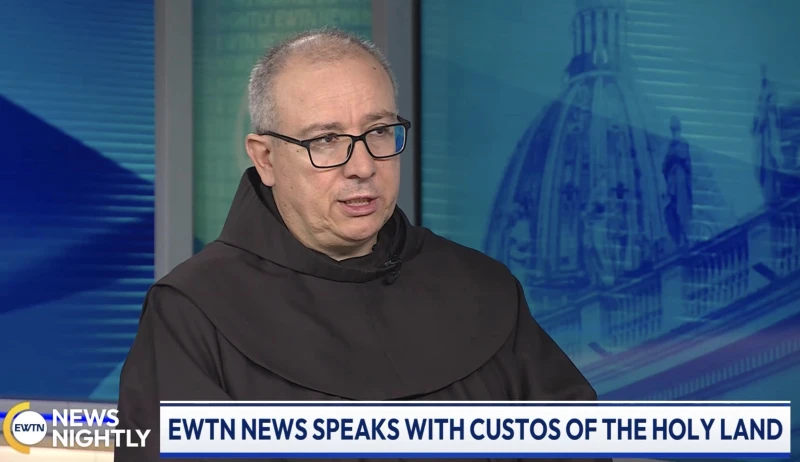
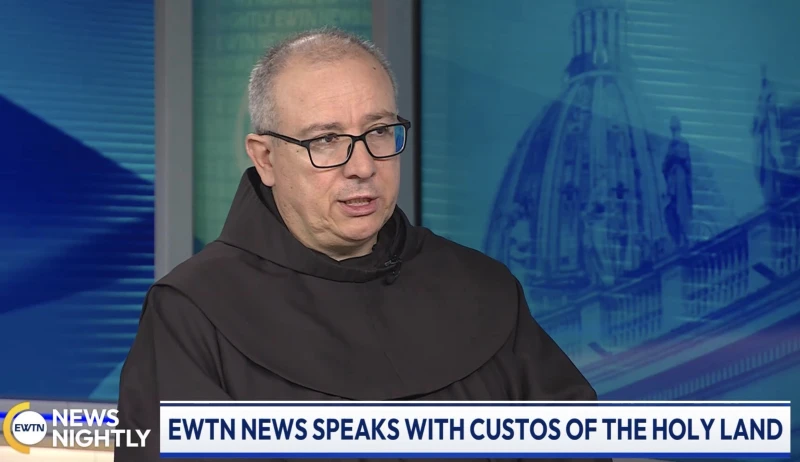
 Custos of the Holy Land Father Franceso Ielpo speaks with EWTN News in a two-part interview that began airing on “EWTN News Nightly” on Nov. 24, 2025. / Credit: “EWTN News Nightly”/Screenshot

Washington, D.C. Newsroom, Nov 25, 2025 / 09:00 am (CNA).
The custos of the Holy Land said in an interview with EWTN News that the “greatest challenge” is to be a source of hope amid perpetual devastation due to conflict. “The greatest challenge is to always be able to give people hope. One can have food, one can have a home, one can have medicine, one can have the best schools, but to live, we all need hope. And this hope always arises when you see, when you feel the presence of God through the presence of the Church beside you,” Father Franceso Ielpo told EWTN News’ Matthew Bunson in a two-part interview that began airing Nov. 24 on “EWTN News Nightly.” Ielpo has served as custos of the Holy Land since his appointment by Pope Leo XIV in June, when he succeeded Father Francesdo Patton. It is Ielpo’s first visit to the United States as custos, a Latin term for “guardian” associated with the Franciscan order’s special responsibility to oversee and care for holy sites in the Holy Land.Ielpo explained this challenge confronts the Christian community not only in Israel and Palestine but also in Lebanon and Syria. Custodians in these countries, he said, are faced with having “to grow and continue to live in a context of tension, in a context of perpetual conflict.” The Custody of the Holy Land is made up of 325 friars from over 40 countries. Ielpo said the latest conflict in Israel “has had very serious consequences” for “all communities in the Holy Land,” particularly in the employment sphere due to a lack of pilgrims to the region, which depends on religious tourism to generate income. He further emphasized the “tension of uncertainty about the future, especially for one’s children.” “The custody continues first and foremost to support and sustain the salaries of all our employees, of all our Christians, and also seeks to continue the educational work that is the schools,” Ielpo said. “We currently have 18 schools with about 10,000 students, both Christian and Muslim. Even for families who can no longer pay for school, we continue to guarantee education because we are convinced that the future is built in the classroom.” The work of the custody is not limited to the Christian community alone, he said, noting that 90% of the student population attending the Franciscan school in Jericho are Muslim. “They understand and appreciate that the service we offer is for everyone and is of high quality,” he said. At Magnificat, a music school that just celebrated its 30th anniversary, students and teachers are Christian, Muslim, and Jewish, he added.“The thing that gives me the most hope is that God’s timing is not our timing, that history is carried forward despite all its contradictions by someone else,” he said. Even amid conflict, he continued, “hope always arises from the fact that God is the true protagonist of history, even in storms, even when it seems that he is on the boat and sleeping.” Concretely, the custos emphasized the need for pilgrims to return, not only for economic reasons, but to demonstrate to residents of the Holy Land that they are “seen, recognized, wanted, loved.” “The invitation is to return to the Holy Land,” he said. “The shrines are safe — come back, visit, and don’t just visit the shrines. Always ask to meet the communities, even if only for a prayer together … even if only for a greeting, because it is good for everyone.”

Giving people hope is greatest challenge, custos of Holy Land says in U.S. visit #Catholic Custos of the Holy Land Father Franceso Ielpo speaks with EWTN News in a two-part interview that began airing on “EWTN News Nightly” on Nov. 24, 2025. / Credit: “EWTN News Nightly”/Screenshot Washington, D.C. Newsroom, Nov 25, 2025 / 09:00 am (CNA). The custos of the Holy Land said in an interview with EWTN News that the “greatest challenge” is to be a source of hope amid perpetual devastation due to conflict. “The greatest challenge is to always be able to give people hope. One can have food, one can have a home, one can have medicine, one can have the best schools, but to live, we all need hope. And this hope always arises when you see, when you feel the presence of God through the presence of the Church beside you,” Father Franceso Ielpo told EWTN News’ Matthew Bunson in a two-part interview that began airing Nov. 24 on “EWTN News Nightly.” Ielpo has served as custos of the Holy Land since his appointment by Pope Leo XIV in June, when he succeeded Father Francesdo Patton. It is Ielpo’s first visit to the United States as custos, a Latin term for “guardian” associated with the Franciscan order’s special responsibility to oversee and care for holy sites in the Holy Land.Ielpo explained this challenge confronts the Christian community not only in Israel and Palestine but also in Lebanon and Syria. Custodians in these countries, he said, are faced with having “to grow and continue to live in a context of tension, in a context of perpetual conflict.” The Custody of the Holy Land is made up of 325 friars from over 40 countries. Ielpo said the latest conflict in Israel “has had very serious consequences” for “all communities in the Holy Land,” particularly in the employment sphere due to a lack of pilgrims to the region, which depends on religious tourism to generate income. He further emphasized the “tension of uncertainty about the future, especially for one’s children.” “The custody continues first and foremost to support and sustain the salaries of all our employees, of all our Christians, and also seeks to continue the educational work that is the schools,” Ielpo said. “We currently have 18 schools with about 10,000 students, both Christian and Muslim. Even for families who can no longer pay for school, we continue to guarantee education because we are convinced that the future is built in the classroom.” The work of the custody is not limited to the Christian community alone, he said, noting that 90% of the student population attending the Franciscan school in Jericho are Muslim. “They understand and appreciate that the service we offer is for everyone and is of high quality,” he said. At Magnificat, a music school that just celebrated its 30th anniversary, students and teachers are Christian, Muslim, and Jewish, he added.“The thing that gives me the most hope is that God’s timing is not our timing, that history is carried forward despite all its contradictions by someone else,” he said. Even amid conflict, he continued, “hope always arises from the fact that God is the true protagonist of history, even in storms, even when it seems that he is on the boat and sleeping.” Concretely, the custos emphasized the need for pilgrims to return, not only for economic reasons, but to demonstrate to residents of the Holy Land that they are “seen, recognized, wanted, loved.” “The invitation is to return to the Holy Land,” he said. “The shrines are safe — come back, visit, and don’t just visit the shrines. Always ask to meet the communities, even if only for a prayer together … even if only for a greeting, because it is good for everyone.”


Custos of the Holy Land Father Franceso Ielpo speaks with EWTN News in a two-part interview that began airing on “EWTN News Nightly” on Nov. 24, 2025. / Credit: “EWTN News Nightly”/Screenshot

Washington, D.C. Newsroom, Nov 25, 2025 / 09:00 am (CNA).

The custos of the Holy Land said in an interview with EWTN News that the “greatest challenge” is to be a source of hope amid perpetual devastation due to conflict. 

“The greatest challenge is to always be able to give people hope. One can have food, one can have a home, one can have medicine, one can have the best schools, but to live, we all need hope. And this hope always arises when you see, when you feel the presence of God through the presence of the Church beside you,” Father Franceso Ielpo told EWTN News’ Matthew Bunson in a two-part interview that began airing Nov. 24 on “EWTN News Nightly.” 

Ielpo has served as custos of the Holy Land since his appointment by Pope Leo XIV in June, when he succeeded Father Francesdo Patton. It is Ielpo’s first visit to the United States as custos, a Latin term for “guardian” associated with the Franciscan order’s special responsibility to oversee and care for holy sites in the Holy Land.

Ielpo explained this challenge confronts the Christian community not only in Israel and Palestine but also in Lebanon and Syria. Custodians in these countries, he said, are faced with having “to grow and continue to live in a context of tension, in a context of perpetual conflict.” The Custody of the Holy Land is made up of 325 friars from over 40 countries. 

Ielpo said the latest conflict in Israel “has had very serious consequences” for “all communities in the Holy Land,” particularly in the employment sphere due to a lack of pilgrims to the region, which depends on religious tourism to generate income. He further emphasized the “tension of uncertainty about the future, especially for one’s children.” 

“The custody continues first and foremost to support and sustain the salaries of all our employees, of all our Christians, and also seeks to continue the educational work that is the schools,” Ielpo said. “We currently have 18 schools with about 10,000 students, both Christian and Muslim. Even for families who can no longer pay for school, we continue to guarantee education because we are convinced that the future is built in the classroom.” 

The work of the custody is not limited to the Christian community alone, he said, noting that 90% of the student population attending the Franciscan school in Jericho are Muslim. “They understand and appreciate that the service we offer is for everyone and is of high quality,” he said. At Magnificat, a music school that just celebrated its 30th anniversary, students and teachers are Christian, Muslim, and Jewish, he added.

“The thing that gives me the most hope is that God’s timing is not our timing, that history is carried forward despite all its contradictions by someone else,” he said. Even amid conflict, he continued, “hope always arises from the fact that God is the true protagonist of history, even in storms, even when it seems that he is on the boat and sleeping.” 

Concretely, the custos emphasized the need for pilgrims to return, not only for economic reasons, but to demonstrate to residents of the Holy Land that they are “seen, recognized, wanted, loved.” 

“The invitation is to return to the Holy Land,” he said. “The shrines are safe — come back, visit, and don’t just visit the shrines. Always ask to meet the communities, even if only for a prayer together … even if only for a greeting, because it is good for everyone.”

Read More
Catholic schools fare better in states with voucher programs #Catholic 
 
 null / Credit: RasyidArt, Shutterstock

CNA Staff, Nov 4, 2025 / 06:30 am (CNA).
Catholic schools are faring much better in dioceses in which state-funded voucher programs are available for parents to use to pay school tuition, one researcher has found, though enrollment is still declining in most places.John F. Quinn, a historian at Salve Regina University in Rhode Island, examined six Catholic dioceses over the last 16 years — three in states with voucher programs and three in states without them — and found that parochial schools are benefiting from vouchers.He presented his research at the Society of Catholic Social Scientists’ annual conference at Franciscan University of Steubenville, Ohio, in October.Quinn found that since 2009, the dioceses of Providence, Rhode Island; Fall River, Massachusetts; and Rockford, Illinois — none of which are located in states with voucher programs — have seen school closures and drops, some very large, in their parochial school enrollment.Providence schools have seen a two-thirds drop, from 16,000 students in 2009 to about 10,000 in 2025, according to the historian. The Diocese of Fall River, meanwhile, saw a 36% drop in enrollment, going from 7,800 students in 2009 to 5,000 in 2025. Rockford’s diocese saw a precipitous 52% drop, with 15,500 students in 2009 and 7,400 today. All three dioceses also saw multiple parochial school closures.The numbers are very different in the dioceses in states that have voucher programs.According to Quinn, the Archdiocese of Indianapolis only saw its enrollment numbers drop 3% since 2009. Nearly 23,000 were enrolled in its parochial schools in 2009, and the number stands at 22,300 today. The overall population of the archdiocese has also dropped 5% over the same time period, he noted.  Indiana’s Choice Scholarship Program was launched in 2011 and expanded to nearly all residents in 2025.Two other dioceses, Orlando and Venice, are both in Florida, a state that approved its voucher program in 1999 and expanded it significantly in 2023.The Diocese of Orlando has seen a 13% drop, going from 14,500 students in 2009 to 12,750 in 2025.The Diocese of Venice, a relatively new one established in 1984, has seen a 52% increase in parish school enrollment since 2009 and growth in its number of parochial schools. In 2009, 4,400 students attended three high schools and 10 elementary schools, and today there are four high schools and 12 elementary schools with an enrollment of 6,800.Quinn acknowledged that Florida has a growing population but said even taking that into account, the voucher programs have indisputably aided the Catholic schools there.“We are full up with nearly every school at capacity,” Father John Belmonte, SJ, Diocese of Venice Superintendent of Catholic Education, said in September.History of parochial schooling“America’s Catholic leaders have long seen parochial schools as critical to the well-being of the Church in America,” Quinn noted. He recalled the Third Plenary Council of Baltimore in 1884, at which the bishops “called for every parish to have a school and for all Catholic parents to send their children” to them.Quinn noted that pastors would sometimes build a parish school first before completing the church building.In 1965, the high point of parochial school enrollment, 52% of American Catholic children, or 5.2 million students, were enrolled at 13,000 Catholic grammar and high schools. Quinn cited the National Catholic Educational Association’s annual report, released in the spring, that showed just under 1.7 million students are currently enrolled in the nation’s current 8,500 parochial schools.In 1965, nearly 70% of all parochial school teachers, or 115,607, were religious sisters, priests, or brothers, according to the Cardinal Newman Society. By 1990, only 2.5% of parochial school faculty were priests or religious, and that number remains the same today.Quinn said costs started rising as more lay teachers replaced religious and priests in the classroom.

Catholic schools fare better in states with voucher programs #Catholic null / Credit: RasyidArt, Shutterstock CNA Staff, Nov 4, 2025 / 06:30 am (CNA). Catholic schools are faring much better in dioceses in which state-funded voucher programs are available for parents to use to pay school tuition, one researcher has found, though enrollment is still declining in most places.John F. Quinn, a historian at Salve Regina University in Rhode Island, examined six Catholic dioceses over the last 16 years — three in states with voucher programs and three in states without them — and found that parochial schools are benefiting from vouchers.He presented his research at the Society of Catholic Social Scientists’ annual conference at Franciscan University of Steubenville, Ohio, in October.Quinn found that since 2009, the dioceses of Providence, Rhode Island; Fall River, Massachusetts; and Rockford, Illinois — none of which are located in states with voucher programs — have seen school closures and drops, some very large, in their parochial school enrollment.Providence schools have seen a two-thirds drop, from 16,000 students in 2009 to about 10,000 in 2025, according to the historian. The Diocese of Fall River, meanwhile, saw a 36% drop in enrollment, going from 7,800 students in 2009 to 5,000 in 2025. Rockford’s diocese saw a precipitous 52% drop, with 15,500 students in 2009 and 7,400 today. All three dioceses also saw multiple parochial school closures.The numbers are very different in the dioceses in states that have voucher programs.According to Quinn, the Archdiocese of Indianapolis only saw its enrollment numbers drop 3% since 2009. Nearly 23,000 were enrolled in its parochial schools in 2009, and the number stands at 22,300 today. The overall population of the archdiocese has also dropped 5% over the same time period, he noted.  Indiana’s Choice Scholarship Program was launched in 2011 and expanded to nearly all residents in 2025.Two other dioceses, Orlando and Venice, are both in Florida, a state that approved its voucher program in 1999 and expanded it significantly in 2023.The Diocese of Orlando has seen a 13% drop, going from 14,500 students in 2009 to 12,750 in 2025.The Diocese of Venice, a relatively new one established in 1984, has seen a 52% increase in parish school enrollment since 2009 and growth in its number of parochial schools. In 2009, 4,400 students attended three high schools and 10 elementary schools, and today there are four high schools and 12 elementary schools with an enrollment of 6,800.Quinn acknowledged that Florida has a growing population but said even taking that into account, the voucher programs have indisputably aided the Catholic schools there.“We are full up with nearly every school at capacity,” Father John Belmonte, SJ, Diocese of Venice Superintendent of Catholic Education, said in September.History of parochial schooling“America’s Catholic leaders have long seen parochial schools as critical to the well-being of the Church in America,” Quinn noted. He recalled the Third Plenary Council of Baltimore in 1884, at which the bishops “called for every parish to have a school and for all Catholic parents to send their children” to them.Quinn noted that pastors would sometimes build a parish school first before completing the church building.In 1965, the high point of parochial school enrollment, 52% of American Catholic children, or 5.2 million students, were enrolled at 13,000 Catholic grammar and high schools. Quinn cited the National Catholic Educational Association’s annual report, released in the spring, that showed just under 1.7 million students are currently enrolled in the nation’s current 8,500 parochial schools.In 1965, nearly 70% of all parochial school teachers, or 115,607, were religious sisters, priests, or brothers, according to the Cardinal Newman Society. By 1990, only 2.5% of parochial school faculty were priests or religious, and that number remains the same today.Quinn said costs started rising as more lay teachers replaced religious and priests in the classroom.


null / Credit: RasyidArt, Shutterstock

CNA Staff, Nov 4, 2025 / 06:30 am (CNA).

Catholic schools are faring much better in dioceses in which state-funded voucher programs are available for parents to use to pay school tuition, one researcher has found, though enrollment is still declining in most places.

John F. Quinn, a historian at Salve Regina University in Rhode Island, examined six Catholic dioceses over the last 16 years — three in states with voucher programs and three in states without them — and found that parochial schools are benefiting from vouchers.

He presented his research at the Society of Catholic Social Scientists’ annual conference at Franciscan University of Steubenville, Ohio, in October.

Quinn found that since 2009, the dioceses of Providence, Rhode Island; Fall River, Massachusetts; and Rockford, Illinois — none of which are located in states with voucher programs — have seen school closures and drops, some very large, in their parochial school enrollment.

Providence schools have seen a two-thirds drop, from 16,000 students in 2009 to about 10,000 in 2025, according to the historian. 

The Diocese of Fall River, meanwhile, saw a 36% drop in enrollment, going from 7,800 students in 2009 to 5,000 in 2025. Rockford’s diocese saw a precipitous 52% drop, with 15,500 students in 2009 and 7,400 today. All three dioceses also saw multiple parochial school closures.

The numbers are very different in the dioceses in states that have voucher programs.

According to Quinn, the Archdiocese of Indianapolis only saw its enrollment numbers drop 3% since 2009. Nearly 23,000 were enrolled in its parochial schools in 2009, and the number stands at 22,300 today. The overall population of the archdiocese has also dropped 5% over the same time period, he noted.  

Indiana’s Choice Scholarship Program was launched in 2011 and expanded to nearly all residents in 2025.

Two other dioceses, Orlando and Venice, are both in Florida, a state that approved its voucher program in 1999 and expanded it significantly in 2023.

The Diocese of Orlando has seen a 13% drop, going from 14,500 students in 2009 to 12,750 in 2025.

The Diocese of Venice, a relatively new one established in 1984, has seen a 52% increase in parish school enrollment since 2009 and growth in its number of parochial schools. In 2009, 4,400 students attended three high schools and 10 elementary schools, and today there are four high schools and 12 elementary schools with an enrollment of 6,800.

Quinn acknowledged that Florida has a growing population but said even taking that into account, the voucher programs have indisputably aided the Catholic schools there.

“We are full up with nearly every school at capacity,” Father John Belmonte, SJ, Diocese of Venice Superintendent of Catholic Education, said in September.

History of parochial schooling

“America’s Catholic leaders have long seen parochial schools as critical to the well-being of the Church in America,” Quinn noted. 

He recalled the Third Plenary Council of Baltimore in 1884, at which the bishops “called for every parish to have a school and for all Catholic parents to send their children” to them.

Quinn noted that pastors would sometimes build a parish school first before completing the church building.

In 1965, the high point of parochial school enrollment, 52% of American Catholic children, or 5.2 million students, were enrolled at 13,000 Catholic grammar and high schools. 

Quinn cited the National Catholic Educational Association’s annual report, released in the spring, that showed just under 1.7 million students are currently enrolled in the nation’s current 8,500 parochial schools.

In 1965, nearly 70% of all parochial school teachers, or 115,607, were religious sisters, priests, or brothers, according to the Cardinal Newman Society. 

By 1990, only 2.5% of parochial school faculty were priests or religious, and that number remains the same today.

Quinn said costs started rising as more lay teachers replaced religious and priests in the classroom.

Read More