color

‘Holiness of family life’: A look behind the icon depicting a mother of 8 #Catholic 
 
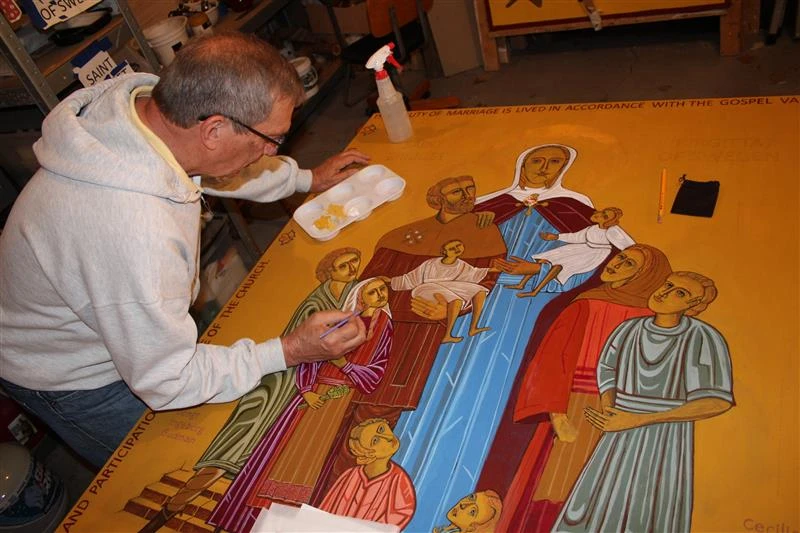
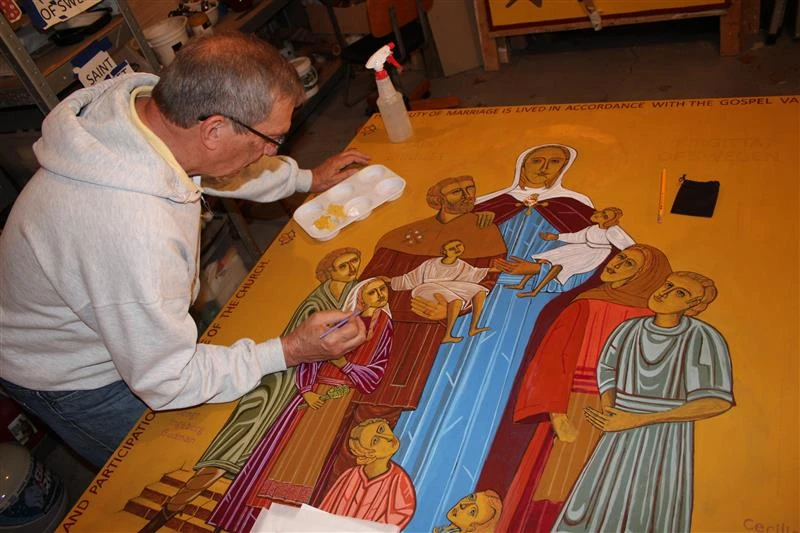
 Father Richard Reiser, an iconographer based in Omaha, Nebraska, writes an icon of St. Bridget of Sweden with her family for FOCCUS Marriage Ministries’ 40th anniversary. / Credit: Photo courtesy of FOCCUS

CNA Staff, Dec 13, 2025 / 06:00 am (CNA).
When an iconographer began his work on a unique icon, he looked to the bones of the saint’s husband for help.FOCCUS Marriage Ministries, a Catholic marriage ministry, invited the priest-iconographer Father Richard Reiser to make an icon of St. Bridget of Sweden, a mystic and the mother of eight. The ministry is celebrating its 40th anniversary this year and chose St. Bridget to be the patron saint of its work.But there was one challenge. According to Reiser, historically there is no established iconographic prototype of an icon of St. Bridget of Sweden.So using his imagination and every historical source available — including the bones of St. Bridget’s husband — the priest developed an entirely new icon of a saint who has gone without an icon for hundreds of years.The domestic church “For me, iconography is first and foremost a form of prayer,” Reiser said. “The entire creative process is an act of listening to God and allowing the sacred story of a saint or mystery to take shape through layers of contemplation, color, and symbolism.”The end result was an icon ripe with symbolic meaning — at its heart, marriage and family.At the blessing ceremony of the icon are (left to right): FOCCUS Director of Ministry Father Michael Grewe, Archbishop Michael McGovern of Omaha, FOCCUS Executive Director Sheila Simpson, and Iconographer Father Richard Reiser. Credit: Photo courtesy of FOCCUSFOCCUS Marriage Ministries chose St. Bridget of Sweden to be its patron because of her commitment to marriage and the Church.St. Bridget’s life “beautifully reflects the heart of marriage ministry,” Sheila Simpson, who heads the archdiocese-owned nonprofit, told CNA.Now displayed in the hallway of the FOCCUS office in the Archdiocese of Omaha, Nebraska, the icon contains a quote from Pope Benedict XVI about the family as the domestic church as well as several symbols of the married couple’s life together. “The icon quietly teaches that marriage is both a covenant of grace and a living witness to the Gospel,” Reiser told CNA. With St. Bridget as its guiding light, FOCCUS is launching resources for couples whose marriages have unusual challenges, such as those who need their marriage convalidated by the Church, as well as those marrying later in life.FOCCUS is most well known for its inventories — questionnaires designed to help engaged couples prepare for marriage by initiating conversations about issues like finance and values. The additional, new questionnaires will have questions tailored for couples in unusual situations, including military couples, first responders, and deacons.Simpson said many couples say FOCCUS “became a turning point — not because it told them what to do, but because it helped them truly hear each other.”Windows into the divine Reiser said that one of the most “fascinating” parts of the icon-making process was consulting the bones of Ulf Gudmarsson, the husband of St. Bridget.“His bones indicated that he was significantly larger in stature than she was,” he said. “To honor historical accuracy while still emphasizing Bridget’s spiritual prominence, I placed her on a small set of steps so she would remain the central figure of the composition,” he explained. Icons are “created for contemplation and spiritual truth more than realism,” Reiser said. “They are windows into the divine — visual theology meant to open the heart and mind to God’s presence,” he continued. “They participate in the mystery of the Incarnation,” Reiser said. “The eternal Word of God takes visible form.”The icon depicts an emblem of the Third Order Franciscans, which the couple joined after they got married.In addition, Gudmarsson holds a staff with a shell, referencing the pilgrimage the couple took to northwestern Spain.It would be the last pilgrimage the couple ever made together. On the return journey from the pilgrimage, Gudmarsson grew ill and died soon after they returned to Sweden.As a widow, St. Bridget dedicated her life to Christ, founding the religious order now known as the Bridgettines, which still exists to this day.The icon of St. Bridget of Sweden and her family by Father Richard Reiser contains many symbols, such as the staff and shell, the 15 florets, and the clasp of St. Bridget’s cloak. Framing the icon are words from Pope Benedict XVI on the domestic church. Credit: Courtesy of FOCCUSAn icon of family and unityIconographers don’t paint — they write.“Every line, color, and gesture carries symbolic meaning,” Reiser said. “That is why we often say icons are ‘written’ rather than painted.”For instance, the 15 florets below St. Bridget of Sweden reference her 15 meditations on Christ’s passion. The cloak she wears has a brooch styled to symbolize the five wounds of Christ. Within the brooch is a relic of St. Bridget.“Writing the icon of St. Bridget of Sweden was a unique and grace-filled experience because, historically, there is no established iconographic prototype of her — especially not one depicting her with her family,” Reiser said. “Without a traditional image to follow, I drew from existing paintings of St. Bridget and shaped them within the contemplative, dignified structure of classical iconography.”With “no established icon tradition for Bridget’s family,” Reiser said he “consulted other family-centered icons, especially images of Christ with children, to discern how to portray children in an authentically iconographic style.”The paintings of the children visually form a circle, which Reiser said represents the unity of the family. One of the children, Ingeborg, holds bluebells, the national flower of St. Bridget’s homeland, Sweden.“Each of these details helps the icon speak not just as artwork but as a theological meditation on the holiness of family life,” Reiser said.

‘Holiness of family life’: A look behind the icon depicting a mother of 8 #Catholic Father Richard Reiser, an iconographer based in Omaha, Nebraska, writes an icon of St. Bridget of Sweden with her family for FOCCUS Marriage Ministries’ 40th anniversary. / Credit: Photo courtesy of FOCCUS CNA Staff, Dec 13, 2025 / 06:00 am (CNA). When an iconographer began his work on a unique icon, he looked to the bones of the saint’s husband for help.FOCCUS Marriage Ministries, a Catholic marriage ministry, invited the priest-iconographer Father Richard Reiser to make an icon of St. Bridget of Sweden, a mystic and the mother of eight. The ministry is celebrating its 40th anniversary this year and chose St. Bridget to be the patron saint of its work.But there was one challenge. According to Reiser, historically there is no established iconographic prototype of an icon of St. Bridget of Sweden.So using his imagination and every historical source available — including the bones of St. Bridget’s husband — the priest developed an entirely new icon of a saint who has gone without an icon for hundreds of years.The domestic church “For me, iconography is first and foremost a form of prayer,” Reiser said. “The entire creative process is an act of listening to God and allowing the sacred story of a saint or mystery to take shape through layers of contemplation, color, and symbolism.”The end result was an icon ripe with symbolic meaning — at its heart, marriage and family.At the blessing ceremony of the icon are (left to right): FOCCUS Director of Ministry Father Michael Grewe, Archbishop Michael McGovern of Omaha, FOCCUS Executive Director Sheila Simpson, and Iconographer Father Richard Reiser. Credit: Photo courtesy of FOCCUSFOCCUS Marriage Ministries chose St. Bridget of Sweden to be its patron because of her commitment to marriage and the Church.St. Bridget’s life “beautifully reflects the heart of marriage ministry,” Sheila Simpson, who heads the archdiocese-owned nonprofit, told CNA.Now displayed in the hallway of the FOCCUS office in the Archdiocese of Omaha, Nebraska, the icon contains a quote from Pope Benedict XVI about the family as the domestic church as well as several symbols of the married couple’s life together. “The icon quietly teaches that marriage is both a covenant of grace and a living witness to the Gospel,” Reiser told CNA. With St. Bridget as its guiding light, FOCCUS is launching resources for couples whose marriages have unusual challenges, such as those who need their marriage convalidated by the Church, as well as those marrying later in life.FOCCUS is most well known for its inventories — questionnaires designed to help engaged couples prepare for marriage by initiating conversations about issues like finance and values. The additional, new questionnaires will have questions tailored for couples in unusual situations, including military couples, first responders, and deacons.Simpson said many couples say FOCCUS “became a turning point — not because it told them what to do, but because it helped them truly hear each other.”Windows into the divine Reiser said that one of the most “fascinating” parts of the icon-making process was consulting the bones of Ulf Gudmarsson, the husband of St. Bridget.“His bones indicated that he was significantly larger in stature than she was,” he said. “To honor historical accuracy while still emphasizing Bridget’s spiritual prominence, I placed her on a small set of steps so she would remain the central figure of the composition,” he explained. Icons are “created for contemplation and spiritual truth more than realism,” Reiser said. “They are windows into the divine — visual theology meant to open the heart and mind to God’s presence,” he continued. “They participate in the mystery of the Incarnation,” Reiser said. “The eternal Word of God takes visible form.”The icon depicts an emblem of the Third Order Franciscans, which the couple joined after they got married.In addition, Gudmarsson holds a staff with a shell, referencing the pilgrimage the couple took to northwestern Spain.It would be the last pilgrimage the couple ever made together. On the return journey from the pilgrimage, Gudmarsson grew ill and died soon after they returned to Sweden.As a widow, St. Bridget dedicated her life to Christ, founding the religious order now known as the Bridgettines, which still exists to this day.The icon of St. Bridget of Sweden and her family by Father Richard Reiser contains many symbols, such as the staff and shell, the 15 florets, and the clasp of St. Bridget’s cloak. Framing the icon are words from Pope Benedict XVI on the domestic church. Credit: Courtesy of FOCCUSAn icon of family and unityIconographers don’t paint — they write.“Every line, color, and gesture carries symbolic meaning,” Reiser said. “That is why we often say icons are ‘written’ rather than painted.”For instance, the 15 florets below St. Bridget of Sweden reference her 15 meditations on Christ’s passion. The cloak she wears has a brooch styled to symbolize the five wounds of Christ. Within the brooch is a relic of St. Bridget.“Writing the icon of St. Bridget of Sweden was a unique and grace-filled experience because, historically, there is no established iconographic prototype of her — especially not one depicting her with her family,” Reiser said. “Without a traditional image to follow, I drew from existing paintings of St. Bridget and shaped them within the contemplative, dignified structure of classical iconography.”With “no established icon tradition for Bridget’s family,” Reiser said he “consulted other family-centered icons, especially images of Christ with children, to discern how to portray children in an authentically iconographic style.”The paintings of the children visually form a circle, which Reiser said represents the unity of the family. One of the children, Ingeborg, holds bluebells, the national flower of St. Bridget’s homeland, Sweden.“Each of these details helps the icon speak not just as artwork but as a theological meditation on the holiness of family life,” Reiser said.


Father Richard Reiser, an iconographer based in Omaha, Nebraska, writes an icon of St. Bridget of Sweden with her family for FOCCUS Marriage Ministries’ 40th anniversary. / Credit: Photo courtesy of FOCCUS

CNA Staff, Dec 13, 2025 / 06:00 am (CNA).

When an iconographer began his work on a unique icon, he looked to the bones of the saint’s husband for help.

FOCCUS Marriage Ministries, a Catholic marriage ministry, invited the priest-iconographer Father Richard Reiser to make an icon of St. Bridget of Sweden, a mystic and the mother of eight. The ministry is celebrating its 40th anniversary this year and chose St. Bridget to be the patron saint of its work.

But there was one challenge. According to Reiser, historically there is no established iconographic prototype of an icon of St. Bridget of Sweden.

So using his imagination and every historical source available — including the bones of St. Bridget’s husband — the priest developed an entirely new icon of a saint who has gone without an icon for hundreds of years.

The domestic church 

“For me, iconography is first and foremost a form of prayer,” Reiser said. “The entire creative process is an act of listening to God and allowing the sacred story of a saint or mystery to take shape through layers of contemplation, color, and symbolism.”

The end result was an icon ripe with symbolic meaning — at its heart, marriage and family.

At the blessing ceremony of the icon are (left to right): FOCCUS Director of Ministry Father Michael Grewe, Archbishop Michael McGovern of Omaha, FOCCUS Executive Director Sheila Simpson, and Iconographer Father Richard Reiser. Credit: Photo courtesy of FOCCUS

FOCCUS Marriage Ministries chose St. Bridget of Sweden to be its patron because of her commitment to marriage and the Church.

St. Bridget’s life “beautifully reflects the heart of marriage ministry,” Sheila Simpson, who heads the archdiocese-owned nonprofit, told CNA.

Now displayed in the hallway of the FOCCUS office in the Archdiocese of Omaha, Nebraska, the icon contains a quote from Pope Benedict XVI about the family as the domestic church as well as several symbols of the married couple’s life together. 

“The icon quietly teaches that marriage is both a covenant of grace and a living witness to the Gospel,” Reiser told CNA. 

With St. Bridget as its guiding light, FOCCUS is launching resources for couples whose marriages have unusual challenges, such as those who need their marriage convalidated by the Church, as well as those marrying later in life.

FOCCUS is most well known for its inventories — questionnaires designed to help engaged couples prepare for marriage by initiating conversations about issues like finance and values. The additional, new questionnaires will have questions tailored for couples in unusual situations, including military couples, first responders, and deacons.

Simpson said many couples say FOCCUS “became a turning point — not because it told them what to do, but because it helped them truly hear each other.”

Windows into the divine 

Reiser said that one of the most “fascinating” parts of the icon-making process was consulting the bones of Ulf Gudmarsson, the husband of St. Bridget.

“His bones indicated that he was significantly larger in stature than she was,” he said. 

“To honor historical accuracy while still emphasizing Bridget’s spiritual prominence, I placed her on a small set of steps so she would remain the central figure of the composition,” he explained. 

Icons are “created for contemplation and spiritual truth more than realism,” Reiser said. 

“They are windows into the divine — visual theology meant to open the heart and mind to God’s presence,” he continued. 

“They participate in the mystery of the Incarnation,” Reiser said. “The eternal Word of God takes visible form.”

The icon depicts an emblem of the Third Order Franciscans, which the couple joined after they got married.

In addition, Gudmarsson holds a staff with a shell, referencing the pilgrimage the couple took to northwestern Spain.

It would be the last pilgrimage the couple ever made together. On the return journey from the pilgrimage, Gudmarsson grew ill and died soon after they returned to Sweden.

As a widow, St. Bridget dedicated her life to Christ, founding the religious order now known as the Bridgettines, which still exists to this day.

The icon of St. Bridget of Sweden and her family by Father Richard Reiser contains many symbols, such as the staff and shell, the 15 florets, and the clasp of St. Bridget’s cloak. Framing the icon are words from Pope Benedict XVI on the domestic church. Credit: Courtesy of FOCCUS

An icon of family and unity

Iconographers don’t paint — they write.

“Every line, color, and gesture carries symbolic meaning,” Reiser said. “That is why we often say icons are ‘written’ rather than painted.”

For instance, the 15 florets below St. Bridget of Sweden reference her 15 meditations on Christ’s passion. The cloak she wears has a brooch styled to symbolize the five wounds of Christ. Within the brooch is a relic of St. Bridget.

“Writing the icon of St. Bridget of Sweden was a unique and grace-filled experience because, historically, there is no established iconographic prototype of her — especially not one depicting her with her family,” Reiser said. “Without a traditional image to follow, I drew from existing paintings of St. Bridget and shaped them within the contemplative, dignified structure of classical iconography.”

With “no established icon tradition for Bridget’s family,” Reiser said he “consulted other family-centered icons, especially images of Christ with children, to discern how to portray children in an authentically iconographic style.”

The paintings of the children visually form a circle, which Reiser said represents the unity of the family. One of the children, Ingeborg, holds bluebells, the national flower of St. Bridget’s homeland, Sweden.

“Each of these details helps the icon speak not just as artwork but as a theological meditation on the holiness of family life,” Reiser said.

Read More
Burials for little ones: How a New Orleans ministry helps families grieve #Catholic 
 
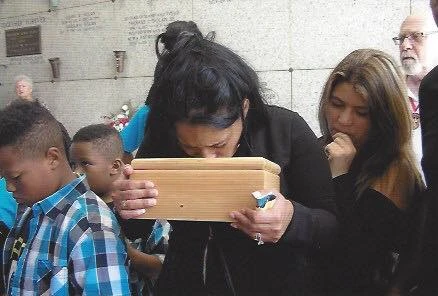
 A family grieves their lost baby at a funeral at the crypt at St. Patrick’s Cemetery in New Orleans. Many friends, relatives, and families attended the funeral that day. / Credit: Photo courtesy of Compassionate Burials for Indigent Babies

CNA Staff, Nov 19, 2025 / 06:00 am (CNA).
Sandy Schaetz still mourns the baby she never met. “It was terrifying and traumatic,” she said of her miscarriage. “I was consoled after by the prayers of a deacon, but never named the baby or knew if it was a boy or girl.” “It was not something I understood at the time and I only wish I had known more of what was happening,” she told CNA. Now, Schaetz volunteers with Compassionate Burials for Indigent Babies (CBIB), an organization that buries babies who died, whether stillborn, miscarried, or aborted.The group organizes everything for the funerals, which are held at a crypt at St. Patrick’s Cemetery in New Orleans.A shoebox-sized casket lined with donated white fabric, usually from wedding dresses, is processed through the cemetery, with Knights of Columbus present as the honor guard. A volunteer musician plays at every funeral; a Catholic deacon presides at almost every burial.Two Knights of Columbus carry the casket of a baby who was murdered. Credit: Photo courtesy of Compassionate Burials for Indigent BabiesWhen Schaetz attended her first burial service as a volunteer, it hit her to the core.  “I find it difficult to put into words how it affected me,” Schaetz said. “All God needed me to do that day was to be present, to pray, to honor the life he had created.” “It opened my eyes to how each life is such a gift, and when that life ends how important it is to show respect and pray for the soul and bury the dead with love,” Schaetz said. Death and resurrection Women who lose children through miscarriage often suffer silently, according to Lise Naccari, the founder of CBIB. “Losing a child is hard. Often women suffer in silence the pain of infant loss and ride that sad emotional roller coaster ride alone,” Naccari told CNA. One in four pregnancies ends in miscarriage — a devastating statistic for many couples. Naccari herself experienced a miscarriage as well as several challenging pregnancies. “I feel a special connection with poor mothers who have lost a child. My heart goes out to them,” Naccari said.Lise Naccari (right) embraces a grieving mother at a burial at the crypt at St. Patrick’s Cemetery in New Orleans. Credit: Photo courtesy of Compassionate Burials for Indigent BabiesNaccari buries the babies who were wanted and loved, but also the babies who were thrown out or mistreated.“CBIB has buried babies as big as a blueberry and up to 2 years old,” Naccari said. “We buried babies stillborn, miscarried, abandoned, unclaimed, aborted, murdered, and thrown away in the trash — and every situation possible.”“Many babies were mistreated, abused, and tossed out … these are heartbreaking funerals to go to,” Naccari said.CBIB dressed and buried seven babies who were left at hospitals labeled “unclaimed and abandoned,” Naccari said. CBIB buried the babies at the crypt at St. Patrick’s Cemetery in New Orleans. Credit: Photo courtesy of Compassionate Burials for Indigent Babies“Babies are left sometimes because some families can not afford funerals for them but would like one,” Naccari said. “Also, many parents are young, and the grief can be overwhelming and they cannot navigate through funeral arrangements.” Her life’s work is to bury the dead — and she looks to the Resurrection. “I consider what I do holy,” Naccari said. “I feel like this is my vocation and I know God orchestrated all of this. I give all honor and glory to him, our loving Father.” “What I do is not about sorrow and death,” Naccari continued. “What I do is really about joy and life — eternal life.” A father (right) whose child was murdered carries the casket with the help of others. Credit: Photo courtesy of Compassionate Burials for Indigent BabiesIt’s not an easy job, and Naccari looks to God for strength.“Lord, I don’t want to do this anymore. It hurts my heart too much,” Naccari remembered praying as she prepared one baby for burial — a baby girl who had been abandoned and tossed out after she was born.“I felt a still small voice within me say, ‘Lise, don’t think about their bodies, focus on the Resurrection,’” Naccari recalled.“The sunlight from the stained-glass windows was shining down a warm yellow color on my face, as I looked up in it and I thought, yes, this is what I needed to hear to keep going — focus on the Resurrection,” she continued.A resource for women in needSheena Lewis was in jail when her son, still a baby, passed away. She couldn’t attend the funeral, but Naccari organized the burial for her.Lewis, now sober and out of jail, visits her son’s crypt often.“I have solace in the fact he was laid to rest in a beautiful manner when I couldn’t be there for him or myself at the time,” Lewis told CNA.Many young mothers CBIB helps are often “steeped in poverty” and have no support system. They are often “low income, uneducated, coming from sometimes addiction or problem homes,” Naccari said.“Often I find at these funerals that the young mothers are alone or they may come with children or other women — but there are no men to help support them,” Naccari said.“My heart is broken for them, for they are not only battling their poverty, they also have to deal with losing a child,” she said.A moment to mourn Funerals help families process their grief — a grief that’s often hidden away due to the nature of miscarriages. Deacon Ricky Suprean preaches at almost every graveside burial — but after a couple years of volunteering, he realized God had called him to this so he could find healing. Suprean and his wife, Lynn, experienced two miscarriages.Suprean struggled to process it at the time, but through his volunteering, he’s found some healing. He still remembers the first CBIB funeral he presided at. “I felt the power of life that day,” he told CNA. “It was cold. I had no idea I would kneel in front of each little coffin and pray for each child and each family with my hand touching each coffin.”Volunteers hugged each family member, he recalled.Deacon Ricky Suprean at the burial of two babies at the crypt at St. Patrick’s Cemetery in New Orleans. Credit: Photo courtesy of Compassionate Burials for Indigent Babies“God has allowed me to give a proper burial to my own two lost children through CBIB time and time again,” Suprean said.“God created these children in my wife’s womb, and they will be waiting for us in heaven,” Suprean continued.Struggling to process grief is common with loss of children, according to Naccari.“Too often people are hurting so much and don’t want to face a funeral,” Naccari said. “They feel vulnerable and so it is easier to turn away and do nothing.”“But on the contrary, I have observed that these funerals provide consolation, comfort, solace, and even a healthy way of healing after the loss of a baby,” Naccari said.“It’s a good grief,” Naccari continued. “Funerals are about love and holding onto friends and family at a time of need. It can be life-changing.”Some funerals have had as many as 100 people in attendance.Many volunteers are “faithfully committed” to being present at every funeral.“It could be freezing cold or blistering hot in the summer, but they just show up and either help set up, greet the parents, or stand tall next to a casket to show the love of Jesus to our families,” Naccari said.The altar at a burial at the crypt at St. Patrick’s Cemetery in New Orleans. CBIB has buried hundreds of babies at the crypt. Credit: Photo courtesy of Compassionate Burials for Indigent BabiesThese funerals “allow parents that special moment to mourn their loss and to remember their little one and ponder the person that little one could have been,” Naccari said.“CBIB celebrates each life, and we believe that God somehow rights all the wrongs and makes all things new,” Naccari said. “And then we move to the next funeral.”

Burials for little ones: How a New Orleans ministry helps families grieve #Catholic A family grieves their lost baby at a funeral at the crypt at St. Patrick’s Cemetery in New Orleans. Many friends, relatives, and families attended the funeral that day. / Credit: Photo courtesy of Compassionate Burials for Indigent Babies CNA Staff, Nov 19, 2025 / 06:00 am (CNA). Sandy Schaetz still mourns the baby she never met. “It was terrifying and traumatic,” she said of her miscarriage. “I was consoled after by the prayers of a deacon, but never named the baby or knew if it was a boy or girl.” “It was not something I understood at the time and I only wish I had known more of what was happening,” she told CNA. Now, Schaetz volunteers with Compassionate Burials for Indigent Babies (CBIB), an organization that buries babies who died, whether stillborn, miscarried, or aborted.The group organizes everything for the funerals, which are held at a crypt at St. Patrick’s Cemetery in New Orleans.A shoebox-sized casket lined with donated white fabric, usually from wedding dresses, is processed through the cemetery, with Knights of Columbus present as the honor guard. A volunteer musician plays at every funeral; a Catholic deacon presides at almost every burial.Two Knights of Columbus carry the casket of a baby who was murdered. Credit: Photo courtesy of Compassionate Burials for Indigent BabiesWhen Schaetz attended her first burial service as a volunteer, it hit her to the core.  “I find it difficult to put into words how it affected me,” Schaetz said. “All God needed me to do that day was to be present, to pray, to honor the life he had created.” “It opened my eyes to how each life is such a gift, and when that life ends how important it is to show respect and pray for the soul and bury the dead with love,” Schaetz said. Death and resurrection Women who lose children through miscarriage often suffer silently, according to Lise Naccari, the founder of CBIB. “Losing a child is hard. Often women suffer in silence the pain of infant loss and ride that sad emotional roller coaster ride alone,” Naccari told CNA. One in four pregnancies ends in miscarriage — a devastating statistic for many couples. Naccari herself experienced a miscarriage as well as several challenging pregnancies. “I feel a special connection with poor mothers who have lost a child. My heart goes out to them,” Naccari said.Lise Naccari (right) embraces a grieving mother at a burial at the crypt at St. Patrick’s Cemetery in New Orleans. Credit: Photo courtesy of Compassionate Burials for Indigent BabiesNaccari buries the babies who were wanted and loved, but also the babies who were thrown out or mistreated.“CBIB has buried babies as big as a blueberry and up to 2 years old,” Naccari said. “We buried babies stillborn, miscarried, abandoned, unclaimed, aborted, murdered, and thrown away in the trash — and every situation possible.”“Many babies were mistreated, abused, and tossed out … these are heartbreaking funerals to go to,” Naccari said.CBIB dressed and buried seven babies who were left at hospitals labeled “unclaimed and abandoned,” Naccari said. CBIB buried the babies at the crypt at St. Patrick’s Cemetery in New Orleans. Credit: Photo courtesy of Compassionate Burials for Indigent Babies“Babies are left sometimes because some families can not afford funerals for them but would like one,” Naccari said. “Also, many parents are young, and the grief can be overwhelming and they cannot navigate through funeral arrangements.” Her life’s work is to bury the dead — and she looks to the Resurrection. “I consider what I do holy,” Naccari said. “I feel like this is my vocation and I know God orchestrated all of this. I give all honor and glory to him, our loving Father.” “What I do is not about sorrow and death,” Naccari continued. “What I do is really about joy and life — eternal life.” A father (right) whose child was murdered carries the casket with the help of others. Credit: Photo courtesy of Compassionate Burials for Indigent BabiesIt’s not an easy job, and Naccari looks to God for strength.“Lord, I don’t want to do this anymore. It hurts my heart too much,” Naccari remembered praying as she prepared one baby for burial — a baby girl who had been abandoned and tossed out after she was born.“I felt a still small voice within me say, ‘Lise, don’t think about their bodies, focus on the Resurrection,’” Naccari recalled.“The sunlight from the stained-glass windows was shining down a warm yellow color on my face, as I looked up in it and I thought, yes, this is what I needed to hear to keep going — focus on the Resurrection,” she continued.A resource for women in needSheena Lewis was in jail when her son, still a baby, passed away. She couldn’t attend the funeral, but Naccari organized the burial for her.Lewis, now sober and out of jail, visits her son’s crypt often.“I have solace in the fact he was laid to rest in a beautiful manner when I couldn’t be there for him or myself at the time,” Lewis told CNA.Many young mothers CBIB helps are often “steeped in poverty” and have no support system. They are often “low income, uneducated, coming from sometimes addiction or problem homes,” Naccari said.“Often I find at these funerals that the young mothers are alone or they may come with children or other women — but there are no men to help support them,” Naccari said.“My heart is broken for them, for they are not only battling their poverty, they also have to deal with losing a child,” she said.A moment to mourn Funerals help families process their grief — a grief that’s often hidden away due to the nature of miscarriages. Deacon Ricky Suprean preaches at almost every graveside burial — but after a couple years of volunteering, he realized God had called him to this so he could find healing. Suprean and his wife, Lynn, experienced two miscarriages.Suprean struggled to process it at the time, but through his volunteering, he’s found some healing. He still remembers the first CBIB funeral he presided at. “I felt the power of life that day,” he told CNA. “It was cold. I had no idea I would kneel in front of each little coffin and pray for each child and each family with my hand touching each coffin.”Volunteers hugged each family member, he recalled.Deacon Ricky Suprean at the burial of two babies at the crypt at St. Patrick’s Cemetery in New Orleans. Credit: Photo courtesy of Compassionate Burials for Indigent Babies“God has allowed me to give a proper burial to my own two lost children through CBIB time and time again,” Suprean said.“God created these children in my wife’s womb, and they will be waiting for us in heaven,” Suprean continued.Struggling to process grief is common with loss of children, according to Naccari.“Too often people are hurting so much and don’t want to face a funeral,” Naccari said. “They feel vulnerable and so it is easier to turn away and do nothing.”“But on the contrary, I have observed that these funerals provide consolation, comfort, solace, and even a healthy way of healing after the loss of a baby,” Naccari said.“It’s a good grief,” Naccari continued. “Funerals are about love and holding onto friends and family at a time of need. It can be life-changing.”Some funerals have had as many as 100 people in attendance.Many volunteers are “faithfully committed” to being present at every funeral.“It could be freezing cold or blistering hot in the summer, but they just show up and either help set up, greet the parents, or stand tall next to a casket to show the love of Jesus to our families,” Naccari said.The altar at a burial at the crypt at St. Patrick’s Cemetery in New Orleans. CBIB has buried hundreds of babies at the crypt. Credit: Photo courtesy of Compassionate Burials for Indigent BabiesThese funerals “allow parents that special moment to mourn their loss and to remember their little one and ponder the person that little one could have been,” Naccari said.“CBIB celebrates each life, and we believe that God somehow rights all the wrongs and makes all things new,” Naccari said. “And then we move to the next funeral.”


A family grieves their lost baby at a funeral at the crypt at St. Patrick’s Cemetery in New Orleans. Many friends, relatives, and families attended the funeral that day. / Credit: Photo courtesy of Compassionate Burials for Indigent Babies

CNA Staff, Nov 19, 2025 / 06:00 am (CNA).

Sandy Schaetz still mourns the baby she never met. 

“It was terrifying and traumatic,” she said of her miscarriage. “I was consoled after by the prayers of a deacon, but never named the baby or knew if it was a boy or girl.” 

“It was not something I understood at the time and I only wish I had known more of what was happening,” she told CNA. 

Now, Schaetz volunteers with Compassionate Burials for Indigent Babies (CBIB), an organization that buries babies who died, whether stillborn, miscarried, or aborted.

The group organizes everything for the funerals, which are held at a crypt at St. Patrick’s Cemetery in New Orleans.

A shoebox-sized casket lined with donated white fabric, usually from wedding dresses, is processed through the cemetery, with Knights of Columbus present as the honor guard. A volunteer musician plays at every funeral; a Catholic deacon presides at almost every burial.

Two Knights of Columbus carry the casket of a baby who was murdered. Credit: Photo courtesy of Compassionate Burials for Indigent Babies

When Schaetz attended her first burial service as a volunteer, it hit her to the core.  

“I find it difficult to put into words how it affected me,” Schaetz said. “All God needed me to do that day was to be present, to pray, to honor the life he had created.” 

“It opened my eyes to how each life is such a gift, and when that life ends how important it is to show respect and pray for the soul and bury the dead with love,” Schaetz said. 

Death and resurrection 

Women who lose children through miscarriage often suffer silently, according to Lise Naccari, the founder of CBIB. 

“Losing a child is hard. Often women suffer in silence the pain of infant loss and ride that sad emotional roller coaster ride alone,” Naccari told CNA. 

One in four pregnancies ends in miscarriage — a devastating statistic for many couples. 

Naccari herself experienced a miscarriage as well as several challenging pregnancies. 

“I feel a special connection with poor mothers who have lost a child. My heart goes out to them,” Naccari said.

Lise Naccari (right) embraces a grieving mother at a burial at the crypt at St. Patrick’s Cemetery in New Orleans. Credit: Photo courtesy of Compassionate Burials for Indigent Babies

Naccari buries the babies who were wanted and loved, but also the babies who were thrown out or mistreated.

“CBIB has buried babies as big as a blueberry and up to 2 years old,” Naccari said. “We buried babies stillborn, miscarried, abandoned, unclaimed, aborted, murdered, and thrown away in the trash — and every situation possible.”

“Many babies were mistreated, abused, and tossed out … these are heartbreaking funerals to go to,” Naccari said.

CBIB dressed and buried seven babies who were left at hospitals labeled “unclaimed and abandoned,” Naccari said. CBIB buried the babies at the crypt at St. Patrick’s Cemetery in New Orleans. Credit: Photo courtesy of Compassionate Burials for Indigent Babies

“Babies are left sometimes because some families can not afford funerals for them but would like one,” Naccari said. “Also, many parents are young, and the grief can be overwhelming and they cannot navigate through funeral arrangements.” 

Her life’s work is to bury the dead — and she looks to the Resurrection. 

“I consider what I do holy,” Naccari said. “I feel like this is my vocation and I know God orchestrated all of this. I give all honor and glory to him, our loving Father.” 

“What I do is not about sorrow and death,” Naccari continued. “What I do is really about joy and life — eternal life.” 

A father (right) whose child was murdered carries the casket with the help of others. Credit: Photo courtesy of Compassionate Burials for Indigent Babies

It’s not an easy job, and Naccari looks to God for strength.

“Lord, I don’t want to do this anymore. It hurts my heart too much,” Naccari remembered praying as she prepared one baby for burial — a baby girl who had been abandoned and tossed out after she was born.

“I felt a still small voice within me say, ‘Lise, don’t think about their bodies, focus on the Resurrection,’” Naccari recalled.

“The sunlight from the stained-glass windows was shining down a warm yellow color on my face, as I looked up in it and I thought, yes, this is what I needed to hear to keep going — focus on the Resurrection,” she continued.

A resource for women in need

Sheena Lewis was in jail when her son, still a baby, passed away. She couldn’t attend the funeral, but Naccari organized the burial for her.

Lewis, now sober and out of jail, visits her son’s crypt often.

“I have solace in the fact he was laid to rest in a beautiful manner when I couldn’t be there for him or myself at the time,” Lewis told CNA.

Many young mothers CBIB helps are often “steeped in poverty” and have no support system. They are often “low income, uneducated, coming from sometimes addiction or problem homes,” Naccari said.

“Often I find at these funerals that the young mothers are alone or they may come with children or other women — but there are no men to help support them,” Naccari said.

“My heart is broken for them, for they are not only battling their poverty, they also have to deal with losing a child,” she said.

A moment to mourn 

Funerals help families process their grief — a grief that’s often hidden away due to the nature of miscarriages. 

Deacon Ricky Suprean preaches at almost every graveside burial — but after a couple years of volunteering, he realized God had called him to this so he could find healing. 

Suprean and his wife, Lynn, experienced two miscarriages.

Suprean struggled to process it at the time, but through his volunteering, he’s found some healing. He still remembers the first CBIB funeral he presided at. 

“I felt the power of life that day,” he told CNA. “It was cold. I had no idea I would kneel in front of each little coffin and pray for each child and each family with my hand touching each coffin.”

Volunteers hugged each family member, he recalled.

Deacon Ricky Suprean at the burial of two babies at the crypt at St. Patrick’s Cemetery in New Orleans. Credit: Photo courtesy of Compassionate Burials for Indigent Babies

“God has allowed me to give a proper burial to my own two lost children through CBIB time and time again,” Suprean said.

“God created these children in my wife’s womb, and they will be waiting for us in heaven,” Suprean continued.

Struggling to process grief is common with loss of children, according to Naccari.

“Too often people are hurting so much and don’t want to face a funeral,” Naccari said. “They feel vulnerable and so it is easier to turn away and do nothing.”

“But on the contrary, I have observed that these funerals provide consolation, comfort, solace, and even a healthy way of healing after the loss of a baby,” Naccari said.

“It’s a good grief,” Naccari continued. “Funerals are about love and holding onto friends and family at a time of need. It can be life-changing.”

Some funerals have had as many as 100 people in attendance.

Many volunteers are “faithfully committed” to being present at every funeral.

“It could be freezing cold or blistering hot in the summer, but they just show up and either help set up, greet the parents, or stand tall next to a casket to show the love of Jesus to our families,” Naccari said.

The altar at a burial at the crypt at St. Patrick’s Cemetery in New Orleans. CBIB has buried hundreds of babies at the crypt. Credit: Photo courtesy of Compassionate Burials for Indigent Babies

These funerals “allow parents that special moment to mourn their loss and to remember their little one and ponder the person that little one could have been,” Naccari said.

“CBIB celebrates each life, and we believe that God somehow rights all the wrongs and makes all things new,” Naccari said. “And then we move to the next funeral.”

Read More
Picture of the day


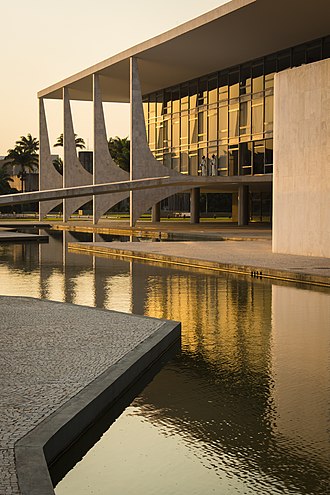
Palácio do Planalto, seat of the Brazilian Federal Executive. In late September afternoon, the height of the dry season, the setting sun gives a special color to the monument. Today is Independence Day in Brazil.
 #ImageOfTheDay
Picture of the day
Palácio do Planalto, seat of the Brazilian Federal Executive. In late September afternoon, the height of the dry season, the setting sun gives a special color to the monument. Today is Independence Day in Brazil.
Read More