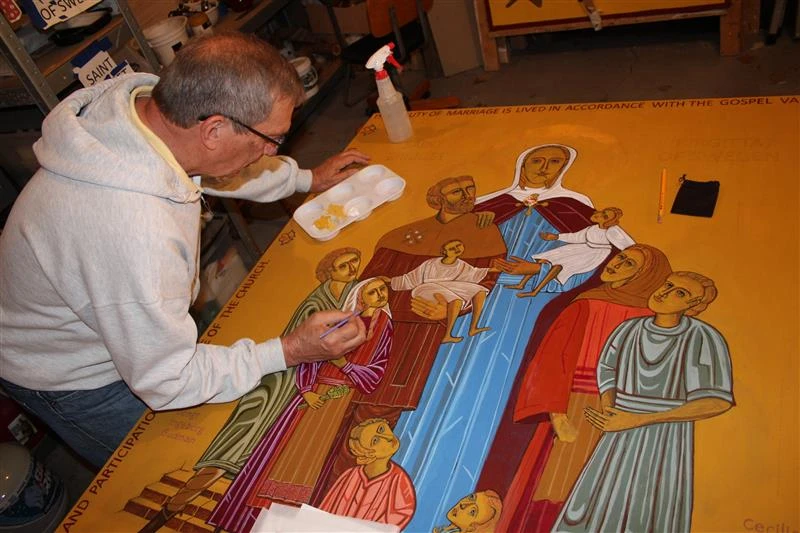

Father Richard Reiser, an iconographer based in Omaha, Nebraska, writes an icon of St. Bridget of Sweden with her family for FOCCUS Marriage Ministries’ 40th anniversary. / Credit: Photo courtesy of FOCCUS
CNA Staff, Dec 13, 2025 / 06:00 am (CNA).
When an iconographer began his work on a unique icon, he looked to the bones of the saint’s husband for help.
FOCCUS Marriage Ministries, a Catholic marriage ministry, invited the priest-iconographer Father Richard Reiser to make an icon of St. Bridget of Sweden, a mystic and the mother of eight. The ministry is celebrating its 40th anniversary this year and chose St. Bridget to be the patron saint of its work.
But there was one challenge. According to Reiser, historically there is no established iconographic prototype of an icon of St. Bridget of Sweden.
So using his imagination and every historical source available — including the bones of St. Bridget’s husband — the priest developed an entirely new icon of a saint who has gone without an icon for hundreds of years.
The domestic church
“For me, iconography is first and foremost a form of prayer,” Reiser said. “The entire creative process is an act of listening to God and allowing the sacred story of a saint or mystery to take shape through layers of contemplation, color, and symbolism.”
The end result was an icon ripe with symbolic meaning — at its heart, marriage and family.

FOCCUS Marriage Ministries chose St. Bridget of Sweden to be its patron because of her commitment to marriage and the Church.
St. Bridget’s life “beautifully reflects the heart of marriage ministry,” Sheila Simpson, who heads the archdiocese-owned nonprofit, told CNA.
Now displayed in the hallway of the FOCCUS office in the Archdiocese of Omaha, Nebraska, the icon contains a quote from Pope Benedict XVI about the family as the domestic church as well as several symbols of the married couple’s life together.
“The icon quietly teaches that marriage is both a covenant of grace and a living witness to the Gospel,” Reiser told CNA.
With St. Bridget as its guiding light, FOCCUS is launching resources for couples whose marriages have unusual challenges, such as those who need their marriage convalidated by the Church, as well as those marrying later in life.
FOCCUS is most well known for its inventories — questionnaires designed to help engaged couples prepare for marriage by initiating conversations about issues like finance and values. The additional, new questionnaires will have questions tailored for couples in unusual situations, including military couples, first responders, and deacons.
Simpson said many couples say FOCCUS “became a turning point — not because it told them what to do, but because it helped them truly hear each other.”
Windows into the divine
Reiser said that one of the most “fascinating” parts of the icon-making process was consulting the bones of Ulf Gudmarsson, the husband of St. Bridget.
“His bones indicated that he was significantly larger in stature than she was,” he said.
“To honor historical accuracy while still emphasizing Bridget’s spiritual prominence, I placed her on a small set of steps so she would remain the central figure of the composition,” he explained.
Icons are “created for contemplation and spiritual truth more than realism,” Reiser said.
“They are windows into the divine — visual theology meant to open the heart and mind to God’s presence,” he continued.
“They participate in the mystery of the Incarnation,” Reiser said. “The eternal Word of God takes visible form.”
The icon depicts an emblem of the Third Order Franciscans, which the couple joined after they got married.
In addition, Gudmarsson holds a staff with a shell, referencing the pilgrimage the couple took to northwestern Spain.
It would be the last pilgrimage the couple ever made together. On the return journey from the pilgrimage, Gudmarsson grew ill and died soon after they returned to Sweden.
As a widow, St. Bridget dedicated her life to Christ, founding the religious order now known as the Bridgettines, which still exists to this day.

An icon of family and unity
Iconographers don’t paint — they write.
“Every line, color, and gesture carries symbolic meaning,” Reiser said. “That is why we often say icons are ‘written’ rather than painted.”
For instance, the 15 florets below St. Bridget of Sweden reference her 15 meditations on Christ’s passion. The cloak she wears has a brooch styled to symbolize the five wounds of Christ. Within the brooch is a relic of St. Bridget.
“Writing the icon of St. Bridget of Sweden was a unique and grace-filled experience because, historically, there is no established iconographic prototype of her — especially not one depicting her with her family,” Reiser said. “Without a traditional image to follow, I drew from existing paintings of St. Bridget and shaped them within the contemplative, dignified structure of classical iconography.”
With “no established icon tradition for Bridget’s family,” Reiser said he “consulted other family-centered icons, especially images of Christ with children, to discern how to portray children in an authentically iconographic style.”
The paintings of the children visually form a circle, which Reiser said represents the unity of the family. One of the children, Ingeborg, holds bluebells, the national flower of St. Bridget’s homeland, Sweden.
“Each of these details helps the icon speak not just as artwork but as a theological meditation on the holiness of family life,” Reiser said.
Read More





![CNA explains: Why does the Catholic Church prohibit ‘gay marriage’? #Catholic
null / Credit: Daniel Jedzura/Shutterstock
CNA Staff, Nov 17, 2025 / 06:00 am (CNA).
Slightly over 10 years after it redefined marriage to include same-sex couples, the U.S. Supreme Court on Nov. 10 declined to revisit that controversial decision, upholding at least for now its ruling in Obergefell v. Hodges that made “gay marriage” the law of the land.A decade after that ruling, nearly a million same-sex couples in the U.S. are participating in what the law now defines as marriage. Yet the Catholic Church has continued to affirm the definition of marriage as being exclusively a union between a man and a woman. That has been the prevailing definition of marriage around the world for at least about 5,000 years of human history, though many societies have allowed polygamy, or multiple spouses, in various forms. The same-sex variant of marriage, meanwhile, only became accepted in recent decades. The Church has held since its beginning that marriage is strictly between one man and one woman. The Catechism of the Catholic Church directs that marriage occurs when “a man and a woman establish between themselves a partnership of the whole of life.” It is “by its nature ordered toward the good of the spouses and the procreation and education of offspring.”Church Fathers and theologians from the earliest days of Catholicism have consistently upheld that marriage is meant to be a lifelong, permanent union between one man and one woman, with St. Augustine explicitly naming “offspring” as one of the blessings of marriage, along with “fidelity” and “the sacramental bond.”Gay marriage a ‘misnomer’ by Church teachingJohn Grabowski, a professor of moral theology at The Catholic University of America, told CNA that marriage in the Catholic Church’s teaching is based on “unity, indissolubility, and [is ordered] toward life,” or the begetting of children.“Those criteria can only be met in a union between a man and a woman,” he said. “They cannot be met in a union between two men and two women. ‘Gay marriage’ is thus a misnomer in the Church’s understanding.”The Supreme Court’s redefinition of marriage, Grabowski argued, was an act of “judicial fiat” rather than a recognition of what marriage actually is. He said the high court was functioning more as a “cultural barometer” reflecting an erroneous shift in perception on what marriage is.“It would be similar to if the court passed a rule saying we could call a square a circle,” he said. “It’s just not based on the reality of the natural world.”The Obergefell ruling came after years of LGBT activist efforts to redefine marriage both within individual states and at the federal level. Advocates had argued that there was no meaningful reason to restrict marriage to opposite-sex couples and that to do so constituted discrimination. Many critics have claimed that the Church’s broader teaching on marriage actually left the door open for same-sex couples to marry — for instance, they argued, by allowing opposite-sex couples to marry even if one or both of the spouses are infertile, the Church implicitly divorces biological childbearing from marriage itself. Grabowski acknowledged that the Church does allow infertile couples to get married (and to stay married if infertility occurs at a later date). But he pointed out that the Church does in fact prohibit marriage for those who are impotent, or constitutionally incapable of intercourse. The key point for the Church, he said, is what St. John Paul II called the “spousal meaning of the body.” The late pope argued that men and women “exist in the relationship of the reciprocal gift of self,” ordered to the communion of “one flesh” of which the Bible speaks in Genesis. The Church’s teaching, Grabowski said, “is based on the natural law. It tells us that the way God designed us is for the good of our flourishing, both as individuals and as the good of society.”Though marriage advocates have continued to criticize the Supreme Court’s decision over the past decade, others have at times suggested a pivot away from directly challenging it at the legal level. In 2017, for instance, Winona-Rochester, Minnesota, Bishop Robert Barron affirmed his opposition to gay marriage but questioned “the prudence and wisdom” of attempting to legislatively outlaw it at that time. The bishop suggested instead that “personal witness and education” were better tools for the current political climate.Grabowski acknowledged that one “could say, realistically, the ship has sailed and the political question is dead.”“But that’s a political judgment,” he said. Catholics should not lose sight of the goal to reestablish correct laws on marriage, he argued.“In terms of something to hope for, pray for, and to the degree that we’re able to, work for it — that’s something Catholics should aspire to.”](http://unitedyam.com/wp-content/uploads/2025/11/cna-explains-why-does-the-catholic-church-prohibit-gay-marriage-catholic-null-credit-daniel-jedzura-shutterstockcna-staff-nov-17-2025-0600-am-cna-slightly-over-10.webp)