Fight

PHOTOS: Tickhill Psalter’s Jesse Tree shines in Morgan Library’s Advent exhibit #Catholic 
 
 Death of Uriah; David in Penance, from the Morgan’s famed Farnese Hours, demonstrates the enduring appeal of the penitential Psalms of David as seen in this early Renaissance book of hours. Italy, Rome, 1546. The Morgan Library & Museum, New York, MS M.69, fols, 63v-63r. Photography by Janny Chiu. / Credit: Courtesy of the New York Library

New York City, New York, Nov 30, 2025 / 08:00 am (CNA).
Part of the New York Public Library’s Spencer Collection, the Tickhill Psalter is on view throughout Advent and Christmas at The Morgan Library & Museum in its exhibit “Sing a New Song: The Psalms in Medieval Art and Life.” A full-page Jesse Tree introduces the Psalms in the Tickhill Psalter, a 14th-century illuminated manuscript from the Augustinian Worksop Priory in Nottinghamshire, England. Tree of Jesse (Psalm 1), from the Tickhill Psalter, England, Nottinghamshire, Worksop Priory, 1303-14, New York Public Library, Spencer 26. fol. 6v. The Medieval manuscript is on display in Morgan Library’s Advent exhibit. Credit: Courtesy of the Morgan LibraryDavid appears in the historiated B of Psalm 1, providing a conceptual link to scenes from his life in the Jesse Tree on the facing page. “Beatus vir,” or “Blessed is the man,” the first stanza opens in celebration of the one who delights in God’s law, concluding: “That person is like a tree planted by streams of water, which yields its fruit in season and whose leaf does not wither, — what they do prospers.” These words and their historiated B, with its visual link to the facing page, highlight David as key author of the Psalms and their prefiguration of Christ, the good fruit of the Jesse Tree, a theme common to medieval illuminated manuscripts.King David as Psalmist, from Florence, Italy, ca. 1408-10, by Lorenzo Monaco, who was born Piero di Giovanni but took the name Lorenzo Monaco, or Lorenzo the Monk, upon joining the monastery of Santa Maria degli Angeli, where he became a skilled illuminator and translated themes common to illuminated manuscripts into panel paintings, like this tempera on wood with gold ground depicting David seated on a stone bench tuning a psaltery, lips parted, prepared to sing, with a halo backing the crown he wears to signify the divine inspiration of his compositions. The Metropolitan Museum of Art, New York, 65.14.4. November 2025. Credit: Courtesy of the Metropolitan Museum of Art, New YorkProphets stand in architectural niches on either side of the Tickhill Psalter’s Jesse Tree, heralding the Psalms as prophecy. Credit: Courtesy of the New York LibraryThe central panel of a 1490 Flemish triptych with scenes from the life of Saint Augustine contextualizes the exhibit. This five-by-five-foot oil on wood painting references Augustine’s use of allegory, essential to his understanding of scripture and interpretation of the psalms as prophecy. One scene captures Augustine’s realization of the Trinity as boundless mystery that dwarfs human understanding, allegorized by a child trying to pour the sea into a hole in the sand. Scenes from the life of St. Augustine of Hippo, 1490, Bruges, Belgium, by the unnamed master of St. Augustine, amplifies the Church’s leading theologian on the allegorical interpretation of Psalms. At center, his installation as bishop of Hippo highlights his teaching authority, flanked by scenes of ordination and preaching on the left. On the right, he engages in scholarly discourse and converses with a child trying to pour the sea into a hole in the sand, illustrating the importance of allegory in Augustinian thought. Credit: Courtesy of the New York Public LibraryLate 12th-century book comprised of Augustine’s Gradual Psalms and his Enchiridion (Greek for “handbook”). The well-worn and annotated pages reflect the proliferation of Augustinian influence on interpretation of Scripture. Spain, Santa Maria de Benevivere, near Palencia. Free Library of Philadelphia, Lewis E22, fols. 68v-69r. Credit: Courtesy of the New York Public LibraryIn the book accompanying the exhibit, Morgan curator Deirdre Jackson extends the psalms’ significance to this triptych through a reference to a surviving panel housed in Ireland that shows Augustine on his deathbed. It’s a scene described by contemporary bishop Possidius of Calama, who said that Augustine “ordered those psalms of David which are especially penitential to be copied out and, when he was very weak, used to lie in bed, facing the wall where the written sheets were put up, gazing at them and reading them, and copiously and continuously weeping as he read.”Death of Uriah; David in Penance, from the Morgan’s famed Farnese Hours, demonstrates the enduring appeal of the penitential Psalms of David as seen in this early Renaissance book of hours. Italy, Rome, 1546. The Morgan Library & Museum, New York, MS M.69, fols, 63v-63r. Photography by Janny Chiu. Credit: Courtesy of the New York Public LibraryScenes from the Life of David, depicting the story of David and Goliath, exemplifies the significance attached to the figure of David in medieval illuminated manuscripts. Winchester Bible, England, Winchester, ca. 1160-80. The Morgan Library & Museum, New York, MS M.619v. Photography by Graham S. Haber. Credit: Courtesy of the New York LibraryIn his book “The Tickhill Psalter and Related Manuscripts,” 20th-century art historian Donald Drew Egbert speculates that the Tickhill Psalter was decorated by highly skilled illuminators working for Augustinian monasteries and patrons of Augustinian houses during a high point of book arts in England.St. Thomas More, “in tribulation vehementi et in carcere” (annotation), from the Prayer Book of Thomas More, France, Paris, 1522 (Psalter) and 1530 (Book of Hours), Beinecke Rare Book & Manuscript Library, Yale University, New Haven, MS Vault More, fol. 68v (Psalter section). Credit: Courtesy of the New York LibraryThis high point inspired a trend of books as personalized treasures, best exemplified in this exhibit by St. Thomas More’s prayer book. Containing much of his own writing in the margins, it consists of a Book of Hours and a Psalter and was with him in the Tower of London while he awaited execution. More’s notes during that time show his preoccupation with the psalms of David’s tribulations. Beside Psalm 87:5-10, “a man without help … in the dark places, and in the shadow of death,” More writes, “in severe tribulation and in prison.”The Prayer Book of Thomas More is backed by a wall-sized image of Hans Holbein’s “Sir Thomas More,” positioned to look like More is gazing intently across the gallery at an image of David from the Crusader Bible. Engelhard Gallery, Photography by Janny Chiu, October 2025. Credit: Courtesy of the New York LibraryMore’s thoughts in distress demonstrate the appeal of David’s story to the human heart, a reality repeatedly expressed throughout the treasures of this exhibit. In the Tickhill Psalter’s Jesse Tree, David is encircled by branches springing from a tree that grows out of his father, Jesse, sprawled in an active sleep, his elbow supporting a hand planted against his head as though dreaming of all that is to come. A crop of the enter of Tickhill Psalter showing the Virgin and Child and the figure of David playing a harp. Credit: Courtesy of the New York LibraryThe branches of the tree wind around David and directly overhead to encircle the Virgin and Child, tracing Christ’s lineage through Mary to the House of David. At the top, the branches surround Christ enthroned in majesty, fulfilling the promise of victory over sin and death foreshadowed in the psalms.David strikes a joyous pose and plays a harp in celebration, and foliage on either side of the main branch wraps around prophets who unfurl scrolls to hint at mysteries about to be foretold in the reading of the psalms.Beneath the figure of Jesse, two separate depictions of David protecting his sheep from wild animals cast his actions as allegory in the fight against evil, segueing to his likeness in the historiated B, dancing and singing his story into the Psalms to animate their prefiguration of Christ.

PHOTOS: Tickhill Psalter’s Jesse Tree shines in Morgan Library’s Advent exhibit #Catholic Death of Uriah; David in Penance, from the Morgan’s famed Farnese Hours, demonstrates the enduring appeal of the penitential Psalms of David as seen in this early Renaissance book of hours. Italy, Rome, 1546. The Morgan Library & Museum, New York, MS M.69, fols, 63v-63r. Photography by Janny Chiu. / Credit: Courtesy of the New York Library New York City, New York, Nov 30, 2025 / 08:00 am (CNA). Part of the New York Public Library’s Spencer Collection, the Tickhill Psalter is on view throughout Advent and Christmas at The Morgan Library & Museum in its exhibit “Sing a New Song: The Psalms in Medieval Art and Life.” A full-page Jesse Tree introduces the Psalms in the Tickhill Psalter, a 14th-century illuminated manuscript from the Augustinian Worksop Priory in Nottinghamshire, England. Tree of Jesse (Psalm 1), from the Tickhill Psalter, England, Nottinghamshire, Worksop Priory, 1303-14, New York Public Library, Spencer 26. fol. 6v. The Medieval manuscript is on display in Morgan Library’s Advent exhibit. Credit: Courtesy of the Morgan LibraryDavid appears in the historiated B of Psalm 1, providing a conceptual link to scenes from his life in the Jesse Tree on the facing page. “Beatus vir,” or “Blessed is the man,” the first stanza opens in celebration of the one who delights in God’s law, concluding: “That person is like a tree planted by streams of water, which yields its fruit in season and whose leaf does not wither, — what they do prospers.” These words and their historiated B, with its visual link to the facing page, highlight David as key author of the Psalms and their prefiguration of Christ, the good fruit of the Jesse Tree, a theme common to medieval illuminated manuscripts.King David as Psalmist, from Florence, Italy, ca. 1408-10, by Lorenzo Monaco, who was born Piero di Giovanni but took the name Lorenzo Monaco, or Lorenzo the Monk, upon joining the monastery of Santa Maria degli Angeli, where he became a skilled illuminator and translated themes common to illuminated manuscripts into panel paintings, like this tempera on wood with gold ground depicting David seated on a stone bench tuning a psaltery, lips parted, prepared to sing, with a halo backing the crown he wears to signify the divine inspiration of his compositions. The Metropolitan Museum of Art, New York, 65.14.4. November 2025. Credit: Courtesy of the Metropolitan Museum of Art, New YorkProphets stand in architectural niches on either side of the Tickhill Psalter’s Jesse Tree, heralding the Psalms as prophecy. Credit: Courtesy of the New York LibraryThe central panel of a 1490 Flemish triptych with scenes from the life of Saint Augustine contextualizes the exhibit. This five-by-five-foot oil on wood painting references Augustine’s use of allegory, essential to his understanding of scripture and interpretation of the psalms as prophecy. One scene captures Augustine’s realization of the Trinity as boundless mystery that dwarfs human understanding, allegorized by a child trying to pour the sea into a hole in the sand. Scenes from the life of St. Augustine of Hippo, 1490, Bruges, Belgium, by the unnamed master of St. Augustine, amplifies the Church’s leading theologian on the allegorical interpretation of Psalms. At center, his installation as bishop of Hippo highlights his teaching authority, flanked by scenes of ordination and preaching on the left. On the right, he engages in scholarly discourse and converses with a child trying to pour the sea into a hole in the sand, illustrating the importance of allegory in Augustinian thought. Credit: Courtesy of the New York Public LibraryLate 12th-century book comprised of Augustine’s Gradual Psalms and his Enchiridion (Greek for “handbook”). The well-worn and annotated pages reflect the proliferation of Augustinian influence on interpretation of Scripture. Spain, Santa Maria de Benevivere, near Palencia. Free Library of Philadelphia, Lewis E22, fols. 68v-69r. Credit: Courtesy of the New York Public LibraryIn the book accompanying the exhibit, Morgan curator Deirdre Jackson extends the psalms’ significance to this triptych through a reference to a surviving panel housed in Ireland that shows Augustine on his deathbed. It’s a scene described by contemporary bishop Possidius of Calama, who said that Augustine “ordered those psalms of David which are especially penitential to be copied out and, when he was very weak, used to lie in bed, facing the wall where the written sheets were put up, gazing at them and reading them, and copiously and continuously weeping as he read.”Death of Uriah; David in Penance, from the Morgan’s famed Farnese Hours, demonstrates the enduring appeal of the penitential Psalms of David as seen in this early Renaissance book of hours. Italy, Rome, 1546. The Morgan Library & Museum, New York, MS M.69, fols, 63v-63r. Photography by Janny Chiu. Credit: Courtesy of the New York Public LibraryScenes from the Life of David, depicting the story of David and Goliath, exemplifies the significance attached to the figure of David in medieval illuminated manuscripts. Winchester Bible, England, Winchester, ca. 1160-80. The Morgan Library & Museum, New York, MS M.619v. Photography by Graham S. Haber. Credit: Courtesy of the New York LibraryIn his book “The Tickhill Psalter and Related Manuscripts,” 20th-century art historian Donald Drew Egbert speculates that the Tickhill Psalter was decorated by highly skilled illuminators working for Augustinian monasteries and patrons of Augustinian houses during a high point of book arts in England.St. Thomas More, “in tribulation vehementi et in carcere” (annotation), from the Prayer Book of Thomas More, France, Paris, 1522 (Psalter) and 1530 (Book of Hours), Beinecke Rare Book & Manuscript Library, Yale University, New Haven, MS Vault More, fol. 68v (Psalter section). Credit: Courtesy of the New York LibraryThis high point inspired a trend of books as personalized treasures, best exemplified in this exhibit by St. Thomas More’s prayer book. Containing much of his own writing in the margins, it consists of a Book of Hours and a Psalter and was with him in the Tower of London while he awaited execution. More’s notes during that time show his preoccupation with the psalms of David’s tribulations. Beside Psalm 87:5-10, “a man without help … in the dark places, and in the shadow of death,” More writes, “in severe tribulation and in prison.”The Prayer Book of Thomas More is backed by a wall-sized image of Hans Holbein’s “Sir Thomas More,” positioned to look like More is gazing intently across the gallery at an image of David from the Crusader Bible. Engelhard Gallery, Photography by Janny Chiu, October 2025. Credit: Courtesy of the New York LibraryMore’s thoughts in distress demonstrate the appeal of David’s story to the human heart, a reality repeatedly expressed throughout the treasures of this exhibit. In the Tickhill Psalter’s Jesse Tree, David is encircled by branches springing from a tree that grows out of his father, Jesse, sprawled in an active sleep, his elbow supporting a hand planted against his head as though dreaming of all that is to come. A crop of the enter of Tickhill Psalter showing the Virgin and Child and the figure of David playing a harp. Credit: Courtesy of the New York LibraryThe branches of the tree wind around David and directly overhead to encircle the Virgin and Child, tracing Christ’s lineage through Mary to the House of David. At the top, the branches surround Christ enthroned in majesty, fulfilling the promise of victory over sin and death foreshadowed in the psalms.David strikes a joyous pose and plays a harp in celebration, and foliage on either side of the main branch wraps around prophets who unfurl scrolls to hint at mysteries about to be foretold in the reading of the psalms.Beneath the figure of Jesse, two separate depictions of David protecting his sheep from wild animals cast his actions as allegory in the fight against evil, segueing to his likeness in the historiated B, dancing and singing his story into the Psalms to animate their prefiguration of Christ.


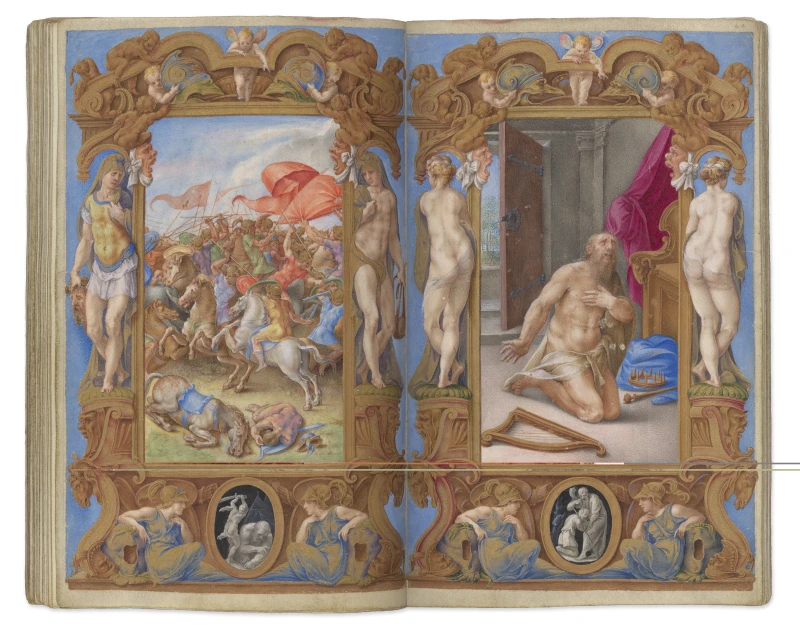
Death of Uriah; David in Penance, from the Morgan’s famed Farnese Hours, demonstrates the enduring appeal of the penitential Psalms of David as seen in this early Renaissance book of hours. Italy, Rome, 1546. The Morgan Library & Museum, New York, MS M.69, fols, 63v-63r. Photography by Janny Chiu. / Credit: Courtesy of the New York Library

New York City, New York, Nov 30, 2025 / 08:00 am (CNA).

Part of the New York Public Library’s Spencer Collection, the Tickhill Psalter is on view throughout Advent and Christmas at The Morgan Library & Museum in its exhibit “Sing a New Song: The Psalms in Medieval Art and Life.” A full-page Jesse Tree introduces the Psalms in the Tickhill Psalter, a 14th-century illuminated manuscript from the Augustinian Worksop Priory in Nottinghamshire, England.

Tree of Jesse (Psalm 1), from the Tickhill Psalter, England, Nottinghamshire, Worksop Priory, 1303-14, New York Public Library, Spencer 26. fol. 6v. The Medieval manuscript is on display in Morgan Library’s Advent exhibit. Credit: Courtesy of the Morgan Library

David appears in the historiated B of Psalm 1, providing a conceptual link to scenes from his life in the Jesse Tree on the facing page. “Beatus vir,” or “Blessed is the man,” the first stanza opens in celebration of the one who delights in God’s law, concluding: “That person is like a tree planted by streams of water, which yields its fruit in season and whose leaf does not wither, — what they do prospers.” 

These words and their historiated B, with its visual link to the facing page, highlight David as key author of the Psalms and their prefiguration of Christ, the good fruit of the Jesse Tree, a theme common to medieval illuminated manuscripts.

King David as Psalmist, from Florence, Italy, ca. 1408-10, by Lorenzo Monaco, who was born Piero di Giovanni but took the name Lorenzo Monaco, or Lorenzo the Monk, upon joining the monastery of Santa Maria degli Angeli, where he became a skilled illuminator and translated themes common to illuminated manuscripts into panel paintings, like this tempera on wood with gold ground depicting David seated on a stone bench tuning a psaltery, lips parted, prepared to sing, with a halo backing the crown he wears to signify the divine inspiration of his compositions. The Metropolitan Museum of Art, New York, 65.14.4. November 2025. Credit: Courtesy of the Metropolitan Museum of Art, New York
Prophets stand in architectural niches on either side of the Tickhill Psalter’s Jesse Tree, heralding the Psalms as prophecy. Credit: Courtesy of the New York Library

The central panel of a 1490 Flemish triptych with scenes from the life of Saint Augustine contextualizes the exhibit. This five-by-five-foot oil on wood painting references Augustine’s use of allegory, essential to his understanding of scripture and interpretation of the psalms as prophecy. One scene captures Augustine’s realization of the Trinity as boundless mystery that dwarfs human understanding, allegorized by a child trying to pour the sea into a hole in the sand. 

Scenes from the life of St. Augustine of Hippo, 1490, Bruges, Belgium, by the unnamed master of St. Augustine, amplifies the Church’s leading theologian on the allegorical interpretation of Psalms. At center, his installation as bishop of Hippo highlights his teaching authority, flanked by scenes of ordination and preaching on the left. On the right, he engages in scholarly discourse and converses with a child trying to pour the sea into a hole in the sand, illustrating the importance of allegory in Augustinian thought. Credit: Courtesy of the New York Public Library
Late 12th-century book comprised of Augustine’s Gradual Psalms and his Enchiridion (Greek for “handbook”). The well-worn and annotated pages reflect the proliferation of Augustinian influence on interpretation of Scripture. Spain, Santa Maria de Benevivere, near Palencia. Free Library of Philadelphia, Lewis E22, fols. 68v-69r. Credit: Courtesy of the New York Public Library

In the book accompanying the exhibit, Morgan curator Deirdre Jackson extends the psalms’ significance to this triptych through a reference to a surviving panel housed in Ireland that shows Augustine on his deathbed. It’s a scene described by contemporary bishop Possidius of Calama, who said that Augustine “ordered those psalms of David which are especially penitential to be copied out and, when he was very weak, used to lie in bed, facing the wall where the written sheets were put up, gazing at them and reading them, and copiously and continuously weeping as he read.”

Death of Uriah; David in Penance, from the Morgan’s famed Farnese Hours, demonstrates the enduring appeal of the penitential Psalms of David as seen in this early Renaissance book of hours. Italy, Rome, 1546. The Morgan Library & Museum, New York, MS M.69, fols, 63v-63r. Photography by Janny Chiu. Credit: Courtesy of the New York Public Library
Scenes from the Life of David, depicting the story of David and Goliath, exemplifies the significance attached to the figure of David in medieval illuminated manuscripts. Winchester Bible, England, Winchester, ca. 1160-80. The Morgan Library & Museum, New York, MS M.619v. Photography by Graham S. Haber. Credit: Courtesy of the New York Library

In his book “The Tickhill Psalter and Related Manuscripts,” 20th-century art historian Donald Drew Egbert speculates that the Tickhill Psalter was decorated by highly skilled illuminators working for Augustinian monasteries and patrons of Augustinian houses during a high point of book arts in England.

St. Thomas More, “in tribulation vehementi et in carcere” (annotation), from the Prayer Book of Thomas More, France, Paris, 1522 (Psalter) and 1530 (Book of Hours), Beinecke Rare Book & Manuscript Library, Yale University, New Haven, MS Vault More, fol. 68v (Psalter section). Credit: Courtesy of the New York Library

This high point inspired a trend of books as personalized treasures, best exemplified in this exhibit by St. Thomas More’s prayer book. Containing much of his own writing in the margins, it consists of a Book of Hours and a Psalter and was with him in the Tower of London while he awaited execution. More’s notes during that time show his preoccupation with the psalms of David’s tribulations. Beside Psalm 87:5-10, “a man without help … in the dark places, and in the shadow of death,” More writes, “in severe tribulation and in prison.”

The Prayer Book of Thomas More is backed by a wall-sized image of Hans Holbein’s "Sir Thomas More," positioned to look like More is gazing intently across the gallery at an image of David from the Crusader Bible. Engelhard Gallery, Photography by Janny Chiu, October 2025. Credit: Courtesy of the New York Library
The Prayer Book of Thomas More is backed by a wall-sized image of Hans Holbein’s “Sir Thomas More,” positioned to look like More is gazing intently across the gallery at an image of David from the Crusader Bible. Engelhard Gallery, Photography by Janny Chiu, October 2025. Credit: Courtesy of the New York Library

More’s thoughts in distress demonstrate the appeal of David’s story to the human heart, a reality repeatedly expressed throughout the treasures of this exhibit. In the Tickhill Psalter’s Jesse Tree, David is encircled by branches springing from a tree that grows out of his father, Jesse, sprawled in an active sleep, his elbow supporting a hand planted against his head as though dreaming of all that is to come. 

A crop of the enter of Tickhill Psalter showing the Virgin and Child and the figure of David playing a harp. Credit: Courtesy of the New York Library

The branches of the tree wind around David and directly overhead to encircle the Virgin and Child, tracing Christ’s lineage through Mary to the House of David. At the top, the branches surround Christ enthroned in majesty, fulfilling the promise of victory over sin and death foreshadowed in the psalms.

David strikes a joyous pose and plays a harp in celebration, and foliage on either side of the main branch wraps around prophets who unfurl scrolls to hint at mysteries about to be foretold in the reading of the psalms.

Beneath the figure of Jesse, two separate depictions of David protecting his sheep from wild animals cast his actions as allegory in the fight against evil, segueing to his likeness in the historiated B, dancing and singing his story into the Psalms to animate their prefiguration of Christ.

Read More
Amid clown protesters, Boston men’s march for life remains ‘prayerful’ #Catholic 
 
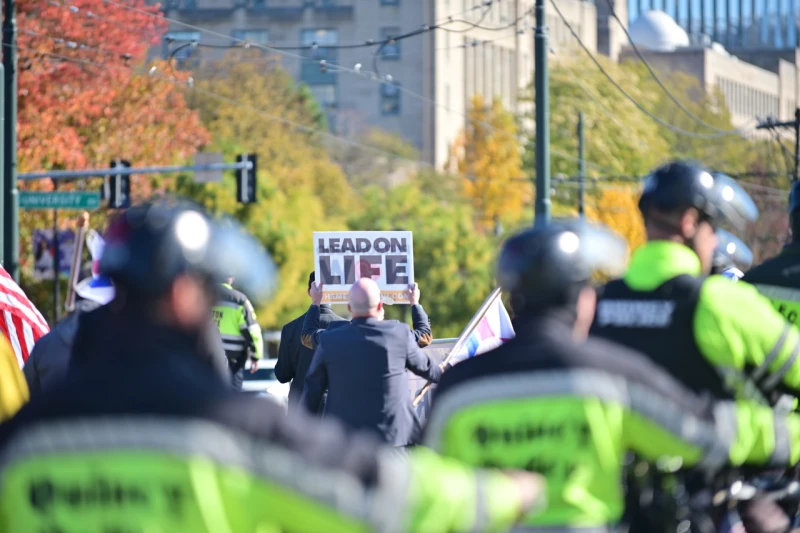
 Police protect marchers at the fourth annual National Men’s March to Abolish Abortion and Rally for Personhood in Boston on Nov. 1, 2025. / Credit: Brother Anthony Marie MICM

CNA Staff, Nov 8, 2025 / 09:00 am (CNA).
Here is a roundup of recent pro-life and abortion-related news:Amid clown protesters, Boston men’s march for life remains ‘prayerful’Hundreds gathered in Boston last Saturday for a men’s march for life, which drew a rambunctious crowd of protesters dressed as clowns and inflatable dinosaurs. The fourth annual National Men’s March to Abolish Abortion and Rally for Personhood began at Boston Planned Parenthood and concluded about three miles away at Boston Common.While counterprotesters — some dressed as clowns or wearing inflatable dinosaur costumes — played instruments and yelled on the sidelines, marchers carried on in a “prayerful and well-composed” manner, said march co-founder and president Jim Havens, who called the event “outstanding.” At the rallying point at Boston Common, an estimated 50 Antifa members also showed up. Another counterprotester wore a pony costume and carried a megaphone. Though the event sees protesters every year, Havens told CNA that the marchers have a good relationship with local law enforcement, so the event is “safe and secure.” “In our current culture of death, when we publicly stand for the least among us and for the abolition of the ongoing daily mass murder of our littlest brothers and sisters, protesters are to be expected,” Havens said. “We strive to incorporate the protesters into those for whom we pray as we march.” A marching band from the American Society for the Defense of Tradition, Family, and Property also participated to counterbalance the noise of the counterprotesters. The march invites men “to step forward to protect the women and children,” Havens explained. The idea that abortion is not a men’s issue is “nonsense,” Havens said. “As men, we have a moral responsibility to protect and defend vulnerable women and children, and it’s time we all get off the sidelines and do so,” Havens said. Speakers included Sister Deirdre Byrne, pro-life activist Will Goodman, and Bishop Joseph Strickland, among others.“As we marched, there was a sense among the men that we were simply being true to who we are as men,” Havens said.“Now active in the urgent fight for abolition, these men will not be going back to the sidelines,” he said. “Instead, they are now asking, ‘What more can I do?’”South Carolina man arrested for threatening pro-lifers with grenade A group was gathered outside a South Carolina church on a Sunday morning to protest board members’ involvement with abortion funds when a man threatened them with a grenade. Video footage shows Richard Lovelace, 79, holding up a grenade, saying: “I have a grenade for y’all, a gift for you protesters.”  After Lovelace was arrested, police found that the grenade was hollowed out.Lovelace, a member of St. Anne Episcopal Church, is a retired lawyer whose wife is on the church’s board and is a judge in South Carolina. The Survivors of the Abortion Holocaust group was protesting the board’s involvement with the Palmetto State Abortion Fund, a group that partners with Planned Parenthood to bring illegal abortion pills into the state and helps women travel out of state for abortions.Police charged Lovelace with four counts of having a hoax device and threatening to use it. On Monday, he was released from the J. Reuben Long Detention Center on a ,000 bond. Nebraska governor signs order barring abortion providers from state fundingNebraska Gov. Jim Pillen on Nov. 6  issued an executive order preventing abortion providers from receiving taxpayer funding in Nebraska. While the federal law and some state laws prevent taxpayer funding from going directly to abortion, state governments often subsidize providers for other services, therefore indirectly funding abortion. In Nebraska in 2025, more than 0,000 went to abortion providers, according to the governor’s office. President Donald Trump’s One Big Beautiful Bill Act recently prohibited federal funds from going toward abortion providers for one year. Pillen said he is “proud that we can take this bold step in halting funding to abortion providers that receive Medicaid funding.” “Nebraskans have made clear they support a culture of love and life in our state — one that provides protections for the unborn,” he said in a press release. Attorney General Mike Hilgers said the issue has “been in the background for a long time for a lot of people.”“In fact, the desire of Nebraska taxpayers to not have their funds be used for abortions has been in state statutes for some time,” Hilgers noted.Thousands gather for Michigan March for LifeThousands gathered for the March for Life in Lansing, Michigan, on Thursday, Nov. 6.March for Life president Jennie Bradley Lichter, who spoke at the event, called the march a chance to “send a vital message to our legislators who have the power to support women, children, and families.” “The women of Michigan deserve better than the tragedy of abortion, and we want them to know we are here for them, no matter what they are facing,” Lichter said in a statement shared with CNA.Bishop Earl Boyea of Lansing as well as Knights of Columbus State Deputy Barry Borsenik spoke at the event. Michigan state lawmakers including state Rep. Ann Bollin, state Sen. John Damoose, and state Rep. Jennifer Wortz also spoke at the event. President of Right to Life Michigan Amber Roseboom said the pro-life movement in Michigan stands with women facing unplanned pregnancies. “While a woman in Michigan can have an abortion at any point in her pregnancy for any reason, no woman should ever be made to feel that abortion is the best or only option,” she said in a statement shared with CNA.  “Pro-lifers from across our state have a powerful message for women facing unplanned pregnancies: You are not alone! We stand with you. We stand for you,” Roseboom said.

Amid clown protesters, Boston men’s march for life remains ‘prayerful’ #Catholic Police protect marchers at the fourth annual National Men’s March to Abolish Abortion and Rally for Personhood in Boston on Nov. 1, 2025. / Credit: Brother Anthony Marie MICM CNA Staff, Nov 8, 2025 / 09:00 am (CNA). Here is a roundup of recent pro-life and abortion-related news:Amid clown protesters, Boston men’s march for life remains ‘prayerful’Hundreds gathered in Boston last Saturday for a men’s march for life, which drew a rambunctious crowd of protesters dressed as clowns and inflatable dinosaurs. The fourth annual National Men’s March to Abolish Abortion and Rally for Personhood began at Boston Planned Parenthood and concluded about three miles away at Boston Common.While counterprotesters — some dressed as clowns or wearing inflatable dinosaur costumes — played instruments and yelled on the sidelines, marchers carried on in a “prayerful and well-composed” manner, said march co-founder and president Jim Havens, who called the event “outstanding.” At the rallying point at Boston Common, an estimated 50 Antifa members also showed up. Another counterprotester wore a pony costume and carried a megaphone. Though the event sees protesters every year, Havens told CNA that the marchers have a good relationship with local law enforcement, so the event is “safe and secure.” “In our current culture of death, when we publicly stand for the least among us and for the abolition of the ongoing daily mass murder of our littlest brothers and sisters, protesters are to be expected,” Havens said. “We strive to incorporate the protesters into those for whom we pray as we march.” A marching band from the American Society for the Defense of Tradition, Family, and Property also participated to counterbalance the noise of the counterprotesters. The march invites men “to step forward to protect the women and children,” Havens explained. The idea that abortion is not a men’s issue is “nonsense,” Havens said. “As men, we have a moral responsibility to protect and defend vulnerable women and children, and it’s time we all get off the sidelines and do so,” Havens said. Speakers included Sister Deirdre Byrne, pro-life activist Will Goodman, and Bishop Joseph Strickland, among others.“As we marched, there was a sense among the men that we were simply being true to who we are as men,” Havens said.“Now active in the urgent fight for abolition, these men will not be going back to the sidelines,” he said. “Instead, they are now asking, ‘What more can I do?’”South Carolina man arrested for threatening pro-lifers with grenade A group was gathered outside a South Carolina church on a Sunday morning to protest board members’ involvement with abortion funds when a man threatened them with a grenade. Video footage shows Richard Lovelace, 79, holding up a grenade, saying: “I have a grenade for y’all, a gift for you protesters.”  After Lovelace was arrested, police found that the grenade was hollowed out.Lovelace, a member of St. Anne Episcopal Church, is a retired lawyer whose wife is on the church’s board and is a judge in South Carolina. The Survivors of the Abortion Holocaust group was protesting the board’s involvement with the Palmetto State Abortion Fund, a group that partners with Planned Parenthood to bring illegal abortion pills into the state and helps women travel out of state for abortions.Police charged Lovelace with four counts of having a hoax device and threatening to use it. On Monday, he was released from the J. Reuben Long Detention Center on a $60,000 bond. Nebraska governor signs order barring abortion providers from state fundingNebraska Gov. Jim Pillen on Nov. 6  issued an executive order preventing abortion providers from receiving taxpayer funding in Nebraska. While the federal law and some state laws prevent taxpayer funding from going directly to abortion, state governments often subsidize providers for other services, therefore indirectly funding abortion. In Nebraska in 2025, more than $300,000 went to abortion providers, according to the governor’s office. President Donald Trump’s One Big Beautiful Bill Act recently prohibited federal funds from going toward abortion providers for one year. Pillen said he is “proud that we can take this bold step in halting funding to abortion providers that receive Medicaid funding.” “Nebraskans have made clear they support a culture of love and life in our state — one that provides protections for the unborn,” he said in a press release. Attorney General Mike Hilgers said the issue has “been in the background for a long time for a lot of people.”“In fact, the desire of Nebraska taxpayers to not have their funds be used for abortions has been in state statutes for some time,” Hilgers noted.Thousands gather for Michigan March for LifeThousands gathered for the March for Life in Lansing, Michigan, on Thursday, Nov. 6.March for Life president Jennie Bradley Lichter, who spoke at the event, called the march a chance to “send a vital message to our legislators who have the power to support women, children, and families.” “The women of Michigan deserve better than the tragedy of abortion, and we want them to know we are here for them, no matter what they are facing,” Lichter said in a statement shared with CNA.Bishop Earl Boyea of Lansing as well as Knights of Columbus State Deputy Barry Borsenik spoke at the event. Michigan state lawmakers including state Rep. Ann Bollin, state Sen. John Damoose, and state Rep. Jennifer Wortz also spoke at the event. President of Right to Life Michigan Amber Roseboom said the pro-life movement in Michigan stands with women facing unplanned pregnancies. “While a woman in Michigan can have an abortion at any point in her pregnancy for any reason, no woman should ever be made to feel that abortion is the best or only option,” she said in a statement shared with CNA.  “Pro-lifers from across our state have a powerful message for women facing unplanned pregnancies: You are not alone! We stand with you. We stand for you,” Roseboom said.


Police protect marchers at the fourth annual National Men’s March to Abolish Abortion and Rally for Personhood in Boston on Nov. 1, 2025. / Credit: Brother Anthony Marie MICM

CNA Staff, Nov 8, 2025 / 09:00 am (CNA).

Here is a roundup of recent pro-life and abortion-related news:

Amid clown protesters, Boston men’s march for life remains ‘prayerful’

Hundreds gathered in Boston last Saturday for a men’s march for life, which drew a rambunctious crowd of protesters dressed as clowns and inflatable dinosaurs. 

The fourth annual National Men’s March to Abolish Abortion and Rally for Personhood began at Boston Planned Parenthood and concluded about three miles away at Boston Common.

While counterprotesters — some dressed as clowns or wearing inflatable dinosaur costumes — played instruments and yelled on the sidelines, marchers carried on in a “prayerful and well-composed” manner, said march co-founder and president Jim Havens, who called the event “outstanding.” 

At the rallying point at Boston Common, an estimated 50 Antifa members also showed up. Another counterprotester wore a pony costume and carried a megaphone. 

Though the event sees protesters every year, Havens told CNA that the marchers have a good relationship with local law enforcement, so the event is “safe and secure.” 

“In our current culture of death, when we publicly stand for the least among us and for the abolition of the ongoing daily mass murder of our littlest brothers and sisters, protesters are to be expected,” Havens said. “We strive to incorporate the protesters into those for whom we pray as we march.” 

A marching band from the American Society for the Defense of Tradition, Family, and Property also participated to counterbalance the noise of the counterprotesters. 

The march invites men “to step forward to protect the women and children,” Havens explained. 

The idea that abortion is not a men’s issue is “nonsense,” Havens said. 

“As men, we have a moral responsibility to protect and defend vulnerable women and children, and it’s time we all get off the sidelines and do so,” Havens said. 

Speakers included Sister Deirdre Byrne, pro-life activist Will Goodman, and Bishop Joseph Strickland, among others.

“As we marched, there was a sense among the men that we were simply being true to who we are as men,” Havens said.

“Now active in the urgent fight for abolition, these men will not be going back to the sidelines,” he said. “Instead, they are now asking, ‘What more can I do?’”

South Carolina man arrested for threatening pro-lifers with grenade 

A group was gathered outside a South Carolina church on a Sunday morning to protest board members’ involvement with abortion funds when a man threatened them with a grenade. 

Video footage shows Richard Lovelace, 79, holding up a grenade, saying: “I have a grenade for y’all, a gift for you protesters.”  

After Lovelace was arrested, police found that the grenade was hollowed out.

Lovelace, a member of St. Anne Episcopal Church, is a retired lawyer whose wife is on the church’s board and is a judge in South Carolina. 

The Survivors of the Abortion Holocaust group was protesting the board’s involvement with the Palmetto State Abortion Fund, a group that partners with Planned Parenthood to bring illegal abortion pills into the state and helps women travel out of state for abortions.

Police charged Lovelace with four counts of having a hoax device and threatening to use it. On Monday, he was released from the J. Reuben Long Detention Center on a $60,000 bond. 

Nebraska governor signs order barring abortion providers from state funding

Nebraska Gov. Jim Pillen on Nov. 6  issued an executive order preventing abortion providers from receiving taxpayer funding in Nebraska. 

While the federal law and some state laws prevent taxpayer funding from going directly to abortion, state governments often subsidize providers for other services, therefore indirectly funding abortion. 

In Nebraska in 2025, more than $300,000 went to abortion providers, according to the governor’s office. President Donald Trump’s One Big Beautiful Bill Act recently prohibited federal funds from going toward abortion providers for one year. 

Pillen said he is “proud that we can take this bold step in halting funding to abortion providers that receive Medicaid funding.” 

“Nebraskans have made clear they support a culture of love and life in our state — one that provides protections for the unborn,” he said in a press release. 

Attorney General Mike Hilgers said the issue has “been in the background for a long time for a lot of people.”

“In fact, the desire of Nebraska taxpayers to not have their funds be used for abortions has been in state statutes for some time,” Hilgers noted.

Thousands gather for Michigan March for Life

Thousands gathered for the March for Life in Lansing, Michigan, on Thursday, Nov. 6.

March for Life president Jennie Bradley Lichter, who spoke at the event, called the march a chance to “send a vital message to our legislators who have the power to support women, children, and families.” 

“The women of Michigan deserve better than the tragedy of abortion, and we want them to know we are here for them, no matter what they are facing,” Lichter said in a statement shared with CNA.

Bishop Earl Boyea of Lansing as well as Knights of Columbus State Deputy Barry Borsenik spoke at the event. Michigan state lawmakers including state Rep. Ann Bollin, state Sen. John Damoose, and state Rep. Jennifer Wortz also spoke at the event. 

President of Right to Life Michigan Amber Roseboom said the pro-life movement in Michigan stands with women facing unplanned pregnancies. 

“While a woman in Michigan can have an abortion at any point in her pregnancy for any reason, no woman should ever be made to feel that abortion is the best or only option,” she said in a statement shared with CNA.  

“Pro-lifers from across our state have a powerful message for women facing unplanned pregnancies: You are not alone! We stand with you. We stand for you,” Roseboom said.

Read More