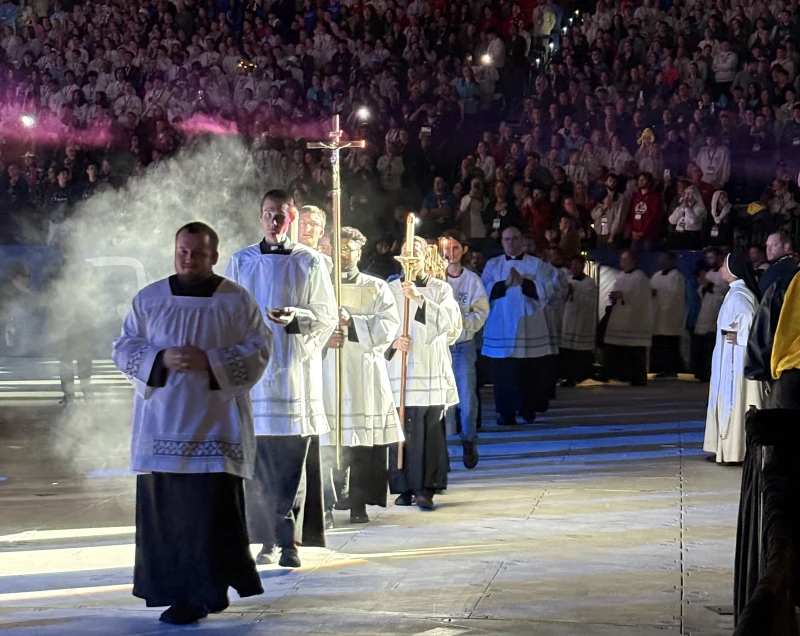
Priests process into Lucas Oil Stadium on Nov. 22, 2025, for the concluding Mass in Lucas Oil Stadium at the National Catholic Youth Conference in Indianapolis. / Credit: Tessa Gervasini/CNA
Indianapolis, Indiana, Nov 24, 2025 / 10:35 am (CNA).
The 2025 National Catholic Youth Conferences (NCYC) concluded with a nighttime Mass drawing around 16,000 teenagers.
After three days of prayer, community, sacraments, and a conversation with Pope Leo XIV, young Catholics packed into Lucas Oil Stadium in Indianapolis to end the conference with Mass on Nov. 22. Archbishop Nelson Pérez told CNA it was “beautiful” to celebrate the Mass alongside 25 of his brother bishops and more than 240 priests.
“It’s the Church in its splendor,” Pérez said. “Tonight, we experienced the Church in its splendor.”
The final Mass was celebrated on the Saturday before the solemnity of Christ the King. In his homily, Pérez said: “When I think about a king, I think about palaces and big thrones and power and authority.”
“But when Jesus talks about king it’s … different,” Pérez said. “His throne is a cross. His crown is not made of gold and gems. It’s made of thorns. He doesn’t wear fancy, beautiful, priceless rings on his hands. He has nails.”
The “very mystery of the life and the death of Christ, the King, and all of our lives is actually a dying and a rising — dying to sin, dying to the parts of our humanity that might be warped and wounded, and rising to new life to renewal of our soul.”
Then “that process goes over and over over and over and over again until we die in Christ for the last time and then rise with him,” Pérez said. “How blessed, how filled with hope we are.”
Pérez reminds teens: ‘Christ loves you just as you are’
Pérez concluded his homily by tying his message back to what Pope Leo told the teens in his digital encounter with them on Nov. 21. Pérez told the teenagers Pope Leo spoke with them because he loves them.
Pope Leo has “gathered with youth all over the place, especially this summer, [during] the Jubilee of Youth,” Pérez said. The pope’s “message is profound, powerful, and simple at the same time: ‘Christ loves you just as you are.’”
Pérez reminded the crowd to listen to what the pope said to them. “Think of your closest friends. If they were hurting, you would walk with them, listen, and stay close,” the pope said. “Our relation with Jesus is similar. He knows when life feels heavy, even when we do not feel his presence, our faith tells us he is there.”
“To entrust our struggles to Jesus, we have to spend time in prayer … We can speak honestly about what’s in our hearts,” Pérez said, quoting the pope. “That is why daily moments of silence are so important, whether through adoration, reading Scripture, or simply talking to him.”
“‘Little by little, we learn to hear his voice, both from within and through the people he sends us. As you grow closer to Jesus,’ he said to us, ‘Do not fear what he may ask of you. If he challenges you to make changes in your life, it’s always because he wants to give you greater joy and freedom. God is never outdone in generosity.’”
“The pope’s digital visit was what made this NCYC epic, really epic and different from any other,” Pérez told CNA. The success was from “the excitement of our youth to welcome the Holy Father” and Pope Leo’s “generosity and willingness” to speak with them.
Being a part of the conference and seeing so many young Catholics at Mass together made Pérez feel “hopeful,” he said. “In a world and a country that’s so divided right now and violent at times, after this, I’m just so full of hope. It’s almost like we’re going to be OK.”
“It’s incredible to see the young Church alive,” Pérez said. “It’s such a beautiful, beautiful gathering.”
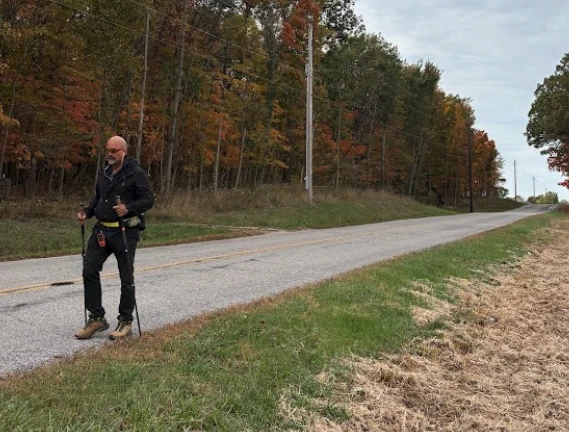
Father Gary Graf walks down a rural road during his trek across America in support of immigrants on Friday, Oct. 17, 2025. / Credit: Photo courtesy of Father Gary Graf
CNA Staff, Nov 24, 2025 / 06:00 am (CNA).
After a month and a half of walking an average of 17 miles a day, 67-year-old Father Gary Graf said he is starting to get “a little pain in one shin,” but his broken ribs are “getting much better.”
On Oct. 6, Graf, a Catholic priest from Chicago, began a journey on foot from Pope Leo XIV’s childhood home in Dolton, Illinois, to New York City to bring attention to the plight of immigrants amid the sometimes “inhumane” ways the Trump administration is treating them during its immigration enforcement actions.
He hopes to arrive at the Statue of Liberty on Ellis Island, where his own great-grandparents entered the country as immigrants, by Dec. 2.
Father Gary Graf speaks to a fellow American at Red Horse Tavern in Pleasant Gap, Pennsylvania, Tuesday, Nov. 11, 2025. Credit: Photo courtesy of Father Gary Graf
A few weeks ago, when visiting a parish in Indiana, he was invited to ride a horse. He fell off as it galloped and broke several ribs, which led him to take one day off to recover. That day, friends walked in his stead.
Graf, the pastor of the mostly Hispanic Our Lady of the Heights Catholic Church in Chicago Heights and a longtime member of Priests for Justice for Immigrants, has committed his life to helping immigrants. Ordained in 1984, he spent five years as a priest in Mexico serving a people “with whom I fell deeply in love.”
He told CNA that after initially feeling helpless watching the raids taking place against his beloved community in his hometown of Chicago, he “felt a call that was directly from above” to start walking.
Father Gary Graf poses before a sunrise near Fremont, Ohio, Tuesday, Oct. 21, 2025. Credit: Photo courtesy of Father Gary Graf
Within weeks, he was on the road. He first spoke to an old friend about his idea, who immediately connected him with Lauren Foley, the head of a public relations firm. She “immediately embraced the idea,” and between her help and that of some “young people who understand social media,” a website as well as social media accounts were set up to chronicle his journey and to share the stories of immigrant families.
Of the immigrants on whose behalf he is walking, Graf said: “I look to help people who get up every single morning to work and raise their families. If I can do this small gesture on their behalf, what a blessing it is, what a privilege.”
Asked about the most profound insight he has gained thus far, Graf said his long days walking through the wide expanse of rural America have helped him understand better the ways of people who did not grow up in a multicultural city like he did.
“We have to reverently appreciate and try to connect with those whose lives we’re passing through,” he said.
As he has spoken with people in diners along his path, Graf has developed “a greater sensitivity,” discovering that “there’s not a lot of animosity against the immigrant.”
Many of the people he has met simply do not know any, he said.
Along the way, he has also experienced unity with Christians from other denominations, as well as with those without religious faith, who all care about the humane treatment of human beings.
“I have seen so much goodness,” he said. “This has brought so many of us together: people from many different faith traditions, or none. This is an opportunity given to us.”
During his quiet walks through rural farmland, he has marveled at the amount of labor it took to build the many roads, bridges, and overpasses he has seen.
“I’m sure the hands of many immigrants helped build these things,” he reflected.
Graf said he is delighted that both the U.S. Conference of Catholic Bishops and Pope Leo XIV addressed the immigration enforcement situation in the past week.
The U.S. bishops issued a special message during its Fall Plenary Assembly two weeks ago, calling for “a meaningful reform of our nation’s immigration laws and procedures.” The bishops argued that “human dignity and national security are not in conflict. Both are possible if people of goodwill work together.”
The pope echoed the bishops’ message. On Nov. 18, he acknowledged to reporters that “every country has a right to determine who and how and when people enter.”
“But when people are living good lives, and many of them for 10, 15, 20 years, to treat them in a way that is extremely disrespectful, to say the least — and there’s been some violence, unfortunately — I think that the bishops have been very clear in what they said.”
“I think that I would just invite all people in the United States to listen to them,” the pope said.
“Both the pope and the bishops used the word ‘indiscriminate’ to talk about the way people are being singled out and aggressively having their wrists zip-tied behind their backs as their faces are pushed to the ground in front of their children,” Graf said.
“It is indeed indiscriminate. This reflects dishonesty on the administration’s part,” he said. “They said they were going after the ‘worst of the worst,’ criminals, but this isn’t the case, at least in Chicago. They’re grabbing people first and asking questions later.”
“The violent way many of these people are being treated is amoral and un-American,” he said.
Like the pope and the American bishops, Graf said he hopes the federal government will establish a more humane immigration system that respects the dignity of immigrants as well as the rule of law and the country’s right to regulate its borders.
“I am not a politician,” he said. “My job is to mediate, to speak up, in God’s name, in the united name of the Church. But can we look for a way for those who are fulfilling their responsibilities; for them to one day receive the rights of citizens?”
The priest, who appeared on “EWTN News Nightly” in October, said he has been “impressed by the media” and is grateful his message is being spread.
“If we don’t hear the whole truth, the incredible ignorance and darkness we live in can paralyze us, and keep us from doing what we ought to do,” he said.
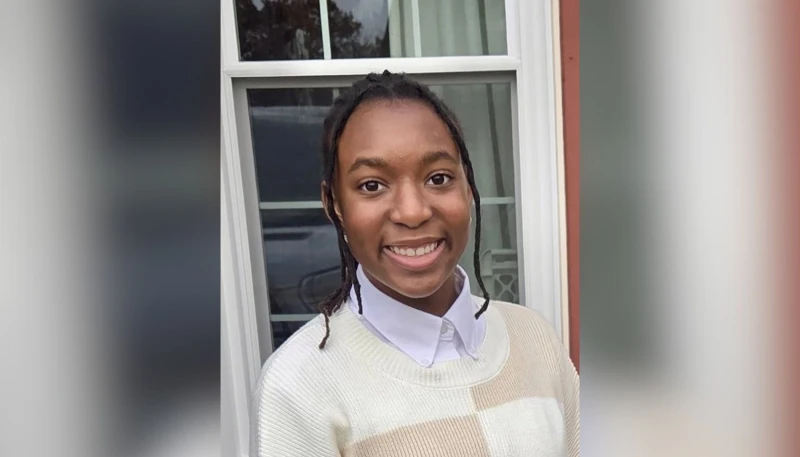
Mia Smothers is among the teens chosen to ask Pope Leo XIV questions at the National Catholic Youth Conference Nov. 21, 2025. / Credit: Photo courtesy of National Federation for Catholic Youth Ministry
Washington, D.C. Newsroom, Nov 19, 2025 / 07:00 am (CNA).
Mia Smothers said she is looking forward to the “opportunity of a lifetime” as she prepares to speak with Pope Leo XIV during a digital encounter at the upcoming National Catholic Youth Conference (NCYC).
The Holy Father will hold a 45-minute digital encounter with young people from across the United States during the Nov. 20–22 conference hosted by the National Federation for Catholic Youth Ministry (NFCYM) in Indianapolis.
More than 40 teens have participated in the dialogue planning process, and five of them will get the chance to speak directly with the Holy Father. Smothers, a high school freshman from Joppa, Maryland, is the youngest teen selected to speak with the pontiff.
“I’m feeling excited,” Smothers said in a Nov. 18 interview with “EWTN News Nightly.” She added: “This is a very good opportunity for me to learn more about my faith and others around me.”
This year marks the first time Smothers will attend NCYC. She said she is looking forward to the opportunity for adoration at the conference, because she heard it “is a very powerful experience.”
Smothers said she thinks the young attendees of NCYC want to get a better understanding of how the Church wants them to act in the faith, how they can be more helpful, and how they can be more hands-on in the Church.
The NCYC team and the students who will speak with the Holy Father have been preparing and practicing in anticipation for the encounter to get a better idea of how they can establish themselves in the Church.
“We have been meeting up on Zoom and doing follow-up questions — practicing what the pope might tell us and to figure out how we could answer and how we could switch the conversation to something that we want to ask,” Smothers said.
As a teenager in the Church, Smothers is concerned about how people are supposed to find their vocations in life. She said: “I really want to ask him how he found out he wanted to become a priest and then how he felt about becoming pope.”
“This is an opportunity of a lifetime and something that you’ve never heard of and never … seen before,” Smothers said. “I plan to tell all of my siblings, all of my friends, and everyone at my school … to be involved and see what the pope wants for us.”
The Vatican choosing to set up this dialogue with the youth at the conference is “making a difference,” Smothers said. She said the Vatican and the pope are starting something that will be passed on to the following generations.
It is impactful that the pope himself is going to be “talking with young kids and trying to make a difference in their lives,” Smothers said.
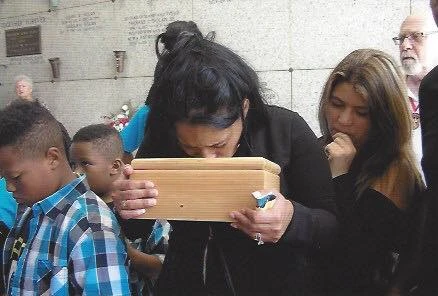
A family grieves their lost baby at a funeral at the crypt at St. Patrick’s Cemetery in New Orleans. Many friends, relatives, and families attended the funeral that day. / Credit: Photo courtesy of Compassionate Burials for Indigent Babies
CNA Staff, Nov 19, 2025 / 06:00 am (CNA).
Sandy Schaetz still mourns the baby she never met.
“It was terrifying and traumatic,” she said of her miscarriage. “I was consoled after by the prayers of a deacon, but never named the baby or knew if it was a boy or girl.”
“It was not something I understood at the time and I only wish I had known more of what was happening,” she told CNA.
Now, Schaetz volunteers with Compassionate Burials for Indigent Babies (CBIB), an organization that buries babies who died, whether stillborn, miscarried, or aborted.
The group organizes everything for the funerals, which are held at a crypt at St. Patrick’s Cemetery in New Orleans.
A shoebox-sized casket lined with donated white fabric, usually from wedding dresses, is processed through the cemetery, with Knights of Columbus present as the honor guard. A volunteer musician plays at every funeral; a Catholic deacon presides at almost every burial.
Two Knights of Columbus carry the casket of a baby who was murdered. Credit: Photo courtesy of Compassionate Burials for Indigent Babies
When Schaetz attended her first burial service as a volunteer, it hit her to the core.
“I find it difficult to put into words how it affected me,” Schaetz said. “All God needed me to do that day was to be present, to pray, to honor the life he had created.”
“It opened my eyes to how each life is such a gift, and when that life ends how important it is to show respect and pray for the soul and bury the dead with love,” Schaetz said.
Death and resurrection
Women who lose children through miscarriage often suffer silently, according to Lise Naccari, the founder of CBIB.
“Losing a child is hard. Often women suffer in silence the pain of infant loss and ride that sad emotional roller coaster ride alone,” Naccari told CNA.
One in four pregnancies ends in miscarriage — a devastating statistic for many couples.
Naccari herself experienced a miscarriage as well as several challenging pregnancies.
“I feel a special connection with poor mothers who have lost a child. My heart goes out to them,” Naccari said.
Lise Naccari (right) embraces a grieving mother at a burial at the crypt at St. Patrick’s Cemetery in New Orleans. Credit: Photo courtesy of Compassionate Burials for Indigent Babies
Naccari buries the babies who were wanted and loved, but also the babies who were thrown out or mistreated.
“CBIB has buried babies as big as a blueberry and up to 2 years old,” Naccari said. “We buried babies stillborn, miscarried, abandoned, unclaimed, aborted, murdered, and thrown away in the trash — and every situation possible.”
“Many babies were mistreated, abused, and tossed out … these are heartbreaking funerals to go to,” Naccari said.
CBIB dressed and buried seven babies who were left at hospitals labeled “unclaimed and abandoned,” Naccari said. CBIB buried the babies at the crypt at St. Patrick’s Cemetery in New Orleans. Credit: Photo courtesy of Compassionate Burials for Indigent Babies
“Babies are left sometimes because some families can not afford funerals for them but would like one,” Naccari said. “Also, many parents are young, and the grief can be overwhelming and they cannot navigate through funeral arrangements.”
Her life’s work is to bury the dead — and she looks to the Resurrection.
“I consider what I do holy,” Naccari said. “I feel like this is my vocation and I know God orchestrated all of this. I give all honor and glory to him, our loving Father.”
“What I do is not about sorrow and death,” Naccari continued. “What I do is really about joy and life — eternal life.”
A father (right) whose child was murdered carries the casket with the help of others. Credit: Photo courtesy of Compassionate Burials for Indigent Babies
It’s not an easy job, and Naccari looks to God for strength.
“Lord, I don’t want to do this anymore. It hurts my heart too much,” Naccari remembered praying as she prepared one baby for burial — a baby girl who had been abandoned and tossed out after she was born.
“I felt a still small voice within me say, ‘Lise, don’t think about their bodies, focus on the Resurrection,’” Naccari recalled.
“The sunlight from the stained-glass windows was shining down a warm yellow color on my face, as I looked up in it and I thought, yes, this is what I needed to hear to keep going — focus on the Resurrection,” she continued.
A resource for women in need
Sheena Lewis was in jail when her son, still a baby, passed away. She couldn’t attend the funeral, but Naccari organized the burial for her.
Lewis, now sober and out of jail, visits her son’s crypt often.
“I have solace in the fact he was laid to rest in a beautiful manner when I couldn’t be there for him or myself at the time,” Lewis told CNA.
Many young mothers CBIB helps are often “steeped in poverty” and have no support system. They are often “low income, uneducated, coming from sometimes addiction or problem homes,” Naccari said.
“Often I find at these funerals that the young mothers are alone or they may come with children or other women — but there are no men to help support them,” Naccari said.
“My heart is broken for them, for they are not only battling their poverty, they also have to deal with losing a child,” she said.
A moment to mourn
Funerals help families process their grief — a grief that’s often hidden away due to the nature of miscarriages.
Deacon Ricky Suprean preaches at almost every graveside burial — but after a couple years of volunteering, he realized God had called him to this so he could find healing.
Suprean and his wife, Lynn, experienced two miscarriages.
Suprean struggled to process it at the time, but through his volunteering, he’s found some healing. He still remembers the first CBIB funeral he presided at.
“I felt the power of life that day,” he told CNA. “It was cold. I had no idea I would kneel in front of each little coffin and pray for each child and each family with my hand touching each coffin.”
Volunteers hugged each family member, he recalled.
Deacon Ricky Suprean at the burial of two babies at the crypt at St. Patrick’s Cemetery in New Orleans. Credit: Photo courtesy of Compassionate Burials for Indigent Babies
“God has allowed me to give a proper burial to my own two lost children through CBIB time and time again,” Suprean said.
“God created these children in my wife’s womb, and they will be waiting for us in heaven,” Suprean continued.
Struggling to process grief is common with loss of children, according to Naccari.
“Too often people are hurting so much and don’t want to face a funeral,” Naccari said. “They feel vulnerable and so it is easier to turn away and do nothing.”
“But on the contrary, I have observed that these funerals provide consolation, comfort, solace, and even a healthy way of healing after the loss of a baby,” Naccari said.
“It’s a good grief,” Naccari continued. “Funerals are about love and holding onto friends and family at a time of need. It can be life-changing.”
Some funerals have had as many as 100 people in attendance.
Many volunteers are “faithfully committed” to being present at every funeral.
“It could be freezing cold or blistering hot in the summer, but they just show up and either help set up, greet the parents, or stand tall next to a casket to show the love of Jesus to our families,” Naccari said.
The altar at a burial at the crypt at St. Patrick’s Cemetery in New Orleans. CBIB has buried hundreds of babies at the crypt. Credit: Photo courtesy of Compassionate Burials for Indigent Babies
These funerals “allow parents that special moment to mourn their loss and to remember their little one and ponder the person that little one could have been,” Naccari said.
“CBIB celebrates each life, and we believe that God somehow rights all the wrongs and makes all things new,” Naccari said. “And then we move to the next funeral.”
Supreme Knight Patrick Kelly (right) speaks at the Symposium on Young American Men, a national conversation on restoring purpose, flourishing, and belonging, at the National Press Club in Washington, D.C., on Nov. 3, 2025. Looking on is Sen. James Lankford of Oklahoma. / Credit: Matthew H. Barrick
CNA Staff, Nov 5, 2025 / 08:00 am (CNA).
At the Symposium on Young American Men in Washington, D.C., on Nov. 3, Supreme Knight Patrick Kelly of the Knights of Columbus said that young men are “lost” and need “purpose and mission.”
The symposium highlighted the mental health crisis, social isolation, digital addiction, and other struggles young men face today.
Panelists — including Sen. James Lankford, R-Oklahoma; Sen. Ruben Gallego, D-Arizona; Sen. John Cornyn, R-Texas; and other experts — discussed ways to address these challenges by helping young men build community.
“Many young men are lost and disconnected,” Kelly said in an opening statement at the beginning of the symposium. “Many come from broken families with fathers who are not a real part of their life. Many are drowning in the depths of the internet and social media.”
Kelly, who heads the Catholic fraternal organization Knights of Columbus, pointed to loneliness and isolation as a challenge for young men.
“It’s increasingly clear that millions of men no longer have friends who they can count on and who can spur them on to excellence,” Kelly continued. “More than a quarter of millennials say they have no close friends, and the rise of artificial intelligence has millions of young men looking for friendship in chatbots.”
Ellen Carmichael, founder of The Lafayette Company, the communications group hosting the symposium, said there is an “urgent need” for action.
“Recent incidents of political violence and growing national concern about young men’s social isolation have underscored what we already knew: This conversation cannot wait,” Carmichael stated.
“We are hardwired as men for purpose and mission,” Kelly said, noting that the Knights of Columbus is centered on Christ and service to local communities.
“We are trying to tackle what the surgeon general recently called the epidemic of loneliness and isolation,” Kelly noted. “We’re giving men the kind of community they truly need, and we will continue to help America’s young men find meaning and mission in life.”
“We’ve always known that men need meaning in life and that a man’s ultimate meaning comes from his personal relationship with others and with God,” Kelly said.
“Friendship is the key,” he said. “Christ did his ministry through friendships … he assembled 12 friends, imperfect people.”
In a panel on the role of faith in rebuilding community for men, Kelly said young men “have had enough” of what the culture offers them and “are really yearning for more of an institution and yearning for moorings.”
He noted that the Knights of Columbus have been bringing in a growing number of men over the past few years and that after an era of relativism, there has been a “swing back” among young men toward tradition.
In a change from previous generations, he said, young men are drawn to ritual.
“The areas they’re searching leave them empty,” Kelly said, so “they turn to God.”
Authorities say the killer of 9-year-old Carol Ann Dougherty, raped and murdered in a Pennsylvania Catholic church 63 years ago, was identified in October 2025 as William Schrader, who died in 2002. / Credit: Courtesy of Buck's County District Attorney's Office
CNA Staff, Oct 31, 2025 / 15:48 pm (CNA).
Authorities announced this week that the killer of 9-year-old Carol Ann Dougherty, raped and murdered in a Pennsylvania Catholic church 63 years ago, has finally been identified as William Schrader, who died in 2002.
The Bucks County Investigation Grand Jury found that Schrader is “definitively linked” to the murder “through the combination of decades-old evidence” and a recent breakthrough in the case, the district attorney’s office said in a statement.
The breakthrough came last year when Pennsylvania State Police interviewed Schrader’s stepson, Robert Leblanc, in November 2024, who said Schrader “confessed to him on two separate occasions that he murdered a little girl in a Pennsylvania church.”
Schrader allegedly told his stepson he lured Carol Ann inside the church, raped her and “had to kill the girl in Bristol to keep her from talking.”
“We believe it may be the only rape and murder of a little girl in a church in the United States,” Bucks County D.A. Jennifer Schorn said at a news conference on Oct 29.
In 1962, a witness reported seeing Schrader — who lived a block and a half from the church — outside the church around the time of the murder, and police initially questioned him, the D.A.’s office said.
Schrader failed a polygraph test and lied to investigators about his alibi, saying he had been at work at the time of the murder. He also provided a pubic hair sample, authorities said.
Knowing he was under investigation, Schrader fled Pennsylvania and moved to Florida and then Texas, eventually settling in Louisiana.
The pubic hair was tested in 1993, and it showed “significant similarities” to hair found in Carol Ann’s hand, according to the DA. Of samples collected from 176 men over the years, 141 pubic hair samples were tested during the decadeslong investigation, and “all other individuals were eliminated,” officials said.
The grand jury’s findings, detailed in a 53-page report approved this week by Judge Raymond McHugh, identified Schrader as an “absolute predator” whose criminal history included assaults with deadly weapons in multiple states.
According to the prosecutor, “Schrader’s life was marked by a pattern of violence and sexual violence, particularly against young, pre-pubescent, and adolescent females.”
The grand jury found that Schrader also “sexually abused nearly every female child he lived with or had access to, including his own biological daughter and granddaughters.”
He was convicted in 1985 in Louisiana for the death of 12-year-old Catherine Smith after he intentionally set fire to his own house, knowing she and her family were still inside.
On Oct. 22, 1962, Carol Ann, an avid reader excited to check out the next book in a mystery series she was reading, was riding her bike to the Bristol Borough Free Library to meet her friends, according to the Bucks County District Attorney’s office.
On her way, she had stopped to buy a soda and candy and was last seen alive outside of the doors to St. Mark’s Roman Catholic Church in Bristol, where she was raped and strangled to death.
Authorities examine a bicycle after the murder of Carol Ann Dougherty in 1962. Credit: Courtesy of Buck’s County District Attorney’s Office.
Her parents began to look for her when she did not return home for dinner. Her father found her body inside the church.
Carol Ann’s sister, Kay Dougherty, speaking at Wednesday’s news conference, expressed her gratitude to Vincent Faragali, the Bristol police chief at the time of her sister’s murder, who kept a framed photograph of Carol Ann on his desk throughout his career to remind him of “a promise he made to seek justice for her.”
She also thanked Faragali’s nephew, Mike Misanelli, a journalist who in 2024 produced a podcast that brought attention to the case.
Doughterty said :“My parents both passed away without knowing on this earth who murdered their daughter. … After so many decades of unknowing, this finding finally brings closure and a truth to a wound that never healed.”
“Our family lived without answers,” Dougherty said, crying, “and the uncertainty surrounding Carol’s death became a part of who we were, a shadow that touched every day of our lives.”
“Though I know nothing can bring Carol back,” Dougherty said, “we can finally let her rest in peace knowing that her story has been told, her truth revealed, and her memory honored.”
![16,000 teens attend Mass together to conclude NCYC #Catholic
Priests process into Lucas Oil Stadium on Nov. 22, 2025, for the concluding Mass in Lucas Oil Stadium at the National Catholic Youth Conference in Indianapolis. / Credit: Tessa Gervasini/CNA
Indianapolis, Indiana, Nov 24, 2025 / 10:35 am (CNA).
The 2025 National Catholic Youth Conferences (NCYC) concluded with a nighttime Mass drawing around 16,000 teenagers.After three days of prayer, community, sacraments, and a conversation with Pope Leo XIV, young Catholics packed into Lucas Oil Stadium in Indianapolis to end the conference with Mass on Nov. 22. Archbishop Nelson Pérez told CNA it was “beautiful” to celebrate the Mass alongside 25 of his brother bishops and more than 240 priests. “It’s the Church in its splendor,” Pérez said. “Tonight, we experienced the Church in its splendor.” The final Mass was celebrated on the Saturday before the solemnity of Christ the King. In his homily, Pérez said: “When I think about a king, I think about palaces and big thrones and power and authority.”“But when Jesus talks about king it’s … different,” Pérez said. “His throne is a cross. His crown is not made of gold and gems. It’s made of thorns. He doesn’t wear fancy, beautiful, priceless rings on his hands. He has nails.”The “very mystery of the life and the death of Christ, the King, and all of our lives is actually a dying and a rising — dying to sin, dying to the parts of our humanity that might be warped and wounded, and rising to new life to renewal of our soul.”Then “that process goes over and over over and over and over again until we die in Christ for the last time and then rise with him,” Pérez said. “How blessed, how filled with hope we are.”Pérez reminds teens: ‘Christ loves you just as you are’Pérez concluded his homily by tying his message back to what Pope Leo told the teens in his digital encounter with them on Nov. 21. Pérez told the teenagers Pope Leo spoke with them because he loves them.Pope Leo has “gathered with youth all over the place, especially this summer, [during] the Jubilee of Youth,” Pérez said. The pope’s “message is profound, powerful, and simple at the same time: ‘Christ loves you just as you are.’”Pérez reminded the crowd to listen to what the pope said to them. “Think of your closest friends. If they were hurting, you would walk with them, listen, and stay close,” the pope said. “Our relation with Jesus is similar. He knows when life feels heavy, even when we do not feel his presence, our faith tells us he is there.”“To entrust our struggles to Jesus, we have to spend time in prayer … We can speak honestly about what’s in our hearts,” Pérez said, quoting the pope. “That is why daily moments of silence are so important, whether through adoration, reading Scripture, or simply talking to him.”“‘Little by little, we learn to hear his voice, both from within and through the people he sends us. As you grow closer to Jesus,’ he said to us, ‘Do not fear what he may ask of you. If he challenges you to make changes in your life, it’s always because he wants to give you greater joy and freedom. God is never outdone in generosity.’”“The pope’s digital visit was what made this NCYC epic, really epic and different from any other,” Pérez told CNA. The success was from “the excitement of our youth to welcome the Holy Father” and Pope Leo’s “generosity and willingness” to speak with them. Being a part of the conference and seeing so many young Catholics at Mass together made Pérez feel “hopeful,” he said. “In a world and a country that’s so divided right now and violent at times, after this, I’m just so full of hope. It’s almost like we’re going to be OK.”“It’s incredible to see the young Church alive,” Pérez said. “It’s such a beautiful, beautiful gathering.”](http://unitedyam.com/wp-content/uploads/2025/11/16000-teens-attend-mass-together-to-conclude-ncyc-catholic-priests-process-into-lucas-oil-stadium-on-nov-22-2025-for-the-concluding-mass-in-lucas-oil-stadium-at-the-national-catholic-youth-co.webp)