
Promo photo for the The Better Part Journal of shadows of Madonna lilies for the Blessed Virgin Mary. / Credit: Photo courtesy of Heidi Bollich-Erne
Washington, D.C. Newsroom, Dec 7, 2025 / 09:00 am (CNA).
While teaching an ethics and culture course, Heidi Bollich-Erne was looking for a journal featuring the work of Catholic women for her students to read. After being told that it simply didn’t exist, she decided to create one herself.
With the help of a team of women, Bollich-Erne has founded what she calls the “first intellectual Catholic women’s journal.” Its purpose is to not only define the feminine genius but also to show how faithful women can embody its beauty in their daily lives.
“I want women to find a home, a place that values their work. The journal itself is edited, written, and published solely by Catholic women,” Bollich-Erne told CNA. “The way that women write, the way that we express ourselves is very different. That’s just who we are. That’s part of the genius of women.”
The Better Part Journal is intended to give women of the Church “hope” by discussing issues that are relevant to them. The first edition of the journal will be released in April 2026.
Before starting the journal, Bollich-Erne studied theology at the University of St. Thomas, where she “fell in love with philosophy.” She went to the Center for Thomistic Studies for her master’s degree in Thomistic philosophy but took a break from her doctorate and started teaching.
She is now based in Texas where she has taught high school, college preparation, college, and adults. While teaching, she tried to find content to help guide discussion on gender complementarity but couldn’t find much written by Catholic women.
“I thought, ‘I want to read more intellectual women,’ but it was a struggle… So I found a friend who works at a university and I said: ‘Can you recommend … an intellectual Catholic women’s magazine? She got back to me a few days later and said, ‘It doesn’t exist.’”
Bollich-Erne started The Better Part Journal by first launching a company called JBG Publishings as “a home” for the journal. She wanted to ensure the publication would not be independently published but be part of a company that would help it to grow.
Bollich-Erne named the company with the initials of her father, who passed away a few years prior. His passing “was a realization that ‘life is too short,’” Bollich-Erne said. “I need to love what I do; I need to really work to find meaning.’”

The Better Part Journal’s mission
“The purpose of the journal is to bring together the voices of intellectual Catholic women who are faithful to the magisterium,” Bollich-Erne said. “I want voices of all backgrounds. I want women of all areas of discipline. I want academics. I want nonacademics. I want all women contributing to this conversation.”
“We all throw around the ‘feminine genius,’ but when you ask someone to stop and give an actual definition, most people can’t,” Bollich-Erne said. Most people define it with a quote by St. John Paul II who coined the term in his apostolic letter Mulieris Dignitatem to describe the unique gifts and qualities women possess, but, she said, “that’s a quote, not a definition.”
“There’s a lot of work that needs to be done in this area, and I know there’s room for it to be done on a theological, philosophical level. So the idea was that we would … define the feminine genius and then show it. Live it. It’s not a theology journal and it’s not a philosophy journal. It’s truly interdisciplinary.”
The first issue of the journal is called “Uncharted” and will tackle a number of topics.
“As soon as women realized that I was serious about truly hearing their voices and not editing them out or telling them what they can and can’t write about, they gave us some really amazing work. I’ve just been blown away. I’m only so creative, but I have a great team.”
The journal will feature articles covering neuroscience and theology and apply it to Mary and the Incarnation. It will have columns by doctors and scientists to look at “faith in the formula” and “applying science to religion.”
There will be discussion of issues women face including body image, infertility, and violence. Articles will explore “the psychology of fairy tales and what that does to young girls growing up, whether that be positive or negative,” Bollich-Erne said. It will look into “what we are exposed to …from the media and what it does to us.”
“The beauty behind the journal has been the women that have come forth to lend their voices,” Bollich-Erne said. “It’s been really amazing to see how excited they are about freedom of voice. It’s been something I wasn’t expecting.”
A print journal in a digital era
Despite a shift in media from print to online formats, The Better Part Journal will only be released in print copies because, Bollich-Erne said, “I want it to be lasting.”
“I am a tactile person. I like to hold a book. I wanted it to be something that is kept. So obviously that’s print,” Bollich-Erne said. “But then if you want to keep it has to be high quality.”
The journal will use original photographs and crafted artwork to accompany the written works.
“It is stunning. It looks like a book,” Bollich-Erne said. “The idea is that you read it, you keep it, and you put it on your bookshelf and you never get rid of it because the topics are lasting.”
For an article to be included, it has to be “something that I think women will find valuable, whether you’re an academic or a high school student,” Bollich-Erne said. “It has to be something that all women find valuable, or we cannot print it.”
“Many women have said they’re excited to hold their work and see it in print as opposed to scrolling past the work. There’s nothing wrong with online formats; it gives voices to a lot of people, but this is just different.”
“I had an author tell me, ‘I don’t write anymore for anyone,’ because, she said, ‘I am so tired of my work just disappearing. It’s online for a week. I spent all this work, all this time, and it was something substantial that I really cared about, and it’s just gone.’”
“She signed up with us for a column specifically because we are in print. The idea is that this work is kept forever.”
The print journals will be published twice a year only, because “I want it to be something that takes a while to digest,” Bollich-Erne said. “Beautiful things take time.”
Looking to the future
JGB Publishings has “goals to expand substantially over the next five to 10 years,” Bollich-Erne said. The company will “take care of” the journal to ensure its message can “grow and expand.”
“To be able, as women in the Church, to truly have a serious conversation about all of these things … we are going to forge our future,” Bollich-Erne said. “We’re going to step forward in hope and show the world this is what an intelligent Catholic woman looks like.”
“We’re not stifled. We’re not sad. We’re not miserable people. We are happy. We are excited about life, and we are treated with respect. We are loved and we love who we are,” Bollich-Erne said. “I want people, especially women, of all ages to see that and to understand that.”
Read More









![A beloved Iowa priest and immigrant advocate dies at 39 #Catholic
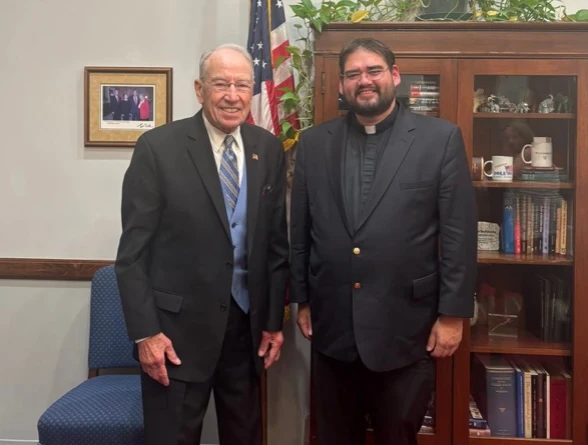
Father Guillermo Treviño Jr.’s national profile stemmed from his immigrant rights work with Escucha Mi Voz Iowa (“Hear My Voice Iowa”), a group aiding Latino workers, including immigrants. He is shown here during a meeting earlier this year with U.S. Sen.Chuck Grassley, R-Iowa. / Credit: Photo courtesy of Escucha Mi Voz Iowa
CNA Staff, Nov 5, 2025 / 17:33 pm (CNA).
Father Guillermo Treviño Jr., a 39-year-old priest who advocated for the rights of immigrants in the Diocese of Davenport, Iowa, passed away suddenly on Oct. 31, just hours after returning from a trip to the Vatican. His death from sepsis after a fatal stomach perforation was a complication of undiagnosed diabetes, according to his sister, Mariela Treviño-Luna, who had traveled with him to Italy.Due to a shortage of priests in Iowa, Treviño served as a pastor of St. Joseph Church in Columbus Junction as well as St. Joseph Church in West Liberty, southeast of Iowa City.Treviño’s national profile stemmed from his immigrant rights work as a founder, board president, and chaplain of Escucha Mi Voz Iowa, a group aiding Latino workers, including immigrants. Treviño had just returned from Rome, where he represented the group at Pope Leo XIV’s World Meeting of Popular Movements.He fought deportations, notably for his godson, 18-year-old Pascual Pedro, a West Liberty High School soccer star U.S. Immigration and Customs Enforcement (ICE) deported this summer despite his Deferred Action for Childhood Arrivals (DACA) status. In a statement issued on the day of his death by the Diocese of Davenport, Bishop Dennis Walsh said: “Father Guillermo’s heart was consistently with those in need. Throughout the current migrant crises, he showed great compassion for the many migrants who find themselves on edge due to aggressive immigration enforcement action.” As pastor of both St. Joseph churches, Treviño nurtured the meatpacking and farming communities there with “remarkable authenticity,” Walsh said. “His voice was becoming a beacon of hope and advocacy on this vital issue, gaining national prominence,” Walsh continued in the statement. “He was recently invited to be part of a panel discussion at Georgetown University and had the distinct honor of traveling to the Vatican as part of the World Gathering of Popular Movements. His leadership and commitment to justice will be deeply missed by the Church and the wider community he so faithfully served.” Archbishop Thomas Zinkula of Dubuque recalled Treviño’s “playful and serious sides,” telling the Des Moines Register this week that “Father Guillermo loved movies, Star Wars, and professional wrestling. But he also was passionate about serving and advocating for immigrants. I was inspired by his total commitment to seeking justice and mercy for people on that particular margin of society.”Born on March 7, 1986, in San Antonio, Texas, to Maria Luna and Guillermo Treviño Sr., Treviño and his family moved to Moline, Illinois, when he was 3. He earned an associate’s degree from Black Hawk College before entering seminary at Conception Seminary College and Mundelein Seminary. Despite an initial rejection, he said at the time that his faith — rekindled after his father’s early death — drove him forward. Ordained on June 6, 2015, he quickly became a force in rural Hispanic parishes.According to the diocese’s statement, Treviño “received the National 2022 Cardinal Bernardin New Leadership Award. The award recognizes a ‘young faith-filled Catholic who has demonstrated leadership against poverty and injustice in the United States,’ according to the USCCB [U.S. Conference of Catholic Bishops].”“It recognizes the leadership, energy, and diverse skills that young people bring to the anti-poverty work of low-income projects and Catholic parishes. It highlights the gifts of young leaders and their Gospel commitment to the poor,” the statement said.Treviño’s funeral Mass is set for Nov. 7 at Sacred Heart Cathedral in Davenport and will be livestreamed on YouTube. He is survived by his mother, sisters, and extended family.](http://unitedyam.com/wp-content/uploads/2025/11/a-beloved-iowa-priest-and-immigrant-advocate-dies-at-39-catholic-father-guillermo-trevino-jr-s-national-profile-stemmed-from-his-immigrant-rights-work-with-escucha-mi-voz-iowa.webp)
![10,000 pro-lifers join LIFE Runners annual relay across the U.S. #Catholic
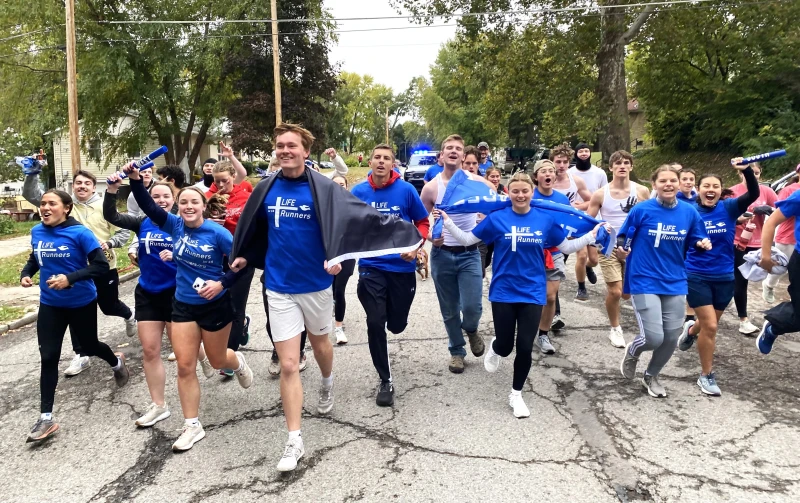
Finish line of the A-Cross America Relay, hosted by Benedictine College in Atchison, Kansas. / Credit: Photo courtesy of LIFE Runners.
CNA Staff, Nov 1, 2025 / 05:55 am (CNA).
A pro-life relay with more than 10,000 participants came to a joyful conclusion in Kansas last Saturday after runners made the shape of a cross as they ran across the U.S.The 5,124 mile “A-Cross America Relay,” organized by pro-life group LIFE Runners, kicked off in September in four cities around the country and ended at Benedictine College in Atchison, Kansas on Oct. 25.The starting points were San Francisco, California; New York City, New York; Austin, Texas; and Fargo, North Dakota, but participants around the world also joined to witness to life in their own nations. The San Francisco kickoff of the A-Cross America Relay began at Star of the Sea Church with students from Stella Maris Academy. Credit: Photo courtesy of LIFE Runners.With more than 25,000 “teammates” in nearly 4,000 cities across 50 countries, LIFE Runners aim to raise awareness for unborn children during their annual relay. Patrick Castle, president and founder of LIFE Runners, spoke with CNA about what inspires participants to run for the unborn. CNA: What inspires the mission of LIFE Runners? Castle: LIFE Runners is inspired by the obvious responsibility of Christians to reach the youth, pregnant mothers, fathers, and influencers with God's love and the truth that abortion isn't a solution to anything, it is the greatest problem, the greatest evil by definition, by the numbers. Abortion claims more American lives in one year than all combat casualties in the history of America. With the 250th anniversary of our country next year, may we reflect on who we are as Americans and as Christians. We are people who stand for God and His gifts of life and liberty. Amen!How does the relay help raise awareness for the unborn?Castle: The LIFE Runners A-Cross America Relay helps raise awareness for the unborn through our public witness [of] wearing “REMEMBER The Unborn” shirts. Eighty-two percent of post-abortion mothers said if they had encountered one supportive person or encouraging message, they would have chosen life. For example, two mothers saw our “REMEMBER The Unborn” witness outside of the Omaha Planned Parenthood, asked for help, and chose life. New York City kickoff for the A-Cross America Relay. Participants prayed and then walked with the big “REMEMBER The Unborn” banner to the Father Francis Duffy statue in Times Square. Credit: Photo courtesy of LIFE Runners.Thousands of people witnessed thousands of LIFE Runners wearing "REMEMBER The Unborn" shirts across America and around the world during the 5,124 mile relay that made a cross over America. With access to abortion in the mail and across state lines, LIFE Runners wear life-saving messages everywhere to inspire a culture of life at work, school, walking, running, grocery store; everywhere! What stood out to you from the finish line relay at Benedictine College in Atchison, Kansas? Castle: I am so encouraged by the authentic, Catholic, pro-life identity of Benedictine College … While running up the hill, students invited other students to join us, like a scene out of the "Rocky" movie when the local community joined him on a training run. The last mile ended on the main campus drive with President [Stephen] Minnis leading a large crowd with cheering. The finish was immediately followed by a beautiful prayer from Archbishop [Joseph]Naumann.What is the significance of having a national relay across the United States? Castle: The significance of having a relay that makes a cross over America is unity. [The relay] connects everyone in a pro-God way, allowing faith and light to overcome the darkness to end abortion — all in Christ for pro-life! Teammates in other countries adopt segments, knowing that America can and should lead the way in ending abortion around the world. The relay is an inspiring light for the world. The cross is the greatest symbol of love, bringing hope that life will prevail!The North arm kickoff of the A-Cross America Relay in Fargo, North Dakota. NDSU Newman Center students helped launch the north arm with a 2.7 mile prayerful witness walk. Credit: Photo courtesy of LIFE Runners.](http://unitedyam.com/wp-content/uploads/2025/11/10000-pro-lifers-join-life-runners-annual-relay-across-the-u-s-catholic-finish-line-of-the-a-cross-america-relay-hosted-by-benedictine-college-in-atchison-kansas-credit-photo-courtesy-of.webp)