
| Picture of the day |
|---|
,_Museo_de_las_Salinas_del_Carmen,_Kristallisierungsbecken_--_2025_--_7231.jpg)
|
|
Salt crystals in the crystallization basin in the museum “Las Salinas del Carmen”, Antigua, Fuerteventura, Spain
|
| Picture of the day |
|---|
|
|
|
Salt crystals in the crystallization basin in the museum “Las Salinas del Carmen”, Antigua, Fuerteventura, Spain
|

| Picture of the day |
|---|

|
|
St. Nicholas the Wonderworker Church (1766) was relocated from the village of Glotovo, Vladimir Oblast to the Museum of Wooden Architecture at the Kremlin in Suzdal, Russia. Today is Saint Nicholas Day in much of Eastern and Western Christianity.
|

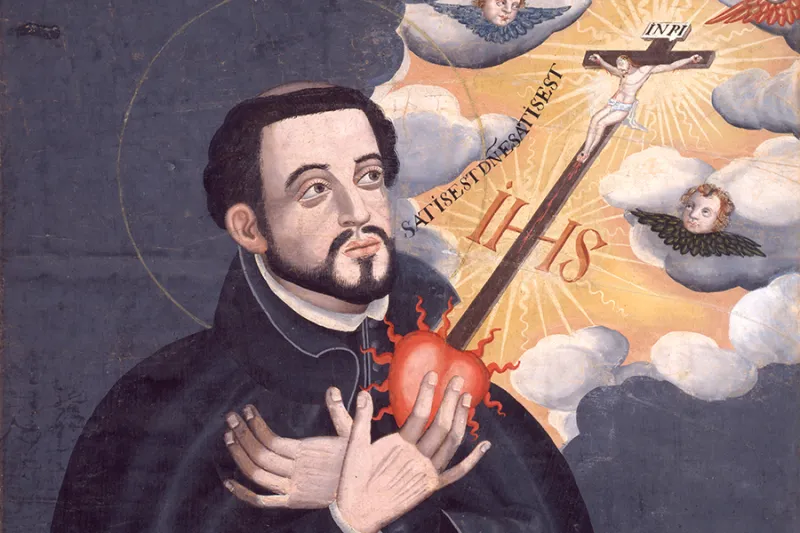
Washington, D.C. Newsroom, Dec 3, 2025 / 04:00 am (CNA).
How far would you go to serve God? Would you be willing to travel to the ends of the earth, with nothing but the guarantee of hardship, deprivation, and persecution?
Dec. 3 is the feast of St. Francis Xavier, the patron saint of missionaries and missions who led an unlikely life of adventure and heroism, full of unexpected twists and turns, taking the faith to the ends of the earth.
Born in 1506 to a noble Navarrese-Basque family, Francis grew up in a land wracked with war. Wedged between the growing imperial powers of Castile-Aragon (Spain) and France, Navarre seldom knew peace during Francis’ childhood.
As a member of the nobility, Francis was expected to lead a warrior’s life along with his father and brothers. But at the age of 10, his life took its first dramatic and tragic turn. His father died, his homeland kingdom of Navarre was defeated by Spain, his brothers were imprisoned, and his childhood home, the Castle of the House of Javier (Xavier), was almost entirely destroyed.
With Francis’ family disgraced and nearly wiped out, his prospects for a bright future looked dim. But God still had incredible plans for young Francis.
Hoping to rebuild the family’s legacy, Francis was sent in 1525 to the center of European theology and studies — the University of Paris.
There, Francis quickly made a name for himself. Handsome, he also had a keen intellect and was an agile athlete with a particular gift for pole vaulting. The last thing on young Francis’ mind was a life of humble service to God and the Church. However, his life took a second dramatic turn after he met a fellow Basque noble, Ignatius of Loyola.
Headstrong and stubborn, Francis was initially repelled by Ignatius’ ideas of radical devotion to God. But Ignatius would remind him of Jesus’ words in the Bible: “For what doth it profit a man, if he gains the whole world and suffers the loss of his own soul?” (Mt 16:26).
Inspired by Ignatius’ piety and fervor, Francis finally decided to dedicate his life to the service of God. In 1534, along with Ignatius and five others, Francis took vows of poverty, chastity, and obedience in a chapel at Montmartre in France.
Receiving holy orders alongside Ignatius in 1537, Francis had intended to make a pilgrimage to the Holy Land. But war in the region made such a journey impossible. Once again, God was about to unexpectedly and radically alter the course of Francis’ life.
Pope Leo III asked the newly-founded Jesuits to send missionaries to the Portuguese colonies in India. Though Francis was originally not supposed to go, one of the Jesuits assigned to the mission fell ill, and Francis volunteered in his place. Through that courageous act of trust, God would use Francis to transform the entire Asian continent.
Francis set out for India in 1541 on his 35th birthday. Traveling by sea at this time was extremely dangerous and uncomfortable, and those who dared to do so risked disease with no guarantee of ever successfully arriving at their destination. Francis had to sail all the way around Africa, past the Cape of Good Hope, almost to the very bottom of the globe, just to cross the Indian Ocean and arrive in Goa, a province in India.
Upon his arrival in India in 1542, Francis immediately faced countless challenges in bringing the word of God to the people of this new and foreign region. For seven years Francis preached in the streets and public squares, laboring tirelessly across India and the Asian Pacific islands, contending with persecution from warlords and at times even from the Portuguese authorities meant to help him.
After converting tens of thousands and planting the seeds of a renewed and lasting Christian Church in India, Francis began to hear stories about an enchanting island nation known as “Japan.” His heart was set ablaze with the desire to bring the Gospel to Japan.
After he had ensured the faithful in India would be properly cared for, Francis set sail for the mysterious new land, becoming the first to bring the Christian faith to Japan, on the complete opposite side of the world from his home in Navarre.
In Japan, Francis and his companions traveled far and wide, often on foot and with almost no resources. Crisscrossing the nation, he built up a vibrant Christian community more than 6,000 miles from Rome.
Francis would then hear of the even more mysterious and closely guarded nation of China and there, too, he decided to bring the word of God. But before he could find a way into China’s heartland, he became ill and died in 1552 while on the Chinese Shangchuan Island.
Now considered one of the greatest of all the Church’s missionaries, St. Francis Xavier proved that one life lived in complete trust in God can transform an entire continent and the whole world.
This story was first published on Dec. 3, 2022, and has been updated.
Read More
New York City, New York, Nov 30, 2025 / 08:00 am (CNA).
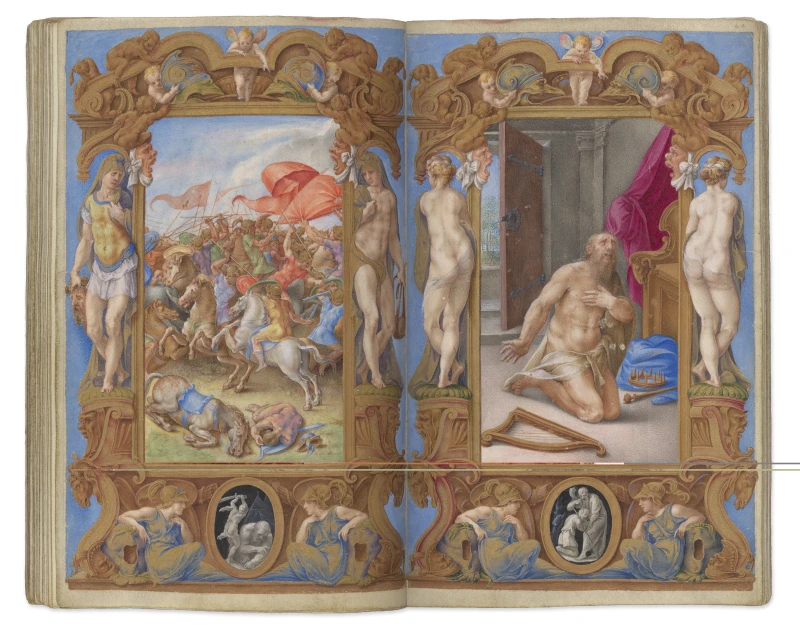
Part of the New York Public Library’s Spencer Collection, the Tickhill Psalter is on view throughout Advent and Christmas at The Morgan Library & Museum in its exhibit “Sing a New Song: The Psalms in Medieval Art and Life.” A full-page Jesse Tree introduces the Psalms in the Tickhill Psalter, a 14th-century illuminated manuscript from the Augustinian Worksop Priory in Nottinghamshire, England.

David appears in the historiated B of Psalm 1, providing a conceptual link to scenes from his life in the Jesse Tree on the facing page. “Beatus vir,” or “Blessed is the man,” the first stanza opens in celebration of the one who delights in God’s law, concluding: “That person is like a tree planted by streams of water, which yields its fruit in season and whose leaf does not wither, — what they do prospers.”
These words and their historiated B, with its visual link to the facing page, highlight David as key author of the Psalms and their prefiguration of Christ, the good fruit of the Jesse Tree, a theme common to medieval illuminated manuscripts.


The central panel of a 1490 Flemish triptych with scenes from the life of Saint Augustine contextualizes the exhibit. This five-by-five-foot oil on wood painting references Augustine’s use of allegory, essential to his understanding of scripture and interpretation of the psalms as prophecy. One scene captures Augustine’s realization of the Trinity as boundless mystery that dwarfs human understanding, allegorized by a child trying to pour the sea into a hole in the sand.


In the book accompanying the exhibit, Morgan curator Deirdre Jackson extends the psalms’ significance to this triptych through a reference to a surviving panel housed in Ireland that shows Augustine on his deathbed. It’s a scene described by contemporary bishop Possidius of Calama, who said that Augustine “ordered those psalms of David which are especially penitential to be copied out and, when he was very weak, used to lie in bed, facing the wall where the written sheets were put up, gazing at them and reading them, and copiously and continuously weeping as he read.”


In his book “The Tickhill Psalter and Related Manuscripts,” 20th-century art historian Donald Drew Egbert speculates that the Tickhill Psalter was decorated by highly skilled illuminators working for Augustinian monasteries and patrons of Augustinian houses during a high point of book arts in England.

This high point inspired a trend of books as personalized treasures, best exemplified in this exhibit by St. Thomas More’s prayer book. Containing much of his own writing in the margins, it consists of a Book of Hours and a Psalter and was with him in the Tower of London while he awaited execution. More’s notes during that time show his preoccupation with the psalms of David’s tribulations. Beside Psalm 87:5-10, “a man without help … in the dark places, and in the shadow of death,” More writes, “in severe tribulation and in prison.”

More’s thoughts in distress demonstrate the appeal of David’s story to the human heart, a reality repeatedly expressed throughout the treasures of this exhibit. In the Tickhill Psalter’s Jesse Tree, David is encircled by branches springing from a tree that grows out of his father, Jesse, sprawled in an active sleep, his elbow supporting a hand planted against his head as though dreaming of all that is to come.

The branches of the tree wind around David and directly overhead to encircle the Virgin and Child, tracing Christ’s lineage through Mary to the House of David. At the top, the branches surround Christ enthroned in majesty, fulfilling the promise of victory over sin and death foreshadowed in the psalms.
David strikes a joyous pose and plays a harp in celebration, and foliage on either side of the main branch wraps around prophets who unfurl scrolls to hint at mysteries about to be foretold in the reading of the psalms.
Beneath the figure of Jesse, two separate depictions of David protecting his sheep from wild animals cast his actions as allegory in the fight against evil, segueing to his likeness in the historiated B, dancing and singing his story into the Psalms to animate their prefiguration of Christ.
Read More

National Catholic Register, Nov 13, 2025 / 04:00 am (CNA).
In April 1912, Mother Frances Cabrini was in Italy with her sisters. Her plans were to visit her foundations in France, Spain, and England before sailing back to the United States in mid-April to continue work in New York City. Her sisters in England were eagerly awaiting this visit from their 62-year-old founder and superior. To help make her journey back to the U.S. more comfortable, they bought her a ticket and booked passage on a new ocean liner, the RMS Titanic.
Although an intrepid traveler who would eventually make 24 transatlantic crossings to establish her foundation, hospitals, and orphanages, Mother Cabrini was not a fan of ocean voyages since she had almost drowned as a child.
While the sisters in England waited, word got to Mother Cabrini that there was trouble at the Columbus Hospital she had established in New York. It was overflowing and there was urgent business to settle connected to a new expansion. She could not wait. She had to get back to raise desperately needed money to proceed with the project. So she changed her plans and left early, sailing from Naples, disappointing the sisters in England who had booked her passage on the Titanic.
The prefix “RMS” in “RMS Titanic” stood for “Royal Mail Ship” because it would also carry mail under contract to the British Royal Mail — an important bit of context for something she wrote in a May 5, 1912, letter to a Sister Gesuina Dotti:
“Only two of your letters I have received so far, and if you have sent five, then it must be said that it went down into the depths with the Titanic. If I was going to London, I might have left with it, but Divine Providence, which is constantly watching, did not allow it. God be blessed.”
This was not Frances Cabrini’s only miss with an iceberg.
In 1890, on her second trip to New York, she was among 1,000 passengers on a ship called La Normandie. The seas were very heavy one night and most skipped dinner and stayed in their cabins — except Mother Cabrini and five other souls. She knew of the dangerous situation and back in the cabin remained ready to save her sisters and herself if the call came to go to the lifeboats. She would later report that “the Good Lord … lulled us all to sleep on a great seesaw, rocking us back and forth.”
But that was only the beginning. As the storm raged on the next day, she braved going on deck, finding a chair in a relatively safe place, and continued writing a letter. In it, she wrote:
“You should see how beautiful the sea is in its great movement, how it swells and foams! It is truly a marvel! … If you were all here with me, daughters, crossing this immense ocean, you would exclaim, ‘Oh how great and wonderful is God in his works!’”
Now that is enlightenment from someone who did not like sailing one bit. Maybe because two days earlier she had, as told in an article about her, “compared the tranquility of the sea to the joy experienced by a soul abiding in the peace of God’s grace. No matter what the circumstances, she was able to see the love of Jesus shining through.”
That was not all on this trip.
Next, around midnight, “we felt a strong jolt and the ship stopped suddenly,” she would write about one such event after another on this journey. She and her sisters dressed and readied to board lifeboats if necessary. The trouble turned out to be something wrong with the engine. At that point “the sea became calm and beautiful” and the ship remained practically motionless until the engine was fixed by the morning and the ship was again able to continue. The breakdown caused an 11-hour delay — a delay that likely saved the ship and passengers from a disaster.
Two days later, Mother Cabrini said, “toward 11 we saw ourselves surrounded by icebergs on every part of the horizon … they were about 12 times the size of our ship.” The captain reduced the ship’s speed to weave slowly and carefully through the ice field to avoid colliding with the “immense, jagged fortresses.”
A story recorded at her shrine described it this way: “Mother Cabrini noted that though they had complained when the engine broke, the crisis was a great grace. Without that delay, the ship’s encounter with the icebergs would have occurred in the dark, most likely with dire consequences.”
Then there was the time the train she was riding from one orphanage to another was shot at outside of Dallas by enemies of the railroad. She remained unruffled and recounted later how one bullet “aimed at my head fell to my side, while it should have pierced my cranium.” When those aboard were aghast about her escape, she told them: “It was the Sacred Heart to whom I had entrusted the journey.”
Shortly after this incident, she wrote a letter stating: “Didn’t I write and tell you that I am alive miraculously?”
From the Titanic to La Normandie to Dallas, there was no question about divine providence in Mother Cabrini’s life. As she would write: “Supported by my Beloved, none of these adversities can shake me. But if I trust in myself, I will fall.” And: “In whatever difficulty I may encounter I want to trust in the goodness of the Sacred Heart of Jesus, who will never abandon me.”
This story was first published by the National Catholic Register, CNA’s sister news partner, and has been adapted by CNA.
Read More
| Picture of the day |
|---|
-L1005406.jpg)
|
|
The former “Kaispeicher B”, one of the oldest preserved warehouse structures in the Port of Hamburg, is now home to the International Maritime Museum Hamburg. The museum opened 17 years ago today, on June 25, 2008.
|

| Picture of the day |
|---|
.jpg)
|
|
Silk painting of Heungseon Daewongun, now in the collection of the National Museum of Korea, created by an unknown artist circa 1869. It is designated a Treasure of Korea.
|


| Picture of the day |
|---|

|
|
Skull of a Smilodon populator Lund, 1842 at the Museum of Zoology of the University of São Paulo, Brazil
|


A visitor takes a picture of a sculpture of an adult Alamosaurus wearing solar glasses outside of The Children’s Museum of Indianapolis, Saturday, April 6, 2024, in Indianapolis, Ind. On Monday, April 8, 2024, a total solar eclipse swept across a narrow portion of the North American continent from Mexico’s Pacific coast to the Atlantic coast of Newfoundland, Canada.
Read More