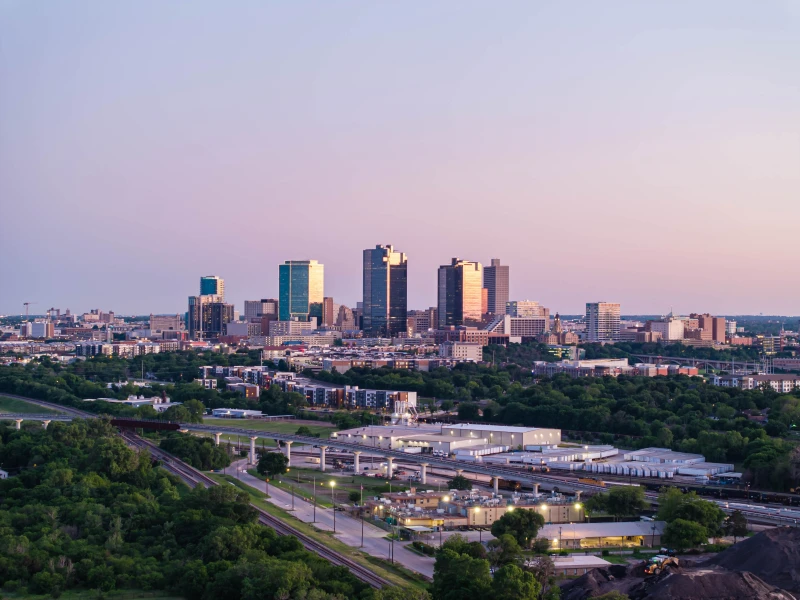

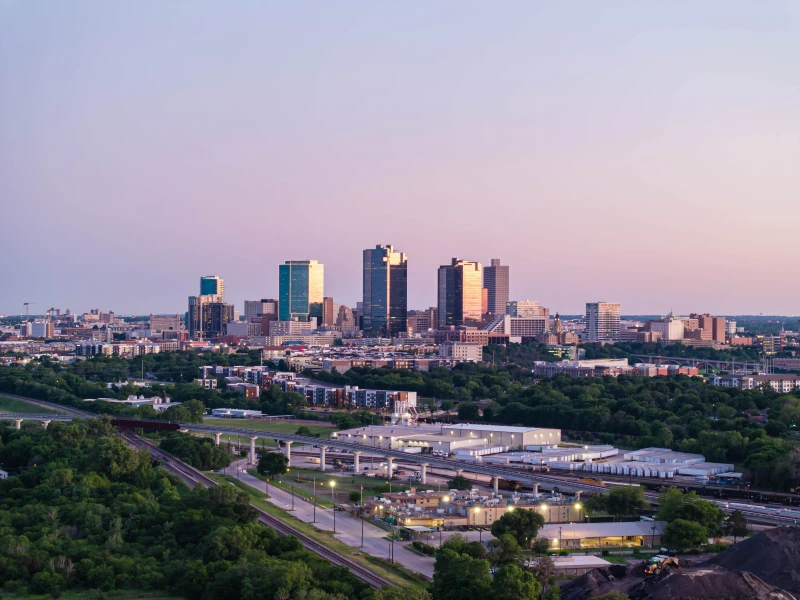
The skyline of Fort Worth, Texas. / Credit: 21 Aerials/Shutterstock
CNA Staff, Dec 12, 2025 / 09:41 am (CNA).
Bishop Michael Olson of the Diocese of Fort Worth, Texas, has announced the opening of a new order of Discalced Carmelite nuns after an older one in the diocese lost its canonical status last year.
Olson announced the news of the opening in a letter on Dec. 2 in which he said the Vatican’s Dicastery for Institutes of Consecrated Life and Societies of Apostolic Life gave permission for the new monastery.
The prelate described it as “a moment of extraordinary grace for our local Church.”
In an interview with CNA, Olson said there has been “a need in our diocese for prayers, for reparation of sin … and through adoration and contemplation and meditation, to pray for all of those intentions — that is the vocation of the new Carmel.”
Olson said that about six months ago he requested that a new order of nuns come to reside in the diocese from the Christ the King Association of Discalced Carmelite Monasteries in the U.S.A.
After making a formal request for permission from the Holy See in October, he received word in November that the Holy See approved the establishment of the new monastery.
The nuns are coming from the Carmel in Lake Elmo, Minnesota.
The bishop emphasized that the Carmel “is an autonomous body even though I have supervisory rights.”
He said the land was “donated generously by the faithful in the diocese” after he acted as an intermediary between the sisters and parishioners.
Asked when he believes the monastery, located in a rural part of northern Cooke County about 80 miles north of Dallas, will be completed, he replied: “That’s in God’s time.”
He said the sisters will not have a website “because it’s a distraction from their religious life. Social media can have adverse effects on a religious vocation, as we have seen.”
Olson told CNA he is “very grateful to the Holy See for this permission, but also to the religious sisters, the nuns who have given of themselves to Christ. It’s a very unique vocation.”
The bishop is encouraging people to be generous with the sisters as they establish their new home in the Fort Worth Diocese: “They’re in full communion with the Church, are rightly ordered in their Carmelite vocation.”
A new page for the Carmelites after scandal
In 2023, a public scandal erupted after Olson began an investigation of an alleged relationship of a sexual nature between the former prioress of the Discalced Carmelite nuns of Arlington, Rev. Mother Teresa Agnes Gerlach, and a priest outside the diocese.
Gerlach denied the allegation and accused Olson of overstepping his authority while seeking to obtain the nuns’ property located in the Dallas-Fort Worth metroplex. Olson has denied both claims.
The scandal played out in the press through actions taken by the Vatican, lawsuits in civil courts, and through public statements on both sides.
Last December, the Vatican issued a decree of suppression of the Arlington Carmelite monastery.
Olson announced the suppression just over a year ago, on Dec. 2, 2024, emphasizing at the time that the women at the monastery “are neither nuns nor Carmelites despite their continued and public self-identification to the contrary.”
He added that the Holy See “suppressed the monastery, so it exists no longer, despite any public self-identification made to the contrary by the former nuns who continue to occupy the premises.”
In August of that year, the nuns posted on their website that they had joined the Society of St. Pius X, a group that is in an “irregular” canonical situation within the Church.
‘May their vocation bring forth many graces’
In his most recent letter announcing the new monastery, Olson said it “will be a place where the beauty of contemplative life radiates outward into the world. Through prayer, silence, work, and sacrifice, the Discalced Carmelite nuns will accompany the faithful and intercede for the needs of our communities.”
“I ask all the faithful of the diocese to join me in prayer for these nuns as they begin this new chapter in their vocation,” the bishop said.
“May their vocation bring forth many graces including priestly and religious vocations, holy and happy marriages, and faithful discipleship,” he added.
Read More






![How pregnancy centers help women: Centers provide $450 million in value, report finds #Catholic
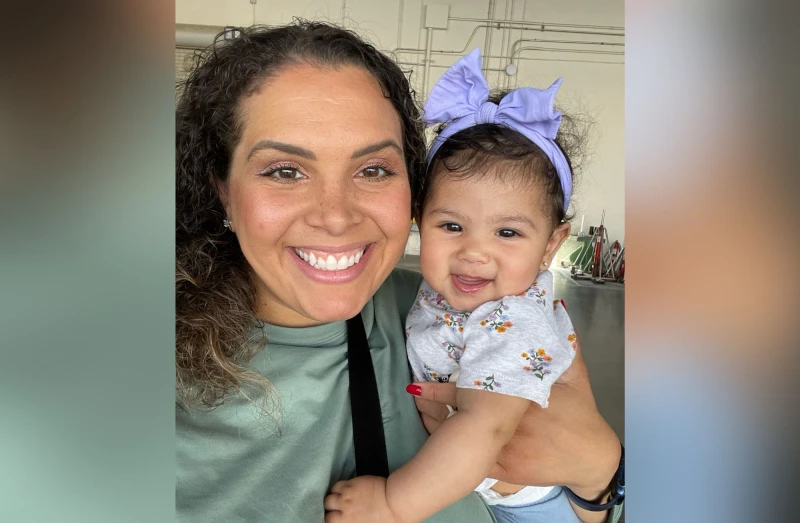
Jessica Williams and her 3-year-old daughter were helped by First Choice Pregnancy Services in Las Vegas. / Credit: Photo courtesy of Susan B. Anthony Pro-Life America
CNA Staff, Nov 17, 2025 / 16:11 pm (CNA).
When Jessica Williams became pregnant with another man’s child while she and her husband were separated, her husband pressured her to abort the child.As soon as she took the first abortion pill, mifepristone, she regretted it. “As a nurse, the reality of what I had done had hit me hard,” said Williams, who was nine weeks pregnant at the time. “Here I was working to save lives and about to take one of my own child’s lives.” But as a nurse, Williams knew that in spite of the pill cutting off the progesterone supply to her child, the baby might still be alive. She hadn’t yet taken the second pill, misoprostol, which would expel the child from her body. When she found a pregnancy center, First Choice Pregnancy Services in Las Vegas, staff immediately brought her in for an ultrasound.“They provided a free ultrasound, and that moment changed everything,” she said. Her baby was still alive.First Choice helped her through the abortion pill reversal process, a practice to reverse the effects of mifepristone soon after the woman takes the first abortion pill. Now, her daughter is a “healthy” and “thriving” 3-year-old, Williams said when she shared her story at a Nov. 17 online press conference.Williams is one of many women who have received help from pregnancy resource centers. Pregnancy centers across the U.S. “provided over $452 million in total medical care, support and education services, and material goods in 2024,” according to a Nov. 17 report by the Charlotte Lozier Institute. Pregnancy centers saw a total of 1 million new patients last year, “which is the equivalent of each center serving a new client every day in 2024,” Karen Czarnecki, the head of Charlotte Lozier Institute, said during the press conference. During the press conference, Marjorie Dannenfelser, head of Susan B. Anthony Pro-Life America, called pregnancy centers the “beating heart” of pro-life movement. Pregnancy centers, Dannenfelser said, “are going to the roots of the problem” by providing support for mothers across the board, whether they are struggling with addiction, domestic abuse, homelessness, completing school, or any other challenge. Report debunks false claims about pregnancy centers Dannenfelser noted there are some claims “often unchecked in the media” that call pregnancy centers “fake clinics” or say they “don’t have licensed medical staff.”“This is flat-out false,” Dannenfelser said. “Eight in 10 centers are providing free or low-cost medical services, staffed by over 10,000 medical professionals.” More than 80% of these centers provide ultrasound services, according to the report. Many of the centers also provide STD and STI testing and treatment, as well as abortion pill reversal, like in Williams’ experience. The report also found a 98% satisfaction rate among their clients — something Williams attested to.“They greeted me gently and were nonjudgmental,” Williams said of the staff and volunteers at the pregnancy clinic she went to. “They provided a safe, calm space for me, emotionally, spiritually.”“They gave me information and education without pushing me in any direction,” she continued. “They simply supported me in whatever path I chose.”More than three years later, Williams still keeps up with the women at the clinic.“I’m meeting with these ladies every month still,” Williams said. “They’re just a phone call, a text away, anything I need. I mean, we’re just almost becoming a family now.” Pregnancy centers also provide material, educational, and emotional support. For instance, 92% of centers offer material items to women in need. On average, each pregnancy center distributed six-packs of diapers and five baby outfits every day, according to the report. First Choice “provided diapers, material support, emotional and spiritual support groups, parenting resources, community connections, and just so much practical help in general,” Williams said. “It was a level of compassion that carried me through my entire pregnancy.” Offering material support is a growing effort in the pro-life movement. At pregnancy centers, material support has grown by more than 300% from 2019 to 2024.Many pregnancy centers also offer a variety of other resources, including childbirth classes, breastfeeding consultations, and outreach to victims of human trafficking. “Even right now, they’re doing a monthly get-together — we get to network with other mamas,” Williams said. “We’re [able] to access any resources.” The majority of pregnancy centers also help support women who are recovering from abortions.Williams said the women at the clinic “understood the pressure and fear” she was under to abort. Even after the reversal, her husband drove her to an abortion clinic when she was 16 weeks pregnant “to finish the job,” she said. “The clinic was on the same exact street [where] I saved my baby,” she said. “I couldn’t do it and demanded he take me home. I now know that the strategic location has also saved many other babies.” “They created a safe place for me to heal and feel supported,” she said of the clinic.](http://unitedyam.com/wp-content/uploads/2025/11/how-pregnancy-centers-help-women-centers-provide-450-million-in-value-report-finds-catholic-jessica-williams-and-her-3-year-old-daughter-were-helped-by-first-choice-pregnancy-services-in-las-v.webp)
![Bishops discuss faith formation before National Catholic Youth Conference #Catholic
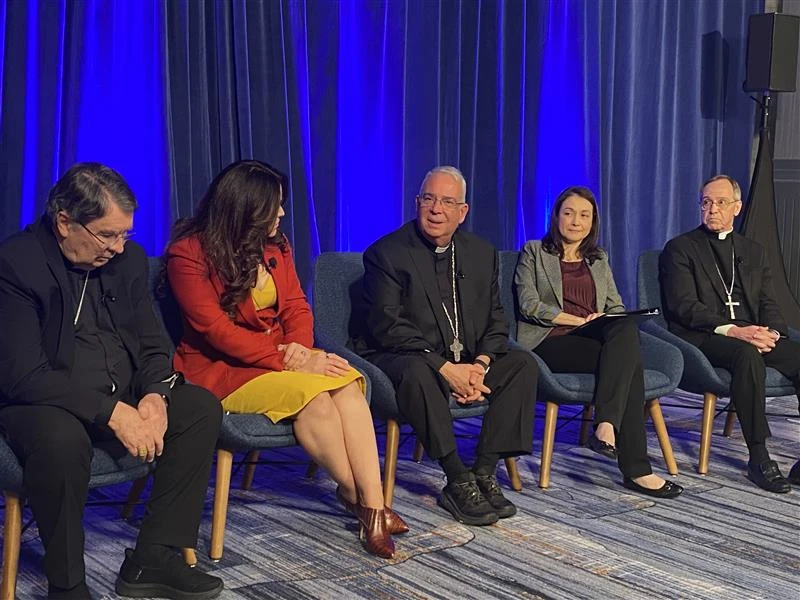
Organizers of Pope Leo XIV’s upcoming digital dialogue with young people Nov. 21 at the National Catholic Youth Conference in Indianapolis speak to the media at the site of the United States Catholic Bishops’ Conference Fall Plenary Assembly in Baltimore on Nov. 12, 2025. Left to right: Cardinal Christophe Pierre, papal nuncio to the United States; Montse Alvarado, president and COO of EWTN News; Archbishop Nelson J. Pérez, Archdiocese of Philadelphia; Christina Lamas, executive director of National Federation for Catholic Youth Ministry; and Archbishop Charles Thompson, Archdiocese of Indianapolis. / Credit: Shannon Mullen/National Catholic Register
Baltimore, Maryland, Nov 17, 2025 / 07:00 am (CNA).
Bishops discussed young Catholics’ place in the Church ahead of the National Catholic Youth Conference.At the United States Conference of Catholic Bishops’ (USCCB) Fall Plenary Assembly in Baltimore, bishops spoke about the young generation as many prepare to attend NCYC. The conference will take place Nov. 20–22 in Indianapolis for prayer, community, evangelization, and service among Catholic teenagers.During NCYC, Pope Leo XIV will hold a digital dialogue with teens from across the nation. “When the pope speaks, he speaks to the world, and this will be a wonderful, wonderful moment. This encounter will engage young people in real time,” said Archbishop Nelson Pérez of Philadelphia. At a Nov. 12 press conference at the USCCB fall plenary, Pérez said “there is a deep significance to this encounter.” He added: “It reflects the Holy Father’s desire to connect with young people, with our youth, whom his predecessor … Pope Francis, called ‘the now of God.’”Pérez said during his time as a priest and bishop, he has noticed teenagers “want a place in the Church.” He said: “They want to be seen, heard, and valued, which is so beautiful ... They want to be loved by the Church.”“Even in today’s interconnected world, the Church can seem far away from young people. The Holy Father’s choice to encounter the American youth ... is an expression of his closeness to the youth of the world.”“This moment will mark a powerful opportunity for young people to witness the beauty of the universal Church with our Holy Father and to express their concerns, voices, experience, [and] what’s in their hearts,” Pérez said.Bishop Joseph Espaillat, auxiliary bishop for the Archdiocese of New York, has attended NCYC more than a dozen times. He told CNA “the energy and the vibrancy of the young people” is why he returns each year.“It’s not just the local parish or the local diocese, but it’s the national Church and there’s something powerful when we come together,” Espaillat said.This year’s event is “the first time ever the Holy Father has a live online interview like this,” at NCYC, Espaillat said. “What I love about it is that the Church in the United States is leading right now. The young people being the focus with our Holy Father is going to be great, and it’s going to produce a lot of positive energy in our Church.”Espaillat encouraged attendees “to be open and allow yourself to be surprised by the Holy Spirit.” He added: “Don’t go in with a preconceived notion. It is a great event in which there are many, many fruits. I’ve seen young people just come to life at the event.”Youth draw closer to the ChurchAs thousands of teenagers plan to gather at the national conference, U.S. bishops further explained why so many young Catholics are looking to the Church. A number of bishops highlighted the Catholic presence on social media is helping to draw them in.Bishop William Byrne of Springfield, Massachusetts, told CNA the exponential growth of young Catholics coming to the Church is “amazing and exciting.” Byrne, who served as chair for the USCCB’s committee on communications, detailed how much its online presence has grown its outreach to the young generation and wider population. “Beginning with the illness of our beloved Pope Francis, through the funeral, and then the transition to Pope Leo, we’ve actually had a 226% growth in our social media on the four platforms we use — TikTok, Instagram, X, and YouTube,” he said.“The amazing thing is, it’s still growing. It means that people are seeing it, sharing it,” Byrne said. He specifically noted it’s the “young people” spreading the message online. “So we see that we are reaching people,” Byrne said. “But our goal is not to get people locked on their phones. Our goal is to get people locked on Jesus Christ and have the impression be Jesus Christ and his bride, the Church.”“This is an exciting time. It’s not without its challenges, but it’s also a wonderful opportunity,” Byrne said. “We’re reaching young people who are curious and hungry. It’s so exciting to see the Church continue to speak to the world, because the Church has never lost her relevance.”The start of the Catholic online presence followed the movement of the new atheists, Bishop Robert Barron of Winona-Rochester, Minnesota, said. He told CNA the movement was made up of “people who were really shaping the culture, saying: ‘There’s no purpose of life. We come from nowhere. We go nowhere. There’s no objective moral value.’”“A lot of people, myself included, began to get on social media with a religious voice,” Barron said. “People who had not heard a religious voice or who were disaffiliated … could find people like me and many others who were actually talking about God and about religion.”“But I think as a whole generation came of age, they realized what a desperately sad and empty message that is,” Barron said. “There’s this hunger in the heart for God, and so that just reasserts itself. I think a lot of younger people who were raised on this very vapid philosophy began to look to religion.”As more young Catholics get involved in youth formation whether in their parishes or at larger gatherings like NCYC, Barron said he encourages them to use the opportunities to “build community and build a sense of family with other believers.”Barron, who is the founder of the Catholic media organization Word on Fire, has gained nearly 3 million YouTube subscribers and millions of other followers across social media platforms. But, he said, “one drawback of social media is that it’s a little private world. It can be a lot of people accessing it, but privately.”“Maybe through social media an individual finds a path to religion, but then to look around a room and see thousands of other people that are on a similar path — that’s a great thing,” Barron said.](http://unitedyam.com/wp-content/uploads/2025/11/bishops-discuss-faith-formation-before-national-catholic-youth-conference-catholic-organizers-of-pope-leo-xivs-upcoming-digital-dialogue-with-young-people-nov-21-at-the-national-catholi.webp)



![Arizona man sentenced to prison after hoax bomb threats at Christian churches #Catholic
null / Credit: Chodyra Mike 1/Shutterstock
CNA Staff, Nov 11, 2025 / 11:40 am (CNA).
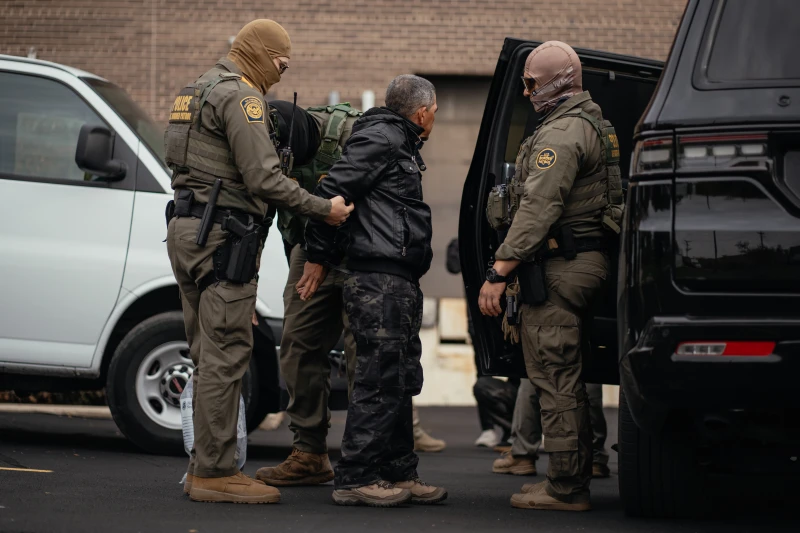
An Arizona man will serve more than half a decade in prison after he carried out multiple hoax bomb threats at churches in the western U.S.The U.S. Department of Justice said in a press release that 46-year-old Phoenix resident Zimnako Salah would spend six years in prison after his 2025 conviction in the terror plot.From September to November 2023 Salah “traveled to four Christian churches in Arizona, California, and Colorado” with black backpacks, according to the Department of Justice. At two churches he was turned away by security, while at two others he “planted” the backpacks, causing congregants to believe they contained bombs, the Justice Department said.Though the planted backpacks were in fact hoaxes, Salah reportedly had “been building a bomb capable of fitting in a backpack,” the department said. FBI investigators said they seized “component parts of an improvised explosive device” from a storage unit being rented by Salah.Salah also had been actively searching for “extremist propaganda online,” the government said, including searches for videos such as “infidels dying.”The jury that convicted Salah in 2025 found that he “targeted the church because of the religion of the people who worshipped there, making the offense a hate crime.”U.S. District Judge Dena Coggins levied a $10,000 fine against Salah, telling him he “failed to take responsibility for [his] actions.”U.S. Attorney Eric Grant said Salah’s ultimate goal appeared to be “many deaths and injuries.”“Thanks to the action of church security, local law enforcement, and the FBI, this defendant was stopped before he had a chance to carry out the crimes he sought to commit,” he said.Assistant Attorney General Harmeet Dhillon, meanwhile, said in the press release that criminals “who target people because of their faith will face the full force of federal law.”“The Department of Justice will continue to protect the rights of all people of faith to worship and live free from fear, and we will hold accountable anyone who threatens or harms them,” she said.](http://unitedyam.com/wp-content/uploads/2025/11/arizona-man-sentenced-to-prison-after-hoax-bomb-threats-at-christian-churches-catholic-null-credit-chodyra-mike-1-shutterstockcna-staff-nov-11-2025-1140-am-cna-an-arizona-man-will-se.webp)


![Religious sisters announce historic land return to Wisconsin Native American tribe #Catholic
LaCrosse, Wisconsin. / Credit: JTTucker/Shutterstock
CNA Staff, Nov 7, 2025 / 06:00 am (CNA).
A Wisconsin religious community says it has completed the first known instance of a Catholic group returning land to a Native American tribe, hailing it as a move made in the “spirit of relationship and healing.”The Franciscan Sisters of Perpetual Adoration announced the transfer in an Oct. 31 news release on its website. The community is located in La Crosse, Wisconsin, near the state’s border with Minnesota.The sisters had purchased the land from the Lac du Flambeau Band of the Lake Superior Chippewa tribe in 1966 and used the property for its Marywood Franciscan Spirituality Center.The sisters said they sold the property to the tribe for $30,000, the exact amount for which they paid for the land six decades ago. The modern sale price represented “just over 1% of [the land’s] current market value,” the sisters said.The bargain sale represents “the first known return of Catholic-owned land to a tribal nation as an act of repair for colonization and residential boarding schools,” the sisters said.“Today, the tribe’s reservation represents only a fraction of [its] traditional territories,” the news release said. “Rebuilding and protecting tribal land bases is vital to sustaining sovereignty — it restores the ability for self-determination, cultural preservation, and community development.” “A strong land base supports essential services, creates employment opportunities, and provides a foundation for long-term economic and social resilience,” the sisters said. Tribal President John Johnson hailed the sale as “an example of what true healing and partnership can look like.” “We are proud to welcome Marywood home, to ensure it continues to serve future generations of the Lac du Flambeau people,” Johnson said. The sisters said the retreat center was “facing challenges to its viability,” leading the community to “discern a future for the land” in line with its institutional priorities. In their press release, the sisters said they have also been in “a process of reckoning” with the history of St. Mary’s Catholic Indian Boarding School. The sisters administered the school in Odanah, Wisconsin, from 1883 to 1969.Critics in recent years have claimed that such boarding schools participated in the erasure of Native American culture. Others have alleged that significant clergy sex abuse took place at such institutions.The sisters on Oct. 31 said such schools were guilty of “separating children from their families, suppressing Native identity, and paving the way for the large-scale seizure of Native homelands.”“It was painful to address our complicity, but we knew it had to be done,” former community president Sister Eileen McKenzie said in the press release.Diocese of Superior Bishop James Powers, meanwhile, praised the transfer, describing it as “a tangible act of justice and reconciliation that flows directly from the heart of our Catholic faith.”The Franciscan Sisters of Perpetual Adoration traces its roots to a group of Bavarian immigrants who traveled to Milwaukee in 1849 “intent upon founding a religious community to spread the Gospel among German immigrants.”The community has run hospitals and schools in Wisconsin and has also sponsored medical clinics and mission schools abroad.](http://unitedyam.com/wp-content/uploads/2025/11/religious-sisters-announce-historic-land-return-to-wisconsin-native-american-tribe-catholic-lacrosse-wisconsin-credit-jttucker-shutterstockcna-staff-nov-7-2025-0600-am-cna-a-wiscon.webp)