Prison

Daughter of political prisoner Jimmy Lai speaks out for the first time #Catholic 
 
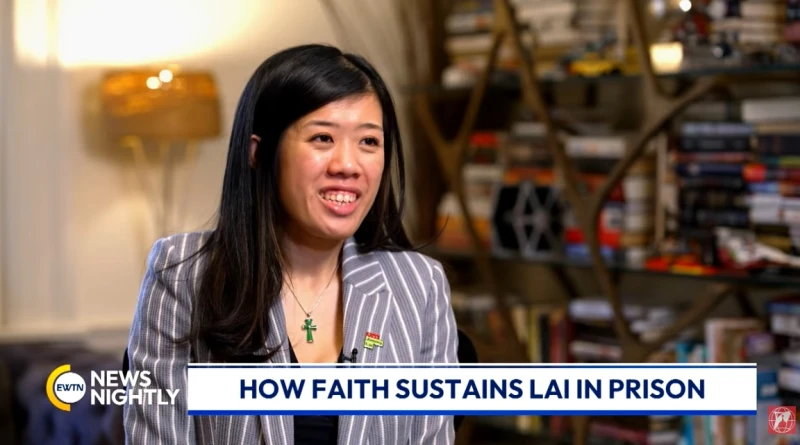
 Claire Lai, daughter of imprisoned Hong Kong activist and Catholic Jimmy Lai, speaks with EWTN News President Montse Alvarado on “EWTN News Nightly” on Dec. 8, 2025. / Credit: “EWTN News Nightly”/Screenshot

Washington, D.C. Newsroom, Dec 9, 2025 / 06:00 am (CNA).
Daughter of imprisoned Catholic activist Jimmy Lai spoke out for the first time ahead of her father’s 78th birthday. “As a daughter, every day I wake up and I hope that today is the day we get my dad home … the day we get to go to Mass together, or to eat dinner around the table, things that years ago I almost took for granted,” Claire Lai said in an interview with EWTN News.Jimmy Lai, the pro-democracy entrepreneur and human rights activist, was arrested in 2020 in Hong Kong. He underwent a trial that lasted nearly two years for allegations of colluding with foreign forces under a national security law put in effect by the communist-controlled Chinese government.The trial ended in August, and Lai continues to wait for the verdict in prison where he faces inhumane living conditions, deteriorating health, and is denied the Eucharist, his daughter said. In an interview with Montse Alvarado, president and COO of EWTN News, Lai’s daughter Claire said: “We’re still waiting for a verdict, five years after he was charged. He is turning 78. We have waited a very, very long time for his cases to be resolved. We do not believe that they will be through the domestic system. Our only hope is outside, and that’s why I’m here now.”Dec. 8 was Jimmy Lai’s 78th birthday, which falls on the feast of the Immaculate Conception. His daughter highlighted Lai’s deep devotion to the Blessed Mother. She said her family has tried to send him a rosary in prison, but “each attempt failed.” She said he fell down once in the shower, and “because of his waist pain he wasn’t able to get up.”“Even some of the guards came over and tried to help him … but he couldn’t get up. So he pretended as though he had a rosary in his hand and prayed to the Blessed Mother. Then he was able to get up without pain,” Claire Lai said.“When you’re a daughter … and you hear stories like that, you wish you could yourself physically pull him up when he is in pain like that. But you find such great comfort in the fact that Our Lady is protecting him,” she said.Conversion to the faithLai said her father’s conversion to Catholicism has been a stable presence during his time in prison. “My father had quite an unconventional childhood. He came to Hong Kong when he was 12. He had nothing to his name, nothing in his pockets. But he was full of optimism and he had a yearning for freedom,” she said.“It was only later on that he understood that there was something, a higher force, guiding him all along, which was why he was able to go from child laborer to a successful entrepreneur and do so almost without fear. It was later on that he understood that to be God,” she said.Jimmy Lai converted the year of the handover of Hong Kong from the United Kingdom to China when “people were filled with doubt and with a certain amount of fear,” his daughter said. “As Our Lady has taught us, there is nothing that conquers doubt and fear except for the love of God. And that was a time when he was ready to receive it.”“My father converted one year after I was born. Really, the only memories I have are of growing up in a very loving Catholic family,” she said.Legal sagaClaire Lai studied law and has been involved with her father’s case and lengthy trial. “There’s an equal amount of outrage, but also it’s a privilege to be able to be there and witness it as closely as I have,” she said. “As someone who grew up admiring the Hong Kong legal system … it has been heartbreaking to see the rule of law break down, but even more so to see my father and his case is at the helm of it.”The bench was “not neutral in any sense of the word,” she said. “They just grilled him repeatedly. There were gag orders that were imposed when the evidence just did not suit the narrative … it was just so deeply unfair.”The trial had unexplained delays that were “clearly meant so that people would forget about my father and so that it would crush his spirit,” she said. But “with the good Lord as his guide, his spirit remained just as strong.”Prison conditions Lai has been in prison for five years, but “his incarceration has just deepened his faith,” his daughter said. “I think there isn’t anything quite as much as suffering that opens your heart to God’s love. We are so grateful that Our Lord has accompanied my father. He wakes up around midnight every night to pray,” she said.“Before the crack of dawn, he would read the Gospel,” Lai said. “At first, he would ask the guards if they could turn on the light so that he could read … For about the first six months, they said ‘yes.’ Afterwards, they always said ‘no.’”“The conditions he’s kept in have just gotten worse over time. They aren’t a natural byproduct of prison. In the prison cell, there is a window that leads outside that should give access to sunlight. His is deliberately blocked so that he doesn’t have access,” she said.“He’s been denied holy Communion for over two years and got it only very, very intermittently this year,” she said. “It’s something that costs them nothing … for him to get. It costs them nothing for him to get the rosary, and it costs them nothing to turn on the light so that he can read the Gospel.”Kept in solitary confinement, he faces extreme heat conditions in his small cell. “In summer, the heat can get up to … 111 degrees Fahrenheit,” she said. “To say that it’s sweltering is a massive understatement.”“He gets heat rushes all over his body, and they last until the middle of autumn. It is outrageous, and it is torturous,” she said.“We have typhoon seasons in Hong Kong … and the cells get wet. Almost everything in there gets wet. Once that happened, the first thing he checked was his Bible, and it was the one thing that remained dry. We’re very grateful that Our Lord and Our Lady continue to watch over him,” she said.Lai’s health has declined rapidly while behind bars. “In less than a year, he lost 10 kilos … after already having lost a significant amount of weight the last few years. His nails are rotting … He has infections that last for months in spite of antibiotics. And his limbs get swollen, very red, and they’re agonizingly painful,” she said.“My dad is not someone who complains. He doesn’t even make faces. You know that when he does, it’s very painful,” she said. “There are times when even from a distance, you can tell that he’s pale and he’s shivering.”“Then there’s the less visible signs,” she said. “He’s diabetic, and he’s had heart issues. He had a perfectly healthy heart before he went to prison.” He has said “that every few days he would have heart palpitations and they would be disabling,” his daughter said.Call for international involvement Jimmy Lai is a British citizen and his daughter said that any communication between Britain and the Chinese government should include discussion of her father. “He is in prison for basically standing in defense for the freedoms he first came to know as a child in Hong Kong when it was still a British embassy and for hoping that they would keep the promise made during the sign of the British Joint Declaration,” she said.U.S. President Donald Trump has vowed to do “everything” possible to “save” Lai. A White House official told EWTN News in October that Trump spoke with Chinese President Xi Jinping about his imprisonment. “We are so extremely grateful to President Trump and his administration,” Claire Lai said. “They have a long, proven record of freeing the unjustly detained, and we hope that my father will follow soon.”“We are also very, very grateful for members of the public. My father is sustained by your prayers,” she said.She shared that Pope Leo XIV is also praying for her father during this time. In October, Lai’s wife, Teresa Lai, and his daughter met Pope Leo after a general audience. “It was such a privilege and a blessing to have an audience with our Holy Father,” Claire Lai said. Hope for a release “The government has no case,” she said. “All they’ve proven is that my father is a good man, a man who loves God, a man who loves freedom, who loves truth, and loves his family.”If she could speak with the Chinese government, Lai said she would say to “do the only just and … only honorable thing, which is to release a 78-year-old man, my father, Jimmy Lai, against whom no case has been made.”“Don’t let him die a martyr in these conditions, in this health. It is a stain on your history that you will never be able to wipe off,” she said.She said she does “worry” that her father could die in prison, but she is “hopeful.”When her father “reflected on his earlier years, he said that even before he converted and before he opened his heart to the love of God, he was always guided by him — even before he knew it,” she said. “I think that’s how he wants to be remembered, as a faithful servant of Our Lord.”

Daughter of political prisoner Jimmy Lai speaks out for the first time #Catholic Claire Lai, daughter of imprisoned Hong Kong activist and Catholic Jimmy Lai, speaks with EWTN News President Montse Alvarado on “EWTN News Nightly” on Dec. 8, 2025. / Credit: “EWTN News Nightly”/Screenshot Washington, D.C. Newsroom, Dec 9, 2025 / 06:00 am (CNA). Daughter of imprisoned Catholic activist Jimmy Lai spoke out for the first time ahead of her father’s 78th birthday. “As a daughter, every day I wake up and I hope that today is the day we get my dad home … the day we get to go to Mass together, or to eat dinner around the table, things that years ago I almost took for granted,” Claire Lai said in an interview with EWTN News.Jimmy Lai, the pro-democracy entrepreneur and human rights activist, was arrested in 2020 in Hong Kong. He underwent a trial that lasted nearly two years for allegations of colluding with foreign forces under a national security law put in effect by the communist-controlled Chinese government.The trial ended in August, and Lai continues to wait for the verdict in prison where he faces inhumane living conditions, deteriorating health, and is denied the Eucharist, his daughter said. In an interview with Montse Alvarado, president and COO of EWTN News, Lai’s daughter Claire said: “We’re still waiting for a verdict, five years after he was charged. He is turning 78. We have waited a very, very long time for his cases to be resolved. We do not believe that they will be through the domestic system. Our only hope is outside, and that’s why I’m here now.”Dec. 8 was Jimmy Lai’s 78th birthday, which falls on the feast of the Immaculate Conception. His daughter highlighted Lai’s deep devotion to the Blessed Mother. She said her family has tried to send him a rosary in prison, but “each attempt failed.” She said he fell down once in the shower, and “because of his waist pain he wasn’t able to get up.”“Even some of the guards came over and tried to help him … but he couldn’t get up. So he pretended as though he had a rosary in his hand and prayed to the Blessed Mother. Then he was able to get up without pain,” Claire Lai said.“When you’re a daughter … and you hear stories like that, you wish you could yourself physically pull him up when he is in pain like that. But you find such great comfort in the fact that Our Lady is protecting him,” she said.Conversion to the faithLai said her father’s conversion to Catholicism has been a stable presence during his time in prison. “My father had quite an unconventional childhood. He came to Hong Kong when he was 12. He had nothing to his name, nothing in his pockets. But he was full of optimism and he had a yearning for freedom,” she said.“It was only later on that he understood that there was something, a higher force, guiding him all along, which was why he was able to go from child laborer to a successful entrepreneur and do so almost without fear. It was later on that he understood that to be God,” she said.Jimmy Lai converted the year of the handover of Hong Kong from the United Kingdom to China when “people were filled with doubt and with a certain amount of fear,” his daughter said. “As Our Lady has taught us, there is nothing that conquers doubt and fear except for the love of God. And that was a time when he was ready to receive it.”“My father converted one year after I was born. Really, the only memories I have are of growing up in a very loving Catholic family,” she said.Legal sagaClaire Lai studied law and has been involved with her father’s case and lengthy trial. “There’s an equal amount of outrage, but also it’s a privilege to be able to be there and witness it as closely as I have,” she said. “As someone who grew up admiring the Hong Kong legal system … it has been heartbreaking to see the rule of law break down, but even more so to see my father and his case is at the helm of it.”The bench was “not neutral in any sense of the word,” she said. “They just grilled him repeatedly. There were gag orders that were imposed when the evidence just did not suit the narrative … it was just so deeply unfair.”The trial had unexplained delays that were “clearly meant so that people would forget about my father and so that it would crush his spirit,” she said. But “with the good Lord as his guide, his spirit remained just as strong.”Prison conditions Lai has been in prison for five years, but “his incarceration has just deepened his faith,” his daughter said. “I think there isn’t anything quite as much as suffering that opens your heart to God’s love. We are so grateful that Our Lord has accompanied my father. He wakes up around midnight every night to pray,” she said.“Before the crack of dawn, he would read the Gospel,” Lai said. “At first, he would ask the guards if they could turn on the light so that he could read … For about the first six months, they said ‘yes.’ Afterwards, they always said ‘no.’”“The conditions he’s kept in have just gotten worse over time. They aren’t a natural byproduct of prison. In the prison cell, there is a window that leads outside that should give access to sunlight. His is deliberately blocked so that he doesn’t have access,” she said.“He’s been denied holy Communion for over two years and got it only very, very intermittently this year,” she said. “It’s something that costs them nothing … for him to get. It costs them nothing for him to get the rosary, and it costs them nothing to turn on the light so that he can read the Gospel.”Kept in solitary confinement, he faces extreme heat conditions in his small cell. “In summer, the heat can get up to … 111 degrees Fahrenheit,” she said. “To say that it’s sweltering is a massive understatement.”“He gets heat rushes all over his body, and they last until the middle of autumn. It is outrageous, and it is torturous,” she said.“We have typhoon seasons in Hong Kong … and the cells get wet. Almost everything in there gets wet. Once that happened, the first thing he checked was his Bible, and it was the one thing that remained dry. We’re very grateful that Our Lord and Our Lady continue to watch over him,” she said.Lai’s health has declined rapidly while behind bars. “In less than a year, he lost 10 kilos … after already having lost a significant amount of weight the last few years. His nails are rotting … He has infections that last for months in spite of antibiotics. And his limbs get swollen, very red, and they’re agonizingly painful,” she said.“My dad is not someone who complains. He doesn’t even make faces. You know that when he does, it’s very painful,” she said. “There are times when even from a distance, you can tell that he’s pale and he’s shivering.”“Then there’s the less visible signs,” she said. “He’s diabetic, and he’s had heart issues. He had a perfectly healthy heart before he went to prison.” He has said “that every few days he would have heart palpitations and they would be disabling,” his daughter said.Call for international involvement Jimmy Lai is a British citizen and his daughter said that any communication between Britain and the Chinese government should include discussion of her father. “He is in prison for basically standing in defense for the freedoms he first came to know as a child in Hong Kong when it was still a British embassy and for hoping that they would keep the promise made during the sign of the British Joint Declaration,” she said.U.S. President Donald Trump has vowed to do “everything” possible to “save” Lai. A White House official told EWTN News in October that Trump spoke with Chinese President Xi Jinping about his imprisonment. “We are so extremely grateful to President Trump and his administration,” Claire Lai said. “They have a long, proven record of freeing the unjustly detained, and we hope that my father will follow soon.”“We are also very, very grateful for members of the public. My father is sustained by your prayers,” she said.She shared that Pope Leo XIV is also praying for her father during this time. In October, Lai’s wife, Teresa Lai, and his daughter met Pope Leo after a general audience. “It was such a privilege and a blessing to have an audience with our Holy Father,” Claire Lai said. Hope for a release “The government has no case,” she said. “All they’ve proven is that my father is a good man, a man who loves God, a man who loves freedom, who loves truth, and loves his family.”If she could speak with the Chinese government, Lai said she would say to “do the only just and … only honorable thing, which is to release a 78-year-old man, my father, Jimmy Lai, against whom no case has been made.”“Don’t let him die a martyr in these conditions, in this health. It is a stain on your history that you will never be able to wipe off,” she said.She said she does “worry” that her father could die in prison, but she is “hopeful.”When her father “reflected on his earlier years, he said that even before he converted and before he opened his heart to the love of God, he was always guided by him — even before he knew it,” she said. “I think that’s how he wants to be remembered, as a faithful servant of Our Lord.”


Claire Lai, daughter of imprisoned Hong Kong activist and Catholic Jimmy Lai, speaks with EWTN News President Montse Alvarado on “EWTN News Nightly” on Dec. 8, 2025. / Credit: “EWTN News Nightly”/Screenshot

Washington, D.C. Newsroom, Dec 9, 2025 / 06:00 am (CNA).

Daughter of imprisoned Catholic activist Jimmy Lai spoke out for the first time ahead of her father’s 78th birthday. 

“As a daughter, every day I wake up and I hope that today is the day we get my dad home … the day we get to go to Mass together, or to eat dinner around the table, things that years ago I almost took for granted,” Claire Lai said in an interview with EWTN News.

Jimmy Lai, the pro-democracy entrepreneur and human rights activist, was arrested in 2020 in Hong Kong. He underwent a trial that lasted nearly two years for allegations of colluding with foreign forces under a national security law put in effect by the communist-controlled Chinese government.

The trial ended in August, and Lai continues to wait for the verdict in prison where he faces inhumane living conditions, deteriorating health, and is denied the Eucharist, his daughter said. 

In an interview with Montse Alvarado, president and COO of EWTN News, Lai’s daughter Claire said: “We’re still waiting for a verdict, five years after he was charged. He is turning 78. We have waited a very, very long time for his cases to be resolved. We do not believe that they will be through the domestic system. Our only hope is outside, and that’s why I’m here now.”

Dec. 8 was Jimmy Lai’s 78th birthday, which falls on the feast of the Immaculate Conception. His daughter highlighted Lai’s deep devotion to the Blessed Mother. 

She said her family has tried to send him a rosary in prison, but “each attempt failed.” She said he fell down once in the shower, and “because of his waist pain he wasn’t able to get up.”

“Even some of the guards came over and tried to help him … but he couldn’t get up. So he pretended as though he had a rosary in his hand and prayed to the Blessed Mother. Then he was able to get up without pain,” Claire Lai said.

“When you’re a daughter … and you hear stories like that, you wish you could yourself physically pull him up when he is in pain like that. But you find such great comfort in the fact that Our Lady is protecting him,” she said.

Conversion to the faith

Lai said her father’s conversion to Catholicism has been a stable presence during his time in prison. 

“My father had quite an unconventional childhood. He came to Hong Kong when he was 12. He had nothing to his name, nothing in his pockets. But he was full of optimism and he had a yearning for freedom,” she said.

“It was only later on that he understood that there was something, a higher force, guiding him all along, which was why he was able to go from child laborer to a successful entrepreneur and do so almost without fear. It was later on that he understood that to be God,” she said.

Jimmy Lai converted the year of the handover of Hong Kong from the United Kingdom to China when “people were filled with doubt and with a certain amount of fear,” his daughter said. “As Our Lady has taught us, there is nothing that conquers doubt and fear except for the love of God. And that was a time when he was ready to receive it.”

“My father converted one year after I was born. Really, the only memories I have are of growing up in a very loving Catholic family,” she said.

Legal saga

Claire Lai studied law and has been involved with her father’s case and lengthy trial. “There’s an equal amount of outrage, but also it’s a privilege to be able to be there and witness it as closely as I have,” she said. 

“As someone who grew up admiring the Hong Kong legal system … it has been heartbreaking to see the rule of law break down, but even more so to see my father and his case is at the helm of it.”

The bench was “not neutral in any sense of the word,” she said. “They just grilled him repeatedly. There were gag orders that were imposed when the evidence just did not suit the narrative … it was just so deeply unfair.”

The trial had unexplained delays that were “clearly meant so that people would forget about my father and so that it would crush his spirit,” she said. But “with the good Lord as his guide, his spirit remained just as strong.”

Prison conditions 

Lai has been in prison for five years, but “his incarceration has just deepened his faith,” his daughter said. 

“I think there isn’t anything quite as much as suffering that opens your heart to God’s love. We are so grateful that Our Lord has accompanied my father. He wakes up around midnight every night to pray,” she said.

“Before the crack of dawn, he would read the Gospel,” Lai said. “At first, he would ask the guards if they could turn on the light so that he could read … For about the first six months, they said ‘yes.’ Afterwards, they always said ‘no.’”

“The conditions he’s kept in have just gotten worse over time. They aren’t a natural byproduct of prison. In the prison cell, there is a window that leads outside that should give access to sunlight. His is deliberately blocked so that he doesn’t have access,” she said.

“He’s been denied holy Communion for over two years and got it only very, very intermittently this year,” she said. “It’s something that costs them nothing … for him to get. It costs them nothing for him to get the rosary, and it costs them nothing to turn on the light so that he can read the Gospel.”

Kept in solitary confinement, he faces extreme heat conditions in his small cell. “In summer, the heat can get up to … 111 degrees Fahrenheit,” she said. “To say that it’s sweltering is a massive understatement.”

“He gets heat rushes all over his body, and they last until the middle of autumn. It is outrageous, and it is torturous,” she said.

“We have typhoon seasons in Hong Kong … and the cells get wet. Almost everything in there gets wet. Once that happened, the first thing he checked was his Bible, and it was the one thing that remained dry. We’re very grateful that Our Lord and Our Lady continue to watch over him,” she said.

Lai’s health has declined rapidly while behind bars. 

“In less than a year, he lost 10 kilos … after already having lost a significant amount of weight the last few years. His nails are rotting … He has infections that last for months in spite of antibiotics. And his limbs get swollen, very red, and they’re agonizingly painful,” she said.

“My dad is not someone who complains. He doesn’t even make faces. You know that when he does, it’s very painful,” she said. “There are times when even from a distance, you can tell that he’s pale and he’s shivering.”

“Then there’s the less visible signs,” she said. “He’s diabetic, and he’s had heart issues. He had a perfectly healthy heart before he went to prison.” He has said “that every few days he would have heart palpitations and they would be disabling,” his daughter said.

Call for international involvement 

Jimmy Lai is a British citizen and his daughter said that any communication between Britain and the Chinese government should include discussion of her father. 

“He is in prison for basically standing in defense for the freedoms he first came to know as a child in Hong Kong when it was still a British embassy and for hoping that they would keep the promise made during the sign of the British Joint Declaration,” she said.

U.S. President Donald Trump has vowed to do “everything” possible to “save” Lai. A White House official told EWTN News in October that Trump spoke with Chinese President Xi Jinping about his imprisonment. 

“We are so extremely grateful to President Trump and his administration,” Claire Lai said. “They have a long, proven record of freeing the unjustly detained, and we hope that my father will follow soon.”

“We are also very, very grateful for members of the public. My father is sustained by your prayers,” she said.

She shared that Pope Leo XIV is also praying for her father during this time. In October, Lai’s wife, Teresa Lai, and his daughter met Pope Leo after a general audience. “It was such a privilege and a blessing to have an audience with our Holy Father,” Claire Lai said. 

Hope for a release 

“The government has no case,” she said. “All they’ve proven is that my father is a good man, a man who loves God, a man who loves freedom, who loves truth, and loves his family.”

If she could speak with the Chinese government, Lai said she would say to “do the only just and … only honorable thing, which is to release a 78-year-old man, my father, Jimmy Lai, against whom no case has been made.”

“Don’t let him die a martyr in these conditions, in this health. It is a stain on your history that you will never be able to wipe off,” she said.

She said she does “worry” that her father could die in prison, but she is “hopeful.”

When her father “reflected on his earlier years, he said that even before he converted and before he opened his heart to the love of God, he was always guided by him — even before he knew it,” she said. “I think that’s how he wants to be remembered, as a faithful servant of Our Lord.”

Read More
PHOTOS: Tickhill Psalter’s Jesse Tree shines in Morgan Library’s Advent exhibit #Catholic 
 
 Death of Uriah; David in Penance, from the Morgan’s famed Farnese Hours, demonstrates the enduring appeal of the penitential Psalms of David as seen in this early Renaissance book of hours. Italy, Rome, 1546. The Morgan Library & Museum, New York, MS M.69, fols, 63v-63r. Photography by Janny Chiu. / Credit: Courtesy of the New York Library

New York City, New York, Nov 30, 2025 / 08:00 am (CNA).
Part of the New York Public Library’s Spencer Collection, the Tickhill Psalter is on view throughout Advent and Christmas at The Morgan Library & Museum in its exhibit “Sing a New Song: The Psalms in Medieval Art and Life.” A full-page Jesse Tree introduces the Psalms in the Tickhill Psalter, a 14th-century illuminated manuscript from the Augustinian Worksop Priory in Nottinghamshire, England. Tree of Jesse (Psalm 1), from the Tickhill Psalter, England, Nottinghamshire, Worksop Priory, 1303-14, New York Public Library, Spencer 26. fol. 6v. The Medieval manuscript is on display in Morgan Library’s Advent exhibit. Credit: Courtesy of the Morgan LibraryDavid appears in the historiated B of Psalm 1, providing a conceptual link to scenes from his life in the Jesse Tree on the facing page. “Beatus vir,” or “Blessed is the man,” the first stanza opens in celebration of the one who delights in God’s law, concluding: “That person is like a tree planted by streams of water, which yields its fruit in season and whose leaf does not wither, — what they do prospers.” These words and their historiated B, with its visual link to the facing page, highlight David as key author of the Psalms and their prefiguration of Christ, the good fruit of the Jesse Tree, a theme common to medieval illuminated manuscripts.King David as Psalmist, from Florence, Italy, ca. 1408-10, by Lorenzo Monaco, who was born Piero di Giovanni but took the name Lorenzo Monaco, or Lorenzo the Monk, upon joining the monastery of Santa Maria degli Angeli, where he became a skilled illuminator and translated themes common to illuminated manuscripts into panel paintings, like this tempera on wood with gold ground depicting David seated on a stone bench tuning a psaltery, lips parted, prepared to sing, with a halo backing the crown he wears to signify the divine inspiration of his compositions. The Metropolitan Museum of Art, New York, 65.14.4. November 2025. Credit: Courtesy of the Metropolitan Museum of Art, New YorkProphets stand in architectural niches on either side of the Tickhill Psalter’s Jesse Tree, heralding the Psalms as prophecy. Credit: Courtesy of the New York LibraryThe central panel of a 1490 Flemish triptych with scenes from the life of Saint Augustine contextualizes the exhibit. This five-by-five-foot oil on wood painting references Augustine’s use of allegory, essential to his understanding of scripture and interpretation of the psalms as prophecy. One scene captures Augustine’s realization of the Trinity as boundless mystery that dwarfs human understanding, allegorized by a child trying to pour the sea into a hole in the sand. Scenes from the life of St. Augustine of Hippo, 1490, Bruges, Belgium, by the unnamed master of St. Augustine, amplifies the Church’s leading theologian on the allegorical interpretation of Psalms. At center, his installation as bishop of Hippo highlights his teaching authority, flanked by scenes of ordination and preaching on the left. On the right, he engages in scholarly discourse and converses with a child trying to pour the sea into a hole in the sand, illustrating the importance of allegory in Augustinian thought. Credit: Courtesy of the New York Public LibraryLate 12th-century book comprised of Augustine’s Gradual Psalms and his Enchiridion (Greek for “handbook”). The well-worn and annotated pages reflect the proliferation of Augustinian influence on interpretation of Scripture. Spain, Santa Maria de Benevivere, near Palencia. Free Library of Philadelphia, Lewis E22, fols. 68v-69r. Credit: Courtesy of the New York Public LibraryIn the book accompanying the exhibit, Morgan curator Deirdre Jackson extends the psalms’ significance to this triptych through a reference to a surviving panel housed in Ireland that shows Augustine on his deathbed. It’s a scene described by contemporary bishop Possidius of Calama, who said that Augustine “ordered those psalms of David which are especially penitential to be copied out and, when he was very weak, used to lie in bed, facing the wall where the written sheets were put up, gazing at them and reading them, and copiously and continuously weeping as he read.”Death of Uriah; David in Penance, from the Morgan’s famed Farnese Hours, demonstrates the enduring appeal of the penitential Psalms of David as seen in this early Renaissance book of hours. Italy, Rome, 1546. The Morgan Library & Museum, New York, MS M.69, fols, 63v-63r. Photography by Janny Chiu. Credit: Courtesy of the New York Public LibraryScenes from the Life of David, depicting the story of David and Goliath, exemplifies the significance attached to the figure of David in medieval illuminated manuscripts. Winchester Bible, England, Winchester, ca. 1160-80. The Morgan Library & Museum, New York, MS M.619v. Photography by Graham S. Haber. Credit: Courtesy of the New York LibraryIn his book “The Tickhill Psalter and Related Manuscripts,” 20th-century art historian Donald Drew Egbert speculates that the Tickhill Psalter was decorated by highly skilled illuminators working for Augustinian monasteries and patrons of Augustinian houses during a high point of book arts in England.St. Thomas More, “in tribulation vehementi et in carcere” (annotation), from the Prayer Book of Thomas More, France, Paris, 1522 (Psalter) and 1530 (Book of Hours), Beinecke Rare Book & Manuscript Library, Yale University, New Haven, MS Vault More, fol. 68v (Psalter section). Credit: Courtesy of the New York LibraryThis high point inspired a trend of books as personalized treasures, best exemplified in this exhibit by St. Thomas More’s prayer book. Containing much of his own writing in the margins, it consists of a Book of Hours and a Psalter and was with him in the Tower of London while he awaited execution. More’s notes during that time show his preoccupation with the psalms of David’s tribulations. Beside Psalm 87:5-10, “a man without help … in the dark places, and in the shadow of death,” More writes, “in severe tribulation and in prison.”The Prayer Book of Thomas More is backed by a wall-sized image of Hans Holbein’s “Sir Thomas More,” positioned to look like More is gazing intently across the gallery at an image of David from the Crusader Bible. Engelhard Gallery, Photography by Janny Chiu, October 2025. Credit: Courtesy of the New York LibraryMore’s thoughts in distress demonstrate the appeal of David’s story to the human heart, a reality repeatedly expressed throughout the treasures of this exhibit. In the Tickhill Psalter’s Jesse Tree, David is encircled by branches springing from a tree that grows out of his father, Jesse, sprawled in an active sleep, his elbow supporting a hand planted against his head as though dreaming of all that is to come. A crop of the enter of Tickhill Psalter showing the Virgin and Child and the figure of David playing a harp. Credit: Courtesy of the New York LibraryThe branches of the tree wind around David and directly overhead to encircle the Virgin and Child, tracing Christ’s lineage through Mary to the House of David. At the top, the branches surround Christ enthroned in majesty, fulfilling the promise of victory over sin and death foreshadowed in the psalms.David strikes a joyous pose and plays a harp in celebration, and foliage on either side of the main branch wraps around prophets who unfurl scrolls to hint at mysteries about to be foretold in the reading of the psalms.Beneath the figure of Jesse, two separate depictions of David protecting his sheep from wild animals cast his actions as allegory in the fight against evil, segueing to his likeness in the historiated B, dancing and singing his story into the Psalms to animate their prefiguration of Christ.

PHOTOS: Tickhill Psalter’s Jesse Tree shines in Morgan Library’s Advent exhibit #Catholic Death of Uriah; David in Penance, from the Morgan’s famed Farnese Hours, demonstrates the enduring appeal of the penitential Psalms of David as seen in this early Renaissance book of hours. Italy, Rome, 1546. The Morgan Library & Museum, New York, MS M.69, fols, 63v-63r. Photography by Janny Chiu. / Credit: Courtesy of the New York Library New York City, New York, Nov 30, 2025 / 08:00 am (CNA). Part of the New York Public Library’s Spencer Collection, the Tickhill Psalter is on view throughout Advent and Christmas at The Morgan Library & Museum in its exhibit “Sing a New Song: The Psalms in Medieval Art and Life.” A full-page Jesse Tree introduces the Psalms in the Tickhill Psalter, a 14th-century illuminated manuscript from the Augustinian Worksop Priory in Nottinghamshire, England. Tree of Jesse (Psalm 1), from the Tickhill Psalter, England, Nottinghamshire, Worksop Priory, 1303-14, New York Public Library, Spencer 26. fol. 6v. The Medieval manuscript is on display in Morgan Library’s Advent exhibit. Credit: Courtesy of the Morgan LibraryDavid appears in the historiated B of Psalm 1, providing a conceptual link to scenes from his life in the Jesse Tree on the facing page. “Beatus vir,” or “Blessed is the man,” the first stanza opens in celebration of the one who delights in God’s law, concluding: “That person is like a tree planted by streams of water, which yields its fruit in season and whose leaf does not wither, — what they do prospers.” These words and their historiated B, with its visual link to the facing page, highlight David as key author of the Psalms and their prefiguration of Christ, the good fruit of the Jesse Tree, a theme common to medieval illuminated manuscripts.King David as Psalmist, from Florence, Italy, ca. 1408-10, by Lorenzo Monaco, who was born Piero di Giovanni but took the name Lorenzo Monaco, or Lorenzo the Monk, upon joining the monastery of Santa Maria degli Angeli, where he became a skilled illuminator and translated themes common to illuminated manuscripts into panel paintings, like this tempera on wood with gold ground depicting David seated on a stone bench tuning a psaltery, lips parted, prepared to sing, with a halo backing the crown he wears to signify the divine inspiration of his compositions. The Metropolitan Museum of Art, New York, 65.14.4. November 2025. Credit: Courtesy of the Metropolitan Museum of Art, New YorkProphets stand in architectural niches on either side of the Tickhill Psalter’s Jesse Tree, heralding the Psalms as prophecy. Credit: Courtesy of the New York LibraryThe central panel of a 1490 Flemish triptych with scenes from the life of Saint Augustine contextualizes the exhibit. This five-by-five-foot oil on wood painting references Augustine’s use of allegory, essential to his understanding of scripture and interpretation of the psalms as prophecy. One scene captures Augustine’s realization of the Trinity as boundless mystery that dwarfs human understanding, allegorized by a child trying to pour the sea into a hole in the sand. Scenes from the life of St. Augustine of Hippo, 1490, Bruges, Belgium, by the unnamed master of St. Augustine, amplifies the Church’s leading theologian on the allegorical interpretation of Psalms. At center, his installation as bishop of Hippo highlights his teaching authority, flanked by scenes of ordination and preaching on the left. On the right, he engages in scholarly discourse and converses with a child trying to pour the sea into a hole in the sand, illustrating the importance of allegory in Augustinian thought. Credit: Courtesy of the New York Public LibraryLate 12th-century book comprised of Augustine’s Gradual Psalms and his Enchiridion (Greek for “handbook”). The well-worn and annotated pages reflect the proliferation of Augustinian influence on interpretation of Scripture. Spain, Santa Maria de Benevivere, near Palencia. Free Library of Philadelphia, Lewis E22, fols. 68v-69r. Credit: Courtesy of the New York Public LibraryIn the book accompanying the exhibit, Morgan curator Deirdre Jackson extends the psalms’ significance to this triptych through a reference to a surviving panel housed in Ireland that shows Augustine on his deathbed. It’s a scene described by contemporary bishop Possidius of Calama, who said that Augustine “ordered those psalms of David which are especially penitential to be copied out and, when he was very weak, used to lie in bed, facing the wall where the written sheets were put up, gazing at them and reading them, and copiously and continuously weeping as he read.”Death of Uriah; David in Penance, from the Morgan’s famed Farnese Hours, demonstrates the enduring appeal of the penitential Psalms of David as seen in this early Renaissance book of hours. Italy, Rome, 1546. The Morgan Library & Museum, New York, MS M.69, fols, 63v-63r. Photography by Janny Chiu. Credit: Courtesy of the New York Public LibraryScenes from the Life of David, depicting the story of David and Goliath, exemplifies the significance attached to the figure of David in medieval illuminated manuscripts. Winchester Bible, England, Winchester, ca. 1160-80. The Morgan Library & Museum, New York, MS M.619v. Photography by Graham S. Haber. Credit: Courtesy of the New York LibraryIn his book “The Tickhill Psalter and Related Manuscripts,” 20th-century art historian Donald Drew Egbert speculates that the Tickhill Psalter was decorated by highly skilled illuminators working for Augustinian monasteries and patrons of Augustinian houses during a high point of book arts in England.St. Thomas More, “in tribulation vehementi et in carcere” (annotation), from the Prayer Book of Thomas More, France, Paris, 1522 (Psalter) and 1530 (Book of Hours), Beinecke Rare Book & Manuscript Library, Yale University, New Haven, MS Vault More, fol. 68v (Psalter section). Credit: Courtesy of the New York LibraryThis high point inspired a trend of books as personalized treasures, best exemplified in this exhibit by St. Thomas More’s prayer book. Containing much of his own writing in the margins, it consists of a Book of Hours and a Psalter and was with him in the Tower of London while he awaited execution. More’s notes during that time show his preoccupation with the psalms of David’s tribulations. Beside Psalm 87:5-10, “a man without help … in the dark places, and in the shadow of death,” More writes, “in severe tribulation and in prison.”The Prayer Book of Thomas More is backed by a wall-sized image of Hans Holbein’s “Sir Thomas More,” positioned to look like More is gazing intently across the gallery at an image of David from the Crusader Bible. Engelhard Gallery, Photography by Janny Chiu, October 2025. Credit: Courtesy of the New York LibraryMore’s thoughts in distress demonstrate the appeal of David’s story to the human heart, a reality repeatedly expressed throughout the treasures of this exhibit. In the Tickhill Psalter’s Jesse Tree, David is encircled by branches springing from a tree that grows out of his father, Jesse, sprawled in an active sleep, his elbow supporting a hand planted against his head as though dreaming of all that is to come. A crop of the enter of Tickhill Psalter showing the Virgin and Child and the figure of David playing a harp. Credit: Courtesy of the New York LibraryThe branches of the tree wind around David and directly overhead to encircle the Virgin and Child, tracing Christ’s lineage through Mary to the House of David. At the top, the branches surround Christ enthroned in majesty, fulfilling the promise of victory over sin and death foreshadowed in the psalms.David strikes a joyous pose and plays a harp in celebration, and foliage on either side of the main branch wraps around prophets who unfurl scrolls to hint at mysteries about to be foretold in the reading of the psalms.Beneath the figure of Jesse, two separate depictions of David protecting his sheep from wild animals cast his actions as allegory in the fight against evil, segueing to his likeness in the historiated B, dancing and singing his story into the Psalms to animate their prefiguration of Christ.


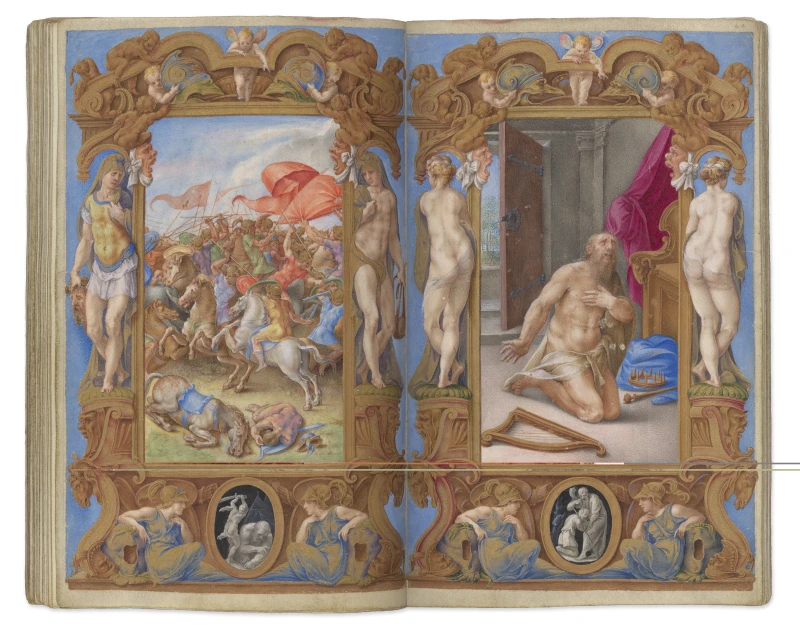
Death of Uriah; David in Penance, from the Morgan’s famed Farnese Hours, demonstrates the enduring appeal of the penitential Psalms of David as seen in this early Renaissance book of hours. Italy, Rome, 1546. The Morgan Library & Museum, New York, MS M.69, fols, 63v-63r. Photography by Janny Chiu. / Credit: Courtesy of the New York Library

New York City, New York, Nov 30, 2025 / 08:00 am (CNA).

Part of the New York Public Library’s Spencer Collection, the Tickhill Psalter is on view throughout Advent and Christmas at The Morgan Library & Museum in its exhibit “Sing a New Song: The Psalms in Medieval Art and Life.” A full-page Jesse Tree introduces the Psalms in the Tickhill Psalter, a 14th-century illuminated manuscript from the Augustinian Worksop Priory in Nottinghamshire, England.

Tree of Jesse (Psalm 1), from the Tickhill Psalter, England, Nottinghamshire, Worksop Priory, 1303-14, New York Public Library, Spencer 26. fol. 6v. The Medieval manuscript is on display in Morgan Library’s Advent exhibit. Credit: Courtesy of the Morgan Library

David appears in the historiated B of Psalm 1, providing a conceptual link to scenes from his life in the Jesse Tree on the facing page. “Beatus vir,” or “Blessed is the man,” the first stanza opens in celebration of the one who delights in God’s law, concluding: “That person is like a tree planted by streams of water, which yields its fruit in season and whose leaf does not wither, — what they do prospers.” 

These words and their historiated B, with its visual link to the facing page, highlight David as key author of the Psalms and their prefiguration of Christ, the good fruit of the Jesse Tree, a theme common to medieval illuminated manuscripts.

King David as Psalmist, from Florence, Italy, ca. 1408-10, by Lorenzo Monaco, who was born Piero di Giovanni but took the name Lorenzo Monaco, or Lorenzo the Monk, upon joining the monastery of Santa Maria degli Angeli, where he became a skilled illuminator and translated themes common to illuminated manuscripts into panel paintings, like this tempera on wood with gold ground depicting David seated on a stone bench tuning a psaltery, lips parted, prepared to sing, with a halo backing the crown he wears to signify the divine inspiration of his compositions. The Metropolitan Museum of Art, New York, 65.14.4. November 2025. Credit: Courtesy of the Metropolitan Museum of Art, New York
Prophets stand in architectural niches on either side of the Tickhill Psalter’s Jesse Tree, heralding the Psalms as prophecy. Credit: Courtesy of the New York Library

The central panel of a 1490 Flemish triptych with scenes from the life of Saint Augustine contextualizes the exhibit. This five-by-five-foot oil on wood painting references Augustine’s use of allegory, essential to his understanding of scripture and interpretation of the psalms as prophecy. One scene captures Augustine’s realization of the Trinity as boundless mystery that dwarfs human understanding, allegorized by a child trying to pour the sea into a hole in the sand. 

Scenes from the life of St. Augustine of Hippo, 1490, Bruges, Belgium, by the unnamed master of St. Augustine, amplifies the Church’s leading theologian on the allegorical interpretation of Psalms. At center, his installation as bishop of Hippo highlights his teaching authority, flanked by scenes of ordination and preaching on the left. On the right, he engages in scholarly discourse and converses with a child trying to pour the sea into a hole in the sand, illustrating the importance of allegory in Augustinian thought. Credit: Courtesy of the New York Public Library
Late 12th-century book comprised of Augustine’s Gradual Psalms and his Enchiridion (Greek for “handbook”). The well-worn and annotated pages reflect the proliferation of Augustinian influence on interpretation of Scripture. Spain, Santa Maria de Benevivere, near Palencia. Free Library of Philadelphia, Lewis E22, fols. 68v-69r. Credit: Courtesy of the New York Public Library

In the book accompanying the exhibit, Morgan curator Deirdre Jackson extends the psalms’ significance to this triptych through a reference to a surviving panel housed in Ireland that shows Augustine on his deathbed. It’s a scene described by contemporary bishop Possidius of Calama, who said that Augustine “ordered those psalms of David which are especially penitential to be copied out and, when he was very weak, used to lie in bed, facing the wall where the written sheets were put up, gazing at them and reading them, and copiously and continuously weeping as he read.”

Death of Uriah; David in Penance, from the Morgan’s famed Farnese Hours, demonstrates the enduring appeal of the penitential Psalms of David as seen in this early Renaissance book of hours. Italy, Rome, 1546. The Morgan Library & Museum, New York, MS M.69, fols, 63v-63r. Photography by Janny Chiu. Credit: Courtesy of the New York Public Library
Scenes from the Life of David, depicting the story of David and Goliath, exemplifies the significance attached to the figure of David in medieval illuminated manuscripts. Winchester Bible, England, Winchester, ca. 1160-80. The Morgan Library & Museum, New York, MS M.619v. Photography by Graham S. Haber. Credit: Courtesy of the New York Library

In his book “The Tickhill Psalter and Related Manuscripts,” 20th-century art historian Donald Drew Egbert speculates that the Tickhill Psalter was decorated by highly skilled illuminators working for Augustinian monasteries and patrons of Augustinian houses during a high point of book arts in England.

St. Thomas More, “in tribulation vehementi et in carcere” (annotation), from the Prayer Book of Thomas More, France, Paris, 1522 (Psalter) and 1530 (Book of Hours), Beinecke Rare Book & Manuscript Library, Yale University, New Haven, MS Vault More, fol. 68v (Psalter section). Credit: Courtesy of the New York Library

This high point inspired a trend of books as personalized treasures, best exemplified in this exhibit by St. Thomas More’s prayer book. Containing much of his own writing in the margins, it consists of a Book of Hours and a Psalter and was with him in the Tower of London while he awaited execution. More’s notes during that time show his preoccupation with the psalms of David’s tribulations. Beside Psalm 87:5-10, “a man without help … in the dark places, and in the shadow of death,” More writes, “in severe tribulation and in prison.”

The Prayer Book of Thomas More is backed by a wall-sized image of Hans Holbein’s "Sir Thomas More," positioned to look like More is gazing intently across the gallery at an image of David from the Crusader Bible. Engelhard Gallery, Photography by Janny Chiu, October 2025. Credit: Courtesy of the New York Library
The Prayer Book of Thomas More is backed by a wall-sized image of Hans Holbein’s “Sir Thomas More,” positioned to look like More is gazing intently across the gallery at an image of David from the Crusader Bible. Engelhard Gallery, Photography by Janny Chiu, October 2025. Credit: Courtesy of the New York Library

More’s thoughts in distress demonstrate the appeal of David’s story to the human heart, a reality repeatedly expressed throughout the treasures of this exhibit. In the Tickhill Psalter’s Jesse Tree, David is encircled by branches springing from a tree that grows out of his father, Jesse, sprawled in an active sleep, his elbow supporting a hand planted against his head as though dreaming of all that is to come. 

A crop of the enter of Tickhill Psalter showing the Virgin and Child and the figure of David playing a harp. Credit: Courtesy of the New York Library

The branches of the tree wind around David and directly overhead to encircle the Virgin and Child, tracing Christ’s lineage through Mary to the House of David. At the top, the branches surround Christ enthroned in majesty, fulfilling the promise of victory over sin and death foreshadowed in the psalms.

David strikes a joyous pose and plays a harp in celebration, and foliage on either side of the main branch wraps around prophets who unfurl scrolls to hint at mysteries about to be foretold in the reading of the psalms.

Beneath the figure of Jesse, two separate depictions of David protecting his sheep from wild animals cast his actions as allegory in the fight against evil, segueing to his likeness in the historiated B, dancing and singing his story into the Psalms to animate their prefiguration of Christ.

Read More
Arizona man sentenced to prison after hoax bomb threats at Christian churches #Catholic 
 
 null / Credit: Chodyra Mike 1/Shutterstock

CNA Staff, Nov 11, 2025 / 11:40 am (CNA).
An Arizona man will serve more than half a decade in prison after he carried out multiple hoax bomb threats at churches in the western U.S.The U.S. Department of Justice said in a press release that 46-year-old Phoenix resident Zimnako Salah would spend six years in prison after his 2025 conviction in the terror plot.From September to November 2023 Salah “traveled to four Christian churches in Arizona, California, and Colorado” with black backpacks, according to the Department of Justice. At two churches he was turned away by security, while at two others he “planted” the backpacks, causing congregants to believe they contained bombs, the Justice Department said.Though the planted backpacks were in fact hoaxes, Salah reportedly had “been building a bomb capable of fitting in a backpack,” the department said. FBI investigators said they seized “component parts of an improvised explosive device” from a storage unit being rented by Salah.Salah also had been actively searching for “extremist propaganda online,” the government said, including searches for videos such as “infidels dying.”The jury that convicted Salah in 2025 found that he “targeted the church because of the religion of the people who worshipped there, making the offense a hate crime.”U.S. District Judge Dena Coggins levied a $10,000 fine against Salah, telling him he “failed to take responsibility for [his] actions.”U.S. Attorney Eric Grant said Salah’s ultimate goal appeared to be “many deaths and injuries.”“Thanks to the action of church security, local law enforcement, and the FBI, this defendant was stopped before he had a chance to carry out the crimes he sought to commit,” he said.Assistant Attorney General Harmeet Dhillon, meanwhile, said in the press release that criminals “who target people because of their faith will face the full force of federal law.”“The Department of Justice will continue to protect the rights of all people of faith to worship and live free from fear, and we will hold accountable anyone who threatens or harms them,” she said. 

Arizona man sentenced to prison after hoax bomb threats at Christian churches #Catholic null / Credit: Chodyra Mike 1/Shutterstock CNA Staff, Nov 11, 2025 / 11:40 am (CNA). An Arizona man will serve more than half a decade in prison after he carried out multiple hoax bomb threats at churches in the western U.S.The U.S. Department of Justice said in a press release that 46-year-old Phoenix resident Zimnako Salah would spend six years in prison after his 2025 conviction in the terror plot.From September to November 2023 Salah “traveled to four Christian churches in Arizona, California, and Colorado” with black backpacks, according to the Department of Justice. At two churches he was turned away by security, while at two others he “planted” the backpacks, causing congregants to believe they contained bombs, the Justice Department said.Though the planted backpacks were in fact hoaxes, Salah reportedly had “been building a bomb capable of fitting in a backpack,” the department said. FBI investigators said they seized “component parts of an improvised explosive device” from a storage unit being rented by Salah.Salah also had been actively searching for “extremist propaganda online,” the government said, including searches for videos such as “infidels dying.”The jury that convicted Salah in 2025 found that he “targeted the church because of the religion of the people who worshipped there, making the offense a hate crime.”U.S. District Judge Dena Coggins levied a $10,000 fine against Salah, telling him he “failed to take responsibility for [his] actions.”U.S. Attorney Eric Grant said Salah’s ultimate goal appeared to be “many deaths and injuries.”“Thanks to the action of church security, local law enforcement, and the FBI, this defendant was stopped before he had a chance to carry out the crimes he sought to commit,” he said.Assistant Attorney General Harmeet Dhillon, meanwhile, said in the press release that criminals “who target people because of their faith will face the full force of federal law.”“The Department of Justice will continue to protect the rights of all people of faith to worship and live free from fear, and we will hold accountable anyone who threatens or harms them,” she said. 


null / Credit: Chodyra Mike 1/Shutterstock

CNA Staff, Nov 11, 2025 / 11:40 am (CNA).

An Arizona man will serve more than half a decade in prison after he carried out multiple hoax bomb threats at churches in the western U.S.

The U.S. Department of Justice said in a press release that 46-year-old Phoenix resident Zimnako Salah would spend six years in prison after his 2025 conviction in the terror plot.

From September to November 2023 Salah “traveled to four Christian churches in Arizona, California, and Colorado” with black backpacks, according to the Department of Justice. At two churches he was turned away by security, while at two others he “planted” the backpacks, causing congregants to believe they contained bombs, the Justice Department said.

Though the planted backpacks were in fact hoaxes, Salah reportedly had “been building a bomb capable of fitting in a backpack,” the department said. FBI investigators said they seized “component parts of an improvised explosive device” from a storage unit being rented by Salah.

Salah also had been actively searching for “extremist propaganda online,” the government said, including searches for videos such as “infidels dying.”

The jury that convicted Salah in 2025 found that he “targeted the church because of the religion of the people who worshipped there, making the offense a hate crime.”

U.S. District Judge Dena Coggins levied a $10,000 fine against Salah, telling him he “failed to take responsibility for [his] actions.”

U.S. Attorney Eric Grant said Salah’s ultimate goal appeared to be “many deaths and injuries.”

“Thanks to the action of church security, local law enforcement, and the FBI, this defendant was stopped before he had a chance to carry out the crimes he sought to commit,” he said.

Assistant Attorney General Harmeet Dhillon, meanwhile, said in the press release that criminals “who target people because of their faith will face the full force of federal law.”

“The Department of Justice will continue to protect the rights of all people of faith to worship and live free from fear, and we will hold accountable anyone who threatens or harms them,” she said. 

Read More