Psalm

Ancient Advent Mass gains new interest among younger Catholics #Catholic 
 
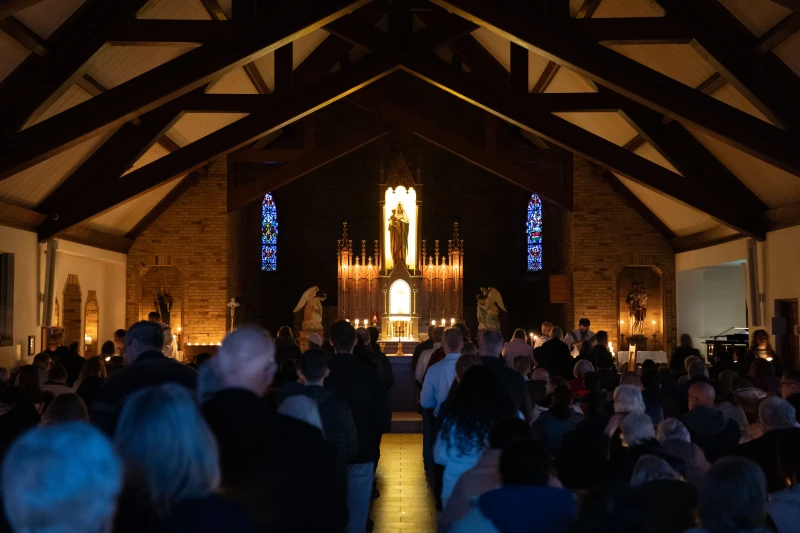
 The Rorate Caeli Advent Mass celebrated at The National Shrine of Our Lady of Champion. / Credit: The National Shrine of Our Lady of Champion

CNA Staff, Dec 14, 2025 / 06:00 am (CNA).
Advent is a season filled with rich Catholic traditions, but a slightly lesser-known one is growing in popularity among younger Catholics. The ancient liturgy of the Rorate Caeli Advent Mass honors the Blessed Virgin Mary through a Mass celebrated at dawn, in complete darkness, and lit only by candles, which symbolizes Christ, the Light of the World, entering into the world with Mary as the vessel. Emerging in the Middle Ages, the Rorate Caeli Mass gets its name from the prophecy of Isaiah. Rorate Caeli is Latin for “drop down, ye heavens.” These are the opening words of this liturgy’s Introit, which is used as an opening psalm or entrance antiphon and comes from Isaiah 45:8.Father Tony Stephens, rector at the National Shrine of Our Lady of Champion in Champion, Wisconsin, calls this Mass “a teachable moment.”“As all of us are gathered in the church, only lit with the candles, slowly the light begins coming in through the windows and it’s like the light of Christ,” he told CNA. The process symbolizes “the light of Christ coming into our lives, slowly but surely and progressively as we go through life.”“And just like that light begins to come in through the windows, as the physical sun rises, so in our journey as Catholics, the closer we get to Christ, the more his light shines in our life,” he said. Fr. Nathaneal Mudd, CPM, celebrates the Rorate Caeli Advent Mass at the National Shrine of Our Lady of Champion in 2024. Credit: The National Shrine of Our Lady of ChampionStephens has been rector of the National Shrine of Our Lady of Champion for two years but was scheduled to celebrate the Rorate Caeli Mass there for the first time on Dec. 13. The shrine is the first and only approved Marian apparition site in the United States. It was here that the Blessed Mother is believed to have appeared to Adele Brise in 1859. When speaking about the Blessed Mother’s role in Advent, Stephens described it as “a season of anticipating Our Lord, but when you look at the subtext of Advent, things about Mary are everywhere — in the readings and her role in salvation history is so important. And so that’s, again, part of the reason you have these special Marian Masses honoring her during this Advent season.”He also highlighted the fact that this ancient Mass is seeing a resurgence in popularity and credited Pope Benedict XVI, in part, for reintroducing Catholics to older, traditional practices and his “desire of the hermeneutic of continuity.” “He in his pontificate really emphasized a desire to have that continuity between the earlier traditions of the Church, even prior to the [Vatican II] council … looking at all of the rich liturgical heritage that we have as Catholics,” he added. The priest pointed out that young people are also searching for more traditional practices.“There is a great love, especially amongst young people, for things that are traditional,” he said, adding that the Mass also “appeals to the senses in a way that technology and phones don’t.” “The real light of a candle is way different than the electronic light put off by a cellphone screen,” he said. “A burning, living candle, the way it flickers, and you can’t recharge a candle — it gives everything it has like Jesus did on the cross. A candle burns with all its might to put off that light. And so there is a selflessness about that light of that candle that’s different than technology, and young people desire that kind of self-gift and authenticity.”Stephens said he hopes those who attend a Rorate Caeli Mass will leave with “an eager anticipation of Jesus coming at Christmastime.”“A Rorate Caeli Mass is one of those times that we can have a little consolation and we’re reminded of the author of all consolation and his mother,” he said.

Ancient Advent Mass gains new interest among younger Catholics #Catholic The Rorate Caeli Advent Mass celebrated at The National Shrine of Our Lady of Champion. / Credit: The National Shrine of Our Lady of Champion CNA Staff, Dec 14, 2025 / 06:00 am (CNA). Advent is a season filled with rich Catholic traditions, but a slightly lesser-known one is growing in popularity among younger Catholics. The ancient liturgy of the Rorate Caeli Advent Mass honors the Blessed Virgin Mary through a Mass celebrated at dawn, in complete darkness, and lit only by candles, which symbolizes Christ, the Light of the World, entering into the world with Mary as the vessel. Emerging in the Middle Ages, the Rorate Caeli Mass gets its name from the prophecy of Isaiah. Rorate Caeli is Latin for “drop down, ye heavens.” These are the opening words of this liturgy’s Introit, which is used as an opening psalm or entrance antiphon and comes from Isaiah 45:8.Father Tony Stephens, rector at the National Shrine of Our Lady of Champion in Champion, Wisconsin, calls this Mass “a teachable moment.”“As all of us are gathered in the church, only lit with the candles, slowly the light begins coming in through the windows and it’s like the light of Christ,” he told CNA. The process symbolizes “the light of Christ coming into our lives, slowly but surely and progressively as we go through life.”“And just like that light begins to come in through the windows, as the physical sun rises, so in our journey as Catholics, the closer we get to Christ, the more his light shines in our life,” he said. Fr. Nathaneal Mudd, CPM, celebrates the Rorate Caeli Advent Mass at the National Shrine of Our Lady of Champion in 2024. Credit: The National Shrine of Our Lady of ChampionStephens has been rector of the National Shrine of Our Lady of Champion for two years but was scheduled to celebrate the Rorate Caeli Mass there for the first time on Dec. 13. The shrine is the first and only approved Marian apparition site in the United States. It was here that the Blessed Mother is believed to have appeared to Adele Brise in 1859. When speaking about the Blessed Mother’s role in Advent, Stephens described it as “a season of anticipating Our Lord, but when you look at the subtext of Advent, things about Mary are everywhere — in the readings and her role in salvation history is so important. And so that’s, again, part of the reason you have these special Marian Masses honoring her during this Advent season.”He also highlighted the fact that this ancient Mass is seeing a resurgence in popularity and credited Pope Benedict XVI, in part, for reintroducing Catholics to older, traditional practices and his “desire of the hermeneutic of continuity.” “He in his pontificate really emphasized a desire to have that continuity between the earlier traditions of the Church, even prior to the [Vatican II] council … looking at all of the rich liturgical heritage that we have as Catholics,” he added. The priest pointed out that young people are also searching for more traditional practices.“There is a great love, especially amongst young people, for things that are traditional,” he said, adding that the Mass also “appeals to the senses in a way that technology and phones don’t.” “The real light of a candle is way different than the electronic light put off by a cellphone screen,” he said. “A burning, living candle, the way it flickers, and you can’t recharge a candle — it gives everything it has like Jesus did on the cross. A candle burns with all its might to put off that light. And so there is a selflessness about that light of that candle that’s different than technology, and young people desire that kind of self-gift and authenticity.”Stephens said he hopes those who attend a Rorate Caeli Mass will leave with “an eager anticipation of Jesus coming at Christmastime.”“A Rorate Caeli Mass is one of those times that we can have a little consolation and we’re reminded of the author of all consolation and his mother,” he said.


The Rorate Caeli Advent Mass celebrated at The National Shrine of Our Lady of Champion. / Credit: The National Shrine of Our Lady of Champion

CNA Staff, Dec 14, 2025 / 06:00 am (CNA).

Advent is a season filled with rich Catholic traditions, but a slightly lesser-known one is growing in popularity among younger Catholics.

The ancient liturgy of the Rorate Caeli Advent Mass honors the Blessed Virgin Mary through a Mass celebrated at dawn, in complete darkness, and lit only by candles, which symbolizes Christ, the Light of the World, entering into the world with Mary as the vessel. 

Emerging in the Middle Ages, the Rorate Caeli Mass gets its name from the prophecy of Isaiah. Rorate Caeli is Latin for “drop down, ye heavens.” These are the opening words of this liturgy’s Introit, which is used as an opening psalm or entrance antiphon and comes from Isaiah 45:8.

Father Tony Stephens, rector at the National Shrine of Our Lady of Champion in Champion, Wisconsin, calls this Mass “a teachable moment.”

“As all of us are gathered in the church, only lit with the candles, slowly the light begins coming in through the windows and it’s like the light of Christ,” he told CNA. The process symbolizes “the light of Christ coming into our lives, slowly but surely and progressively as we go through life.”

“And just like that light begins to come in through the windows, as the physical sun rises, so in our journey as Catholics, the closer we get to Christ, the more his light shines in our life,” he said.

Fr. Nathaneal Mudd, CPM, celebrates the Rorate Caeli Advent Mass at the National Shrine of Our Lady of Champion in 2024. Credit: The National Shrine of Our Lady of Champion

Stephens has been rector of the National Shrine of Our Lady of Champion for two years but was scheduled to celebrate the Rorate Caeli Mass there for the first time on Dec. 13. The shrine is the first and only approved Marian apparition site in the United States. It was here that the Blessed Mother is believed to have appeared to Adele Brise in 1859. 

When speaking about the Blessed Mother’s role in Advent, Stephens described it as “a season of anticipating Our Lord, but when you look at the subtext of Advent, things about Mary are everywhere — in the readings and her role in salvation history is so important. And so that’s, again, part of the reason you have these special Marian Masses honoring her during this Advent season.”

He also highlighted the fact that this ancient Mass is seeing a resurgence in popularity and credited Pope Benedict XVI, in part, for reintroducing Catholics to older, traditional practices and his “desire of the hermeneutic of continuity.” 

“He in his pontificate really emphasized a desire to have that continuity between the earlier traditions of the Church, even prior to the [Vatican II] council … looking at all of the rich liturgical heritage that we have as Catholics,” he added. 

The priest pointed out that young people are also searching for more traditional practices.

“There is a great love, especially amongst young people, for things that are traditional,” he said, adding that the Mass also “appeals to the senses in a way that technology and phones don’t.” 

“The real light of a candle is way different than the electronic light put off by a cellphone screen,” he said. “A burning, living candle, the way it flickers, and you can’t recharge a candle — it gives everything it has like Jesus did on the cross. A candle burns with all its might to put off that light. And so there is a selflessness about that light of that candle that’s different than technology, and young people desire that kind of self-gift and authenticity.”

Stephens said he hopes those who attend a Rorate Caeli Mass will leave with “an eager anticipation of Jesus coming at Christmastime.”

“A Rorate Caeli Mass is one of those times that we can have a little consolation and we’re reminded of the author of all consolation and his mother,” he said.

Read More
PHOTOS: Tickhill Psalter’s Jesse Tree shines in Morgan Library’s Advent exhibit #Catholic 
 
 Death of Uriah; David in Penance, from the Morgan’s famed Farnese Hours, demonstrates the enduring appeal of the penitential Psalms of David as seen in this early Renaissance book of hours. Italy, Rome, 1546. The Morgan Library & Museum, New York, MS M.69, fols, 63v-63r. Photography by Janny Chiu. / Credit: Courtesy of the New York Library

New York City, New York, Nov 30, 2025 / 08:00 am (CNA).
Part of the New York Public Library’s Spencer Collection, the Tickhill Psalter is on view throughout Advent and Christmas at The Morgan Library & Museum in its exhibit “Sing a New Song: The Psalms in Medieval Art and Life.” A full-page Jesse Tree introduces the Psalms in the Tickhill Psalter, a 14th-century illuminated manuscript from the Augustinian Worksop Priory in Nottinghamshire, England. Tree of Jesse (Psalm 1), from the Tickhill Psalter, England, Nottinghamshire, Worksop Priory, 1303-14, New York Public Library, Spencer 26. fol. 6v. The Medieval manuscript is on display in Morgan Library’s Advent exhibit. Credit: Courtesy of the Morgan LibraryDavid appears in the historiated B of Psalm 1, providing a conceptual link to scenes from his life in the Jesse Tree on the facing page. “Beatus vir,” or “Blessed is the man,” the first stanza opens in celebration of the one who delights in God’s law, concluding: “That person is like a tree planted by streams of water, which yields its fruit in season and whose leaf does not wither, — what they do prospers.” These words and their historiated B, with its visual link to the facing page, highlight David as key author of the Psalms and their prefiguration of Christ, the good fruit of the Jesse Tree, a theme common to medieval illuminated manuscripts.King David as Psalmist, from Florence, Italy, ca. 1408-10, by Lorenzo Monaco, who was born Piero di Giovanni but took the name Lorenzo Monaco, or Lorenzo the Monk, upon joining the monastery of Santa Maria degli Angeli, where he became a skilled illuminator and translated themes common to illuminated manuscripts into panel paintings, like this tempera on wood with gold ground depicting David seated on a stone bench tuning a psaltery, lips parted, prepared to sing, with a halo backing the crown he wears to signify the divine inspiration of his compositions. The Metropolitan Museum of Art, New York, 65.14.4. November 2025. Credit: Courtesy of the Metropolitan Museum of Art, New YorkProphets stand in architectural niches on either side of the Tickhill Psalter’s Jesse Tree, heralding the Psalms as prophecy. Credit: Courtesy of the New York LibraryThe central panel of a 1490 Flemish triptych with scenes from the life of Saint Augustine contextualizes the exhibit. This five-by-five-foot oil on wood painting references Augustine’s use of allegory, essential to his understanding of scripture and interpretation of the psalms as prophecy. One scene captures Augustine’s realization of the Trinity as boundless mystery that dwarfs human understanding, allegorized by a child trying to pour the sea into a hole in the sand. Scenes from the life of St. Augustine of Hippo, 1490, Bruges, Belgium, by the unnamed master of St. Augustine, amplifies the Church’s leading theologian on the allegorical interpretation of Psalms. At center, his installation as bishop of Hippo highlights his teaching authority, flanked by scenes of ordination and preaching on the left. On the right, he engages in scholarly discourse and converses with a child trying to pour the sea into a hole in the sand, illustrating the importance of allegory in Augustinian thought. Credit: Courtesy of the New York Public LibraryLate 12th-century book comprised of Augustine’s Gradual Psalms and his Enchiridion (Greek for “handbook”). The well-worn and annotated pages reflect the proliferation of Augustinian influence on interpretation of Scripture. Spain, Santa Maria de Benevivere, near Palencia. Free Library of Philadelphia, Lewis E22, fols. 68v-69r. Credit: Courtesy of the New York Public LibraryIn the book accompanying the exhibit, Morgan curator Deirdre Jackson extends the psalms’ significance to this triptych through a reference to a surviving panel housed in Ireland that shows Augustine on his deathbed. It’s a scene described by contemporary bishop Possidius of Calama, who said that Augustine “ordered those psalms of David which are especially penitential to be copied out and, when he was very weak, used to lie in bed, facing the wall where the written sheets were put up, gazing at them and reading them, and copiously and continuously weeping as he read.”Death of Uriah; David in Penance, from the Morgan’s famed Farnese Hours, demonstrates the enduring appeal of the penitential Psalms of David as seen in this early Renaissance book of hours. Italy, Rome, 1546. The Morgan Library & Museum, New York, MS M.69, fols, 63v-63r. Photography by Janny Chiu. Credit: Courtesy of the New York Public LibraryScenes from the Life of David, depicting the story of David and Goliath, exemplifies the significance attached to the figure of David in medieval illuminated manuscripts. Winchester Bible, England, Winchester, ca. 1160-80. The Morgan Library & Museum, New York, MS M.619v. Photography by Graham S. Haber. Credit: Courtesy of the New York LibraryIn his book “The Tickhill Psalter and Related Manuscripts,” 20th-century art historian Donald Drew Egbert speculates that the Tickhill Psalter was decorated by highly skilled illuminators working for Augustinian monasteries and patrons of Augustinian houses during a high point of book arts in England.St. Thomas More, “in tribulation vehementi et in carcere” (annotation), from the Prayer Book of Thomas More, France, Paris, 1522 (Psalter) and 1530 (Book of Hours), Beinecke Rare Book & Manuscript Library, Yale University, New Haven, MS Vault More, fol. 68v (Psalter section). Credit: Courtesy of the New York LibraryThis high point inspired a trend of books as personalized treasures, best exemplified in this exhibit by St. Thomas More’s prayer book. Containing much of his own writing in the margins, it consists of a Book of Hours and a Psalter and was with him in the Tower of London while he awaited execution. More’s notes during that time show his preoccupation with the psalms of David’s tribulations. Beside Psalm 87:5-10, “a man without help … in the dark places, and in the shadow of death,” More writes, “in severe tribulation and in prison.”The Prayer Book of Thomas More is backed by a wall-sized image of Hans Holbein’s “Sir Thomas More,” positioned to look like More is gazing intently across the gallery at an image of David from the Crusader Bible. Engelhard Gallery, Photography by Janny Chiu, October 2025. Credit: Courtesy of the New York LibraryMore’s thoughts in distress demonstrate the appeal of David’s story to the human heart, a reality repeatedly expressed throughout the treasures of this exhibit. In the Tickhill Psalter’s Jesse Tree, David is encircled by branches springing from a tree that grows out of his father, Jesse, sprawled in an active sleep, his elbow supporting a hand planted against his head as though dreaming of all that is to come. A crop of the enter of Tickhill Psalter showing the Virgin and Child and the figure of David playing a harp. Credit: Courtesy of the New York LibraryThe branches of the tree wind around David and directly overhead to encircle the Virgin and Child, tracing Christ’s lineage through Mary to the House of David. At the top, the branches surround Christ enthroned in majesty, fulfilling the promise of victory over sin and death foreshadowed in the psalms.David strikes a joyous pose and plays a harp in celebration, and foliage on either side of the main branch wraps around prophets who unfurl scrolls to hint at mysteries about to be foretold in the reading of the psalms.Beneath the figure of Jesse, two separate depictions of David protecting his sheep from wild animals cast his actions as allegory in the fight against evil, segueing to his likeness in the historiated B, dancing and singing his story into the Psalms to animate their prefiguration of Christ.

PHOTOS: Tickhill Psalter’s Jesse Tree shines in Morgan Library’s Advent exhibit #Catholic Death of Uriah; David in Penance, from the Morgan’s famed Farnese Hours, demonstrates the enduring appeal of the penitential Psalms of David as seen in this early Renaissance book of hours. Italy, Rome, 1546. The Morgan Library & Museum, New York, MS M.69, fols, 63v-63r. Photography by Janny Chiu. / Credit: Courtesy of the New York Library New York City, New York, Nov 30, 2025 / 08:00 am (CNA). Part of the New York Public Library’s Spencer Collection, the Tickhill Psalter is on view throughout Advent and Christmas at The Morgan Library & Museum in its exhibit “Sing a New Song: The Psalms in Medieval Art and Life.” A full-page Jesse Tree introduces the Psalms in the Tickhill Psalter, a 14th-century illuminated manuscript from the Augustinian Worksop Priory in Nottinghamshire, England. Tree of Jesse (Psalm 1), from the Tickhill Psalter, England, Nottinghamshire, Worksop Priory, 1303-14, New York Public Library, Spencer 26. fol. 6v. The Medieval manuscript is on display in Morgan Library’s Advent exhibit. Credit: Courtesy of the Morgan LibraryDavid appears in the historiated B of Psalm 1, providing a conceptual link to scenes from his life in the Jesse Tree on the facing page. “Beatus vir,” or “Blessed is the man,” the first stanza opens in celebration of the one who delights in God’s law, concluding: “That person is like a tree planted by streams of water, which yields its fruit in season and whose leaf does not wither, — what they do prospers.” These words and their historiated B, with its visual link to the facing page, highlight David as key author of the Psalms and their prefiguration of Christ, the good fruit of the Jesse Tree, a theme common to medieval illuminated manuscripts.King David as Psalmist, from Florence, Italy, ca. 1408-10, by Lorenzo Monaco, who was born Piero di Giovanni but took the name Lorenzo Monaco, or Lorenzo the Monk, upon joining the monastery of Santa Maria degli Angeli, where he became a skilled illuminator and translated themes common to illuminated manuscripts into panel paintings, like this tempera on wood with gold ground depicting David seated on a stone bench tuning a psaltery, lips parted, prepared to sing, with a halo backing the crown he wears to signify the divine inspiration of his compositions. The Metropolitan Museum of Art, New York, 65.14.4. November 2025. Credit: Courtesy of the Metropolitan Museum of Art, New YorkProphets stand in architectural niches on either side of the Tickhill Psalter’s Jesse Tree, heralding the Psalms as prophecy. Credit: Courtesy of the New York LibraryThe central panel of a 1490 Flemish triptych with scenes from the life of Saint Augustine contextualizes the exhibit. This five-by-five-foot oil on wood painting references Augustine’s use of allegory, essential to his understanding of scripture and interpretation of the psalms as prophecy. One scene captures Augustine’s realization of the Trinity as boundless mystery that dwarfs human understanding, allegorized by a child trying to pour the sea into a hole in the sand. Scenes from the life of St. Augustine of Hippo, 1490, Bruges, Belgium, by the unnamed master of St. Augustine, amplifies the Church’s leading theologian on the allegorical interpretation of Psalms. At center, his installation as bishop of Hippo highlights his teaching authority, flanked by scenes of ordination and preaching on the left. On the right, he engages in scholarly discourse and converses with a child trying to pour the sea into a hole in the sand, illustrating the importance of allegory in Augustinian thought. Credit: Courtesy of the New York Public LibraryLate 12th-century book comprised of Augustine’s Gradual Psalms and his Enchiridion (Greek for “handbook”). The well-worn and annotated pages reflect the proliferation of Augustinian influence on interpretation of Scripture. Spain, Santa Maria de Benevivere, near Palencia. Free Library of Philadelphia, Lewis E22, fols. 68v-69r. Credit: Courtesy of the New York Public LibraryIn the book accompanying the exhibit, Morgan curator Deirdre Jackson extends the psalms’ significance to this triptych through a reference to a surviving panel housed in Ireland that shows Augustine on his deathbed. It’s a scene described by contemporary bishop Possidius of Calama, who said that Augustine “ordered those psalms of David which are especially penitential to be copied out and, when he was very weak, used to lie in bed, facing the wall where the written sheets were put up, gazing at them and reading them, and copiously and continuously weeping as he read.”Death of Uriah; David in Penance, from the Morgan’s famed Farnese Hours, demonstrates the enduring appeal of the penitential Psalms of David as seen in this early Renaissance book of hours. Italy, Rome, 1546. The Morgan Library & Museum, New York, MS M.69, fols, 63v-63r. Photography by Janny Chiu. Credit: Courtesy of the New York Public LibraryScenes from the Life of David, depicting the story of David and Goliath, exemplifies the significance attached to the figure of David in medieval illuminated manuscripts. Winchester Bible, England, Winchester, ca. 1160-80. The Morgan Library & Museum, New York, MS M.619v. Photography by Graham S. Haber. Credit: Courtesy of the New York LibraryIn his book “The Tickhill Psalter and Related Manuscripts,” 20th-century art historian Donald Drew Egbert speculates that the Tickhill Psalter was decorated by highly skilled illuminators working for Augustinian monasteries and patrons of Augustinian houses during a high point of book arts in England.St. Thomas More, “in tribulation vehementi et in carcere” (annotation), from the Prayer Book of Thomas More, France, Paris, 1522 (Psalter) and 1530 (Book of Hours), Beinecke Rare Book & Manuscript Library, Yale University, New Haven, MS Vault More, fol. 68v (Psalter section). Credit: Courtesy of the New York LibraryThis high point inspired a trend of books as personalized treasures, best exemplified in this exhibit by St. Thomas More’s prayer book. Containing much of his own writing in the margins, it consists of a Book of Hours and a Psalter and was with him in the Tower of London while he awaited execution. More’s notes during that time show his preoccupation with the psalms of David’s tribulations. Beside Psalm 87:5-10, “a man without help … in the dark places, and in the shadow of death,” More writes, “in severe tribulation and in prison.”The Prayer Book of Thomas More is backed by a wall-sized image of Hans Holbein’s “Sir Thomas More,” positioned to look like More is gazing intently across the gallery at an image of David from the Crusader Bible. Engelhard Gallery, Photography by Janny Chiu, October 2025. Credit: Courtesy of the New York LibraryMore’s thoughts in distress demonstrate the appeal of David’s story to the human heart, a reality repeatedly expressed throughout the treasures of this exhibit. In the Tickhill Psalter’s Jesse Tree, David is encircled by branches springing from a tree that grows out of his father, Jesse, sprawled in an active sleep, his elbow supporting a hand planted against his head as though dreaming of all that is to come. A crop of the enter of Tickhill Psalter showing the Virgin and Child and the figure of David playing a harp. Credit: Courtesy of the New York LibraryThe branches of the tree wind around David and directly overhead to encircle the Virgin and Child, tracing Christ’s lineage through Mary to the House of David. At the top, the branches surround Christ enthroned in majesty, fulfilling the promise of victory over sin and death foreshadowed in the psalms.David strikes a joyous pose and plays a harp in celebration, and foliage on either side of the main branch wraps around prophets who unfurl scrolls to hint at mysteries about to be foretold in the reading of the psalms.Beneath the figure of Jesse, two separate depictions of David protecting his sheep from wild animals cast his actions as allegory in the fight against evil, segueing to his likeness in the historiated B, dancing and singing his story into the Psalms to animate their prefiguration of Christ.


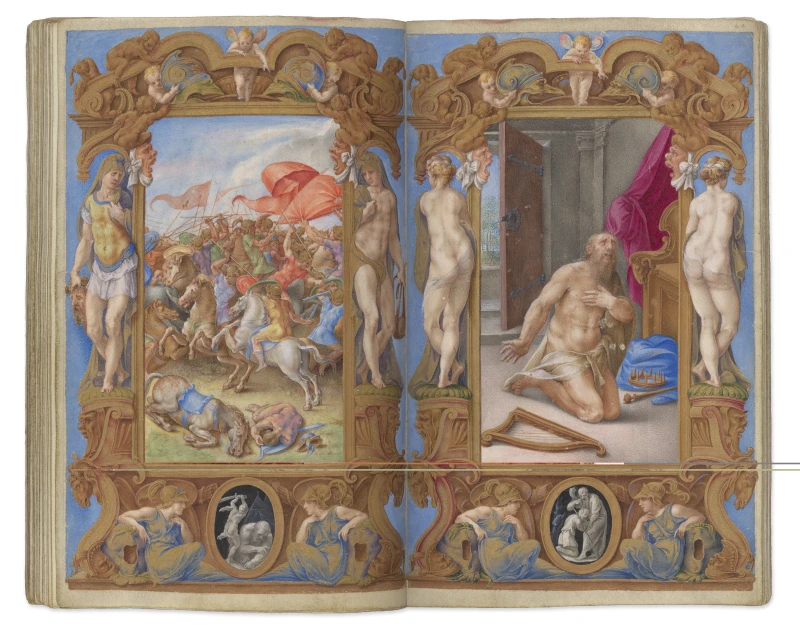
Death of Uriah; David in Penance, from the Morgan’s famed Farnese Hours, demonstrates the enduring appeal of the penitential Psalms of David as seen in this early Renaissance book of hours. Italy, Rome, 1546. The Morgan Library & Museum, New York, MS M.69, fols, 63v-63r. Photography by Janny Chiu. / Credit: Courtesy of the New York Library

New York City, New York, Nov 30, 2025 / 08:00 am (CNA).

Part of the New York Public Library’s Spencer Collection, the Tickhill Psalter is on view throughout Advent and Christmas at The Morgan Library & Museum in its exhibit “Sing a New Song: The Psalms in Medieval Art and Life.” A full-page Jesse Tree introduces the Psalms in the Tickhill Psalter, a 14th-century illuminated manuscript from the Augustinian Worksop Priory in Nottinghamshire, England.

Tree of Jesse (Psalm 1), from the Tickhill Psalter, England, Nottinghamshire, Worksop Priory, 1303-14, New York Public Library, Spencer 26. fol. 6v. The Medieval manuscript is on display in Morgan Library’s Advent exhibit. Credit: Courtesy of the Morgan Library

David appears in the historiated B of Psalm 1, providing a conceptual link to scenes from his life in the Jesse Tree on the facing page. “Beatus vir,” or “Blessed is the man,” the first stanza opens in celebration of the one who delights in God’s law, concluding: “That person is like a tree planted by streams of water, which yields its fruit in season and whose leaf does not wither, — what they do prospers.” 

These words and their historiated B, with its visual link to the facing page, highlight David as key author of the Psalms and their prefiguration of Christ, the good fruit of the Jesse Tree, a theme common to medieval illuminated manuscripts.

King David as Psalmist, from Florence, Italy, ca. 1408-10, by Lorenzo Monaco, who was born Piero di Giovanni but took the name Lorenzo Monaco, or Lorenzo the Monk, upon joining the monastery of Santa Maria degli Angeli, where he became a skilled illuminator and translated themes common to illuminated manuscripts into panel paintings, like this tempera on wood with gold ground depicting David seated on a stone bench tuning a psaltery, lips parted, prepared to sing, with a halo backing the crown he wears to signify the divine inspiration of his compositions. The Metropolitan Museum of Art, New York, 65.14.4. November 2025. Credit: Courtesy of the Metropolitan Museum of Art, New York
Prophets stand in architectural niches on either side of the Tickhill Psalter’s Jesse Tree, heralding the Psalms as prophecy. Credit: Courtesy of the New York Library

The central panel of a 1490 Flemish triptych with scenes from the life of Saint Augustine contextualizes the exhibit. This five-by-five-foot oil on wood painting references Augustine’s use of allegory, essential to his understanding of scripture and interpretation of the psalms as prophecy. One scene captures Augustine’s realization of the Trinity as boundless mystery that dwarfs human understanding, allegorized by a child trying to pour the sea into a hole in the sand. 

Scenes from the life of St. Augustine of Hippo, 1490, Bruges, Belgium, by the unnamed master of St. Augustine, amplifies the Church’s leading theologian on the allegorical interpretation of Psalms. At center, his installation as bishop of Hippo highlights his teaching authority, flanked by scenes of ordination and preaching on the left. On the right, he engages in scholarly discourse and converses with a child trying to pour the sea into a hole in the sand, illustrating the importance of allegory in Augustinian thought. Credit: Courtesy of the New York Public Library
Late 12th-century book comprised of Augustine’s Gradual Psalms and his Enchiridion (Greek for “handbook”). The well-worn and annotated pages reflect the proliferation of Augustinian influence on interpretation of Scripture. Spain, Santa Maria de Benevivere, near Palencia. Free Library of Philadelphia, Lewis E22, fols. 68v-69r. Credit: Courtesy of the New York Public Library

In the book accompanying the exhibit, Morgan curator Deirdre Jackson extends the psalms’ significance to this triptych through a reference to a surviving panel housed in Ireland that shows Augustine on his deathbed. It’s a scene described by contemporary bishop Possidius of Calama, who said that Augustine “ordered those psalms of David which are especially penitential to be copied out and, when he was very weak, used to lie in bed, facing the wall where the written sheets were put up, gazing at them and reading them, and copiously and continuously weeping as he read.”

Death of Uriah; David in Penance, from the Morgan’s famed Farnese Hours, demonstrates the enduring appeal of the penitential Psalms of David as seen in this early Renaissance book of hours. Italy, Rome, 1546. The Morgan Library & Museum, New York, MS M.69, fols, 63v-63r. Photography by Janny Chiu. Credit: Courtesy of the New York Public Library
Scenes from the Life of David, depicting the story of David and Goliath, exemplifies the significance attached to the figure of David in medieval illuminated manuscripts. Winchester Bible, England, Winchester, ca. 1160-80. The Morgan Library & Museum, New York, MS M.619v. Photography by Graham S. Haber. Credit: Courtesy of the New York Library

In his book “The Tickhill Psalter and Related Manuscripts,” 20th-century art historian Donald Drew Egbert speculates that the Tickhill Psalter was decorated by highly skilled illuminators working for Augustinian monasteries and patrons of Augustinian houses during a high point of book arts in England.

St. Thomas More, “in tribulation vehementi et in carcere” (annotation), from the Prayer Book of Thomas More, France, Paris, 1522 (Psalter) and 1530 (Book of Hours), Beinecke Rare Book & Manuscript Library, Yale University, New Haven, MS Vault More, fol. 68v (Psalter section). Credit: Courtesy of the New York Library

This high point inspired a trend of books as personalized treasures, best exemplified in this exhibit by St. Thomas More’s prayer book. Containing much of his own writing in the margins, it consists of a Book of Hours and a Psalter and was with him in the Tower of London while he awaited execution. More’s notes during that time show his preoccupation with the psalms of David’s tribulations. Beside Psalm 87:5-10, “a man without help … in the dark places, and in the shadow of death,” More writes, “in severe tribulation and in prison.”

The Prayer Book of Thomas More is backed by a wall-sized image of Hans Holbein’s "Sir Thomas More," positioned to look like More is gazing intently across the gallery at an image of David from the Crusader Bible. Engelhard Gallery, Photography by Janny Chiu, October 2025. Credit: Courtesy of the New York Library
The Prayer Book of Thomas More is backed by a wall-sized image of Hans Holbein’s “Sir Thomas More,” positioned to look like More is gazing intently across the gallery at an image of David from the Crusader Bible. Engelhard Gallery, Photography by Janny Chiu, October 2025. Credit: Courtesy of the New York Library

More’s thoughts in distress demonstrate the appeal of David’s story to the human heart, a reality repeatedly expressed throughout the treasures of this exhibit. In the Tickhill Psalter’s Jesse Tree, David is encircled by branches springing from a tree that grows out of his father, Jesse, sprawled in an active sleep, his elbow supporting a hand planted against his head as though dreaming of all that is to come. 

A crop of the enter of Tickhill Psalter showing the Virgin and Child and the figure of David playing a harp. Credit: Courtesy of the New York Library

The branches of the tree wind around David and directly overhead to encircle the Virgin and Child, tracing Christ’s lineage through Mary to the House of David. At the top, the branches surround Christ enthroned in majesty, fulfilling the promise of victory over sin and death foreshadowed in the psalms.

David strikes a joyous pose and plays a harp in celebration, and foliage on either side of the main branch wraps around prophets who unfurl scrolls to hint at mysteries about to be foretold in the reading of the psalms.

Beneath the figure of Jesse, two separate depictions of David protecting his sheep from wild animals cast his actions as allegory in the fight against evil, segueing to his likeness in the historiated B, dancing and singing his story into the Psalms to animate their prefiguration of Christ.

Read More