Quote

‘Holiness of family life’: A look behind the icon depicting a mother of 8 #Catholic 
 
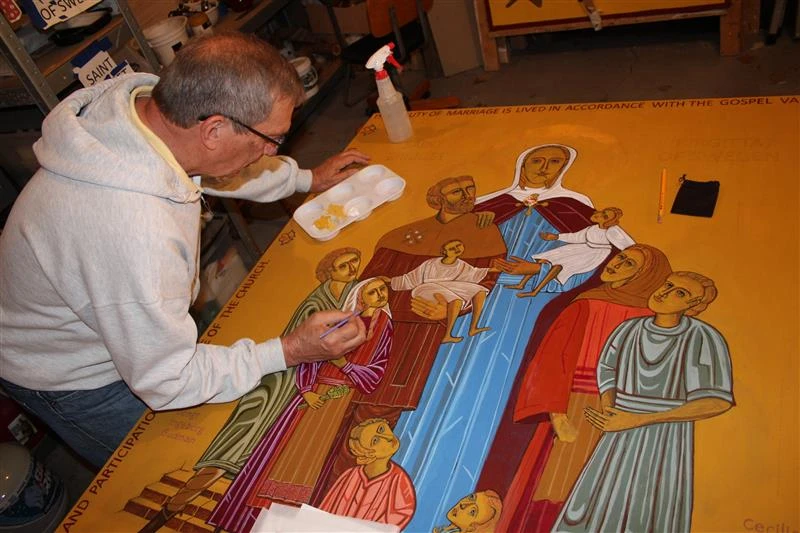
 Father Richard Reiser, an iconographer based in Omaha, Nebraska, writes an icon of St. Bridget of Sweden with her family for FOCCUS Marriage Ministries’ 40th anniversary. / Credit: Photo courtesy of FOCCUS

CNA Staff, Dec 13, 2025 / 06:00 am (CNA).
When an iconographer began his work on a unique icon, he looked to the bones of the saint’s husband for help.FOCCUS Marriage Ministries, a Catholic marriage ministry, invited the priest-iconographer Father Richard Reiser to make an icon of St. Bridget of Sweden, a mystic and the mother of eight. The ministry is celebrating its 40th anniversary this year and chose St. Bridget to be the patron saint of its work.But there was one challenge. According to Reiser, historically there is no established iconographic prototype of an icon of St. Bridget of Sweden.So using his imagination and every historical source available — including the bones of St. Bridget’s husband — the priest developed an entirely new icon of a saint who has gone without an icon for hundreds of years.The domestic church “For me, iconography is first and foremost a form of prayer,” Reiser said. “The entire creative process is an act of listening to God and allowing the sacred story of a saint or mystery to take shape through layers of contemplation, color, and symbolism.”The end result was an icon ripe with symbolic meaning — at its heart, marriage and family.At the blessing ceremony of the icon are (left to right): FOCCUS Director of Ministry Father Michael Grewe, Archbishop Michael McGovern of Omaha, FOCCUS Executive Director Sheila Simpson, and Iconographer Father Richard Reiser. Credit: Photo courtesy of FOCCUSFOCCUS Marriage Ministries chose St. Bridget of Sweden to be its patron because of her commitment to marriage and the Church.St. Bridget’s life “beautifully reflects the heart of marriage ministry,” Sheila Simpson, who heads the archdiocese-owned nonprofit, told CNA.Now displayed in the hallway of the FOCCUS office in the Archdiocese of Omaha, Nebraska, the icon contains a quote from Pope Benedict XVI about the family as the domestic church as well as several symbols of the married couple’s life together. “The icon quietly teaches that marriage is both a covenant of grace and a living witness to the Gospel,” Reiser told CNA. With St. Bridget as its guiding light, FOCCUS is launching resources for couples whose marriages have unusual challenges, such as those who need their marriage convalidated by the Church, as well as those marrying later in life.FOCCUS is most well known for its inventories — questionnaires designed to help engaged couples prepare for marriage by initiating conversations about issues like finance and values. The additional, new questionnaires will have questions tailored for couples in unusual situations, including military couples, first responders, and deacons.Simpson said many couples say FOCCUS “became a turning point — not because it told them what to do, but because it helped them truly hear each other.”Windows into the divine Reiser said that one of the most “fascinating” parts of the icon-making process was consulting the bones of Ulf Gudmarsson, the husband of St. Bridget.“His bones indicated that he was significantly larger in stature than she was,” he said. “To honor historical accuracy while still emphasizing Bridget’s spiritual prominence, I placed her on a small set of steps so she would remain the central figure of the composition,” he explained. Icons are “created for contemplation and spiritual truth more than realism,” Reiser said. “They are windows into the divine — visual theology meant to open the heart and mind to God’s presence,” he continued. “They participate in the mystery of the Incarnation,” Reiser said. “The eternal Word of God takes visible form.”The icon depicts an emblem of the Third Order Franciscans, which the couple joined after they got married.In addition, Gudmarsson holds a staff with a shell, referencing the pilgrimage the couple took to northwestern Spain.It would be the last pilgrimage the couple ever made together. On the return journey from the pilgrimage, Gudmarsson grew ill and died soon after they returned to Sweden.As a widow, St. Bridget dedicated her life to Christ, founding the religious order now known as the Bridgettines, which still exists to this day.The icon of St. Bridget of Sweden and her family by Father Richard Reiser contains many symbols, such as the staff and shell, the 15 florets, and the clasp of St. Bridget’s cloak. Framing the icon are words from Pope Benedict XVI on the domestic church. Credit: Courtesy of FOCCUSAn icon of family and unityIconographers don’t paint — they write.“Every line, color, and gesture carries symbolic meaning,” Reiser said. “That is why we often say icons are ‘written’ rather than painted.”For instance, the 15 florets below St. Bridget of Sweden reference her 15 meditations on Christ’s passion. The cloak she wears has a brooch styled to symbolize the five wounds of Christ. Within the brooch is a relic of St. Bridget.“Writing the icon of St. Bridget of Sweden was a unique and grace-filled experience because, historically, there is no established iconographic prototype of her — especially not one depicting her with her family,” Reiser said. “Without a traditional image to follow, I drew from existing paintings of St. Bridget and shaped them within the contemplative, dignified structure of classical iconography.”With “no established icon tradition for Bridget’s family,” Reiser said he “consulted other family-centered icons, especially images of Christ with children, to discern how to portray children in an authentically iconographic style.”The paintings of the children visually form a circle, which Reiser said represents the unity of the family. One of the children, Ingeborg, holds bluebells, the national flower of St. Bridget’s homeland, Sweden.“Each of these details helps the icon speak not just as artwork but as a theological meditation on the holiness of family life,” Reiser said.

‘Holiness of family life’: A look behind the icon depicting a mother of 8 #Catholic Father Richard Reiser, an iconographer based in Omaha, Nebraska, writes an icon of St. Bridget of Sweden with her family for FOCCUS Marriage Ministries’ 40th anniversary. / Credit: Photo courtesy of FOCCUS CNA Staff, Dec 13, 2025 / 06:00 am (CNA). When an iconographer began his work on a unique icon, he looked to the bones of the saint’s husband for help.FOCCUS Marriage Ministries, a Catholic marriage ministry, invited the priest-iconographer Father Richard Reiser to make an icon of St. Bridget of Sweden, a mystic and the mother of eight. The ministry is celebrating its 40th anniversary this year and chose St. Bridget to be the patron saint of its work.But there was one challenge. According to Reiser, historically there is no established iconographic prototype of an icon of St. Bridget of Sweden.So using his imagination and every historical source available — including the bones of St. Bridget’s husband — the priest developed an entirely new icon of a saint who has gone without an icon for hundreds of years.The domestic church “For me, iconography is first and foremost a form of prayer,” Reiser said. “The entire creative process is an act of listening to God and allowing the sacred story of a saint or mystery to take shape through layers of contemplation, color, and symbolism.”The end result was an icon ripe with symbolic meaning — at its heart, marriage and family.At the blessing ceremony of the icon are (left to right): FOCCUS Director of Ministry Father Michael Grewe, Archbishop Michael McGovern of Omaha, FOCCUS Executive Director Sheila Simpson, and Iconographer Father Richard Reiser. Credit: Photo courtesy of FOCCUSFOCCUS Marriage Ministries chose St. Bridget of Sweden to be its patron because of her commitment to marriage and the Church.St. Bridget’s life “beautifully reflects the heart of marriage ministry,” Sheila Simpson, who heads the archdiocese-owned nonprofit, told CNA.Now displayed in the hallway of the FOCCUS office in the Archdiocese of Omaha, Nebraska, the icon contains a quote from Pope Benedict XVI about the family as the domestic church as well as several symbols of the married couple’s life together. “The icon quietly teaches that marriage is both a covenant of grace and a living witness to the Gospel,” Reiser told CNA. With St. Bridget as its guiding light, FOCCUS is launching resources for couples whose marriages have unusual challenges, such as those who need their marriage convalidated by the Church, as well as those marrying later in life.FOCCUS is most well known for its inventories — questionnaires designed to help engaged couples prepare for marriage by initiating conversations about issues like finance and values. The additional, new questionnaires will have questions tailored for couples in unusual situations, including military couples, first responders, and deacons.Simpson said many couples say FOCCUS “became a turning point — not because it told them what to do, but because it helped them truly hear each other.”Windows into the divine Reiser said that one of the most “fascinating” parts of the icon-making process was consulting the bones of Ulf Gudmarsson, the husband of St. Bridget.“His bones indicated that he was significantly larger in stature than she was,” he said. “To honor historical accuracy while still emphasizing Bridget’s spiritual prominence, I placed her on a small set of steps so she would remain the central figure of the composition,” he explained. Icons are “created for contemplation and spiritual truth more than realism,” Reiser said. “They are windows into the divine — visual theology meant to open the heart and mind to God’s presence,” he continued. “They participate in the mystery of the Incarnation,” Reiser said. “The eternal Word of God takes visible form.”The icon depicts an emblem of the Third Order Franciscans, which the couple joined after they got married.In addition, Gudmarsson holds a staff with a shell, referencing the pilgrimage the couple took to northwestern Spain.It would be the last pilgrimage the couple ever made together. On the return journey from the pilgrimage, Gudmarsson grew ill and died soon after they returned to Sweden.As a widow, St. Bridget dedicated her life to Christ, founding the religious order now known as the Bridgettines, which still exists to this day.The icon of St. Bridget of Sweden and her family by Father Richard Reiser contains many symbols, such as the staff and shell, the 15 florets, and the clasp of St. Bridget’s cloak. Framing the icon are words from Pope Benedict XVI on the domestic church. Credit: Courtesy of FOCCUSAn icon of family and unityIconographers don’t paint — they write.“Every line, color, and gesture carries symbolic meaning,” Reiser said. “That is why we often say icons are ‘written’ rather than painted.”For instance, the 15 florets below St. Bridget of Sweden reference her 15 meditations on Christ’s passion. The cloak she wears has a brooch styled to symbolize the five wounds of Christ. Within the brooch is a relic of St. Bridget.“Writing the icon of St. Bridget of Sweden was a unique and grace-filled experience because, historically, there is no established iconographic prototype of her — especially not one depicting her with her family,” Reiser said. “Without a traditional image to follow, I drew from existing paintings of St. Bridget and shaped them within the contemplative, dignified structure of classical iconography.”With “no established icon tradition for Bridget’s family,” Reiser said he “consulted other family-centered icons, especially images of Christ with children, to discern how to portray children in an authentically iconographic style.”The paintings of the children visually form a circle, which Reiser said represents the unity of the family. One of the children, Ingeborg, holds bluebells, the national flower of St. Bridget’s homeland, Sweden.“Each of these details helps the icon speak not just as artwork but as a theological meditation on the holiness of family life,” Reiser said.


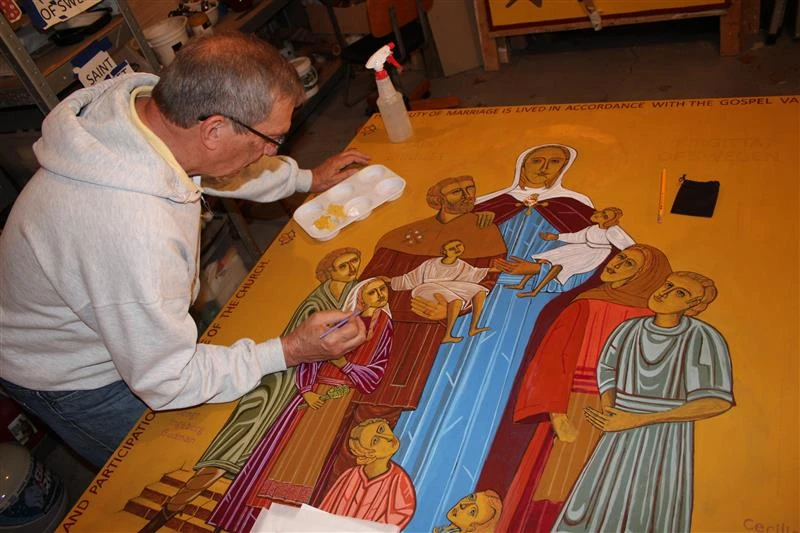
Father Richard Reiser, an iconographer based in Omaha, Nebraska, writes an icon of St. Bridget of Sweden with her family for FOCCUS Marriage Ministries’ 40th anniversary. / Credit: Photo courtesy of FOCCUS

CNA Staff, Dec 13, 2025 / 06:00 am (CNA).

When an iconographer began his work on a unique icon, he looked to the bones of the saint’s husband for help.

FOCCUS Marriage Ministries, a Catholic marriage ministry, invited the priest-iconographer Father Richard Reiser to make an icon of St. Bridget of Sweden, a mystic and the mother of eight. The ministry is celebrating its 40th anniversary this year and chose St. Bridget to be the patron saint of its work.

But there was one challenge. According to Reiser, historically there is no established iconographic prototype of an icon of St. Bridget of Sweden.

So using his imagination and every historical source available — including the bones of St. Bridget’s husband — the priest developed an entirely new icon of a saint who has gone without an icon for hundreds of years.

The domestic church 

“For me, iconography is first and foremost a form of prayer,” Reiser said. “The entire creative process is an act of listening to God and allowing the sacred story of a saint or mystery to take shape through layers of contemplation, color, and symbolism.”

The end result was an icon ripe with symbolic meaning — at its heart, marriage and family.

At the blessing ceremony of the icon are (left to right): FOCCUS Director of Ministry Father Michael Grewe, Archbishop Michael McGovern of Omaha, FOCCUS Executive Director Sheila Simpson, and Iconographer Father Richard Reiser. Credit: Photo courtesy of FOCCUS

FOCCUS Marriage Ministries chose St. Bridget of Sweden to be its patron because of her commitment to marriage and the Church.

St. Bridget’s life “beautifully reflects the heart of marriage ministry,” Sheila Simpson, who heads the archdiocese-owned nonprofit, told CNA.

Now displayed in the hallway of the FOCCUS office in the Archdiocese of Omaha, Nebraska, the icon contains a quote from Pope Benedict XVI about the family as the domestic church as well as several symbols of the married couple’s life together. 

“The icon quietly teaches that marriage is both a covenant of grace and a living witness to the Gospel,” Reiser told CNA. 

With St. Bridget as its guiding light, FOCCUS is launching resources for couples whose marriages have unusual challenges, such as those who need their marriage convalidated by the Church, as well as those marrying later in life.

FOCCUS is most well known for its inventories — questionnaires designed to help engaged couples prepare for marriage by initiating conversations about issues like finance and values. The additional, new questionnaires will have questions tailored for couples in unusual situations, including military couples, first responders, and deacons.

Simpson said many couples say FOCCUS “became a turning point — not because it told them what to do, but because it helped them truly hear each other.”

Windows into the divine 

Reiser said that one of the most “fascinating” parts of the icon-making process was consulting the bones of Ulf Gudmarsson, the husband of St. Bridget.

“His bones indicated that he was significantly larger in stature than she was,” he said. 

“To honor historical accuracy while still emphasizing Bridget’s spiritual prominence, I placed her on a small set of steps so she would remain the central figure of the composition,” he explained. 

Icons are “created for contemplation and spiritual truth more than realism,” Reiser said. 

“They are windows into the divine — visual theology meant to open the heart and mind to God’s presence,” he continued. 

“They participate in the mystery of the Incarnation,” Reiser said. “The eternal Word of God takes visible form.”

The icon depicts an emblem of the Third Order Franciscans, which the couple joined after they got married.

In addition, Gudmarsson holds a staff with a shell, referencing the pilgrimage the couple took to northwestern Spain.

It would be the last pilgrimage the couple ever made together. On the return journey from the pilgrimage, Gudmarsson grew ill and died soon after they returned to Sweden.

As a widow, St. Bridget dedicated her life to Christ, founding the religious order now known as the Bridgettines, which still exists to this day.

The icon of St. Bridget of Sweden and her family by Father Richard Reiser contains many symbols, such as the staff and shell, the 15 florets, and the clasp of St. Bridget’s cloak. Framing the icon are words from Pope Benedict XVI on the domestic church. Credit: Courtesy of FOCCUS

An icon of family and unity

Iconographers don’t paint — they write.

“Every line, color, and gesture carries symbolic meaning,” Reiser said. “That is why we often say icons are ‘written’ rather than painted.”

For instance, the 15 florets below St. Bridget of Sweden reference her 15 meditations on Christ’s passion. The cloak she wears has a brooch styled to symbolize the five wounds of Christ. Within the brooch is a relic of St. Bridget.

“Writing the icon of St. Bridget of Sweden was a unique and grace-filled experience because, historically, there is no established iconographic prototype of her — especially not one depicting her with her family,” Reiser said. “Without a traditional image to follow, I drew from existing paintings of St. Bridget and shaped them within the contemplative, dignified structure of classical iconography.”

With “no established icon tradition for Bridget’s family,” Reiser said he “consulted other family-centered icons, especially images of Christ with children, to discern how to portray children in an authentically iconographic style.”

The paintings of the children visually form a circle, which Reiser said represents the unity of the family. One of the children, Ingeborg, holds bluebells, the national flower of St. Bridget’s homeland, Sweden.

“Each of these details helps the icon speak not just as artwork but as a theological meditation on the holiness of family life,” Reiser said.

Read More
New print journal for ‘intellectual Catholic women’ to be released in April #Catholic 
 
 Promo photo for the The Better Part Journal of shadows of Madonna lilies for the Blessed Virgin Mary. / Credit: Photo courtesy of Heidi Bollich-Erne

Washington, D.C. Newsroom, Dec 7, 2025 / 09:00 am (CNA).
While teaching an ethics and culture course, Heidi Bollich-Erne was looking for a journal featuring the work of Catholic women for her students to read. After being told that it simply didn’t exist, she decided to create one herself.With the help of a team of women, Bollich-Erne has founded what she calls the “first intellectual Catholic women’s journal.” Its purpose is to not only define the feminine genius but also to show how faithful women can embody its beauty in their daily lives. “I want women to find a home, a place that values their work. The journal itself is edited, written, and published solely by Catholic women,” Bollich-Erne told CNA. “The way that women write, the way that we express ourselves is very different. That’s just who we are. That’s part of the genius of women.”The Better Part Journal is intended to give women of the Church “hope” by discussing issues that are relevant to them. The first edition of the journal will be released in April 2026. Before starting the journal, Bollich-Erne studied theology at the University of St. Thomas, where she “fell in love with philosophy.” She went to the Center for Thomistic Studies for her master’s degree in Thomistic philosophy but took a break from her doctorate and started teaching. She is now based in Texas where she has taught high school, college preparation, college, and adults. While teaching, she tried to find content to help guide discussion on gender complementarity but couldn’t find much written by Catholic women.“I thought, ‘I want to read more intellectual women,’ but it was a struggle… So I found a friend who works at a university and I said: ‘Can you recommend … an intellectual Catholic women’s magazine? She got back to me a few days later and said, ‘It doesn’t exist.’”Bollich-Erne started The Better Part Journal by first launching a company called JBG Publishings as “a home” for the journal. She wanted to ensure the publication would not be independently published but be part of a company that would help it to grow.Bollich-Erne named the company with the initials of her father, who passed away a few years prior. His passing “was a realization that ‘life is too short,’”  Bollich-Erne said. “I need to love what I do; I need to really work to find meaning.’”Heidi Bollich-Erne is the founding editor and editor-in-chief of The Better Part Journal, the first intellectual Catholic women’s journal. She holds an undergraduate degree in theology from the University of St. Thomas and a master’s in Thomistic Philosophy from the Center for Thomistic Studies. Credit: Photo courtesy of Heidi Bollich-ErneThe Better Part Journal’s mission“The purpose of the journal is to bring together the voices of intellectual Catholic women who are faithful to the magisterium,” Bollich-Erne said. “I want voices of all backgrounds. I want women of all areas of discipline. I want academics. I want nonacademics. I want all women contributing to this conversation.”“We all throw around the ‘feminine genius,’ but when you ask someone to stop and give an actual definition, most people can’t,” Bollich-Erne said. Most people define it with a quote by St. John Paul II who coined the term in his apostolic letter Mulieris Dignitatem to describe the unique gifts and qualities women possess, but, she said, “that’s a quote, not a definition.” “There’s a lot of work that needs to be done in this area, and I know there’s room for it to be done on a theological, philosophical level. So the idea was that we would … define the feminine genius and then show it. Live it. It’s not a theology journal and it’s not a philosophy journal. It’s truly interdisciplinary.”The first issue of the journal is called “Uncharted” and will tackle a number of topics.“As soon as women realized that I was serious about truly hearing their voices and not editing them out or telling them what they can and can’t write about, they gave us some really amazing work. I’ve just been blown away. I’m only so creative, but I have a great team.”The journal will feature articles covering neuroscience and theology and apply it to Mary and the Incarnation. It will have columns by doctors and scientists to look at “faith in the formula” and “applying science to religion.”There will be discussion of issues women face including body image, infertility, and violence. Articles will explore “the psychology of fairy tales and what that does to young girls growing up, whether that be positive or negative,” Bollich-Erne said. It will look into “what we are exposed to …from the media and what it does to us.”“The beauty behind the journal has been the women that have come forth to lend their voices,” Bollich-Erne said. “It’s been really amazing to see how excited they are about freedom of voice. It’s been something I wasn’t expecting.”A print journal in a digital eraDespite a shift in media from print to online formats, The Better Part Journal will only be released in print copies because, Bollich-Erne said, “I want it to be lasting.”“I am a tactile person. I like to hold a book. I wanted it to be something that is kept. So obviously that’s print,” Bollich-Erne said. “But then if you want to keep it has to be high quality.”The journal will use original photographs and crafted artwork to accompany the written works. “It is stunning. It looks like a book,” Bollich-Erne said. “The idea is that you read it, you keep it, and you put it on your bookshelf and you never get rid of it because the topics are lasting.”For an article to be included, it has to be “something that I think women will find valuable, whether you’re an academic or a high school student,” Bollich-Erne said. “It has to be something that all women find valuable, or we cannot print it.”“Many women have said they’re excited to hold their work and see it in print as opposed to scrolling past the work. There’s nothing wrong with online formats; it gives voices to a lot of people, but this is just different.”“I had an author tell me, ‘I don’t write anymore for anyone,’ because, she said, ‘I am so tired of my work just disappearing. It’s online for a week. I spent all this work, all this time, and it was something substantial that I really cared about, and it’s just gone.’” “She signed up with us for a column specifically because we are in print. The idea is that this work is kept forever.”The print journals will be published twice a year only, because “I want it to be something that takes a while to digest,” Bollich-Erne said. “Beautiful things take time.”Looking to the futureJGB Publishings has “goals to expand substantially over the next five to 10 years,” Bollich-Erne said. The company will “take care of” the journal to ensure its message can “grow and expand.”“To be able, as women in the Church, to truly have a serious conversation about all of these things … we are going to forge our future,” Bollich-Erne said. “We’re going to step forward in hope and show the world this is what an intelligent Catholic woman looks like.”“We’re not stifled. We’re not sad. We’re not miserable people. We are happy. We are excited about life, and we are treated with respect. We are loved and we love who we are,” Bollich-Erne said. “I want people, especially women, of all ages to see that and to understand that.”

New print journal for ‘intellectual Catholic women’ to be released in April #Catholic Promo photo for the The Better Part Journal of shadows of Madonna lilies for the Blessed Virgin Mary. / Credit: Photo courtesy of Heidi Bollich-Erne Washington, D.C. Newsroom, Dec 7, 2025 / 09:00 am (CNA). While teaching an ethics and culture course, Heidi Bollich-Erne was looking for a journal featuring the work of Catholic women for her students to read. After being told that it simply didn’t exist, she decided to create one herself.With the help of a team of women, Bollich-Erne has founded what she calls the “first intellectual Catholic women’s journal.” Its purpose is to not only define the feminine genius but also to show how faithful women can embody its beauty in their daily lives. “I want women to find a home, a place that values their work. The journal itself is edited, written, and published solely by Catholic women,” Bollich-Erne told CNA. “The way that women write, the way that we express ourselves is very different. That’s just who we are. That’s part of the genius of women.”The Better Part Journal is intended to give women of the Church “hope” by discussing issues that are relevant to them. The first edition of the journal will be released in April 2026. Before starting the journal, Bollich-Erne studied theology at the University of St. Thomas, where she “fell in love with philosophy.” She went to the Center for Thomistic Studies for her master’s degree in Thomistic philosophy but took a break from her doctorate and started teaching. She is now based in Texas where she has taught high school, college preparation, college, and adults. While teaching, she tried to find content to help guide discussion on gender complementarity but couldn’t find much written by Catholic women.“I thought, ‘I want to read more intellectual women,’ but it was a struggle… So I found a friend who works at a university and I said: ‘Can you recommend … an intellectual Catholic women’s magazine? She got back to me a few days later and said, ‘It doesn’t exist.’”Bollich-Erne started The Better Part Journal by first launching a company called JBG Publishings as “a home” for the journal. She wanted to ensure the publication would not be independently published but be part of a company that would help it to grow.Bollich-Erne named the company with the initials of her father, who passed away a few years prior. His passing “was a realization that ‘life is too short,’”  Bollich-Erne said. “I need to love what I do; I need to really work to find meaning.’”Heidi Bollich-Erne is the founding editor and editor-in-chief of The Better Part Journal, the first intellectual Catholic women’s journal. She holds an undergraduate degree in theology from the University of St. Thomas and a master’s in Thomistic Philosophy from the Center for Thomistic Studies. Credit: Photo courtesy of Heidi Bollich-ErneThe Better Part Journal’s mission“The purpose of the journal is to bring together the voices of intellectual Catholic women who are faithful to the magisterium,” Bollich-Erne said. “I want voices of all backgrounds. I want women of all areas of discipline. I want academics. I want nonacademics. I want all women contributing to this conversation.”“We all throw around the ‘feminine genius,’ but when you ask someone to stop and give an actual definition, most people can’t,” Bollich-Erne said. Most people define it with a quote by St. John Paul II who coined the term in his apostolic letter Mulieris Dignitatem to describe the unique gifts and qualities women possess, but, she said, “that’s a quote, not a definition.” “There’s a lot of work that needs to be done in this area, and I know there’s room for it to be done on a theological, philosophical level. So the idea was that we would … define the feminine genius and then show it. Live it. It’s not a theology journal and it’s not a philosophy journal. It’s truly interdisciplinary.”The first issue of the journal is called “Uncharted” and will tackle a number of topics.“As soon as women realized that I was serious about truly hearing their voices and not editing them out or telling them what they can and can’t write about, they gave us some really amazing work. I’ve just been blown away. I’m only so creative, but I have a great team.”The journal will feature articles covering neuroscience and theology and apply it to Mary and the Incarnation. It will have columns by doctors and scientists to look at “faith in the formula” and “applying science to religion.”There will be discussion of issues women face including body image, infertility, and violence. Articles will explore “the psychology of fairy tales and what that does to young girls growing up, whether that be positive or negative,” Bollich-Erne said. It will look into “what we are exposed to …from the media and what it does to us.”“The beauty behind the journal has been the women that have come forth to lend their voices,” Bollich-Erne said. “It’s been really amazing to see how excited they are about freedom of voice. It’s been something I wasn’t expecting.”A print journal in a digital eraDespite a shift in media from print to online formats, The Better Part Journal will only be released in print copies because, Bollich-Erne said, “I want it to be lasting.”“I am a tactile person. I like to hold a book. I wanted it to be something that is kept. So obviously that’s print,” Bollich-Erne said. “But then if you want to keep it has to be high quality.”The journal will use original photographs and crafted artwork to accompany the written works. “It is stunning. It looks like a book,” Bollich-Erne said. “The idea is that you read it, you keep it, and you put it on your bookshelf and you never get rid of it because the topics are lasting.”For an article to be included, it has to be “something that I think women will find valuable, whether you’re an academic or a high school student,” Bollich-Erne said. “It has to be something that all women find valuable, or we cannot print it.”“Many women have said they’re excited to hold their work and see it in print as opposed to scrolling past the work. There’s nothing wrong with online formats; it gives voices to a lot of people, but this is just different.”“I had an author tell me, ‘I don’t write anymore for anyone,’ because, she said, ‘I am so tired of my work just disappearing. It’s online for a week. I spent all this work, all this time, and it was something substantial that I really cared about, and it’s just gone.’” “She signed up with us for a column specifically because we are in print. The idea is that this work is kept forever.”The print journals will be published twice a year only, because “I want it to be something that takes a while to digest,” Bollich-Erne said. “Beautiful things take time.”Looking to the futureJGB Publishings has “goals to expand substantially over the next five to 10 years,” Bollich-Erne said. The company will “take care of” the journal to ensure its message can “grow and expand.”“To be able, as women in the Church, to truly have a serious conversation about all of these things … we are going to forge our future,” Bollich-Erne said. “We’re going to step forward in hope and show the world this is what an intelligent Catholic woman looks like.”“We’re not stifled. We’re not sad. We’re not miserable people. We are happy. We are excited about life, and we are treated with respect. We are loved and we love who we are,” Bollich-Erne said. “I want people, especially women, of all ages to see that and to understand that.”


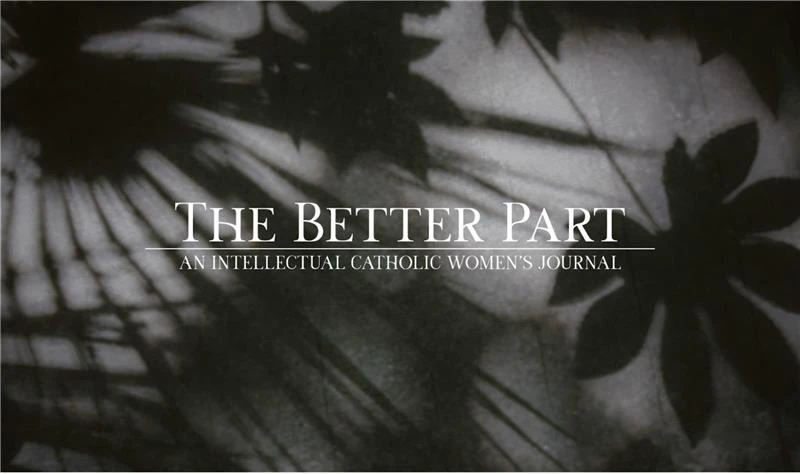
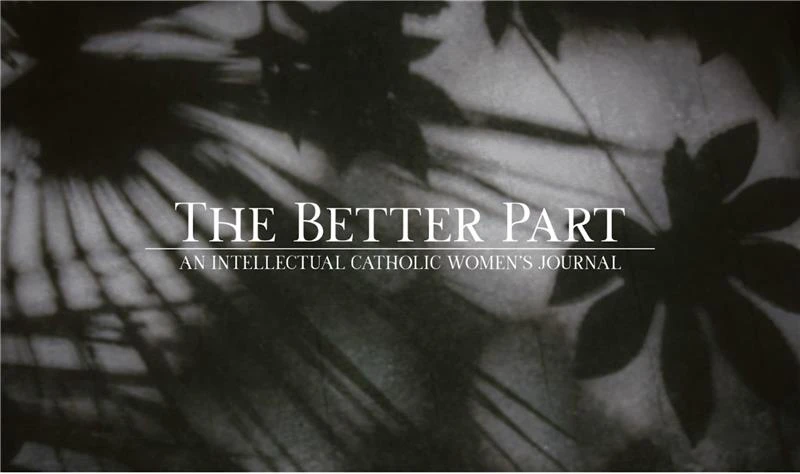
Promo photo for the The Better Part Journal of shadows of Madonna lilies for the Blessed Virgin Mary. / Credit: Photo courtesy of Heidi Bollich-Erne

Washington, D.C. Newsroom, Dec 7, 2025 / 09:00 am (CNA).

While teaching an ethics and culture course, Heidi Bollich-Erne was looking for a journal featuring the work of Catholic women for her students to read. After being told that it simply didn’t exist, she decided to create one herself.

With the help of a team of women, Bollich-Erne has founded what she calls the “first intellectual Catholic women’s journal.” Its purpose is to not only define the feminine genius but also to show how faithful women can embody its beauty in their daily lives. 

“I want women to find a home, a place that values their work. The journal itself is edited, written, and published solely by Catholic women,” Bollich-Erne told CNA. “The way that women write, the way that we express ourselves is very different. That’s just who we are. That’s part of the genius of women.”

The Better Part Journal is intended to give women of the Church “hope” by discussing issues that are relevant to them. The first edition of the journal will be released in April 2026. 

Before starting the journal, Bollich-Erne studied theology at the University of St. Thomas, where she “fell in love with philosophy.” She went to the Center for Thomistic Studies for her master’s degree in Thomistic philosophy but took a break from her doctorate and started teaching. 

She is now based in Texas where she has taught high school, college preparation, college, and adults. While teaching, she tried to find content to help guide discussion on gender complementarity but couldn’t find much written by Catholic women.

“I thought, ‘I want to read more intellectual women,’ but it was a struggle… So I found a friend who works at a university and I said: ‘Can you recommend … an intellectual Catholic women’s magazine? She got back to me a few days later and said, ‘It doesn’t exist.’”

Bollich-Erne started The Better Part Journal by first launching a company called JBG Publishings as “a home” for the journal. She wanted to ensure the publication would not be independently published but be part of a company that would help it to grow.

Bollich-Erne named the company with the initials of her father, who passed away a few years prior. His passing “was a realization that ‘life is too short,’”  Bollich-Erne said. “I need to love what I do; I need to really work to find meaning.’”

Heidi Bollich-Erne is the founding editor and editor-in-chief of The Better Part Journal, the first intellectual Catholic women’s journal. She holds an undergraduate degree in theology from the University of St. Thomas and a master's in Thomistic Philosophy from the Center for Thomistic Studies. Credit: Photo courtesy of  Heidi Bollich-Erne
Heidi Bollich-Erne is the founding editor and editor-in-chief of The Better Part Journal, the first intellectual Catholic women’s journal. She holds an undergraduate degree in theology from the University of St. Thomas and a master’s in Thomistic Philosophy from the Center for Thomistic Studies. Credit: Photo courtesy of Heidi Bollich-Erne

The Better Part Journal’s mission

“The purpose of the journal is to bring together the voices of intellectual Catholic women who are faithful to the magisterium,” Bollich-Erne said. “I want voices of all backgrounds. I want women of all areas of discipline. I want academics. I want nonacademics. I want all women contributing to this conversation.”

“We all throw around the ‘feminine genius,’ but when you ask someone to stop and give an actual definition, most people can’t,” Bollich-Erne said. Most people define it with a quote by St. John Paul II who coined the term in his apostolic letter Mulieris Dignitatem to describe the unique gifts and qualities women possess, but, she said, “that’s a quote, not a definition.” 

“There’s a lot of work that needs to be done in this area, and I know there’s room for it to be done on a theological, philosophical level. So the idea was that we would … define the feminine genius and then show it. Live it. It’s not a theology journal and it’s not a philosophy journal. It’s truly interdisciplinary.”

The first issue of the journal is called “Uncharted” and will tackle a number of topics.

“As soon as women realized that I was serious about truly hearing their voices and not editing them out or telling them what they can and can’t write about, they gave us some really amazing work. I’ve just been blown away. I’m only so creative, but I have a great team.”

The journal will feature articles covering neuroscience and theology and apply it to Mary and the Incarnation. It will have columns by doctors and scientists to look at “faith in the formula” and “applying science to religion.”

There will be discussion of issues women face including body image, infertility, and violence. Articles will explore “the psychology of fairy tales and what that does to young girls growing up, whether that be positive or negative,” Bollich-Erne said. It will look into “what we are exposed to …from the media and what it does to us.”

“The beauty behind the journal has been the women that have come forth to lend their voices,” Bollich-Erne said. “It’s been really amazing to see how excited they are about freedom of voice. It’s been something I wasn’t expecting.”

A print journal in a digital era

Despite a shift in media from print to online formats, The Better Part Journal will only be released in print copies because, Bollich-Erne said, “I want it to be lasting.”

“I am a tactile person. I like to hold a book. I wanted it to be something that is kept. So obviously that’s print,” Bollich-Erne said. “But then if you want to keep it has to be high quality.”

The journal will use original photographs and crafted artwork to accompany the written works. 

“It is stunning. It looks like a book,” Bollich-Erne said. “The idea is that you read it, you keep it, and you put it on your bookshelf and you never get rid of it because the topics are lasting.”

For an article to be included, it has to be “something that I think women will find valuable, whether you’re an academic or a high school student,” Bollich-Erne said. “It has to be something that all women find valuable, or we cannot print it.”

“Many women have said they’re excited to hold their work and see it in print as opposed to scrolling past the work. There’s nothing wrong with online formats; it gives voices to a lot of people, but this is just different.”

“I had an author tell me, ‘I don’t write anymore for anyone,’ because, she said, ‘I am so tired of my work just disappearing. It’s online for a week. I spent all this work, all this time, and it was something substantial that I really cared about, and it’s just gone.’” 

“She signed up with us for a column specifically because we are in print. The idea is that this work is kept forever.”

The print journals will be published twice a year only, because “I want it to be something that takes a while to digest,” Bollich-Erne said. “Beautiful things take time.”

Looking to the future

JGB Publishings has “goals to expand substantially over the next five to 10 years,” Bollich-Erne said. The company will “take care of” the journal to ensure its message can “grow and expand.”

“To be able, as women in the Church, to truly have a serious conversation about all of these things … we are going to forge our future,” Bollich-Erne said. “We’re going to step forward in hope and show the world this is what an intelligent Catholic woman looks like.”

“We’re not stifled. We’re not sad. We’re not miserable people. We are happy. We are excited about life, and we are treated with respect. We are loved and we love who we are,” Bollich-Erne said. “I want people, especially women, of all ages to see that and to understand that.”

Read More