null / Credit: Paul Gueu/Shutterstock
Denver, Colorado, Dec 5, 2025 / 18:18 pm (CNA).
After receiving a letter of excommunication from the Vatican, the leader of a schismatic group in Colorado Springs told congregants he would ignore it — furthering the divide between the small splinter group and the Catholic Church.
Anthony Ward heads the Servants of the Holy Family, a group that labels itself as Catholic in spite of the Diocese of Colorado Springs’ declaration that the group is schismatic.
In a 40-minute speech to his congregation in which he called Church authorities “a kangaroo court” of “heretics” and “freemasons,” Ward went public on Nov. 16 about his excommunication and his plans to continue ignoring the Catholic Church’s directives.
During a secret ceremony in 2024, a bishop whose name was withheld at the time consecrated Ward as a bishop without papal permission.
In the Catholic Church, only the pope can appoint bishops. Consecrating a bishop without papal mandate is considered illicit and incurs an automatic “latae sententiae” excommunication for both parties.
During the meeting at the Servants’ chapel on Nov. 16, Ward told his congregation that the Catholic Church had made a declaration of excommunication against him due to what he described as “persistent, rebellious disobedience.”
Though excommunication is a “medicinal penalty” designed to urge an individual to repent, Ward has said he is “ignoring” the letter and will not be responding within the 30-day window given to him.
Embracing the claims of the letter, Ward said he will continue to disobey, instead putting his loyalty toward what he called “the true Catholic faith.”
“I have not and will not obey commands from the kangaroo court composed of heretics, schismatics, Freemasons, representatives of the most vile sinful perversions, enemies of the cross of Christ,” Ward told the congregation, “of whom the majority of bishops — particularly in this country — no longer believe in the real presence of Our Lord and Savior, Jesus, Christ in the Eucharist.”
The U.S. Catholic bishops recently led a yearslong Eucharistic Revival that centered on the Catholic belief that the Eucharist is the body, blood, soul, and divinity of Jesus Christ.
Despite the local Catholic diocese’s denouncement of the Servants, the group continues to hold Eucharistic celebrations and is recruiting minors as well as adult men to be trained as priests.
The Servants’ website advertises the group as “faithful to the Latin Mass” as well as to “Catholic doctrine and morals” and claims it is “endorsed by Catholic bishops worldwide.”
Ward named Archbishop Telesphore George Mpundu Lusaka, the African archbishop emeritus of Zambia, as the bishop who illicitly consecrated him, but the other bishops are not specified readily on the website.
When asked to comment, a spokesperson for the Diocese of Colorado Springs referred to the most recent public statement by Bishop James Golka in April 2024.
Since 2013, the Diocese of Colorado Springs has publicly held that the Servants are “not in good standing” with the Church.
Pointing to continued “obstinate ill will” by the Servants, Golka declared last year that Ward and other priests affiliated with the Servants “are not in good standing with the diocesan or the universal Catholic Church” and declared it “a schismatic group.”
Pointing to canon law, Golka declared that its Eucharistic celebration “is illicit and a grave moral offense” and that its celebration of baptism “is illicit.” The bishop also declared celebrations of penance, the sacrament of matrimony, confirmation, and holy orders by this group to be invalid.
Golka said it would be “an act of spiritual danger” for Catholics to attend celebrations led by the Servants and encouraged the faithful to pray for reconciliation.
The Servants did not respond to a request for comment in time for publication.
Read More![Religious sisters announce historic land return to Wisconsin Native American tribe #Catholic
LaCrosse, Wisconsin. / Credit: JTTucker/Shutterstock
CNA Staff, Nov 7, 2025 / 06:00 am (CNA).
A Wisconsin religious community says it has completed the first known instance of a Catholic group returning land to a Native American tribe, hailing it as a move made in the “spirit of relationship and healing.”The Franciscan Sisters of Perpetual Adoration announced the transfer in an Oct. 31 news release on its website. The community is located in La Crosse, Wisconsin, near the state’s border with Minnesota.The sisters had purchased the land from the Lac du Flambeau Band of the Lake Superior Chippewa tribe in 1966 and used the property for its Marywood Franciscan Spirituality Center.The sisters said they sold the property to the tribe for $30,000, the exact amount for which they paid for the land six decades ago. The modern sale price represented “just over 1% of [the land’s] current market value,” the sisters said.The bargain sale represents “the first known return of Catholic-owned land to a tribal nation as an act of repair for colonization and residential boarding schools,” the sisters said.“Today, the tribe’s reservation represents only a fraction of [its] traditional territories,” the news release said. “Rebuilding and protecting tribal land bases is vital to sustaining sovereignty — it restores the ability for self-determination, cultural preservation, and community development.” “A strong land base supports essential services, creates employment opportunities, and provides a foundation for long-term economic and social resilience,” the sisters said. Tribal President John Johnson hailed the sale as “an example of what true healing and partnership can look like.” “We are proud to welcome Marywood home, to ensure it continues to serve future generations of the Lac du Flambeau people,” Johnson said. The sisters said the retreat center was “facing challenges to its viability,” leading the community to “discern a future for the land” in line with its institutional priorities. In their press release, the sisters said they have also been in “a process of reckoning” with the history of St. Mary’s Catholic Indian Boarding School. The sisters administered the school in Odanah, Wisconsin, from 1883 to 1969.Critics in recent years have claimed that such boarding schools participated in the erasure of Native American culture. Others have alleged that significant clergy sex abuse took place at such institutions.The sisters on Oct. 31 said such schools were guilty of “separating children from their families, suppressing Native identity, and paving the way for the large-scale seizure of Native homelands.”“It was painful to address our complicity, but we knew it had to be done,” former community president Sister Eileen McKenzie said in the press release.Diocese of Superior Bishop James Powers, meanwhile, praised the transfer, describing it as “a tangible act of justice and reconciliation that flows directly from the heart of our Catholic faith.”The Franciscan Sisters of Perpetual Adoration traces its roots to a group of Bavarian immigrants who traveled to Milwaukee in 1849 “intent upon founding a religious community to spread the Gospel among German immigrants.”The community has run hospitals and schools in Wisconsin and has also sponsored medical clinics and mission schools abroad.](http://unitedyam.com/wp-content/uploads/2025/11/religious-sisters-announce-historic-land-return-to-wisconsin-native-american-tribe-catholic-lacrosse-wisconsin-credit-jttucker-shutterstockcna-staff-nov-7-2025-0600-am-cna-a-wiscon.webp)

![Preparing for death with the Sister Servants of Mary #Catholic
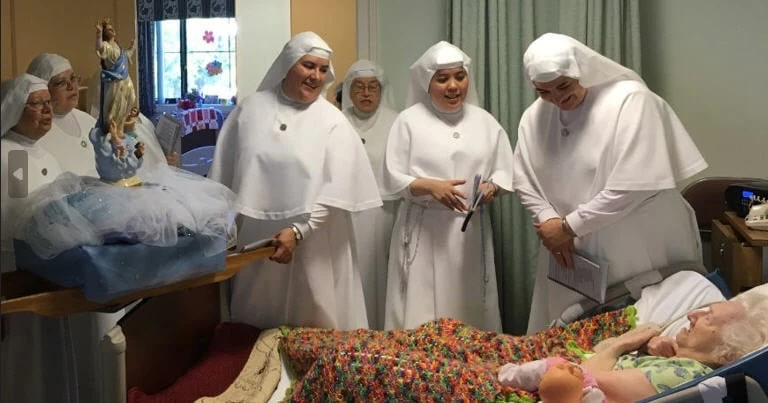
The Sister Servants of Mary hold a procession with the statue of Our Lady of the Assumption at Mary Health of the Sick Convalescent Hospital in Newbury Park, California. / Credit: Photo courtesy of the Servants of Mary, Ministers to the Sick
CNA Staff, Nov 2, 2025 / 06:00 am (CNA).
When a 93-year-old Catholic father from New Orleans had a stroke, he knew he was prepared to die.Clinton Jacob attended adoration and Mass daily and was “rarely without a prayer book or rosary in hand,” according to his daughter, Kim DeSopo.“[He] never spoke of death with fear or sadness,” she told CNA. “He would simply say, ‘I’ll be going home.’”But not everyone feels prepared for death.The Servants of Mary, Ministers to the Sick, is a Catholic community of sisters who dedicate their lives to caring for the sick and dying in New Orleans and around the world. As nurses, they are at the bedside of the dying through the long nights, whether their patients are lifelong Catholics or have never thought about religion.The sisters often encounter patients as well as family members who are struggling to accept “an illness or imminent death,” Sister Catherine Bussen, a Servant of Mary, told CNA.“Many times, there is a need for reconciliation within the family, for a return to their faith, for acceptance of their condition, etc.,” Bussen said.As medical professionals, the sisters provide physical treatment, but they also walk with their patients throughout their illnesses, encouraging patients and families “always with the hope of eternal life,” Bussen said. DeSopo, Jacob’s daughter, called the sisters for support. The next day, Bussen arrived at their doorstep, and every night for two weeks, she sat at Jacob’s bedside. Bussen’s presence was “a gift,” DeSopo said. “Sister Catherine brought peace and calm into a time filled with stress and sorrow.”“Her prayers, patience, and care provided comfort not only to my father but also to my mother, who could finally sleep knowing someone trustworthy and compassionate was by his side,” DeSopo said, recalling Bussen’s “selfless dedication” and “unwavering faith.” Bussen was with Jacob when he died on Sept. 26, 2024. She prepared his body, cleaning him and sprinkling him with holy water, and then prayed with his wife and daughter.“I will never forget the care and dignity she gave him, even after his final breath,” DeSopo said.Sister Catherine (left) and Sister Dorian Salvador (right) pray for the soul of Kim DeSopa’s father on Oct. 1, 2024, at St. Clement of Rome Church in Metairie, Louisiana. Credit: Photo courtesy of Kim DeSopa and Sister CatherineMary at the foot of the cross “I was sick and you visited me.”This Scripture verse, Matthew 25:36, summarizes the charism of the Servants of Mary, according to Bussen. When they care for the sick, they care for Christ.The sisters will care for anyone in need, preferably within the sick person’s own home. In those who are suffering, the sisters “discover Jesus carrying his cross,” Bussen explained. “By caring for the sick, we believe that we are caring for Christ himself, who still suffers today in the suffering mystical body of Christ,” she said.Sister Angélica Ramos cares for Mrs. Hura, a resident of Mary Health of the Sick Convalescent Hospital in Newbury Park, California. Credit: Photo courtesy of the Servants of Mary, Ministers to the SickFounded in Madrid, Spain, in the 1800s, the sisters care for the sick and dying in Louisiana, Kansas, and California as well as throughout Central and South America, Spain, France, England, Italy, Cameroon, the Philippines, and Indonesia. They run a hospital for the poor in Bamenda, Cameroon, as well as two missionary houses in Oaxaca, Mexico.The sisters look to Mary as an example as they accompany those who are suffering.“Although we are not able to take away someone’s cross, we are present to them, offering all to the Father, like Mary did at the cross of Jesus, that all suffering may be redemptive and fruitful,” Bussen said.“Every one of us sisters would tell you that it is an absolute privilege to be able to enter into the intimacy of a family’s home, listening to the dying, praying with them, and encouraging them on the final stage of their journey as their soul passes into eternity,” she said.Sister Servants of Mary Fatima Muñoz and Carmela Sanz (front) celebrate a May crowning in Kansas City, Kansas. Credit: Photo courtesy of the Servants of Mary, Ministers to the Sick“Our Catholic Christian faith is a beautiful comfort during these times because it is all about looking forward to the promised life to come, the whole goal of our lives, eternal life,” Bussen said.One woman from New Orleans received news no one wants to hear — she had a terminal illness. Though she was not religious, she knew she needed help and did not know who else to turn to, so she called the Servants of Mary.As they cared for her and helped her deal with her terminal diagnosis, the sisters learned the woman was “completely alone in the world,” said Bussen, who took care of her. Other people from the surrounding Catholic community volunteered to stay with her.During that time, the woman found a home in the Catholic Church and received the sacrament of baptism.Her “anxiety was transformed into peace,” said Bussen, who was with her as she died.“As the end drew near, she had a new faith family,” Bussen said. “She was no longer alone.”Remembering the dead The life of a sister Servant of Mary is “contemplative in action.” The sisters unite “our prayer life with our work — going about what we are doing, in all the business of daily life, in a prayerful spirit,” Bussen said.The sisters have time set aside for prayer and work, “but these two aspects cannot be separated from one another,” she continued. “The grace and light received in prayer flows into our work and ministry, and everything we experience in our ministry is taken to prayer.”The Servants of Mary, Ministers to the Sick care for the sick and the dying. Credit: Photo courtesy of the Servants of Mary, Ministers to the SickThroughout the year, the sisters take special care to remember the dead. In November especially, Bussen said the sisters “remember all our patients who have died with us by placing their names in our chapel and offering Masses for their eternal happiness.”“Even after a patient has passed,” she said, “and they no longer need physical care, our ministry continues by praying for their soul.”](http://unitedyam.com/wp-content/uploads/2025/11/preparing-for-death-with-the-sister-servants-of-mary-catholic-the-sister-servants-of-mary-hold-a-procession-with-the-statue-of-our-lady-of-the-assumption-at-mary-health-of-the-sick-convalescent-h.webp)