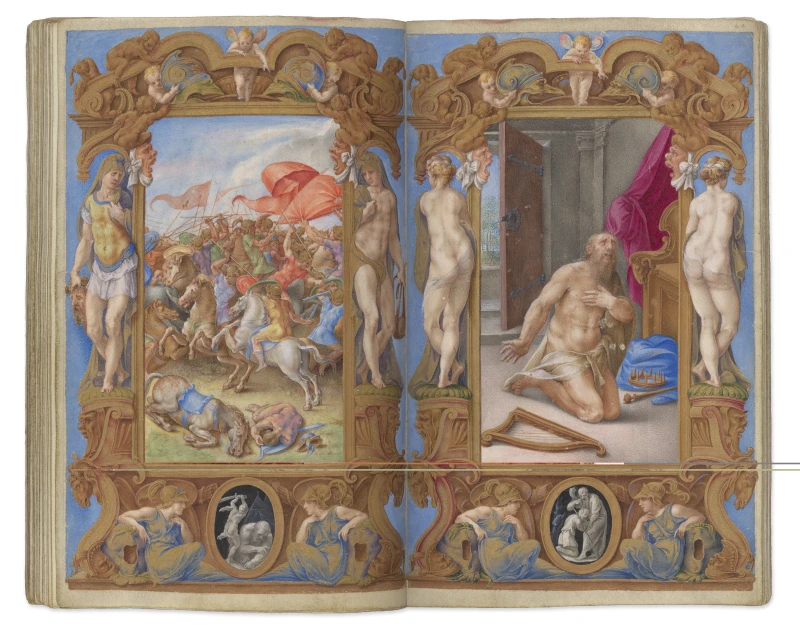
Death of Uriah; David in Penance, from the Morgan’s famed Farnese Hours, demonstrates the enduring appeal of the penitential Psalms of David as seen in this early Renaissance book of hours. Italy, Rome, 1546. The Morgan Library & Museum, New York, MS M.69, fols, 63v-63r. Photography by Janny Chiu. / Credit: Courtesy of the New York Library
New York City, New York, Nov 30, 2025 / 08:00 am (CNA).
Part of the New York Public Library’s Spencer Collection, the Tickhill Psalter is on view throughout Advent and Christmas at The Morgan Library & Museum in its exhibit “Sing a New Song: The Psalms in Medieval Art and Life.” A full-page Jesse Tree introduces the Psalms in the Tickhill Psalter, a 14th-century illuminated manuscript from the Augustinian Worksop Priory in Nottinghamshire, England.

David appears in the historiated B of Psalm 1, providing a conceptual link to scenes from his life in the Jesse Tree on the facing page. “Beatus vir,” or “Blessed is the man,” the first stanza opens in celebration of the one who delights in God’s law, concluding: “That person is like a tree planted by streams of water, which yields its fruit in season and whose leaf does not wither, — what they do prospers.”
These words and their historiated B, with its visual link to the facing page, highlight David as key author of the Psalms and their prefiguration of Christ, the good fruit of the Jesse Tree, a theme common to medieval illuminated manuscripts.


The central panel of a 1490 Flemish triptych with scenes from the life of Saint Augustine contextualizes the exhibit. This five-by-five-foot oil on wood painting references Augustine’s use of allegory, essential to his understanding of scripture and interpretation of the psalms as prophecy. One scene captures Augustine’s realization of the Trinity as boundless mystery that dwarfs human understanding, allegorized by a child trying to pour the sea into a hole in the sand.


In the book accompanying the exhibit, Morgan curator Deirdre Jackson extends the psalms’ significance to this triptych through a reference to a surviving panel housed in Ireland that shows Augustine on his deathbed. It’s a scene described by contemporary bishop Possidius of Calama, who said that Augustine “ordered those psalms of David which are especially penitential to be copied out and, when he was very weak, used to lie in bed, facing the wall where the written sheets were put up, gazing at them and reading them, and copiously and continuously weeping as he read.”


In his book “The Tickhill Psalter and Related Manuscripts,” 20th-century art historian Donald Drew Egbert speculates that the Tickhill Psalter was decorated by highly skilled illuminators working for Augustinian monasteries and patrons of Augustinian houses during a high point of book arts in England.

This high point inspired a trend of books as personalized treasures, best exemplified in this exhibit by St. Thomas More’s prayer book. Containing much of his own writing in the margins, it consists of a Book of Hours and a Psalter and was with him in the Tower of London while he awaited execution. More’s notes during that time show his preoccupation with the psalms of David’s tribulations. Beside Psalm 87:5-10, “a man without help … in the dark places, and in the shadow of death,” More writes, “in severe tribulation and in prison.”

More’s thoughts in distress demonstrate the appeal of David’s story to the human heart, a reality repeatedly expressed throughout the treasures of this exhibit. In the Tickhill Psalter’s Jesse Tree, David is encircled by branches springing from a tree that grows out of his father, Jesse, sprawled in an active sleep, his elbow supporting a hand planted against his head as though dreaming of all that is to come.

The branches of the tree wind around David and directly overhead to encircle the Virgin and Child, tracing Christ’s lineage through Mary to the House of David. At the top, the branches surround Christ enthroned in majesty, fulfilling the promise of victory over sin and death foreshadowed in the psalms.
David strikes a joyous pose and plays a harp in celebration, and foliage on either side of the main branch wraps around prophets who unfurl scrolls to hint at mysteries about to be foretold in the reading of the psalms.
Beneath the figure of Jesse, two separate depictions of David protecting his sheep from wild animals cast his actions as allegory in the fight against evil, segueing to his likeness in the historiated B, dancing and singing his story into the Psalms to animate their prefiguration of Christ.
Read More





![10,000 pro-lifers join LIFE Runners annual relay across the U.S. #Catholic
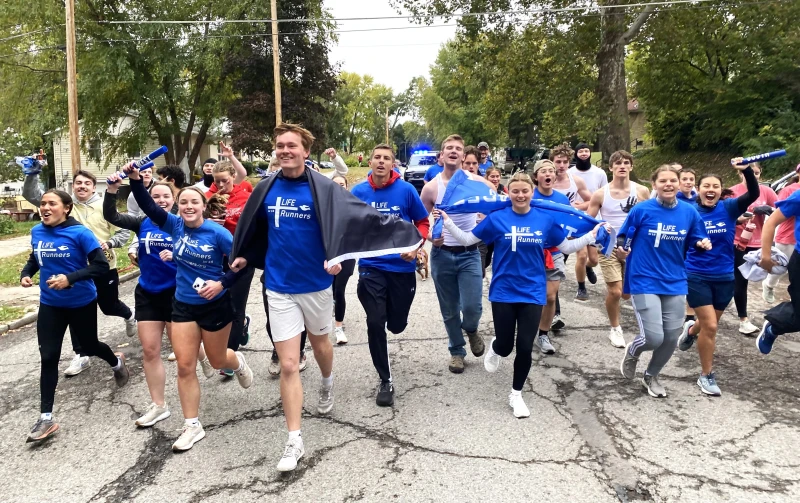
Finish line of the A-Cross America Relay, hosted by Benedictine College in Atchison, Kansas. / Credit: Photo courtesy of LIFE Runners.
CNA Staff, Nov 1, 2025 / 05:55 am (CNA).
A pro-life relay with more than 10,000 participants came to a joyful conclusion in Kansas last Saturday after runners made the shape of a cross as they ran across the U.S.The 5,124 mile “A-Cross America Relay,” organized by pro-life group LIFE Runners, kicked off in September in four cities around the country and ended at Benedictine College in Atchison, Kansas on Oct. 25.The starting points were San Francisco, California; New York City, New York; Austin, Texas; and Fargo, North Dakota, but participants around the world also joined to witness to life in their own nations. The San Francisco kickoff of the A-Cross America Relay began at Star of the Sea Church with students from Stella Maris Academy. Credit: Photo courtesy of LIFE Runners.With more than 25,000 “teammates” in nearly 4,000 cities across 50 countries, LIFE Runners aim to raise awareness for unborn children during their annual relay. Patrick Castle, president and founder of LIFE Runners, spoke with CNA about what inspires participants to run for the unborn. CNA: What inspires the mission of LIFE Runners? Castle: LIFE Runners is inspired by the obvious responsibility of Christians to reach the youth, pregnant mothers, fathers, and influencers with God's love and the truth that abortion isn't a solution to anything, it is the greatest problem, the greatest evil by definition, by the numbers. Abortion claims more American lives in one year than all combat casualties in the history of America. With the 250th anniversary of our country next year, may we reflect on who we are as Americans and as Christians. We are people who stand for God and His gifts of life and liberty. Amen!How does the relay help raise awareness for the unborn?Castle: The LIFE Runners A-Cross America Relay helps raise awareness for the unborn through our public witness [of] wearing “REMEMBER The Unborn” shirts. Eighty-two percent of post-abortion mothers said if they had encountered one supportive person or encouraging message, they would have chosen life. For example, two mothers saw our “REMEMBER The Unborn” witness outside of the Omaha Planned Parenthood, asked for help, and chose life. New York City kickoff for the A-Cross America Relay. Participants prayed and then walked with the big “REMEMBER The Unborn” banner to the Father Francis Duffy statue in Times Square. Credit: Photo courtesy of LIFE Runners.Thousands of people witnessed thousands of LIFE Runners wearing "REMEMBER The Unborn" shirts across America and around the world during the 5,124 mile relay that made a cross over America. With access to abortion in the mail and across state lines, LIFE Runners wear life-saving messages everywhere to inspire a culture of life at work, school, walking, running, grocery store; everywhere! What stood out to you from the finish line relay at Benedictine College in Atchison, Kansas? Castle: I am so encouraged by the authentic, Catholic, pro-life identity of Benedictine College … While running up the hill, students invited other students to join us, like a scene out of the "Rocky" movie when the local community joined him on a training run. The last mile ended on the main campus drive with President [Stephen] Minnis leading a large crowd with cheering. The finish was immediately followed by a beautiful prayer from Archbishop [Joseph]Naumann.What is the significance of having a national relay across the United States? Castle: The significance of having a relay that makes a cross over America is unity. [The relay] connects everyone in a pro-God way, allowing faith and light to overcome the darkness to end abortion — all in Christ for pro-life! Teammates in other countries adopt segments, knowing that America can and should lead the way in ending abortion around the world. The relay is an inspiring light for the world. The cross is the greatest symbol of love, bringing hope that life will prevail!The North arm kickoff of the A-Cross America Relay in Fargo, North Dakota. NDSU Newman Center students helped launch the north arm with a 2.7 mile prayerful witness walk. Credit: Photo courtesy of LIFE Runners.](http://unitedyam.com/wp-content/uploads/2025/11/10000-pro-lifers-join-life-runners-annual-relay-across-the-u-s-catholic-finish-line-of-the-a-cross-america-relay-hosted-by-benedictine-college-in-atchison-kansas-credit-photo-courtesy-of.webp)