screen

Ancient Advent Mass gains new interest among younger Catholics #Catholic 
 
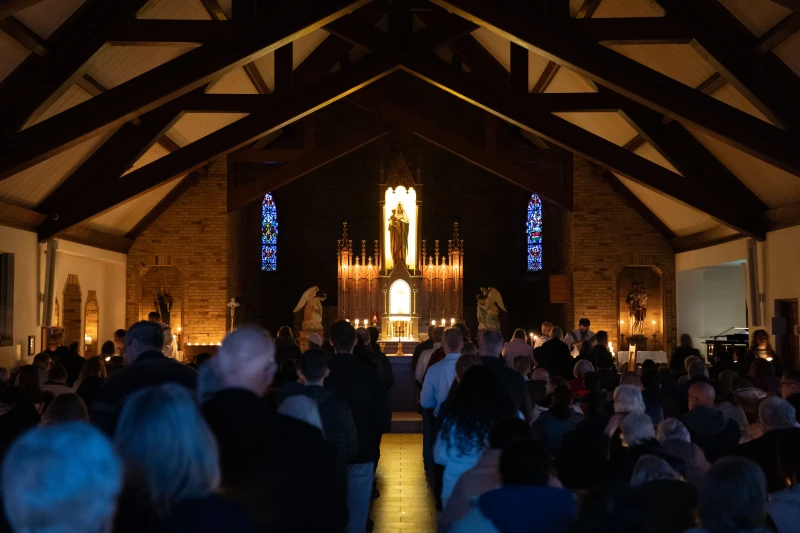
 The Rorate Caeli Advent Mass celebrated at The National Shrine of Our Lady of Champion. / Credit: The National Shrine of Our Lady of Champion

CNA Staff, Dec 14, 2025 / 06:00 am (CNA).
Advent is a season filled with rich Catholic traditions, but a slightly lesser-known one is growing in popularity among younger Catholics. The ancient liturgy of the Rorate Caeli Advent Mass honors the Blessed Virgin Mary through a Mass celebrated at dawn, in complete darkness, and lit only by candles, which symbolizes Christ, the Light of the World, entering into the world with Mary as the vessel. Emerging in the Middle Ages, the Rorate Caeli Mass gets its name from the prophecy of Isaiah. Rorate Caeli is Latin for “drop down, ye heavens.” These are the opening words of this liturgy’s Introit, which is used as an opening psalm or entrance antiphon and comes from Isaiah 45:8.Father Tony Stephens, rector at the National Shrine of Our Lady of Champion in Champion, Wisconsin, calls this Mass “a teachable moment.”“As all of us are gathered in the church, only lit with the candles, slowly the light begins coming in through the windows and it’s like the light of Christ,” he told CNA. The process symbolizes “the light of Christ coming into our lives, slowly but surely and progressively as we go through life.”“And just like that light begins to come in through the windows, as the physical sun rises, so in our journey as Catholics, the closer we get to Christ, the more his light shines in our life,” he said. Fr. Nathaneal Mudd, CPM, celebrates the Rorate Caeli Advent Mass at the National Shrine of Our Lady of Champion in 2024. Credit: The National Shrine of Our Lady of ChampionStephens has been rector of the National Shrine of Our Lady of Champion for two years but was scheduled to celebrate the Rorate Caeli Mass there for the first time on Dec. 13. The shrine is the first and only approved Marian apparition site in the United States. It was here that the Blessed Mother is believed to have appeared to Adele Brise in 1859. When speaking about the Blessed Mother’s role in Advent, Stephens described it as “a season of anticipating Our Lord, but when you look at the subtext of Advent, things about Mary are everywhere — in the readings and her role in salvation history is so important. And so that’s, again, part of the reason you have these special Marian Masses honoring her during this Advent season.”He also highlighted the fact that this ancient Mass is seeing a resurgence in popularity and credited Pope Benedict XVI, in part, for reintroducing Catholics to older, traditional practices and his “desire of the hermeneutic of continuity.” “He in his pontificate really emphasized a desire to have that continuity between the earlier traditions of the Church, even prior to the [Vatican II] council … looking at all of the rich liturgical heritage that we have as Catholics,” he added. The priest pointed out that young people are also searching for more traditional practices.“There is a great love, especially amongst young people, for things that are traditional,” he said, adding that the Mass also “appeals to the senses in a way that technology and phones don’t.” “The real light of a candle is way different than the electronic light put off by a cellphone screen,” he said. “A burning, living candle, the way it flickers, and you can’t recharge a candle — it gives everything it has like Jesus did on the cross. A candle burns with all its might to put off that light. And so there is a selflessness about that light of that candle that’s different than technology, and young people desire that kind of self-gift and authenticity.”Stephens said he hopes those who attend a Rorate Caeli Mass will leave with “an eager anticipation of Jesus coming at Christmastime.”“A Rorate Caeli Mass is one of those times that we can have a little consolation and we’re reminded of the author of all consolation and his mother,” he said.

Ancient Advent Mass gains new interest among younger Catholics #Catholic The Rorate Caeli Advent Mass celebrated at The National Shrine of Our Lady of Champion. / Credit: The National Shrine of Our Lady of Champion CNA Staff, Dec 14, 2025 / 06:00 am (CNA). Advent is a season filled with rich Catholic traditions, but a slightly lesser-known one is growing in popularity among younger Catholics. The ancient liturgy of the Rorate Caeli Advent Mass honors the Blessed Virgin Mary through a Mass celebrated at dawn, in complete darkness, and lit only by candles, which symbolizes Christ, the Light of the World, entering into the world with Mary as the vessel. Emerging in the Middle Ages, the Rorate Caeli Mass gets its name from the prophecy of Isaiah. Rorate Caeli is Latin for “drop down, ye heavens.” These are the opening words of this liturgy’s Introit, which is used as an opening psalm or entrance antiphon and comes from Isaiah 45:8.Father Tony Stephens, rector at the National Shrine of Our Lady of Champion in Champion, Wisconsin, calls this Mass “a teachable moment.”“As all of us are gathered in the church, only lit with the candles, slowly the light begins coming in through the windows and it’s like the light of Christ,” he told CNA. The process symbolizes “the light of Christ coming into our lives, slowly but surely and progressively as we go through life.”“And just like that light begins to come in through the windows, as the physical sun rises, so in our journey as Catholics, the closer we get to Christ, the more his light shines in our life,” he said. Fr. Nathaneal Mudd, CPM, celebrates the Rorate Caeli Advent Mass at the National Shrine of Our Lady of Champion in 2024. Credit: The National Shrine of Our Lady of ChampionStephens has been rector of the National Shrine of Our Lady of Champion for two years but was scheduled to celebrate the Rorate Caeli Mass there for the first time on Dec. 13. The shrine is the first and only approved Marian apparition site in the United States. It was here that the Blessed Mother is believed to have appeared to Adele Brise in 1859. When speaking about the Blessed Mother’s role in Advent, Stephens described it as “a season of anticipating Our Lord, but when you look at the subtext of Advent, things about Mary are everywhere — in the readings and her role in salvation history is so important. And so that’s, again, part of the reason you have these special Marian Masses honoring her during this Advent season.”He also highlighted the fact that this ancient Mass is seeing a resurgence in popularity and credited Pope Benedict XVI, in part, for reintroducing Catholics to older, traditional practices and his “desire of the hermeneutic of continuity.” “He in his pontificate really emphasized a desire to have that continuity between the earlier traditions of the Church, even prior to the [Vatican II] council … looking at all of the rich liturgical heritage that we have as Catholics,” he added. The priest pointed out that young people are also searching for more traditional practices.“There is a great love, especially amongst young people, for things that are traditional,” he said, adding that the Mass also “appeals to the senses in a way that technology and phones don’t.” “The real light of a candle is way different than the electronic light put off by a cellphone screen,” he said. “A burning, living candle, the way it flickers, and you can’t recharge a candle — it gives everything it has like Jesus did on the cross. A candle burns with all its might to put off that light. And so there is a selflessness about that light of that candle that’s different than technology, and young people desire that kind of self-gift and authenticity.”Stephens said he hopes those who attend a Rorate Caeli Mass will leave with “an eager anticipation of Jesus coming at Christmastime.”“A Rorate Caeli Mass is one of those times that we can have a little consolation and we’re reminded of the author of all consolation and his mother,” he said.


The Rorate Caeli Advent Mass celebrated at The National Shrine of Our Lady of Champion. / Credit: The National Shrine of Our Lady of Champion

CNA Staff, Dec 14, 2025 / 06:00 am (CNA).

Advent is a season filled with rich Catholic traditions, but a slightly lesser-known one is growing in popularity among younger Catholics.

The ancient liturgy of the Rorate Caeli Advent Mass honors the Blessed Virgin Mary through a Mass celebrated at dawn, in complete darkness, and lit only by candles, which symbolizes Christ, the Light of the World, entering into the world with Mary as the vessel. 

Emerging in the Middle Ages, the Rorate Caeli Mass gets its name from the prophecy of Isaiah. Rorate Caeli is Latin for “drop down, ye heavens.” These are the opening words of this liturgy’s Introit, which is used as an opening psalm or entrance antiphon and comes from Isaiah 45:8.

Father Tony Stephens, rector at the National Shrine of Our Lady of Champion in Champion, Wisconsin, calls this Mass “a teachable moment.”

“As all of us are gathered in the church, only lit with the candles, slowly the light begins coming in through the windows and it’s like the light of Christ,” he told CNA. The process symbolizes “the light of Christ coming into our lives, slowly but surely and progressively as we go through life.”

“And just like that light begins to come in through the windows, as the physical sun rises, so in our journey as Catholics, the closer we get to Christ, the more his light shines in our life,” he said.

Fr. Nathaneal Mudd, CPM, celebrates the Rorate Caeli Advent Mass at the National Shrine of Our Lady of Champion in 2024. Credit: The National Shrine of Our Lady of Champion

Stephens has been rector of the National Shrine of Our Lady of Champion for two years but was scheduled to celebrate the Rorate Caeli Mass there for the first time on Dec. 13. The shrine is the first and only approved Marian apparition site in the United States. It was here that the Blessed Mother is believed to have appeared to Adele Brise in 1859. 

When speaking about the Blessed Mother’s role in Advent, Stephens described it as “a season of anticipating Our Lord, but when you look at the subtext of Advent, things about Mary are everywhere — in the readings and her role in salvation history is so important. And so that’s, again, part of the reason you have these special Marian Masses honoring her during this Advent season.”

He also highlighted the fact that this ancient Mass is seeing a resurgence in popularity and credited Pope Benedict XVI, in part, for reintroducing Catholics to older, traditional practices and his “desire of the hermeneutic of continuity.” 

“He in his pontificate really emphasized a desire to have that continuity between the earlier traditions of the Church, even prior to the [Vatican II] council … looking at all of the rich liturgical heritage that we have as Catholics,” he added. 

The priest pointed out that young people are also searching for more traditional practices.

“There is a great love, especially amongst young people, for things that are traditional,” he said, adding that the Mass also “appeals to the senses in a way that technology and phones don’t.” 

“The real light of a candle is way different than the electronic light put off by a cellphone screen,” he said. “A burning, living candle, the way it flickers, and you can’t recharge a candle — it gives everything it has like Jesus did on the cross. A candle burns with all its might to put off that light. And so there is a selflessness about that light of that candle that’s different than technology, and young people desire that kind of self-gift and authenticity.”

Stephens said he hopes those who attend a Rorate Caeli Mass will leave with “an eager anticipation of Jesus coming at Christmastime.”

“A Rorate Caeli Mass is one of those times that we can have a little consolation and we’re reminded of the author of all consolation and his mother,” he said.

Read More

4 out of 5 Americans have concerns with embryonic screening, study finds #Catholic 
 
 null / Credit: Andrii Vodolazhskyi/CNA

CNA Staff, Nov 22, 2025 / 08:20 am (CNA).
Here is a roundup of recent pro-life and abortion-related news.4 out of 5 Americans have concerns with embryonic screening, study findsFour in five voters have some at least some concerns about embryo screening, a recent Ethics and Public Policy Center poll found.Embryonic screening is the practice of selecting some babies to be born because of their genetic traits — such as appearance, health, or predicted intelligence — while discarding other unborn babies. The Ethics and Public Policy Center poll, led by center fellow Patrick Brown, comes in the wake of some Silicon Valley-funded startups saying they will give parents the ability to screen embryos.  The poll found that very few Americans want Silicon Valley to “hack” reproduction.“While Americans support measures to help infertile couples have children, they express concerns about broader implications of these technologies,” the report says. Across demographic groups, voters voiced support for “commonsense regulations.” Women were more likely to have concerns about embryo screening than men, while older voters (ages 46+) were more likely to have concerns than younger voters (ages 18-45).  South Carolina right-to-life group opposes proposed bill to criminalize women who have abortionsA South Carolina bill would enable prosecution of women who have abortions — a practice that South Carolina Citizens for Life (SCCL) and most pro-life groups oppose. The bill, which would designate abortion as equivalent to the homicide of a born person, contains no provisions protecting women who obtain abortions. While pro-life groups tend to support prosecution of abortionists who illegally perform the deadly procedure, most groups oppose the prosecution of abortive mothers themselves, whom they also consider to be victims of abortion. Holly Gatling, who heads South Carolina Citizens for Life, called the bill “unacceptable.” “This provision of the law alone would shut down post-abortion ministries such as Rachel’s Vineyard and jeopardize the livesaving, compassionate work of pregnancy care ministries,” she told CNA.The Catholic bishops ask that Project Rachel, a counseling resource for post-abortive women, be present in every diocese in the U.S.Gatling said she opposes the bill “because it criminalizes post-aborted women, jeopardizes the work of pregnancy care centers and post-abortion ministries, and undermines the pro-life legislation previously passed by the General Assembly.” “Not only are post-aborted women subject to criminal prosecution, but pastors, counselors, and any ‘person’ also can be compelled to testify in the criminal prosecution of a post-aborted woman,” Gatling said. Gatling noted that South Carolina’s current heartbeat law has saved thousands of lives while explicitly protecting women from prosecution. “SCCL and many other pro-life and pro-family organizations in South Carolina oppose legislation that reverses this protection for women,” Gatling said. U.S. government can’t compel Christian employers to accommodate abortions, judge rulesA federal court has issued a permanent injunction ruling that Christian employers will not be compelled to accommodate abortions.The Herzog Foundation in a lawsuit had argued that a Biden-era rule requiring employers to accommodate abortions for pregnant employees violated the First Amendment. On Tuesday, the U.S. District Court for the Western District of Missouri granted the permanent injunction protecting faith-based employers.Herzog Foundation spokeswoman Elizabeth Roberts lauded the court’s decision in a Nov. 20 statement, saying that the ruling “solidifies that the government cannot overstep its authority by trying to dictate or suppress our beliefs.” 3 state attorneys general file challenge to mail-in chemical abortion drugsAttorneys general of Idaho, Kansas, and Missouri filed a challenge to stop mail-order abortion drugs and block the recent approval of generic mifepristone.The Nov. 20 challenge claims that the FDA “cut corners when it removed safeguards from this dangerous drug.” Mifeprisotone’s label says that 1 in 25 women will go to the emergency room after taking the drug, while other studies have found that it poses a risk to the women and girls who take it.  Missouri Attorney General Catherine Hanaway said in a statement that Missouri “will not stand by while manufacturers gamble with women’s lives.” “Mifepristone is sending women to the hospital with life-threatening complications, and yet drug companies continue pushing new versions of it into the market without basic medical safeguards,” Hanaway said.Texas sees decrease in minors getting abortionsAfter Texas implemented a heartbeat law protecting unborn children when their heartbeats are detectable, the state has seen a marked drop in abortions among minors, a recent study found. Published online on Nov. 13 by the American Journal of Public Health, the study found that abortions decreased by more than 25% among minors in Texas.Additionally, among Texans ages 18-24, abortions decreased by about 20%; for Texans aged 25-29, abortions decreased by 17%, the study found. The study, which cited concerns about “young people’s reproductive autonomy,” has several authors affiliated with abortion clinics including Planned Parenthood as well as two authors affiliated with a pro-abortion research center, Resound Research for Reproductive Health.

4 out of 5 Americans have concerns with embryonic screening, study finds #Catholic null / Credit: Andrii Vodolazhskyi/CNA CNA Staff, Nov 22, 2025 / 08:20 am (CNA). Here is a roundup of recent pro-life and abortion-related news.4 out of 5 Americans have concerns with embryonic screening, study findsFour in five voters have some at least some concerns about embryo screening, a recent Ethics and Public Policy Center poll found.Embryonic screening is the practice of selecting some babies to be born because of their genetic traits — such as appearance, health, or predicted intelligence — while discarding other unborn babies. The Ethics and Public Policy Center poll, led by center fellow Patrick Brown, comes in the wake of some Silicon Valley-funded startups saying they will give parents the ability to screen embryos.  The poll found that very few Americans want Silicon Valley to “hack” reproduction.“While Americans support measures to help infertile couples have children, they express concerns about broader implications of these technologies,” the report says. Across demographic groups, voters voiced support for “commonsense regulations.” Women were more likely to have concerns about embryo screening than men, while older voters (ages 46+) were more likely to have concerns than younger voters (ages 18-45).  South Carolina right-to-life group opposes proposed bill to criminalize women who have abortionsA South Carolina bill would enable prosecution of women who have abortions — a practice that South Carolina Citizens for Life (SCCL) and most pro-life groups oppose. The bill, which would designate abortion as equivalent to the homicide of a born person, contains no provisions protecting women who obtain abortions. While pro-life groups tend to support prosecution of abortionists who illegally perform the deadly procedure, most groups oppose the prosecution of abortive mothers themselves, whom they also consider to be victims of abortion. Holly Gatling, who heads South Carolina Citizens for Life, called the bill “unacceptable.” “This provision of the law alone would shut down post-abortion ministries such as Rachel’s Vineyard and jeopardize the livesaving, compassionate work of pregnancy care ministries,” she told CNA.The Catholic bishops ask that Project Rachel, a counseling resource for post-abortive women, be present in every diocese in the U.S.Gatling said she opposes the bill “because it criminalizes post-aborted women, jeopardizes the work of pregnancy care centers and post-abortion ministries, and undermines the pro-life legislation previously passed by the General Assembly.” “Not only are post-aborted women subject to criminal prosecution, but pastors, counselors, and any ‘person’ also can be compelled to testify in the criminal prosecution of a post-aborted woman,” Gatling said. Gatling noted that South Carolina’s current heartbeat law has saved thousands of lives while explicitly protecting women from prosecution. “SCCL and many other pro-life and pro-family organizations in South Carolina oppose legislation that reverses this protection for women,” Gatling said. U.S. government can’t compel Christian employers to accommodate abortions, judge rulesA federal court has issued a permanent injunction ruling that Christian employers will not be compelled to accommodate abortions.The Herzog Foundation in a lawsuit had argued that a Biden-era rule requiring employers to accommodate abortions for pregnant employees violated the First Amendment. On Tuesday, the U.S. District Court for the Western District of Missouri granted the permanent injunction protecting faith-based employers.Herzog Foundation spokeswoman Elizabeth Roberts lauded the court’s decision in a Nov. 20 statement, saying that the ruling “solidifies that the government cannot overstep its authority by trying to dictate or suppress our beliefs.” 3 state attorneys general file challenge to mail-in chemical abortion drugsAttorneys general of Idaho, Kansas, and Missouri filed a challenge to stop mail-order abortion drugs and block the recent approval of generic mifepristone.The Nov. 20 challenge claims that the FDA “cut corners when it removed safeguards from this dangerous drug.” Mifeprisotone’s label says that 1 in 25 women will go to the emergency room after taking the drug, while other studies have found that it poses a risk to the women and girls who take it.  Missouri Attorney General Catherine Hanaway said in a statement that Missouri “will not stand by while manufacturers gamble with women’s lives.” “Mifepristone is sending women to the hospital with life-threatening complications, and yet drug companies continue pushing new versions of it into the market without basic medical safeguards,” Hanaway said.Texas sees decrease in minors getting abortionsAfter Texas implemented a heartbeat law protecting unborn children when their heartbeats are detectable, the state has seen a marked drop in abortions among minors, a recent study found. Published online on Nov. 13 by the American Journal of Public Health, the study found that abortions decreased by more than 25% among minors in Texas.Additionally, among Texans ages 18-24, abortions decreased by about 20%; for Texans aged 25-29, abortions decreased by 17%, the study found. The study, which cited concerns about “young people’s reproductive autonomy,” has several authors affiliated with abortion clinics including Planned Parenthood as well as two authors affiliated with a pro-abortion research center, Resound Research for Reproductive Health.


null / Credit: Andrii Vodolazhskyi/CNA

CNA Staff, Nov 22, 2025 / 08:20 am (CNA).

Here is a roundup of recent pro-life and abortion-related news.

4 out of 5 Americans have concerns with embryonic screening, study finds

Four in five voters have some at least some concerns about embryo screening, a recent Ethics and Public Policy Center poll found.

Embryonic screening is the practice of selecting some babies to be born because of their genetic traits — such as appearance, health, or predicted intelligence — while discarding other unborn babies. 

The Ethics and Public Policy Center poll, led by center fellow Patrick Brown, comes in the wake of some Silicon Valley-funded startups saying they will give parents the ability to screen embryos.  

The poll found that very few Americans want Silicon Valley to “hack” reproduction.

“While Americans support measures to help infertile couples have children, they express concerns about broader implications of these technologies,” the report says. 

Across demographic groups, voters voiced support for “commonsense regulations.” 

Women were more likely to have concerns about embryo screening than men, while older voters (ages 46+) were more likely to have concerns than younger voters (ages 18-45).  

South Carolina right-to-life group opposes proposed bill to criminalize women who have abortions

A South Carolina bill would enable prosecution of women who have abortions — a practice that South Carolina Citizens for Life (SCCL) and most pro-life groups oppose. 

The bill, which would designate abortion as equivalent to the homicide of a born person, contains no provisions protecting women who obtain abortions. 

While pro-life groups tend to support prosecution of abortionists who illegally perform the deadly procedure, most groups oppose the prosecution of abortive mothers themselves, whom they also consider to be victims of abortion. 

Holly Gatling, who heads South Carolina Citizens for Life, called the bill “unacceptable.” 

“This provision of the law alone would shut down post-abortion ministries such as Rachel’s Vineyard and jeopardize the livesaving, compassionate work of pregnancy care ministries,” she told CNA.

The Catholic bishops ask that Project Rachel, a counseling resource for post-abortive women, be present in every diocese in the U.S.

Gatling said she opposes the bill “because it criminalizes post-aborted women, jeopardizes the work of pregnancy care centers and post-abortion ministries, and undermines the pro-life legislation previously passed by the General Assembly.” 

“Not only are post-aborted women subject to criminal prosecution, but pastors, counselors, and any ‘person’ also can be compelled to testify in the criminal prosecution of a post-aborted woman,” Gatling said. 

Gatling noted that South Carolina’s current heartbeat law has saved thousands of lives while explicitly protecting women from prosecution. 

“SCCL and many other pro-life and pro-family organizations in South Carolina oppose legislation that reverses this protection for women,” Gatling said. 

U.S. government can’t compel Christian employers to accommodate abortions, judge rules

A federal court has issued a permanent injunction ruling that Christian employers will not be compelled to accommodate abortions.

The Herzog Foundation in a lawsuit had argued that a Biden-era rule requiring employers to accommodate abortions for pregnant employees violated the First Amendment. 

On Tuesday, the U.S. District Court for the Western District of Missouri granted the permanent injunction protecting faith-based employers.

Herzog Foundation spokeswoman Elizabeth Roberts lauded the court’s decision in a Nov. 20 statement, saying that the ruling “solidifies that the government cannot overstep its authority by trying to dictate or suppress our beliefs.” 

3 state attorneys general file challenge to mail-in chemical abortion drugs

Attorneys general of Idaho, Kansas, and Missouri filed a challenge to stop mail-order abortion drugs and block the recent approval of generic mifepristone.

The Nov. 20 challenge claims that the FDA “cut corners when it removed safeguards from this dangerous drug.” 

Mifeprisotone’s label says that 1 in 25 women will go to the emergency room after taking the drug, while other studies have found that it poses a risk to the women and girls who take it.  

Missouri Attorney General Catherine Hanaway said in a statement that Missouri “will not stand by while manufacturers gamble with women’s lives.” 

“Mifepristone is sending women to the hospital with life-threatening complications, and yet drug companies continue pushing new versions of it into the market without basic medical safeguards,” Hanaway said.

Texas sees decrease in minors getting abortions

After Texas implemented a heartbeat law protecting unborn children when their heartbeats are detectable, the state has seen a marked drop in abortions among minors, a recent study found. 

Published online on Nov. 13 by the American Journal of Public Health, the study found that abortions decreased by more than 25% among minors in Texas.

Additionally, among Texans ages 18-24, abortions decreased by about 20%; for Texans aged 25-29, abortions decreased by 17%, the study found. 

The study, which cited concerns about “young people’s reproductive autonomy,” has several authors affiliated with abortion clinics including Planned Parenthood as well as two authors affiliated with a pro-abortion research center, Resound Research for Reproductive Health.

Read More