
silence

New Carmelite monastery to open in Fort Worth Diocese following scandal #Catholic 
 
 The skyline of Fort Worth, Texas. / Credit: 21 Aerials/Shutterstock

CNA Staff, Dec 12, 2025 / 09:41 am (CNA).
Bishop Michael Olson of the Diocese of Fort Worth, Texas, has announced the opening of a new order of Discalced Carmelite nuns after an older one in the diocese lost its canonical status last year. Olson announced the news of the opening in a letter on Dec. 2 in which he said the Vatican’s Dicastery for Institutes of Consecrated Life and Societies of Apostolic Life gave permission for the new monastery.The prelate described it as “a moment of extraordinary grace for our local Church.”In an interview with CNA, Olson said there has been “a need in our diocese for prayers, for reparation of sin … and through adoration and contemplation and meditation, to pray for all of those intentions — that is the vocation of the new Carmel.”Olson said that about six months ago he requested that a new order of nuns come to reside in the diocese from the Christ the King Association of Discalced Carmelite Monasteries in the U.S.A.After making a formal request for permission from the Holy See in October, he received word in November that the Holy See approved the establishment of the new monastery. The nuns are coming from the Carmel in Lake Elmo, Minnesota. The bishop emphasized that the Carmel “is an autonomous body even though I have supervisory rights.”He said the land was “donated generously by the faithful in the diocese” after he acted as an intermediary between the sisters and parishioners.Asked when he believes the monastery, located in a rural part of northern Cooke County about 80 miles north of Dallas, will be completed, he replied: “That’s in God’s time.” He said the sisters will not have a website “because it’s a distraction from their religious life. Social media can have adverse effects on a religious vocation, as we have seen.” Olson told CNA he is “very grateful to the Holy See for this permission, but also to the religious sisters, the nuns who have given of themselves to Christ. It’s a very unique vocation.” The bishop is encouraging people to be generous with the sisters as they establish their new home in the Fort Worth Diocese: “They’re in full communion with the Church, are rightly ordered in their Carmelite vocation.”A new page for the Carmelites after scandalIn 2023, a public scandal erupted after Olson began an investigation of an alleged relationship of a sexual nature between the former prioress of the Discalced Carmelite nuns of Arlington, Rev. Mother Teresa Agnes Gerlach, and a priest outside the diocese. Gerlach denied the allegation and accused Olson of overstepping his authority while seeking to obtain the nuns’ property located in the Dallas-Fort Worth metroplex. Olson has denied both claims. The scandal played out in the press through actions taken by the Vatican, lawsuits in civil courts, and through public statements on both sides. Last December, the Vatican issued a decree of suppression of the Arlington Carmelite monastery.Olson announced the suppression just over a year ago, on Dec. 2, 2024, emphasizing at the time that the women at the monastery “are neither nuns nor Carmelites despite their continued and public self-identification to the contrary.”He added that the Holy See “suppressed the monastery, so it exists no longer, despite any public self-identification made to the contrary by the former nuns who continue to occupy the premises.”In August of that year, the nuns posted on their website that they had joined the Society of St. Pius X, a group that is in an “irregular” canonical situation within the Church.‘May their vocation bring forth many graces’In his most recent letter announcing the new monastery, Olson said it “will be a place where the beauty of contemplative life radiates outward into the world. Through prayer, silence, work, and sacrifice, the Discalced Carmelite nuns will accompany the faithful and intercede for the needs of our communities.” “I ask all the faithful of the diocese to join me in prayer for these nuns as they begin this new chapter in their vocation,” the bishop said. “May their vocation bring forth many graces including priestly and religious vocations, holy and happy marriages, and faithful discipleship,” he added.

New Carmelite monastery to open in Fort Worth Diocese following scandal #Catholic The skyline of Fort Worth, Texas. / Credit: 21 Aerials/Shutterstock CNA Staff, Dec 12, 2025 / 09:41 am (CNA). Bishop Michael Olson of the Diocese of Fort Worth, Texas, has announced the opening of a new order of Discalced Carmelite nuns after an older one in the diocese lost its canonical status last year. Olson announced the news of the opening in a letter on Dec. 2 in which he said the Vatican’s Dicastery for Institutes of Consecrated Life and Societies of Apostolic Life gave permission for the new monastery.The prelate described it as “a moment of extraordinary grace for our local Church.”In an interview with CNA, Olson said there has been “a need in our diocese for prayers, for reparation of sin … and through adoration and contemplation and meditation, to pray for all of those intentions — that is the vocation of the new Carmel.”Olson said that about six months ago he requested that a new order of nuns come to reside in the diocese from the Christ the King Association of Discalced Carmelite Monasteries in the U.S.A.After making a formal request for permission from the Holy See in October, he received word in November that the Holy See approved the establishment of the new monastery. The nuns are coming from the Carmel in Lake Elmo, Minnesota. The bishop emphasized that the Carmel “is an autonomous body even though I have supervisory rights.”He said the land was “donated generously by the faithful in the diocese” after he acted as an intermediary between the sisters and parishioners.Asked when he believes the monastery, located in a rural part of northern Cooke County about 80 miles north of Dallas, will be completed, he replied: “That’s in God’s time.” He said the sisters will not have a website “because it’s a distraction from their religious life. Social media can have adverse effects on a religious vocation, as we have seen.” Olson told CNA he is “very grateful to the Holy See for this permission, but also to the religious sisters, the nuns who have given of themselves to Christ. It’s a very unique vocation.” The bishop is encouraging people to be generous with the sisters as they establish their new home in the Fort Worth Diocese: “They’re in full communion with the Church, are rightly ordered in their Carmelite vocation.”A new page for the Carmelites after scandalIn 2023, a public scandal erupted after Olson began an investigation of an alleged relationship of a sexual nature between the former prioress of the Discalced Carmelite nuns of Arlington, Rev. Mother Teresa Agnes Gerlach, and a priest outside the diocese. Gerlach denied the allegation and accused Olson of overstepping his authority while seeking to obtain the nuns’ property located in the Dallas-Fort Worth metroplex. Olson has denied both claims. The scandal played out in the press through actions taken by the Vatican, lawsuits in civil courts, and through public statements on both sides. Last December, the Vatican issued a decree of suppression of the Arlington Carmelite monastery.Olson announced the suppression just over a year ago, on Dec. 2, 2024, emphasizing at the time that the women at the monastery “are neither nuns nor Carmelites despite their continued and public self-identification to the contrary.”He added that the Holy See “suppressed the monastery, so it exists no longer, despite any public self-identification made to the contrary by the former nuns who continue to occupy the premises.”In August of that year, the nuns posted on their website that they had joined the Society of St. Pius X, a group that is in an “irregular” canonical situation within the Church.‘May their vocation bring forth many graces’In his most recent letter announcing the new monastery, Olson said it “will be a place where the beauty of contemplative life radiates outward into the world. Through prayer, silence, work, and sacrifice, the Discalced Carmelite nuns will accompany the faithful and intercede for the needs of our communities.” “I ask all the faithful of the diocese to join me in prayer for these nuns as they begin this new chapter in their vocation,” the bishop said. “May their vocation bring forth many graces including priestly and religious vocations, holy and happy marriages, and faithful discipleship,” he added.


The skyline of Fort Worth, Texas. / Credit: 21 Aerials/Shutterstock

CNA Staff, Dec 12, 2025 / 09:41 am (CNA).

Bishop Michael Olson of the Diocese of Fort Worth, Texas, has announced the opening of a new order of Discalced Carmelite nuns after an older one in the diocese lost its canonical status last year. 

Olson announced the news of the opening in a letter on Dec. 2 in which he said the Vatican’s Dicastery for Institutes of Consecrated Life and Societies of Apostolic Life gave permission for the new monastery.

The prelate described it as “a moment of extraordinary grace for our local Church.”

In an interview with CNA, Olson said there has been “a need in our diocese for prayers, for reparation of sin … and through adoration and contemplation and meditation, to pray for all of those intentions — that is the vocation of the new Carmel.”

Olson said that about six months ago he requested that a new order of nuns come to reside in the diocese from the Christ the King Association of Discalced Carmelite Monasteries in the U.S.A.

After making a formal request for permission from the Holy See in October, he received word in November that the Holy See approved the establishment of the new monastery. 

The nuns are coming from the Carmel in Lake Elmo, Minnesota. 

The bishop emphasized that the Carmel “is an autonomous body even though I have supervisory rights.”

He said the land was “donated generously by the faithful in the diocese” after he acted as an intermediary between the sisters and parishioners.

Asked when he believes the monastery, located in a rural part of northern Cooke County about 80 miles north of Dallas, will be completed, he replied: “That’s in God’s time.” 

He said the sisters will not have a website “because it’s a distraction from their religious life. Social media can have adverse effects on a religious vocation, as we have seen.” 

Olson told CNA he is “very grateful to the Holy See for this permission, but also to the religious sisters, the nuns who have given of themselves to Christ. It’s a very unique vocation.” 

The bishop is encouraging people to be generous with the sisters as they establish their new home in the Fort Worth Diocese: “They’re in full communion with the Church, are rightly ordered in their Carmelite vocation.”

A new page for the Carmelites after scandal

In 2023, a public scandal erupted after Olson began an investigation of an alleged relationship of a sexual nature between the former prioress of the Discalced Carmelite nuns of Arlington, Rev. Mother Teresa Agnes Gerlach, and a priest outside the diocese. 

Gerlach denied the allegation and accused Olson of overstepping his authority while seeking to obtain the nuns’ property located in the Dallas-Fort Worth metroplex. Olson has denied both claims. 

The scandal played out in the press through actions taken by the Vatican, lawsuits in civil courts, and through public statements on both sides. 

Last December, the Vatican issued a decree of suppression of the Arlington Carmelite monastery.

Olson announced the suppression just over a year ago, on Dec. 2, 2024, emphasizing at the time that the women at the monastery “are neither nuns nor Carmelites despite their continued and public self-identification to the contrary.”

He added that the Holy See “suppressed the monastery, so it exists no longer, despite any public self-identification made to the contrary by the former nuns who continue to occupy the premises.”

In August of that year, the nuns posted on their website that they had joined the Society of St. Pius X, a group that is in an “irregular” canonical situation within the Church.

‘May their vocation bring forth many graces’

In his most recent letter announcing the new monastery, Olson said it “will be a place where the beauty of contemplative life radiates outward into the world. Through prayer, silence, work, and sacrifice, the Discalced Carmelite nuns will accompany the faithful and intercede for the needs of our communities.” 

“I ask all the faithful of the diocese to join me in prayer for these nuns as they begin this new chapter in their vocation,” the bishop said. 

“May their vocation bring forth many graces including priestly and religious vocations, holy and happy marriages, and faithful discipleship,” he added.

Read More

Advent: What is it and how should it be celebrated? #Catholic 
 
 Advent candles. / Credit: Romolo Tavini/Shutterstock

CNA Staff, Nov 30, 2025 / 04:00 am (CNA).
Advent begins this year on Sunday, Nov. 30. Most Catholics — even those who don’t often go to Mass — know that Advent involves a wreath with candles, possibly a “calendar” of hidden chocolates, and untangling strings of Christmas lights. But Advent is much more than that. Here’s an explainer of what Advent is really about.What is Advent?The people of Israel waited for generations for the promised Messiah to arrive. Their poetry, their songs and stories, and their religious worship focused on an awaited savior who would come to them to set them free from captivity and to lead them to the fulfillment of all that God had promised.Israel longed for a Messiah, and John the Baptist, who came before Jesus, promised that the Messiah was coming and could be found in Jesus Christ, God’s Son, the “Lamb of God who takes away the sins of the world.”Advent is a season in the Church’s life intended to renew the experience of waiting and longing for the Messiah. Though Christ has already come into the world, the Church invites us to renew our desire for the Lord more deeply in our lives and to renew our desire for Christ’s triumphant second coming into the world.Advent is the time in which we prepare for Christmas, the memorial of Jesus Christ being born into the world. Preparations are practical, like decorating trees and gift giving, but they’re also intended to be spiritual.During Advent, we’re invited to enter more frequently into silence, into prayer and reflection, into Scripture, and into the sacramental life of the Church — all to prepare for celebrating Christmas.The Catechism of the Catholic Church says the goal of Advent is to make present for ourselves and our families the “ancient expectancy of the Messiah … by sharing in the long preparation for the Savior’s first coming.”What does the word ‘Advent’ mean?Advent comes from the Latin “ad + venire,” which means, essentially, “to come to” or “to come toward.” “Ad + venire” is the root of the Latin “adventus,” which means “arrival.”So Advent is the season of arrival: the arrival of Christ in our hearts, in the world, and into God’s extraordinary plan for our salvation.So, it’s four weeks long?Advent is a slightly different length each year. It starts four Sundays before Christmas. But because Christmas is on a fixed date and could fall on different days of the week, Advent can be as short as three weeks and a day or as long as four weeks. Does Advent mark a ‘new year’?The Church’s feasts and celebrations run on a yearlong cycle, which we call the “liturgical year.” The “liturgical year” starts on the first Sunday of Advent. So it’s a new liturgical year when Advent starts. But the Church also uses the ordinary calendar, so it would probably be a bit weird to have a “New Year’s Eve” party the night before Advent starts.What is the significance of the Advent wreath? The Catholic Church has been using Advent wreaths since the Middle Ages. Lighting candles as we prepare for Christmas reminds us that Christ is the light of the world. And the evergreen boughs remind us of new and eternal life in Christ, the eternal son of the Father.It is definitely true that Germanic people were lighting up candle wreaths in wintertime long before the Gospel arrived in their homeland. They did so because candle wreaths in winter are beautiful and warm. That a Christian symbol emerged from that tradition is an indication that the Gospel can be expressed through the language, customs, and symbols of cultures that come to believe that Christ Jesus is Lord.One candle is pink on the wreath — why?There are four candles on the Advent wreath. Three are purple and lit on the first, second, and fourth Sundays of Advent. The pink candle is lit on the third Sunday of Advent, which we call Gaudete Sunday. On that Sunday, in addition to the pink candle, the priest wears a pink vestment, which he might refer to as “rose.”Gaudete is a word that means “rejoice,” and we rejoice on Gaudete Sunday because we are halfway through Advent. Some people have the custom of throwing Gaudete parties, and this is also a day on which Christmas carolers may begin caroling door to door.The three purple candles are sometimes said to represent prayer, fasting, and almsgiving — the three spiritual disciplines that are key to a fruitful Advent.Is it wrong to sing Christmas songs during Advent?No, but there are a lot of great Advent hymns and songs, such as “O Come O Come Emmanuel,” “Come Thou Long Expected Jesus,” “O Come Divine Messiah,” “Come Thou Fount,” and “Hark! A Thrilling Voice Is Sounding.”When should the tree go up?When to put up the tree is a decision that families decide on their own. Some people put up their tree and decorate it on the first Sunday of Advent to make a big transformation in their home and get them into “preparing for Christmas” mode. Some put up the tree on the first Sunday of Advent, put on lights the next Sunday, ornaments the next, and decorate it more and more as they get closer to Christmas. Some put up the tree on Gaudete Sunday, as a kind of rejoicing, and decorate it in the weeks between Gaudate and Christmas. When the tree goes up and gets decorated is up to the individual and family, but having a Christmas tree is a big part of many people’s Advent traditions. This story was first published in November 2019 and has been updated.

Advent: What is it and how should it be celebrated? #Catholic Advent candles. / Credit: Romolo Tavini/Shutterstock CNA Staff, Nov 30, 2025 / 04:00 am (CNA). Advent begins this year on Sunday, Nov. 30. Most Catholics — even those who don’t often go to Mass — know that Advent involves a wreath with candles, possibly a “calendar” of hidden chocolates, and untangling strings of Christmas lights. But Advent is much more than that. Here’s an explainer of what Advent is really about.What is Advent?The people of Israel waited for generations for the promised Messiah to arrive. Their poetry, their songs and stories, and their religious worship focused on an awaited savior who would come to them to set them free from captivity and to lead them to the fulfillment of all that God had promised.Israel longed for a Messiah, and John the Baptist, who came before Jesus, promised that the Messiah was coming and could be found in Jesus Christ, God’s Son, the “Lamb of God who takes away the sins of the world.”Advent is a season in the Church’s life intended to renew the experience of waiting and longing for the Messiah. Though Christ has already come into the world, the Church invites us to renew our desire for the Lord more deeply in our lives and to renew our desire for Christ’s triumphant second coming into the world.Advent is the time in which we prepare for Christmas, the memorial of Jesus Christ being born into the world. Preparations are practical, like decorating trees and gift giving, but they’re also intended to be spiritual.During Advent, we’re invited to enter more frequently into silence, into prayer and reflection, into Scripture, and into the sacramental life of the Church — all to prepare for celebrating Christmas.The Catechism of the Catholic Church says the goal of Advent is to make present for ourselves and our families the “ancient expectancy of the Messiah … by sharing in the long preparation for the Savior’s first coming.”What does the word ‘Advent’ mean?Advent comes from the Latin “ad + venire,” which means, essentially, “to come to” or “to come toward.” “Ad + venire” is the root of the Latin “adventus,” which means “arrival.”So Advent is the season of arrival: the arrival of Christ in our hearts, in the world, and into God’s extraordinary plan for our salvation.So, it’s four weeks long?Advent is a slightly different length each year. It starts four Sundays before Christmas. But because Christmas is on a fixed date and could fall on different days of the week, Advent can be as short as three weeks and a day or as long as four weeks. Does Advent mark a ‘new year’?The Church’s feasts and celebrations run on a yearlong cycle, which we call the “liturgical year.” The “liturgical year” starts on the first Sunday of Advent. So it’s a new liturgical year when Advent starts. But the Church also uses the ordinary calendar, so it would probably be a bit weird to have a “New Year’s Eve” party the night before Advent starts.What is the significance of the Advent wreath? The Catholic Church has been using Advent wreaths since the Middle Ages. Lighting candles as we prepare for Christmas reminds us that Christ is the light of the world. And the evergreen boughs remind us of new and eternal life in Christ, the eternal son of the Father.It is definitely true that Germanic people were lighting up candle wreaths in wintertime long before the Gospel arrived in their homeland. They did so because candle wreaths in winter are beautiful and warm. That a Christian symbol emerged from that tradition is an indication that the Gospel can be expressed through the language, customs, and symbols of cultures that come to believe that Christ Jesus is Lord.One candle is pink on the wreath — why?There are four candles on the Advent wreath. Three are purple and lit on the first, second, and fourth Sundays of Advent. The pink candle is lit on the third Sunday of Advent, which we call Gaudete Sunday. On that Sunday, in addition to the pink candle, the priest wears a pink vestment, which he might refer to as “rose.”Gaudete is a word that means “rejoice,” and we rejoice on Gaudete Sunday because we are halfway through Advent. Some people have the custom of throwing Gaudete parties, and this is also a day on which Christmas carolers may begin caroling door to door.The three purple candles are sometimes said to represent prayer, fasting, and almsgiving — the three spiritual disciplines that are key to a fruitful Advent.Is it wrong to sing Christmas songs during Advent?No, but there are a lot of great Advent hymns and songs, such as “O Come O Come Emmanuel,” “Come Thou Long Expected Jesus,” “O Come Divine Messiah,” “Come Thou Fount,” and “Hark! A Thrilling Voice Is Sounding.”When should the tree go up?When to put up the tree is a decision that families decide on their own. Some people put up their tree and decorate it on the first Sunday of Advent to make a big transformation in their home and get them into “preparing for Christmas” mode. Some put up the tree on the first Sunday of Advent, put on lights the next Sunday, ornaments the next, and decorate it more and more as they get closer to Christmas. Some put up the tree on Gaudete Sunday, as a kind of rejoicing, and decorate it in the weeks between Gaudate and Christmas. When the tree goes up and gets decorated is up to the individual and family, but having a Christmas tree is a big part of many people’s Advent traditions. This story was first published in November 2019 and has been updated.


Advent candles. / Credit: Romolo Tavini/Shutterstock

CNA Staff, Nov 30, 2025 / 04:00 am (CNA).

Advent begins this year on Sunday, Nov. 30. Most Catholics — even those who don’t often go to Mass — know that Advent involves a wreath with candles, possibly a “calendar” of hidden chocolates, and untangling strings of Christmas lights. But Advent is much more than that. Here’s an explainer of what Advent is really about.

What is Advent?

The people of Israel waited for generations for the promised Messiah to arrive. Their poetry, their songs and stories, and their religious worship focused on an awaited savior who would come to them to set them free from captivity and to lead them to the fulfillment of all that God had promised.

Israel longed for a Messiah, and John the Baptist, who came before Jesus, promised that the Messiah was coming and could be found in Jesus Christ, God’s Son, the “Lamb of God who takes away the sins of the world.”

Advent is a season in the Church’s life intended to renew the experience of waiting and longing for the Messiah. Though Christ has already come into the world, the Church invites us to renew our desire for the Lord more deeply in our lives and to renew our desire for Christ’s triumphant second coming into the world.

Advent is the time in which we prepare for Christmas, the memorial of Jesus Christ being born into the world. Preparations are practical, like decorating trees and gift giving, but they’re also intended to be spiritual.

During Advent, we’re invited to enter more frequently into silence, into prayer and reflection, into Scripture, and into the sacramental life of the Church — all to prepare for celebrating Christmas.

The Catechism of the Catholic Church says the goal of Advent is to make present for ourselves and our families the “ancient expectancy of the Messiah … by sharing in the long preparation for the Savior’s first coming.”

What does the word ‘Advent’ mean?

Advent comes from the Latin “ad + venire,” which means, essentially, “to come to” or “to come toward.” “Ad + venire” is the root of the Latin “adventus,” which means “arrival.”

So Advent is the season of arrival: the arrival of Christ in our hearts, in the world, and into God’s extraordinary plan for our salvation.

So, it’s four weeks long?

Advent is a slightly different length each year. It starts four Sundays before Christmas. But because Christmas is on a fixed date and could fall on different days of the week, Advent can be as short as three weeks and a day or as long as four weeks.

Does Advent mark a ‘new year’?

The Church’s feasts and celebrations run on a yearlong cycle, which we call the “liturgical year.” The “liturgical year” starts on the first Sunday of Advent. So it’s a new liturgical year when Advent starts. But the Church also uses the ordinary calendar, so it would probably be a bit weird to have a “New Year’s Eve” party the night before Advent starts.

What is the significance of the Advent wreath?

The Catholic Church has been using Advent wreaths since the Middle Ages. Lighting candles as we prepare for Christmas reminds us that Christ is the light of the world. And the evergreen boughs remind us of new and eternal life in Christ, the eternal son of the Father.

It is definitely true that Germanic people were lighting up candle wreaths in wintertime long before the Gospel arrived in their homeland. They did so because candle wreaths in winter are beautiful and warm. That a Christian symbol emerged from that tradition is an indication that the Gospel can be expressed through the language, customs, and symbols of cultures that come to believe that Christ Jesus is Lord.

One candle is pink on the wreath — why?

There are four candles on the Advent wreath. Three are purple and lit on the first, second, and fourth Sundays of Advent. The pink candle is lit on the third Sunday of Advent, which we call Gaudete Sunday. On that Sunday, in addition to the pink candle, the priest wears a pink vestment, which he might refer to as “rose.”

Gaudete is a word that means “rejoice,” and we rejoice on Gaudete Sunday because we are halfway through Advent. Some people have the custom of throwing Gaudete parties, and this is also a day on which Christmas carolers may begin caroling door to door.

The three purple candles are sometimes said to represent prayer, fasting, and almsgiving — the three spiritual disciplines that are key to a fruitful Advent.

Is it wrong to sing Christmas songs during Advent?

No, but there are a lot of great Advent hymns and songs, such as “O Come O Come Emmanuel,” “Come Thou Long Expected Jesus,” “O Come Divine Messiah,” “Come Thou Fount,” and “Hark! A Thrilling Voice Is Sounding.”

When should the tree go up?

When to put up the tree is a decision that families decide on their own. Some people put up their tree and decorate it on the first Sunday of Advent to make a big transformation in their home and get them into “preparing for Christmas” mode.

Some put up the tree on the first Sunday of Advent, put on lights the next Sunday, ornaments the next, and decorate it more and more as they get closer to Christmas.

Some put up the tree on Gaudete Sunday, as a kind of rejoicing, and decorate it in the weeks between Gaudate and Christmas.

When the tree goes up and gets decorated is up to the individual and family, but having a Christmas tree is a big part of many people’s Advent traditions.

This story was first published in November 2019 and has been updated.

Read More
16,000 teens attend Mass together to conclude NCYC #Catholic 
 
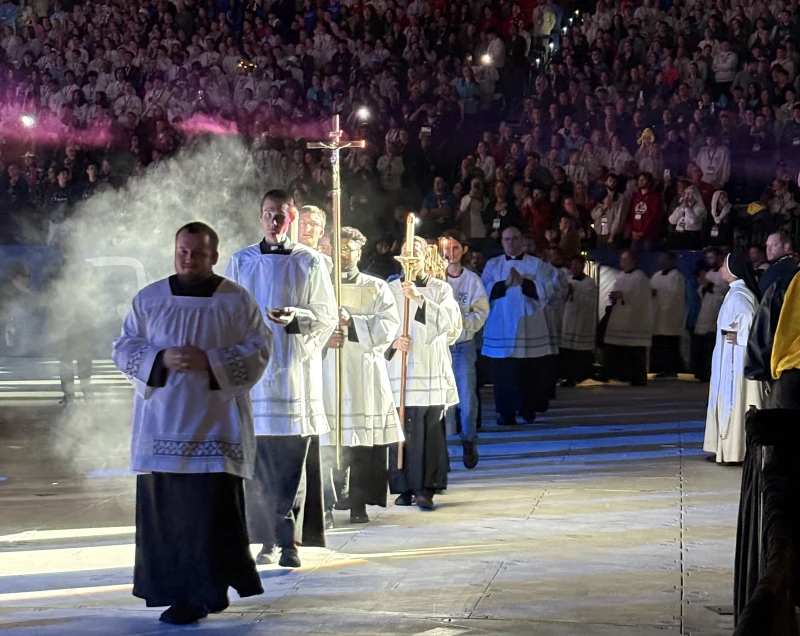
 Priests process into Lucas Oil Stadium on Nov. 22, 2025, for the concluding Mass in Lucas Oil Stadium at the National Catholic Youth Conference in Indianapolis. / Credit: Tessa Gervasini/CNA

Indianapolis, Indiana, Nov 24, 2025 / 10:35 am (CNA).
The 2025 National Catholic Youth Conferences (NCYC) concluded with a nighttime Mass drawing around 16,000 teenagers.After three days of prayer, community, sacraments, and a conversation with Pope Leo XIV, young Catholics packed into Lucas Oil Stadium in Indianapolis to end the conference with Mass on Nov. 22. Archbishop Nelson Pérez told CNA it was “beautiful” to celebrate the Mass alongside 25 of his brother bishops and more than 240 priests. “It’s the Church in its splendor,” Pérez said. “Tonight, we experienced the Church in its splendor.” The final Mass was celebrated on the Saturday before the solemnity of Christ the King. In his homily, Pérez said: “When I think about a king, I think about palaces and big thrones and power and authority.”“But when Jesus talks about king it’s … different,” Pérez said. “His throne is a cross. His crown is not made of gold and gems. It’s made of thorns. He doesn’t wear fancy, beautiful, priceless rings on his hands. He has nails.”The “very mystery of the life and the death of Christ, the King, and all of our lives is actually a dying and a rising — dying to sin, dying to the parts of our humanity that might be warped and wounded, and rising to new life to renewal of our soul.”Then “that process goes over and over over and over and over again until we die in Christ for the last time and then rise with him,” Pérez said. “How blessed, how filled with hope we are.”Pérez reminds teens: ‘Christ loves you just as you are’Pérez concluded his homily by tying his message back to what Pope Leo told the teens in his digital encounter with them on Nov. 21. Pérez told the teenagers Pope Leo spoke with them because he loves them.Pope Leo has “gathered with youth all over the place, especially this summer, [during] the Jubilee of Youth,” Pérez said. The pope’s “message is profound, powerful, and simple at the same time: ‘Christ loves you just as you are.’”Pérez reminded the crowd to listen to what the pope said to them. “Think of your closest friends. If they were hurting, you would walk with them, listen, and stay close,” the pope said. “Our relation with Jesus is similar. He knows when life feels heavy, even when we do not feel his presence, our faith tells us he is there.”“To entrust our struggles to Jesus, we have to spend time in prayer … We can speak honestly about what’s in our hearts,” Pérez said, quoting the pope. “That is why daily moments of silence are so important, whether through adoration, reading Scripture, or simply talking to him.”“‘Little by little, we learn to hear his voice, both from within and through the people he sends us. As you grow closer to Jesus,’ he said to us, ‘Do not fear what he may ask of you. If he challenges you to make changes in your life, it’s always because he wants to give you greater joy and freedom. God is never outdone in generosity.’”“The pope’s digital visit was what made this NCYC epic, really epic and different from any other,” Pérez told CNA. The success was from “the excitement of our youth to welcome the Holy Father” and Pope Leo’s “generosity and willingness” to speak with them. Being a part of the conference and seeing so many young Catholics at Mass together made Pérez feel “hopeful,” he said. “In a world and a country that’s so divided right now and violent at times, after this, I’m just so full of hope. It’s almost like we’re going to be OK.”“It’s incredible to see the young Church alive,” Pérez said. “It’s such a beautiful, beautiful gathering.”

16,000 teens attend Mass together to conclude NCYC #Catholic Priests process into Lucas Oil Stadium on Nov. 22, 2025, for the concluding Mass in Lucas Oil Stadium at the National Catholic Youth Conference in Indianapolis. / Credit: Tessa Gervasini/CNA Indianapolis, Indiana, Nov 24, 2025 / 10:35 am (CNA). The 2025 National Catholic Youth Conferences (NCYC) concluded with a nighttime Mass drawing around 16,000 teenagers.After three days of prayer, community, sacraments, and a conversation with Pope Leo XIV, young Catholics packed into Lucas Oil Stadium in Indianapolis to end the conference with Mass on Nov. 22. Archbishop Nelson Pérez told CNA it was “beautiful” to celebrate the Mass alongside 25 of his brother bishops and more than 240 priests. “It’s the Church in its splendor,” Pérez said. “Tonight, we experienced the Church in its splendor.” The final Mass was celebrated on the Saturday before the solemnity of Christ the King. In his homily, Pérez said: “When I think about a king, I think about palaces and big thrones and power and authority.”“But when Jesus talks about king it’s … different,” Pérez said. “His throne is a cross. His crown is not made of gold and gems. It’s made of thorns. He doesn’t wear fancy, beautiful, priceless rings on his hands. He has nails.”The “very mystery of the life and the death of Christ, the King, and all of our lives is actually a dying and a rising — dying to sin, dying to the parts of our humanity that might be warped and wounded, and rising to new life to renewal of our soul.”Then “that process goes over and over over and over and over again until we die in Christ for the last time and then rise with him,” Pérez said. “How blessed, how filled with hope we are.”Pérez reminds teens: ‘Christ loves you just as you are’Pérez concluded his homily by tying his message back to what Pope Leo told the teens in his digital encounter with them on Nov. 21. Pérez told the teenagers Pope Leo spoke with them because he loves them.Pope Leo has “gathered with youth all over the place, especially this summer, [during] the Jubilee of Youth,” Pérez said. The pope’s “message is profound, powerful, and simple at the same time: ‘Christ loves you just as you are.’”Pérez reminded the crowd to listen to what the pope said to them. “Think of your closest friends. If they were hurting, you would walk with them, listen, and stay close,” the pope said. “Our relation with Jesus is similar. He knows when life feels heavy, even when we do not feel his presence, our faith tells us he is there.”“To entrust our struggles to Jesus, we have to spend time in prayer … We can speak honestly about what’s in our hearts,” Pérez said, quoting the pope. “That is why daily moments of silence are so important, whether through adoration, reading Scripture, or simply talking to him.”“‘Little by little, we learn to hear his voice, both from within and through the people he sends us. As you grow closer to Jesus,’ he said to us, ‘Do not fear what he may ask of you. If he challenges you to make changes in your life, it’s always because he wants to give you greater joy and freedom. God is never outdone in generosity.’”“The pope’s digital visit was what made this NCYC epic, really epic and different from any other,” Pérez told CNA. The success was from “the excitement of our youth to welcome the Holy Father” and Pope Leo’s “generosity and willingness” to speak with them. Being a part of the conference and seeing so many young Catholics at Mass together made Pérez feel “hopeful,” he said. “In a world and a country that’s so divided right now and violent at times, after this, I’m just so full of hope. It’s almost like we’re going to be OK.”“It’s incredible to see the young Church alive,” Pérez said. “It’s such a beautiful, beautiful gathering.”


Priests process into Lucas Oil Stadium on Nov. 22, 2025, for the concluding Mass in Lucas Oil Stadium at the National Catholic Youth Conference in Indianapolis. / Credit: Tessa Gervasini/CNA

Indianapolis, Indiana, Nov 24, 2025 / 10:35 am (CNA).

The 2025 National Catholic Youth Conferences (NCYC) concluded with a nighttime Mass drawing around 16,000 teenagers.

After three days of prayer, community, sacraments, and a conversation with Pope Leo XIV, young Catholics packed into Lucas Oil Stadium in Indianapolis to end the conference with Mass on Nov. 22. Archbishop Nelson Pérez told CNA it was “beautiful” to celebrate the Mass alongside 25 of his brother bishops and more than 240 priests. 

“It’s the Church in its splendor,” Pérez said. “Tonight, we experienced the Church in its splendor.” 

The final Mass was celebrated on the Saturday before the solemnity of Christ the King. In his homily, Pérez said: “When I think about a king, I think about palaces and big thrones and power and authority.”

“But when Jesus talks about king it’s … different,” Pérez said. “His throne is a cross. His crown is not made of gold and gems. It’s made of thorns. He doesn’t wear fancy, beautiful, priceless rings on his hands. He has nails.”

The “very mystery of the life and the death of Christ, the King, and all of our lives is actually a dying and a rising — dying to sin, dying to the parts of our humanity that might be warped and wounded, and rising to new life to renewal of our soul.”

Then “that process goes over and over over and over and over again until we die in Christ for the last time and then rise with him,” Pérez said. “How blessed, how filled with hope we are.”

Pérez reminds teens: ‘Christ loves you just as you are’

Pérez concluded his homily by tying his message back to what Pope Leo told the teens in his digital encounter with them on Nov. 21. Pérez told the teenagers Pope Leo spoke with them because he loves them.

Pope Leo has “gathered with youth all over the place, especially this summer, [during] the Jubilee of Youth,” Pérez said. The pope’s “message is profound, powerful, and simple at the same time: ‘Christ loves you just as you are.’”

Pérez reminded the crowd to listen to what the pope said to them. “Think of your closest friends. If they were hurting, you would walk with them, listen, and stay close,” the pope said. “Our relation with Jesus is similar. He knows when life feels heavy, even when we do not feel his presence, our faith tells us he is there.”

“To entrust our struggles to Jesus, we have to spend time in prayer … We can speak honestly about what’s in our hearts,” Pérez said, quoting the pope. “That is why daily moments of silence are so important, whether through adoration, reading Scripture, or simply talking to him.”

“‘Little by little, we learn to hear his voice, both from within and through the people he sends us. As you grow closer to Jesus,’ he said to us, ‘Do not fear what he may ask of you. If he challenges you to make changes in your life, it’s always because he wants to give you greater joy and freedom. God is never outdone in generosity.’”

“The pope’s digital visit was what made this NCYC epic, really epic and different from any other,” Pérez told CNA. The success was from “the excitement of our youth to welcome the Holy Father” and Pope Leo’s “generosity and willingness” to speak with them. 

Being a part of the conference and seeing so many young Catholics at Mass together made Pérez feel “hopeful,” he said. “In a world and a country that’s so divided right now and violent at times, after this, I’m just so full of hope. It’s almost like we’re going to be OK.”

“It’s incredible to see the young Church alive,” Pérez said. “It’s such a beautiful, beautiful gathering.”

Read More
Burials for little ones: How a New Orleans ministry helps families grieve #Catholic 
 
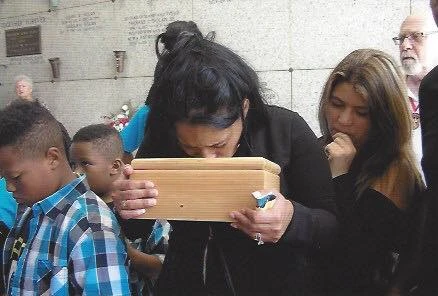
 A family grieves their lost baby at a funeral at the crypt at St. Patrick’s Cemetery in New Orleans. Many friends, relatives, and families attended the funeral that day. / Credit: Photo courtesy of Compassionate Burials for Indigent Babies

CNA Staff, Nov 19, 2025 / 06:00 am (CNA).
Sandy Schaetz still mourns the baby she never met. “It was terrifying and traumatic,” she said of her miscarriage. “I was consoled after by the prayers of a deacon, but never named the baby or knew if it was a boy or girl.” “It was not something I understood at the time and I only wish I had known more of what was happening,” she told CNA. Now, Schaetz volunteers with Compassionate Burials for Indigent Babies (CBIB), an organization that buries babies who died, whether stillborn, miscarried, or aborted.The group organizes everything for the funerals, which are held at a crypt at St. Patrick’s Cemetery in New Orleans.A shoebox-sized casket lined with donated white fabric, usually from wedding dresses, is processed through the cemetery, with Knights of Columbus present as the honor guard. A volunteer musician plays at every funeral; a Catholic deacon presides at almost every burial.Two Knights of Columbus carry the casket of a baby who was murdered. Credit: Photo courtesy of Compassionate Burials for Indigent BabiesWhen Schaetz attended her first burial service as a volunteer, it hit her to the core.  “I find it difficult to put into words how it affected me,” Schaetz said. “All God needed me to do that day was to be present, to pray, to honor the life he had created.” “It opened my eyes to how each life is such a gift, and when that life ends how important it is to show respect and pray for the soul and bury the dead with love,” Schaetz said. Death and resurrection Women who lose children through miscarriage often suffer silently, according to Lise Naccari, the founder of CBIB. “Losing a child is hard. Often women suffer in silence the pain of infant loss and ride that sad emotional roller coaster ride alone,” Naccari told CNA. One in four pregnancies ends in miscarriage — a devastating statistic for many couples. Naccari herself experienced a miscarriage as well as several challenging pregnancies. “I feel a special connection with poor mothers who have lost a child. My heart goes out to them,” Naccari said.Lise Naccari (right) embraces a grieving mother at a burial at the crypt at St. Patrick’s Cemetery in New Orleans. Credit: Photo courtesy of Compassionate Burials for Indigent BabiesNaccari buries the babies who were wanted and loved, but also the babies who were thrown out or mistreated.“CBIB has buried babies as big as a blueberry and up to 2 years old,” Naccari said. “We buried babies stillborn, miscarried, abandoned, unclaimed, aborted, murdered, and thrown away in the trash — and every situation possible.”“Many babies were mistreated, abused, and tossed out … these are heartbreaking funerals to go to,” Naccari said.CBIB dressed and buried seven babies who were left at hospitals labeled “unclaimed and abandoned,” Naccari said. CBIB buried the babies at the crypt at St. Patrick’s Cemetery in New Orleans. Credit: Photo courtesy of Compassionate Burials for Indigent Babies“Babies are left sometimes because some families can not afford funerals for them but would like one,” Naccari said. “Also, many parents are young, and the grief can be overwhelming and they cannot navigate through funeral arrangements.” Her life’s work is to bury the dead — and she looks to the Resurrection. “I consider what I do holy,” Naccari said. “I feel like this is my vocation and I know God orchestrated all of this. I give all honor and glory to him, our loving Father.” “What I do is not about sorrow and death,” Naccari continued. “What I do is really about joy and life — eternal life.” A father (right) whose child was murdered carries the casket with the help of others. Credit: Photo courtesy of Compassionate Burials for Indigent BabiesIt’s not an easy job, and Naccari looks to God for strength.“Lord, I don’t want to do this anymore. It hurts my heart too much,” Naccari remembered praying as she prepared one baby for burial — a baby girl who had been abandoned and tossed out after she was born.“I felt a still small voice within me say, ‘Lise, don’t think about their bodies, focus on the Resurrection,’” Naccari recalled.“The sunlight from the stained-glass windows was shining down a warm yellow color on my face, as I looked up in it and I thought, yes, this is what I needed to hear to keep going — focus on the Resurrection,” she continued.A resource for women in needSheena Lewis was in jail when her son, still a baby, passed away. She couldn’t attend the funeral, but Naccari organized the burial for her.Lewis, now sober and out of jail, visits her son’s crypt often.“I have solace in the fact he was laid to rest in a beautiful manner when I couldn’t be there for him or myself at the time,” Lewis told CNA.Many young mothers CBIB helps are often “steeped in poverty” and have no support system. They are often “low income, uneducated, coming from sometimes addiction or problem homes,” Naccari said.“Often I find at these funerals that the young mothers are alone or they may come with children or other women — but there are no men to help support them,” Naccari said.“My heart is broken for them, for they are not only battling their poverty, they also have to deal with losing a child,” she said.A moment to mourn Funerals help families process their grief — a grief that’s often hidden away due to the nature of miscarriages. Deacon Ricky Suprean preaches at almost every graveside burial — but after a couple years of volunteering, he realized God had called him to this so he could find healing. Suprean and his wife, Lynn, experienced two miscarriages.Suprean struggled to process it at the time, but through his volunteering, he’s found some healing. He still remembers the first CBIB funeral he presided at. “I felt the power of life that day,” he told CNA. “It was cold. I had no idea I would kneel in front of each little coffin and pray for each child and each family with my hand touching each coffin.”Volunteers hugged each family member, he recalled.Deacon Ricky Suprean at the burial of two babies at the crypt at St. Patrick’s Cemetery in New Orleans. Credit: Photo courtesy of Compassionate Burials for Indigent Babies“God has allowed me to give a proper burial to my own two lost children through CBIB time and time again,” Suprean said.“God created these children in my wife’s womb, and they will be waiting for us in heaven,” Suprean continued.Struggling to process grief is common with loss of children, according to Naccari.“Too often people are hurting so much and don’t want to face a funeral,” Naccari said. “They feel vulnerable and so it is easier to turn away and do nothing.”“But on the contrary, I have observed that these funerals provide consolation, comfort, solace, and even a healthy way of healing after the loss of a baby,” Naccari said.“It’s a good grief,” Naccari continued. “Funerals are about love and holding onto friends and family at a time of need. It can be life-changing.”Some funerals have had as many as 100 people in attendance.Many volunteers are “faithfully committed” to being present at every funeral.“It could be freezing cold or blistering hot in the summer, but they just show up and either help set up, greet the parents, or stand tall next to a casket to show the love of Jesus to our families,” Naccari said.The altar at a burial at the crypt at St. Patrick’s Cemetery in New Orleans. CBIB has buried hundreds of babies at the crypt. Credit: Photo courtesy of Compassionate Burials for Indigent BabiesThese funerals “allow parents that special moment to mourn their loss and to remember their little one and ponder the person that little one could have been,” Naccari said.“CBIB celebrates each life, and we believe that God somehow rights all the wrongs and makes all things new,” Naccari said. “And then we move to the next funeral.”

Burials for little ones: How a New Orleans ministry helps families grieve #Catholic A family grieves their lost baby at a funeral at the crypt at St. Patrick’s Cemetery in New Orleans. Many friends, relatives, and families attended the funeral that day. / Credit: Photo courtesy of Compassionate Burials for Indigent Babies CNA Staff, Nov 19, 2025 / 06:00 am (CNA). Sandy Schaetz still mourns the baby she never met. “It was terrifying and traumatic,” she said of her miscarriage. “I was consoled after by the prayers of a deacon, but never named the baby or knew if it was a boy or girl.” “It was not something I understood at the time and I only wish I had known more of what was happening,” she told CNA. Now, Schaetz volunteers with Compassionate Burials for Indigent Babies (CBIB), an organization that buries babies who died, whether stillborn, miscarried, or aborted.The group organizes everything for the funerals, which are held at a crypt at St. Patrick’s Cemetery in New Orleans.A shoebox-sized casket lined with donated white fabric, usually from wedding dresses, is processed through the cemetery, with Knights of Columbus present as the honor guard. A volunteer musician plays at every funeral; a Catholic deacon presides at almost every burial.Two Knights of Columbus carry the casket of a baby who was murdered. Credit: Photo courtesy of Compassionate Burials for Indigent BabiesWhen Schaetz attended her first burial service as a volunteer, it hit her to the core.  “I find it difficult to put into words how it affected me,” Schaetz said. “All God needed me to do that day was to be present, to pray, to honor the life he had created.” “It opened my eyes to how each life is such a gift, and when that life ends how important it is to show respect and pray for the soul and bury the dead with love,” Schaetz said. Death and resurrection Women who lose children through miscarriage often suffer silently, according to Lise Naccari, the founder of CBIB. “Losing a child is hard. Often women suffer in silence the pain of infant loss and ride that sad emotional roller coaster ride alone,” Naccari told CNA. One in four pregnancies ends in miscarriage — a devastating statistic for many couples. Naccari herself experienced a miscarriage as well as several challenging pregnancies. “I feel a special connection with poor mothers who have lost a child. My heart goes out to them,” Naccari said.Lise Naccari (right) embraces a grieving mother at a burial at the crypt at St. Patrick’s Cemetery in New Orleans. Credit: Photo courtesy of Compassionate Burials for Indigent BabiesNaccari buries the babies who were wanted and loved, but also the babies who were thrown out or mistreated.“CBIB has buried babies as big as a blueberry and up to 2 years old,” Naccari said. “We buried babies stillborn, miscarried, abandoned, unclaimed, aborted, murdered, and thrown away in the trash — and every situation possible.”“Many babies were mistreated, abused, and tossed out … these are heartbreaking funerals to go to,” Naccari said.CBIB dressed and buried seven babies who were left at hospitals labeled “unclaimed and abandoned,” Naccari said. CBIB buried the babies at the crypt at St. Patrick’s Cemetery in New Orleans. Credit: Photo courtesy of Compassionate Burials for Indigent Babies“Babies are left sometimes because some families can not afford funerals for them but would like one,” Naccari said. “Also, many parents are young, and the grief can be overwhelming and they cannot navigate through funeral arrangements.” Her life’s work is to bury the dead — and she looks to the Resurrection. “I consider what I do holy,” Naccari said. “I feel like this is my vocation and I know God orchestrated all of this. I give all honor and glory to him, our loving Father.” “What I do is not about sorrow and death,” Naccari continued. “What I do is really about joy and life — eternal life.” A father (right) whose child was murdered carries the casket with the help of others. Credit: Photo courtesy of Compassionate Burials for Indigent BabiesIt’s not an easy job, and Naccari looks to God for strength.“Lord, I don’t want to do this anymore. It hurts my heart too much,” Naccari remembered praying as she prepared one baby for burial — a baby girl who had been abandoned and tossed out after she was born.“I felt a still small voice within me say, ‘Lise, don’t think about their bodies, focus on the Resurrection,’” Naccari recalled.“The sunlight from the stained-glass windows was shining down a warm yellow color on my face, as I looked up in it and I thought, yes, this is what I needed to hear to keep going — focus on the Resurrection,” she continued.A resource for women in needSheena Lewis was in jail when her son, still a baby, passed away. She couldn’t attend the funeral, but Naccari organized the burial for her.Lewis, now sober and out of jail, visits her son’s crypt often.“I have solace in the fact he was laid to rest in a beautiful manner when I couldn’t be there for him or myself at the time,” Lewis told CNA.Many young mothers CBIB helps are often “steeped in poverty” and have no support system. They are often “low income, uneducated, coming from sometimes addiction or problem homes,” Naccari said.“Often I find at these funerals that the young mothers are alone or they may come with children or other women — but there are no men to help support them,” Naccari said.“My heart is broken for them, for they are not only battling their poverty, they also have to deal with losing a child,” she said.A moment to mourn Funerals help families process their grief — a grief that’s often hidden away due to the nature of miscarriages. Deacon Ricky Suprean preaches at almost every graveside burial — but after a couple years of volunteering, he realized God had called him to this so he could find healing. Suprean and his wife, Lynn, experienced two miscarriages.Suprean struggled to process it at the time, but through his volunteering, he’s found some healing. He still remembers the first CBIB funeral he presided at. “I felt the power of life that day,” he told CNA. “It was cold. I had no idea I would kneel in front of each little coffin and pray for each child and each family with my hand touching each coffin.”Volunteers hugged each family member, he recalled.Deacon Ricky Suprean at the burial of two babies at the crypt at St. Patrick’s Cemetery in New Orleans. Credit: Photo courtesy of Compassionate Burials for Indigent Babies“God has allowed me to give a proper burial to my own two lost children through CBIB time and time again,” Suprean said.“God created these children in my wife’s womb, and they will be waiting for us in heaven,” Suprean continued.Struggling to process grief is common with loss of children, according to Naccari.“Too often people are hurting so much and don’t want to face a funeral,” Naccari said. “They feel vulnerable and so it is easier to turn away and do nothing.”“But on the contrary, I have observed that these funerals provide consolation, comfort, solace, and even a healthy way of healing after the loss of a baby,” Naccari said.“It’s a good grief,” Naccari continued. “Funerals are about love and holding onto friends and family at a time of need. It can be life-changing.”Some funerals have had as many as 100 people in attendance.Many volunteers are “faithfully committed” to being present at every funeral.“It could be freezing cold or blistering hot in the summer, but they just show up and either help set up, greet the parents, or stand tall next to a casket to show the love of Jesus to our families,” Naccari said.The altar at a burial at the crypt at St. Patrick’s Cemetery in New Orleans. CBIB has buried hundreds of babies at the crypt. Credit: Photo courtesy of Compassionate Burials for Indigent BabiesThese funerals “allow parents that special moment to mourn their loss and to remember their little one and ponder the person that little one could have been,” Naccari said.“CBIB celebrates each life, and we believe that God somehow rights all the wrongs and makes all things new,” Naccari said. “And then we move to the next funeral.”


A family grieves their lost baby at a funeral at the crypt at St. Patrick’s Cemetery in New Orleans. Many friends, relatives, and families attended the funeral that day. / Credit: Photo courtesy of Compassionate Burials for Indigent Babies

CNA Staff, Nov 19, 2025 / 06:00 am (CNA).

Sandy Schaetz still mourns the baby she never met. 

“It was terrifying and traumatic,” she said of her miscarriage. “I was consoled after by the prayers of a deacon, but never named the baby or knew if it was a boy or girl.” 

“It was not something I understood at the time and I only wish I had known more of what was happening,” she told CNA. 

Now, Schaetz volunteers with Compassionate Burials for Indigent Babies (CBIB), an organization that buries babies who died, whether stillborn, miscarried, or aborted.

The group organizes everything for the funerals, which are held at a crypt at St. Patrick’s Cemetery in New Orleans.

A shoebox-sized casket lined with donated white fabric, usually from wedding dresses, is processed through the cemetery, with Knights of Columbus present as the honor guard. A volunteer musician plays at every funeral; a Catholic deacon presides at almost every burial.

Two Knights of Columbus carry the casket of a baby who was murdered. Credit: Photo courtesy of Compassionate Burials for Indigent Babies

When Schaetz attended her first burial service as a volunteer, it hit her to the core.  

“I find it difficult to put into words how it affected me,” Schaetz said. “All God needed me to do that day was to be present, to pray, to honor the life he had created.” 

“It opened my eyes to how each life is such a gift, and when that life ends how important it is to show respect and pray for the soul and bury the dead with love,” Schaetz said. 

Death and resurrection 

Women who lose children through miscarriage often suffer silently, according to Lise Naccari, the founder of CBIB. 

“Losing a child is hard. Often women suffer in silence the pain of infant loss and ride that sad emotional roller coaster ride alone,” Naccari told CNA. 

One in four pregnancies ends in miscarriage — a devastating statistic for many couples. 

Naccari herself experienced a miscarriage as well as several challenging pregnancies. 

“I feel a special connection with poor mothers who have lost a child. My heart goes out to them,” Naccari said.

Lise Naccari (right) embraces a grieving mother at a burial at the crypt at St. Patrick’s Cemetery in New Orleans. Credit: Photo courtesy of Compassionate Burials for Indigent Babies

Naccari buries the babies who were wanted and loved, but also the babies who were thrown out or mistreated.

“CBIB has buried babies as big as a blueberry and up to 2 years old,” Naccari said. “We buried babies stillborn, miscarried, abandoned, unclaimed, aborted, murdered, and thrown away in the trash — and every situation possible.”

“Many babies were mistreated, abused, and tossed out … these are heartbreaking funerals to go to,” Naccari said.

CBIB dressed and buried seven babies who were left at hospitals labeled “unclaimed and abandoned,” Naccari said. CBIB buried the babies at the crypt at St. Patrick’s Cemetery in New Orleans. Credit: Photo courtesy of Compassionate Burials for Indigent Babies

“Babies are left sometimes because some families can not afford funerals for them but would like one,” Naccari said. “Also, many parents are young, and the grief can be overwhelming and they cannot navigate through funeral arrangements.” 

Her life’s work is to bury the dead — and she looks to the Resurrection. 

“I consider what I do holy,” Naccari said. “I feel like this is my vocation and I know God orchestrated all of this. I give all honor and glory to him, our loving Father.” 

“What I do is not about sorrow and death,” Naccari continued. “What I do is really about joy and life — eternal life.” 

A father (right) whose child was murdered carries the casket with the help of others. Credit: Photo courtesy of Compassionate Burials for Indigent Babies

It’s not an easy job, and Naccari looks to God for strength.

“Lord, I don’t want to do this anymore. It hurts my heart too much,” Naccari remembered praying as she prepared one baby for burial — a baby girl who had been abandoned and tossed out after she was born.

“I felt a still small voice within me say, ‘Lise, don’t think about their bodies, focus on the Resurrection,’” Naccari recalled.

“The sunlight from the stained-glass windows was shining down a warm yellow color on my face, as I looked up in it and I thought, yes, this is what I needed to hear to keep going — focus on the Resurrection,” she continued.

A resource for women in need

Sheena Lewis was in jail when her son, still a baby, passed away. She couldn’t attend the funeral, but Naccari organized the burial for her.

Lewis, now sober and out of jail, visits her son’s crypt often.

“I have solace in the fact he was laid to rest in a beautiful manner when I couldn’t be there for him or myself at the time,” Lewis told CNA.

Many young mothers CBIB helps are often “steeped in poverty” and have no support system. They are often “low income, uneducated, coming from sometimes addiction or problem homes,” Naccari said.

“Often I find at these funerals that the young mothers are alone or they may come with children or other women — but there are no men to help support them,” Naccari said.

“My heart is broken for them, for they are not only battling their poverty, they also have to deal with losing a child,” she said.

A moment to mourn 

Funerals help families process their grief — a grief that’s often hidden away due to the nature of miscarriages. 

Deacon Ricky Suprean preaches at almost every graveside burial — but after a couple years of volunteering, he realized God had called him to this so he could find healing. 

Suprean and his wife, Lynn, experienced two miscarriages.

Suprean struggled to process it at the time, but through his volunteering, he’s found some healing. He still remembers the first CBIB funeral he presided at. 

“I felt the power of life that day,” he told CNA. “It was cold. I had no idea I would kneel in front of each little coffin and pray for each child and each family with my hand touching each coffin.”

Volunteers hugged each family member, he recalled.

Deacon Ricky Suprean at the burial of two babies at the crypt at St. Patrick’s Cemetery in New Orleans. Credit: Photo courtesy of Compassionate Burials for Indigent Babies

“God has allowed me to give a proper burial to my own two lost children through CBIB time and time again,” Suprean said.

“God created these children in my wife’s womb, and they will be waiting for us in heaven,” Suprean continued.

Struggling to process grief is common with loss of children, according to Naccari.

“Too often people are hurting so much and don’t want to face a funeral,” Naccari said. “They feel vulnerable and so it is easier to turn away and do nothing.”

“But on the contrary, I have observed that these funerals provide consolation, comfort, solace, and even a healthy way of healing after the loss of a baby,” Naccari said.

“It’s a good grief,” Naccari continued. “Funerals are about love and holding onto friends and family at a time of need. It can be life-changing.”

Some funerals have had as many as 100 people in attendance.

Many volunteers are “faithfully committed” to being present at every funeral.

“It could be freezing cold or blistering hot in the summer, but they just show up and either help set up, greet the parents, or stand tall next to a casket to show the love of Jesus to our families,” Naccari said.

The altar at a burial at the crypt at St. Patrick’s Cemetery in New Orleans. CBIB has buried hundreds of babies at the crypt. Credit: Photo courtesy of Compassionate Burials for Indigent Babies

These funerals “allow parents that special moment to mourn their loss and to remember their little one and ponder the person that little one could have been,” Naccari said.

“CBIB celebrates each life, and we believe that God somehow rights all the wrongs and makes all things new,” Naccari said. “And then we move to the next funeral.”

Read More