sleep

PHOTOS: Tickhill Psalter’s Jesse Tree shines in Morgan Library’s Advent exhibit #Catholic 
 
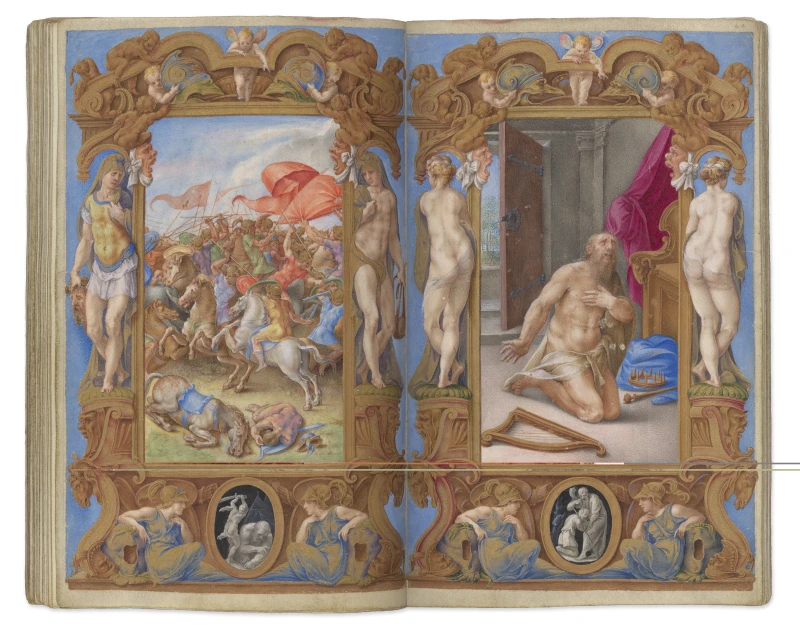
 Death of Uriah; David in Penance, from the Morgan’s famed Farnese Hours, demonstrates the enduring appeal of the penitential Psalms of David as seen in this early Renaissance book of hours. Italy, Rome, 1546. The Morgan Library & Museum, New York, MS M.69, fols, 63v-63r. Photography by Janny Chiu. / Credit: Courtesy of the New York Library

New York City, New York, Nov 30, 2025 / 08:00 am (CNA).
Part of the New York Public Library’s Spencer Collection, the Tickhill Psalter is on view throughout Advent and Christmas at The Morgan Library & Museum in its exhibit “Sing a New Song: The Psalms in Medieval Art and Life.” A full-page Jesse Tree introduces the Psalms in the Tickhill Psalter, a 14th-century illuminated manuscript from the Augustinian Worksop Priory in Nottinghamshire, England. Tree of Jesse (Psalm 1), from the Tickhill Psalter, England, Nottinghamshire, Worksop Priory, 1303-14, New York Public Library, Spencer 26. fol. 6v. The Medieval manuscript is on display in Morgan Library’s Advent exhibit. Credit: Courtesy of the Morgan LibraryDavid appears in the historiated B of Psalm 1, providing a conceptual link to scenes from his life in the Jesse Tree on the facing page. “Beatus vir,” or “Blessed is the man,” the first stanza opens in celebration of the one who delights in God’s law, concluding: “That person is like a tree planted by streams of water, which yields its fruit in season and whose leaf does not wither, — what they do prospers.” These words and their historiated B, with its visual link to the facing page, highlight David as key author of the Psalms and their prefiguration of Christ, the good fruit of the Jesse Tree, a theme common to medieval illuminated manuscripts.King David as Psalmist, from Florence, Italy, ca. 1408-10, by Lorenzo Monaco, who was born Piero di Giovanni but took the name Lorenzo Monaco, or Lorenzo the Monk, upon joining the monastery of Santa Maria degli Angeli, where he became a skilled illuminator and translated themes common to illuminated manuscripts into panel paintings, like this tempera on wood with gold ground depicting David seated on a stone bench tuning a psaltery, lips parted, prepared to sing, with a halo backing the crown he wears to signify the divine inspiration of his compositions. The Metropolitan Museum of Art, New York, 65.14.4. November 2025. Credit: Courtesy of the Metropolitan Museum of Art, New YorkProphets stand in architectural niches on either side of the Tickhill Psalter’s Jesse Tree, heralding the Psalms as prophecy. Credit: Courtesy of the New York LibraryThe central panel of a 1490 Flemish triptych with scenes from the life of Saint Augustine contextualizes the exhibit. This five-by-five-foot oil on wood painting references Augustine’s use of allegory, essential to his understanding of scripture and interpretation of the psalms as prophecy. One scene captures Augustine’s realization of the Trinity as boundless mystery that dwarfs human understanding, allegorized by a child trying to pour the sea into a hole in the sand. Scenes from the life of St. Augustine of Hippo, 1490, Bruges, Belgium, by the unnamed master of St. Augustine, amplifies the Church’s leading theologian on the allegorical interpretation of Psalms. At center, his installation as bishop of Hippo highlights his teaching authority, flanked by scenes of ordination and preaching on the left. On the right, he engages in scholarly discourse and converses with a child trying to pour the sea into a hole in the sand, illustrating the importance of allegory in Augustinian thought. Credit: Courtesy of the New York Public LibraryLate 12th-century book comprised of Augustine’s Gradual Psalms and his Enchiridion (Greek for “handbook”). The well-worn and annotated pages reflect the proliferation of Augustinian influence on interpretation of Scripture. Spain, Santa Maria de Benevivere, near Palencia. Free Library of Philadelphia, Lewis E22, fols. 68v-69r. Credit: Courtesy of the New York Public LibraryIn the book accompanying the exhibit, Morgan curator Deirdre Jackson extends the psalms’ significance to this triptych through a reference to a surviving panel housed in Ireland that shows Augustine on his deathbed. It’s a scene described by contemporary bishop Possidius of Calama, who said that Augustine “ordered those psalms of David which are especially penitential to be copied out and, when he was very weak, used to lie in bed, facing the wall where the written sheets were put up, gazing at them and reading them, and copiously and continuously weeping as he read.”Death of Uriah; David in Penance, from the Morgan’s famed Farnese Hours, demonstrates the enduring appeal of the penitential Psalms of David as seen in this early Renaissance book of hours. Italy, Rome, 1546. The Morgan Library & Museum, New York, MS M.69, fols, 63v-63r. Photography by Janny Chiu. Credit: Courtesy of the New York Public LibraryScenes from the Life of David, depicting the story of David and Goliath, exemplifies the significance attached to the figure of David in medieval illuminated manuscripts. Winchester Bible, England, Winchester, ca. 1160-80. The Morgan Library & Museum, New York, MS M.619v. Photography by Graham S. Haber. Credit: Courtesy of the New York LibraryIn his book “The Tickhill Psalter and Related Manuscripts,” 20th-century art historian Donald Drew Egbert speculates that the Tickhill Psalter was decorated by highly skilled illuminators working for Augustinian monasteries and patrons of Augustinian houses during a high point of book arts in England.St. Thomas More, “in tribulation vehementi et in carcere” (annotation), from the Prayer Book of Thomas More, France, Paris, 1522 (Psalter) and 1530 (Book of Hours), Beinecke Rare Book & Manuscript Library, Yale University, New Haven, MS Vault More, fol. 68v (Psalter section). Credit: Courtesy of the New York LibraryThis high point inspired a trend of books as personalized treasures, best exemplified in this exhibit by St. Thomas More’s prayer book. Containing much of his own writing in the margins, it consists of a Book of Hours and a Psalter and was with him in the Tower of London while he awaited execution. More’s notes during that time show his preoccupation with the psalms of David’s tribulations. Beside Psalm 87:5-10, “a man without help … in the dark places, and in the shadow of death,” More writes, “in severe tribulation and in prison.”The Prayer Book of Thomas More is backed by a wall-sized image of Hans Holbein’s “Sir Thomas More,” positioned to look like More is gazing intently across the gallery at an image of David from the Crusader Bible. Engelhard Gallery, Photography by Janny Chiu, October 2025. Credit: Courtesy of the New York LibraryMore’s thoughts in distress demonstrate the appeal of David’s story to the human heart, a reality repeatedly expressed throughout the treasures of this exhibit. In the Tickhill Psalter’s Jesse Tree, David is encircled by branches springing from a tree that grows out of his father, Jesse, sprawled in an active sleep, his elbow supporting a hand planted against his head as though dreaming of all that is to come. A crop of the enter of Tickhill Psalter showing the Virgin and Child and the figure of David playing a harp. Credit: Courtesy of the New York LibraryThe branches of the tree wind around David and directly overhead to encircle the Virgin and Child, tracing Christ’s lineage through Mary to the House of David. At the top, the branches surround Christ enthroned in majesty, fulfilling the promise of victory over sin and death foreshadowed in the psalms.David strikes a joyous pose and plays a harp in celebration, and foliage on either side of the main branch wraps around prophets who unfurl scrolls to hint at mysteries about to be foretold in the reading of the psalms.Beneath the figure of Jesse, two separate depictions of David protecting his sheep from wild animals cast his actions as allegory in the fight against evil, segueing to his likeness in the historiated B, dancing and singing his story into the Psalms to animate their prefiguration of Christ.

PHOTOS: Tickhill Psalter’s Jesse Tree shines in Morgan Library’s Advent exhibit #Catholic Death of Uriah; David in Penance, from the Morgan’s famed Farnese Hours, demonstrates the enduring appeal of the penitential Psalms of David as seen in this early Renaissance book of hours. Italy, Rome, 1546. The Morgan Library & Museum, New York, MS M.69, fols, 63v-63r. Photography by Janny Chiu. / Credit: Courtesy of the New York Library New York City, New York, Nov 30, 2025 / 08:00 am (CNA). Part of the New York Public Library’s Spencer Collection, the Tickhill Psalter is on view throughout Advent and Christmas at The Morgan Library & Museum in its exhibit “Sing a New Song: The Psalms in Medieval Art and Life.” A full-page Jesse Tree introduces the Psalms in the Tickhill Psalter, a 14th-century illuminated manuscript from the Augustinian Worksop Priory in Nottinghamshire, England. Tree of Jesse (Psalm 1), from the Tickhill Psalter, England, Nottinghamshire, Worksop Priory, 1303-14, New York Public Library, Spencer 26. fol. 6v. The Medieval manuscript is on display in Morgan Library’s Advent exhibit. Credit: Courtesy of the Morgan LibraryDavid appears in the historiated B of Psalm 1, providing a conceptual link to scenes from his life in the Jesse Tree on the facing page. “Beatus vir,” or “Blessed is the man,” the first stanza opens in celebration of the one who delights in God’s law, concluding: “That person is like a tree planted by streams of water, which yields its fruit in season and whose leaf does not wither, — what they do prospers.” These words and their historiated B, with its visual link to the facing page, highlight David as key author of the Psalms and their prefiguration of Christ, the good fruit of the Jesse Tree, a theme common to medieval illuminated manuscripts.King David as Psalmist, from Florence, Italy, ca. 1408-10, by Lorenzo Monaco, who was born Piero di Giovanni but took the name Lorenzo Monaco, or Lorenzo the Monk, upon joining the monastery of Santa Maria degli Angeli, where he became a skilled illuminator and translated themes common to illuminated manuscripts into panel paintings, like this tempera on wood with gold ground depicting David seated on a stone bench tuning a psaltery, lips parted, prepared to sing, with a halo backing the crown he wears to signify the divine inspiration of his compositions. The Metropolitan Museum of Art, New York, 65.14.4. November 2025. Credit: Courtesy of the Metropolitan Museum of Art, New YorkProphets stand in architectural niches on either side of the Tickhill Psalter’s Jesse Tree, heralding the Psalms as prophecy. Credit: Courtesy of the New York LibraryThe central panel of a 1490 Flemish triptych with scenes from the life of Saint Augustine contextualizes the exhibit. This five-by-five-foot oil on wood painting references Augustine’s use of allegory, essential to his understanding of scripture and interpretation of the psalms as prophecy. One scene captures Augustine’s realization of the Trinity as boundless mystery that dwarfs human understanding, allegorized by a child trying to pour the sea into a hole in the sand. Scenes from the life of St. Augustine of Hippo, 1490, Bruges, Belgium, by the unnamed master of St. Augustine, amplifies the Church’s leading theologian on the allegorical interpretation of Psalms. At center, his installation as bishop of Hippo highlights his teaching authority, flanked by scenes of ordination and preaching on the left. On the right, he engages in scholarly discourse and converses with a child trying to pour the sea into a hole in the sand, illustrating the importance of allegory in Augustinian thought. Credit: Courtesy of the New York Public LibraryLate 12th-century book comprised of Augustine’s Gradual Psalms and his Enchiridion (Greek for “handbook”). The well-worn and annotated pages reflect the proliferation of Augustinian influence on interpretation of Scripture. Spain, Santa Maria de Benevivere, near Palencia. Free Library of Philadelphia, Lewis E22, fols. 68v-69r. Credit: Courtesy of the New York Public LibraryIn the book accompanying the exhibit, Morgan curator Deirdre Jackson extends the psalms’ significance to this triptych through a reference to a surviving panel housed in Ireland that shows Augustine on his deathbed. It’s a scene described by contemporary bishop Possidius of Calama, who said that Augustine “ordered those psalms of David which are especially penitential to be copied out and, when he was very weak, used to lie in bed, facing the wall where the written sheets were put up, gazing at them and reading them, and copiously and continuously weeping as he read.”Death of Uriah; David in Penance, from the Morgan’s famed Farnese Hours, demonstrates the enduring appeal of the penitential Psalms of David as seen in this early Renaissance book of hours. Italy, Rome, 1546. The Morgan Library & Museum, New York, MS M.69, fols, 63v-63r. Photography by Janny Chiu. Credit: Courtesy of the New York Public LibraryScenes from the Life of David, depicting the story of David and Goliath, exemplifies the significance attached to the figure of David in medieval illuminated manuscripts. Winchester Bible, England, Winchester, ca. 1160-80. The Morgan Library & Museum, New York, MS M.619v. Photography by Graham S. Haber. Credit: Courtesy of the New York LibraryIn his book “The Tickhill Psalter and Related Manuscripts,” 20th-century art historian Donald Drew Egbert speculates that the Tickhill Psalter was decorated by highly skilled illuminators working for Augustinian monasteries and patrons of Augustinian houses during a high point of book arts in England.St. Thomas More, “in tribulation vehementi et in carcere” (annotation), from the Prayer Book of Thomas More, France, Paris, 1522 (Psalter) and 1530 (Book of Hours), Beinecke Rare Book & Manuscript Library, Yale University, New Haven, MS Vault More, fol. 68v (Psalter section). Credit: Courtesy of the New York LibraryThis high point inspired a trend of books as personalized treasures, best exemplified in this exhibit by St. Thomas More’s prayer book. Containing much of his own writing in the margins, it consists of a Book of Hours and a Psalter and was with him in the Tower of London while he awaited execution. More’s notes during that time show his preoccupation with the psalms of David’s tribulations. Beside Psalm 87:5-10, “a man without help … in the dark places, and in the shadow of death,” More writes, “in severe tribulation and in prison.”The Prayer Book of Thomas More is backed by a wall-sized image of Hans Holbein’s “Sir Thomas More,” positioned to look like More is gazing intently across the gallery at an image of David from the Crusader Bible. Engelhard Gallery, Photography by Janny Chiu, October 2025. Credit: Courtesy of the New York LibraryMore’s thoughts in distress demonstrate the appeal of David’s story to the human heart, a reality repeatedly expressed throughout the treasures of this exhibit. In the Tickhill Psalter’s Jesse Tree, David is encircled by branches springing from a tree that grows out of his father, Jesse, sprawled in an active sleep, his elbow supporting a hand planted against his head as though dreaming of all that is to come. A crop of the enter of Tickhill Psalter showing the Virgin and Child and the figure of David playing a harp. Credit: Courtesy of the New York LibraryThe branches of the tree wind around David and directly overhead to encircle the Virgin and Child, tracing Christ’s lineage through Mary to the House of David. At the top, the branches surround Christ enthroned in majesty, fulfilling the promise of victory over sin and death foreshadowed in the psalms.David strikes a joyous pose and plays a harp in celebration, and foliage on either side of the main branch wraps around prophets who unfurl scrolls to hint at mysteries about to be foretold in the reading of the psalms.Beneath the figure of Jesse, two separate depictions of David protecting his sheep from wild animals cast his actions as allegory in the fight against evil, segueing to his likeness in the historiated B, dancing and singing his story into the Psalms to animate their prefiguration of Christ.


Death of Uriah; David in Penance, from the Morgan’s famed Farnese Hours, demonstrates the enduring appeal of the penitential Psalms of David as seen in this early Renaissance book of hours. Italy, Rome, 1546. The Morgan Library & Museum, New York, MS M.69, fols, 63v-63r. Photography by Janny Chiu. / Credit: Courtesy of the New York Library

New York City, New York, Nov 30, 2025 / 08:00 am (CNA).

Part of the New York Public Library’s Spencer Collection, the Tickhill Psalter is on view throughout Advent and Christmas at The Morgan Library & Museum in its exhibit “Sing a New Song: The Psalms in Medieval Art and Life.” A full-page Jesse Tree introduces the Psalms in the Tickhill Psalter, a 14th-century illuminated manuscript from the Augustinian Worksop Priory in Nottinghamshire, England.

Tree of Jesse (Psalm 1), from the Tickhill Psalter, England, Nottinghamshire, Worksop Priory, 1303-14, New York Public Library, Spencer 26. fol. 6v. The Medieval manuscript is on display in Morgan Library’s Advent exhibit. Credit: Courtesy of the Morgan Library

David appears in the historiated B of Psalm 1, providing a conceptual link to scenes from his life in the Jesse Tree on the facing page. “Beatus vir,” or “Blessed is the man,” the first stanza opens in celebration of the one who delights in God’s law, concluding: “That person is like a tree planted by streams of water, which yields its fruit in season and whose leaf does not wither, — what they do prospers.” 

These words and their historiated B, with its visual link to the facing page, highlight David as key author of the Psalms and their prefiguration of Christ, the good fruit of the Jesse Tree, a theme common to medieval illuminated manuscripts.

King David as Psalmist, from Florence, Italy, ca. 1408-10, by Lorenzo Monaco, who was born Piero di Giovanni but took the name Lorenzo Monaco, or Lorenzo the Monk, upon joining the monastery of Santa Maria degli Angeli, where he became a skilled illuminator and translated themes common to illuminated manuscripts into panel paintings, like this tempera on wood with gold ground depicting David seated on a stone bench tuning a psaltery, lips parted, prepared to sing, with a halo backing the crown he wears to signify the divine inspiration of his compositions. The Metropolitan Museum of Art, New York, 65.14.4. November 2025. Credit: Courtesy of the Metropolitan Museum of Art, New York
Prophets stand in architectural niches on either side of the Tickhill Psalter’s Jesse Tree, heralding the Psalms as prophecy. Credit: Courtesy of the New York Library

The central panel of a 1490 Flemish triptych with scenes from the life of Saint Augustine contextualizes the exhibit. This five-by-five-foot oil on wood painting references Augustine’s use of allegory, essential to his understanding of scripture and interpretation of the psalms as prophecy. One scene captures Augustine’s realization of the Trinity as boundless mystery that dwarfs human understanding, allegorized by a child trying to pour the sea into a hole in the sand. 

Scenes from the life of St. Augustine of Hippo, 1490, Bruges, Belgium, by the unnamed master of St. Augustine, amplifies the Church’s leading theologian on the allegorical interpretation of Psalms. At center, his installation as bishop of Hippo highlights his teaching authority, flanked by scenes of ordination and preaching on the left. On the right, he engages in scholarly discourse and converses with a child trying to pour the sea into a hole in the sand, illustrating the importance of allegory in Augustinian thought. Credit: Courtesy of the New York Public Library
Late 12th-century book comprised of Augustine’s Gradual Psalms and his Enchiridion (Greek for “handbook”). The well-worn and annotated pages reflect the proliferation of Augustinian influence on interpretation of Scripture. Spain, Santa Maria de Benevivere, near Palencia. Free Library of Philadelphia, Lewis E22, fols. 68v-69r. Credit: Courtesy of the New York Public Library

In the book accompanying the exhibit, Morgan curator Deirdre Jackson extends the psalms’ significance to this triptych through a reference to a surviving panel housed in Ireland that shows Augustine on his deathbed. It’s a scene described by contemporary bishop Possidius of Calama, who said that Augustine “ordered those psalms of David which are especially penitential to be copied out and, when he was very weak, used to lie in bed, facing the wall where the written sheets were put up, gazing at them and reading them, and copiously and continuously weeping as he read.”

Death of Uriah; David in Penance, from the Morgan’s famed Farnese Hours, demonstrates the enduring appeal of the penitential Psalms of David as seen in this early Renaissance book of hours. Italy, Rome, 1546. The Morgan Library & Museum, New York, MS M.69, fols, 63v-63r. Photography by Janny Chiu. Credit: Courtesy of the New York Public Library
Scenes from the Life of David, depicting the story of David and Goliath, exemplifies the significance attached to the figure of David in medieval illuminated manuscripts. Winchester Bible, England, Winchester, ca. 1160-80. The Morgan Library & Museum, New York, MS M.619v. Photography by Graham S. Haber. Credit: Courtesy of the New York Library

In his book “The Tickhill Psalter and Related Manuscripts,” 20th-century art historian Donald Drew Egbert speculates that the Tickhill Psalter was decorated by highly skilled illuminators working for Augustinian monasteries and patrons of Augustinian houses during a high point of book arts in England.

St. Thomas More, “in tribulation vehementi et in carcere” (annotation), from the Prayer Book of Thomas More, France, Paris, 1522 (Psalter) and 1530 (Book of Hours), Beinecke Rare Book & Manuscript Library, Yale University, New Haven, MS Vault More, fol. 68v (Psalter section). Credit: Courtesy of the New York Library

This high point inspired a trend of books as personalized treasures, best exemplified in this exhibit by St. Thomas More’s prayer book. Containing much of his own writing in the margins, it consists of a Book of Hours and a Psalter and was with him in the Tower of London while he awaited execution. More’s notes during that time show his preoccupation with the psalms of David’s tribulations. Beside Psalm 87:5-10, “a man without help … in the dark places, and in the shadow of death,” More writes, “in severe tribulation and in prison.”

The Prayer Book of Thomas More is backed by a wall-sized image of Hans Holbein’s "Sir Thomas More," positioned to look like More is gazing intently across the gallery at an image of David from the Crusader Bible. Engelhard Gallery, Photography by Janny Chiu, October 2025. Credit: Courtesy of the New York Library
The Prayer Book of Thomas More is backed by a wall-sized image of Hans Holbein’s “Sir Thomas More,” positioned to look like More is gazing intently across the gallery at an image of David from the Crusader Bible. Engelhard Gallery, Photography by Janny Chiu, October 2025. Credit: Courtesy of the New York Library

More’s thoughts in distress demonstrate the appeal of David’s story to the human heart, a reality repeatedly expressed throughout the treasures of this exhibit. In the Tickhill Psalter’s Jesse Tree, David is encircled by branches springing from a tree that grows out of his father, Jesse, sprawled in an active sleep, his elbow supporting a hand planted against his head as though dreaming of all that is to come. 

A crop of the enter of Tickhill Psalter showing the Virgin and Child and the figure of David playing a harp. Credit: Courtesy of the New York Library

The branches of the tree wind around David and directly overhead to encircle the Virgin and Child, tracing Christ’s lineage through Mary to the House of David. At the top, the branches surround Christ enthroned in majesty, fulfilling the promise of victory over sin and death foreshadowed in the psalms.

David strikes a joyous pose and plays a harp in celebration, and foliage on either side of the main branch wraps around prophets who unfurl scrolls to hint at mysteries about to be foretold in the reading of the psalms.

Beneath the figure of Jesse, two separate depictions of David protecting his sheep from wild animals cast his actions as allegory in the fight against evil, segueing to his likeness in the historiated B, dancing and singing his story into the Psalms to animate their prefiguration of Christ.

Read More
Mother Frances Cabrini: The unsinkable saint who missed the Titanic #Catholic 
 
 A photo of St. Frances Cabrini from 1880, the year she founded her order, is seen against a 1913 painting by Harry J. Jansen, “The Steamship Titanic.” / Credit: National Maritime Museum, Greenwich, England, public domain via Wikimedia Commons

National Catholic Register, Nov 13, 2025 / 04:00 am (CNA).
In April 1912, Mother Frances Cabrini was in Italy with her sisters. Her plans were to visit her foundations in France, Spain, and England before sailing back to the United States in mid-April to continue work in New York City. Her sisters in England were eagerly awaiting this visit from their 62-year-old founder and superior. To help make her journey back to the U.S. more comfortable, they bought her a ticket and booked passage on a new ocean liner, the RMS Titanic.Although an intrepid traveler who would eventually make 24 transatlantic crossings to establish her foundation, hospitals, and orphanages, Mother Cabrini was not a fan of ocean voyages since she had almost drowned as a child.While the sisters in England waited, word got to Mother Cabrini that there was trouble at the Columbus Hospital she had established in New York. It was overflowing and there was urgent business to settle connected to a new expansion. She could not wait. She had to get back to raise desperately needed money to proceed with the project. So she changed her plans and left early, sailing from Naples, disappointing the sisters in England who had booked her passage on the Titanic.The prefix “RMS” in “RMS Titanic” stood for “Royal Mail Ship” because it would also carry mail under contract to the British Royal Mail — an important bit of context for something she wrote in a May 5, 1912, letter to a Sister Gesuina Dotti:“Only two of your letters I have received so far, and if you have sent five, then it must be said that it went down into the depths with the Titanic. If I was going to London, I might have left with it, but Divine Providence, which is constantly watching, did not allow it. God be blessed.”Another close call at seaThis was not Frances Cabrini’s only miss with an iceberg.In 1890, on her second trip to New York, she was among 1,000 passengers on a ship called La Normandie. The seas were very heavy one night and most skipped dinner and stayed in their cabins — except Mother Cabrini and five other souls. She knew of the dangerous situation and back in the cabin remained ready to save her sisters and herself if the call came to go to the lifeboats. She would later report that “the Good Lord … lulled us all to sleep on a great seesaw, rocking us back and forth.”But that was only the beginning. As the storm raged on the next day, she braved going on deck, finding a chair in a relatively safe place, and continued writing a letter. In it, she wrote:“You should see how beautiful the sea is in its great movement, how it swells and foams! It is truly a marvel! … If you were all here with me, daughters, crossing this immense ocean, you would exclaim, ‘Oh how great and wonderful is God in his works!’”Now that is enlightenment from someone who did not like sailing one bit. Maybe because two days earlier she had, as told in an article about her, “compared the tranquility of the sea to the joy experienced by a soul abiding in the peace of God’s grace. No matter what the circumstances, she was able to see the love of Jesus shining through.”That was not all on this trip. Next, around midnight, “we felt a strong jolt and the ship stopped suddenly,” she would write about one such event after another on this journey. She and her sisters dressed and readied to board lifeboats if necessary. The trouble turned out to be something wrong with the engine. At that point “the sea became calm and beautiful” and the ship remained practically motionless until the engine was fixed by the morning and the ship was again able to continue. The breakdown caused an 11-hour delay — a delay that likely saved the ship and passengers from a disaster.Two days later, Mother Cabrini said, “toward 11 we saw ourselves surrounded by icebergs on every part of the horizon … they were about 12 times the size of our ship.” The captain reduced the ship’s speed to weave slowly and carefully through the ice field to avoid colliding with the “immense, jagged fortresses.”A story recorded at her shrine described it this way: “Mother Cabrini noted that though they had complained when the engine broke, the crisis was a great grace. Without that delay, the ship’s encounter with the icebergs would have occurred in the dark, most likely with dire consequences.”‘Supported by my Beloved’Then there was the time the train she was riding from one orphanage to another was shot at outside of Dallas by enemies of the railroad. She remained unruffled and recounted later how one bullet “aimed at my head fell to my side, while it should have pierced my cranium.” When those aboard were aghast about her escape, she told them: “It was the Sacred Heart to whom I had entrusted the journey.”Shortly after this incident, she wrote a letter stating: “Didn’t I write and tell you that I am alive miraculously?”From the Titanic to La Normandie to Dallas, there was no question about divine providence in Mother Cabrini’s life. As she would write: “Supported by my Beloved, none of these adversities can shake me. But if I trust in myself, I will fall.” And: “In whatever difficulty I may encounter I want to trust in the goodness of the Sacred Heart of Jesus, who will never abandon me.”This story was first published by the National Catholic Register, CNA’s sister news partner, and has been adapted by CNA.

Mother Frances Cabrini: The unsinkable saint who missed the Titanic #Catholic A photo of St. Frances Cabrini from 1880, the year she founded her order, is seen against a 1913 painting by Harry J. Jansen, “The Steamship Titanic.” / Credit: National Maritime Museum, Greenwich, England, public domain via Wikimedia Commons National Catholic Register, Nov 13, 2025 / 04:00 am (CNA). In April 1912, Mother Frances Cabrini was in Italy with her sisters. Her plans were to visit her foundations in France, Spain, and England before sailing back to the United States in mid-April to continue work in New York City. Her sisters in England were eagerly awaiting this visit from their 62-year-old founder and superior. To help make her journey back to the U.S. more comfortable, they bought her a ticket and booked passage on a new ocean liner, the RMS Titanic.Although an intrepid traveler who would eventually make 24 transatlantic crossings to establish her foundation, hospitals, and orphanages, Mother Cabrini was not a fan of ocean voyages since she had almost drowned as a child.While the sisters in England waited, word got to Mother Cabrini that there was trouble at the Columbus Hospital she had established in New York. It was overflowing and there was urgent business to settle connected to a new expansion. She could not wait. She had to get back to raise desperately needed money to proceed with the project. So she changed her plans and left early, sailing from Naples, disappointing the sisters in England who had booked her passage on the Titanic.The prefix “RMS” in “RMS Titanic” stood for “Royal Mail Ship” because it would also carry mail under contract to the British Royal Mail — an important bit of context for something she wrote in a May 5, 1912, letter to a Sister Gesuina Dotti:“Only two of your letters I have received so far, and if you have sent five, then it must be said that it went down into the depths with the Titanic. If I was going to London, I might have left with it, but Divine Providence, which is constantly watching, did not allow it. God be blessed.”Another close call at seaThis was not Frances Cabrini’s only miss with an iceberg.In 1890, on her second trip to New York, she was among 1,000 passengers on a ship called La Normandie. The seas were very heavy one night and most skipped dinner and stayed in their cabins — except Mother Cabrini and five other souls. She knew of the dangerous situation and back in the cabin remained ready to save her sisters and herself if the call came to go to the lifeboats. She would later report that “the Good Lord … lulled us all to sleep on a great seesaw, rocking us back and forth.”But that was only the beginning. As the storm raged on the next day, she braved going on deck, finding a chair in a relatively safe place, and continued writing a letter. In it, she wrote:“You should see how beautiful the sea is in its great movement, how it swells and foams! It is truly a marvel! … If you were all here with me, daughters, crossing this immense ocean, you would exclaim, ‘Oh how great and wonderful is God in his works!’”Now that is enlightenment from someone who did not like sailing one bit. Maybe because two days earlier she had, as told in an article about her, “compared the tranquility of the sea to the joy experienced by a soul abiding in the peace of God’s grace. No matter what the circumstances, she was able to see the love of Jesus shining through.”That was not all on this trip. Next, around midnight, “we felt a strong jolt and the ship stopped suddenly,” she would write about one such event after another on this journey. She and her sisters dressed and readied to board lifeboats if necessary. The trouble turned out to be something wrong with the engine. At that point “the sea became calm and beautiful” and the ship remained practically motionless until the engine was fixed by the morning and the ship was again able to continue. The breakdown caused an 11-hour delay — a delay that likely saved the ship and passengers from a disaster.Two days later, Mother Cabrini said, “toward 11 we saw ourselves surrounded by icebergs on every part of the horizon … they were about 12 times the size of our ship.” The captain reduced the ship’s speed to weave slowly and carefully through the ice field to avoid colliding with the “immense, jagged fortresses.”A story recorded at her shrine described it this way: “Mother Cabrini noted that though they had complained when the engine broke, the crisis was a great grace. Without that delay, the ship’s encounter with the icebergs would have occurred in the dark, most likely with dire consequences.”‘Supported by my Beloved’Then there was the time the train she was riding from one orphanage to another was shot at outside of Dallas by enemies of the railroad. She remained unruffled and recounted later how one bullet “aimed at my head fell to my side, while it should have pierced my cranium.” When those aboard were aghast about her escape, she told them: “It was the Sacred Heart to whom I had entrusted the journey.”Shortly after this incident, she wrote a letter stating: “Didn’t I write and tell you that I am alive miraculously?”From the Titanic to La Normandie to Dallas, there was no question about divine providence in Mother Cabrini’s life. As she would write: “Supported by my Beloved, none of these adversities can shake me. But if I trust in myself, I will fall.” And: “In whatever difficulty I may encounter I want to trust in the goodness of the Sacred Heart of Jesus, who will never abandon me.”This story was first published by the National Catholic Register, CNA’s sister news partner, and has been adapted by CNA.


A photo of St. Frances Cabrini from 1880, the year she founded her order, is seen against a 1913 painting by Harry J. Jansen, “The Steamship Titanic.” / Credit: National Maritime Museum, Greenwich, England, public domain via Wikimedia Commons

National Catholic Register, Nov 13, 2025 / 04:00 am (CNA).

In April 1912, Mother Frances Cabrini was in Italy with her sisters. Her plans were to visit her foundations in France, Spain, and England before sailing back to the United States in mid-April to continue work in New York City. Her sisters in England were eagerly awaiting this visit from their 62-year-old founder and superior. To help make her journey back to the U.S. more comfortable, they bought her a ticket and booked passage on a new ocean liner, the RMS Titanic.

Although an intrepid traveler who would eventually make 24 transatlantic crossings to establish her foundation, hospitals, and orphanages, Mother Cabrini was not a fan of ocean voyages since she had almost drowned as a child.

While the sisters in England waited, word got to Mother Cabrini that there was trouble at the Columbus Hospital she had established in New York. It was overflowing and there was urgent business to settle connected to a new expansion. She could not wait. She had to get back to raise desperately needed money to proceed with the project. So she changed her plans and left early, sailing from Naples, disappointing the sisters in England who had booked her passage on the Titanic.

The prefix “RMS” in “RMS Titanic” stood for “Royal Mail Ship” because it would also carry mail under contract to the British Royal Mail — an important bit of context for something she wrote in a May 5, 1912, letter to a Sister Gesuina Dotti:

“Only two of your letters I have received so far, and if you have sent five, then it must be said that it went down into the depths with the Titanic. If I was going to London, I might have left with it, but Divine Providence, which is constantly watching, did not allow it. God be blessed.”

Another close call at sea

This was not Frances Cabrini’s only miss with an iceberg.

In 1890, on her second trip to New York, she was among 1,000 passengers on a ship called La Normandie. The seas were very heavy one night and most skipped dinner and stayed in their cabins — except Mother Cabrini and five other souls. She knew of the dangerous situation and back in the cabin remained ready to save her sisters and herself if the call came to go to the lifeboats. She would later report that “the Good Lord … lulled us all to sleep on a great seesaw, rocking us back and forth.”

But that was only the beginning. As the storm raged on the next day, she braved going on deck, finding a chair in a relatively safe place, and continued writing a letter. In it, she wrote:

“You should see how beautiful the sea is in its great movement, how it swells and foams! It is truly a marvel! … If you were all here with me, daughters, crossing this immense ocean, you would exclaim, ‘Oh how great and wonderful is God in his works!’”

Now that is enlightenment from someone who did not like sailing one bit. Maybe because two days earlier she had, as told in an article about her, “compared the tranquility of the sea to the joy experienced by a soul abiding in the peace of God’s grace. No matter what the circumstances, she was able to see the love of Jesus shining through.”

That was not all on this trip.

Next, around midnight, “we felt a strong jolt and the ship stopped suddenly,” she would write about one such event after another on this journey. She and her sisters dressed and readied to board lifeboats if necessary. The trouble turned out to be something wrong with the engine. At that point “the sea became calm and beautiful” and the ship remained practically motionless until the engine was fixed by the morning and the ship was again able to continue. The breakdown caused an 11-hour delay — a delay that likely saved the ship and passengers from a disaster.

Two days later, Mother Cabrini said, “toward 11 we saw ourselves surrounded by icebergs on every part of the horizon … they were about 12 times the size of our ship.” The captain reduced the ship’s speed to weave slowly and carefully through the ice field to avoid colliding with the “immense, jagged fortresses.”

A story recorded at her shrine described it this way: “Mother Cabrini noted that though they had complained when the engine broke, the crisis was a great grace. Without that delay, the ship’s encounter with the icebergs would have occurred in the dark, most likely with dire consequences.”

‘Supported by my Beloved’

Then there was the time the train she was riding from one orphanage to another was shot at outside of Dallas by enemies of the railroad. She remained unruffled and recounted later how one bullet “aimed at my head fell to my side, while it should have pierced my cranium.” When those aboard were aghast about her escape, she told them: “It was the Sacred Heart to whom I had entrusted the journey.”

Shortly after this incident, she wrote a letter stating: “Didn’t I write and tell you that I am alive miraculously?”

From the Titanic to La Normandie to Dallas, there was no question about divine providence in Mother Cabrini’s life. As she would write: “Supported by my Beloved, none of these adversities can shake me. But if I trust in myself, I will fall.” And: “In whatever difficulty I may encounter I want to trust in the goodness of the Sacred Heart of Jesus, who will never abandon me.”

This story was first published by the National Catholic Register, CNA’s sister news partner, and has been adapted by CNA.

Read More
Preparing for death with the Sister Servants of Mary #Catholic 
 
 The Sister Servants of Mary hold a procession with the statue of Our Lady of the Assumption at Mary Health of the Sick Convalescent Hospital in Newbury Park, California. / Credit: Photo courtesy of the Servants of Mary, Ministers to the Sick

CNA Staff, Nov 2, 2025 / 06:00 am (CNA).
When a 93-year-old Catholic father from New Orleans had a stroke, he knew he was prepared to die.Clinton Jacob attended adoration and Mass daily and was “rarely without a prayer book or rosary in hand,” according to his daughter, Kim DeSopo.“[He] never spoke of death with fear or sadness,” she told CNA. “He would simply say, ‘I’ll be going home.’”But not everyone feels prepared for death.The Servants of Mary, Ministers to the Sick, is a Catholic community of sisters who dedicate their lives to caring for the sick and dying in New Orleans and around the world. As nurses, they are at the bedside of the dying through the long nights, whether their patients are lifelong Catholics or have never thought about religion.The sisters often encounter patients as well as family members who are struggling to accept “an illness or imminent death,” Sister Catherine Bussen, a Servant of Mary, told CNA.“Many times, there is a need for reconciliation within the family, for a return to their faith, for acceptance of their condition, etc.,” Bussen said.As medical professionals, the sisters provide physical treatment, but they also walk with their patients throughout their illnesses, encouraging patients and families “always with the hope of eternal life,” Bussen said. DeSopo, Jacob’s daughter, called the sisters for support. The next day, Bussen arrived at their doorstep, and every night for two weeks, she sat at Jacob’s bedside. Bussen’s presence was “a gift,” DeSopo said. “Sister Catherine brought peace and calm into a time filled with stress and sorrow.”“Her prayers, patience, and care provided comfort not only to my father but also to my mother, who could finally sleep knowing someone trustworthy and compassionate was by his side,” DeSopo said, recalling Bussen’s “selfless dedication” and “unwavering faith.” Bussen was with Jacob when he died on Sept. 26, 2024. She prepared his body, cleaning him and sprinkling him with holy water, and then prayed with his wife and daughter.“I will never forget the care and dignity she gave him, even after his final breath,” DeSopo said.Sister Catherine (left) and Sister Dorian Salvador (right) pray for the soul of Kim DeSopa’s father on Oct. 1, 2024, at St. Clement of Rome Church in Metairie, Louisiana. Credit: Photo courtesy of Kim DeSopa and Sister CatherineMary at the foot of the cross “I was sick and you visited me.”This Scripture verse, Matthew 25:36, summarizes the charism of the Servants of Mary, according to Bussen. When they care for the sick, they care for Christ.The sisters will care for anyone in need, preferably within the sick person’s own home. In those who are suffering, the sisters “discover Jesus carrying his cross,” Bussen explained. “By caring for the sick, we believe that we are caring for Christ himself, who still suffers today in the suffering mystical body of Christ,” she said.Sister Angélica Ramos cares for Mrs. Hura, a resident of Mary Health of the Sick Convalescent Hospital in Newbury Park, California. Credit: Photo courtesy of the Servants of Mary, Ministers to the SickFounded in Madrid, Spain, in the 1800s, the sisters care for the sick and dying in Louisiana, Kansas, and California as well as throughout Central and South America, Spain, France, England, Italy, Cameroon, the Philippines, and Indonesia. They run a hospital for the poor in Bamenda, Cameroon, as well as two missionary houses in Oaxaca, Mexico.The sisters look to Mary as an example as they accompany those who are suffering.“Although we are not able to take away someone’s cross, we are present to them, offering all to the Father, like Mary did at the cross of Jesus, that all suffering may be redemptive and fruitful,” Bussen said.“Every one of us sisters would tell you that it is an absolute privilege to be able to enter into the intimacy of a family’s home, listening to the dying, praying with them, and encouraging them on the final stage of their journey as their soul passes into eternity,” she said.Sister Servants of Mary Fatima Muñoz and Carmela Sanz (front) celebrate a May crowning in Kansas City, Kansas. Credit: Photo courtesy of the Servants of Mary, Ministers to the Sick“Our Catholic Christian faith is a beautiful comfort during these times because it is all about looking forward to the promised life to come, the whole goal of our lives, eternal life,” Bussen said.One woman from New Orleans received news no one wants to hear — she had a terminal illness. Though she was not religious, she knew she needed help and did not know who else to turn to, so she called the Servants of Mary.As they cared for her and helped her deal with her terminal diagnosis, the sisters learned the woman was “completely alone in the world,” said Bussen, who took care of her. Other people from the surrounding Catholic community volunteered to stay with her.During that time, the woman found a home in the Catholic Church and received the sacrament of baptism.Her “anxiety was transformed into peace,” said Bussen, who was with her as she died.“As the end drew near, she had a new faith family,” Bussen said. “She was no longer alone.”Remembering the dead The life of a sister Servant of Mary is “contemplative in action.” The sisters unite “our prayer life with our work — going about what we are doing, in all the business of daily life, in a prayerful spirit,” Bussen said.The sisters have time set aside for prayer and work, “but these two aspects cannot be separated from one another,” she continued. “The grace and light received in prayer flows into our work and ministry, and everything we experience in our ministry is taken to prayer.”The Servants of Mary, Ministers to the Sick care for the sick and the dying. Credit: Photo courtesy of the Servants of Mary, Ministers to the SickThroughout the year, the sisters take special care to remember the dead. In November especially, Bussen said the sisters “remember all our patients who have died with us by placing their names in our chapel and offering Masses for their eternal happiness.”“Even after a patient has passed,” she said, “and they no longer need physical care, our ministry continues by praying for their soul.”

Preparing for death with the Sister Servants of Mary #Catholic The Sister Servants of Mary hold a procession with the statue of Our Lady of the Assumption at Mary Health of the Sick Convalescent Hospital in Newbury Park, California. / Credit: Photo courtesy of the Servants of Mary, Ministers to the Sick CNA Staff, Nov 2, 2025 / 06:00 am (CNA). When a 93-year-old Catholic father from New Orleans had a stroke, he knew he was prepared to die.Clinton Jacob attended adoration and Mass daily and was “rarely without a prayer book or rosary in hand,” according to his daughter, Kim DeSopo.“[He] never spoke of death with fear or sadness,” she told CNA. “He would simply say, ‘I’ll be going home.’”But not everyone feels prepared for death.The Servants of Mary, Ministers to the Sick, is a Catholic community of sisters who dedicate their lives to caring for the sick and dying in New Orleans and around the world. As nurses, they are at the bedside of the dying through the long nights, whether their patients are lifelong Catholics or have never thought about religion.The sisters often encounter patients as well as family members who are struggling to accept “an illness or imminent death,” Sister Catherine Bussen, a Servant of Mary, told CNA.“Many times, there is a need for reconciliation within the family, for a return to their faith, for acceptance of their condition, etc.,” Bussen said.As medical professionals, the sisters provide physical treatment, but they also walk with their patients throughout their illnesses, encouraging patients and families “always with the hope of eternal life,” Bussen said. DeSopo, Jacob’s daughter, called the sisters for support. The next day, Bussen arrived at their doorstep, and every night for two weeks, she sat at Jacob’s bedside. Bussen’s presence was “a gift,” DeSopo said. “Sister Catherine brought peace and calm into a time filled with stress and sorrow.”“Her prayers, patience, and care provided comfort not only to my father but also to my mother, who could finally sleep knowing someone trustworthy and compassionate was by his side,” DeSopo said, recalling Bussen’s “selfless dedication” and “unwavering faith.” Bussen was with Jacob when he died on Sept. 26, 2024. She prepared his body, cleaning him and sprinkling him with holy water, and then prayed with his wife and daughter.“I will never forget the care and dignity she gave him, even after his final breath,” DeSopo said.Sister Catherine (left) and Sister Dorian Salvador (right) pray for the soul of Kim DeSopa’s father on Oct. 1, 2024, at St. Clement of Rome Church in Metairie, Louisiana. Credit: Photo courtesy of Kim DeSopa and Sister CatherineMary at the foot of the cross “I was sick and you visited me.”This Scripture verse, Matthew 25:36, summarizes the charism of the Servants of Mary, according to Bussen. When they care for the sick, they care for Christ.The sisters will care for anyone in need, preferably within the sick person’s own home. In those who are suffering, the sisters “discover Jesus carrying his cross,” Bussen explained. “By caring for the sick, we believe that we are caring for Christ himself, who still suffers today in the suffering mystical body of Christ,” she said.Sister Angélica Ramos cares for Mrs. Hura, a resident of Mary Health of the Sick Convalescent Hospital in Newbury Park, California. Credit: Photo courtesy of the Servants of Mary, Ministers to the SickFounded in Madrid, Spain, in the 1800s, the sisters care for the sick and dying in Louisiana, Kansas, and California as well as throughout Central and South America, Spain, France, England, Italy, Cameroon, the Philippines, and Indonesia. They run a hospital for the poor in Bamenda, Cameroon, as well as two missionary houses in Oaxaca, Mexico.The sisters look to Mary as an example as they accompany those who are suffering.“Although we are not able to take away someone’s cross, we are present to them, offering all to the Father, like Mary did at the cross of Jesus, that all suffering may be redemptive and fruitful,” Bussen said.“Every one of us sisters would tell you that it is an absolute privilege to be able to enter into the intimacy of a family’s home, listening to the dying, praying with them, and encouraging them on the final stage of their journey as their soul passes into eternity,” she said.Sister Servants of Mary Fatima Muñoz and Carmela Sanz (front) celebrate a May crowning in Kansas City, Kansas. Credit: Photo courtesy of the Servants of Mary, Ministers to the Sick“Our Catholic Christian faith is a beautiful comfort during these times because it is all about looking forward to the promised life to come, the whole goal of our lives, eternal life,” Bussen said.One woman from New Orleans received news no one wants to hear — she had a terminal illness. Though she was not religious, she knew she needed help and did not know who else to turn to, so she called the Servants of Mary.As they cared for her and helped her deal with her terminal diagnosis, the sisters learned the woman was “completely alone in the world,” said Bussen, who took care of her. Other people from the surrounding Catholic community volunteered to stay with her.During that time, the woman found a home in the Catholic Church and received the sacrament of baptism.Her “anxiety was transformed into peace,” said Bussen, who was with her as she died.“As the end drew near, she had a new faith family,” Bussen said. “She was no longer alone.”Remembering the dead The life of a sister Servant of Mary is “contemplative in action.” The sisters unite “our prayer life with our work — going about what we are doing, in all the business of daily life, in a prayerful spirit,” Bussen said.The sisters have time set aside for prayer and work, “but these two aspects cannot be separated from one another,” she continued. “The grace and light received in prayer flows into our work and ministry, and everything we experience in our ministry is taken to prayer.”The Servants of Mary, Ministers to the Sick care for the sick and the dying. Credit: Photo courtesy of the Servants of Mary, Ministers to the SickThroughout the year, the sisters take special care to remember the dead. In November especially, Bussen said the sisters “remember all our patients who have died with us by placing their names in our chapel and offering Masses for their eternal happiness.”“Even after a patient has passed,” she said, “and they no longer need physical care, our ministry continues by praying for their soul.”


The Sister Servants of Mary hold a procession with the statue of Our Lady of the Assumption at Mary Health of the Sick Convalescent Hospital in Newbury Park, California. / Credit: Photo courtesy of the Servants of Mary, Ministers to the Sick

CNA Staff, Nov 2, 2025 / 06:00 am (CNA).

When a 93-year-old Catholic father from New Orleans had a stroke, he knew he was prepared to die.

Clinton Jacob attended adoration and Mass daily and was “rarely without a prayer book or rosary in hand,” according to his daughter, Kim DeSopo.

“[He] never spoke of death with fear or sadness,” she told CNA. “He would simply say, ‘I’ll be going home.’”

But not everyone feels prepared for death.

The Servants of Mary, Ministers to the Sick, is a Catholic community of sisters who dedicate their lives to caring for the sick and dying in New Orleans and around the world. As nurses, they are at the bedside of the dying through the long nights, whether their patients are lifelong Catholics or have never thought about religion.

The sisters often encounter patients as well as family members who are struggling to accept “an illness or imminent death,” Sister Catherine Bussen, a Servant of Mary, told CNA.

“Many times, there is a need for reconciliation within the family, for a return to their faith, for acceptance of their condition, etc.,” Bussen said.

As medical professionals, the sisters provide physical treatment, but they also walk with their patients throughout their illnesses, encouraging patients and families “always with the hope of eternal life,” Bussen said. 

DeSopo, Jacob’s daughter, called the sisters for support. The next day, Bussen arrived at their doorstep, and every night for two weeks, she sat at Jacob’s bedside. 

Bussen’s presence was “a gift,” DeSopo said. “Sister Catherine brought peace and calm into a time filled with stress and sorrow.”

“Her prayers, patience, and care provided comfort not only to my father but also to my mother, who could finally sleep knowing someone trustworthy and compassionate was by his side,” DeSopo said, recalling Bussen’s “selfless dedication” and “unwavering faith.” 

Bussen was with Jacob when he died on Sept. 26, 2024. She prepared his body, cleaning him and sprinkling him with holy water, and then prayed with his wife and daughter.

“I will never forget the care and dignity she gave him, even after his final breath,” DeSopo said.

Sister Catherine (left) and Sister Dorian Salvador (right) pray for the soul of Kim DeSopa’s father on Oct. 1, 2024, at St. Clement of Rome Church in Metairie, Louisiana. Credit: Photo courtesy of Kim DeSopa and Sister Catherine

Mary at the foot of the cross 

“I was sick and you visited me.”

This Scripture verse, Matthew 25:36, summarizes the charism of the Servants of Mary, according to Bussen. 

When they care for the sick, they care for Christ.

The sisters will care for anyone in need, preferably within the sick person’s own home. In those who are suffering, the sisters “discover Jesus carrying his cross,” Bussen explained. 

“By caring for the sick, we believe that we are caring for Christ himself, who still suffers today in the suffering mystical body of Christ,” she said.

Sister Angélica Ramos cares for Mrs. Hura, a resident of Mary Health of the Sick Convalescent Hospital in Newbury Park, California. Credit: Photo courtesy of the Servants of Mary, Ministers to the Sick

Founded in Madrid, Spain, in the 1800s, the sisters care for the sick and dying in Louisiana, Kansas, and California as well as throughout Central and South America, Spain, France, England, Italy, Cameroon, the Philippines, and Indonesia. They run a hospital for the poor in Bamenda, Cameroon, as well as two missionary houses in Oaxaca, Mexico.

The sisters look to Mary as an example as they accompany those who are suffering.

“Although we are not able to take away someone’s cross, we are present to them, offering all to the Father, like Mary did at the cross of Jesus, that all suffering may be redemptive and fruitful,” Bussen said.

“Every one of us sisters would tell you that it is an absolute privilege to be able to enter into the intimacy of a family’s home, listening to the dying, praying with them, and encouraging them on the final stage of their journey as their soul passes into eternity,” she said.

Sister Servants of Mary Fatima Muñoz and Carmela Sanz (front) celebrate a May crowning in Kansas City, Kansas. Credit: Photo courtesy of the Servants of Mary, Ministers to the Sick

“Our Catholic Christian faith is a beautiful comfort during these times because it is all about looking forward to the promised life to come, the whole goal of our lives, eternal life,” Bussen said.

One woman from New Orleans received news no one wants to hear — she had a terminal illness. Though she was not religious, she knew she needed help and did not know who else to turn to, so she called the Servants of Mary.

As they cared for her and helped her deal with her terminal diagnosis, the sisters learned the woman was “completely alone in the world,” said Bussen, who took care of her. Other people from the surrounding Catholic community volunteered to stay with her.

During that time, the woman found a home in the Catholic Church and received the sacrament of baptism.

Her “anxiety was transformed into peace,” said Bussen, who was with her as she died.

“As the end drew near, she had a new faith family,” Bussen said. “She was no longer alone.”

Remembering the dead 

The life of a sister Servant of Mary is “contemplative in action.” 

The sisters unite “our prayer life with our work — going about what we are doing, in all the business of daily life, in a prayerful spirit,” Bussen said.

The sisters have time set aside for prayer and work, “but these two aspects cannot be separated from one another,” she continued. “The grace and light received in prayer flows into our work and ministry, and everything we experience in our ministry is taken to prayer.”

The Servants of Mary, Ministers to the Sick care for the sick and the dying. Credit: Photo courtesy of the Servants of Mary, Ministers to the Sick

Throughout the year, the sisters take special care to remember the dead. 

In November especially, Bussen said the sisters “remember all our patients who have died with us by placing their names in our chapel and offering Masses for their eternal happiness.”

“Even after a patient has passed,” she said, “and they no longer need physical care, our ministry continues by praying for their soul.”

Read More