student

College campus ministries register remarkable growth in baptisms, confirmations #Catholic 
 
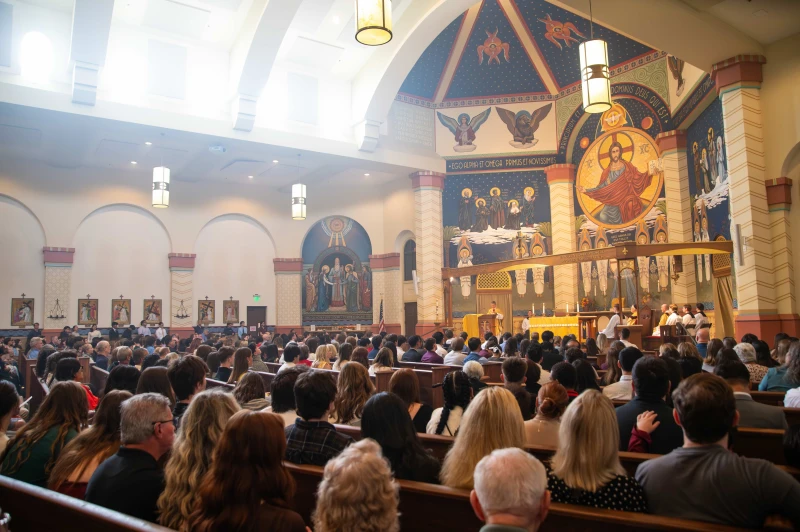
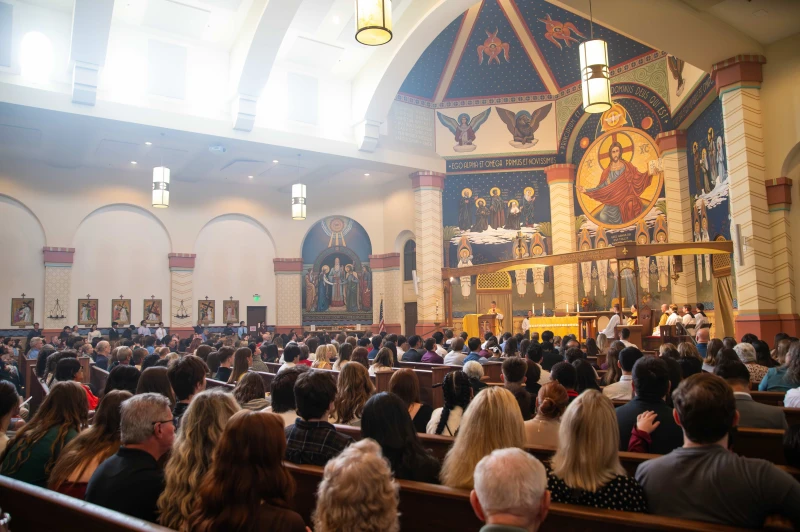
 Mass at Arizona State University’s Newman Center chapel. / Credit: Photo courtesy of Father Bill Clements, director of ASU Newman Center

Ann Arbor, Michigan, Dec 15, 2025 / 07:00 am (CNA).
Several college campuses across the country are witnessing a notable rise in baptisms and confirmations among students. Catholic evangelists tell CNA that this growth reflects a deepening desire among young adults for certainty, stability, and faith amid today’s turbulent cultural landscape.For example, at Arizona State University, the Newman Center is experiencing its largest group of students entering the Church. Ryan Ayala, a former seminarian and campus minister who has served at ASU for three years, oversees the evangelization efforts. “This past semester, we welcomed 52 students into the Church at Christ the King Parish” in Mesa, Ayala said. “And we are expecting 50 more for the Easter Vigil this spring.” According to Ayala, this year marked a record number of students received into the Catholic Church at ASU.Each year, ASU’s campus ministry prepares students for baptism, confirmation, and full communion through a fall vigil held in collaboration with Christ the King Parish. Students enter the Church from a wide range of backgrounds: Some encounter Christianity for the first time, others come from Protestant communities, and still others are baptized Catholics preparing to complete their sacraments. Yailen Cho (at left) was one of 52 Arizona State University students received into the Church last month. Credit: Photo courtesy of Yailen ChoThis year’s group included eight catechumens who were baptized, 26 Christians who made affirmations of faith, and a significant number of Catholics who received confirmation. The ceremony took place on the feast of Christ the King, Nov. 23.Ayala attributes the growth in part to simple, consistent outreach. “No phone call goes unanswered,” he said. Students come from Lutheran, Methodist, Presbyterian, and nondenominational evangelical backgrounds. Those not yet baptized often come from nonreligious homes, and two identified as atheists. One Muslim student is expected to join the program in January. ASU enrolls approximately 200,000 students.Overall, participation in ASU’s OCIA (Order of Christian Initiation of Adults) program has more than doubled. “This is by far the biggest class we’ve had,” Ayala said.Supporting this expansion are missionaries from the Fellowship of Catholic University Students (FOCUS), who lead Bible studies and accompany students in their growing faith. Ayala supervises the missionaries and has completed FOCUS formation himself. The Newman Center offers a focused nine-week OCIA process — shorter than the traditional yearlong program — requiring weekly sessions alongside FOCUS Bible studies.Reflecting on the surge of interest, Ayala sees both cultural and pastoral dynamics at work. “Two things are going on in this surge. There’s a trend in Gen Z. They are asking deeper, philosophical, and theological questions. Some students were shaken up by the shooting of Charlie Kirk. The other thing is simply responding to emails. I ask my staff to be diligent to inquirers. The most important thing is to respond and give them clarity about how to become Catholic.”“Our main strategy is to have an urgency to respond to them,” he added. “It was so moving to see all those students from other faith traditions stand up and make the commitment to become Catholic.” Ayala also noted the role of Catholic media, highlighting one student influenced by Father Mike Schmitz’s online ministry. He further praised the spiritual guidance of Father Bill Clements, who leads the Newman Center. “He does a great job humanizing the priesthood but also removing a lot of the anxieties that newcomers to the faith may have.”Clements, who has directed the Newman Center for 15 years, reports that about 400 students participate in weekly FOCUS Bible studies, and approximately 1,500 attend one of the six weekend Masses. He said he has seen a clear shift in the past two years. “In the last two years, a switch was flipped. I think people are tired of crazy. They’re hungry for some direction, truth, goodness, and beauty. We have one of the most beautiful Newman chapels in the country,” he said, “and that has been a huge attraction.”To meet the growing demand, Clements expanded the OCIA schedule. “I revamped the OCIA process here. When people would hit me up at this time of year, I would have to tell them that we start that in the fall. But I couldn’t stand making people wait. So now I have three sessions: fall, spring, and summer.” He credited FOCUS missionaries for their close accompaniment of students. “They appeal to students. It affords students a chance to connect with other Catholics, and it’s been instrumental in reviving interest in the Church. The missionaries work hard,” he said.One student, Yailen Cho, received baptism and confirmation on Nov. 23 at the ASU Newman Chapel. She told CNA: “I didn’t grow up very religious at all. My dad became Catholic two years ago, but I didn’t have any religious background.” Cho now regularly attends Mass and says the FOCUS program helped deepen her reading of the Gospels. Reflecting on her journey, she shared: “I’d had a prayer relationship with God for a while, and I had prayed that my heart would be softened towards God.” After wrestling with questions of faith, she reached out to the Newman Center, which she said she found “very warm and welcoming.” Directing a message to others considering the Catholic faith, she said: “I want everyone to be happy, and I want to be happy. If you live by the Word, as the Bible says, you can be happy in heaven forever.”Meanwhile, in Michigan and NebraskaSimilar momentum is evident at the University of Michigan in Ann Arbor. Rita Zyber, OCIA coordinator at St. Mary Student Parish, said 50 students are currently preparing to enter the Church. Last Easter, 30 students were received, compared with about 20 in 2024.With daily liturgies and seven weekend Masses, the parish remains consistently full. One Mass was added this year to accommodate greater attendance. “They are packed,” Zyber said.Reflecting on the increase, she noted: “There is so much chaos in the world. They are looking for structure, stability, and some grounding in God.”The parish is staffed by Jesuit priests whose Ignatian spirituality resonates strongly with students, Zyber said. She added that other campus and parish OCIA programs across Michigan are seeing similar growth.In a report last month in the National Catholic Register, CNA’s sister news partner, Father Ryan Kaup, pastor of St. Thomas Aquinas Church and Newman Center at the University of Nebraska-Lincoln, characterized the current situation as “a golden age of campus ministry.” Kaup reported that this past spring, 72 converts entered the Church at the Easter Vigil. So far this semester, they already have 125 students interested in joining the Church, he said.

College campus ministries register remarkable growth in baptisms, confirmations #Catholic Mass at Arizona State University’s Newman Center chapel. / Credit: Photo courtesy of Father Bill Clements, director of ASU Newman Center Ann Arbor, Michigan, Dec 15, 2025 / 07:00 am (CNA). Several college campuses across the country are witnessing a notable rise in baptisms and confirmations among students. Catholic evangelists tell CNA that this growth reflects a deepening desire among young adults for certainty, stability, and faith amid today’s turbulent cultural landscape.For example, at Arizona State University, the Newman Center is experiencing its largest group of students entering the Church. Ryan Ayala, a former seminarian and campus minister who has served at ASU for three years, oversees the evangelization efforts. “This past semester, we welcomed 52 students into the Church at Christ the King Parish” in Mesa, Ayala said. “And we are expecting 50 more for the Easter Vigil this spring.” According to Ayala, this year marked a record number of students received into the Catholic Church at ASU.Each year, ASU’s campus ministry prepares students for baptism, confirmation, and full communion through a fall vigil held in collaboration with Christ the King Parish. Students enter the Church from a wide range of backgrounds: Some encounter Christianity for the first time, others come from Protestant communities, and still others are baptized Catholics preparing to complete their sacraments. Yailen Cho (at left) was one of 52 Arizona State University students received into the Church last month. Credit: Photo courtesy of Yailen ChoThis year’s group included eight catechumens who were baptized, 26 Christians who made affirmations of faith, and a significant number of Catholics who received confirmation. The ceremony took place on the feast of Christ the King, Nov. 23.Ayala attributes the growth in part to simple, consistent outreach. “No phone call goes unanswered,” he said. Students come from Lutheran, Methodist, Presbyterian, and nondenominational evangelical backgrounds. Those not yet baptized often come from nonreligious homes, and two identified as atheists. One Muslim student is expected to join the program in January. ASU enrolls approximately 200,000 students.Overall, participation in ASU’s OCIA (Order of Christian Initiation of Adults) program has more than doubled. “This is by far the biggest class we’ve had,” Ayala said.Supporting this expansion are missionaries from the Fellowship of Catholic University Students (FOCUS), who lead Bible studies and accompany students in their growing faith. Ayala supervises the missionaries and has completed FOCUS formation himself. The Newman Center offers a focused nine-week OCIA process — shorter than the traditional yearlong program — requiring weekly sessions alongside FOCUS Bible studies.Reflecting on the surge of interest, Ayala sees both cultural and pastoral dynamics at work. “Two things are going on in this surge. There’s a trend in Gen Z. They are asking deeper, philosophical, and theological questions. Some students were shaken up by the shooting of Charlie Kirk. The other thing is simply responding to emails. I ask my staff to be diligent to inquirers. The most important thing is to respond and give them clarity about how to become Catholic.”“Our main strategy is to have an urgency to respond to them,” he added. “It was so moving to see all those students from other faith traditions stand up and make the commitment to become Catholic.” Ayala also noted the role of Catholic media, highlighting one student influenced by Father Mike Schmitz’s online ministry. He further praised the spiritual guidance of Father Bill Clements, who leads the Newman Center. “He does a great job humanizing the priesthood but also removing a lot of the anxieties that newcomers to the faith may have.”Clements, who has directed the Newman Center for 15 years, reports that about 400 students participate in weekly FOCUS Bible studies, and approximately 1,500 attend one of the six weekend Masses. He said he has seen a clear shift in the past two years. “In the last two years, a switch was flipped. I think people are tired of crazy. They’re hungry for some direction, truth, goodness, and beauty. We have one of the most beautiful Newman chapels in the country,” he said, “and that has been a huge attraction.”To meet the growing demand, Clements expanded the OCIA schedule. “I revamped the OCIA process here. When people would hit me up at this time of year, I would have to tell them that we start that in the fall. But I couldn’t stand making people wait. So now I have three sessions: fall, spring, and summer.” He credited FOCUS missionaries for their close accompaniment of students. “They appeal to students. It affords students a chance to connect with other Catholics, and it’s been instrumental in reviving interest in the Church. The missionaries work hard,” he said.One student, Yailen Cho, received baptism and confirmation on Nov. 23 at the ASU Newman Chapel. She told CNA: “I didn’t grow up very religious at all. My dad became Catholic two years ago, but I didn’t have any religious background.” Cho now regularly attends Mass and says the FOCUS program helped deepen her reading of the Gospels. Reflecting on her journey, she shared: “I’d had a prayer relationship with God for a while, and I had prayed that my heart would be softened towards God.” After wrestling with questions of faith, she reached out to the Newman Center, which she said she found “very warm and welcoming.” Directing a message to others considering the Catholic faith, she said: “I want everyone to be happy, and I want to be happy. If you live by the Word, as the Bible says, you can be happy in heaven forever.”Meanwhile, in Michigan and NebraskaSimilar momentum is evident at the University of Michigan in Ann Arbor. Rita Zyber, OCIA coordinator at St. Mary Student Parish, said 50 students are currently preparing to enter the Church. Last Easter, 30 students were received, compared with about 20 in 2024.With daily liturgies and seven weekend Masses, the parish remains consistently full. One Mass was added this year to accommodate greater attendance. “They are packed,” Zyber said.Reflecting on the increase, she noted: “There is so much chaos in the world. They are looking for structure, stability, and some grounding in God.”The parish is staffed by Jesuit priests whose Ignatian spirituality resonates strongly with students, Zyber said. She added that other campus and parish OCIA programs across Michigan are seeing similar growth.In a report last month in the National Catholic Register, CNA’s sister news partner, Father Ryan Kaup, pastor of St. Thomas Aquinas Church and Newman Center at the University of Nebraska-Lincoln, characterized the current situation as “a golden age of campus ministry.” Kaup reported that this past spring, 72 converts entered the Church at the Easter Vigil. So far this semester, they already have 125 students interested in joining the Church, he said.


Mass at Arizona State University’s Newman Center chapel. / Credit: Photo courtesy of Father Bill Clements, director of ASU Newman Center

Ann Arbor, Michigan, Dec 15, 2025 / 07:00 am (CNA).

Several college campuses across the country are witnessing a notable rise in baptisms and confirmations among students. Catholic evangelists tell CNA that this growth reflects a deepening desire among young adults for certainty, stability, and faith amid today’s turbulent cultural landscape.

For example, at Arizona State University, the Newman Center is experiencing its largest group of students entering the Church. Ryan Ayala, a former seminarian and campus minister who has served at ASU for three years, oversees the evangelization efforts. 

“This past semester, we welcomed 52 students into the Church at Christ the King Parish” in Mesa, Ayala said. “And we are expecting 50 more for the Easter Vigil this spring.” According to Ayala, this year marked a record number of students received into the Catholic Church at ASU.

Each year, ASU’s campus ministry prepares students for baptism, confirmation, and full communion through a fall vigil held in collaboration with Christ the King Parish. Students enter the Church from a wide range of backgrounds: Some encounter Christianity for the first time, others come from Protestant communities, and still others are baptized Catholics preparing to complete their sacraments. 

Yailen Cho (at left) was one of 52 Arizona State University students received into the Church last month. Credit: Photo courtesy of Yailen Cho

This year’s group included eight catechumens who were baptized, 26 Christians who made affirmations of faith, and a significant number of Catholics who received confirmation. The ceremony took place on the feast of Christ the King, Nov. 23.

Ayala attributes the growth in part to simple, consistent outreach. “No phone call goes unanswered,” he said. Students come from Lutheran, Methodist, Presbyterian, and nondenominational evangelical backgrounds. Those not yet baptized often come from nonreligious homes, and two identified as atheists. One Muslim student is expected to join the program in January. ASU enrolls approximately 200,000 students.

Overall, participation in ASU’s OCIA (Order of Christian Initiation of Adults) program has more than doubled. “This is by far the biggest class we’ve had,” Ayala said.

Supporting this expansion are missionaries from the Fellowship of Catholic University Students (FOCUS), who lead Bible studies and accompany students in their growing faith. Ayala supervises the missionaries and has completed FOCUS formation himself. The Newman Center offers a focused nine-week OCIA process — shorter than the traditional yearlong program — requiring weekly sessions alongside FOCUS Bible studies.

Reflecting on the surge of interest, Ayala sees both cultural and pastoral dynamics at work. “Two things are going on in this surge. There’s a trend in Gen Z. They are asking deeper, philosophical, and theological questions. Some students were shaken up by the shooting of Charlie Kirk. The other thing is simply responding to emails. I ask my staff to be diligent to inquirers. The most important thing is to respond and give them clarity about how to become Catholic.”

“Our main strategy is to have an urgency to respond to them,” he added. “It was so moving to see all those students from other faith traditions stand up and make the commitment to become Catholic.”

Ayala also noted the role of Catholic media, highlighting one student influenced by Father Mike Schmitz’s online ministry. He further praised the spiritual guidance of Father Bill Clements, who leads the Newman Center. “He does a great job humanizing the priesthood but also removing a lot of the anxieties that newcomers to the faith may have.”

Clements, who has directed the Newman Center for 15 years, reports that about 400 students participate in weekly FOCUS Bible studies, and approximately 1,500 attend one of the six weekend Masses. He said he has seen a clear shift in the past two years.

“In the last two years, a switch was flipped. I think people are tired of crazy. They’re hungry for some direction, truth, goodness, and beauty. We have one of the most beautiful Newman chapels in the country,” he said, “and that has been a huge attraction.”

To meet the growing demand, Clements expanded the OCIA schedule. “I revamped the OCIA process here. When people would hit me up at this time of year, I would have to tell them that we start that in the fall. But I couldn’t stand making people wait. So now I have three sessions: fall, spring, and summer.”

He credited FOCUS missionaries for their close accompaniment of students. “They appeal to students. It affords students a chance to connect with other Catholics, and it’s been instrumental in reviving interest in the Church. The missionaries work hard,” he said.

One student, Yailen Cho, received baptism and confirmation on Nov. 23 at the ASU Newman Chapel. She told CNA: “I didn’t grow up very religious at all. My dad became Catholic two years ago, but I didn’t have any religious background.” 

Cho now regularly attends Mass and says the FOCUS program helped deepen her reading of the Gospels. Reflecting on her journey, she shared: “I’d had a prayer relationship with God for a while, and I had prayed that my heart would be softened towards God.”

After wrestling with questions of faith, she reached out to the Newman Center, which she said she found “very warm and welcoming.”

Directing a message to others considering the Catholic faith, she said: “I want everyone to be happy, and I want to be happy. If you live by the Word, as the Bible says, you can be happy in heaven forever.”

Meanwhile, in Michigan and Nebraska

Similar momentum is evident at the University of Michigan in Ann Arbor. Rita Zyber, OCIA coordinator at St. Mary Student Parish, said 50 students are currently preparing to enter the Church. Last Easter, 30 students were received, compared with about 20 in 2024.

With daily liturgies and seven weekend Masses, the parish remains consistently full. One Mass was added this year to accommodate greater attendance. “They are packed,” Zyber said.

Reflecting on the increase, she noted: “There is so much chaos in the world. They are looking for structure, stability, and some grounding in God.”

The parish is staffed by Jesuit priests whose Ignatian spirituality resonates strongly with students, Zyber said. She added that other campus and parish OCIA programs across Michigan are seeing similar growth.

In a report last month in the National Catholic Register, CNA’s sister news partner, Father Ryan Kaup, pastor of St. Thomas Aquinas Church and Newman Center at the University of Nebraska-Lincoln, characterized the current situation as “a golden age of campus ministry.”

Kaup reported that this past spring, 72 converts entered the Church at the Easter Vigil. So far this semester, they already have 125 students interested in joining the Church, he said.

Read More
New print journal for ‘intellectual Catholic women’ to be released in April #Catholic 
 
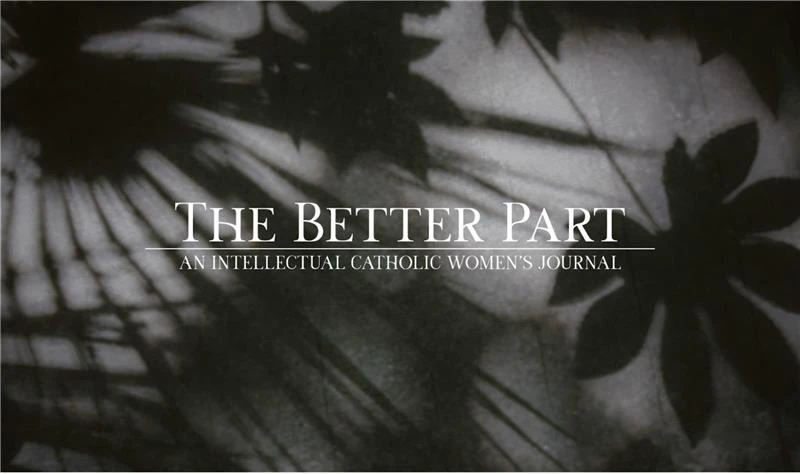
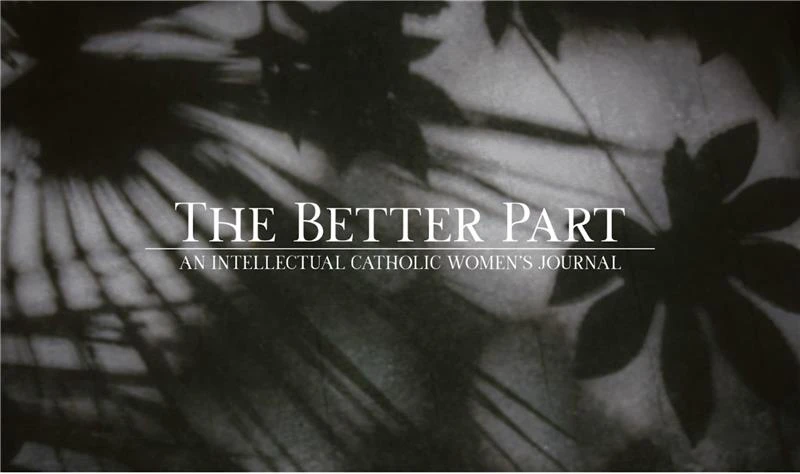
 Promo photo for the The Better Part Journal of shadows of Madonna lilies for the Blessed Virgin Mary. / Credit: Photo courtesy of Heidi Bollich-Erne

Washington, D.C. Newsroom, Dec 7, 2025 / 09:00 am (CNA).
While teaching an ethics and culture course, Heidi Bollich-Erne was looking for a journal featuring the work of Catholic women for her students to read. After being told that it simply didn’t exist, she decided to create one herself.With the help of a team of women, Bollich-Erne has founded what she calls the “first intellectual Catholic women’s journal.” Its purpose is to not only define the feminine genius but also to show how faithful women can embody its beauty in their daily lives. “I want women to find a home, a place that values their work. The journal itself is edited, written, and published solely by Catholic women,” Bollich-Erne told CNA. “The way that women write, the way that we express ourselves is very different. That’s just who we are. That’s part of the genius of women.”The Better Part Journal is intended to give women of the Church “hope” by discussing issues that are relevant to them. The first edition of the journal will be released in April 2026. Before starting the journal, Bollich-Erne studied theology at the University of St. Thomas, where she “fell in love with philosophy.” She went to the Center for Thomistic Studies for her master’s degree in Thomistic philosophy but took a break from her doctorate and started teaching. She is now based in Texas where she has taught high school, college preparation, college, and adults. While teaching, she tried to find content to help guide discussion on gender complementarity but couldn’t find much written by Catholic women.“I thought, ‘I want to read more intellectual women,’ but it was a struggle… So I found a friend who works at a university and I said: ‘Can you recommend … an intellectual Catholic women’s magazine? She got back to me a few days later and said, ‘It doesn’t exist.’”Bollich-Erne started The Better Part Journal by first launching a company called JBG Publishings as “a home” for the journal. She wanted to ensure the publication would not be independently published but be part of a company that would help it to grow.Bollich-Erne named the company with the initials of her father, who passed away a few years prior. His passing “was a realization that ‘life is too short,’”  Bollich-Erne said. “I need to love what I do; I need to really work to find meaning.’”Heidi Bollich-Erne is the founding editor and editor-in-chief of The Better Part Journal, the first intellectual Catholic women’s journal. She holds an undergraduate degree in theology from the University of St. Thomas and a master’s in Thomistic Philosophy from the Center for Thomistic Studies. Credit: Photo courtesy of Heidi Bollich-ErneThe Better Part Journal’s mission“The purpose of the journal is to bring together the voices of intellectual Catholic women who are faithful to the magisterium,” Bollich-Erne said. “I want voices of all backgrounds. I want women of all areas of discipline. I want academics. I want nonacademics. I want all women contributing to this conversation.”“We all throw around the ‘feminine genius,’ but when you ask someone to stop and give an actual definition, most people can’t,” Bollich-Erne said. Most people define it with a quote by St. John Paul II who coined the term in his apostolic letter Mulieris Dignitatem to describe the unique gifts and qualities women possess, but, she said, “that’s a quote, not a definition.” “There’s a lot of work that needs to be done in this area, and I know there’s room for it to be done on a theological, philosophical level. So the idea was that we would … define the feminine genius and then show it. Live it. It’s not a theology journal and it’s not a philosophy journal. It’s truly interdisciplinary.”The first issue of the journal is called “Uncharted” and will tackle a number of topics.“As soon as women realized that I was serious about truly hearing their voices and not editing them out or telling them what they can and can’t write about, they gave us some really amazing work. I’ve just been blown away. I’m only so creative, but I have a great team.”The journal will feature articles covering neuroscience and theology and apply it to Mary and the Incarnation. It will have columns by doctors and scientists to look at “faith in the formula” and “applying science to religion.”There will be discussion of issues women face including body image, infertility, and violence. Articles will explore “the psychology of fairy tales and what that does to young girls growing up, whether that be positive or negative,” Bollich-Erne said. It will look into “what we are exposed to …from the media and what it does to us.”“The beauty behind the journal has been the women that have come forth to lend their voices,” Bollich-Erne said. “It’s been really amazing to see how excited they are about freedom of voice. It’s been something I wasn’t expecting.”A print journal in a digital eraDespite a shift in media from print to online formats, The Better Part Journal will only be released in print copies because, Bollich-Erne said, “I want it to be lasting.”“I am a tactile person. I like to hold a book. I wanted it to be something that is kept. So obviously that’s print,” Bollich-Erne said. “But then if you want to keep it has to be high quality.”The journal will use original photographs and crafted artwork to accompany the written works. “It is stunning. It looks like a book,” Bollich-Erne said. “The idea is that you read it, you keep it, and you put it on your bookshelf and you never get rid of it because the topics are lasting.”For an article to be included, it has to be “something that I think women will find valuable, whether you’re an academic or a high school student,” Bollich-Erne said. “It has to be something that all women find valuable, or we cannot print it.”“Many women have said they’re excited to hold their work and see it in print as opposed to scrolling past the work. There’s nothing wrong with online formats; it gives voices to a lot of people, but this is just different.”“I had an author tell me, ‘I don’t write anymore for anyone,’ because, she said, ‘I am so tired of my work just disappearing. It’s online for a week. I spent all this work, all this time, and it was something substantial that I really cared about, and it’s just gone.’” “She signed up with us for a column specifically because we are in print. The idea is that this work is kept forever.”The print journals will be published twice a year only, because “I want it to be something that takes a while to digest,” Bollich-Erne said. “Beautiful things take time.”Looking to the futureJGB Publishings has “goals to expand substantially over the next five to 10 years,” Bollich-Erne said. The company will “take care of” the journal to ensure its message can “grow and expand.”“To be able, as women in the Church, to truly have a serious conversation about all of these things … we are going to forge our future,” Bollich-Erne said. “We’re going to step forward in hope and show the world this is what an intelligent Catholic woman looks like.”“We’re not stifled. We’re not sad. We’re not miserable people. We are happy. We are excited about life, and we are treated with respect. We are loved and we love who we are,” Bollich-Erne said. “I want people, especially women, of all ages to see that and to understand that.”

New print journal for ‘intellectual Catholic women’ to be released in April #Catholic Promo photo for the The Better Part Journal of shadows of Madonna lilies for the Blessed Virgin Mary. / Credit: Photo courtesy of Heidi Bollich-Erne Washington, D.C. Newsroom, Dec 7, 2025 / 09:00 am (CNA). While teaching an ethics and culture course, Heidi Bollich-Erne was looking for a journal featuring the work of Catholic women for her students to read. After being told that it simply didn’t exist, she decided to create one herself.With the help of a team of women, Bollich-Erne has founded what she calls the “first intellectual Catholic women’s journal.” Its purpose is to not only define the feminine genius but also to show how faithful women can embody its beauty in their daily lives. “I want women to find a home, a place that values their work. The journal itself is edited, written, and published solely by Catholic women,” Bollich-Erne told CNA. “The way that women write, the way that we express ourselves is very different. That’s just who we are. That’s part of the genius of women.”The Better Part Journal is intended to give women of the Church “hope” by discussing issues that are relevant to them. The first edition of the journal will be released in April 2026. Before starting the journal, Bollich-Erne studied theology at the University of St. Thomas, where she “fell in love with philosophy.” She went to the Center for Thomistic Studies for her master’s degree in Thomistic philosophy but took a break from her doctorate and started teaching. She is now based in Texas where she has taught high school, college preparation, college, and adults. While teaching, she tried to find content to help guide discussion on gender complementarity but couldn’t find much written by Catholic women.“I thought, ‘I want to read more intellectual women,’ but it was a struggle… So I found a friend who works at a university and I said: ‘Can you recommend … an intellectual Catholic women’s magazine? She got back to me a few days later and said, ‘It doesn’t exist.’”Bollich-Erne started The Better Part Journal by first launching a company called JBG Publishings as “a home” for the journal. She wanted to ensure the publication would not be independently published but be part of a company that would help it to grow.Bollich-Erne named the company with the initials of her father, who passed away a few years prior. His passing “was a realization that ‘life is too short,’”  Bollich-Erne said. “I need to love what I do; I need to really work to find meaning.’”Heidi Bollich-Erne is the founding editor and editor-in-chief of The Better Part Journal, the first intellectual Catholic women’s journal. She holds an undergraduate degree in theology from the University of St. Thomas and a master’s in Thomistic Philosophy from the Center for Thomistic Studies. Credit: Photo courtesy of Heidi Bollich-ErneThe Better Part Journal’s mission“The purpose of the journal is to bring together the voices of intellectual Catholic women who are faithful to the magisterium,” Bollich-Erne said. “I want voices of all backgrounds. I want women of all areas of discipline. I want academics. I want nonacademics. I want all women contributing to this conversation.”“We all throw around the ‘feminine genius,’ but when you ask someone to stop and give an actual definition, most people can’t,” Bollich-Erne said. Most people define it with a quote by St. John Paul II who coined the term in his apostolic letter Mulieris Dignitatem to describe the unique gifts and qualities women possess, but, she said, “that’s a quote, not a definition.” “There’s a lot of work that needs to be done in this area, and I know there’s room for it to be done on a theological, philosophical level. So the idea was that we would … define the feminine genius and then show it. Live it. It’s not a theology journal and it’s not a philosophy journal. It’s truly interdisciplinary.”The first issue of the journal is called “Uncharted” and will tackle a number of topics.“As soon as women realized that I was serious about truly hearing their voices and not editing them out or telling them what they can and can’t write about, they gave us some really amazing work. I’ve just been blown away. I’m only so creative, but I have a great team.”The journal will feature articles covering neuroscience and theology and apply it to Mary and the Incarnation. It will have columns by doctors and scientists to look at “faith in the formula” and “applying science to religion.”There will be discussion of issues women face including body image, infertility, and violence. Articles will explore “the psychology of fairy tales and what that does to young girls growing up, whether that be positive or negative,” Bollich-Erne said. It will look into “what we are exposed to …from the media and what it does to us.”“The beauty behind the journal has been the women that have come forth to lend their voices,” Bollich-Erne said. “It’s been really amazing to see how excited they are about freedom of voice. It’s been something I wasn’t expecting.”A print journal in a digital eraDespite a shift in media from print to online formats, The Better Part Journal will only be released in print copies because, Bollich-Erne said, “I want it to be lasting.”“I am a tactile person. I like to hold a book. I wanted it to be something that is kept. So obviously that’s print,” Bollich-Erne said. “But then if you want to keep it has to be high quality.”The journal will use original photographs and crafted artwork to accompany the written works. “It is stunning. It looks like a book,” Bollich-Erne said. “The idea is that you read it, you keep it, and you put it on your bookshelf and you never get rid of it because the topics are lasting.”For an article to be included, it has to be “something that I think women will find valuable, whether you’re an academic or a high school student,” Bollich-Erne said. “It has to be something that all women find valuable, or we cannot print it.”“Many women have said they’re excited to hold their work and see it in print as opposed to scrolling past the work. There’s nothing wrong with online formats; it gives voices to a lot of people, but this is just different.”“I had an author tell me, ‘I don’t write anymore for anyone,’ because, she said, ‘I am so tired of my work just disappearing. It’s online for a week. I spent all this work, all this time, and it was something substantial that I really cared about, and it’s just gone.’” “She signed up with us for a column specifically because we are in print. The idea is that this work is kept forever.”The print journals will be published twice a year only, because “I want it to be something that takes a while to digest,” Bollich-Erne said. “Beautiful things take time.”Looking to the futureJGB Publishings has “goals to expand substantially over the next five to 10 years,” Bollich-Erne said. The company will “take care of” the journal to ensure its message can “grow and expand.”“To be able, as women in the Church, to truly have a serious conversation about all of these things … we are going to forge our future,” Bollich-Erne said. “We’re going to step forward in hope and show the world this is what an intelligent Catholic woman looks like.”“We’re not stifled. We’re not sad. We’re not miserable people. We are happy. We are excited about life, and we are treated with respect. We are loved and we love who we are,” Bollich-Erne said. “I want people, especially women, of all ages to see that and to understand that.”


Promo photo for the The Better Part Journal of shadows of Madonna lilies for the Blessed Virgin Mary. / Credit: Photo courtesy of Heidi Bollich-Erne

Washington, D.C. Newsroom, Dec 7, 2025 / 09:00 am (CNA).

While teaching an ethics and culture course, Heidi Bollich-Erne was looking for a journal featuring the work of Catholic women for her students to read. After being told that it simply didn’t exist, she decided to create one herself.

With the help of a team of women, Bollich-Erne has founded what she calls the “first intellectual Catholic women’s journal.” Its purpose is to not only define the feminine genius but also to show how faithful women can embody its beauty in their daily lives. 

“I want women to find a home, a place that values their work. The journal itself is edited, written, and published solely by Catholic women,” Bollich-Erne told CNA. “The way that women write, the way that we express ourselves is very different. That’s just who we are. That’s part of the genius of women.”

The Better Part Journal is intended to give women of the Church “hope” by discussing issues that are relevant to them. The first edition of the journal will be released in April 2026. 

Before starting the journal, Bollich-Erne studied theology at the University of St. Thomas, where she “fell in love with philosophy.” She went to the Center for Thomistic Studies for her master’s degree in Thomistic philosophy but took a break from her doctorate and started teaching. 

She is now based in Texas where she has taught high school, college preparation, college, and adults. While teaching, she tried to find content to help guide discussion on gender complementarity but couldn’t find much written by Catholic women.

“I thought, ‘I want to read more intellectual women,’ but it was a struggle… So I found a friend who works at a university and I said: ‘Can you recommend … an intellectual Catholic women’s magazine? She got back to me a few days later and said, ‘It doesn’t exist.’”

Bollich-Erne started The Better Part Journal by first launching a company called JBG Publishings as “a home” for the journal. She wanted to ensure the publication would not be independently published but be part of a company that would help it to grow.

Bollich-Erne named the company with the initials of her father, who passed away a few years prior. His passing “was a realization that ‘life is too short,’”  Bollich-Erne said. “I need to love what I do; I need to really work to find meaning.’”

Heidi Bollich-Erne is the founding editor and editor-in-chief of The Better Part Journal, the first intellectual Catholic women’s journal. She holds an undergraduate degree in theology from the University of St. Thomas and a master's in Thomistic Philosophy from the Center for Thomistic Studies. Credit: Photo courtesy of  Heidi Bollich-Erne
Heidi Bollich-Erne is the founding editor and editor-in-chief of The Better Part Journal, the first intellectual Catholic women’s journal. She holds an undergraduate degree in theology from the University of St. Thomas and a master’s in Thomistic Philosophy from the Center for Thomistic Studies. Credit: Photo courtesy of Heidi Bollich-Erne

The Better Part Journal’s mission

“The purpose of the journal is to bring together the voices of intellectual Catholic women who are faithful to the magisterium,” Bollich-Erne said. “I want voices of all backgrounds. I want women of all areas of discipline. I want academics. I want nonacademics. I want all women contributing to this conversation.”

“We all throw around the ‘feminine genius,’ but when you ask someone to stop and give an actual definition, most people can’t,” Bollich-Erne said. Most people define it with a quote by St. John Paul II who coined the term in his apostolic letter Mulieris Dignitatem to describe the unique gifts and qualities women possess, but, she said, “that’s a quote, not a definition.” 

“There’s a lot of work that needs to be done in this area, and I know there’s room for it to be done on a theological, philosophical level. So the idea was that we would … define the feminine genius and then show it. Live it. It’s not a theology journal and it’s not a philosophy journal. It’s truly interdisciplinary.”

The first issue of the journal is called “Uncharted” and will tackle a number of topics.

“As soon as women realized that I was serious about truly hearing their voices and not editing them out or telling them what they can and can’t write about, they gave us some really amazing work. I’ve just been blown away. I’m only so creative, but I have a great team.”

The journal will feature articles covering neuroscience and theology and apply it to Mary and the Incarnation. It will have columns by doctors and scientists to look at “faith in the formula” and “applying science to religion.”

There will be discussion of issues women face including body image, infertility, and violence. Articles will explore “the psychology of fairy tales and what that does to young girls growing up, whether that be positive or negative,” Bollich-Erne said. It will look into “what we are exposed to …from the media and what it does to us.”

“The beauty behind the journal has been the women that have come forth to lend their voices,” Bollich-Erne said. “It’s been really amazing to see how excited they are about freedom of voice. It’s been something I wasn’t expecting.”

A print journal in a digital era

Despite a shift in media from print to online formats, The Better Part Journal will only be released in print copies because, Bollich-Erne said, “I want it to be lasting.”

“I am a tactile person. I like to hold a book. I wanted it to be something that is kept. So obviously that’s print,” Bollich-Erne said. “But then if you want to keep it has to be high quality.”

The journal will use original photographs and crafted artwork to accompany the written works. 

“It is stunning. It looks like a book,” Bollich-Erne said. “The idea is that you read it, you keep it, and you put it on your bookshelf and you never get rid of it because the topics are lasting.”

For an article to be included, it has to be “something that I think women will find valuable, whether you’re an academic or a high school student,” Bollich-Erne said. “It has to be something that all women find valuable, or we cannot print it.”

“Many women have said they’re excited to hold their work and see it in print as opposed to scrolling past the work. There’s nothing wrong with online formats; it gives voices to a lot of people, but this is just different.”

“I had an author tell me, ‘I don’t write anymore for anyone,’ because, she said, ‘I am so tired of my work just disappearing. It’s online for a week. I spent all this work, all this time, and it was something substantial that I really cared about, and it’s just gone.’” 

“She signed up with us for a column specifically because we are in print. The idea is that this work is kept forever.”

The print journals will be published twice a year only, because “I want it to be something that takes a while to digest,” Bollich-Erne said. “Beautiful things take time.”

Looking to the future

JGB Publishings has “goals to expand substantially over the next five to 10 years,” Bollich-Erne said. The company will “take care of” the journal to ensure its message can “grow and expand.”

“To be able, as women in the Church, to truly have a serious conversation about all of these things … we are going to forge our future,” Bollich-Erne said. “We’re going to step forward in hope and show the world this is what an intelligent Catholic woman looks like.”

“We’re not stifled. We’re not sad. We’re not miserable people. We are happy. We are excited about life, and we are treated with respect. We are loved and we love who we are,” Bollich-Erne said. “I want people, especially women, of all ages to see that and to understand that.”

Read More
Archdiocese of Chicago kept ‘known serial predators’ in ministry for years, lawsuits say #Catholic 
 
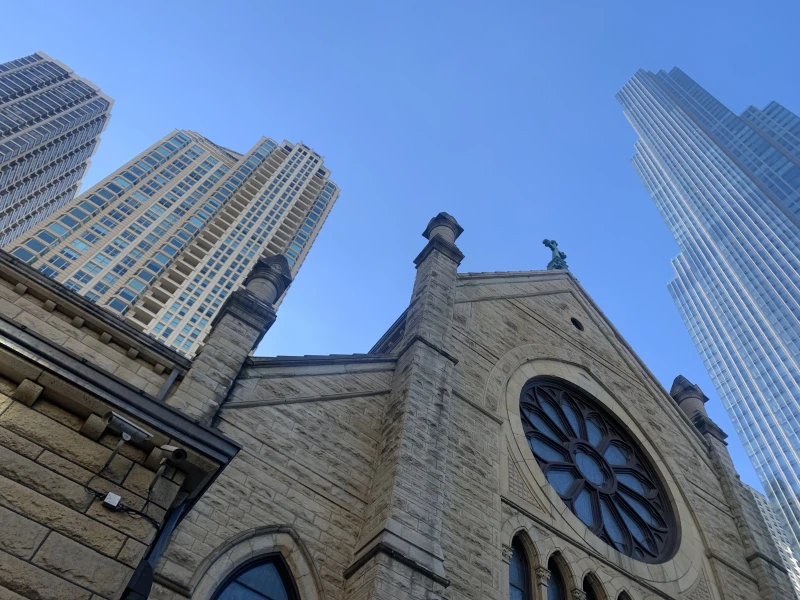
 Holy Name Cathedral, the seat of the Archdiocese of Chicago. / Credit: Photo courtesy of Maddy Johnson/Church Properties Initiative

CNA Staff, Nov 25, 2025 / 16:31 pm (CNA).
Multiple lawsuits allege that the Archdiocese of Chicago kept two priests in active ministry in spite of years of “mounting complaints” of child sexual abuse leveled against them.The suits, filed by the Chicago-based law firm Gould, Grieco, & Hensley, allege that archdiocesan officials allowed Father Daniel Holihan and Father John Curran to continue ministry “even after Church officials were aware of their history abusing children.”The suits were filed on behalf of students from two archdiocesan schools, Quigley Preparatory Seminary and St. Christina Catholic School. Holihan is alleged to have abused a male student at the now-closed preparatory seminary during the 1980s, while Curran allegedly abused two students at St. Christina around the same time.The law firm claims the archdiocese had been warned about both Holihan and Curran as early as the 1960s. The alleged abuse victims said they were unaware of the archdiocese’s alleged prior knowledge until recently, when “previously concealed internal documents became accessible.”The law firm alleged that the archdiocese “relied on a pattern of relocating clergy with known problems rather than addressing the underlying misconduct.”“For decades, the archdiocese relied on secrecy and reassignment instead of transparency and accountability,” attorney Mike Grieco said in a press release. “That structure is what allowed priests like Holihan and Curran to stay in ministry for years, putting children in harm’s way.”The Chicago Archdiocese did not immediately respond to a request for comment on the lawsuits.As part of its investigations into clergy abuse, the Illinois attorney general’s office described Holihan as “one of the more notorious abusers in archdiocesan history.”“The archdiocese knew what Holihan was doing to children years before it removed him from the pastorate — but during that time, it did nothing to stop him, taking him at his word that he could turn over a new leaf of his own accord,” the prosecutor’s office said.The attorney general’s office also identified Curran as an alleged abuser. Holihan died in 2016, while Curran died in 2000.Both Curran and Holihan are on the archdiocese’s list of priests with “substantiated” allegations of abuse leveled against them, and both are listed as having served at eight different locations in the archdiocese. Holihan was removed from public ministry in 2002 and laicized in 2010, while Curran was removed from public ministry in 1994.

Archdiocese of Chicago kept ‘known serial predators’ in ministry for years, lawsuits say #Catholic Holy Name Cathedral, the seat of the Archdiocese of Chicago. / Credit: Photo courtesy of Maddy Johnson/Church Properties Initiative CNA Staff, Nov 25, 2025 / 16:31 pm (CNA). Multiple lawsuits allege that the Archdiocese of Chicago kept two priests in active ministry in spite of years of “mounting complaints” of child sexual abuse leveled against them.The suits, filed by the Chicago-based law firm Gould, Grieco, & Hensley, allege that archdiocesan officials allowed Father Daniel Holihan and Father John Curran to continue ministry “even after Church officials were aware of their history abusing children.”The suits were filed on behalf of students from two archdiocesan schools, Quigley Preparatory Seminary and St. Christina Catholic School. Holihan is alleged to have abused a male student at the now-closed preparatory seminary during the 1980s, while Curran allegedly abused two students at St. Christina around the same time.The law firm claims the archdiocese had been warned about both Holihan and Curran as early as the 1960s. The alleged abuse victims said they were unaware of the archdiocese’s alleged prior knowledge until recently, when “previously concealed internal documents became accessible.”The law firm alleged that the archdiocese “relied on a pattern of relocating clergy with known problems rather than addressing the underlying misconduct.”“For decades, the archdiocese relied on secrecy and reassignment instead of transparency and accountability,” attorney Mike Grieco said in a press release. “That structure is what allowed priests like Holihan and Curran to stay in ministry for years, putting children in harm’s way.”The Chicago Archdiocese did not immediately respond to a request for comment on the lawsuits.As part of its investigations into clergy abuse, the Illinois attorney general’s office described Holihan as “one of the more notorious abusers in archdiocesan history.”“The archdiocese knew what Holihan was doing to children years before it removed him from the pastorate — but during that time, it did nothing to stop him, taking him at his word that he could turn over a new leaf of his own accord,” the prosecutor’s office said.The attorney general’s office also identified Curran as an alleged abuser. Holihan died in 2016, while Curran died in 2000.Both Curran and Holihan are on the archdiocese’s list of priests with “substantiated” allegations of abuse leveled against them, and both are listed as having served at eight different locations in the archdiocese. Holihan was removed from public ministry in 2002 and laicized in 2010, while Curran was removed from public ministry in 1994.


Holy Name Cathedral, the seat of the Archdiocese of Chicago. / Credit: Photo courtesy of Maddy Johnson/Church Properties Initiative

CNA Staff, Nov 25, 2025 / 16:31 pm (CNA).

Multiple lawsuits allege that the Archdiocese of Chicago kept two priests in active ministry in spite of years of “mounting complaints” of child sexual abuse leveled against them.

The suits, filed by the Chicago-based law firm Gould, Grieco, & Hensley, allege that archdiocesan officials allowed Father Daniel Holihan and Father John Curran to continue ministry “even after Church officials were aware of their history abusing children.”

The suits were filed on behalf of students from two archdiocesan schools, Quigley Preparatory Seminary and St. Christina Catholic School. Holihan is alleged to have abused a male student at the now-closed preparatory seminary during the 1980s, while Curran allegedly abused two students at St. Christina around the same time.

The law firm claims the archdiocese had been warned about both Holihan and Curran as early as the 1960s. The alleged abuse victims said they were unaware of the archdiocese’s alleged prior knowledge until recently, when “previously concealed internal documents became accessible.”

The law firm alleged that the archdiocese “relied on a pattern of relocating clergy with known problems rather than addressing the underlying misconduct.”

“For decades, the archdiocese relied on secrecy and reassignment instead of transparency and accountability,” attorney Mike Grieco said in a press release. “That structure is what allowed priests like Holihan and Curran to stay in ministry for years, putting children in harm’s way.”

The Chicago Archdiocese did not immediately respond to a request for comment on the lawsuits.

As part of its investigations into clergy abuse, the Illinois attorney general’s office described Holihan as “one of the more notorious abusers in archdiocesan history.”

“The archdiocese knew what Holihan was doing to children years before it removed him from the pastorate — but during that time, it did nothing to stop him, taking him at his word that he could turn over a new leaf of his own accord,” the prosecutor’s office said.

The attorney general’s office also identified Curran as an alleged abuser. Holihan died in 2016, while Curran died in 2000.

Both Curran and Holihan are on the archdiocese’s list of priests with “substantiated” allegations of abuse leveled against them, and both are listed as having served at eight different locations in the archdiocese. Holihan was removed from public ministry in 2002 and laicized in 2010, while Curran was removed from public ministry in 1994.

Read More
Giving people hope is greatest challenge, custos of Holy Land says in U.S. visit #Catholic 
 
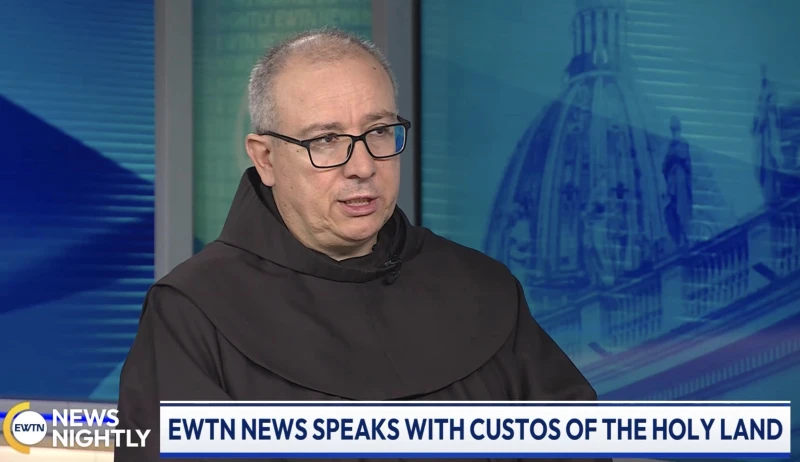
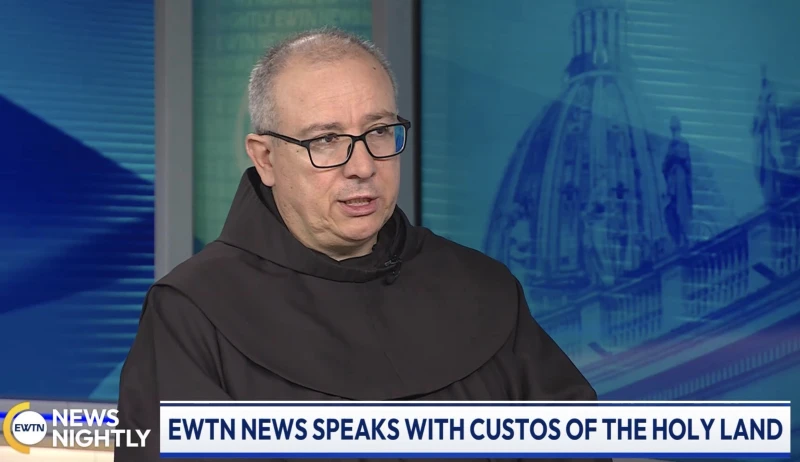
 Custos of the Holy Land Father Franceso Ielpo speaks with EWTN News in a two-part interview that began airing on “EWTN News Nightly” on Nov. 24, 2025. / Credit: “EWTN News Nightly”/Screenshot

Washington, D.C. Newsroom, Nov 25, 2025 / 09:00 am (CNA).
The custos of the Holy Land said in an interview with EWTN News that the “greatest challenge” is to be a source of hope amid perpetual devastation due to conflict. “The greatest challenge is to always be able to give people hope. One can have food, one can have a home, one can have medicine, one can have the best schools, but to live, we all need hope. And this hope always arises when you see, when you feel the presence of God through the presence of the Church beside you,” Father Franceso Ielpo told EWTN News’ Matthew Bunson in a two-part interview that began airing Nov. 24 on “EWTN News Nightly.” Ielpo has served as custos of the Holy Land since his appointment by Pope Leo XIV in June, when he succeeded Father Francesdo Patton. It is Ielpo’s first visit to the United States as custos, a Latin term for “guardian” associated with the Franciscan order’s special responsibility to oversee and care for holy sites in the Holy Land.Ielpo explained this challenge confronts the Christian community not only in Israel and Palestine but also in Lebanon and Syria. Custodians in these countries, he said, are faced with having “to grow and continue to live in a context of tension, in a context of perpetual conflict.” The Custody of the Holy Land is made up of 325 friars from over 40 countries. Ielpo said the latest conflict in Israel “has had very serious consequences” for “all communities in the Holy Land,” particularly in the employment sphere due to a lack of pilgrims to the region, which depends on religious tourism to generate income. He further emphasized the “tension of uncertainty about the future, especially for one’s children.” “The custody continues first and foremost to support and sustain the salaries of all our employees, of all our Christians, and also seeks to continue the educational work that is the schools,” Ielpo said. “We currently have 18 schools with about 10,000 students, both Christian and Muslim. Even for families who can no longer pay for school, we continue to guarantee education because we are convinced that the future is built in the classroom.” The work of the custody is not limited to the Christian community alone, he said, noting that 90% of the student population attending the Franciscan school in Jericho are Muslim. “They understand and appreciate that the service we offer is for everyone and is of high quality,” he said. At Magnificat, a music school that just celebrated its 30th anniversary, students and teachers are Christian, Muslim, and Jewish, he added.“The thing that gives me the most hope is that God’s timing is not our timing, that history is carried forward despite all its contradictions by someone else,” he said. Even amid conflict, he continued, “hope always arises from the fact that God is the true protagonist of history, even in storms, even when it seems that he is on the boat and sleeping.” Concretely, the custos emphasized the need for pilgrims to return, not only for economic reasons, but to demonstrate to residents of the Holy Land that they are “seen, recognized, wanted, loved.” “The invitation is to return to the Holy Land,” he said. “The shrines are safe — come back, visit, and don’t just visit the shrines. Always ask to meet the communities, even if only for a prayer together … even if only for a greeting, because it is good for everyone.”

Giving people hope is greatest challenge, custos of Holy Land says in U.S. visit #Catholic Custos of the Holy Land Father Franceso Ielpo speaks with EWTN News in a two-part interview that began airing on “EWTN News Nightly” on Nov. 24, 2025. / Credit: “EWTN News Nightly”/Screenshot Washington, D.C. Newsroom, Nov 25, 2025 / 09:00 am (CNA). The custos of the Holy Land said in an interview with EWTN News that the “greatest challenge” is to be a source of hope amid perpetual devastation due to conflict. “The greatest challenge is to always be able to give people hope. One can have food, one can have a home, one can have medicine, one can have the best schools, but to live, we all need hope. And this hope always arises when you see, when you feel the presence of God through the presence of the Church beside you,” Father Franceso Ielpo told EWTN News’ Matthew Bunson in a two-part interview that began airing Nov. 24 on “EWTN News Nightly.” Ielpo has served as custos of the Holy Land since his appointment by Pope Leo XIV in June, when he succeeded Father Francesdo Patton. It is Ielpo’s first visit to the United States as custos, a Latin term for “guardian” associated with the Franciscan order’s special responsibility to oversee and care for holy sites in the Holy Land.Ielpo explained this challenge confronts the Christian community not only in Israel and Palestine but also in Lebanon and Syria. Custodians in these countries, he said, are faced with having “to grow and continue to live in a context of tension, in a context of perpetual conflict.” The Custody of the Holy Land is made up of 325 friars from over 40 countries. Ielpo said the latest conflict in Israel “has had very serious consequences” for “all communities in the Holy Land,” particularly in the employment sphere due to a lack of pilgrims to the region, which depends on religious tourism to generate income. He further emphasized the “tension of uncertainty about the future, especially for one’s children.” “The custody continues first and foremost to support and sustain the salaries of all our employees, of all our Christians, and also seeks to continue the educational work that is the schools,” Ielpo said. “We currently have 18 schools with about 10,000 students, both Christian and Muslim. Even for families who can no longer pay for school, we continue to guarantee education because we are convinced that the future is built in the classroom.” The work of the custody is not limited to the Christian community alone, he said, noting that 90% of the student population attending the Franciscan school in Jericho are Muslim. “They understand and appreciate that the service we offer is for everyone and is of high quality,” he said. At Magnificat, a music school that just celebrated its 30th anniversary, students and teachers are Christian, Muslim, and Jewish, he added.“The thing that gives me the most hope is that God’s timing is not our timing, that history is carried forward despite all its contradictions by someone else,” he said. Even amid conflict, he continued, “hope always arises from the fact that God is the true protagonist of history, even in storms, even when it seems that he is on the boat and sleeping.” Concretely, the custos emphasized the need for pilgrims to return, not only for economic reasons, but to demonstrate to residents of the Holy Land that they are “seen, recognized, wanted, loved.” “The invitation is to return to the Holy Land,” he said. “The shrines are safe — come back, visit, and don’t just visit the shrines. Always ask to meet the communities, even if only for a prayer together … even if only for a greeting, because it is good for everyone.”


Custos of the Holy Land Father Franceso Ielpo speaks with EWTN News in a two-part interview that began airing on “EWTN News Nightly” on Nov. 24, 2025. / Credit: “EWTN News Nightly”/Screenshot

Washington, D.C. Newsroom, Nov 25, 2025 / 09:00 am (CNA).

The custos of the Holy Land said in an interview with EWTN News that the “greatest challenge” is to be a source of hope amid perpetual devastation due to conflict. 

“The greatest challenge is to always be able to give people hope. One can have food, one can have a home, one can have medicine, one can have the best schools, but to live, we all need hope. And this hope always arises when you see, when you feel the presence of God through the presence of the Church beside you,” Father Franceso Ielpo told EWTN News’ Matthew Bunson in a two-part interview that began airing Nov. 24 on “EWTN News Nightly.” 

Ielpo has served as custos of the Holy Land since his appointment by Pope Leo XIV in June, when he succeeded Father Francesdo Patton. It is Ielpo’s first visit to the United States as custos, a Latin term for “guardian” associated with the Franciscan order’s special responsibility to oversee and care for holy sites in the Holy Land.

Ielpo explained this challenge confronts the Christian community not only in Israel and Palestine but also in Lebanon and Syria. Custodians in these countries, he said, are faced with having “to grow and continue to live in a context of tension, in a context of perpetual conflict.” The Custody of the Holy Land is made up of 325 friars from over 40 countries. 

Ielpo said the latest conflict in Israel “has had very serious consequences” for “all communities in the Holy Land,” particularly in the employment sphere due to a lack of pilgrims to the region, which depends on religious tourism to generate income. He further emphasized the “tension of uncertainty about the future, especially for one’s children.” 

“The custody continues first and foremost to support and sustain the salaries of all our employees, of all our Christians, and also seeks to continue the educational work that is the schools,” Ielpo said. “We currently have 18 schools with about 10,000 students, both Christian and Muslim. Even for families who can no longer pay for school, we continue to guarantee education because we are convinced that the future is built in the classroom.” 

The work of the custody is not limited to the Christian community alone, he said, noting that 90% of the student population attending the Franciscan school in Jericho are Muslim. “They understand and appreciate that the service we offer is for everyone and is of high quality,” he said. At Magnificat, a music school that just celebrated its 30th anniversary, students and teachers are Christian, Muslim, and Jewish, he added.

“The thing that gives me the most hope is that God’s timing is not our timing, that history is carried forward despite all its contradictions by someone else,” he said. Even amid conflict, he continued, “hope always arises from the fact that God is the true protagonist of history, even in storms, even when it seems that he is on the boat and sleeping.” 

Concretely, the custos emphasized the need for pilgrims to return, not only for economic reasons, but to demonstrate to residents of the Holy Land that they are “seen, recognized, wanted, loved.” 

“The invitation is to return to the Holy Land,” he said. “The shrines are safe — come back, visit, and don’t just visit the shrines. Always ask to meet the communities, even if only for a prayer together … even if only for a greeting, because it is good for everyone.”

Read More
Newman Guide adds Catholic elementary, secondary, graduate school sections #Catholic 
 
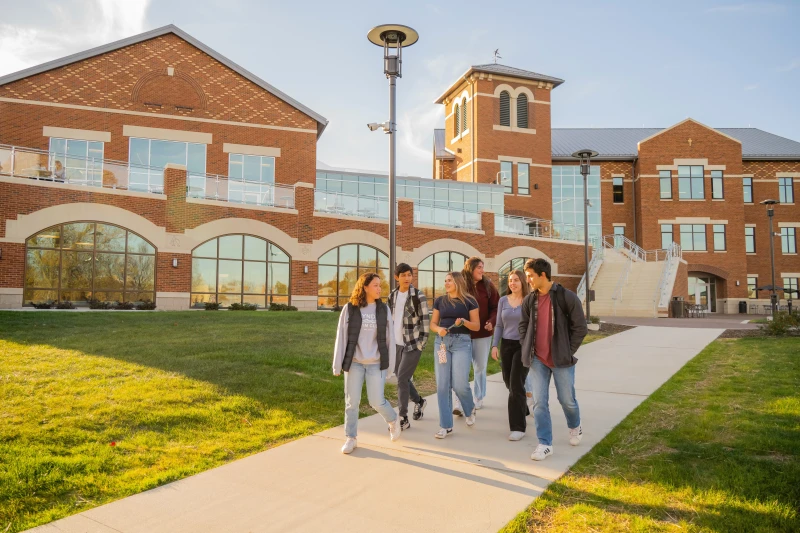
 Franciscan University of Steubenville. / Credit: Photo courtesy of Franciscan University of Steubenville

Washington, D.C. Newsroom, Nov 24, 2025 / 15:08 pm (CNA).
The 2025-2026 Newman Guide will be available in December to help parents and students find reliable Catholic elementary, secondary, college, international, and graduate education programs.The Cardinal Newman Society, which publishes a yearly guide on the most faithfully Catholic schools in the U.S., will release its new edition as both an e-book and a digest-sized print book. The Newman Guide has recommended colleges for Catholic families for 20 years, but the 2025-2026 edition is the first that will recommend elementary schools, secondary schools, colleges, and graduate programs. The new guide follows the recent announcements of St. John Henry Newman becoming a doctor of the Church and a patron saint of Catholic education. The Newman Guide has recommended colleges for Catholic families for 20 years, but the 2025-2026 edition is the first that will recommend elementary schools, secondary schools, colleges, and graduate programs. Credit: Cardinal Newman SocietyThe guide gives families a path to a faithful Catholic education, which is growing more relevant, according to the Cardinal Newman Society, which reported a 55% decline in enrollment at Catholic schools in the last 50 years. Recognizing that Catholic education is the Church’s most effective means of evangelization and Catholic formation, the society says it continues to respond with tools, including the Newman Guide. “With so many Catholic colleges compromising their mission, the Newman Guide served as a trusted resource to identify schools committed to forming students intellectually and spiritually in line with Church teachings,” said Dominic Kalpakgian, a student who started attending a Newman Guide-recommended college in 2024.“The guide’s endorsement carried significant weight with my parents, who trusted the Newman Guide schools to uphold the values and principles they had instilled in me,” Kalpakgian said.“The Newman Guide was instrumental in helping my family locate a faithfully Catholic grade school when we were moving across the country,” said Molly Metzgar, a mother, teacher, and Cardinal Newman Society employee. “While subsequently teaching at my child’s school, I helped successfully navigate the Newman Guide application process.”The guide reaches more than 75,000 families online each year and now plans to expand numbers with the additional print version. Since starting to approve schools beyond just colleges, 28 elementary schools and 55 graduate programs have become Newman Guide-recommended.“Out of our 160+ graduates, those who attended Newman Guide colleges are the ones still practicing their faith,” said Derek Tremblay, the headmaster of Mount Royal Academy. How to become Newman Guide recommendedSince 2007, the Cardinal Newman Society has recognized Catholic colleges in the Newman Guide that have strong policies and standards and uphold Catholic identity within academics, athletics, faculty hiring, and campus life.The key elements in faithful Catholic education, according to the society, is looking for salvation of souls, Catholic community, prayer, Scripture and sacrament, integral formation, and Christian worldview.To be recognized in the Newman Guide, “a Catholic school must be committed to strong Catholic identity and model the ‘Principles of Catholic Identity in Education,’ use the Catholic ‘Curriculum Standards’ in whole or part, and align their school policies with standards promoted by the society which are derived from Church teaching.”Catholic schools must have a curriculum that provides for the integral formation of the whole person and helps students know and understand objective reality, including transcendent truth.The Newman Guide policy standards are derived from guidance from Church councils, popes, Vatican congregations, bishops conferences, the Catechism of the Catholic Church, and other Church documents.

Newman Guide adds Catholic elementary, secondary, graduate school sections #Catholic Franciscan University of Steubenville. / Credit: Photo courtesy of Franciscan University of Steubenville Washington, D.C. Newsroom, Nov 24, 2025 / 15:08 pm (CNA). The 2025-2026 Newman Guide will be available in December to help parents and students find reliable Catholic elementary, secondary, college, international, and graduate education programs.The Cardinal Newman Society, which publishes a yearly guide on the most faithfully Catholic schools in the U.S., will release its new edition as both an e-book and a digest-sized print book. The Newman Guide has recommended colleges for Catholic families for 20 years, but the 2025-2026 edition is the first that will recommend elementary schools, secondary schools, colleges, and graduate programs. The new guide follows the recent announcements of St. John Henry Newman becoming a doctor of the Church and a patron saint of Catholic education. The Newman Guide has recommended colleges for Catholic families for 20 years, but the 2025-2026 edition is the first that will recommend elementary schools, secondary schools, colleges, and graduate programs. Credit: Cardinal Newman SocietyThe guide gives families a path to a faithful Catholic education, which is growing more relevant, according to the Cardinal Newman Society, which reported a 55% decline in enrollment at Catholic schools in the last 50 years. Recognizing that Catholic education is the Church’s most effective means of evangelization and Catholic formation, the society says it continues to respond with tools, including the Newman Guide. “With so many Catholic colleges compromising their mission, the Newman Guide served as a trusted resource to identify schools committed to forming students intellectually and spiritually in line with Church teachings,” said Dominic Kalpakgian, a student who started attending a Newman Guide-recommended college in 2024.“The guide’s endorsement carried significant weight with my parents, who trusted the Newman Guide schools to uphold the values and principles they had instilled in me,” Kalpakgian said.“The Newman Guide was instrumental in helping my family locate a faithfully Catholic grade school when we were moving across the country,” said Molly Metzgar, a mother, teacher, and Cardinal Newman Society employee. “While subsequently teaching at my child’s school, I helped successfully navigate the Newman Guide application process.”The guide reaches more than 75,000 families online each year and now plans to expand numbers with the additional print version. Since starting to approve schools beyond just colleges, 28 elementary schools and 55 graduate programs have become Newman Guide-recommended.“Out of our 160+ graduates, those who attended Newman Guide colleges are the ones still practicing their faith,” said Derek Tremblay, the headmaster of Mount Royal Academy. How to become Newman Guide recommendedSince 2007, the Cardinal Newman Society has recognized Catholic colleges in the Newman Guide that have strong policies and standards and uphold Catholic identity within academics, athletics, faculty hiring, and campus life.The key elements in faithful Catholic education, according to the society, is looking for salvation of souls, Catholic community, prayer, Scripture and sacrament, integral formation, and Christian worldview.To be recognized in the Newman Guide, “a Catholic school must be committed to strong Catholic identity and model the ‘Principles of Catholic Identity in Education,’ use the Catholic ‘Curriculum Standards’ in whole or part, and align their school policies with standards promoted by the society which are derived from Church teaching.”Catholic schools must have a curriculum that provides for the integral formation of the whole person and helps students know and understand objective reality, including transcendent truth.The Newman Guide policy standards are derived from guidance from Church councils, popes, Vatican congregations, bishops conferences, the Catechism of the Catholic Church, and other Church documents.


Franciscan University of Steubenville. / Credit: Photo courtesy of Franciscan University of Steubenville

Washington, D.C. Newsroom, Nov 24, 2025 / 15:08 pm (CNA).

The 2025-2026 Newman Guide will be available in December to help parents and students find reliable Catholic elementary, secondary, college, international, and graduate education programs.

The Cardinal Newman Society, which publishes a yearly guide on the most faithfully Catholic schools in the U.S., will release its new edition as both an e-book and a digest-sized print book. 

The Newman Guide has recommended colleges for Catholic families for 20 years, but the 2025-2026 edition is the first that will recommend elementary schools, secondary schools, colleges, and graduate programs. The new guide follows the recent announcements of St. John Henry Newman becoming a doctor of the Church and a patron saint of Catholic education. 

The Newman Guide has recommended colleges for Catholic families for 20 years, but the 2025-2026 edition is the first that will recommend elementary schools, secondary schools, colleges, and graduate programs. Credit: Cardinal Newman Society

The guide gives families a path to a faithful Catholic education, which is growing more relevant, according to the Cardinal Newman Society, which reported a 55% decline in enrollment at Catholic schools in the last 50 years. Recognizing that Catholic education is the Church’s most effective means of evangelization and Catholic formation, the society says it continues to respond with tools, including the Newman Guide. 

“With so many Catholic colleges compromising their mission, the Newman Guide served as a trusted resource to identify schools committed to forming students intellectually and spiritually in line with Church teachings,” said Dominic Kalpakgian, a student who started attending a Newman Guide-recommended college in 2024.

“The guide’s endorsement carried significant weight with my parents, who trusted the Newman Guide schools to uphold the values and principles they had instilled in me,” Kalpakgian said.

“The Newman Guide was instrumental in helping my family locate a faithfully Catholic grade school when we were moving across the country,” said Molly Metzgar, a mother, teacher, and Cardinal Newman Society employee. “While subsequently teaching at my child’s school, I helped successfully navigate the Newman Guide application process.”

The guide reaches more than 75,000 families online each year and now plans to expand numbers with the additional print version. Since starting to approve schools beyond just colleges, 28 elementary schools and 55 graduate programs have become Newman Guide-recommended.

“Out of our 160+ graduates, those who attended Newman Guide colleges are the ones still practicing their faith,” said Derek Tremblay, the headmaster of Mount Royal Academy. 

How to become Newman Guide recommended

Since 2007, the Cardinal Newman Society has recognized Catholic colleges in the Newman Guide that have strong policies and standards and uphold Catholic identity within academics, athletics, faculty hiring, and campus life.

The key elements in faithful Catholic education, according to the society, is looking for salvation of souls, Catholic community, prayer, Scripture and sacrament, integral formation, and Christian worldview.

To be recognized in the Newman Guide, “a Catholic school must be committed to strong Catholic identity and model the ‘Principles of Catholic Identity in Education,’ use the Catholic ‘Curriculum Standards’ in whole or part, and align their school policies with standards promoted by the society which are derived from Church teaching.”

Catholic schools must have a curriculum that provides for the integral formation of the whole person and helps students know and understand objective reality, including transcendent truth.

The Newman Guide policy standards are derived from guidance from Church councils, popes, Vatican congregations, bishops conferences, the Catechism of the Catholic Church, and other Church documents.

Read More
Notre Dame drops ‘acceptance and support for Catholic mission’ from staff values #Catholic 
 
 The University of Notre Dame. / Credit: Matt B. via Flickr (CC BY-NC-SA 2.0)

Washington, D.C. Newsroom, Nov 16, 2025 / 07:00 am (CNA).
Here’s a roundup of the latest Catholic education news in the United States:Notre Dame drops ‘acceptance and support for Catholic mission’ from staff values The University of Notre Dame has dropped acceptance and support for its Catholic mission from the list of staff values it has held for the past 20 years. The university’s leadership announced new updates to its staff values at its Fall 2025 Staff Town Halls on Oct. 29 and 30, according to a press release. Human Resources President Heather Christophersen said the new values were “an expression of how we seek to advance Notre Dame’s mission as a global, Catholic research university.”Prior to the change, Notre Dame’s staff values were as follows: — Accountability: Takes responsibility and ownership for decisions, actions, and results. Accountable for both how and what is accomplished— Teamwork: Works cooperatively as a member of a team and is committed to the overall team objectives rather than own interests— Integrity: Demonstrates honest and ethical behavior that displays a high moral standard. Widely trusted, respectful, and honorable— Leadership in Excellence: Demonstrates energy and commitment to improving results, takes initiatives often involving calculated risks while considering the common good— Leadership in Mission: Understands, accepts, and supports the Catholic mission of the university and fosters values consistent with that missionThe new and pared down values and their descriptions are: — Community: Treat every person with dignity and respect.— Collaboration: Work together with honesty, kindness, and humility.— Excellence: Pursue the highest standards with a commitment to truth and service.— Innovation: Embrace opportunities with creativity and dedication.According to the Notre Dame Observer, Christophersen said in an email to staff that the former Notre Dame values “had only one value that pointed into mission” and that the decision to remove the “Leadership in Mission” value was motivated by a desire to reframe the school’s Catholic mission as all-encompassing. She said the old values had caused confusion in staff evaluation processes during annual performance reviews and that the school does not monitor religious affiliation for staff in the same way as faculty and students. Notre Dame did not return multiple requests for comment.University of St. Francis and Belleville Diocese announce student admission partnershipThe University of St. Francis (USF) and the Diocese of Belleville, Illinois, have announced a new partnership guaranteeing admission for diocesan high school graduates. Students from Althoff Catholic High School, Mater Dei Catholic High School, and Gibault Catholic High School will have guaranteed admission at the university as well as the opportunity to earn scholarships of up to ,000. “We are so pleased with this partnership and look forward to welcoming students from the Catholic high schools within the Belleville Diocese,” University of St. Francis President Ryan C. Hendrickson said in a press release announcing the partnership. “In addition to the guaranteed admission, USF plans to host workshops and information sessions for diocese-based school counselors, teachers, parents, and prospective students. USF will also offer campus visitation days, facilitating exploration and engagement with the diocese schools,” the release stated.Archdiocese of Hartford to open 2 new Catholic schools amid Mass attendance boom The Archdiocese of Hartford, Connecticut, will open two new Catholic schools next year as Mass attendance and renewed interest in the faith continues to rise. “A lot of the decisions that are being made in the public-school systems are not decisions that a lot of people find easy to hold, and they’re looking for places where they could just find a little bit less politics,” Archbishop Christopher Coyne said, emphasizing the important role of Catholic schools in this environment, according to a local report. Coyne said elsewhere that the new school openings come amid “a great reversal of the downward trends we experienced before and during COVID.”One of the schools, Chesterton Academy of St. Francis of Assisi, will accept ninth and 10th grade students in fall 2026. The other school, the Catholic Academy of Hartford, will accept pre-K through second graders starting in the fall, adding a grade each year until it reaches the eighth grade. The school will operate on an income-based tuition model. St. Anselm College announces reception of  million gift St. Anselm College, a Benedictine liberal arts school in New Hampshire, announced a  million gift, the largest donation in the school’s 136-year history. The gift was from Robert and Beverly Grappone, whose son, Greg, graduated from the college in 2004 and passed away from cancer at the age of 35. “While many colleges and universities are struggling in a challenging higher education environment, St. Anselm is fortunate to have a different story,” the college said in a press release announcing the historic gift. “The college has seen enrollment growth over the last four years, increasing each year since the post-COVID class. This year’s incoming freshmen class set a record with 647 students. The college has a retention rate of 90%.”The gift includes  million designated for the school of business, which will be named the Robert J. Grappone School of Business and Innovation, a  million endowment to the Grappone Humanities Institute, and “multimillion dollar renovations” to the school’s residence halls, support for the athletic complex, an endowment for the school’s nursing program, scholarships, and further campus improvements.

Notre Dame drops ‘acceptance and support for Catholic mission’ from staff values #Catholic The University of Notre Dame. / Credit: Matt B. via Flickr (CC BY-NC-SA 2.0) Washington, D.C. Newsroom, Nov 16, 2025 / 07:00 am (CNA). Here’s a roundup of the latest Catholic education news in the United States:Notre Dame drops ‘acceptance and support for Catholic mission’ from staff values The University of Notre Dame has dropped acceptance and support for its Catholic mission from the list of staff values it has held for the past 20 years. The university’s leadership announced new updates to its staff values at its Fall 2025 Staff Town Halls on Oct. 29 and 30, according to a press release. Human Resources President Heather Christophersen said the new values were “an expression of how we seek to advance Notre Dame’s mission as a global, Catholic research university.”Prior to the change, Notre Dame’s staff values were as follows: — Accountability: Takes responsibility and ownership for decisions, actions, and results. Accountable for both how and what is accomplished— Teamwork: Works cooperatively as a member of a team and is committed to the overall team objectives rather than own interests— Integrity: Demonstrates honest and ethical behavior that displays a high moral standard. Widely trusted, respectful, and honorable— Leadership in Excellence: Demonstrates energy and commitment to improving results, takes initiatives often involving calculated risks while considering the common good— Leadership in Mission: Understands, accepts, and supports the Catholic mission of the university and fosters values consistent with that missionThe new and pared down values and their descriptions are: — Community: Treat every person with dignity and respect.— Collaboration: Work together with honesty, kindness, and humility.— Excellence: Pursue the highest standards with a commitment to truth and service.— Innovation: Embrace opportunities with creativity and dedication.According to the Notre Dame Observer, Christophersen said in an email to staff that the former Notre Dame values “had only one value that pointed into mission” and that the decision to remove the “Leadership in Mission” value was motivated by a desire to reframe the school’s Catholic mission as all-encompassing. She said the old values had caused confusion in staff evaluation processes during annual performance reviews and that the school does not monitor religious affiliation for staff in the same way as faculty and students. Notre Dame did not return multiple requests for comment.University of St. Francis and Belleville Diocese announce student admission partnershipThe University of St. Francis (USF) and the Diocese of Belleville, Illinois, have announced a new partnership guaranteeing admission for diocesan high school graduates. Students from Althoff Catholic High School, Mater Dei Catholic High School, and Gibault Catholic High School will have guaranteed admission at the university as well as the opportunity to earn scholarships of up to $3,000. “We are so pleased with this partnership and look forward to welcoming students from the Catholic high schools within the Belleville Diocese,” University of St. Francis President Ryan C. Hendrickson said in a press release announcing the partnership. “In addition to the guaranteed admission, USF plans to host workshops and information sessions for diocese-based school counselors, teachers, parents, and prospective students. USF will also offer campus visitation days, facilitating exploration and engagement with the diocese schools,” the release stated.Archdiocese of Hartford to open 2 new Catholic schools amid Mass attendance boom The Archdiocese of Hartford, Connecticut, will open two new Catholic schools next year as Mass attendance and renewed interest in the faith continues to rise. “A lot of the decisions that are being made in the public-school systems are not decisions that a lot of people find easy to hold, and they’re looking for places where they could just find a little bit less politics,” Archbishop Christopher Coyne said, emphasizing the important role of Catholic schools in this environment, according to a local report. Coyne said elsewhere that the new school openings come amid “a great reversal of the downward trends we experienced before and during COVID.”One of the schools, Chesterton Academy of St. Francis of Assisi, will accept ninth and 10th grade students in fall 2026. The other school, the Catholic Academy of Hartford, will accept pre-K through second graders starting in the fall, adding a grade each year until it reaches the eighth grade. The school will operate on an income-based tuition model. St. Anselm College announces reception of $40 million gift St. Anselm College, a Benedictine liberal arts school in New Hampshire, announced a $40 million gift, the largest donation in the school’s 136-year history. The gift was from Robert and Beverly Grappone, whose son, Greg, graduated from the college in 2004 and passed away from cancer at the age of 35. “While many colleges and universities are struggling in a challenging higher education environment, St. Anselm is fortunate to have a different story,” the college said in a press release announcing the historic gift. “The college has seen enrollment growth over the last four years, increasing each year since the post-COVID class. This year’s incoming freshmen class set a record with 647 students. The college has a retention rate of 90%.”The gift includes $11 million designated for the school of business, which will be named the Robert J. Grappone School of Business and Innovation, a $5 million endowment to the Grappone Humanities Institute, and “multimillion dollar renovations” to the school’s residence halls, support for the athletic complex, an endowment for the school’s nursing program, scholarships, and further campus improvements.


The University of Notre Dame. / Credit: Matt B. via Flickr (CC BY-NC-SA 2.0)

Washington, D.C. Newsroom, Nov 16, 2025 / 07:00 am (CNA).

Here’s a roundup of the latest Catholic education news in the United States:

Notre Dame drops ‘acceptance and support for Catholic mission’ from staff values 

The University of Notre Dame has dropped acceptance and support for its Catholic mission from the list of staff values it has held for the past 20 years. 

The university’s leadership announced new updates to its staff values at its Fall 2025 Staff Town Halls on Oct. 29 and 30, according to a press release. Human Resources President Heather Christophersen said the new values were “an expression of how we seek to advance Notre Dame’s mission as a global, Catholic research university.”

Prior to the change, Notre Dame’s staff values were as follows: 

— Accountability: Takes responsibility and ownership for decisions, actions, and results. Accountable for both how and what is accomplished

— Teamwork: Works cooperatively as a member of a team and is committed to the overall team objectives rather than own interests

— Integrity: Demonstrates honest and ethical behavior that displays a high moral standard. Widely trusted, respectful, and honorable

— Leadership in Excellence: Demonstrates energy and commitment to improving results, takes initiatives often involving calculated risks while considering the common good

— Leadership in Mission: Understands, accepts, and supports the Catholic mission of the university and fosters values consistent with that mission

The new and pared down values and their descriptions are: 

— Community: Treat every person with dignity and respect.

— Collaboration: Work together with honesty, kindness, and humility.

— Excellence: Pursue the highest standards with a commitment to truth and service.

— Innovation: Embrace opportunities with creativity and dedication.

According to the Notre Dame Observer, Christophersen said in an email to staff that the former Notre Dame values “had only one value that pointed into mission” and that the decision to remove the “Leadership in Mission” value was motivated by a desire to reframe the school’s Catholic mission as all-encompassing. She said the old values had caused confusion in staff evaluation processes during annual performance reviews and that the school does not monitor religious affiliation for staff in the same way as faculty and students. 

Notre Dame did not return multiple requests for comment.

University of St. Francis and Belleville Diocese announce student admission partnership

The University of St. Francis (USF) and the Diocese of Belleville, Illinois, have announced a new partnership guaranteeing admission for diocesan high school graduates. 

Students from Althoff Catholic High School, Mater Dei Catholic High School, and Gibault Catholic High School will have guaranteed admission at the university as well as the opportunity to earn scholarships of up to $3,000. 

“We are so pleased with this partnership and look forward to welcoming students from the Catholic high schools within the Belleville Diocese,” University of St. Francis President Ryan C. Hendrickson said in a press release announcing the partnership. 

“In addition to the guaranteed admission, USF plans to host workshops and information sessions for diocese-based school counselors, teachers, parents, and prospective students. USF will also offer campus visitation days, facilitating exploration and engagement with the diocese schools,” the release stated.

Archdiocese of Hartford to open 2 new Catholic schools amid Mass attendance boom 

The Archdiocese of Hartford, Connecticut, will open two new Catholic schools next year as Mass attendance and renewed interest in the faith continues to rise. 

“A lot of the decisions that are being made in the public-school systems are not decisions that a lot of people find easy to hold, and they’re looking for places where they could just find a little bit less politics,” Archbishop Christopher Coyne said, emphasizing the important role of Catholic schools in this environment, according to a local report. Coyne said elsewhere that the new school openings come amid “a great reversal of the downward trends we experienced before and during COVID.”

One of the schools, Chesterton Academy of St. Francis of Assisi, will accept ninth and 10th grade students in fall 2026. The other school, the Catholic Academy of Hartford, will accept pre-K through second graders starting in the fall, adding a grade each year until it reaches the eighth grade. The school will operate on an income-based tuition model. 

St. Anselm College announces reception of $40 million gift 

St. Anselm College, a Benedictine liberal arts school in New Hampshire, announced a $40 million gift, the largest donation in the school’s 136-year history. 

The gift was from Robert and Beverly Grappone, whose son, Greg, graduated from the college in 2004 and passed away from cancer at the age of 35. “While many colleges and universities are struggling in a challenging higher education environment, St. Anselm is fortunate to have a different story,” the college said in a press release announcing the historic gift. “The college has seen enrollment growth over the last four years, increasing each year since the post-COVID class. This year’s incoming freshmen class set a record with 647 students. The college has a retention rate of 90%.”

The gift includes $11 million designated for the school of business, which will be named the Robert J. Grappone School of Business and Innovation, a $5 million endowment to the Grappone Humanities Institute, and “multimillion dollar renovations” to the school’s residence halls, support for the athletic complex, an endowment for the school’s nursing program, scholarships, and further campus improvements.

Read More
Meet the college student sharing bumper stickers to save unborn lives #Catholic 
 
 Gabriel Dionisi, a 22-year-old college student who makes pro-life bumper stickers with the goal of spreading the pro-life message and spread awareness to others, displays one of his works. / Credit: Gabriel Dionisi

CNA Staff, Nov 10, 2025 / 06:00 am (CNA).
Born and raised Catholic, 22-year-old Gabriel Dionisi always knew that life begins at conception and that it’s wrong to kill an unborn child in the womb. But it wasn’t until he was a teenager that he became more interested in his faith and started to read more Catholic news, which led to him learning more about the abortion issue. Feeling called to do more for the unborn, he created a pro-life ministry using bumper stickers to help spread awareness. “I’d heard the word abortion before, I knew it was a sin, but I didn’t realize how widespread it was,” Dionisi told CNA in an interview. One day at Mass, he read a pamphlet explaining the different abortion procedures and was left “disturbed” after reading about how many unborn babies are dismembered in certain kinds of abortion procedures.He said he was also surprised to hear how many women are pressured into abortion.“I remember being struck by reading about how many women didn’t want to have abortions — felt pressured or coerced or it wasn’t their first choice — and that was also surprising to me because it made me think, ‘OK, we could actually do something about this,’” he said.Gabriel Dionisi’s pro-life bumper sticker rests on an information table with other resources for pregnant women. Credit: Photo courtesy of Kevin JorreyIn 2018 Dionisi decided to create bumper stickers encouraging individuals to “choose life.” For women who might be in crisis pregnancies, the stickers include the URL to Option Line, a website run by Heartbeat International that offers a map of pregnancy resource centers around the country. The site also offers a 24/7 helpline with counselors who speak both English and Spanish.Dionisi explained that he chose to create bumper stickers because they’re inexpensive to print and “there’s such a good return on investment because if you put a bumper sticker on your car and let’s say 20 people see it every day as you drive, you multiply that by 365, that’s over 7,000 a year.”Since launching his pro-life ministry, Dionisi has shared over 10,000 bumper stickers with people in 45 out of the 50 states.Speaking to the importance of defending the unborn, Dionisi said: “It’s foundational. If we want to see our country succeed and thrive, we need to respect that value of equal human dignity.”He added: “The magnitude of the problem is that so many babies are being lost and not just that, but so many women who are being hurt, men who are being hurt, and it affects our whole society when people are just carrying that wound around with them.”Dionisi said he hopes his bumper stickers are helping to spread awareness of the many resources available for pregnant women in need.“I think it’s important to spread this awareness to everybody because you never know when someone in your own life might be going through a situation where they need help,” he said.“The amazing thing about the pro-life movement is that there are so many opportunities for us, just as regular people, to literally save the lives of others. This is especially important as Catholics, because we know that every human being is made in the image of God and has an enormous potential to bring more love into the world.”Dionisi’s free pro-life bumper stickers can be found here.

Meet the college student sharing bumper stickers to save unborn lives #Catholic Gabriel Dionisi, a 22-year-old college student who makes pro-life bumper stickers with the goal of spreading the pro-life message and spread awareness to others, displays one of his works. / Credit: Gabriel Dionisi CNA Staff, Nov 10, 2025 / 06:00 am (CNA). Born and raised Catholic, 22-year-old Gabriel Dionisi always knew that life begins at conception and that it’s wrong to kill an unborn child in the womb. But it wasn’t until he was a teenager that he became more interested in his faith and started to read more Catholic news, which led to him learning more about the abortion issue. Feeling called to do more for the unborn, he created a pro-life ministry using bumper stickers to help spread awareness. “I’d heard the word abortion before, I knew it was a sin, but I didn’t realize how widespread it was,” Dionisi told CNA in an interview. One day at Mass, he read a pamphlet explaining the different abortion procedures and was left “disturbed” after reading about how many unborn babies are dismembered in certain kinds of abortion procedures.He said he was also surprised to hear how many women are pressured into abortion.“I remember being struck by reading about how many women didn’t want to have abortions — felt pressured or coerced or it wasn’t their first choice — and that was also surprising to me because it made me think, ‘OK, we could actually do something about this,’” he said.Gabriel Dionisi’s pro-life bumper sticker rests on an information table with other resources for pregnant women. Credit: Photo courtesy of Kevin JorreyIn 2018 Dionisi decided to create bumper stickers encouraging individuals to “choose life.” For women who might be in crisis pregnancies, the stickers include the URL to Option Line, a website run by Heartbeat International that offers a map of pregnancy resource centers around the country. The site also offers a 24/7 helpline with counselors who speak both English and Spanish.Dionisi explained that he chose to create bumper stickers because they’re inexpensive to print and “there’s such a good return on investment because if you put a bumper sticker on your car and let’s say 20 people see it every day as you drive, you multiply that by 365, that’s over 7,000 a year.”Since launching his pro-life ministry, Dionisi has shared over 10,000 bumper stickers with people in 45 out of the 50 states.Speaking to the importance of defending the unborn, Dionisi said: “It’s foundational. If we want to see our country succeed and thrive, we need to respect that value of equal human dignity.”He added: “The magnitude of the problem is that so many babies are being lost and not just that, but so many women who are being hurt, men who are being hurt, and it affects our whole society when people are just carrying that wound around with them.”Dionisi said he hopes his bumper stickers are helping to spread awareness of the many resources available for pregnant women in need.“I think it’s important to spread this awareness to everybody because you never know when someone in your own life might be going through a situation where they need help,” he said.“The amazing thing about the pro-life movement is that there are so many opportunities for us, just as regular people, to literally save the lives of others. This is especially important as Catholics, because we know that every human being is made in the image of God and has an enormous potential to bring more love into the world.”Dionisi’s free pro-life bumper stickers can be found here.


Gabriel Dionisi, a 22-year-old college student who makes pro-life bumper stickers with the goal of spreading the pro-life message and spread awareness to others, displays one of his works. / Credit: Gabriel Dionisi

CNA Staff, Nov 10, 2025 / 06:00 am (CNA).

Born and raised Catholic, 22-year-old Gabriel Dionisi always knew that life begins at conception and that it’s wrong to kill an unborn child in the womb. But it wasn’t until he was a teenager that he became more interested in his faith and started to read more Catholic news, which led to him learning more about the abortion issue. Feeling called to do more for the unborn, he created a pro-life ministry using bumper stickers to help spread awareness. 

“I’d heard the word abortion before, I knew it was a sin, but I didn’t realize how widespread it was,” Dionisi told CNA in an interview. 

One day at Mass, he read a pamphlet explaining the different abortion procedures and was left “disturbed” after reading about how many unborn babies are dismembered in certain kinds of abortion procedures.

He said he was also surprised to hear how many women are pressured into abortion.

“I remember being struck by reading about how many women didn’t want to have abortions — felt pressured or coerced or it wasn’t their first choice — and that was also surprising to me because it made me think, ‘OK, we could actually do something about this,’” he said.

Gabriel Dionisi’s pro-life bumper sticker rests on an information table with other resources for pregnant women. Credit: Photo courtesy of Kevin Jorrey

In 2018 Dionisi decided to create bumper stickers encouraging individuals to “choose life.” For women who might be in crisis pregnancies, the stickers include the URL to Option Line, a website run by Heartbeat International that offers a map of pregnancy resource centers around the country. The site also offers a 24/7 helpline with counselors who speak both English and Spanish.

Dionisi explained that he chose to create bumper stickers because they’re inexpensive to print and “there’s such a good return on investment because if you put a bumper sticker on your car and let’s say 20 people see it every day as you drive, you multiply that by 365, that’s over 7,000 a year.”

Since launching his pro-life ministry, Dionisi has shared over 10,000 bumper stickers with people in 45 out of the 50 states.

Speaking to the importance of defending the unborn, Dionisi said: “It’s foundational. If we want to see our country succeed and thrive, we need to respect that value of equal human dignity.”

He added: “The magnitude of the problem is that so many babies are being lost and not just that, but so many women who are being hurt, men who are being hurt, and it affects our whole society when people are just carrying that wound around with them.”

Dionisi said he hopes his bumper stickers are helping to spread awareness of the many resources available for pregnant women in need.

“I think it’s important to spread this awareness to everybody because you never know when someone in your own life might be going through a situation where they need help,” he said.

“The amazing thing about the pro-life movement is that there are so many opportunities for us, just as regular people, to literally save the lives of others. This is especially important as Catholics, because we know that every human being is made in the image of God and has an enormous potential to bring more love into the world.”

Dionisi’s free pro-life bumper stickers can be found here.

Read More
Poll: 7 in 10 voters support requiring doctor’s visit for abortion pills #Catholic 
 
 null / Credit: SibRapid/Shutterstock

Denver, Colorado, Nov 1, 2025 / 07:19 am (CNA).
Here is a roundup of recent pro-life and abortion-related news.7 in 10 voters support requiring doctor’s visit for abortion pills More than 7 in 10 voters believe a doctor’s visit should be required for a chemical abortion prescription, a recent poll found. The McLaughlin & Associates poll of 1,600 participants found that 71% of voters approved of a proposal “requiring a doctor’s visit in order for the chemical abortion drug to be prescribed to terminate an unwanted pregnancy.” The poll also found that 30% of voters had “significant concerns” about the safety of the abortion pill.  Current federal regulations allow providers to prescribe abortion drugs through telehealth and send them by mail. States like California even allow anonymous prescription of the abortion pill, and states including New York and California have “shield laws” that protect abortion providers who ship drugs into states where it is illegal. SBA Pro-Life America President Marjorie Dannenfelser said this week, “The harmful impact of Biden’s FDA removing safeguards on abortion drugs, like in-person doctor visits, is an issue that overwhelmingly unites voters of all stripes.”“As a growing body of research indicates these drugs are far more dangerous than advertised, and new horror stories emerge day after day of women coerced and drugged against their will, landing in the ER and even dying along with their babies, Americans’ concerns are more than valid,” she said in an Oct. 28 statement.Dannenfelser urged the Trump administration to “heed the emerging science and the will of the people and immediately reinstate in-person doctor visits.” Texas AG Paxton secures win in Yelp’s targeting of pregnancy centersTexas Attorney General Ken Paxton secured an appellate court victory against Yelp, Inc. for allegedly adding misleading notices to pro-life pregnancy centers. Paxton filed the lawsuit after misleading notices were attached to the pages of crisis pregnancy centers. The 15th U.S. Court of Appeals reversed a lower court’s dismissal, which had concluded that Texas did not have jurisdiction over Yelp because it is based in California. The 15th U.S. Court of Appeals concluded this week that the company is still “subject to specific jurisdiction in Texas” and that the concern is relevant to other states as well. “As evidenced by the number of attorneys general who signed the letter sent to Yelp, several states share Texas’s interest in ensuring that Crisis Pregnancy Centers are not the targets of actionable misleading statements,” Justice April Farris wrote in the opinion. Paxton said in a statement that Yelp tried to “steer users away from pro-life resources,” noting that Texas will keep Yelp accountable. Paxton pledged to “continue to defend pro-life organizations that serve Texans and make sure that women and families are receiving accurate information about our state’s resources.”Virginia superintendent denies that staff facilitated student abortionsA Virginia public school district has denied allegations that staff at a high school facilitated student abortions without parental consent or knowledge.In an Oct. 16 letter to families and staff at Centreville High School, Fairfax County Superintendent Michelle Reid said that internal investigations found that the “allegations are likely untrue” as “new details have emerged.” In the wake of an investigative report by a local blogger and accusations by a teacher on staff, Virginia Gov. Glenn Youngkin instructed police to launch a criminal investigation. U.S. Senator Bill Cassidy, chairman of the Senate Health, Education, Labor and Pension Committee as well as the U.S. Department of Education also launched investigations. Reid said that “such behavior would never be acceptable” in the school district, which “is fully cooperating with these government investigations.” Planned Parenthood Wisconsin resumes abortionsAfter a temporary pause this month, Wisconsin Planned Parenthood resumed providing abortions in the state by giving up its designation as an “essential community provider” under the Affordable Care Act. Planned Parenthood Wisconsin stopped offering abortions on Oct. 1, after President Donald Trump cut federal Medicaid funding for abortion providers. The yearlong pause is designed to prevent federal tax dollars from subsidizing organizations that provide abortions. Heather Weininger, executive director of Wisconsin Right to Life, said, “Planned Parenthood’s abortion-first business model underscores why taxpayer funding should never support organizations that make abortion a priority.”“Women in difficult circumstances deserve compassionate, life-affirming care — the kind of support the pro-life movement is committed to offering,” she said in an Oct. 27 statement.  Ohio cuts medicaid contract with Planned Parenthood Ohio has terminated Medicaid provider contracts with Planned Parenthood, preventing state funds from going to the abortion giant there.The Ohio Department of Medicaid cited Trump’s recent yearlong pause on Medicaid reimbursements to abortion providers as the reason for termination. Planned Parenthood has since requested a hearing with the department to oppose the termination. Whether the state’s decision to end the agreement will extend longer than the federal pause is unclear.

Poll: 7 in 10 voters support requiring doctor’s visit for abortion pills #Catholic null / Credit: SibRapid/Shutterstock Denver, Colorado, Nov 1, 2025 / 07:19 am (CNA). Here is a roundup of recent pro-life and abortion-related news.7 in 10 voters support requiring doctor’s visit for abortion pills More than 7 in 10 voters believe a doctor’s visit should be required for a chemical abortion prescription, a recent poll found. The McLaughlin & Associates poll of 1,600 participants found that 71% of voters approved of a proposal “requiring a doctor’s visit in order for the chemical abortion drug to be prescribed to terminate an unwanted pregnancy.” The poll also found that 30% of voters had “significant concerns” about the safety of the abortion pill.  Current federal regulations allow providers to prescribe abortion drugs through telehealth and send them by mail. States like California even allow anonymous prescription of the abortion pill, and states including New York and California have “shield laws” that protect abortion providers who ship drugs into states where it is illegal. SBA Pro-Life America President Marjorie Dannenfelser said this week, “The harmful impact of Biden’s FDA removing safeguards on abortion drugs, like in-person doctor visits, is an issue that overwhelmingly unites voters of all stripes.”“As a growing body of research indicates these drugs are far more dangerous than advertised, and new horror stories emerge day after day of women coerced and drugged against their will, landing in the ER and even dying along with their babies, Americans’ concerns are more than valid,” she said in an Oct. 28 statement.Dannenfelser urged the Trump administration to “heed the emerging science and the will of the people and immediately reinstate in-person doctor visits.” Texas AG Paxton secures win in Yelp’s targeting of pregnancy centersTexas Attorney General Ken Paxton secured an appellate court victory against Yelp, Inc. for allegedly adding misleading notices to pro-life pregnancy centers. Paxton filed the lawsuit after misleading notices were attached to the pages of crisis pregnancy centers. The 15th U.S. Court of Appeals reversed a lower court’s dismissal, which had concluded that Texas did not have jurisdiction over Yelp because it is based in California. The 15th U.S. Court of Appeals concluded this week that the company is still “subject to specific jurisdiction in Texas” and that the concern is relevant to other states as well. “As evidenced by the number of attorneys general who signed the letter sent to Yelp, several states share Texas’s interest in ensuring that Crisis Pregnancy Centers are not the targets of actionable misleading statements,” Justice April Farris wrote in the opinion. Paxton said in a statement that Yelp tried to “steer users away from pro-life resources,” noting that Texas will keep Yelp accountable. Paxton pledged to “continue to defend pro-life organizations that serve Texans and make sure that women and families are receiving accurate information about our state’s resources.”Virginia superintendent denies that staff facilitated student abortionsA Virginia public school district has denied allegations that staff at a high school facilitated student abortions without parental consent or knowledge.In an Oct. 16 letter to families and staff at Centreville High School, Fairfax County Superintendent Michelle Reid said that internal investigations found that the “allegations are likely untrue” as “new details have emerged.” In the wake of an investigative report by a local blogger and accusations by a teacher on staff, Virginia Gov. Glenn Youngkin instructed police to launch a criminal investigation. U.S. Senator Bill Cassidy, chairman of the Senate Health, Education, Labor and Pension Committee as well as the U.S. Department of Education also launched investigations. Reid said that “such behavior would never be acceptable” in the school district, which “is fully cooperating with these government investigations.” Planned Parenthood Wisconsin resumes abortionsAfter a temporary pause this month, Wisconsin Planned Parenthood resumed providing abortions in the state by giving up its designation as an “essential community provider” under the Affordable Care Act. Planned Parenthood Wisconsin stopped offering abortions on Oct. 1, after President Donald Trump cut federal Medicaid funding for abortion providers. The yearlong pause is designed to prevent federal tax dollars from subsidizing organizations that provide abortions. Heather Weininger, executive director of Wisconsin Right to Life, said, “Planned Parenthood’s abortion-first business model underscores why taxpayer funding should never support organizations that make abortion a priority.”“Women in difficult circumstances deserve compassionate, life-affirming care — the kind of support the pro-life movement is committed to offering,” she said in an Oct. 27 statement.  Ohio cuts medicaid contract with Planned Parenthood Ohio has terminated Medicaid provider contracts with Planned Parenthood, preventing state funds from going to the abortion giant there.The Ohio Department of Medicaid cited Trump’s recent yearlong pause on Medicaid reimbursements to abortion providers as the reason for termination. Planned Parenthood has since requested a hearing with the department to oppose the termination. Whether the state’s decision to end the agreement will extend longer than the federal pause is unclear.


null / Credit: SibRapid/Shutterstock

Denver, Colorado, Nov 1, 2025 / 07:19 am (CNA).

Here is a roundup of recent pro-life and abortion-related news.

7 in 10 voters support requiring doctor’s visit for abortion pills 

More than 7 in 10 voters believe a doctor’s visit should be required for a chemical abortion prescription, a recent poll found. 

The McLaughlin & Associates poll of 1,600 participants found that 71% of voters approved of a proposal “requiring a doctor’s visit in order for the chemical abortion drug to be prescribed to terminate an unwanted pregnancy.” 

The poll also found that 30% of voters had “significant concerns” about the safety of the abortion pill.  

Current federal regulations allow providers to prescribe abortion drugs through telehealth and send them by mail. 

States like California even allow anonymous prescription of the abortion pill, and states including New York and California have “shield laws” that protect abortion providers who ship drugs into states where it is illegal. 

SBA Pro-Life America President Marjorie Dannenfelser said this week, “The harmful impact of Biden’s FDA removing safeguards on abortion drugs, like in-person doctor visits, is an issue that overwhelmingly unites voters of all stripes.”

“As a growing body of research indicates these drugs are far more dangerous than advertised, and new horror stories emerge day after day of women coerced and drugged against their will, landing in the ER and even dying along with their babies, Americans’ concerns are more than valid,” she said in an Oct. 28 statement.

Dannenfelser urged the Trump administration to “heed the emerging science and the will of the people and immediately reinstate in-person doctor visits.” 

Texas AG Paxton secures win in Yelp’s targeting of pregnancy centers

Texas Attorney General Ken Paxton secured an appellate court victory against Yelp, Inc. for allegedly adding misleading notices to pro-life pregnancy centers. 

Paxton filed the lawsuit after misleading notices were attached to the pages of crisis pregnancy centers. The 15th U.S. Court of Appeals reversed a lower court’s dismissal, which had concluded that Texas did not have jurisdiction over Yelp because it is based in California. 

The 15th U.S. Court of Appeals concluded this week that the company is still “subject to specific jurisdiction in Texas” and that the concern is relevant to other states as well. 

“As evidenced by the number of attorneys general who signed the letter sent to Yelp, several states share Texas’s interest in ensuring that Crisis Pregnancy Centers are not the targets of actionable misleading statements,” Justice April Farris wrote in the opinion

Paxton said in a statement that Yelp tried to “steer users away from pro-life resources,” noting that Texas will keep Yelp accountable. 

Paxton pledged to “continue to defend pro-life organizations that serve Texans and make sure that women and families are receiving accurate information about our state’s resources.”

Virginia superintendent denies that staff facilitated student abortions

A Virginia public school district has denied allegations that staff at a high school facilitated student abortions without parental consent or knowledge.

In an Oct. 16 letter to families and staff at Centreville High School, Fairfax County Superintendent Michelle Reid said that internal investigations found that the “allegations are likely untrue” as “new details have emerged.” 

In the wake of an investigative report by a local blogger and accusations by a teacher on staff, Virginia Gov. Glenn Youngkin instructed police to launch a criminal investigation. U.S. Senator Bill Cassidy, chairman of the Senate Health, Education, Labor and Pension Committee as well as the U.S. Department of Education also launched investigations. 

Reid said that “such behavior would never be acceptable” in the school district, which “is fully cooperating with these government investigations.” 

Planned Parenthood Wisconsin resumes abortions

After a temporary pause this month, Wisconsin Planned Parenthood resumed providing abortions in the state by giving up its designation as an “essential community provider” under the Affordable Care Act. 

Planned Parenthood Wisconsin stopped offering abortions on Oct. 1, after President Donald Trump cut federal Medicaid funding for abortion providers. The yearlong pause is designed to prevent federal tax dollars from subsidizing organizations that provide abortions. 

Heather Weininger, executive director of Wisconsin Right to Life, said, “Planned Parenthood’s abortion-first business model underscores why taxpayer funding should never support organizations that make abortion a priority.”

“Women in difficult circumstances deserve compassionate, life-affirming care — the kind of support the pro-life movement is committed to offering,” she said in an Oct. 27 statement.  

Ohio cuts medicaid contract with Planned Parenthood 

Ohio has terminated Medicaid provider contracts with Planned Parenthood, preventing state funds from going to the abortion giant there.

The Ohio Department of Medicaid cited Trump’s recent yearlong pause on Medicaid reimbursements to abortion providers as the reason for termination. Planned Parenthood has since requested a hearing with the department to oppose the termination. Whether the state’s decision to end the agreement will extend longer than the federal pause is unclear.

Read More
Laboratory Director Tawnya Plummer Laughinghouse

“As a young college student, it was the first time I ever faced [this situation], and it buckled me. It set me back until I realized that I could do it and that my worth wasn’t based on what someone else thought of me or my abilities…If I had pulled myself out of that STEM major, I would never have been managing a technology demonstration program for NASA that launched ten technologies into space.”
– Tawnya Plummer Laughinghouse, Director of the Materials and Processes Laboratory, Engineering Directorate, NASA’s Marshall Space Flight Center

Read More