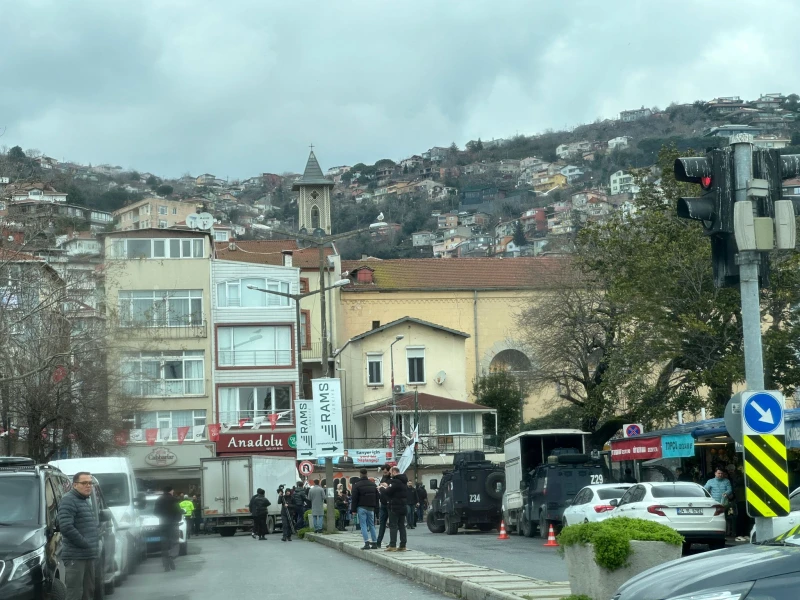

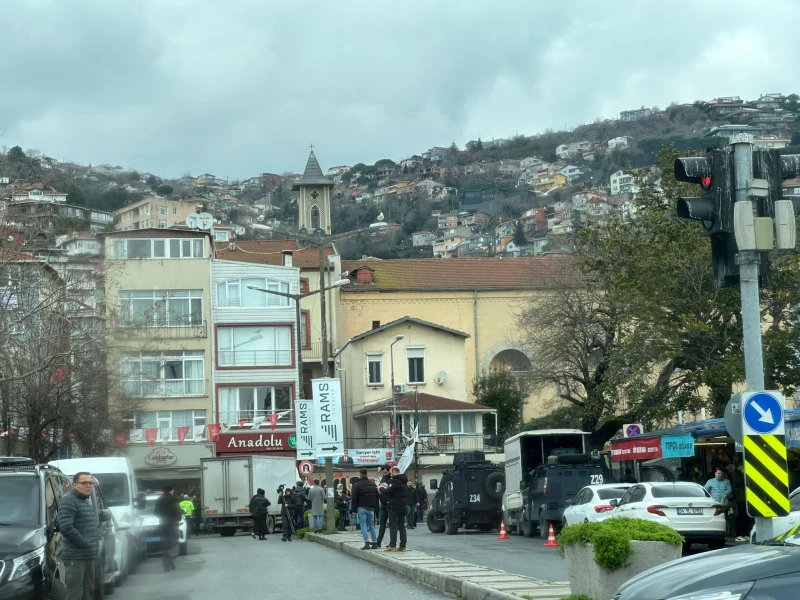
The scene outside a Catholic church in Istanbul, Turkey, where a reported armed attack took place on Jan. 28, 2024. / Credit: Rudolf Gehrig/EWTN
Washington, D.C. Newsroom, Nov 26, 2025 / 16:15 pm (CNA).
A Christian advocacy group’s report details “legal, institutional, and social hostility” toward Turkish Christians as Pope Leo XIV begins his six-day visit to Turkey and Lebanon Thursday.
The report from The European Centre for Law and Justice (ECLJ), titled “The Persecution of Christians in Turkey,” explores government interference against clergy and Christian entities, restrictions on foreign Christians who visit the country, and widespread social animosity toward the faithful, which sometimes includes direct violence.
“Communities that were once integral to the cultural, religious, and historical fabric of Anatolia have been reduced to a fragile remnant,” the authors state.
“Their disappearance is not the product of a single event but the cumulative result of restrictive legislation, administrative obstruction, property confiscations, denial of legal personality, and — more recently — arbitrary expulsions of clergy, missionaries, and converts,” they add.
Modern-day Turkey, which was governed by Christians prior to the Ottoman Empire invasions in late Middle Ages, is still home to about 257,000 Christians. In 1915, Christians still accounted for about 20% of the Turkish population, but the number has dwindled over the past century and they now account for less than 0.3% of the population.
Persecution of Christians
The report says hostility toward Christians is kept alive through environmental factors, such as Turkey’s refusal to recognize its past by continuing to deny the genocide of Armenians and other Christians during World War I.
At that time, about 1.5 million Armenians and 500,000 other Christians were forcibly deported or massacred, and Turkey’s criminalization of “insulting the Turkish nation” and “insulting Turkishness” is often enforced to quell speech about the historical events, according to the report.
It notes that politicians and state-run media frequently scapegoat Christians for societal issues and depict them as an external and internal threat, with one example being President Recep Tayyip Erdoğan referring to survivors of the genocide as “terrorists escaped from the sword” and another being the state-run Yeni Akit allegedly editing Wikipedia to smear Christians, Jews, and other groups.
In some cases, this hostility yields violence, including a 2024 terrorist attack on a Catholic church that killed one person, and other acts of violence and vandalism.
The report notes that Turkey signed the Treaty of Lausanne after the Armenian genocide, which granted people who believe some non-majority faiths full legal recognition and property rights.
Yet, a narrow interpretation of the treaty ensures “a national narrative that presents Sunni Islam as the primary marker of Turkish identity,” the report says. The treaty also fails to recognize all Christians, only giving a specific reference to Greek Orthodox, Armenian Apostolic Christians, and Jews, but not Catholics or Protestants, according to the report.
It states that Sunni Islam is often tied to Turkish identity in public education and the process to be exempt from compulsory Islamic education is burdensome for Christians not covered under the treaty.
No church holds legal personality as a religious institution, which means patriarchates, dioceses, and churches cannot “own property in their own name, initiate legal proceedings, employ staff, open bank accounts, or formally interact with public authorities,” the report states.
The government also interferes with religious leadership, prohibiting non-Turkish citizens from being elected as Ecumenical Patriarch, sitting on the Holy Synod, or participating in patriarchal elections in the Greek Orthodox Church. The government also regulates elections for leadership in the Armenian Apostolic Church.
Turkey shut down the Greek Orthodox Halki Seminary in 1971 and — despite promises to let it reopen — keeps it shut down, according to the report.
The report also says Turkey imposes legal constraints and administrative obstruction on Christian “community foundations,” which operate churches, schools, hospitals, and charitable institutions.
This includes blocking board elections and failing to enforce court orders. One of the more egregious violations is imposing “mazbut” trusteeship, which ends Christian institutions’ legal recognition and grants control to the government, which essentially confiscates property, the report said.
“These practices reveal a structural system designed to undermine the autonomy, continuity, and survival of Christian communities in Turkey,” the report states.
According to the report, foreign Protestant pastors are often expelled from seminaries. More broadly, it states that foreign missionaries and converts are often targeted as “national security” threats and frequently expelled from Turkey.
The authors encouraged Turkey to grant full legal recognition to all churches, halt interference in Christian organizations, protect places of worship, end arbitrary expulsions, and return property that has been confiscated.
Read More![Catholic advocates petition New York foundation to fund pensions, church preservation #Catholic
St. Joseph Cathedral, Buffalo, New York. / Credit: CiEll/Shutterstock
CNA Staff, Nov 20, 2025 / 10:40 am (CNA).
Advocates in New York state are petitioning a Catholic foundation there to help fund major pension shortages and church preservation efforts as well as to help support victims of clergy sex abuse.In a Nov. 13 letter to the Mother Cabrini Health Foundation in New York City, representatives of the group Save Our Buffalo Churches, sexual abuse victims, and pensioners of the former St. Clare’s Hospital asked the foundation to help the three communities with the “profound hardship” they are experiencing.Numerous parishes in Buffalo have been fighting diocesan-mandated closures and mergers over the past year. Hundreds of former workers of St. Clare’s, meanwhile, saw their pensions reduced or eliminated starting in 2018 due to major shortfalls. The hospital itself closed about a decade before.Abuse victims, meanwhile, have “been locked in a legal morass, denied the long-term healing resources and institutional acknowledgment of the harm they endured,” the letter said.The foundation arose in 2018 after the Diocese of Brooklyn sold the health insurer Fidelis Care. The organization, whose roughly $3.2 billion in assets came from that sale, is named after Mother Frances Xavier Cabrini, the first American recognized as a saint, who founded the Missionary Sisters of the Sacred Heart of Jesus.The letter noted that Cabrini “devoted her life to the people others overlooked,” including immigrants and the poor.“Guided by that legacy, we ask the foundation to explore emergency relief, stabilization funds, and community support initiatives” to help fund the three groups.The letter-writers asked for a meeting with foundation leaders “to explore potential pathways for assistance aligned with both the foundation’s mission and the pressing needs of survivors, pensioners, and parish communities.”Mary Pruski, who leads the Save Our Buffalo Churches group, told CNA that advocates in New York City would be following up with the foundation this week.“This is a complex project and will bring much peace and healing across [New York state],” she said.Pensioners with St. Clare’s Hospital are currently in the midst of a lawsuit brought by New York state against the Diocese of Albany for what the state attorney general’s office says was “[failure] to adequately fund, manage, and protect hospital employees’ hard-earned pensions.”The prosecutor’s office alleges that the diocese “[failed] to take adequate measures” to secure the pension fund, including “failing to make any annual contributions to the pension for all but two years from 2000 to 2019 and hiding the collapse of the pension plan from former hospital workers who were vested in the plan.”Parishioners in Buffalo, meanwhile, have challenged the diocesan parish merger and closure plan, with advocates securing a reprieve against the diocese at the state Supreme Court in July.The state high court ultimately tossed the lawsuit out in September, ruling that the court had no jurisdiction over the dispute.](http://unitedyam.com/wp-content/uploads/2025/11/catholic-advocates-petition-new-york-foundation-to-fund-pensions-church-preservation-catholic-st-joseph-cathedral-buffalo-new-york-credit-ciell-shutterstockcna-staff-nov-20-2025-10.webp)