Transition

Bishops discuss faith formation before National Catholic Youth Conference #Catholic 
 
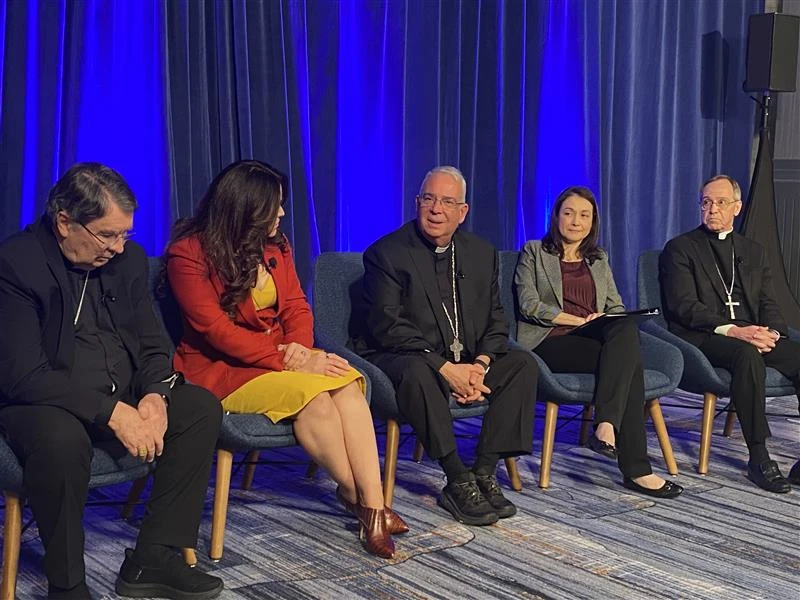
 Organizers of Pope Leo XIV’s upcoming digital dialogue with young people Nov. 21 at the National Catholic Youth Conference in Indianapolis speak to the media at the site of the United States Catholic Bishops’ Conference Fall Plenary Assembly in Baltimore on Nov. 12, 2025. Left to right: Cardinal Christophe Pierre, papal nuncio to the United States; Montse Alvarado, president and COO of EWTN News; Archbishop Nelson J. Pérez, Archdiocese of Philadelphia; Christina Lamas, executive director of National Federation for Catholic Youth Ministry; and Archbishop Charles Thompson, Archdiocese of Indianapolis. / Credit: Shannon Mullen/National Catholic Register

Baltimore, Maryland, Nov 17, 2025 / 07:00 am (CNA).
Bishops discussed young Catholics’ place in the Church ahead of the National Catholic Youth Conference.At the United States Conference of Catholic Bishops’ (USCCB) Fall Plenary Assembly in Baltimore, bishops spoke about the young generation as many prepare to attend NCYC. The conference will take place Nov. 20–22 in Indianapolis for prayer, community, evangelization, and service among Catholic teenagers.During NCYC, Pope Leo XIV will hold a digital dialogue with teens from across the nation. “When the pope speaks, he speaks to the world, and this will be a wonderful, wonderful moment. This encounter will engage young people in real time,” said Archbishop Nelson Pérez of Philadelphia. At a Nov. 12 press conference at the USCCB fall plenary, Pérez said “there is a deep significance to this encounter.” He added: “It reflects the Holy Father’s desire to connect with young people, with our youth, whom his predecessor … Pope Francis, called ‘the now of God.’”Pérez said during his time as a priest and bishop, he has noticed teenagers “want a place in the Church.” He said: “They want to be seen, heard, and valued, which is so beautiful ... They want to be loved by the Church.”“Even in today’s interconnected world, the Church can seem far away from young people. The Holy Father’s choice to encounter the American youth ... is an expression of his closeness to the youth of the world.”“This moment will mark a powerful opportunity for young people to witness the beauty of the universal Church with our Holy Father and to express their concerns, voices, experience, [and] what’s in their hearts,” Pérez said.Bishop Joseph Espaillat, auxiliary bishop for the Archdiocese of New York, has attended NCYC more than a dozen times. He told CNA “the energy and the vibrancy of the young people” is why he returns each year.“It’s not just the local parish or the local diocese, but it’s the national Church and there’s something powerful when we come together,” Espaillat said.​This year’s event is “the first time ever the Holy Father has a live online interview like this,” at NCYC, Espaillat said. “What I love about it is that the Church in the United States is leading right now. The young people being the focus with our Holy Father is going to be great, and it’s going to produce a lot of positive energy in our Church.”Espaillat encouraged attendees “to be open and allow yourself to be surprised by the Holy Spirit.” He added: “Don’t go in with a preconceived notion. It is a great event in which there are many, many fruits. I’ve seen young people just come to life at the event.”Youth draw closer to the ChurchAs thousands of teenagers plan to gather at the national conference, U.S. bishops further explained why so many young Catholics are looking to the Church. A number of bishops highlighted the Catholic presence on social media is helping to draw them in.Bishop William Byrne of Springfield, Massachusetts, told CNA the exponential growth of young Catholics coming to the Church is “amazing and exciting.” Byrne, who served as chair for the USCCB’s committee on communications, detailed how much its online presence has grown its outreach to the young generation and wider population. “Beginning with the illness of our beloved Pope Francis, through the funeral, and then the transition to Pope Leo, we’ve actually had a 226% growth in our social media on the four platforms we use — TikTok, Instagram, X, and YouTube,” he said.“The amazing thing is, it’s still growing. It means that people are seeing it, sharing it,” Byrne said. He specifically noted it’s the “young people” spreading the message online. “So we see that we are reaching people,” Byrne said. “But our goal is not to get people locked on their phones. Our goal is to get people locked on Jesus Christ and have the impression be Jesus Christ and his bride, the Church.”“This is an exciting time. It’s not without its challenges, but it’s also a wonderful opportunity,” Byrne said. “We’re reaching young people who are curious and hungry. It’s so exciting to see the Church continue to speak to the world, because the Church has never lost her relevance.”The start of the Catholic online presence followed the movement of the new atheists, Bishop Robert Barron of Winona-Rochester, Minnesota, said. He told CNA the movement was made up of “people who were really shaping the culture, saying: ‘There’s no purpose of life. We come from nowhere. We go nowhere. There’s no objective moral value.’”“A lot of people, myself included, began to get on social media with a religious voice,” Barron said. “People who had not heard a religious voice or who were disaffiliated … could find people like me and many others who were actually talking about God and about religion.”“But I think as a whole generation came of age, they realized what a desperately sad and empty message that is,” Barron said. “There’s this hunger in the heart for God, and so that just reasserts itself. I think a lot of younger people who were raised on this very vapid philosophy began to look to religion.”As more young Catholics get involved in youth formation whether in their parishes or at larger gatherings like NCYC, Barron said he encourages them to use the opportunities to “build community and build a sense of family with other believers.”Barron, who is the founder of the Catholic media organization Word on Fire, has gained nearly 3 million YouTube subscribers and millions of other followers across social media platforms. But, he said, “one drawback of social media is that it’s a little private world. It can be a lot of people accessing it, but privately.”“Maybe through social media an individual finds a path to religion, but then to look around a room and see thousands of other people that are on a similar path — that’s a great thing,” Barron said.

Bishops discuss faith formation before National Catholic Youth Conference #Catholic Organizers of Pope Leo XIV’s upcoming digital dialogue with young people Nov. 21 at the National Catholic Youth Conference in Indianapolis speak to the media at the site of the United States Catholic Bishops’ Conference Fall Plenary Assembly in Baltimore on Nov. 12, 2025. Left to right: Cardinal Christophe Pierre, papal nuncio to the United States; Montse Alvarado, president and COO of EWTN News; Archbishop Nelson J. Pérez, Archdiocese of Philadelphia; Christina Lamas, executive director of National Federation for Catholic Youth Ministry; and Archbishop Charles Thompson, Archdiocese of Indianapolis. / Credit: Shannon Mullen/National Catholic Register Baltimore, Maryland, Nov 17, 2025 / 07:00 am (CNA). Bishops discussed young Catholics’ place in the Church ahead of the National Catholic Youth Conference.At the United States Conference of Catholic Bishops’ (USCCB) Fall Plenary Assembly in Baltimore, bishops spoke about the young generation as many prepare to attend NCYC. The conference will take place Nov. 20–22 in Indianapolis for prayer, community, evangelization, and service among Catholic teenagers.During NCYC, Pope Leo XIV will hold a digital dialogue with teens from across the nation. “When the pope speaks, he speaks to the world, and this will be a wonderful, wonderful moment. This encounter will engage young people in real time,” said Archbishop Nelson Pérez of Philadelphia. At a Nov. 12 press conference at the USCCB fall plenary, Pérez said “there is a deep significance to this encounter.” He added: “It reflects the Holy Father’s desire to connect with young people, with our youth, whom his predecessor … Pope Francis, called ‘the now of God.’”Pérez said during his time as a priest and bishop, he has noticed teenagers “want a place in the Church.” He said: “They want to be seen, heard, and valued, which is so beautiful … They want to be loved by the Church.”“Even in today’s interconnected world, the Church can seem far away from young people. The Holy Father’s choice to encounter the American youth … is an expression of his closeness to the youth of the world.”“This moment will mark a powerful opportunity for young people to witness the beauty of the universal Church with our Holy Father and to express their concerns, voices, experience, [and] what’s in their hearts,” Pérez said.Bishop Joseph Espaillat, auxiliary bishop for the Archdiocese of New York, has attended NCYC more than a dozen times. He told CNA “the energy and the vibrancy of the young people” is why he returns each year.“It’s not just the local parish or the local diocese, but it’s the national Church and there’s something powerful when we come together,” Espaillat said.​This year’s event is “the first time ever the Holy Father has a live online interview like this,” at NCYC, Espaillat said. “What I love about it is that the Church in the United States is leading right now. The young people being the focus with our Holy Father is going to be great, and it’s going to produce a lot of positive energy in our Church.”Espaillat encouraged attendees “to be open and allow yourself to be surprised by the Holy Spirit.” He added: “Don’t go in with a preconceived notion. It is a great event in which there are many, many fruits. I’ve seen young people just come to life at the event.”Youth draw closer to the ChurchAs thousands of teenagers plan to gather at the national conference, U.S. bishops further explained why so many young Catholics are looking to the Church. A number of bishops highlighted the Catholic presence on social media is helping to draw them in.Bishop William Byrne of Springfield, Massachusetts, told CNA the exponential growth of young Catholics coming to the Church is “amazing and exciting.” Byrne, who served as chair for the USCCB’s committee on communications, detailed how much its online presence has grown its outreach to the young generation and wider population. “Beginning with the illness of our beloved Pope Francis, through the funeral, and then the transition to Pope Leo, we’ve actually had a 226% growth in our social media on the four platforms we use — TikTok, Instagram, X, and YouTube,” he said.“The amazing thing is, it’s still growing. It means that people are seeing it, sharing it,” Byrne said. He specifically noted it’s the “young people” spreading the message online. “So we see that we are reaching people,” Byrne said. “But our goal is not to get people locked on their phones. Our goal is to get people locked on Jesus Christ and have the impression be Jesus Christ and his bride, the Church.”“This is an exciting time. It’s not without its challenges, but it’s also a wonderful opportunity,” Byrne said. “We’re reaching young people who are curious and hungry. It’s so exciting to see the Church continue to speak to the world, because the Church has never lost her relevance.”The start of the Catholic online presence followed the movement of the new atheists, Bishop Robert Barron of Winona-Rochester, Minnesota, said. He told CNA the movement was made up of “people who were really shaping the culture, saying: ‘There’s no purpose of life. We come from nowhere. We go nowhere. There’s no objective moral value.’”“A lot of people, myself included, began to get on social media with a religious voice,” Barron said. “People who had not heard a religious voice or who were disaffiliated … could find people like me and many others who were actually talking about God and about religion.”“But I think as a whole generation came of age, they realized what a desperately sad and empty message that is,” Barron said. “There’s this hunger in the heart for God, and so that just reasserts itself. I think a lot of younger people who were raised on this very vapid philosophy began to look to religion.”As more young Catholics get involved in youth formation whether in their parishes or at larger gatherings like NCYC, Barron said he encourages them to use the opportunities to “build community and build a sense of family with other believers.”Barron, who is the founder of the Catholic media organization Word on Fire, has gained nearly 3 million YouTube subscribers and millions of other followers across social media platforms. But, he said, “one drawback of social media is that it’s a little private world. It can be a lot of people accessing it, but privately.”“Maybe through social media an individual finds a path to religion, but then to look around a room and see thousands of other people that are on a similar path — that’s a great thing,” Barron said.


Organizers of Pope Leo XIV’s upcoming digital dialogue with young people Nov. 21 at the National Catholic Youth Conference in Indianapolis speak to the media at the site of the United States Catholic Bishops’ Conference Fall Plenary Assembly in Baltimore on Nov. 12, 2025. Left to right: Cardinal Christophe Pierre, papal nuncio to the United States; Montse Alvarado, president and COO of EWTN News; Archbishop Nelson J. Pérez, Archdiocese of Philadelphia; Christina Lamas, executive director of National Federation for Catholic Youth Ministry; and Archbishop Charles Thompson, Archdiocese of Indianapolis. / Credit: Shannon Mullen/National Catholic Register

Baltimore, Maryland, Nov 17, 2025 / 07:00 am (CNA).

Bishops discussed young Catholics’ place in the Church ahead of the National Catholic Youth Conference.

At the United States Conference of Catholic Bishops’ (USCCB) Fall Plenary Assembly in Baltimore, bishops spoke about the young generation as many prepare to attend NCYC. The conference will take place Nov. 20–22 in Indianapolis for prayer, community, evangelization, and service among Catholic teenagers.

During NCYC, Pope Leo XIV will hold a digital dialogue with teens from across the nation. “When the pope speaks, he speaks to the world, and this will be a wonderful, wonderful moment. This encounter will engage young people in real time,” said Archbishop Nelson Pérez of Philadelphia. 

At a Nov. 12 press conference at the USCCB fall plenary, Pérez said “there is a deep significance to this encounter.” He added: “It reflects the Holy Father’s desire to connect with young people, with our youth, whom his predecessor … Pope Francis, called ‘the now of God.’”

Pérez said during his time as a priest and bishop, he has noticed teenagers “want a place in the Church.” He said: “They want to be seen, heard, and valued, which is so beautiful … They want to be loved by the Church.”

“Even in today’s interconnected world, the Church can seem far away from young people. The Holy Father’s choice to encounter the American youth … is an expression of his closeness to the youth of the world.”

“This moment will mark a powerful opportunity for young people to witness the beauty of the universal Church with our Holy Father and to express their concerns, voices, experience, [and] what’s in their hearts,” Pérez said.

Bishop Joseph Espaillat, auxiliary bishop for the Archdiocese of New York, has attended NCYC more than a dozen times. He told CNA “the energy and the vibrancy of the young people” is why he returns each year.

“It’s not just the local parish or the local diocese, but it’s the national Church and there’s something powerful when we come together,” Espaillat said.

​This year’s event is “the first time ever the Holy Father has a live online interview like this,” at NCYC, Espaillat said. “What I love about it is that the Church in the United States is leading right now. The young people being the focus with our Holy Father is going to be great, and it’s going to produce a lot of positive energy in our Church.”

Espaillat encouraged attendees “to be open and allow yourself to be surprised by the Holy Spirit.” He added: “Don’t go in with a preconceived notion. It is a great event in which there are many, many fruits. I’ve seen young people just come to life at the event.”

Youth draw closer to the Church

As thousands of teenagers plan to gather at the national conference, U.S. bishops further explained why so many young Catholics are looking to the Church. A number of bishops highlighted the Catholic presence on social media is helping to draw them in.

Bishop William Byrne of Springfield, Massachusetts, told CNA the exponential growth of young Catholics coming to the Church is “amazing and exciting.” Byrne, who served as chair for the USCCB’s committee on communications, detailed how much its online presence has grown its outreach to the young generation and wider population. 

“Beginning with the illness of our beloved Pope Francis, through the funeral, and then the transition to Pope Leo, we’ve actually had a 226% growth in our social media on the four platforms we use — TikTok, Instagram, X, and YouTube,” he said.

“The amazing thing is, it’s still growing. It means that people are seeing it, sharing it,” Byrne said. He specifically noted it’s the “young people” spreading the message online. 

“So we see that we are reaching people,” Byrne said. “But our goal is not to get people locked on their phones. Our goal is to get people locked on Jesus Christ and have the impression be Jesus Christ and his bride, the Church.”

“This is an exciting time. It’s not without its challenges, but it’s also a wonderful opportunity,” Byrne said. “We’re reaching young people who are curious and hungry. It’s so exciting to see the Church continue to speak to the world, because the Church has never lost her relevance.”

The start of the Catholic online presence followed the movement of the new atheists, Bishop Robert Barron of Winona-Rochester, Minnesota, said. He told CNA the movement was made up of “people who were really shaping the culture, saying: ‘There’s no purpose of life. We come from nowhere. We go nowhere. There’s no objective moral value.’”

“A lot of people, myself included, began to get on social media with a religious voice,” Barron said. “People who had not heard a religious voice or who were disaffiliated … could find people like me and many others who were actually talking about God and about religion.”

“But I think as a whole generation came of age, they realized what a desperately sad and empty message that is,” Barron said. “There’s this hunger in the heart for God, and so that just reasserts itself. I think a lot of younger people who were raised on this very vapid philosophy began to look to religion.”

As more young Catholics get involved in youth formation whether in their parishes or at larger gatherings like NCYC, Barron said he encourages them to use the opportunities to “build community and build a sense of family with other believers.”

Barron, who is the founder of the Catholic media organization Word on Fire, has gained nearly 3 million YouTube subscribers and millions of other followers across social media platforms. But, he said, “one drawback of social media is that it’s a little private world. It can be a lot of people accessing it, but privately.”

“Maybe through social media an individual finds a path to religion, but then to look around a room and see thousands of other people that are on a similar path — that’s a great thing,” Barron said.

Read More

U.S. bishops urge world leaders to address climate change at upcoming conference #Catholic 
 
 null / Credit: Harvepino/Shutterstock

Washington, D.C. Newsroom, Nov 4, 2025 / 17:47 pm (CNA).
U.S. bishops and other Catholic leaders are offering “prayers of support and solidarity” for world leaders who will discuss climate change and other environmental matters at an upcoming conference.The 30th annual United Nations Climate Change Conference (COP30) is scheduled for Nov. 10–21 in Belém, Brazil. World leaders, scientists, and representatives from civil society will discuss ways to implement solutions to combat climate change and form new national action plans. Archbishop Borys Gudziak, chair of the United States Conference of Catholic Bishops’ (USCCB) Committee on Domestic Justice and Human Development; Bishop A. Elias Zaidan, chair of the Committee on International Justice and Peace; and Sean Callahan, CEO of Catholic Relief Services (CRS), are calling for “urgent, courageous action to protect God’s creation and people.” “This year’s COP30 convenes while the Catholic Church celebrates the Jubilee Year of Hope,” the leaders said in a Nov. 4 statement. It is “a sacred opportunity to restore relationships and renew creation at a time when the gift of life is under grave threat.”“Pope Leo XIV called for the participants of COP30 to ‘listen to the cry of the Earth and the cry of the poor, families, Indigenous peoples, involuntary migrants and believers throughout the world,’” the leaders said.“Climate change, biodiversity loss, and environmental degradation are devastating communities already burdened by poverty and exclusion. Farming and fishing families confront threats to their livelihoods; Indigenous peoples face destruction of their ancestral lands; children’s health, safety, and futures are at risk,” the statement said.“A decade ago, in Laudato Si’, Pope Francis reminded us that the climate is a common good, belonging to all and meant for all, and that intergenerational solidarity is not optional,” the statement said. “Failing to steward God’s creation ignores our responsibility as one human family.”The leaders are calling on world leaders to act “urgently” to implement the Paris Agreement, a 2015 international treaty to limit global warming that “protects God’s creation and people.”The leaders asked that countries and civil society organizations recommit to implementation that fosters economic opportunities, commits to efforts that reduce climate warming emissions, and pledges loss and damage financing that guarantees priority and direct access to vulnerable communities. They also asked that they ensure a just transition to a sustainable economy centered on workers, communities, and creation and make financing for climate solutions timely and transparent while also upholding human dignity.“As all of us are impacted, so must we all be responsible for addressing this global challenge,” the leaders said. “Together, these actions can work towards integral ecology and ‘give priority to the poor and marginalized in the process.’”

U.S. bishops urge world leaders to address climate change at upcoming conference #Catholic null / Credit: Harvepino/Shutterstock Washington, D.C. Newsroom, Nov 4, 2025 / 17:47 pm (CNA). U.S. bishops and other Catholic leaders are offering “prayers of support and solidarity” for world leaders who will discuss climate change and other environmental matters at an upcoming conference.The 30th annual United Nations Climate Change Conference (COP30) is scheduled for Nov. 10–21 in Belém, Brazil. World leaders, scientists, and representatives from civil society will discuss ways to implement solutions to combat climate change and form new national action plans. Archbishop Borys Gudziak, chair of the United States Conference of Catholic Bishops’ (USCCB) Committee on Domestic Justice and Human Development; Bishop A. Elias Zaidan, chair of the Committee on International Justice and Peace; and Sean Callahan, CEO of Catholic Relief Services (CRS), are calling for “urgent, courageous action to protect God’s creation and people.” “This year’s COP30 convenes while the Catholic Church celebrates the Jubilee Year of Hope,” the leaders said in a Nov. 4 statement. It is “a sacred opportunity to restore relationships and renew creation at a time when the gift of life is under grave threat.”“Pope Leo XIV called for the participants of COP30 to ‘listen to the cry of the Earth and the cry of the poor, families, Indigenous peoples, involuntary migrants and believers throughout the world,’” the leaders said.“Climate change, biodiversity loss, and environmental degradation are devastating communities already burdened by poverty and exclusion. Farming and fishing families confront threats to their livelihoods; Indigenous peoples face destruction of their ancestral lands; children’s health, safety, and futures are at risk,” the statement said.“A decade ago, in Laudato Si’, Pope Francis reminded us that the climate is a common good, belonging to all and meant for all, and that intergenerational solidarity is not optional,” the statement said. “Failing to steward God’s creation ignores our responsibility as one human family.”The leaders are calling on world leaders to act “urgently” to implement the Paris Agreement, a 2015 international treaty to limit global warming that “protects God’s creation and people.”The leaders asked that countries and civil society organizations recommit to implementation that fosters economic opportunities, commits to efforts that reduce climate warming emissions, and pledges loss and damage financing that guarantees priority and direct access to vulnerable communities. They also asked that they ensure a just transition to a sustainable economy centered on workers, communities, and creation and make financing for climate solutions timely and transparent while also upholding human dignity.“As all of us are impacted, so must we all be responsible for addressing this global challenge,” the leaders said. “Together, these actions can work towards integral ecology and ‘give priority to the poor and marginalized in the process.’”


null / Credit: Harvepino/Shutterstock

Washington, D.C. Newsroom, Nov 4, 2025 / 17:47 pm (CNA).

U.S. bishops and other Catholic leaders are offering “prayers of support and solidarity” for world leaders who will discuss climate change and other environmental matters at an upcoming conference.

The 30th annual United Nations Climate Change Conference (COP30) is scheduled for Nov. 10–21 in Belém, Brazil. World leaders, scientists, and representatives from civil society will discuss ways to implement solutions to combat climate change and form new national action plans. 

Archbishop Borys Gudziak, chair of the United States Conference of Catholic Bishops’ (USCCB) Committee on Domestic Justice and Human Development; Bishop A. Elias Zaidan, chair of the Committee on International Justice and Peace; and Sean Callahan, CEO of Catholic Relief Services (CRS), are calling for “urgent, courageous action to protect God’s creation and people.” 

“This year’s COP30 convenes while the Catholic Church celebrates the Jubilee Year of Hope,” the leaders said in a Nov. 4 statement. It is “a sacred opportunity to restore relationships and renew creation at a time when the gift of life is under grave threat.”

“Pope Leo XIV called for the participants of COP30 to ‘listen to the cry of the Earth and the cry of the poor, families, Indigenous peoples, involuntary migrants and believers throughout the world,’” the leaders said.

“Climate change, biodiversity loss, and environmental degradation are devastating communities already burdened by poverty and exclusion. Farming and fishing families confront threats to their livelihoods; Indigenous peoples face destruction of their ancestral lands; children’s health, safety, and futures are at risk,” the statement said.

“A decade ago, in Laudato Si’, Pope Francis reminded us that the climate is a common good, belonging to all and meant for all, and that intergenerational solidarity is not optional,” the statement said. “Failing to steward God’s creation ignores our responsibility as one human family.”

The leaders are calling on world leaders to act “urgently” to implement the Paris Agreement, a 2015 international treaty to limit global warming that “protects God’s creation and people.”

The leaders asked that countries and civil society organizations recommit to implementation that fosters economic opportunities, commits to efforts that reduce climate warming emissions, and pledges loss and damage financing that guarantees priority and direct access to vulnerable communities. 

They also asked that they ensure a just transition to a sustainable economy centered on workers, communities, and creation and make financing for climate solutions timely and transparent while also upholding human dignity.

“As all of us are impacted, so must we all be responsible for addressing this global challenge,” the leaders said. “Together, these actions can work towards integral ecology and ‘give priority to the poor and marginalized in the process.’”

Read More