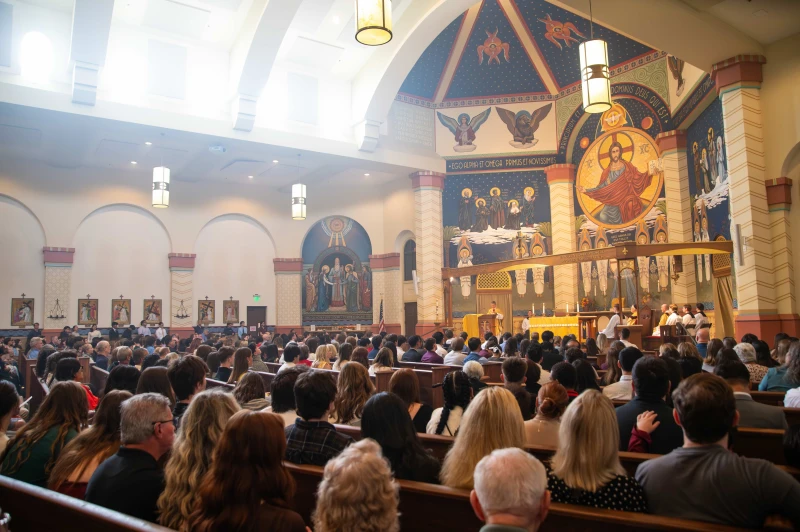

Mass at Arizona State University’s Newman Center chapel. / Credit: Photo courtesy of Father Bill Clements, director of ASU Newman Center
Ann Arbor, Michigan, Dec 15, 2025 / 07:00 am (CNA).
Several college campuses across the country are witnessing a notable rise in baptisms and confirmations among students. Catholic evangelists tell CNA that this growth reflects a deepening desire among young adults for certainty, stability, and faith amid today’s turbulent cultural landscape.
For example, at Arizona State University, the Newman Center is experiencing its largest group of students entering the Church. Ryan Ayala, a former seminarian and campus minister who has served at ASU for three years, oversees the evangelization efforts.
“This past semester, we welcomed 52 students into the Church at Christ the King Parish” in Mesa, Ayala said. “And we are expecting 50 more for the Easter Vigil this spring.” According to Ayala, this year marked a record number of students received into the Catholic Church at ASU.
Each year, ASU’s campus ministry prepares students for baptism, confirmation, and full communion through a fall vigil held in collaboration with Christ the King Parish. Students enter the Church from a wide range of backgrounds: Some encounter Christianity for the first time, others come from Protestant communities, and still others are baptized Catholics preparing to complete their sacraments.

This year’s group included eight catechumens who were baptized, 26 Christians who made affirmations of faith, and a significant number of Catholics who received confirmation. The ceremony took place on the feast of Christ the King, Nov. 23.
Ayala attributes the growth in part to simple, consistent outreach. “No phone call goes unanswered,” he said. Students come from Lutheran, Methodist, Presbyterian, and nondenominational evangelical backgrounds. Those not yet baptized often come from nonreligious homes, and two identified as atheists. One Muslim student is expected to join the program in January. ASU enrolls approximately 200,000 students.
Overall, participation in ASU’s OCIA (Order of Christian Initiation of Adults) program has more than doubled. “This is by far the biggest class we’ve had,” Ayala said.
Supporting this expansion are missionaries from the Fellowship of Catholic University Students (FOCUS), who lead Bible studies and accompany students in their growing faith. Ayala supervises the missionaries and has completed FOCUS formation himself. The Newman Center offers a focused nine-week OCIA process — shorter than the traditional yearlong program — requiring weekly sessions alongside FOCUS Bible studies.
Reflecting on the surge of interest, Ayala sees both cultural and pastoral dynamics at work. “Two things are going on in this surge. There’s a trend in Gen Z. They are asking deeper, philosophical, and theological questions. Some students were shaken up by the shooting of Charlie Kirk. The other thing is simply responding to emails. I ask my staff to be diligent to inquirers. The most important thing is to respond and give them clarity about how to become Catholic.”
“Our main strategy is to have an urgency to respond to them,” he added. “It was so moving to see all those students from other faith traditions stand up and make the commitment to become Catholic.”
Ayala also noted the role of Catholic media, highlighting one student influenced by Father Mike Schmitz’s online ministry. He further praised the spiritual guidance of Father Bill Clements, who leads the Newman Center. “He does a great job humanizing the priesthood but also removing a lot of the anxieties that newcomers to the faith may have.”
Clements, who has directed the Newman Center for 15 years, reports that about 400 students participate in weekly FOCUS Bible studies, and approximately 1,500 attend one of the six weekend Masses. He said he has seen a clear shift in the past two years.
“In the last two years, a switch was flipped. I think people are tired of crazy. They’re hungry for some direction, truth, goodness, and beauty. We have one of the most beautiful Newman chapels in the country,” he said, “and that has been a huge attraction.”
To meet the growing demand, Clements expanded the OCIA schedule. “I revamped the OCIA process here. When people would hit me up at this time of year, I would have to tell them that we start that in the fall. But I couldn’t stand making people wait. So now I have three sessions: fall, spring, and summer.”
He credited FOCUS missionaries for their close accompaniment of students. “They appeal to students. It affords students a chance to connect with other Catholics, and it’s been instrumental in reviving interest in the Church. The missionaries work hard,” he said.
One student, Yailen Cho, received baptism and confirmation on Nov. 23 at the ASU Newman Chapel. She told CNA: “I didn’t grow up very religious at all. My dad became Catholic two years ago, but I didn’t have any religious background.”
Cho now regularly attends Mass and says the FOCUS program helped deepen her reading of the Gospels. Reflecting on her journey, she shared: “I’d had a prayer relationship with God for a while, and I had prayed that my heart would be softened towards God.”
After wrestling with questions of faith, she reached out to the Newman Center, which she said she found “very warm and welcoming.”
Directing a message to others considering the Catholic faith, she said: “I want everyone to be happy, and I want to be happy. If you live by the Word, as the Bible says, you can be happy in heaven forever.”
Meanwhile, in Michigan and Nebraska
Similar momentum is evident at the University of Michigan in Ann Arbor. Rita Zyber, OCIA coordinator at St. Mary Student Parish, said 50 students are currently preparing to enter the Church. Last Easter, 30 students were received, compared with about 20 in 2024.
With daily liturgies and seven weekend Masses, the parish remains consistently full. One Mass was added this year to accommodate greater attendance. “They are packed,” Zyber said.
Reflecting on the increase, she noted: “There is so much chaos in the world. They are looking for structure, stability, and some grounding in God.”
The parish is staffed by Jesuit priests whose Ignatian spirituality resonates strongly with students, Zyber said. She added that other campus and parish OCIA programs across Michigan are seeing similar growth.
In a report last month in the National Catholic Register, CNA’s sister news partner, Father Ryan Kaup, pastor of St. Thomas Aquinas Church and Newman Center at the University of Nebraska-Lincoln, characterized the current situation as “a golden age of campus ministry.”
Kaup reported that this past spring, 72 converts entered the Church at the Easter Vigil. So far this semester, they already have 125 students interested in joining the Church, he said.
Read More



![What is ‘papal infallibility?’ CNA explains an often-misunderstood Church teaching #Catholic
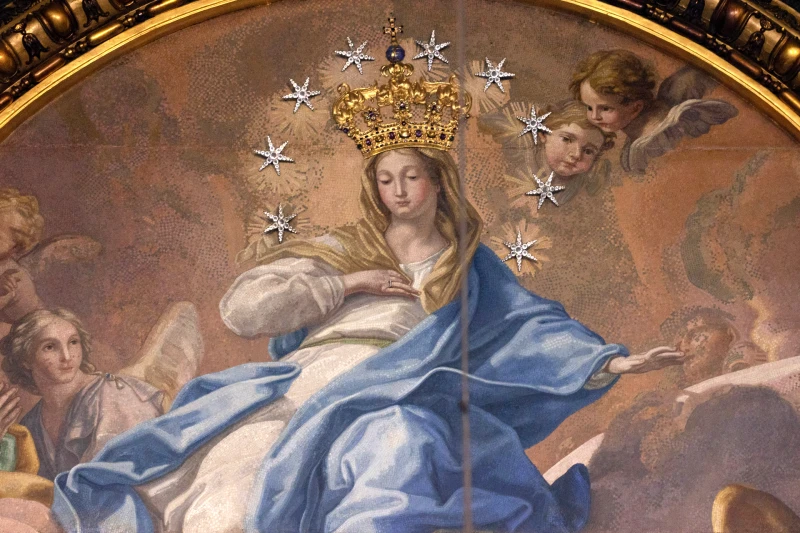
When Pope Pius IX declared the doctrine of the Immaculate Conception of the Virgin Mary on Dec. 8, 1854, he had a golden crown added to the mosaic of Mary, Virgin Immaculate, in the Chapel of the Choir in St. Peter’s Basilica. / Credit: Daniel Ibañez/CNA
CNA Staff, Dec 8, 2025 / 06:00 am (CNA).
On Dec. 8 the Catholic Church celebrates the solemnity of the Immaculate Conception — a paramount feast in the Church’s liturgical calendar and one that indirectly touches on a regularly misunderstood but important piece of Church dogma.The solemnity is the patronal feast of the United States and marks the recognition of the Blessed Mother’s freedom from original sin, which the Church teaches she was granted from the moment of conception.The Catechism of the Catholic Church states that Mary was “redeemed from the moment of her conception” (No. 491) in order “to be able to give the free assent of her faith to the announcement of her vocation” (No. 490). The dogma was disputed and challenged by Protestants over the centuries, leading Pope Pius IX to affirm it in his 1854 encyclical Ineffabilis Deus, stating unequivocally that Mary “was endowed with the grace of the Holy Spirit and preserved from original sin” upon her conception. Ineffabilis Deus is among the papal pronouncements that theologians have long considered to be “infallible.” But what does papal infallibility mean in the context and history of the Church?Defined by First Vatican Council in 1870Though Church historians argue that numerous papal statements down through the centuries can potentially be regarded as infallible under this teaching, the concept itself was not fully defined by the Church until the mid-19th century.In its first dogmatic constitution on the Church of Christ, Pastor Aeternus, the First Vatican Council held that the pope, when speaking “in the exercise of his office as shepherd and teacher of all Christians, in virtue of his supreme apostolic authority,” and while defining “a doctrine concerning faith or morals to be held by the whole Church,” possesses the infallibility that Jesus “willed his Church to enjoy in defining doctrine concerning faith or morals.”Father Patrick Flanagan, an associate professor of theology at St. John’s University, told CNA that the doctrine of papal infallibility “does not concern the pope’s character.”“The pope is human,” Flanagan said. “In other words, he is fallible. He can sin and err in what he says about everyday matters.”Yet in “rare historical, narrowly defined moments” when the pope “exercises his authority as the supreme teacher of the Church of the Petrine office” and speaks “ex cathedra,” he is guided by the Holy Spirit to speak “indisputable truth” about faith and morals, Flanagan said. Flanagan underscored the four specific criteria that a papal statement must make to be considered infallible. For one, the pope must speak “in his official capacity as supreme pontiff,” not off-the-cuff or informally. The doctrine, meanwhile, must concern a matter of faith or morals. “No pope would speak ex cathedra on scientific, economic, or other nonreligious subjects,” Flanagan said. The statement must also be “explicitly straightforward and definitive,” he said, and it “must be intended to bind the whole Church as a matter of divine and Roman Catholic faith.” John P. Joy, a professor of theology and the dean of faculty at St. Ambrose Academy in Madison, Wisconsin, told CNA that the doctrine can be identified in part by the reading of Matthew 16:19.In that passage, Christ tells Peter, the first pope: “I will give you the keys to the kingdom of heaven. Whatever you bind on earth shall be bound in heaven, and whatever you loose on earth shall be loosed in heaven.”“Part of what Jesus is promising here is that he will endorse and ratify in heaven all of the judgments that Peter makes on earth,” Joy said. “So when Peter (or one of his successors) turns the key, so to speak, that is, when he explicitly declares that all Catholics are bound to believe something on earth, then we have the words of Jesus assuring us that God himself will hold us bound to believe the same thing in heaven,” he said. Though the concept of papal infallibility is well known and has become something of a pop culture reference, the number of times a pope has declared something infallibly appears to be relatively small. Theologians and historians do not always agree on what papal statements through the centuries can be deemed infallible. Joy pointed to the Immaculate Conception, as well as Pope Pius XII’s declaration on the Assumption of the Blessed Virgin in 1950, as two of the most well known.He pointed to numerous other statements, such as Pope Benedict XII’s Benedictus Deus from 1336 and Pope Leo X’s Exsurge Domine in 1520, as infallible statements. Flanagan pointed out that there is “no official list” of papally infallible statements. Such declarations are “rare,” he said. “A pope invokes his extraordinary magisterial powers sparingly.” When Catholics trust a papally infallible statement, Joy stressed, they “are not putting [their] faith in the pope as if he were an oracle of truth or a source of divine revelation.” “We are rather putting our faith in God, whom we firmly believe will intervene in order to stop any pope who might be tempted to proclaim a false doctrine in a definitive way,” he said.](http://unitedyam.com/wp-content/uploads/2025/12/what-is-papal-infallibility-cna-explains-an-often-misunderstood-church-teaching-catholic-when-pope-pius-ix-declared-the-doctrine-of-the-immaculate-conception-of-the-virgin-mary.webp)




![10,000 pro-lifers join LIFE Runners annual relay across the U.S. #Catholic
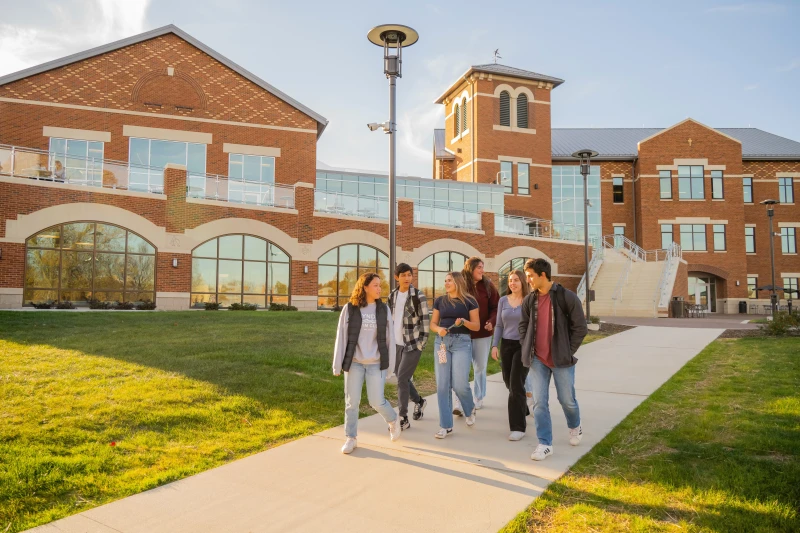
Finish line of the A-Cross America Relay, hosted by Benedictine College in Atchison, Kansas. / Credit: Photo courtesy of LIFE Runners.
CNA Staff, Nov 1, 2025 / 05:55 am (CNA).
A pro-life relay with more than 10,000 participants came to a joyful conclusion in Kansas last Saturday after runners made the shape of a cross as they ran across the U.S.The 5,124 mile “A-Cross America Relay,” organized by pro-life group LIFE Runners, kicked off in September in four cities around the country and ended at Benedictine College in Atchison, Kansas on Oct. 25.The starting points were San Francisco, California; New York City, New York; Austin, Texas; and Fargo, North Dakota, but participants around the world also joined to witness to life in their own nations. The San Francisco kickoff of the A-Cross America Relay began at Star of the Sea Church with students from Stella Maris Academy. Credit: Photo courtesy of LIFE Runners.With more than 25,000 “teammates” in nearly 4,000 cities across 50 countries, LIFE Runners aim to raise awareness for unborn children during their annual relay. Patrick Castle, president and founder of LIFE Runners, spoke with CNA about what inspires participants to run for the unborn. CNA: What inspires the mission of LIFE Runners? Castle: LIFE Runners is inspired by the obvious responsibility of Christians to reach the youth, pregnant mothers, fathers, and influencers with God's love and the truth that abortion isn't a solution to anything, it is the greatest problem, the greatest evil by definition, by the numbers. Abortion claims more American lives in one year than all combat casualties in the history of America. With the 250th anniversary of our country next year, may we reflect on who we are as Americans and as Christians. We are people who stand for God and His gifts of life and liberty. Amen!How does the relay help raise awareness for the unborn?Castle: The LIFE Runners A-Cross America Relay helps raise awareness for the unborn through our public witness [of] wearing “REMEMBER The Unborn” shirts. Eighty-two percent of post-abortion mothers said if they had encountered one supportive person or encouraging message, they would have chosen life. For example, two mothers saw our “REMEMBER The Unborn” witness outside of the Omaha Planned Parenthood, asked for help, and chose life. New York City kickoff for the A-Cross America Relay. Participants prayed and then walked with the big “REMEMBER The Unborn” banner to the Father Francis Duffy statue in Times Square. Credit: Photo courtesy of LIFE Runners.Thousands of people witnessed thousands of LIFE Runners wearing "REMEMBER The Unborn" shirts across America and around the world during the 5,124 mile relay that made a cross over America. With access to abortion in the mail and across state lines, LIFE Runners wear life-saving messages everywhere to inspire a culture of life at work, school, walking, running, grocery store; everywhere! What stood out to you from the finish line relay at Benedictine College in Atchison, Kansas? Castle: I am so encouraged by the authentic, Catholic, pro-life identity of Benedictine College … While running up the hill, students invited other students to join us, like a scene out of the "Rocky" movie when the local community joined him on a training run. The last mile ended on the main campus drive with President [Stephen] Minnis leading a large crowd with cheering. The finish was immediately followed by a beautiful prayer from Archbishop [Joseph]Naumann.What is the significance of having a national relay across the United States? Castle: The significance of having a relay that makes a cross over America is unity. [The relay] connects everyone in a pro-God way, allowing faith and light to overcome the darkness to end abortion — all in Christ for pro-life! Teammates in other countries adopt segments, knowing that America can and should lead the way in ending abortion around the world. The relay is an inspiring light for the world. The cross is the greatest symbol of love, bringing hope that life will prevail!The North arm kickoff of the A-Cross America Relay in Fargo, North Dakota. NDSU Newman Center students helped launch the north arm with a 2.7 mile prayerful witness walk. Credit: Photo courtesy of LIFE Runners.](http://unitedyam.com/wp-content/uploads/2025/11/10000-pro-lifers-join-life-runners-annual-relay-across-the-u-s-catholic-finish-line-of-the-a-cross-america-relay-hosted-by-benedictine-college-in-atchison-kansas-credit-photo-courtesy-of.webp)