Visit

Christmas 2025: Handmade gifts from 14 Catholic monasteries #Catholic 
 
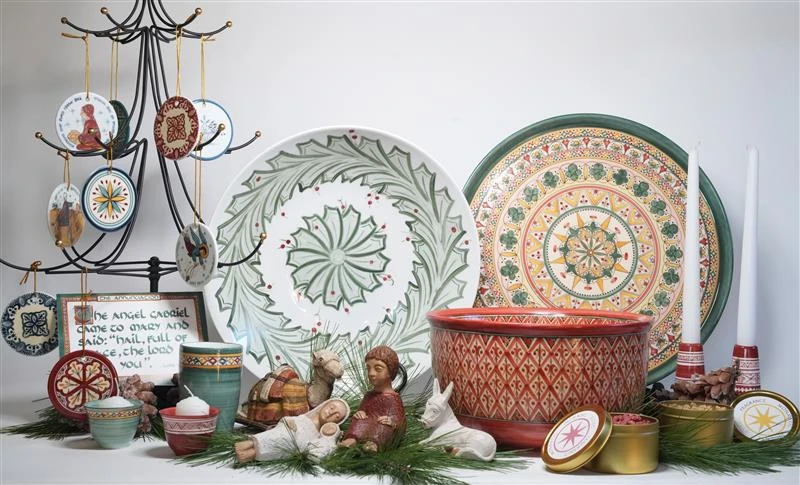
 The contemplative Sisters of the Monastery of Bethlehem in Livingston Manor, New York, support themselves by offering their hand-painted chinaware and other unique gifts for sale. / Credit: Monastery of Bethlehem

Washington, D.C. Newsroom, Dec 6, 2025 / 06:00 am (CNA).
Many monasteries and communities of religious brothers and sisters depend on proceeds from the sales of their products to sustain their lives of prayer and service throughout the year. These days, most have online gift shops that will ship your purchases to arrive before Christmas.Here’s a guide to some of our favorite handmade gifts to give and receive this year:Fudge and candyMonk Bakery Gifts, Monastery of the Holy Spirit: Monks in Conyers, Georgia, make their famous fudge with premium chocolate and real butter. Try a 12-ounce gift box for . And for a taste of Georgia, try their Southern Touch fudge, “made with real peach morsels, pecans, and a touch of peach brandy.”Monastery Candy, Our Lady of the Mississippi Abbey: These contemplative nuns in Dubuque, Iowa, are known for their delicious caramels, which they make by hand to support their way of life. A 9-ounce box of chocolate-covered caramels sells for .55.Monastery Creamed Honey, Holy Cross Abbey: The monks at Our Lady of the Holy Cross Abbey in Berryville, Virginia, support themselves financially through their own labor, a characteristic of the Cistercian order’s way of life. Their 100% natural Monastery Creamed Honey, locally sourced in the Shenandoah Valley of Virginia, makes a great gift. A set of four 10-ounce tubs includes natural-, cinnamon-, almond-, and brandy-flavored honey and sells for .95. Add some delicious chocolate truffles to the order for a sure-to-be-appreciated Christmas gift.CookiesClarisa Cookies, Capuchin Poor Clare Sisters: The Capuchin Poor Clare nuns make their famous butter cookies from their monastery in Denver. The “Clarisas” come in a beautiful gift box featuring an image of St. Clare and sell for  for a 1.5-pound box.Monks’ Biscotti, Abbey of the Genesee: The Trappist monks of the Abbey of the Genesee have been baking from their monastery in western New York since 1953. As their website explains: “The bakery supports the monastery’s primary mission, which is to pray for the world.” The twice-baked biscotti is a popular item, which makes a great gift basket when combined with monk-made coffee and a mug. A bundle of four boxes of biscotti in a variety of flavors sells for .99. Springerele Christmas cookies, Sisters of St. Benedict: The Benedictine religious sisters are known for their Springerele cookies, a traditional German treat with an “Old World” charm. A package of six cookies, each bearing a different, intricate design, sells for . CoffeeMystic Monk Coffee, Carmelites Monks of Wyoming Monastery: The Monks of the Most Blessed Virgin Mary of Mount Carmel live a cloistered life in the Rocky Mountains in the Diocese of Cheyenne, Wyoming. They help support themselves through Mystic Monk Coffee, which they roast in small batches. The website CoffeeReview.com ranks their coffee among the highest of the coffees it reviews. A 12-ounce bag of their most popular flavor, Jingle Bell Java, sells for .95 in the EWTN Religious Catalogue. Visit their website for more coffee selections.FruitcakeBrandy-dipped fruitcake, New Camaldoli Hermitage: With all due respect, this is not your grandmother’s fruitcake. The monks of New Camaldoli Hermitage in Big Sur, California, offer a fruitcake soaked in brandy and aged for three months. It “has converted many a fruitcake ‘atheist,’” according to its creators. Order a 1-pound fruitcake for .98.Kentucky Bourbon Fruitcake, Monks of the Abbey of Gethsemani: At their monastery in New Haven, Kentucky, Trappist monks offer a 20-ounce Kentucky Bourbon Fruitcake along with a jar of Trappist Apricot-Pineapple preserves and a jar of Trappist Quince Jelly, which makes a lovely Christmas gift for .50.BeerBirra Nursia, Benedictine Monks of Norcia: In 2012, a community of Benedictine monks revived the order’s ancient beer-making tradition at their 16th-century monastery in Nursia, the birthplace of St. Benedict. Tragically, four years later, a devastating earthquake struck, seriously damaging their monastery and threatening their way of life. Today, their monastery is open again thanks to money raised in part from the beer they make and sell and export to the United States and elsewhere. Beer in 750-milliliter (25-ounce) bottles is available at their U.S. online store for .99 each.Handmade Christmas-themed giftsChristmas Boutique, Monastery of Bethlehem: The contemplative Sisters of the Monastery of Bethlehem in Livingston Manor, New York, support themselves by offering their hand-painted chinaware and other unique gifts for sale. This Christmas their online shop features several Christmas-related items that would make wonderful gifts. A beautiful hand-carved Nativity, made in the sisters’ monastery in Mougères, France, includes Joseph, Mary, the baby Jesus, and a wooden manger, and sells for 0. This is a great value for a keepsake that is sure to be passed down from generation to generation. Or why not come bearing the gift of myrrh this Christmas with an attractive tin of imported incense ()? Also available: a pack of five Christmas greeting cards, hand-calligraphed by the sisters and duplicated on fine paper. Each card features a mystery of the lives of Jesus and Mary.Custom rosaries, Carmelite Monastery of the Sacred Hearts: The cloistered nuns of the Carmelite Monastery of the Sacred Hearts in Colorado also offer several handmade items that would make beautiful gifts including custom, handmade rosaries. Those interested can choose their own beads, crucifix, centerpiece, the option to add decorative caps and side medals, and whether you would like the rosary to be a one-decade, five-decade, or 15-decade rosary.Gifts from the Holy LandHoly Land gifts, Franciscan Monastery of the Holy Land in America: The Franciscan friars based at their monastery in Washington, D.C., are dedicated to supporting and protecting the sacred sites and people of the Holy Land. They sell products made by artisans in the Holy Land to help their businesses so they can continue to live in the land of their forefathers. Among the gifts at the Holy Land gift shop are hand-painted ceramic candleholders made by a young artist in Bethlehem; olive wood Nativity sets, crosses, and rosaries; and olive oil soap. Visit the Holy Land Gift Shop here. Soaps and candlesCloister Shoppe, Summit Dominicans: The nuns from the Dominican Monastery of Our Lady of the Rosary in Summit, New Jersey, live a life of prayer through Eucharistic adoration and dedication to the rosary. To support this way of life they create handmade candles and skin-care products, which they sell at their Cloister Shoppe. Create your own Christmas gift bag of two bars of soap, a hand cream, a jar candle, a face moisturizer, and a handmade rosary made from olive wood beads from the Holy Land for . Throw in a pair of Bayberry Christmas Eve Tapers for  to give your holiday table a festive glow.

Christmas 2025: Handmade gifts from 14 Catholic monasteries #Catholic The contemplative Sisters of the Monastery of Bethlehem in Livingston Manor, New York, support themselves by offering their hand-painted chinaware and other unique gifts for sale. / Credit: Monastery of Bethlehem Washington, D.C. Newsroom, Dec 6, 2025 / 06:00 am (CNA). Many monasteries and communities of religious brothers and sisters depend on proceeds from the sales of their products to sustain their lives of prayer and service throughout the year. These days, most have online gift shops that will ship your purchases to arrive before Christmas.Here’s a guide to some of our favorite handmade gifts to give and receive this year:Fudge and candyMonk Bakery Gifts, Monastery of the Holy Spirit: Monks in Conyers, Georgia, make their famous fudge with premium chocolate and real butter. Try a 12-ounce gift box for $15. And for a taste of Georgia, try their Southern Touch fudge, “made with real peach morsels, pecans, and a touch of peach brandy.”Monastery Candy, Our Lady of the Mississippi Abbey: These contemplative nuns in Dubuque, Iowa, are known for their delicious caramels, which they make by hand to support their way of life. A 9-ounce box of chocolate-covered caramels sells for $16.55.Monastery Creamed Honey, Holy Cross Abbey: The monks at Our Lady of the Holy Cross Abbey in Berryville, Virginia, support themselves financially through their own labor, a characteristic of the Cistercian order’s way of life. Their 100% natural Monastery Creamed Honey, locally sourced in the Shenandoah Valley of Virginia, makes a great gift. A set of four 10-ounce tubs includes natural-, cinnamon-, almond-, and brandy-flavored honey and sells for $35.95. Add some delicious chocolate truffles to the order for a sure-to-be-appreciated Christmas gift.CookiesClarisa Cookies, Capuchin Poor Clare Sisters: The Capuchin Poor Clare nuns make their famous butter cookies from their monastery in Denver. The “Clarisas” come in a beautiful gift box featuring an image of St. Clare and sell for $18 for a 1.5-pound box.Monks’ Biscotti, Abbey of the Genesee: The Trappist monks of the Abbey of the Genesee have been baking from their monastery in western New York since 1953. As their website explains: “The bakery supports the monastery’s primary mission, which is to pray for the world.” The twice-baked biscotti is a popular item, which makes a great gift basket when combined with monk-made coffee and a mug. A bundle of four boxes of biscotti in a variety of flavors sells for $33.99. Springerele Christmas cookies, Sisters of St. Benedict: The Benedictine religious sisters are known for their Springerele cookies, a traditional German treat with an “Old World” charm. A package of six cookies, each bearing a different, intricate design, sells for $11. CoffeeMystic Monk Coffee, Carmelites Monks of Wyoming Monastery: The Monks of the Most Blessed Virgin Mary of Mount Carmel live a cloistered life in the Rocky Mountains in the Diocese of Cheyenne, Wyoming. They help support themselves through Mystic Monk Coffee, which they roast in small batches. The website CoffeeReview.com ranks their coffee among the highest of the coffees it reviews. A 12-ounce bag of their most popular flavor, Jingle Bell Java, sells for $14.95 in the EWTN Religious Catalogue. Visit their website for more coffee selections.FruitcakeBrandy-dipped fruitcake, New Camaldoli Hermitage: With all due respect, this is not your grandmother’s fruitcake. The monks of New Camaldoli Hermitage in Big Sur, California, offer a fruitcake soaked in brandy and aged for three months. It “has converted many a fruitcake ‘atheist,’” according to its creators. Order a 1-pound fruitcake for $27.98.Kentucky Bourbon Fruitcake, Monks of the Abbey of Gethsemani: At their monastery in New Haven, Kentucky, Trappist monks offer a 20-ounce Kentucky Bourbon Fruitcake along with a jar of Trappist Apricot-Pineapple preserves and a jar of Trappist Quince Jelly, which makes a lovely Christmas gift for $33.50.BeerBirra Nursia, Benedictine Monks of Norcia: In 2012, a community of Benedictine monks revived the order’s ancient beer-making tradition at their 16th-century monastery in Nursia, the birthplace of St. Benedict. Tragically, four years later, a devastating earthquake struck, seriously damaging their monastery and threatening their way of life. Today, their monastery is open again thanks to money raised in part from the beer they make and sell and export to the United States and elsewhere. Beer in 750-milliliter (25-ounce) bottles is available at their U.S. online store for $15.99 each.Handmade Christmas-themed giftsChristmas Boutique, Monastery of Bethlehem: The contemplative Sisters of the Monastery of Bethlehem in Livingston Manor, New York, support themselves by offering their hand-painted chinaware and other unique gifts for sale. This Christmas their online shop features several Christmas-related items that would make wonderful gifts. A beautiful hand-carved Nativity, made in the sisters’ monastery in Mougères, France, includes Joseph, Mary, the baby Jesus, and a wooden manger, and sells for $180. This is a great value for a keepsake that is sure to be passed down from generation to generation. Or why not come bearing the gift of myrrh this Christmas with an attractive tin of imported incense ($56)? Also available: a pack of five Christmas greeting cards, hand-calligraphed by the sisters and duplicated on fine paper. Each card features a mystery of the lives of Jesus and Mary.Custom rosaries, Carmelite Monastery of the Sacred Hearts: The cloistered nuns of the Carmelite Monastery of the Sacred Hearts in Colorado also offer several handmade items that would make beautiful gifts including custom, handmade rosaries. Those interested can choose their own beads, crucifix, centerpiece, the option to add decorative caps and side medals, and whether you would like the rosary to be a one-decade, five-decade, or 15-decade rosary.Gifts from the Holy LandHoly Land gifts, Franciscan Monastery of the Holy Land in America: The Franciscan friars based at their monastery in Washington, D.C., are dedicated to supporting and protecting the sacred sites and people of the Holy Land. They sell products made by artisans in the Holy Land to help their businesses so they can continue to live in the land of their forefathers. Among the gifts at the Holy Land gift shop are hand-painted ceramic candleholders made by a young artist in Bethlehem; olive wood Nativity sets, crosses, and rosaries; and olive oil soap. Visit the Holy Land Gift Shop here. Soaps and candlesCloister Shoppe, Summit Dominicans: The nuns from the Dominican Monastery of Our Lady of the Rosary in Summit, New Jersey, live a life of prayer through Eucharistic adoration and dedication to the rosary. To support this way of life they create handmade candles and skin-care products, which they sell at their Cloister Shoppe. Create your own Christmas gift bag of two bars of soap, a hand cream, a jar candle, a face moisturizer, and a handmade rosary made from olive wood beads from the Holy Land for $50. Throw in a pair of Bayberry Christmas Eve Tapers for $18 to give your holiday table a festive glow.


The contemplative Sisters of the Monastery of Bethlehem in Livingston Manor, New York, support themselves by offering their hand-painted chinaware and other unique gifts for sale. / Credit: Monastery of Bethlehem

Washington, D.C. Newsroom, Dec 6, 2025 / 06:00 am (CNA).

Many monasteries and communities of religious brothers and sisters depend on proceeds from the sales of their products to sustain their lives of prayer and service throughout the year. These days, most have online gift shops that will ship your purchases to arrive before Christmas.

Here’s a guide to some of our favorite handmade gifts to give and receive this year:

Fudge and candy

Monk Bakery Gifts, Monastery of the Holy Spirit: Monks in Conyers, Georgia, make their famous fudge with premium chocolate and real butter. Try a 12-ounce gift box for $15. And for a taste of Georgia, try their Southern Touch fudge, “made with real peach morsels, pecans, and a touch of peach brandy.”

Monastery Candy, Our Lady of the Mississippi Abbey: These contemplative nuns in Dubuque, Iowa, are known for their delicious caramels, which they make by hand to support their way of life. A 9-ounce box of chocolate-covered caramels sells for $16.55.

Monastery Creamed Honey, Holy Cross Abbey: The monks at Our Lady of the Holy Cross Abbey in Berryville, Virginia, support themselves financially through their own labor, a characteristic of the Cistercian order’s way of life. Their 100% natural Monastery Creamed Honey, locally sourced in the Shenandoah Valley of Virginia, makes a great gift. A set of four 10-ounce tubs includes natural-, cinnamon-, almond-, and brandy-flavored honey and sells for $35.95. Add some delicious chocolate truffles to the order for a sure-to-be-appreciated Christmas gift.

Cookies

Clarisa Cookies, Capuchin Poor Clare Sisters: The Capuchin Poor Clare nuns make their famous butter cookies from their monastery in Denver. The “Clarisas” come in a beautiful gift box featuring an image of St. Clare and sell for $18 for a 1.5-pound box.

Monks’ Biscotti, Abbey of the Genesee: The Trappist monks of the Abbey of the Genesee have been baking from their monastery in western New York since 1953. As their website explains: “The bakery supports the monastery’s primary mission, which is to pray for the world.” The twice-baked biscotti is a popular item, which makes a great gift basket when combined with monk-made coffee and a mug. A bundle of four boxes of biscotti in a variety of flavors sells for $33.99

Springerele Christmas cookies, Sisters of St. Benedict: The Benedictine religious sisters are known for their Springerele cookies, a traditional German treat with an “Old World” charm. A package of six cookies, each bearing a different, intricate design, sells for $11. 

Coffee

Mystic Monk Coffee, Carmelites Monks of Wyoming Monastery: The Monks of the Most Blessed Virgin Mary of Mount Carmel live a cloistered life in the Rocky Mountains in the Diocese of Cheyenne, Wyoming. They help support themselves through Mystic Monk Coffee, which they roast in small batches. The website CoffeeReview.com ranks their coffee among the highest of the coffees it reviews. A 12-ounce bag of their most popular flavor, Jingle Bell Java, sells for $14.95 in the EWTN Religious Catalogue. Visit their website for more coffee selections.

Fruitcake

Brandy-dipped fruitcake, New Camaldoli Hermitage: With all due respect, this is not your grandmother’s fruitcake. The monks of New Camaldoli Hermitage in Big Sur, California, offer a fruitcake soaked in brandy and aged for three months. It “has converted many a fruitcake ‘atheist,’” according to its creators. Order a 1-pound fruitcake for $27.98.

Kentucky Bourbon Fruitcake, Monks of the Abbey of Gethsemani: At their monastery in New Haven, Kentucky, Trappist monks offer a 20-ounce Kentucky Bourbon Fruitcake along with a jar of Trappist Apricot-Pineapple preserves and a jar of Trappist Quince Jelly, which makes a lovely Christmas gift for $33.50.

Beer

Birra Nursia, Benedictine Monks of Norcia: In 2012, a community of Benedictine monks revived the order’s ancient beer-making tradition at their 16th-century monastery in Nursia, the birthplace of St. Benedict. Tragically, four years later, a devastating earthquake struck, seriously damaging their monastery and threatening their way of life. Today, their monastery is open again thanks to money raised in part from the beer they make and sell and export to the United States and elsewhere. Beer in 750-milliliter (25-ounce) bottles is available at their U.S. online store for $15.99 each.

Handmade Christmas-themed gifts

Christmas Boutique, Monastery of Bethlehem: The contemplative Sisters of the Monastery of Bethlehem in Livingston Manor, New York, support themselves by offering their hand-painted chinaware and other unique gifts for sale. This Christmas their online shop features several Christmas-related items that would make wonderful gifts. 

A beautiful hand-carved Nativity, made in the sisters’ monastery in Mougères, France, includes Joseph, Mary, the baby Jesus, and a wooden manger, and sells for $180. This is a great value for a keepsake that is sure to be passed down from generation to generation. Or why not come bearing the gift of myrrh this Christmas with an attractive tin of imported incense ($56)? Also available: a pack of five Christmas greeting cards, hand-calligraphed by the sisters and duplicated on fine paper. Each card features a mystery of the lives of Jesus and Mary.

Custom rosaries, Carmelite Monastery of the Sacred Hearts: The cloistered nuns of the Carmelite Monastery of the Sacred Hearts in Colorado also offer several handmade items that would make beautiful gifts including custom, handmade rosaries. Those interested can choose their own beads, crucifix, centerpiece, the option to add decorative caps and side medals, and whether you would like the rosary to be a one-decade, five-decade, or 15-decade rosary.

Gifts from the Holy Land

Holy Land gifts, Franciscan Monastery of the Holy Land in America: The Franciscan friars based at their monastery in Washington, D.C., are dedicated to supporting and protecting the sacred sites and people of the Holy Land. They sell products made by artisans in the Holy Land to help their businesses so they can continue to live in the land of their forefathers. Among the gifts at the Holy Land gift shop are hand-painted ceramic candleholders made by a young artist in Bethlehem; olive wood Nativity sets, crosses, and rosaries; and olive oil soap. Visit the Holy Land Gift Shop here

Soaps and candles

Cloister Shoppe, Summit Dominicans: The nuns from the Dominican Monastery of Our Lady of the Rosary in Summit, New Jersey, live a life of prayer through Eucharistic adoration and dedication to the rosary. To support this way of life they create handmade candles and skin-care products, which they sell at their Cloister Shoppe. Create your own Christmas gift bag of two bars of soap, a hand cream, a jar candle, a face moisturizer, and a handmade rosary made from olive wood beads from the Holy Land for $50. Throw in a pair of Bayberry Christmas Eve Tapers for $18 to give your holiday table a festive glow.

Read More
Report details persecution of Turkish Christians ahead of Pope Leo XIV's visit #Catholic 
 
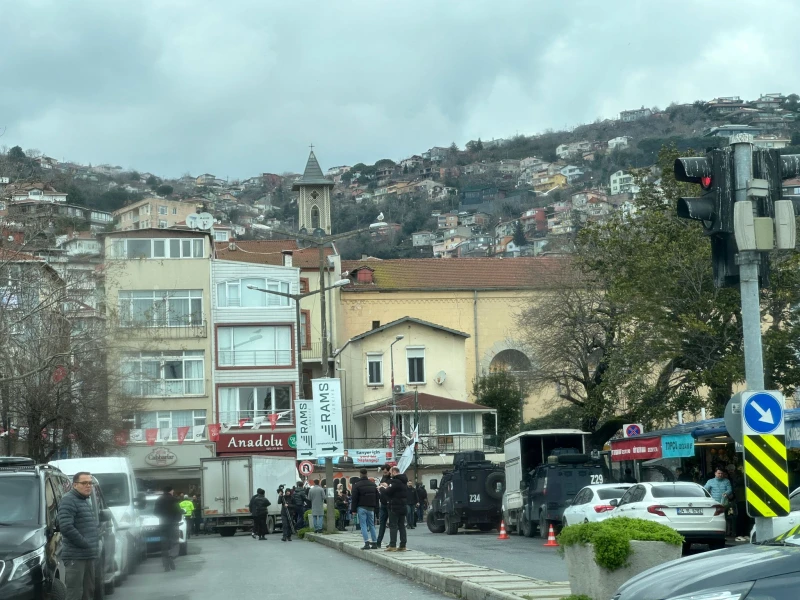
 The scene outside a Catholic church in Istanbul, Turkey, where a reported armed attack took place on Jan. 28, 2024. / Credit: Rudolf Gehrig/EWTN

Washington, D.C. Newsroom, Nov 26, 2025 / 16:15 pm (CNA).
A Christian advocacy group’s report details “legal, institutional, and social hostility” toward Turkish Christians as Pope Leo XIV begins his six-day visit to Turkey and Lebanon Thursday.The report from The European Centre for Law and Justice (ECLJ), titled “The Persecution of Christians in Turkey,” explores government interference against clergy and Christian entities, restrictions on foreign Christians who visit the country, and widespread social animosity toward the faithful, which sometimes includes direct violence.“Communities that were once integral to the cultural, religious, and historical fabric of Anatolia have been reduced to a fragile remnant,” the authors state.“Their disappearance is not the product of a single event but the cumulative result of restrictive legislation, administrative obstruction, property confiscations, denial of legal personality, and — more recently — arbitrary expulsions of clergy, missionaries, and converts,” they add.Modern-day Turkey, which was governed by Christians prior to the Ottoman Empire invasions in late Middle Ages, is still home to about 257,000 Christians. In 1915, Christians still accounted for about 20% of the Turkish population, but the number has dwindled over the past century and they now account for less than 0.3% of the population.Persecution of ChristiansThe report says hostility toward Christians is kept alive through environmental factors, such as Turkey’s refusal to recognize its past by continuing to deny the genocide of Armenians and other Christians during World War I. At that time, about 1.5 million Armenians and 500,000 other Christians were forcibly deported or massacred, and Turkey’s criminalization of “insulting the Turkish nation” and “insulting Turkishness” is often enforced to quell speech about the historical events, according to the report.It notes that politicians and state-run media frequently scapegoat Christians for societal issues and depict them as an external and internal threat, with one example being President Recep Tayyip Erdoğan referring to survivors of the genocide as “terrorists escaped from the sword” and another being the state-run Yeni Akit allegedly editing Wikipedia to smear Christians, Jews, and other groups.In some cases, this hostility yields violence, including a 2024 terrorist attack on a Catholic church that killed one person, and other acts of violence and vandalism.The report notes that Turkey signed the Treaty of Lausanne after the Armenian genocide, which granted people who believe some non-majority faiths full legal recognition and property rights.Yet, a narrow interpretation of the treaty ensures “a national narrative that presents Sunni Islam as the primary marker of Turkish identity,” the report says. The treaty also fails to recognize all Christians, only giving a specific reference to Greek Orthodox, Armenian Apostolic Christians, and Jews, but not Catholics or Protestants, according to the report.It states that Sunni Islam is often tied to Turkish identity in public education and the process to be exempt from compulsory Islamic education is burdensome for Christians not covered under the treaty.No church holds legal personality as a religious institution, which means patriarchates, dioceses, and churches cannot “own property in their own name, initiate legal proceedings, employ staff, open bank accounts, or formally interact with public authorities,” the report states.The government also interferes with religious leadership, prohibiting non-Turkish citizens from being elected as Ecumenical Patriarch, sitting on the Holy Synod, or participating in patriarchal elections in the Greek Orthodox Church. The government also regulates elections for leadership in the Armenian Apostolic Church.Turkey shut down the Greek Orthodox Halki Seminary in 1971 and — despite promises to let it reopen — keeps it shut down, according to the report.The report also says Turkey imposes legal constraints and administrative obstruction on Christian “community foundations,” which operate churches, schools, hospitals, and charitable institutions.This includes blocking board elections and failing to enforce court orders. One of the more egregious violations is imposing “mazbut” trusteeship, which ends Christian institutions’ legal recognition and grants control to the government, which essentially confiscates property, the report said.“These practices reveal a structural system designed to undermine the autonomy, continuity, and survival of Christian communities in Turkey,” the report states.According to the report, foreign Protestant pastors are often expelled from seminaries. More broadly, it states that foreign missionaries and converts are often targeted as “national security” threats and frequently expelled from Turkey. The authors encouraged Turkey to grant full legal recognition to all churches, halt interference in Christian organizations, protect places of worship, end arbitrary expulsions, and return property that has been confiscated.

Report details persecution of Turkish Christians ahead of Pope Leo XIV's visit #Catholic The scene outside a Catholic church in Istanbul, Turkey, where a reported armed attack took place on Jan. 28, 2024. / Credit: Rudolf Gehrig/EWTN Washington, D.C. Newsroom, Nov 26, 2025 / 16:15 pm (CNA). A Christian advocacy group’s report details “legal, institutional, and social hostility” toward Turkish Christians as Pope Leo XIV begins his six-day visit to Turkey and Lebanon Thursday.The report from The European Centre for Law and Justice (ECLJ), titled “The Persecution of Christians in Turkey,” explores government interference against clergy and Christian entities, restrictions on foreign Christians who visit the country, and widespread social animosity toward the faithful, which sometimes includes direct violence.“Communities that were once integral to the cultural, religious, and historical fabric of Anatolia have been reduced to a fragile remnant,” the authors state.“Their disappearance is not the product of a single event but the cumulative result of restrictive legislation, administrative obstruction, property confiscations, denial of legal personality, and — more recently — arbitrary expulsions of clergy, missionaries, and converts,” they add.Modern-day Turkey, which was governed by Christians prior to the Ottoman Empire invasions in late Middle Ages, is still home to about 257,000 Christians. In 1915, Christians still accounted for about 20% of the Turkish population, but the number has dwindled over the past century and they now account for less than 0.3% of the population.Persecution of ChristiansThe report says hostility toward Christians is kept alive through environmental factors, such as Turkey’s refusal to recognize its past by continuing to deny the genocide of Armenians and other Christians during World War I. At that time, about 1.5 million Armenians and 500,000 other Christians were forcibly deported or massacred, and Turkey’s criminalization of “insulting the Turkish nation” and “insulting Turkishness” is often enforced to quell speech about the historical events, according to the report.It notes that politicians and state-run media frequently scapegoat Christians for societal issues and depict them as an external and internal threat, with one example being President Recep Tayyip Erdoğan referring to survivors of the genocide as “terrorists escaped from the sword” and another being the state-run Yeni Akit allegedly editing Wikipedia to smear Christians, Jews, and other groups.In some cases, this hostility yields violence, including a 2024 terrorist attack on a Catholic church that killed one person, and other acts of violence and vandalism.The report notes that Turkey signed the Treaty of Lausanne after the Armenian genocide, which granted people who believe some non-majority faiths full legal recognition and property rights.Yet, a narrow interpretation of the treaty ensures “a national narrative that presents Sunni Islam as the primary marker of Turkish identity,” the report says. The treaty also fails to recognize all Christians, only giving a specific reference to Greek Orthodox, Armenian Apostolic Christians, and Jews, but not Catholics or Protestants, according to the report.It states that Sunni Islam is often tied to Turkish identity in public education and the process to be exempt from compulsory Islamic education is burdensome for Christians not covered under the treaty.No church holds legal personality as a religious institution, which means patriarchates, dioceses, and churches cannot “own property in their own name, initiate legal proceedings, employ staff, open bank accounts, or formally interact with public authorities,” the report states.The government also interferes with religious leadership, prohibiting non-Turkish citizens from being elected as Ecumenical Patriarch, sitting on the Holy Synod, or participating in patriarchal elections in the Greek Orthodox Church. The government also regulates elections for leadership in the Armenian Apostolic Church.Turkey shut down the Greek Orthodox Halki Seminary in 1971 and — despite promises to let it reopen — keeps it shut down, according to the report.The report also says Turkey imposes legal constraints and administrative obstruction on Christian “community foundations,” which operate churches, schools, hospitals, and charitable institutions.This includes blocking board elections and failing to enforce court orders. One of the more egregious violations is imposing “mazbut” trusteeship, which ends Christian institutions’ legal recognition and grants control to the government, which essentially confiscates property, the report said.“These practices reveal a structural system designed to undermine the autonomy, continuity, and survival of Christian communities in Turkey,” the report states.According to the report, foreign Protestant pastors are often expelled from seminaries. More broadly, it states that foreign missionaries and converts are often targeted as “national security” threats and frequently expelled from Turkey. The authors encouraged Turkey to grant full legal recognition to all churches, halt interference in Christian organizations, protect places of worship, end arbitrary expulsions, and return property that has been confiscated.


The scene outside a Catholic church in Istanbul, Turkey, where a reported armed attack took place on Jan. 28, 2024. / Credit: Rudolf Gehrig/EWTN

Washington, D.C. Newsroom, Nov 26, 2025 / 16:15 pm (CNA).

A Christian advocacy group’s report details “legal, institutional, and social hostility” toward Turkish Christians as Pope Leo XIV begins his six-day visit to Turkey and Lebanon Thursday.

The report from The European Centre for Law and Justice (ECLJ), titled “The Persecution of Christians in Turkey,” explores government interference against clergy and Christian entities, restrictions on foreign Christians who visit the country, and widespread social animosity toward the faithful, which sometimes includes direct violence.

“Communities that were once integral to the cultural, religious, and historical fabric of Anatolia have been reduced to a fragile remnant,” the authors state.

“Their disappearance is not the product of a single event but the cumulative result of restrictive legislation, administrative obstruction, property confiscations, denial of legal personality, and — more recently — arbitrary expulsions of clergy, missionaries, and converts,” they add.

Modern-day Turkey, which was governed by Christians prior to the Ottoman Empire invasions in late Middle Ages, is still home to about 257,000 Christians. In 1915, Christians still accounted for about 20% of the Turkish population, but the number has dwindled over the past century and they now account for less than 0.3% of the population.

Persecution of Christians

The report says hostility toward Christians is kept alive through environmental factors, such as Turkey’s refusal to recognize its past by continuing to deny the genocide of Armenians and other Christians during World War I. 

At that time, about 1.5 million Armenians and 500,000 other Christians were forcibly deported or massacred, and Turkey’s criminalization of “insulting the Turkish nation” and “insulting Turkishness” is often enforced to quell speech about the historical events, according to the report.

It notes that politicians and state-run media frequently scapegoat Christians for societal issues and depict them as an external and internal threat, with one example being President Recep Tayyip Erdoğan referring to survivors of the genocide as “terrorists escaped from the sword” and another being the state-run Yeni Akit allegedly editing Wikipedia to smear Christians, Jews, and other groups.

In some cases, this hostility yields violence, including a 2024 terrorist attack on a Catholic church that killed one person, and other acts of violence and vandalism.

The report notes that Turkey signed the Treaty of Lausanne after the Armenian genocide, which granted people who believe some non-majority faiths full legal recognition and property rights.

Yet, a narrow interpretation of the treaty ensures “a national narrative that presents Sunni Islam as the primary marker of Turkish identity,” the report says. The treaty also fails to recognize all Christians, only giving a specific reference to Greek Orthodox, Armenian Apostolic Christians, and Jews, but not Catholics or Protestants, according to the report.

It states that Sunni Islam is often tied to Turkish identity in public education and the process to be exempt from compulsory Islamic education is burdensome for Christians not covered under the treaty.

No church holds legal personality as a religious institution, which means patriarchates, dioceses, and churches cannot “own property in their own name, initiate legal proceedings, employ staff, open bank accounts, or formally interact with public authorities,” the report states.

The government also interferes with religious leadership, prohibiting non-Turkish citizens from being elected as Ecumenical Patriarch, sitting on the Holy Synod, or participating in patriarchal elections in the Greek Orthodox Church. The government also regulates elections for leadership in the Armenian Apostolic Church.

Turkey shut down the Greek Orthodox Halki Seminary in 1971 and — despite promises to let it reopen — keeps it shut down, according to the report.

The report also says Turkey imposes legal constraints and administrative obstruction on Christian “community foundations,” which operate churches, schools, hospitals, and charitable institutions.

This includes blocking board elections and failing to enforce court orders. One of the more egregious violations is imposing “mazbut” trusteeship, which ends Christian institutions’ legal recognition and grants control to the government, which essentially confiscates property, the report said.

“These practices reveal a structural system designed to undermine the autonomy, continuity, and survival of Christian communities in Turkey,” the report states.

According to the report, foreign Protestant pastors are often expelled from seminaries. More broadly, it states that foreign missionaries and converts are often targeted as “national security” threats and frequently expelled from Turkey. 

The authors encouraged Turkey to grant full legal recognition to all churches, halt interference in Christian organizations, protect places of worship, end arbitrary expulsions, and return property that has been confiscated.

Read More
‘Say thank you to someone’ this Thanksgiving, Pope Leo XIV says #Catholic 
 
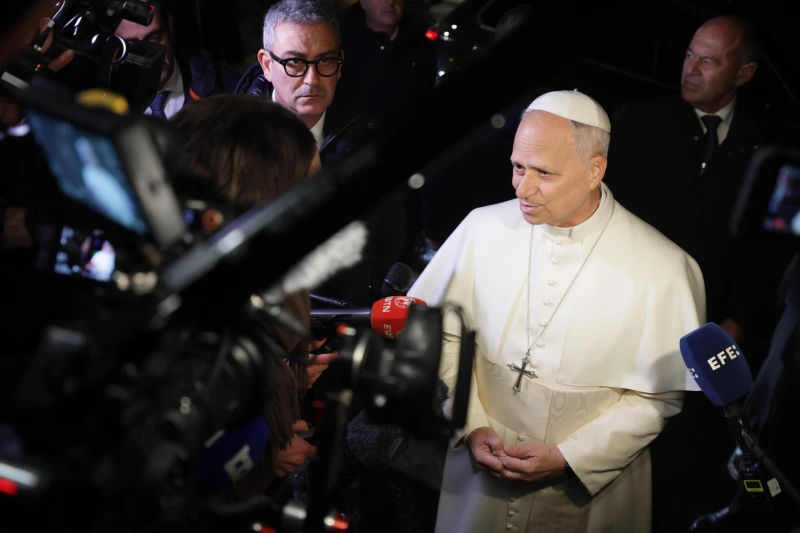
 Pope Leo XIV speaks to reporters after a daylong stay at the papal villa of Castel Gandolfo on Nov. 25, 2025. / Credit: Daniel Ibáñez/CNA

Castel Gandolfo, Italy, Nov 25, 2025 / 15:31 pm (CNA).
Pope Leo XIV on Tuesday suggested that people “say thank you to someone” this Thanksgiving and he addressed concerns about violence in Lebanon ahead of his trip there later this week.Speaking two days before Thanksgiving, the first U.S.-born pope celebrated what he called “this beautiful feast that we have in the United States, which unites all people, people of different faiths, people who perhaps do not have the gift of faith.” The pope urged all people, not just Americans, to take the occasion “to recognize that we all have received so many gifts, first and foremost, the gift of life, the gift of faith, the gift of unity … and to give thanks to God for the many gifts we’ve been given.” Pope Leo answered questions from reporters as he left for Rome after a daylong stay at the papal villa of Castel Gandolfo.Pope Leo XIV speaks to reporters after a daylong stay at the papal villa of Castel Gandolfo on Nov. 25, 2025. Credit: Daniel Ibáñez/CNALeo is set to begin his first international trip as pope Nov. 27, a six-day visit to Turkey and Lebanon. The foreign trip is the fulfillment of a promise made by Pope Francis to visit Lebanon, a Muslim-majority country. Regional instability and internal crises have battered the small country where about a third of the population is Christian.Reporters asked Leo if violence in Lebanon is a concern.“It’s always a concern,” the pope said. “Again, I would invite all people to look for ways, to abandon the use of arms as a way of solving problems, and to come together, to respect one another, to sit down together at the table, to dialogue and to work together for solutions for the problems that affect us.”Pope Leo XIV answers questions from reporters as he leaves for Rome after a daylong stay at the papal villa of Castel Gandolfo on Nov. 25, 2025. Credit: Daniel Ibáñez/CNARegarding a message for Israel, the pope said he likewise encourages all people “to look for peace, to look for justice, because oftentimes violence occurs as a result of injustices. And I think we have to work together, look for greater unity, respect for all people and all religions.”Pope Leo XIV exits the papal villa of Castel Gandolfo on Nov. 25, 2025. Credit: Daniel Ibáñez/CNA

‘Say thank you to someone’ this Thanksgiving, Pope Leo XIV says #Catholic Pope Leo XIV speaks to reporters after a daylong stay at the papal villa of Castel Gandolfo on Nov. 25, 2025. / Credit: Daniel Ibáñez/CNA Castel Gandolfo, Italy, Nov 25, 2025 / 15:31 pm (CNA). Pope Leo XIV on Tuesday suggested that people “say thank you to someone” this Thanksgiving and he addressed concerns about violence in Lebanon ahead of his trip there later this week.Speaking two days before Thanksgiving, the first U.S.-born pope celebrated what he called “this beautiful feast that we have in the United States, which unites all people, people of different faiths, people who perhaps do not have the gift of faith.” The pope urged all people, not just Americans, to take the occasion “to recognize that we all have received so many gifts, first and foremost, the gift of life, the gift of faith, the gift of unity … and to give thanks to God for the many gifts we’ve been given.” Pope Leo answered questions from reporters as he left for Rome after a daylong stay at the papal villa of Castel Gandolfo.Pope Leo XIV speaks to reporters after a daylong stay at the papal villa of Castel Gandolfo on Nov. 25, 2025. Credit: Daniel Ibáñez/CNALeo is set to begin his first international trip as pope Nov. 27, a six-day visit to Turkey and Lebanon. The foreign trip is the fulfillment of a promise made by Pope Francis to visit Lebanon, a Muslim-majority country. Regional instability and internal crises have battered the small country where about a third of the population is Christian.Reporters asked Leo if violence in Lebanon is a concern.“It’s always a concern,” the pope said. “Again, I would invite all people to look for ways, to abandon the use of arms as a way of solving problems, and to come together, to respect one another, to sit down together at the table, to dialogue and to work together for solutions for the problems that affect us.”Pope Leo XIV answers questions from reporters as he leaves for Rome after a daylong stay at the papal villa of Castel Gandolfo on Nov. 25, 2025. Credit: Daniel Ibáñez/CNARegarding a message for Israel, the pope said he likewise encourages all people “to look for peace, to look for justice, because oftentimes violence occurs as a result of injustices. And I think we have to work together, look for greater unity, respect for all people and all religions.”Pope Leo XIV exits the papal villa of Castel Gandolfo on Nov. 25, 2025. Credit: Daniel Ibáñez/CNA


Pope Leo XIV speaks to reporters after a daylong stay at the papal villa of Castel Gandolfo on Nov. 25, 2025. / Credit: Daniel Ibáñez/CNA

Castel Gandolfo, Italy, Nov 25, 2025 / 15:31 pm (CNA).

Pope Leo XIV on Tuesday suggested that people “say thank you to someone” this Thanksgiving and he addressed concerns about violence in Lebanon ahead of his trip there later this week.

Speaking two days before Thanksgiving, the first U.S.-born pope celebrated what he called “this beautiful feast that we have in the United States, which unites all people, people of different faiths, people who perhaps do not have the gift of faith.” 

The pope urged all people, not just Americans, to take the occasion “to recognize that we all have received so many gifts, first and foremost, the gift of life, the gift of faith, the gift of unity … and to give thanks to God for the many gifts we’ve been given.” 

Pope Leo answered questions from reporters as he left for Rome after a daylong stay at the papal villa of Castel Gandolfo.

Pope Leo XIV speaks to reporters after a daylong stay at the papal villa of Castel Gandolfo on Nov. 25, 2025. Credit: Daniel Ibáñez/CNA

Leo is set to begin his first international trip as pope Nov. 27, a six-day visit to Turkey and Lebanon. The foreign trip is the fulfillment of a promise made by Pope Francis to visit Lebanon, a Muslim-majority country. Regional instability and internal crises have battered the small country where about a third of the population is Christian.

Reporters asked Leo if violence in Lebanon is a concern.

“It’s always a concern,” the pope said. “Again, I would invite all people to look for ways, to abandon the use of arms as a way of solving problems, and to come together, to respect one another, to sit down together at the table, to dialogue and to work together for solutions for the problems that affect us.”

Pope Leo XIV answers questions from reporters as he leaves for Rome after a daylong stay at the papal villa of Castel Gandolfo on Nov. 25, 2025. Credit: Daniel Ibáñez/CNA

Regarding a message for Israel, the pope said he likewise encourages all people “to look for peace, to look for justice, because oftentimes violence occurs as a result of injustices. And I think we have to work together, look for greater unity, respect for all people and all religions.”

Pope Leo XIV exits the papal villa of Castel Gandolfo on Nov. 25, 2025. Credit: Daniel Ibáñez/CNA

Read More
Giving people hope is greatest challenge, custos of Holy Land says in U.S. visit #Catholic 
 
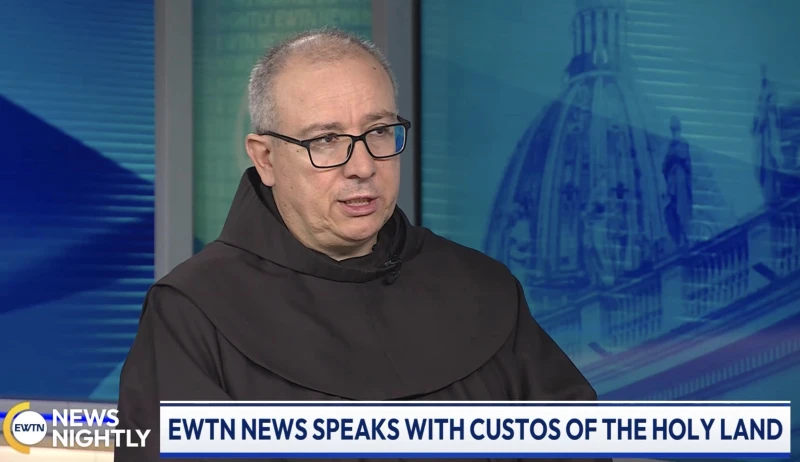
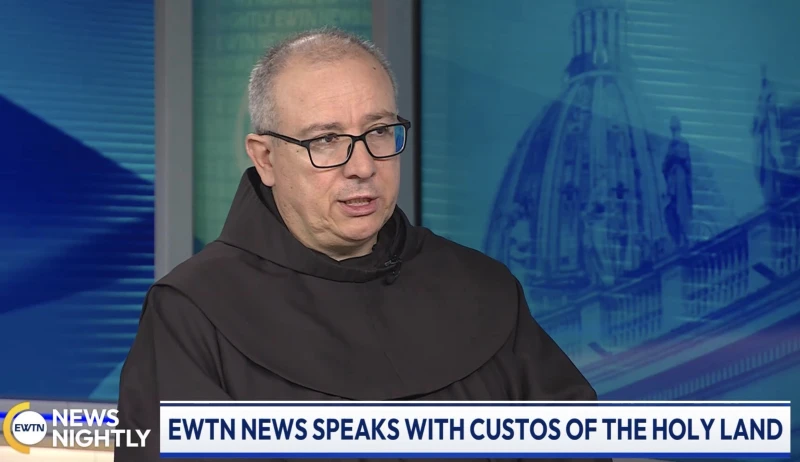
 Custos of the Holy Land Father Franceso Ielpo speaks with EWTN News in a two-part interview that began airing on “EWTN News Nightly” on Nov. 24, 2025. / Credit: “EWTN News Nightly”/Screenshot

Washington, D.C. Newsroom, Nov 25, 2025 / 09:00 am (CNA).
The custos of the Holy Land said in an interview with EWTN News that the “greatest challenge” is to be a source of hope amid perpetual devastation due to conflict. “The greatest challenge is to always be able to give people hope. One can have food, one can have a home, one can have medicine, one can have the best schools, but to live, we all need hope. And this hope always arises when you see, when you feel the presence of God through the presence of the Church beside you,” Father Franceso Ielpo told EWTN News’ Matthew Bunson in a two-part interview that began airing Nov. 24 on “EWTN News Nightly.” Ielpo has served as custos of the Holy Land since his appointment by Pope Leo XIV in June, when he succeeded Father Francesdo Patton. It is Ielpo’s first visit to the United States as custos, a Latin term for “guardian” associated with the Franciscan order’s special responsibility to oversee and care for holy sites in the Holy Land.Ielpo explained this challenge confronts the Christian community not only in Israel and Palestine but also in Lebanon and Syria. Custodians in these countries, he said, are faced with having “to grow and continue to live in a context of tension, in a context of perpetual conflict.” The Custody of the Holy Land is made up of 325 friars from over 40 countries. Ielpo said the latest conflict in Israel “has had very serious consequences” for “all communities in the Holy Land,” particularly in the employment sphere due to a lack of pilgrims to the region, which depends on religious tourism to generate income. He further emphasized the “tension of uncertainty about the future, especially for one’s children.” “The custody continues first and foremost to support and sustain the salaries of all our employees, of all our Christians, and also seeks to continue the educational work that is the schools,” Ielpo said. “We currently have 18 schools with about 10,000 students, both Christian and Muslim. Even for families who can no longer pay for school, we continue to guarantee education because we are convinced that the future is built in the classroom.” The work of the custody is not limited to the Christian community alone, he said, noting that 90% of the student population attending the Franciscan school in Jericho are Muslim. “They understand and appreciate that the service we offer is for everyone and is of high quality,” he said. At Magnificat, a music school that just celebrated its 30th anniversary, students and teachers are Christian, Muslim, and Jewish, he added.“The thing that gives me the most hope is that God’s timing is not our timing, that history is carried forward despite all its contradictions by someone else,” he said. Even amid conflict, he continued, “hope always arises from the fact that God is the true protagonist of history, even in storms, even when it seems that he is on the boat and sleeping.” Concretely, the custos emphasized the need for pilgrims to return, not only for economic reasons, but to demonstrate to residents of the Holy Land that they are “seen, recognized, wanted, loved.” “The invitation is to return to the Holy Land,” he said. “The shrines are safe — come back, visit, and don’t just visit the shrines. Always ask to meet the communities, even if only for a prayer together … even if only for a greeting, because it is good for everyone.”

Giving people hope is greatest challenge, custos of Holy Land says in U.S. visit #Catholic Custos of the Holy Land Father Franceso Ielpo speaks with EWTN News in a two-part interview that began airing on “EWTN News Nightly” on Nov. 24, 2025. / Credit: “EWTN News Nightly”/Screenshot Washington, D.C. Newsroom, Nov 25, 2025 / 09:00 am (CNA). The custos of the Holy Land said in an interview with EWTN News that the “greatest challenge” is to be a source of hope amid perpetual devastation due to conflict. “The greatest challenge is to always be able to give people hope. One can have food, one can have a home, one can have medicine, one can have the best schools, but to live, we all need hope. And this hope always arises when you see, when you feel the presence of God through the presence of the Church beside you,” Father Franceso Ielpo told EWTN News’ Matthew Bunson in a two-part interview that began airing Nov. 24 on “EWTN News Nightly.” Ielpo has served as custos of the Holy Land since his appointment by Pope Leo XIV in June, when he succeeded Father Francesdo Patton. It is Ielpo’s first visit to the United States as custos, a Latin term for “guardian” associated with the Franciscan order’s special responsibility to oversee and care for holy sites in the Holy Land.Ielpo explained this challenge confronts the Christian community not only in Israel and Palestine but also in Lebanon and Syria. Custodians in these countries, he said, are faced with having “to grow and continue to live in a context of tension, in a context of perpetual conflict.” The Custody of the Holy Land is made up of 325 friars from over 40 countries. Ielpo said the latest conflict in Israel “has had very serious consequences” for “all communities in the Holy Land,” particularly in the employment sphere due to a lack of pilgrims to the region, which depends on religious tourism to generate income. He further emphasized the “tension of uncertainty about the future, especially for one’s children.” “The custody continues first and foremost to support and sustain the salaries of all our employees, of all our Christians, and also seeks to continue the educational work that is the schools,” Ielpo said. “We currently have 18 schools with about 10,000 students, both Christian and Muslim. Even for families who can no longer pay for school, we continue to guarantee education because we are convinced that the future is built in the classroom.” The work of the custody is not limited to the Christian community alone, he said, noting that 90% of the student population attending the Franciscan school in Jericho are Muslim. “They understand and appreciate that the service we offer is for everyone and is of high quality,” he said. At Magnificat, a music school that just celebrated its 30th anniversary, students and teachers are Christian, Muslim, and Jewish, he added.“The thing that gives me the most hope is that God’s timing is not our timing, that history is carried forward despite all its contradictions by someone else,” he said. Even amid conflict, he continued, “hope always arises from the fact that God is the true protagonist of history, even in storms, even when it seems that he is on the boat and sleeping.” Concretely, the custos emphasized the need for pilgrims to return, not only for economic reasons, but to demonstrate to residents of the Holy Land that they are “seen, recognized, wanted, loved.” “The invitation is to return to the Holy Land,” he said. “The shrines are safe — come back, visit, and don’t just visit the shrines. Always ask to meet the communities, even if only for a prayer together … even if only for a greeting, because it is good for everyone.”


Custos of the Holy Land Father Franceso Ielpo speaks with EWTN News in a two-part interview that began airing on “EWTN News Nightly” on Nov. 24, 2025. / Credit: “EWTN News Nightly”/Screenshot

Washington, D.C. Newsroom, Nov 25, 2025 / 09:00 am (CNA).

The custos of the Holy Land said in an interview with EWTN News that the “greatest challenge” is to be a source of hope amid perpetual devastation due to conflict. 

“The greatest challenge is to always be able to give people hope. One can have food, one can have a home, one can have medicine, one can have the best schools, but to live, we all need hope. And this hope always arises when you see, when you feel the presence of God through the presence of the Church beside you,” Father Franceso Ielpo told EWTN News’ Matthew Bunson in a two-part interview that began airing Nov. 24 on “EWTN News Nightly.” 

Ielpo has served as custos of the Holy Land since his appointment by Pope Leo XIV in June, when he succeeded Father Francesdo Patton. It is Ielpo’s first visit to the United States as custos, a Latin term for “guardian” associated with the Franciscan order’s special responsibility to oversee and care for holy sites in the Holy Land.

Ielpo explained this challenge confronts the Christian community not only in Israel and Palestine but also in Lebanon and Syria. Custodians in these countries, he said, are faced with having “to grow and continue to live in a context of tension, in a context of perpetual conflict.” The Custody of the Holy Land is made up of 325 friars from over 40 countries. 

Ielpo said the latest conflict in Israel “has had very serious consequences” for “all communities in the Holy Land,” particularly in the employment sphere due to a lack of pilgrims to the region, which depends on religious tourism to generate income. He further emphasized the “tension of uncertainty about the future, especially for one’s children.” 

“The custody continues first and foremost to support and sustain the salaries of all our employees, of all our Christians, and also seeks to continue the educational work that is the schools,” Ielpo said. “We currently have 18 schools with about 10,000 students, both Christian and Muslim. Even for families who can no longer pay for school, we continue to guarantee education because we are convinced that the future is built in the classroom.” 

The work of the custody is not limited to the Christian community alone, he said, noting that 90% of the student population attending the Franciscan school in Jericho are Muslim. “They understand and appreciate that the service we offer is for everyone and is of high quality,” he said. At Magnificat, a music school that just celebrated its 30th anniversary, students and teachers are Christian, Muslim, and Jewish, he added.

“The thing that gives me the most hope is that God’s timing is not our timing, that history is carried forward despite all its contradictions by someone else,” he said. Even amid conflict, he continued, “hope always arises from the fact that God is the true protagonist of history, even in storms, even when it seems that he is on the boat and sleeping.” 

Concretely, the custos emphasized the need for pilgrims to return, not only for economic reasons, but to demonstrate to residents of the Holy Land that they are “seen, recognized, wanted, loved.” 

“The invitation is to return to the Holy Land,” he said. “The shrines are safe — come back, visit, and don’t just visit the shrines. Always ask to meet the communities, even if only for a prayer together … even if only for a greeting, because it is good for everyone.”

Read More
16,000 teens attend Mass together to conclude NCYC #Catholic 
 
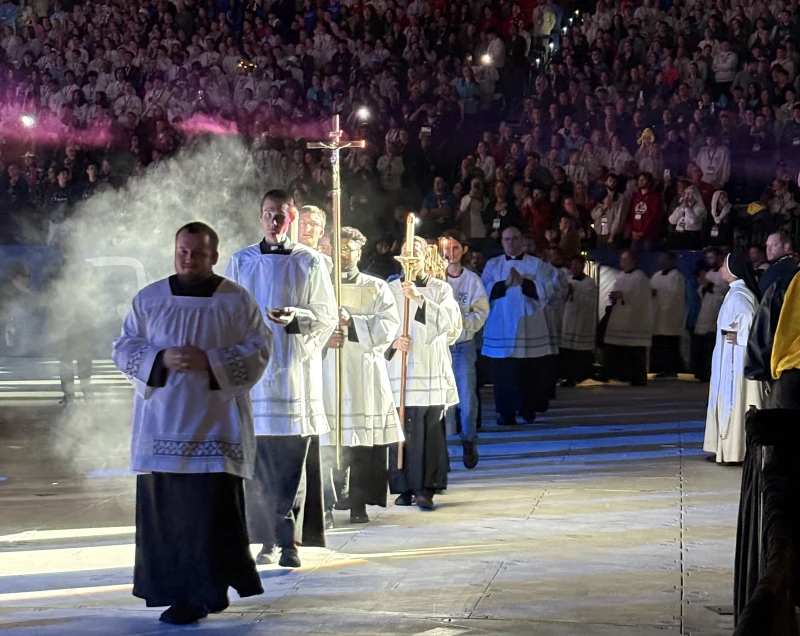
 Priests process into Lucas Oil Stadium on Nov. 22, 2025, for the concluding Mass in Lucas Oil Stadium at the National Catholic Youth Conference in Indianapolis. / Credit: Tessa Gervasini/CNA

Indianapolis, Indiana, Nov 24, 2025 / 10:35 am (CNA).
The 2025 National Catholic Youth Conferences (NCYC) concluded with a nighttime Mass drawing around 16,000 teenagers.After three days of prayer, community, sacraments, and a conversation with Pope Leo XIV, young Catholics packed into Lucas Oil Stadium in Indianapolis to end the conference with Mass on Nov. 22. Archbishop Nelson Pérez told CNA it was “beautiful” to celebrate the Mass alongside 25 of his brother bishops and more than 240 priests. “It’s the Church in its splendor,” Pérez said. “Tonight, we experienced the Church in its splendor.” The final Mass was celebrated on the Saturday before the solemnity of Christ the King. In his homily, Pérez said: “When I think about a king, I think about palaces and big thrones and power and authority.”“But when Jesus talks about king it’s … different,” Pérez said. “His throne is a cross. His crown is not made of gold and gems. It’s made of thorns. He doesn’t wear fancy, beautiful, priceless rings on his hands. He has nails.”The “very mystery of the life and the death of Christ, the King, and all of our lives is actually a dying and a rising — dying to sin, dying to the parts of our humanity that might be warped and wounded, and rising to new life to renewal of our soul.”Then “that process goes over and over over and over and over again until we die in Christ for the last time and then rise with him,” Pérez said. “How blessed, how filled with hope we are.”Pérez reminds teens: ‘Christ loves you just as you are’Pérez concluded his homily by tying his message back to what Pope Leo told the teens in his digital encounter with them on Nov. 21. Pérez told the teenagers Pope Leo spoke with them because he loves them.Pope Leo has “gathered with youth all over the place, especially this summer, [during] the Jubilee of Youth,” Pérez said. The pope’s “message is profound, powerful, and simple at the same time: ‘Christ loves you just as you are.’”Pérez reminded the crowd to listen to what the pope said to them. “Think of your closest friends. If they were hurting, you would walk with them, listen, and stay close,” the pope said. “Our relation with Jesus is similar. He knows when life feels heavy, even when we do not feel his presence, our faith tells us he is there.”“To entrust our struggles to Jesus, we have to spend time in prayer … We can speak honestly about what’s in our hearts,” Pérez said, quoting the pope. “That is why daily moments of silence are so important, whether through adoration, reading Scripture, or simply talking to him.”“‘Little by little, we learn to hear his voice, both from within and through the people he sends us. As you grow closer to Jesus,’ he said to us, ‘Do not fear what he may ask of you. If he challenges you to make changes in your life, it’s always because he wants to give you greater joy and freedom. God is never outdone in generosity.’”“The pope’s digital visit was what made this NCYC epic, really epic and different from any other,” Pérez told CNA. The success was from “the excitement of our youth to welcome the Holy Father” and Pope Leo’s “generosity and willingness” to speak with them. Being a part of the conference and seeing so many young Catholics at Mass together made Pérez feel “hopeful,” he said. “In a world and a country that’s so divided right now and violent at times, after this, I’m just so full of hope. It’s almost like we’re going to be OK.”“It’s incredible to see the young Church alive,” Pérez said. “It’s such a beautiful, beautiful gathering.”

16,000 teens attend Mass together to conclude NCYC #Catholic Priests process into Lucas Oil Stadium on Nov. 22, 2025, for the concluding Mass in Lucas Oil Stadium at the National Catholic Youth Conference in Indianapolis. / Credit: Tessa Gervasini/CNA Indianapolis, Indiana, Nov 24, 2025 / 10:35 am (CNA). The 2025 National Catholic Youth Conferences (NCYC) concluded with a nighttime Mass drawing around 16,000 teenagers.After three days of prayer, community, sacraments, and a conversation with Pope Leo XIV, young Catholics packed into Lucas Oil Stadium in Indianapolis to end the conference with Mass on Nov. 22. Archbishop Nelson Pérez told CNA it was “beautiful” to celebrate the Mass alongside 25 of his brother bishops and more than 240 priests. “It’s the Church in its splendor,” Pérez said. “Tonight, we experienced the Church in its splendor.” The final Mass was celebrated on the Saturday before the solemnity of Christ the King. In his homily, Pérez said: “When I think about a king, I think about palaces and big thrones and power and authority.”“But when Jesus talks about king it’s … different,” Pérez said. “His throne is a cross. His crown is not made of gold and gems. It’s made of thorns. He doesn’t wear fancy, beautiful, priceless rings on his hands. He has nails.”The “very mystery of the life and the death of Christ, the King, and all of our lives is actually a dying and a rising — dying to sin, dying to the parts of our humanity that might be warped and wounded, and rising to new life to renewal of our soul.”Then “that process goes over and over over and over and over again until we die in Christ for the last time and then rise with him,” Pérez said. “How blessed, how filled with hope we are.”Pérez reminds teens: ‘Christ loves you just as you are’Pérez concluded his homily by tying his message back to what Pope Leo told the teens in his digital encounter with them on Nov. 21. Pérez told the teenagers Pope Leo spoke with them because he loves them.Pope Leo has “gathered with youth all over the place, especially this summer, [during] the Jubilee of Youth,” Pérez said. The pope’s “message is profound, powerful, and simple at the same time: ‘Christ loves you just as you are.’”Pérez reminded the crowd to listen to what the pope said to them. “Think of your closest friends. If they were hurting, you would walk with them, listen, and stay close,” the pope said. “Our relation with Jesus is similar. He knows when life feels heavy, even when we do not feel his presence, our faith tells us he is there.”“To entrust our struggles to Jesus, we have to spend time in prayer … We can speak honestly about what’s in our hearts,” Pérez said, quoting the pope. “That is why daily moments of silence are so important, whether through adoration, reading Scripture, or simply talking to him.”“‘Little by little, we learn to hear his voice, both from within and through the people he sends us. As you grow closer to Jesus,’ he said to us, ‘Do not fear what he may ask of you. If he challenges you to make changes in your life, it’s always because he wants to give you greater joy and freedom. God is never outdone in generosity.’”“The pope’s digital visit was what made this NCYC epic, really epic and different from any other,” Pérez told CNA. The success was from “the excitement of our youth to welcome the Holy Father” and Pope Leo’s “generosity and willingness” to speak with them. Being a part of the conference and seeing so many young Catholics at Mass together made Pérez feel “hopeful,” he said. “In a world and a country that’s so divided right now and violent at times, after this, I’m just so full of hope. It’s almost like we’re going to be OK.”“It’s incredible to see the young Church alive,” Pérez said. “It’s such a beautiful, beautiful gathering.”


Priests process into Lucas Oil Stadium on Nov. 22, 2025, for the concluding Mass in Lucas Oil Stadium at the National Catholic Youth Conference in Indianapolis. / Credit: Tessa Gervasini/CNA

Indianapolis, Indiana, Nov 24, 2025 / 10:35 am (CNA).

The 2025 National Catholic Youth Conferences (NCYC) concluded with a nighttime Mass drawing around 16,000 teenagers.

After three days of prayer, community, sacraments, and a conversation with Pope Leo XIV, young Catholics packed into Lucas Oil Stadium in Indianapolis to end the conference with Mass on Nov. 22. Archbishop Nelson Pérez told CNA it was “beautiful” to celebrate the Mass alongside 25 of his brother bishops and more than 240 priests. 

“It’s the Church in its splendor,” Pérez said. “Tonight, we experienced the Church in its splendor.” 

The final Mass was celebrated on the Saturday before the solemnity of Christ the King. In his homily, Pérez said: “When I think about a king, I think about palaces and big thrones and power and authority.”

“But when Jesus talks about king it’s … different,” Pérez said. “His throne is a cross. His crown is not made of gold and gems. It’s made of thorns. He doesn’t wear fancy, beautiful, priceless rings on his hands. He has nails.”

The “very mystery of the life and the death of Christ, the King, and all of our lives is actually a dying and a rising — dying to sin, dying to the parts of our humanity that might be warped and wounded, and rising to new life to renewal of our soul.”

Then “that process goes over and over over and over and over again until we die in Christ for the last time and then rise with him,” Pérez said. “How blessed, how filled with hope we are.”

Pérez reminds teens: ‘Christ loves you just as you are’

Pérez concluded his homily by tying his message back to what Pope Leo told the teens in his digital encounter with them on Nov. 21. Pérez told the teenagers Pope Leo spoke with them because he loves them.

Pope Leo has “gathered with youth all over the place, especially this summer, [during] the Jubilee of Youth,” Pérez said. The pope’s “message is profound, powerful, and simple at the same time: ‘Christ loves you just as you are.’”

Pérez reminded the crowd to listen to what the pope said to them. “Think of your closest friends. If they were hurting, you would walk with them, listen, and stay close,” the pope said. “Our relation with Jesus is similar. He knows when life feels heavy, even when we do not feel his presence, our faith tells us he is there.”

“To entrust our struggles to Jesus, we have to spend time in prayer … We can speak honestly about what’s in our hearts,” Pérez said, quoting the pope. “That is why daily moments of silence are so important, whether through adoration, reading Scripture, or simply talking to him.”

“‘Little by little, we learn to hear his voice, both from within and through the people he sends us. As you grow closer to Jesus,’ he said to us, ‘Do not fear what he may ask of you. If he challenges you to make changes in your life, it’s always because he wants to give you greater joy and freedom. God is never outdone in generosity.’”

“The pope’s digital visit was what made this NCYC epic, really epic and different from any other,” Pérez told CNA. The success was from “the excitement of our youth to welcome the Holy Father” and Pope Leo’s “generosity and willingness” to speak with them. 

Being a part of the conference and seeing so many young Catholics at Mass together made Pérez feel “hopeful,” he said. “In a world and a country that’s so divided right now and violent at times, after this, I’m just so full of hope. It’s almost like we’re going to be OK.”

“It’s incredible to see the young Church alive,” Pérez said. “It’s such a beautiful, beautiful gathering.”

Read More
More than half a million people to participate in Aid to the Church in Need ‘Red Week’ #Catholic 
 
 The Austrian Parliament building is lit red as part of the international “Red Week” in honor of persecuted Christians across the globe. / Credit: Aid to the Church in Need

Washington, D.C. Newsroom, Nov 14, 2025 / 06:00 am (CNA).
Here is a roundup of Catholic world news from the past week that you might have missed:More than half a million people to participate in Aid to the Church in Need ‘Red Week’ Over 500,000 people will take part in Aid to the Church in Need International’s Red Week 2025, which will see churches and landmarks around the world illuminated in red to raise awareness of religious persecution internationally.Set to take place Nov. 15–23, the global initiative is expected to see “over 10,000 direct participants for prayers, public events, school gatherings, concerts, and marches,” and to draw in “more than 500,000 participants through media outreach and online platforms,” according to an ACN International press release.More than 100 events are scheduled around the world, including in Australia, Austria, Germany, Portugal, the Netherlands, the United Kingdom, France, Italy, Ireland, Switzerland, Hungary, Canada, Mexico, Colombia, and more.Catholic bishops in Ghana express closeness with stampede victimsCatholic bishops in Ghana have expressed their closeness with victims of a stampede at the El-Wak Stadium in Accra that left six people dead and several others injured during a Ghana Armed Forces recruitment exercise, ACI Africa, CNA’s news partner in Africa, reported Nov. 13. “We unite our hearts with the bereaved families in grief and lift our prayers to Almighty God for the eternal repose of the departed and the swift recovery of all who are injured,” Ghana’s Catholic bishops said in a statement following the Nov. 12 stampede. Citing figures released by the acting minister of defense, Cassiel Ato Forson, the bishops noted that 34 casualties were recorded. Of these, six were reportedly confirmed dead, five were in critical condition, 12 were in fairly critical condition, and others were under observation.Oman opens Catholic pastoral center in MuscatOman has inaugurated a new Catholic pastoral center in Muscat — an important sign of the country’s long-standing respect for religious diversity, according to ACI MENA, CNA’s Arabic-language news partner.Built on land donated in 1977 by the late Sultan Qaboos, the center provides formation programs, catechesis, and housing for clergy.Omani Ambassador Mahmoud al-Hassani said the project reflects the nation’s vision of peaceful coexistence and aligns with the Vatican’s mission of dialogue. The center also strengthens ties between Oman and the Holy See, which formally established diplomatic relations in 2023.International contemplative congregation of sisters celebrates 200 years The Sisters of Our Lady of Charity of the Good Shepherd (RGS) officially concluded the yearlong celebration of their 200th anniversary on Nov. 11. The contemplative order was founded in 1825 by St. Mary Euphrasia Pelletier in Myanmar.“I hope it rekindles in all of us a renewed openness to be shaped and made radiant by grace, so that together, as one congregation, and, as one people of God, we allow the fire of God’s love to warm, illumine, and shine through us into the heart of the world,” said Sister Joan Marie Lopez, RGS congregational leader, on her hope for the bicentenary year, according to Vatican News. Cardinal Luis Antonio Tagle, pro-prefect of the Dicastery for Evangelization, presided over a Mass in Rome for the bicentennial celebration.Christian families return to al-Ghassaniyah, Syria, after 13 yearsAfter more than a decade of displacement, Christian families have begun returning to the village of al-Ghassaniyah in Idlib, Syria, ACI MENA reported Nov. 13. Their return was made possible by a firm government decision to remove foreign extremist groups and by sustained efforts from the Franciscan community. Although many homes are damaged or looted, residents spoke of renewed hope as the Church offered support for the first returning families. The development comes amid wider security shifts in the region and ongoing diplomatic efforts related to extremist fighters.Typhoons, floods devastate Vietnam; Catholic communities respond The Catholic Church is calling for communities to respond after Typhoon Kalmaegi destroyed buildings across the Qui Nhon Diocese, including the house of the bishop and Lang Song Seminary. “The main house of the Congregation of the Lovers of the Holy Cross in Qui Nhon, the Congregation of the Handmaids of Jesus of Mercy, and many parish churches like Qui Nhon Cathedral and other churches throughout the diocese were severely damaged,” Fides News Agency reported. This comes after severe flooding the week prior, which left 13 dead, 34 injured, and 11 missing. Maria Vu Thi Hong Anh, head of Da Nang Cathedral Parish Caritas, said in wake of the flooding: “Seeing the images of this historic flood, I feel very sorry for the residents in the rural areas; they are poor and now their life is much more difficult when losing their properties.”Youth Encounter Triduum in Baghdad encourages holinessThe Catholic Youth Committee in Baghdad held a three-day gathering titled “Think, Discern, Decide,” bringing together young people from several dioceses, according to a Nov. 10 report from ACI MENA.The event focused on the call to holiness, drawing inspiration from biblical teaching and modern Iraqi witnesses of faith such as Father Ragheed Ganni and other martyrs. Workshops, talks, and prayer times encouraged young participants to live holiness through everyday acts of love and commitment.Catholic patriarchs and bishops open 58th session in LebanonLebanon’s Catholic leaders gathered in Bkerke, Lebanon, for the opening of the 58th session of the Council of Catholic Patriarchs and Bishops, ACI MENA reported. The meeting focuses on building a synodal Church that listens and acts with spiritual discernment. Maronite Patriarch Cardinal Bechara Boutros al-Rahi highlighted preparations for Pope Leo XIV’s upcoming visit and called for nationwide prayers and the ringing of church bells upon his arrival. Apostolic Nuncio Paolo Borgia noted that the papal visit will include meetings with all segments of Lebanese society.

More than half a million people to participate in Aid to the Church in Need ‘Red Week’ #Catholic The Austrian Parliament building is lit red as part of the international “Red Week” in honor of persecuted Christians across the globe. / Credit: Aid to the Church in Need Washington, D.C. Newsroom, Nov 14, 2025 / 06:00 am (CNA). Here is a roundup of Catholic world news from the past week that you might have missed:More than half a million people to participate in Aid to the Church in Need ‘Red Week’ Over 500,000 people will take part in Aid to the Church in Need International’s Red Week 2025, which will see churches and landmarks around the world illuminated in red to raise awareness of religious persecution internationally.Set to take place Nov. 15–23, the global initiative is expected to see “over 10,000 direct participants for prayers, public events, school gatherings, concerts, and marches,” and to draw in “more than 500,000 participants through media outreach and online platforms,” according to an ACN International press release.More than 100 events are scheduled around the world, including in Australia, Austria, Germany, Portugal, the Netherlands, the United Kingdom, France, Italy, Ireland, Switzerland, Hungary, Canada, Mexico, Colombia, and more.Catholic bishops in Ghana express closeness with stampede victimsCatholic bishops in Ghana have expressed their closeness with victims of a stampede at the El-Wak Stadium in Accra that left six people dead and several others injured during a Ghana Armed Forces recruitment exercise, ACI Africa, CNA’s news partner in Africa, reported Nov. 13. “We unite our hearts with the bereaved families in grief and lift our prayers to Almighty God for the eternal repose of the departed and the swift recovery of all who are injured,” Ghana’s Catholic bishops said in a statement following the Nov. 12 stampede. Citing figures released by the acting minister of defense, Cassiel Ato Forson, the bishops noted that 34 casualties were recorded. Of these, six were reportedly confirmed dead, five were in critical condition, 12 were in fairly critical condition, and others were under observation.Oman opens Catholic pastoral center in MuscatOman has inaugurated a new Catholic pastoral center in Muscat — an important sign of the country’s long-standing respect for religious diversity, according to ACI MENA, CNA’s Arabic-language news partner.Built on land donated in 1977 by the late Sultan Qaboos, the center provides formation programs, catechesis, and housing for clergy.Omani Ambassador Mahmoud al-Hassani said the project reflects the nation’s vision of peaceful coexistence and aligns with the Vatican’s mission of dialogue. The center also strengthens ties between Oman and the Holy See, which formally established diplomatic relations in 2023.International contemplative congregation of sisters celebrates 200 years The Sisters of Our Lady of Charity of the Good Shepherd (RGS) officially concluded the yearlong celebration of their 200th anniversary on Nov. 11. The contemplative order was founded in 1825 by St. Mary Euphrasia Pelletier in Myanmar.“I hope it rekindles in all of us a renewed openness to be shaped and made radiant by grace, so that together, as one congregation, and, as one people of God, we allow the fire of God’s love to warm, illumine, and shine through us into the heart of the world,” said Sister Joan Marie Lopez, RGS congregational leader, on her hope for the bicentenary year, according to Vatican News. Cardinal Luis Antonio Tagle, pro-prefect of the Dicastery for Evangelization, presided over a Mass in Rome for the bicentennial celebration.Christian families return to al-Ghassaniyah, Syria, after 13 yearsAfter more than a decade of displacement, Christian families have begun returning to the village of al-Ghassaniyah in Idlib, Syria, ACI MENA reported Nov. 13. Their return was made possible by a firm government decision to remove foreign extremist groups and by sustained efforts from the Franciscan community. Although many homes are damaged or looted, residents spoke of renewed hope as the Church offered support for the first returning families. The development comes amid wider security shifts in the region and ongoing diplomatic efforts related to extremist fighters.Typhoons, floods devastate Vietnam; Catholic communities respond The Catholic Church is calling for communities to respond after Typhoon Kalmaegi destroyed buildings across the Qui Nhon Diocese, including the house of the bishop and Lang Song Seminary. “The main house of the Congregation of the Lovers of the Holy Cross in Qui Nhon, the Congregation of the Handmaids of Jesus of Mercy, and many parish churches like Qui Nhon Cathedral and other churches throughout the diocese were severely damaged,” Fides News Agency reported. This comes after severe flooding the week prior, which left 13 dead, 34 injured, and 11 missing. Maria Vu Thi Hong Anh, head of Da Nang Cathedral Parish Caritas, said in wake of the flooding: “Seeing the images of this historic flood, I feel very sorry for the residents in the rural areas; they are poor and now their life is much more difficult when losing their properties.”Youth Encounter Triduum in Baghdad encourages holinessThe Catholic Youth Committee in Baghdad held a three-day gathering titled “Think, Discern, Decide,” bringing together young people from several dioceses, according to a Nov. 10 report from ACI MENA.The event focused on the call to holiness, drawing inspiration from biblical teaching and modern Iraqi witnesses of faith such as Father Ragheed Ganni and other martyrs. Workshops, talks, and prayer times encouraged young participants to live holiness through everyday acts of love and commitment.Catholic patriarchs and bishops open 58th session in LebanonLebanon’s Catholic leaders gathered in Bkerke, Lebanon, for the opening of the 58th session of the Council of Catholic Patriarchs and Bishops, ACI MENA reported. The meeting focuses on building a synodal Church that listens and acts with spiritual discernment. Maronite Patriarch Cardinal Bechara Boutros al-Rahi highlighted preparations for Pope Leo XIV’s upcoming visit and called for nationwide prayers and the ringing of church bells upon his arrival. Apostolic Nuncio Paolo Borgia noted that the papal visit will include meetings with all segments of Lebanese society.


The Austrian Parliament building is lit red as part of the international “Red Week” in honor of persecuted Christians across the globe. / Credit: Aid to the Church in Need

Washington, D.C. Newsroom, Nov 14, 2025 / 06:00 am (CNA).

Here is a roundup of Catholic world news from the past week that you might have missed:

More than half a million people to participate in Aid to the Church in Need ‘Red Week’ 

Over 500,000 people will take part in Aid to the Church in Need International’s Red Week 2025, which will see churches and landmarks around the world illuminated in red to raise awareness of religious persecution internationally.

Set to take place Nov. 15–23, the global initiative is expected to see “over 10,000 direct participants for prayers, public events, school gatherings, concerts, and marches,” and to draw in “more than 500,000 participants through media outreach and online platforms,” according to an ACN International press release.

More than 100 events are scheduled around the world, including in Australia, Austria, Germany, Portugal, the Netherlands, the United Kingdom, France, Italy, Ireland, Switzerland, Hungary, Canada, Mexico, Colombia, and more.

Catholic bishops in Ghana express closeness with stampede victims

Catholic bishops in Ghana have expressed their closeness with victims of a stampede at the El-Wak Stadium in Accra that left six people dead and several others injured during a Ghana Armed Forces recruitment exercise, ACI Africa, CNA’s news partner in Africa, reported Nov. 13

“We unite our hearts with the bereaved families in grief and lift our prayers to Almighty God for the eternal repose of the departed and the swift recovery of all who are injured,” Ghana’s Catholic bishops said in a statement following the Nov. 12 stampede.

Citing figures released by the acting minister of defense, Cassiel Ato Forson, the bishops noted that 34 casualties were recorded. Of these, six were reportedly confirmed dead, five were in critical condition, 12 were in fairly critical condition, and others were under observation.

Oman opens Catholic pastoral center in Muscat

Oman has inaugurated a new Catholic pastoral center in Muscat — an important sign of the country’s long-standing respect for religious diversity, according to ACI MENA, CNA’s Arabic-language news partner.

Built on land donated in 1977 by the late Sultan Qaboos, the center provides formation programs, catechesis, and housing for clergy.

Omani Ambassador Mahmoud al-Hassani said the project reflects the nation’s vision of peaceful coexistence and aligns with the Vatican’s mission of dialogue. The center also strengthens ties between Oman and the Holy See, which formally established diplomatic relations in 2023.

International contemplative congregation of sisters celebrates 200 years 

The Sisters of Our Lady of Charity of the Good Shepherd (RGS) officially concluded the yearlong celebration of their 200th anniversary on Nov. 11. The contemplative order was founded in 1825 by St. Mary Euphrasia Pelletier in Myanmar.

“I hope it rekindles in all of us a renewed openness to be shaped and made radiant by grace, so that together, as one congregation, and, as one people of God, we allow the fire of God’s love to warm, illumine, and shine through us into the heart of the world,” said Sister Joan Marie Lopez, RGS congregational leader, on her hope for the bicentenary year, according to Vatican News.

Cardinal Luis Antonio Tagle, pro-prefect of the Dicastery for Evangelization, presided over a Mass in Rome for the bicentennial celebration.

Christian families return to al-Ghassaniyah, Syria, after 13 years

After more than a decade of displacement, Christian families have begun returning to the village of al-Ghassaniyah in Idlib, Syria, ACI MENA reported Nov. 13

Their return was made possible by a firm government decision to remove foreign extremist groups and by sustained efforts from the Franciscan community. Although many homes are damaged or looted, residents spoke of renewed hope as the Church offered support for the first returning families. The development comes amid wider security shifts in the region and ongoing diplomatic efforts related to extremist fighters.

Typhoons, floods devastate Vietnam; Catholic communities respond 

The Catholic Church is calling for communities to respond after Typhoon Kalmaegi destroyed buildings across the Qui Nhon Diocese, including the house of the bishop and Lang Song Seminary.

“The main house of the Congregation of the Lovers of the Holy Cross in Qui Nhon, the Congregation of the Handmaids of Jesus of Mercy, and many parish churches like Qui Nhon Cathedral and other churches throughout the diocese were severely damaged,” Fides News Agency reported. This comes after severe flooding the week prior, which left 13 dead, 34 injured, and 11 missing.

Maria Vu Thi Hong Anh, head of Da Nang Cathedral Parish Caritas, said in wake of the flooding: “Seeing the images of this historic flood, I feel very sorry for the residents in the rural areas; they are poor and now their life is much more difficult when losing their properties.”

Youth Encounter Triduum in Baghdad encourages holiness

The Catholic Youth Committee in Baghdad held a three-day gathering titled “Think, Discern, Decide,” bringing together young people from several dioceses, according to a Nov. 10 report from ACI MENA.

The event focused on the call to holiness, drawing inspiration from biblical teaching and modern Iraqi witnesses of faith such as Father Ragheed Ganni and other martyrs. Workshops, talks, and prayer times encouraged young participants to live holiness through everyday acts of love and commitment.

Catholic patriarchs and bishops open 58th session in Lebanon

Lebanon’s Catholic leaders gathered in Bkerke, Lebanon, for the opening of the 58th session of the Council of Catholic Patriarchs and Bishops, ACI MENA reported

The meeting focuses on building a synodal Church that listens and acts with spiritual discernment.

Maronite Patriarch Cardinal Bechara Boutros al-Rahi highlighted preparations for Pope Leo XIV’s upcoming visit and called for nationwide prayers and the ringing of church bells upon his arrival. Apostolic Nuncio Paolo Borgia noted that the papal visit will include meetings with all segments of Lebanese society.

Read More
Mother Frances Cabrini: The unsinkable saint who missed the Titanic #Catholic 
 
 A photo of St. Frances Cabrini from 1880, the year she founded her order, is seen against a 1913 painting by Harry J. Jansen, “The Steamship Titanic.” / Credit: National Maritime Museum, Greenwich, England, public domain via Wikimedia Commons

National Catholic Register, Nov 13, 2025 / 04:00 am (CNA).
In April 1912, Mother Frances Cabrini was in Italy with her sisters. Her plans were to visit her foundations in France, Spain, and England before sailing back to the United States in mid-April to continue work in New York City. Her sisters in England were eagerly awaiting this visit from their 62-year-old founder and superior. To help make her journey back to the U.S. more comfortable, they bought her a ticket and booked passage on a new ocean liner, the RMS Titanic.Although an intrepid traveler who would eventually make 24 transatlantic crossings to establish her foundation, hospitals, and orphanages, Mother Cabrini was not a fan of ocean voyages since she had almost drowned as a child.While the sisters in England waited, word got to Mother Cabrini that there was trouble at the Columbus Hospital she had established in New York. It was overflowing and there was urgent business to settle connected to a new expansion. She could not wait. She had to get back to raise desperately needed money to proceed with the project. So she changed her plans and left early, sailing from Naples, disappointing the sisters in England who had booked her passage on the Titanic.The prefix “RMS” in “RMS Titanic” stood for “Royal Mail Ship” because it would also carry mail under contract to the British Royal Mail — an important bit of context for something she wrote in a May 5, 1912, letter to a Sister Gesuina Dotti:“Only two of your letters I have received so far, and if you have sent five, then it must be said that it went down into the depths with the Titanic. If I was going to London, I might have left with it, but Divine Providence, which is constantly watching, did not allow it. God be blessed.”Another close call at seaThis was not Frances Cabrini’s only miss with an iceberg.In 1890, on her second trip to New York, she was among 1,000 passengers on a ship called La Normandie. The seas were very heavy one night and most skipped dinner and stayed in their cabins — except Mother Cabrini and five other souls. She knew of the dangerous situation and back in the cabin remained ready to save her sisters and herself if the call came to go to the lifeboats. She would later report that “the Good Lord … lulled us all to sleep on a great seesaw, rocking us back and forth.”But that was only the beginning. As the storm raged on the next day, she braved going on deck, finding a chair in a relatively safe place, and continued writing a letter. In it, she wrote:“You should see how beautiful the sea is in its great movement, how it swells and foams! It is truly a marvel! … If you were all here with me, daughters, crossing this immense ocean, you would exclaim, ‘Oh how great and wonderful is God in his works!’”Now that is enlightenment from someone who did not like sailing one bit. Maybe because two days earlier she had, as told in an article about her, “compared the tranquility of the sea to the joy experienced by a soul abiding in the peace of God’s grace. No matter what the circumstances, she was able to see the love of Jesus shining through.”That was not all on this trip. Next, around midnight, “we felt a strong jolt and the ship stopped suddenly,” she would write about one such event after another on this journey. She and her sisters dressed and readied to board lifeboats if necessary. The trouble turned out to be something wrong with the engine. At that point “the sea became calm and beautiful” and the ship remained practically motionless until the engine was fixed by the morning and the ship was again able to continue. The breakdown caused an 11-hour delay — a delay that likely saved the ship and passengers from a disaster.Two days later, Mother Cabrini said, “toward 11 we saw ourselves surrounded by icebergs on every part of the horizon … they were about 12 times the size of our ship.” The captain reduced the ship’s speed to weave slowly and carefully through the ice field to avoid colliding with the “immense, jagged fortresses.”A story recorded at her shrine described it this way: “Mother Cabrini noted that though they had complained when the engine broke, the crisis was a great grace. Without that delay, the ship’s encounter with the icebergs would have occurred in the dark, most likely with dire consequences.”‘Supported by my Beloved’Then there was the time the train she was riding from one orphanage to another was shot at outside of Dallas by enemies of the railroad. She remained unruffled and recounted later how one bullet “aimed at my head fell to my side, while it should have pierced my cranium.” When those aboard were aghast about her escape, she told them: “It was the Sacred Heart to whom I had entrusted the journey.”Shortly after this incident, she wrote a letter stating: “Didn’t I write and tell you that I am alive miraculously?”From the Titanic to La Normandie to Dallas, there was no question about divine providence in Mother Cabrini’s life. As she would write: “Supported by my Beloved, none of these adversities can shake me. But if I trust in myself, I will fall.” And: “In whatever difficulty I may encounter I want to trust in the goodness of the Sacred Heart of Jesus, who will never abandon me.”This story was first published by the National Catholic Register, CNA’s sister news partner, and has been adapted by CNA.

Mother Frances Cabrini: The unsinkable saint who missed the Titanic #Catholic A photo of St. Frances Cabrini from 1880, the year she founded her order, is seen against a 1913 painting by Harry J. Jansen, “The Steamship Titanic.” / Credit: National Maritime Museum, Greenwich, England, public domain via Wikimedia Commons National Catholic Register, Nov 13, 2025 / 04:00 am (CNA). In April 1912, Mother Frances Cabrini was in Italy with her sisters. Her plans were to visit her foundations in France, Spain, and England before sailing back to the United States in mid-April to continue work in New York City. Her sisters in England were eagerly awaiting this visit from their 62-year-old founder and superior. To help make her journey back to the U.S. more comfortable, they bought her a ticket and booked passage on a new ocean liner, the RMS Titanic.Although an intrepid traveler who would eventually make 24 transatlantic crossings to establish her foundation, hospitals, and orphanages, Mother Cabrini was not a fan of ocean voyages since she had almost drowned as a child.While the sisters in England waited, word got to Mother Cabrini that there was trouble at the Columbus Hospital she had established in New York. It was overflowing and there was urgent business to settle connected to a new expansion. She could not wait. She had to get back to raise desperately needed money to proceed with the project. So she changed her plans and left early, sailing from Naples, disappointing the sisters in England who had booked her passage on the Titanic.The prefix “RMS” in “RMS Titanic” stood for “Royal Mail Ship” because it would also carry mail under contract to the British Royal Mail — an important bit of context for something she wrote in a May 5, 1912, letter to a Sister Gesuina Dotti:“Only two of your letters I have received so far, and if you have sent five, then it must be said that it went down into the depths with the Titanic. If I was going to London, I might have left with it, but Divine Providence, which is constantly watching, did not allow it. God be blessed.”Another close call at seaThis was not Frances Cabrini’s only miss with an iceberg.In 1890, on her second trip to New York, she was among 1,000 passengers on a ship called La Normandie. The seas were very heavy one night and most skipped dinner and stayed in their cabins — except Mother Cabrini and five other souls. She knew of the dangerous situation and back in the cabin remained ready to save her sisters and herself if the call came to go to the lifeboats. She would later report that “the Good Lord … lulled us all to sleep on a great seesaw, rocking us back and forth.”But that was only the beginning. As the storm raged on the next day, she braved going on deck, finding a chair in a relatively safe place, and continued writing a letter. In it, she wrote:“You should see how beautiful the sea is in its great movement, how it swells and foams! It is truly a marvel! … If you were all here with me, daughters, crossing this immense ocean, you would exclaim, ‘Oh how great and wonderful is God in his works!’”Now that is enlightenment from someone who did not like sailing one bit. Maybe because two days earlier she had, as told in an article about her, “compared the tranquility of the sea to the joy experienced by a soul abiding in the peace of God’s grace. No matter what the circumstances, she was able to see the love of Jesus shining through.”That was not all on this trip. Next, around midnight, “we felt a strong jolt and the ship stopped suddenly,” she would write about one such event after another on this journey. She and her sisters dressed and readied to board lifeboats if necessary. The trouble turned out to be something wrong with the engine. At that point “the sea became calm and beautiful” and the ship remained practically motionless until the engine was fixed by the morning and the ship was again able to continue. The breakdown caused an 11-hour delay — a delay that likely saved the ship and passengers from a disaster.Two days later, Mother Cabrini said, “toward 11 we saw ourselves surrounded by icebergs on every part of the horizon … they were about 12 times the size of our ship.” The captain reduced the ship’s speed to weave slowly and carefully through the ice field to avoid colliding with the “immense, jagged fortresses.”A story recorded at her shrine described it this way: “Mother Cabrini noted that though they had complained when the engine broke, the crisis was a great grace. Without that delay, the ship’s encounter with the icebergs would have occurred in the dark, most likely with dire consequences.”‘Supported by my Beloved’Then there was the time the train she was riding from one orphanage to another was shot at outside of Dallas by enemies of the railroad. She remained unruffled and recounted later how one bullet “aimed at my head fell to my side, while it should have pierced my cranium.” When those aboard were aghast about her escape, she told them: “It was the Sacred Heart to whom I had entrusted the journey.”Shortly after this incident, she wrote a letter stating: “Didn’t I write and tell you that I am alive miraculously?”From the Titanic to La Normandie to Dallas, there was no question about divine providence in Mother Cabrini’s life. As she would write: “Supported by my Beloved, none of these adversities can shake me. But if I trust in myself, I will fall.” And: “In whatever difficulty I may encounter I want to trust in the goodness of the Sacred Heart of Jesus, who will never abandon me.”This story was first published by the National Catholic Register, CNA’s sister news partner, and has been adapted by CNA.


A photo of St. Frances Cabrini from 1880, the year she founded her order, is seen against a 1913 painting by Harry J. Jansen, “The Steamship Titanic.” / Credit: National Maritime Museum, Greenwich, England, public domain via Wikimedia Commons

National Catholic Register, Nov 13, 2025 / 04:00 am (CNA).

In April 1912, Mother Frances Cabrini was in Italy with her sisters. Her plans were to visit her foundations in France, Spain, and England before sailing back to the United States in mid-April to continue work in New York City. Her sisters in England were eagerly awaiting this visit from their 62-year-old founder and superior. To help make her journey back to the U.S. more comfortable, they bought her a ticket and booked passage on a new ocean liner, the RMS Titanic.

Although an intrepid traveler who would eventually make 24 transatlantic crossings to establish her foundation, hospitals, and orphanages, Mother Cabrini was not a fan of ocean voyages since she had almost drowned as a child.

While the sisters in England waited, word got to Mother Cabrini that there was trouble at the Columbus Hospital she had established in New York. It was overflowing and there was urgent business to settle connected to a new expansion. She could not wait. She had to get back to raise desperately needed money to proceed with the project. So she changed her plans and left early, sailing from Naples, disappointing the sisters in England who had booked her passage on the Titanic.

The prefix “RMS” in “RMS Titanic” stood for “Royal Mail Ship” because it would also carry mail under contract to the British Royal Mail — an important bit of context for something she wrote in a May 5, 1912, letter to a Sister Gesuina Dotti:

“Only two of your letters I have received so far, and if you have sent five, then it must be said that it went down into the depths with the Titanic. If I was going to London, I might have left with it, but Divine Providence, which is constantly watching, did not allow it. God be blessed.”

Another close call at sea

This was not Frances Cabrini’s only miss with an iceberg.

In 1890, on her second trip to New York, she was among 1,000 passengers on a ship called La Normandie. The seas were very heavy one night and most skipped dinner and stayed in their cabins — except Mother Cabrini and five other souls. She knew of the dangerous situation and back in the cabin remained ready to save her sisters and herself if the call came to go to the lifeboats. She would later report that “the Good Lord … lulled us all to sleep on a great seesaw, rocking us back and forth.”

But that was only the beginning. As the storm raged on the next day, she braved going on deck, finding a chair in a relatively safe place, and continued writing a letter. In it, she wrote:

“You should see how beautiful the sea is in its great movement, how it swells and foams! It is truly a marvel! … If you were all here with me, daughters, crossing this immense ocean, you would exclaim, ‘Oh how great and wonderful is God in his works!’”

Now that is enlightenment from someone who did not like sailing one bit. Maybe because two days earlier she had, as told in an article about her, “compared the tranquility of the sea to the joy experienced by a soul abiding in the peace of God’s grace. No matter what the circumstances, she was able to see the love of Jesus shining through.”

That was not all on this trip.

Next, around midnight, “we felt a strong jolt and the ship stopped suddenly,” she would write about one such event after another on this journey. She and her sisters dressed and readied to board lifeboats if necessary. The trouble turned out to be something wrong with the engine. At that point “the sea became calm and beautiful” and the ship remained practically motionless until the engine was fixed by the morning and the ship was again able to continue. The breakdown caused an 11-hour delay — a delay that likely saved the ship and passengers from a disaster.

Two days later, Mother Cabrini said, “toward 11 we saw ourselves surrounded by icebergs on every part of the horizon … they were about 12 times the size of our ship.” The captain reduced the ship’s speed to weave slowly and carefully through the ice field to avoid colliding with the “immense, jagged fortresses.”

A story recorded at her shrine described it this way: “Mother Cabrini noted that though they had complained when the engine broke, the crisis was a great grace. Without that delay, the ship’s encounter with the icebergs would have occurred in the dark, most likely with dire consequences.”

‘Supported by my Beloved’

Then there was the time the train she was riding from one orphanage to another was shot at outside of Dallas by enemies of the railroad. She remained unruffled and recounted later how one bullet “aimed at my head fell to my side, while it should have pierced my cranium.” When those aboard were aghast about her escape, she told them: “It was the Sacred Heart to whom I had entrusted the journey.”

Shortly after this incident, she wrote a letter stating: “Didn’t I write and tell you that I am alive miraculously?”

From the Titanic to La Normandie to Dallas, there was no question about divine providence in Mother Cabrini’s life. As she would write: “Supported by my Beloved, none of these adversities can shake me. But if I trust in myself, I will fall.” And: “In whatever difficulty I may encounter I want to trust in the goodness of the Sacred Heart of Jesus, who will never abandon me.”

This story was first published by the National Catholic Register, CNA’s sister news partner, and has been adapted by CNA.

Read More
DHS blasts order for improvements to migrant facility, says it houses ‘worst of the worst’ #Catholic 
 
 Auxiliary Bishop Jose María García-Maldonado attempts to visit detainees at the Broadview, Illinois, immigration facility and was not admitted Nov. 1, 2025. / Credit: Bryan Sebastian, courtesy of Coalition for Spiritual and Public Leadership

Washington, D.C., Nov 7, 2025 / 18:40 pm (CNA).
The Trump administration this week denounced a Chicago-based federal judge’s ruling that mandated cleanliness and hygiene standards as well as adequate legal representation at a U.S. Immigration and Customs Enforcement (ICE) facility in Illinois.Government lawyers said Nov. 7 they are in compliance or are in the midst of complying with the judge’s conditions. The detainees’ attorneys, however, say they “are doubtful” the government is “actually in compliance” with some of the conditions, “including as to facility cleaning, the provision of food and water, and the provision of prescription medication.” The detainees’ attorneys asked the court to conduct an inspection with an expert and have the government provide immediate proof of compliance.Administration officials said an “activist judge” issued the temporary restraining order and based it on hoaxes, while religious and civil-rights advocates pressed for detainees’ access to the Eucharist. Access to CommunionA group of 19 spiritual leaders including six priests renewed a request to offer pastoral care and Communion at the Broadview facility in a Nov. 6 letter to ICE and asked to discuss “procedures by which our small delegation of religious ministers can be granted access.” The delegation bringing Communion was denied access Nov. 1.Scene from Nov. 1, 2025, Mass outside the Broadview facility near Chicago where immigration advocates allege federal authorities inhumanely treat detainees. Credit: Bryan Sebastian, courtesy of Coalition for Spiritual and Public LeadershipThe judge’s temporary restraining order followed an Oct. 30 lawsuit in which detainees claimed they were placed in unsanitary conditions, provided inadequate food and water, and unconstitutionally deprived of access to legal representation and spiritual care. The Department of Homeland Security (DHS) said ICE’s Broadview facility houses “criminal illegal aliens” whom it described as “some of the worst of the worst.”“Some of the worst of the worst including pedophiles, gang members, and rapists have been processed through the facility in recent weeks,” Tricia McLaughlin, assistant Homeland Security secretary for public affairs, said in a Nov. 5 statement.The list included Jose Manuel Escobar-Cardona, described by DHS as “a criminal illegal alien” from Honduras who was convicted of multiple charges of lewd or lascivious acts with a minor, assault, driving under the influence of liquor, making a false report, illegal reentry, and making a false report.Also named by DHS was Alfonso Batalla-Garcia, “a criminal illegal alien from Mexico, convicted of sex assault, kidnapping an adult to sexually assault, and homicide.”Other detainees named by DHS included migrants who were said to have been convicted of drug trafficking, kidnapping, first-degree murder, and weapons trafficking. Publicly reported individuals detained by ICE in November also included a day care worker at the Rayito De Sol center, a Chicago preschool where the woman was removed in front of children.Pope Leo XIV on Nov. 4 said: “Many people who’ve lived for years and years and years, never causing problems, have been deeply affected by what’s going on right now.” Leo invited authorities to allow pastoral workers to attend to the needs of detainees.He reminded that “Jesus says very clearly … at the end of the world, we’re going to be asked … how did you receive the foreigner? Did you receive him and welcome him or not? And I think that there’s a deep reflection that needs to be made in terms of what’s happening.”A detainee testified he spent six days at the Broadview ICE facility before Judge Robert Gettleman ordered bedding, three meals a day, free water, hygiene products, papers translated into Spanish, a clock in each hold room, and free phone service for detainees to talk to counsel. Gettleman also ordered DHS to list all detainees on the Locator Online Detainee Locator System of ICE.DHS says facilities such as Broadview are designed to serve only as short-term holding centers, typically for about 12 hours, where individuals are briefly held for processing before being moved to longer-term detention facilities.“Despite hoaxes spread by criminal illegal aliens, the complicit media, and now an activist judge, the ICE Broadview facility does not have subpar conditions,” McLaughlin said. She said detainees receive three meals a day, access to water, and proper medical care.Neither McLaughlin’s statement nor the judge’s order addressed the lawsuit’s claims that Broadview detainees have been unconstitutionally denied access to faith leaders and clergy.McLaughlin wrote on X that “religious organizations have ALWAYS been welcome to provide services to detainees in ICE detention facilities. Religious leaders may request access to facilities through proper channels and have those requests approved.”McLaughlin also responded to questions from CNA, saying dangerous conditions — including belligerent actions and “attacks,” such as the use of tear gas, by protesters — and Broadview’s status as a short-term “field office” have prevented ICE from accommodating requests by religious organizations seeking access to detainees there.“ICE staff has repeatedly informed religious organizations that, due to Broadview’s status as a field office and the ongoing threat to civilians, detainees, and officers, they are not able to accommodate these requests at this time,” McLaughlin told CNA. “Even before the attacks on the Broadview facility, it was not within standard operating procedure for religious services to be provided in a field office, as detainees are continuously brought in, processed, and transferred out.”Chicago faith leaders wrote to ICE Nov. 7: “We understand that in past years ministers were granted access to the Broadview ICE facility for pastoral purposes. We also note public statements by DHS acknowledging detainees’ rights to chaplaincy and religious resources, while noting that requests for entry may require advance approval.”‘Careful review’Bishop Robert E. Barron of the Diocese of Winona-Rochester, Minnesota, who serves on the Department of Justice’s Religious Liberty Commission, said on X that senior officials in the U.S. government “assured” him that detainees in immigration custody will have access to Catholic sacraments and that the situation is “under careful review.”The Catholic Legal Immigration Network (CLINIC) said in a email Nov. 7: “CLINIC is disturbed by these instances in which the human and constitutional right to religious practice is being restricted. We hope the administration follows up on its ‘careful review’ by rectifying this and taking further action.”Pope Leo’s recent exhortation Dilexi Te says: “The Church, like a mother, accompanies those who are walking. Where the world sees threats, she sees children; where walls are built, she builds bridges. She knows that her proclamation of the Gospel is credible only when it is translated into gestures of closeness and welcome. And she knows that in every rejected migrant, it is Christ himself who knocks at the door of the community.”

DHS blasts order for improvements to migrant facility, says it houses ‘worst of the worst’ #Catholic Auxiliary Bishop Jose María García-Maldonado attempts to visit detainees at the Broadview, Illinois, immigration facility and was not admitted Nov. 1, 2025. / Credit: Bryan Sebastian, courtesy of Coalition for Spiritual and Public Leadership Washington, D.C., Nov 7, 2025 / 18:40 pm (CNA). The Trump administration this week denounced a Chicago-based federal judge’s ruling that mandated cleanliness and hygiene standards as well as adequate legal representation at a U.S. Immigration and Customs Enforcement (ICE) facility in Illinois.Government lawyers said Nov. 7 they are in compliance or are in the midst of complying with the judge’s conditions. The detainees’ attorneys, however, say they “are doubtful” the government is “actually in compliance” with some of the conditions, “including as to facility cleaning, the provision of food and water, and the provision of prescription medication.” The detainees’ attorneys asked the court to conduct an inspection with an expert and have the government provide immediate proof of compliance.Administration officials said an “activist judge” issued the temporary restraining order and based it on hoaxes, while religious and civil-rights advocates pressed for detainees’ access to the Eucharist. Access to CommunionA group of 19 spiritual leaders including six priests renewed a request to offer pastoral care and Communion at the Broadview facility in a Nov. 6 letter to ICE and asked to discuss “procedures by which our small delegation of religious ministers can be granted access.” The delegation bringing Communion was denied access Nov. 1.Scene from Nov. 1, 2025, Mass outside the Broadview facility near Chicago where immigration advocates allege federal authorities inhumanely treat detainees. Credit: Bryan Sebastian, courtesy of Coalition for Spiritual and Public LeadershipThe judge’s temporary restraining order followed an Oct. 30 lawsuit in which detainees claimed they were placed in unsanitary conditions, provided inadequate food and water, and unconstitutionally deprived of access to legal representation and spiritual care. The Department of Homeland Security (DHS) said ICE’s Broadview facility houses “criminal illegal aliens” whom it described as “some of the worst of the worst.”“Some of the worst of the worst including pedophiles, gang members, and rapists have been processed through the facility in recent weeks,” Tricia McLaughlin, assistant Homeland Security secretary for public affairs, said in a Nov. 5 statement.The list included Jose Manuel Escobar-Cardona, described by DHS as “a criminal illegal alien” from Honduras who was convicted of multiple charges of lewd or lascivious acts with a minor, assault, driving under the influence of liquor, making a false report, illegal reentry, and making a false report.Also named by DHS was Alfonso Batalla-Garcia, “a criminal illegal alien from Mexico, convicted of sex assault, kidnapping an adult to sexually assault, and homicide.”Other detainees named by DHS included migrants who were said to have been convicted of drug trafficking, kidnapping, first-degree murder, and weapons trafficking. Publicly reported individuals detained by ICE in November also included a day care worker at the Rayito De Sol center, a Chicago preschool where the woman was removed in front of children.Pope Leo XIV on Nov. 4 said: “Many people who’ve lived for years and years and years, never causing problems, have been deeply affected by what’s going on right now.” Leo invited authorities to allow pastoral workers to attend to the needs of detainees.He reminded that “Jesus says very clearly … at the end of the world, we’re going to be asked … how did you receive the foreigner? Did you receive him and welcome him or not? And I think that there’s a deep reflection that needs to be made in terms of what’s happening.”A detainee testified he spent six days at the Broadview ICE facility before Judge Robert Gettleman ordered bedding, three meals a day, free water, hygiene products, papers translated into Spanish, a clock in each hold room, and free phone service for detainees to talk to counsel. Gettleman also ordered DHS to list all detainees on the Locator Online Detainee Locator System of ICE.DHS says facilities such as Broadview are designed to serve only as short-term holding centers, typically for about 12 hours, where individuals are briefly held for processing before being moved to longer-term detention facilities.“Despite hoaxes spread by criminal illegal aliens, the complicit media, and now an activist judge, the ICE Broadview facility does not have subpar conditions,” McLaughlin said. She said detainees receive three meals a day, access to water, and proper medical care.Neither McLaughlin’s statement nor the judge’s order addressed the lawsuit’s claims that Broadview detainees have been unconstitutionally denied access to faith leaders and clergy.McLaughlin wrote on X that “religious organizations have ALWAYS been welcome to provide services to detainees in ICE detention facilities. Religious leaders may request access to facilities through proper channels and have those requests approved.”McLaughlin also responded to questions from CNA, saying dangerous conditions — including belligerent actions and “attacks,” such as the use of tear gas, by protesters — and Broadview’s status as a short-term “field office” have prevented ICE from accommodating requests by religious organizations seeking access to detainees there.“ICE staff has repeatedly informed religious organizations that, due to Broadview’s status as a field office and the ongoing threat to civilians, detainees, and officers, they are not able to accommodate these requests at this time,” McLaughlin told CNA. “Even before the attacks on the Broadview facility, it was not within standard operating procedure for religious services to be provided in a field office, as detainees are continuously brought in, processed, and transferred out.”Chicago faith leaders wrote to ICE Nov. 7: “We understand that in past years ministers were granted access to the Broadview ICE facility for pastoral purposes. We also note public statements by DHS acknowledging detainees’ rights to chaplaincy and religious resources, while noting that requests for entry may require advance approval.”‘Careful review’Bishop Robert E. Barron of the Diocese of Winona-Rochester, Minnesota, who serves on the Department of Justice’s Religious Liberty Commission, said on X that senior officials in the U.S. government “assured” him that detainees in immigration custody will have access to Catholic sacraments and that the situation is “under careful review.”The Catholic Legal Immigration Network (CLINIC) said in a email Nov. 7: “CLINIC is disturbed by these instances in which the human and constitutional right to religious practice is being restricted. We hope the administration follows up on its ‘careful review’ by rectifying this and taking further action.”Pope Leo’s recent exhortation Dilexi Te says: “The Church, like a mother, accompanies those who are walking. Where the world sees threats, she sees children; where walls are built, she builds bridges. She knows that her proclamation of the Gospel is credible only when it is translated into gestures of closeness and welcome. And she knows that in every rejected migrant, it is Christ himself who knocks at the door of the community.”


Auxiliary Bishop Jose María García-Maldonado attempts to visit detainees at the Broadview, Illinois, immigration facility and was not admitted Nov. 1, 2025. / Credit: Bryan Sebastian, courtesy of Coalition for Spiritual and Public Leadership

Washington, D.C., Nov 7, 2025 / 18:40 pm (CNA).

The Trump administration this week denounced a Chicago-based federal judge’s ruling that mandated cleanliness and hygiene standards as well as adequate legal representation at a U.S. Immigration and Customs Enforcement (ICE) facility in Illinois.

Government lawyers said Nov. 7 they are in compliance or are in the midst of complying with the judge’s conditions. The detainees’ attorneys, however, say they “are doubtful” the government is “actually in compliance” with some of the conditions, “including as to facility cleaning, the provision of food and water, and the provision of prescription medication.” 

The detainees’ attorneys asked the court to conduct an inspection with an expert and have the government provide immediate proof of compliance.

Administration officials said an “activist judge” issued the temporary restraining order and based it on hoaxes, while religious and civil-rights advocates pressed for detainees’ access to the Eucharist. 

Access to Communion

A group of 19 spiritual leaders including six priests renewed a request to offer pastoral care and Communion at the Broadview facility in a Nov. 6 letter to ICE and asked to discuss “procedures by which our small delegation of religious ministers can be granted access.” The delegation bringing Communion was denied access Nov. 1.

Scene from Nov. 1, 2025, Mass outside the Broadview facility near Chicago where immigration advocates allege federal authorities inhumanely treat detainees. Credit: Bryan Sebastian, courtesy of Coalition for Spiritual and Public Leadership

The judge’s temporary restraining order followed an Oct. 30 lawsuit in which detainees claimed they were placed in unsanitary conditions, provided inadequate food and water, and unconstitutionally deprived of access to legal representation and spiritual care. The Department of Homeland Security (DHS) said ICE’s Broadview facility houses “criminal illegal aliens” whom it described as “some of the worst of the worst.”

“Some of the worst of the worst including pedophiles, gang members, and rapists have been processed through the facility in recent weeks,” Tricia McLaughlin, assistant Homeland Security secretary for public affairs, said in a Nov. 5 statement.

The list included Jose Manuel Escobar-Cardona, described by DHS as “a criminal illegal alien” from Honduras who was convicted of multiple charges of lewd or lascivious acts with a minor, assault, driving under the influence of liquor, making a false report, illegal reentry, and making a false report.

Also named by DHS was Alfonso Batalla-Garcia, “a criminal illegal alien from Mexico, convicted of sex assault, kidnapping an adult to sexually assault, and homicide.”

Other detainees named by DHS included migrants who were said to have been convicted of drug trafficking, kidnapping, first-degree murder, and weapons trafficking. 

Publicly reported individuals detained by ICE in November also included a day care worker at the Rayito De Sol center, a Chicago preschool where the woman was removed in front of children.

Pope Leo XIV on Nov. 4 said: “Many people who’ve lived for years and years and years, never causing problems, have been deeply affected by what’s going on right now.” Leo invited authorities to allow pastoral workers to attend to the needs of detainees.

He reminded that “Jesus says very clearly … at the end of the world, we’re going to be asked … how did you receive the foreigner? Did you receive him and welcome him or not? And I think that there’s a deep reflection that needs to be made in terms of what’s happening.”

A detainee testified he spent six days at the Broadview ICE facility before Judge Robert Gettleman ordered bedding, three meals a day, free water, hygiene products, papers translated into Spanish, a clock in each hold room, and free phone service for detainees to talk to counsel. Gettleman also ordered DHS to list all detainees on the Locator Online Detainee Locator System of ICE.

DHS says facilities such as Broadview are designed to serve only as short-term holding centers, typically for about 12 hours, where individuals are briefly held for processing before being moved to longer-term detention facilities.

“Despite hoaxes spread by criminal illegal aliens, the complicit media, and now an activist judge, the ICE Broadview facility does not have subpar conditions,” McLaughlin said. She said detainees receive three meals a day, access to water, and proper medical care.

Neither McLaughlin’s statement nor the judge’s order addressed the lawsuit’s claims that Broadview detainees have been unconstitutionally denied access to faith leaders and clergy.

McLaughlin wrote on X that “religious organizations have ALWAYS been welcome to provide services to detainees in ICE detention facilities. Religious leaders may request access to facilities through proper channels and have those requests approved.”

McLaughlin also responded to questions from CNA, saying dangerous conditions — including belligerent actions and “attacks,” such as the use of tear gas, by protesters — and Broadview’s status as a short-term “field office” have prevented ICE from accommodating requests by religious organizations seeking access to detainees there.

“ICE staff has repeatedly informed religious organizations that, due to Broadview’s status as a field office and the ongoing threat to civilians, detainees, and officers, they are not able to accommodate these requests at this time,” McLaughlin told CNA. “Even before the attacks on the Broadview facility, it was not within standard operating procedure for religious services to be provided in a field office, as detainees are continuously brought in, processed, and transferred out.”

Chicago faith leaders wrote to ICE Nov. 7: “We understand that in past years ministers were granted access to the Broadview ICE facility for pastoral purposes. We also note public statements by DHS acknowledging detainees’ rights to chaplaincy and religious resources, while noting that requests for entry may require advance approval.”

‘Careful review’

Bishop Robert E. Barron of the Diocese of Winona-Rochester, Minnesota, who serves on the Department of Justice’s Religious Liberty Commission, said on X that senior officials in the U.S. government “assured” him that detainees in immigration custody will have access to Catholic sacraments and that the situation is “under careful review.”

The Catholic Legal Immigration Network (CLINIC) said in a email Nov. 7: “CLINIC is disturbed by these instances in which the human and constitutional right to religious practice is being restricted. We hope the administration follows up on its ‘careful review’ by rectifying this and taking further action.”

Pope Leo’s recent exhortation Dilexi Te says: “The Church, like a mother, accompanies those who are walking. Where the world sees threats, she sees children; where walls are built, she builds bridges. She knows that her proclamation of the Gospel is credible only when it is translated into gestures of closeness and welcome. And she knows that in every rejected migrant, it is Christ himself who knocks at the door of the community.”

Read More
Catholics mobilize in Caribbean following Category 5 hurricane  #Catholic 
 
 Residents help move food supplies at a community center before distribution to the Whitehouse community in Westmoreland, Jamaica, one of the areas most severely affected by the passage of Hurricane Melissa, on Nov. 2, 2025. / Credit: Ricardo Makyn/AFP via Getty Images

Washington, D.C. Newsroom, Nov 6, 2025 / 14:15 pm (CNA).
Catholic leaders and agencies have mobilized to help communities left devastated after Hurricane Melissa hit Jamaica.The Category 5 hurricane swept through the Caribbean with sustained winds of 185 miles per hour and claimed up to 50 lives after making landfall on Oct. 28. Jamaica suffered the largest impact, but neighboring nations also experienced immense effects including flash flooding and landslides.In Jamaica, practically no buildings along the country’s southern coast remain intact. Areas have experienced structural failures, immense roof damage, floods, power outages, and communication disruptions. Families have a long road to recovery after many lost loved ones, property, possessions, and livelihoods.To help communities suffering from Hurricane Melissa’s aftermath, Catholic agencies are on the ground supporting relief efforts and fundraising across the globe to provide aid. Providing aid Dominican friars with St. Martin’s Missions, an initiative that supports communities in Jamaica and Grenada, are working to help communities most affected. Father Bede Mullens, OP, one of the friars working in Jamaica, told CNA they are based in Kingston, “which mercifully was left largely unscathed by the hurricane.”“Nonetheless, some of our poorer parishioners in August Town, an impoverished neighborhood, did lose roofs, walls, and in one case pretty much the whole house,” Mullens said. With the help of donations from across the globe, St. Martin’s will purchase and provide materials for repairs and food.Mullens explained that “after recent panic-buying, some food items are hard to come by, and food prices on the whole are set to go up in the coming months, as the part of the island hardest hit is a major agricultural area.”This Friday, Nov. 7, the friars will distribute 300 meals to students at the University of the West Indies in Mona, Jamaica, and to several less-well-off parishioners. Mullens said: “We are trying to arrange sponsorship from local benefactors for students in need to receive support for food and personal hygiene items.”Across the island the friars have been able to contact some parishes near Montego Bay, which suffered great damage. “One of the churches is currently operating as a shelter with just half a roof,” Mullens said.The friars have also coordinated provisions of basic building materials and essentials including water and baby food that will be transported to Sacred Heart Church near Montego Bay and St. Agnes Church in Chester Castle.When the roads reopen and the friars are able to make contact with more parishes in other areas, they plan to also assist their rebuilding efforts and support the local community needs.“There is, of course, a massive need for material assistance, but for us it is very important that St. Martin’s bears witness to our worldwide solidarity in the body of Christ,” Mullens said. “We belong to a Church that is at once truly Catholic and truly one, at once global and personal.”Franciscan Friars Charities (FFC), the charitable arm of the Province of Our Lady of Guadalupe, activated the Franciscan Relief Fund to help the people in western Jamaica recover from extensive damage.“The friars in Negril have quickly mobilized to assess the community’s needs after the storm,” FFC said in a statement. “Each day they ground their hearts in faith through morning prayer and daily Mass before heading out into the community to provide vital services.”The friars are serving warm meals daily at St. Anthony Kitchen, a soup kitchen in Negril. They anticipate a significant increase in the number of people coming to the kitchen, expecting approximately 400 to 500 people a day.The friars are cleaning the Revival Health Clinic, which provides basic medical care, and are looking into creating a mobile clinic to visit remote areas. They are also visiting parishioners, many of whom have lost their homes, and providing them with immediate relief including water and food.“Communicating with our friars in Negril has been difficult because there’s no electricity and the cellular services are down,” said Brother Jim Bok, OFM. “There’s just unbelievable destruction. It’s going to take years to recover. A tremendous amount of outside support will be needed to help deal with it.”Organizations respond with action Hospital Sisters Mission Outreach, an Illinois-based organization that partners with organizations, hospitals, and clinics around the world, is working directly with Food for the Poor and other organizations transporting and distributing aid.After learning there was an urgent need for diapers, Mission Outreach’s warehouse team mobilized to send out 4,000 it had available. It also shipped out a 40-foot container to Jamaica filled with requested medical supplies and equipment.A number of Catholic relief organizations including Cross Catholic Outreach (CCO) and Catholic Relief Services (CRS) are fundraising to send food, medicines, and housing supplies to ministry partners in Jamaica, the Dominican Republic, Haiti, and Cuba.CCO said it is “sending shipments of recovery supplies to the Compassionate Franciscan Sisters of the Poor and will airlift medical supplies into Montego Bay when conditions are safe enough to do so.” It is also working to help the Diocese of Mandeville to rebuild St. Theresa Kindergarten, which was destroyed in the storm.CRS is working to help on the ground with “a team of 100 staff in Haiti and local partners in Jamaica and the region,” the organization reported. “CRS and the Catholic Church are committed to walking with families through every phase of recovery — from immediate relief to long-term rebuilding. ”The U.S. State Department’s Bureau of Western Hemisphere Affairs will coordinate with the Catholic Church to distribute  million in humanitarian assistance. The funds will go directly to helping those impacted in eastern Cuba by the devastation of Hurricane Melissa.

Catholics mobilize in Caribbean following Category 5 hurricane  #Catholic Residents help move food supplies at a community center before distribution to the Whitehouse community in Westmoreland, Jamaica, one of the areas most severely affected by the passage of Hurricane Melissa, on Nov. 2, 2025. / Credit: Ricardo Makyn/AFP via Getty Images Washington, D.C. Newsroom, Nov 6, 2025 / 14:15 pm (CNA). Catholic leaders and agencies have mobilized to help communities left devastated after Hurricane Melissa hit Jamaica.The Category 5 hurricane swept through the Caribbean with sustained winds of 185 miles per hour and claimed up to 50 lives after making landfall on Oct. 28. Jamaica suffered the largest impact, but neighboring nations also experienced immense effects including flash flooding and landslides.In Jamaica, practically no buildings along the country’s southern coast remain intact. Areas have experienced structural failures, immense roof damage, floods, power outages, and communication disruptions. Families have a long road to recovery after many lost loved ones, property, possessions, and livelihoods.To help communities suffering from Hurricane Melissa’s aftermath, Catholic agencies are on the ground supporting relief efforts and fundraising across the globe to provide aid. Providing aid Dominican friars with St. Martin’s Missions, an initiative that supports communities in Jamaica and Grenada, are working to help communities most affected. Father Bede Mullens, OP, one of the friars working in Jamaica, told CNA they are based in Kingston, “which mercifully was left largely unscathed by the hurricane.”“Nonetheless, some of our poorer parishioners in August Town, an impoverished neighborhood, did lose roofs, walls, and in one case pretty much the whole house,” Mullens said. With the help of donations from across the globe, St. Martin’s will purchase and provide materials for repairs and food.Mullens explained that “after recent panic-buying, some food items are hard to come by, and food prices on the whole are set to go up in the coming months, as the part of the island hardest hit is a major agricultural area.”This Friday, Nov. 7, the friars will distribute 300 meals to students at the University of the West Indies in Mona, Jamaica, and to several less-well-off parishioners. Mullens said: “We are trying to arrange sponsorship from local benefactors for students in need to receive support for food and personal hygiene items.”Across the island the friars have been able to contact some parishes near Montego Bay, which suffered great damage. “One of the churches is currently operating as a shelter with just half a roof,” Mullens said.The friars have also coordinated provisions of basic building materials and essentials including water and baby food that will be transported to Sacred Heart Church near Montego Bay and St. Agnes Church in Chester Castle.When the roads reopen and the friars are able to make contact with more parishes in other areas, they plan to also assist their rebuilding efforts and support the local community needs.“There is, of course, a massive need for material assistance, but for us it is very important that St. Martin’s bears witness to our worldwide solidarity in the body of Christ,” Mullens said. “We belong to a Church that is at once truly Catholic and truly one, at once global and personal.”Franciscan Friars Charities (FFC), the charitable arm of the Province of Our Lady of Guadalupe, activated the Franciscan Relief Fund to help the people in western Jamaica recover from extensive damage.“The friars in Negril have quickly mobilized to assess the community’s needs after the storm,” FFC said in a statement. “Each day they ground their hearts in faith through morning prayer and daily Mass before heading out into the community to provide vital services.”The friars are serving warm meals daily at St. Anthony Kitchen, a soup kitchen in Negril. They anticipate a significant increase in the number of people coming to the kitchen, expecting approximately 400 to 500 people a day.The friars are cleaning the Revival Health Clinic, which provides basic medical care, and are looking into creating a mobile clinic to visit remote areas. They are also visiting parishioners, many of whom have lost their homes, and providing them with immediate relief including water and food.“Communicating with our friars in Negril has been difficult because there’s no electricity and the cellular services are down,” said Brother Jim Bok, OFM. “There’s just unbelievable destruction. It’s going to take years to recover. A tremendous amount of outside support will be needed to help deal with it.”Organizations respond with action Hospital Sisters Mission Outreach, an Illinois-based organization that partners with organizations, hospitals, and clinics around the world, is working directly with Food for the Poor and other organizations transporting and distributing aid.After learning there was an urgent need for diapers, Mission Outreach’s warehouse team mobilized to send out 4,000 it had available. It also shipped out a 40-foot container to Jamaica filled with requested medical supplies and equipment.A number of Catholic relief organizations including Cross Catholic Outreach (CCO) and Catholic Relief Services (CRS) are fundraising to send food, medicines, and housing supplies to ministry partners in Jamaica, the Dominican Republic, Haiti, and Cuba.CCO said it is “sending shipments of recovery supplies to the Compassionate Franciscan Sisters of the Poor and will airlift medical supplies into Montego Bay when conditions are safe enough to do so.” It is also working to help the Diocese of Mandeville to rebuild St. Theresa Kindergarten, which was destroyed in the storm.CRS is working to help on the ground with “a team of 100 staff in Haiti and local partners in Jamaica and the region,” the organization reported. “CRS and the Catholic Church are committed to walking with families through every phase of recovery — from immediate relief to long-term rebuilding. ”The U.S. State Department’s Bureau of Western Hemisphere Affairs will coordinate with the Catholic Church to distribute $3 million in humanitarian assistance. The funds will go directly to helping those impacted in eastern Cuba by the devastation of Hurricane Melissa.


Residents help move food supplies at a community center before distribution to the Whitehouse community in Westmoreland, Jamaica, one of the areas most severely affected by the passage of Hurricane Melissa, on Nov. 2, 2025. / Credit: Ricardo Makyn/AFP via Getty Images

Washington, D.C. Newsroom, Nov 6, 2025 / 14:15 pm (CNA).

Catholic leaders and agencies have mobilized to help communities left devastated after Hurricane Melissa hit Jamaica.

The Category 5 hurricane swept through the Caribbean with sustained winds of 185 miles per hour and claimed up to 50 lives after making landfall on Oct. 28. Jamaica suffered the largest impact, but neighboring nations also experienced immense effects including flash flooding and landslides.

In Jamaica, practically no buildings along the country’s southern coast remain intact. Areas have experienced structural failures, immense roof damage, floods, power outages, and communication disruptions. Families have a long road to recovery after many lost loved ones, property, possessions, and livelihoods.

To help communities suffering from Hurricane Melissa’s aftermath, Catholic agencies are on the ground supporting relief efforts and fundraising across the globe to provide aid. 

Providing aid 

Dominican friars with St. Martin’s Missions, an initiative that supports communities in Jamaica and Grenada, are working to help communities most affected. Father Bede Mullens, OP, one of the friars working in Jamaica, told CNA they are based in Kingston, “which mercifully was left largely unscathed by the hurricane.”

“Nonetheless, some of our poorer parishioners in August Town, an impoverished neighborhood, did lose roofs, walls, and in one case pretty much the whole house,” Mullens said. With the help of donations from across the globe, St. Martin’s will purchase and provide materials for repairs and food.

Mullens explained that “after recent panic-buying, some food items are hard to come by, and food prices on the whole are set to go up in the coming months, as the part of the island hardest hit is a major agricultural area.”

This Friday, Nov. 7, the friars will distribute 300 meals to students at the University of the West Indies in Mona, Jamaica, and to several less-well-off parishioners. Mullens said: “We are trying to arrange sponsorship from local benefactors for students in need to receive support for food and personal hygiene items.”

Across the island the friars have been able to contact some parishes near Montego Bay, which suffered great damage. “One of the churches is currently operating as a shelter with just half a roof,” Mullens said.

The friars have also coordinated provisions of basic building materials and essentials including water and baby food that will be transported to Sacred Heart Church near Montego Bay and St. Agnes Church in Chester Castle.

When the roads reopen and the friars are able to make contact with more parishes in other areas, they plan to also assist their rebuilding efforts and support the local community needs.

“There is, of course, a massive need for material assistance, but for us it is very important that St. Martin’s bears witness to our worldwide solidarity in the body of Christ,” Mullens said. “We belong to a Church that is at once truly Catholic and truly one, at once global and personal.”

Franciscan Friars Charities (FFC), the charitable arm of the Province of Our Lady of Guadalupe, activated the Franciscan Relief Fund to help the people in western Jamaica recover from extensive damage.

“The friars in Negril have quickly mobilized to assess the community’s needs after the storm,” FFC said in a statement. “Each day they ground their hearts in faith through morning prayer and daily Mass before heading out into the community to provide vital services.”

The friars are serving warm meals daily at St. Anthony Kitchen, a soup kitchen in Negril. They anticipate a significant increase in the number of people coming to the kitchen, expecting approximately 400 to 500 people a day.

The friars are cleaning the Revival Health Clinic, which provides basic medical care, and are looking into creating a mobile clinic to visit remote areas. They are also visiting parishioners, many of whom have lost their homes, and providing them with immediate relief including water and food.

“Communicating with our friars in Negril has been difficult because there’s no electricity and the cellular services are down,” said Brother Jim Bok, OFM. “There’s just unbelievable destruction. It’s going to take years to recover. A tremendous amount of outside support will be needed to help deal with it.”

Organizations respond with action 

Hospital Sisters Mission Outreach, an Illinois-based organization that partners with organizations, hospitals, and clinics around the world, is working directly with Food for the Poor and other organizations transporting and distributing aid.

After learning there was an urgent need for diapers, Mission Outreach’s warehouse team mobilized to send out 4,000 it had available. It also shipped out a 40-foot container to Jamaica filled with requested medical supplies and equipment.

A number of Catholic relief organizations including Cross Catholic Outreach (CCO) and Catholic Relief Services (CRS) are fundraising to send food, medicines, and housing supplies to ministry partners in Jamaica, the Dominican Republic, Haiti, and Cuba.

CCO said it is “sending shipments of recovery supplies to the Compassionate Franciscan Sisters of the Poor and will airlift medical supplies into Montego Bay when conditions are safe enough to do so.” It is also working to help the Diocese of Mandeville to rebuild St. Theresa Kindergarten, which was destroyed in the storm.

CRS is working to help on the ground with “a team of 100 staff in Haiti and local partners in Jamaica and the region,” the organization reported. “CRS and the Catholic Church are committed to walking with families through every phase of recovery — from immediate relief to long-term rebuilding. ”

The U.S. State Department’s Bureau of Western Hemisphere Affairs will coordinate with the Catholic Church to distribute $3 million in humanitarian assistance. The funds will go directly to helping those impacted in eastern Cuba by the devastation of Hurricane Melissa.

Read More
Poll: 7 in 10 voters support requiring doctor’s visit for abortion pills #Catholic 
 
 null / Credit: SibRapid/Shutterstock

Denver, Colorado, Nov 1, 2025 / 07:19 am (CNA).
Here is a roundup of recent pro-life and abortion-related news.7 in 10 voters support requiring doctor’s visit for abortion pills More than 7 in 10 voters believe a doctor’s visit should be required for a chemical abortion prescription, a recent poll found. The McLaughlin & Associates poll of 1,600 participants found that 71% of voters approved of a proposal “requiring a doctor’s visit in order for the chemical abortion drug to be prescribed to terminate an unwanted pregnancy.” The poll also found that 30% of voters had “significant concerns” about the safety of the abortion pill.  Current federal regulations allow providers to prescribe abortion drugs through telehealth and send them by mail. States like California even allow anonymous prescription of the abortion pill, and states including New York and California have “shield laws” that protect abortion providers who ship drugs into states where it is illegal. SBA Pro-Life America President Marjorie Dannenfelser said this week, “The harmful impact of Biden’s FDA removing safeguards on abortion drugs, like in-person doctor visits, is an issue that overwhelmingly unites voters of all stripes.”“As a growing body of research indicates these drugs are far more dangerous than advertised, and new horror stories emerge day after day of women coerced and drugged against their will, landing in the ER and even dying along with their babies, Americans’ concerns are more than valid,” she said in an Oct. 28 statement.Dannenfelser urged the Trump administration to “heed the emerging science and the will of the people and immediately reinstate in-person doctor visits.” Texas AG Paxton secures win in Yelp’s targeting of pregnancy centersTexas Attorney General Ken Paxton secured an appellate court victory against Yelp, Inc. for allegedly adding misleading notices to pro-life pregnancy centers. Paxton filed the lawsuit after misleading notices were attached to the pages of crisis pregnancy centers. The 15th U.S. Court of Appeals reversed a lower court’s dismissal, which had concluded that Texas did not have jurisdiction over Yelp because it is based in California. The 15th U.S. Court of Appeals concluded this week that the company is still “subject to specific jurisdiction in Texas” and that the concern is relevant to other states as well. “As evidenced by the number of attorneys general who signed the letter sent to Yelp, several states share Texas’s interest in ensuring that Crisis Pregnancy Centers are not the targets of actionable misleading statements,” Justice April Farris wrote in the opinion. Paxton said in a statement that Yelp tried to “steer users away from pro-life resources,” noting that Texas will keep Yelp accountable. Paxton pledged to “continue to defend pro-life organizations that serve Texans and make sure that women and families are receiving accurate information about our state’s resources.”Virginia superintendent denies that staff facilitated student abortionsA Virginia public school district has denied allegations that staff at a high school facilitated student abortions without parental consent or knowledge.In an Oct. 16 letter to families and staff at Centreville High School, Fairfax County Superintendent Michelle Reid said that internal investigations found that the “allegations are likely untrue” as “new details have emerged.” In the wake of an investigative report by a local blogger and accusations by a teacher on staff, Virginia Gov. Glenn Youngkin instructed police to launch a criminal investigation. U.S. Senator Bill Cassidy, chairman of the Senate Health, Education, Labor and Pension Committee as well as the U.S. Department of Education also launched investigations. Reid said that “such behavior would never be acceptable” in the school district, which “is fully cooperating with these government investigations.” Planned Parenthood Wisconsin resumes abortionsAfter a temporary pause this month, Wisconsin Planned Parenthood resumed providing abortions in the state by giving up its designation as an “essential community provider” under the Affordable Care Act. Planned Parenthood Wisconsin stopped offering abortions on Oct. 1, after President Donald Trump cut federal Medicaid funding for abortion providers. The yearlong pause is designed to prevent federal tax dollars from subsidizing organizations that provide abortions. Heather Weininger, executive director of Wisconsin Right to Life, said, “Planned Parenthood’s abortion-first business model underscores why taxpayer funding should never support organizations that make abortion a priority.”“Women in difficult circumstances deserve compassionate, life-affirming care — the kind of support the pro-life movement is committed to offering,” she said in an Oct. 27 statement.  Ohio cuts medicaid contract with Planned Parenthood Ohio has terminated Medicaid provider contracts with Planned Parenthood, preventing state funds from going to the abortion giant there.The Ohio Department of Medicaid cited Trump’s recent yearlong pause on Medicaid reimbursements to abortion providers as the reason for termination. Planned Parenthood has since requested a hearing with the department to oppose the termination. Whether the state’s decision to end the agreement will extend longer than the federal pause is unclear.

Poll: 7 in 10 voters support requiring doctor’s visit for abortion pills #Catholic null / Credit: SibRapid/Shutterstock Denver, Colorado, Nov 1, 2025 / 07:19 am (CNA). Here is a roundup of recent pro-life and abortion-related news.7 in 10 voters support requiring doctor’s visit for abortion pills More than 7 in 10 voters believe a doctor’s visit should be required for a chemical abortion prescription, a recent poll found. The McLaughlin & Associates poll of 1,600 participants found that 71% of voters approved of a proposal “requiring a doctor’s visit in order for the chemical abortion drug to be prescribed to terminate an unwanted pregnancy.” The poll also found that 30% of voters had “significant concerns” about the safety of the abortion pill.  Current federal regulations allow providers to prescribe abortion drugs through telehealth and send them by mail. States like California even allow anonymous prescription of the abortion pill, and states including New York and California have “shield laws” that protect abortion providers who ship drugs into states where it is illegal. SBA Pro-Life America President Marjorie Dannenfelser said this week, “The harmful impact of Biden’s FDA removing safeguards on abortion drugs, like in-person doctor visits, is an issue that overwhelmingly unites voters of all stripes.”“As a growing body of research indicates these drugs are far more dangerous than advertised, and new horror stories emerge day after day of women coerced and drugged against their will, landing in the ER and even dying along with their babies, Americans’ concerns are more than valid,” she said in an Oct. 28 statement.Dannenfelser urged the Trump administration to “heed the emerging science and the will of the people and immediately reinstate in-person doctor visits.” Texas AG Paxton secures win in Yelp’s targeting of pregnancy centersTexas Attorney General Ken Paxton secured an appellate court victory against Yelp, Inc. for allegedly adding misleading notices to pro-life pregnancy centers. Paxton filed the lawsuit after misleading notices were attached to the pages of crisis pregnancy centers. The 15th U.S. Court of Appeals reversed a lower court’s dismissal, which had concluded that Texas did not have jurisdiction over Yelp because it is based in California. The 15th U.S. Court of Appeals concluded this week that the company is still “subject to specific jurisdiction in Texas” and that the concern is relevant to other states as well. “As evidenced by the number of attorneys general who signed the letter sent to Yelp, several states share Texas’s interest in ensuring that Crisis Pregnancy Centers are not the targets of actionable misleading statements,” Justice April Farris wrote in the opinion. Paxton said in a statement that Yelp tried to “steer users away from pro-life resources,” noting that Texas will keep Yelp accountable. Paxton pledged to “continue to defend pro-life organizations that serve Texans and make sure that women and families are receiving accurate information about our state’s resources.”Virginia superintendent denies that staff facilitated student abortionsA Virginia public school district has denied allegations that staff at a high school facilitated student abortions without parental consent or knowledge.In an Oct. 16 letter to families and staff at Centreville High School, Fairfax County Superintendent Michelle Reid said that internal investigations found that the “allegations are likely untrue” as “new details have emerged.” In the wake of an investigative report by a local blogger and accusations by a teacher on staff, Virginia Gov. Glenn Youngkin instructed police to launch a criminal investigation. U.S. Senator Bill Cassidy, chairman of the Senate Health, Education, Labor and Pension Committee as well as the U.S. Department of Education also launched investigations. Reid said that “such behavior would never be acceptable” in the school district, which “is fully cooperating with these government investigations.” Planned Parenthood Wisconsin resumes abortionsAfter a temporary pause this month, Wisconsin Planned Parenthood resumed providing abortions in the state by giving up its designation as an “essential community provider” under the Affordable Care Act. Planned Parenthood Wisconsin stopped offering abortions on Oct. 1, after President Donald Trump cut federal Medicaid funding for abortion providers. The yearlong pause is designed to prevent federal tax dollars from subsidizing organizations that provide abortions. Heather Weininger, executive director of Wisconsin Right to Life, said, “Planned Parenthood’s abortion-first business model underscores why taxpayer funding should never support organizations that make abortion a priority.”“Women in difficult circumstances deserve compassionate, life-affirming care — the kind of support the pro-life movement is committed to offering,” she said in an Oct. 27 statement.  Ohio cuts medicaid contract with Planned Parenthood Ohio has terminated Medicaid provider contracts with Planned Parenthood, preventing state funds from going to the abortion giant there.The Ohio Department of Medicaid cited Trump’s recent yearlong pause on Medicaid reimbursements to abortion providers as the reason for termination. Planned Parenthood has since requested a hearing with the department to oppose the termination. Whether the state’s decision to end the agreement will extend longer than the federal pause is unclear.


null / Credit: SibRapid/Shutterstock

Denver, Colorado, Nov 1, 2025 / 07:19 am (CNA).

Here is a roundup of recent pro-life and abortion-related news.

7 in 10 voters support requiring doctor’s visit for abortion pills 

More than 7 in 10 voters believe a doctor’s visit should be required for a chemical abortion prescription, a recent poll found. 

The McLaughlin & Associates poll of 1,600 participants found that 71% of voters approved of a proposal “requiring a doctor’s visit in order for the chemical abortion drug to be prescribed to terminate an unwanted pregnancy.” 

The poll also found that 30% of voters had “significant concerns” about the safety of the abortion pill.  

Current federal regulations allow providers to prescribe abortion drugs through telehealth and send them by mail. 

States like California even allow anonymous prescription of the abortion pill, and states including New York and California have “shield laws” that protect abortion providers who ship drugs into states where it is illegal. 

SBA Pro-Life America President Marjorie Dannenfelser said this week, “The harmful impact of Biden’s FDA removing safeguards on abortion drugs, like in-person doctor visits, is an issue that overwhelmingly unites voters of all stripes.”

“As a growing body of research indicates these drugs are far more dangerous than advertised, and new horror stories emerge day after day of women coerced and drugged against their will, landing in the ER and even dying along with their babies, Americans’ concerns are more than valid,” she said in an Oct. 28 statement.

Dannenfelser urged the Trump administration to “heed the emerging science and the will of the people and immediately reinstate in-person doctor visits.” 

Texas AG Paxton secures win in Yelp’s targeting of pregnancy centers

Texas Attorney General Ken Paxton secured an appellate court victory against Yelp, Inc. for allegedly adding misleading notices to pro-life pregnancy centers. 

Paxton filed the lawsuit after misleading notices were attached to the pages of crisis pregnancy centers. The 15th U.S. Court of Appeals reversed a lower court’s dismissal, which had concluded that Texas did not have jurisdiction over Yelp because it is based in California. 

The 15th U.S. Court of Appeals concluded this week that the company is still “subject to specific jurisdiction in Texas” and that the concern is relevant to other states as well. 

“As evidenced by the number of attorneys general who signed the letter sent to Yelp, several states share Texas’s interest in ensuring that Crisis Pregnancy Centers are not the targets of actionable misleading statements,” Justice April Farris wrote in the opinion

Paxton said in a statement that Yelp tried to “steer users away from pro-life resources,” noting that Texas will keep Yelp accountable. 

Paxton pledged to “continue to defend pro-life organizations that serve Texans and make sure that women and families are receiving accurate information about our state’s resources.”

Virginia superintendent denies that staff facilitated student abortions

A Virginia public school district has denied allegations that staff at a high school facilitated student abortions without parental consent or knowledge.

In an Oct. 16 letter to families and staff at Centreville High School, Fairfax County Superintendent Michelle Reid said that internal investigations found that the “allegations are likely untrue” as “new details have emerged.” 

In the wake of an investigative report by a local blogger and accusations by a teacher on staff, Virginia Gov. Glenn Youngkin instructed police to launch a criminal investigation. U.S. Senator Bill Cassidy, chairman of the Senate Health, Education, Labor and Pension Committee as well as the U.S. Department of Education also launched investigations. 

Reid said that “such behavior would never be acceptable” in the school district, which “is fully cooperating with these government investigations.” 

Planned Parenthood Wisconsin resumes abortions

After a temporary pause this month, Wisconsin Planned Parenthood resumed providing abortions in the state by giving up its designation as an “essential community provider” under the Affordable Care Act. 

Planned Parenthood Wisconsin stopped offering abortions on Oct. 1, after President Donald Trump cut federal Medicaid funding for abortion providers. The yearlong pause is designed to prevent federal tax dollars from subsidizing organizations that provide abortions. 

Heather Weininger, executive director of Wisconsin Right to Life, said, “Planned Parenthood’s abortion-first business model underscores why taxpayer funding should never support organizations that make abortion a priority.”

“Women in difficult circumstances deserve compassionate, life-affirming care — the kind of support the pro-life movement is committed to offering,” she said in an Oct. 27 statement.  

Ohio cuts medicaid contract with Planned Parenthood 

Ohio has terminated Medicaid provider contracts with Planned Parenthood, preventing state funds from going to the abortion giant there.

The Ohio Department of Medicaid cited Trump’s recent yearlong pause on Medicaid reimbursements to abortion providers as the reason for termination. Planned Parenthood has since requested a hearing with the department to oppose the termination. Whether the state’s decision to end the agreement will extend longer than the federal pause is unclear.

Read More