water

PHOTOS: Tickhill Psalter’s Jesse Tree shines in Morgan Library’s Advent exhibit #Catholic 
 
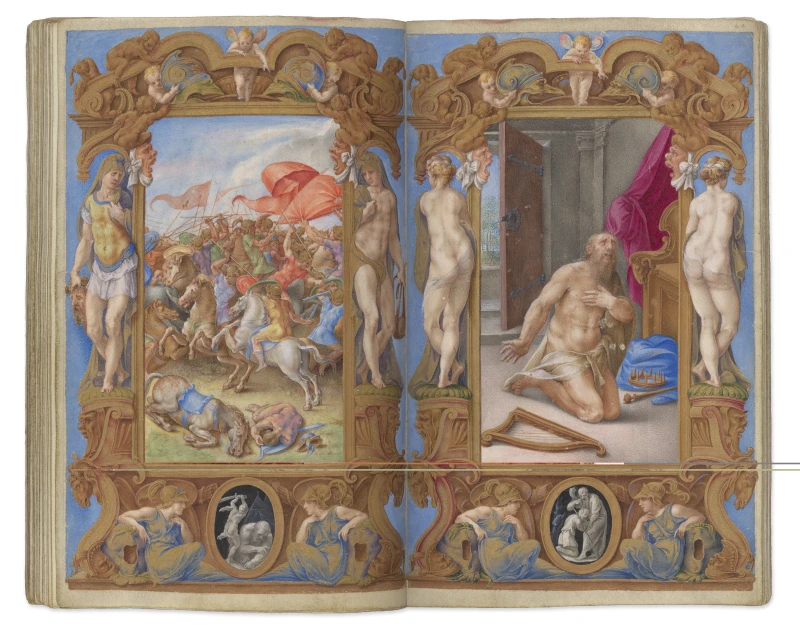
 Death of Uriah; David in Penance, from the Morgan’s famed Farnese Hours, demonstrates the enduring appeal of the penitential Psalms of David as seen in this early Renaissance book of hours. Italy, Rome, 1546. The Morgan Library & Museum, New York, MS M.69, fols, 63v-63r. Photography by Janny Chiu. / Credit: Courtesy of the New York Library

New York City, New York, Nov 30, 2025 / 08:00 am (CNA).
Part of the New York Public Library’s Spencer Collection, the Tickhill Psalter is on view throughout Advent and Christmas at The Morgan Library & Museum in its exhibit “Sing a New Song: The Psalms in Medieval Art and Life.” A full-page Jesse Tree introduces the Psalms in the Tickhill Psalter, a 14th-century illuminated manuscript from the Augustinian Worksop Priory in Nottinghamshire, England. Tree of Jesse (Psalm 1), from the Tickhill Psalter, England, Nottinghamshire, Worksop Priory, 1303-14, New York Public Library, Spencer 26. fol. 6v. The Medieval manuscript is on display in Morgan Library’s Advent exhibit. Credit: Courtesy of the Morgan LibraryDavid appears in the historiated B of Psalm 1, providing a conceptual link to scenes from his life in the Jesse Tree on the facing page. “Beatus vir,” or “Blessed is the man,” the first stanza opens in celebration of the one who delights in God’s law, concluding: “That person is like a tree planted by streams of water, which yields its fruit in season and whose leaf does not wither, — what they do prospers.” These words and their historiated B, with its visual link to the facing page, highlight David as key author of the Psalms and their prefiguration of Christ, the good fruit of the Jesse Tree, a theme common to medieval illuminated manuscripts.King David as Psalmist, from Florence, Italy, ca. 1408-10, by Lorenzo Monaco, who was born Piero di Giovanni but took the name Lorenzo Monaco, or Lorenzo the Monk, upon joining the monastery of Santa Maria degli Angeli, where he became a skilled illuminator and translated themes common to illuminated manuscripts into panel paintings, like this tempera on wood with gold ground depicting David seated on a stone bench tuning a psaltery, lips parted, prepared to sing, with a halo backing the crown he wears to signify the divine inspiration of his compositions. The Metropolitan Museum of Art, New York, 65.14.4. November 2025. Credit: Courtesy of the Metropolitan Museum of Art, New YorkProphets stand in architectural niches on either side of the Tickhill Psalter’s Jesse Tree, heralding the Psalms as prophecy. Credit: Courtesy of the New York LibraryThe central panel of a 1490 Flemish triptych with scenes from the life of Saint Augustine contextualizes the exhibit. This five-by-five-foot oil on wood painting references Augustine’s use of allegory, essential to his understanding of scripture and interpretation of the psalms as prophecy. One scene captures Augustine’s realization of the Trinity as boundless mystery that dwarfs human understanding, allegorized by a child trying to pour the sea into a hole in the sand. Scenes from the life of St. Augustine of Hippo, 1490, Bruges, Belgium, by the unnamed master of St. Augustine, amplifies the Church’s leading theologian on the allegorical interpretation of Psalms. At center, his installation as bishop of Hippo highlights his teaching authority, flanked by scenes of ordination and preaching on the left. On the right, he engages in scholarly discourse and converses with a child trying to pour the sea into a hole in the sand, illustrating the importance of allegory in Augustinian thought. Credit: Courtesy of the New York Public LibraryLate 12th-century book comprised of Augustine’s Gradual Psalms and his Enchiridion (Greek for “handbook”). The well-worn and annotated pages reflect the proliferation of Augustinian influence on interpretation of Scripture. Spain, Santa Maria de Benevivere, near Palencia. Free Library of Philadelphia, Lewis E22, fols. 68v-69r. Credit: Courtesy of the New York Public LibraryIn the book accompanying the exhibit, Morgan curator Deirdre Jackson extends the psalms’ significance to this triptych through a reference to a surviving panel housed in Ireland that shows Augustine on his deathbed. It’s a scene described by contemporary bishop Possidius of Calama, who said that Augustine “ordered those psalms of David which are especially penitential to be copied out and, when he was very weak, used to lie in bed, facing the wall where the written sheets were put up, gazing at them and reading them, and copiously and continuously weeping as he read.”Death of Uriah; David in Penance, from the Morgan’s famed Farnese Hours, demonstrates the enduring appeal of the penitential Psalms of David as seen in this early Renaissance book of hours. Italy, Rome, 1546. The Morgan Library & Museum, New York, MS M.69, fols, 63v-63r. Photography by Janny Chiu. Credit: Courtesy of the New York Public LibraryScenes from the Life of David, depicting the story of David and Goliath, exemplifies the significance attached to the figure of David in medieval illuminated manuscripts. Winchester Bible, England, Winchester, ca. 1160-80. The Morgan Library & Museum, New York, MS M.619v. Photography by Graham S. Haber. Credit: Courtesy of the New York LibraryIn his book “The Tickhill Psalter and Related Manuscripts,” 20th-century art historian Donald Drew Egbert speculates that the Tickhill Psalter was decorated by highly skilled illuminators working for Augustinian monasteries and patrons of Augustinian houses during a high point of book arts in England.St. Thomas More, “in tribulation vehementi et in carcere” (annotation), from the Prayer Book of Thomas More, France, Paris, 1522 (Psalter) and 1530 (Book of Hours), Beinecke Rare Book & Manuscript Library, Yale University, New Haven, MS Vault More, fol. 68v (Psalter section). Credit: Courtesy of the New York LibraryThis high point inspired a trend of books as personalized treasures, best exemplified in this exhibit by St. Thomas More’s prayer book. Containing much of his own writing in the margins, it consists of a Book of Hours and a Psalter and was with him in the Tower of London while he awaited execution. More’s notes during that time show his preoccupation with the psalms of David’s tribulations. Beside Psalm 87:5-10, “a man without help … in the dark places, and in the shadow of death,” More writes, “in severe tribulation and in prison.”The Prayer Book of Thomas More is backed by a wall-sized image of Hans Holbein’s “Sir Thomas More,” positioned to look like More is gazing intently across the gallery at an image of David from the Crusader Bible. Engelhard Gallery, Photography by Janny Chiu, October 2025. Credit: Courtesy of the New York LibraryMore’s thoughts in distress demonstrate the appeal of David’s story to the human heart, a reality repeatedly expressed throughout the treasures of this exhibit. In the Tickhill Psalter’s Jesse Tree, David is encircled by branches springing from a tree that grows out of his father, Jesse, sprawled in an active sleep, his elbow supporting a hand planted against his head as though dreaming of all that is to come. A crop of the enter of Tickhill Psalter showing the Virgin and Child and the figure of David playing a harp. Credit: Courtesy of the New York LibraryThe branches of the tree wind around David and directly overhead to encircle the Virgin and Child, tracing Christ’s lineage through Mary to the House of David. At the top, the branches surround Christ enthroned in majesty, fulfilling the promise of victory over sin and death foreshadowed in the psalms.David strikes a joyous pose and plays a harp in celebration, and foliage on either side of the main branch wraps around prophets who unfurl scrolls to hint at mysteries about to be foretold in the reading of the psalms.Beneath the figure of Jesse, two separate depictions of David protecting his sheep from wild animals cast his actions as allegory in the fight against evil, segueing to his likeness in the historiated B, dancing and singing his story into the Psalms to animate their prefiguration of Christ.

PHOTOS: Tickhill Psalter’s Jesse Tree shines in Morgan Library’s Advent exhibit #Catholic Death of Uriah; David in Penance, from the Morgan’s famed Farnese Hours, demonstrates the enduring appeal of the penitential Psalms of David as seen in this early Renaissance book of hours. Italy, Rome, 1546. The Morgan Library & Museum, New York, MS M.69, fols, 63v-63r. Photography by Janny Chiu. / Credit: Courtesy of the New York Library New York City, New York, Nov 30, 2025 / 08:00 am (CNA). Part of the New York Public Library’s Spencer Collection, the Tickhill Psalter is on view throughout Advent and Christmas at The Morgan Library & Museum in its exhibit “Sing a New Song: The Psalms in Medieval Art and Life.” A full-page Jesse Tree introduces the Psalms in the Tickhill Psalter, a 14th-century illuminated manuscript from the Augustinian Worksop Priory in Nottinghamshire, England. Tree of Jesse (Psalm 1), from the Tickhill Psalter, England, Nottinghamshire, Worksop Priory, 1303-14, New York Public Library, Spencer 26. fol. 6v. The Medieval manuscript is on display in Morgan Library’s Advent exhibit. Credit: Courtesy of the Morgan LibraryDavid appears in the historiated B of Psalm 1, providing a conceptual link to scenes from his life in the Jesse Tree on the facing page. “Beatus vir,” or “Blessed is the man,” the first stanza opens in celebration of the one who delights in God’s law, concluding: “That person is like a tree planted by streams of water, which yields its fruit in season and whose leaf does not wither, — what they do prospers.” These words and their historiated B, with its visual link to the facing page, highlight David as key author of the Psalms and their prefiguration of Christ, the good fruit of the Jesse Tree, a theme common to medieval illuminated manuscripts.King David as Psalmist, from Florence, Italy, ca. 1408-10, by Lorenzo Monaco, who was born Piero di Giovanni but took the name Lorenzo Monaco, or Lorenzo the Monk, upon joining the monastery of Santa Maria degli Angeli, where he became a skilled illuminator and translated themes common to illuminated manuscripts into panel paintings, like this tempera on wood with gold ground depicting David seated on a stone bench tuning a psaltery, lips parted, prepared to sing, with a halo backing the crown he wears to signify the divine inspiration of his compositions. The Metropolitan Museum of Art, New York, 65.14.4. November 2025. Credit: Courtesy of the Metropolitan Museum of Art, New YorkProphets stand in architectural niches on either side of the Tickhill Psalter’s Jesse Tree, heralding the Psalms as prophecy. Credit: Courtesy of the New York LibraryThe central panel of a 1490 Flemish triptych with scenes from the life of Saint Augustine contextualizes the exhibit. This five-by-five-foot oil on wood painting references Augustine’s use of allegory, essential to his understanding of scripture and interpretation of the psalms as prophecy. One scene captures Augustine’s realization of the Trinity as boundless mystery that dwarfs human understanding, allegorized by a child trying to pour the sea into a hole in the sand. Scenes from the life of St. Augustine of Hippo, 1490, Bruges, Belgium, by the unnamed master of St. Augustine, amplifies the Church’s leading theologian on the allegorical interpretation of Psalms. At center, his installation as bishop of Hippo highlights his teaching authority, flanked by scenes of ordination and preaching on the left. On the right, he engages in scholarly discourse and converses with a child trying to pour the sea into a hole in the sand, illustrating the importance of allegory in Augustinian thought. Credit: Courtesy of the New York Public LibraryLate 12th-century book comprised of Augustine’s Gradual Psalms and his Enchiridion (Greek for “handbook”). The well-worn and annotated pages reflect the proliferation of Augustinian influence on interpretation of Scripture. Spain, Santa Maria de Benevivere, near Palencia. Free Library of Philadelphia, Lewis E22, fols. 68v-69r. Credit: Courtesy of the New York Public LibraryIn the book accompanying the exhibit, Morgan curator Deirdre Jackson extends the psalms’ significance to this triptych through a reference to a surviving panel housed in Ireland that shows Augustine on his deathbed. It’s a scene described by contemporary bishop Possidius of Calama, who said that Augustine “ordered those psalms of David which are especially penitential to be copied out and, when he was very weak, used to lie in bed, facing the wall where the written sheets were put up, gazing at them and reading them, and copiously and continuously weeping as he read.”Death of Uriah; David in Penance, from the Morgan’s famed Farnese Hours, demonstrates the enduring appeal of the penitential Psalms of David as seen in this early Renaissance book of hours. Italy, Rome, 1546. The Morgan Library & Museum, New York, MS M.69, fols, 63v-63r. Photography by Janny Chiu. Credit: Courtesy of the New York Public LibraryScenes from the Life of David, depicting the story of David and Goliath, exemplifies the significance attached to the figure of David in medieval illuminated manuscripts. Winchester Bible, England, Winchester, ca. 1160-80. The Morgan Library & Museum, New York, MS M.619v. Photography by Graham S. Haber. Credit: Courtesy of the New York LibraryIn his book “The Tickhill Psalter and Related Manuscripts,” 20th-century art historian Donald Drew Egbert speculates that the Tickhill Psalter was decorated by highly skilled illuminators working for Augustinian monasteries and patrons of Augustinian houses during a high point of book arts in England.St. Thomas More, “in tribulation vehementi et in carcere” (annotation), from the Prayer Book of Thomas More, France, Paris, 1522 (Psalter) and 1530 (Book of Hours), Beinecke Rare Book & Manuscript Library, Yale University, New Haven, MS Vault More, fol. 68v (Psalter section). Credit: Courtesy of the New York LibraryThis high point inspired a trend of books as personalized treasures, best exemplified in this exhibit by St. Thomas More’s prayer book. Containing much of his own writing in the margins, it consists of a Book of Hours and a Psalter and was with him in the Tower of London while he awaited execution. More’s notes during that time show his preoccupation with the psalms of David’s tribulations. Beside Psalm 87:5-10, “a man without help … in the dark places, and in the shadow of death,” More writes, “in severe tribulation and in prison.”The Prayer Book of Thomas More is backed by a wall-sized image of Hans Holbein’s “Sir Thomas More,” positioned to look like More is gazing intently across the gallery at an image of David from the Crusader Bible. Engelhard Gallery, Photography by Janny Chiu, October 2025. Credit: Courtesy of the New York LibraryMore’s thoughts in distress demonstrate the appeal of David’s story to the human heart, a reality repeatedly expressed throughout the treasures of this exhibit. In the Tickhill Psalter’s Jesse Tree, David is encircled by branches springing from a tree that grows out of his father, Jesse, sprawled in an active sleep, his elbow supporting a hand planted against his head as though dreaming of all that is to come. A crop of the enter of Tickhill Psalter showing the Virgin and Child and the figure of David playing a harp. Credit: Courtesy of the New York LibraryThe branches of the tree wind around David and directly overhead to encircle the Virgin and Child, tracing Christ’s lineage through Mary to the House of David. At the top, the branches surround Christ enthroned in majesty, fulfilling the promise of victory over sin and death foreshadowed in the psalms.David strikes a joyous pose and plays a harp in celebration, and foliage on either side of the main branch wraps around prophets who unfurl scrolls to hint at mysteries about to be foretold in the reading of the psalms.Beneath the figure of Jesse, two separate depictions of David protecting his sheep from wild animals cast his actions as allegory in the fight against evil, segueing to his likeness in the historiated B, dancing and singing his story into the Psalms to animate their prefiguration of Christ.


Death of Uriah; David in Penance, from the Morgan’s famed Farnese Hours, demonstrates the enduring appeal of the penitential Psalms of David as seen in this early Renaissance book of hours. Italy, Rome, 1546. The Morgan Library & Museum, New York, MS M.69, fols, 63v-63r. Photography by Janny Chiu. / Credit: Courtesy of the New York Library

New York City, New York, Nov 30, 2025 / 08:00 am (CNA).

Part of the New York Public Library’s Spencer Collection, the Tickhill Psalter is on view throughout Advent and Christmas at The Morgan Library & Museum in its exhibit “Sing a New Song: The Psalms in Medieval Art and Life.” A full-page Jesse Tree introduces the Psalms in the Tickhill Psalter, a 14th-century illuminated manuscript from the Augustinian Worksop Priory in Nottinghamshire, England.

Tree of Jesse (Psalm 1), from the Tickhill Psalter, England, Nottinghamshire, Worksop Priory, 1303-14, New York Public Library, Spencer 26. fol. 6v. The Medieval manuscript is on display in Morgan Library’s Advent exhibit. Credit: Courtesy of the Morgan Library

David appears in the historiated B of Psalm 1, providing a conceptual link to scenes from his life in the Jesse Tree on the facing page. “Beatus vir,” or “Blessed is the man,” the first stanza opens in celebration of the one who delights in God’s law, concluding: “That person is like a tree planted by streams of water, which yields its fruit in season and whose leaf does not wither, — what they do prospers.” 

These words and their historiated B, with its visual link to the facing page, highlight David as key author of the Psalms and their prefiguration of Christ, the good fruit of the Jesse Tree, a theme common to medieval illuminated manuscripts.

King David as Psalmist, from Florence, Italy, ca. 1408-10, by Lorenzo Monaco, who was born Piero di Giovanni but took the name Lorenzo Monaco, or Lorenzo the Monk, upon joining the monastery of Santa Maria degli Angeli, where he became a skilled illuminator and translated themes common to illuminated manuscripts into panel paintings, like this tempera on wood with gold ground depicting David seated on a stone bench tuning a psaltery, lips parted, prepared to sing, with a halo backing the crown he wears to signify the divine inspiration of his compositions. The Metropolitan Museum of Art, New York, 65.14.4. November 2025. Credit: Courtesy of the Metropolitan Museum of Art, New York
Prophets stand in architectural niches on either side of the Tickhill Psalter’s Jesse Tree, heralding the Psalms as prophecy. Credit: Courtesy of the New York Library

The central panel of a 1490 Flemish triptych with scenes from the life of Saint Augustine contextualizes the exhibit. This five-by-five-foot oil on wood painting references Augustine’s use of allegory, essential to his understanding of scripture and interpretation of the psalms as prophecy. One scene captures Augustine’s realization of the Trinity as boundless mystery that dwarfs human understanding, allegorized by a child trying to pour the sea into a hole in the sand. 

Scenes from the life of St. Augustine of Hippo, 1490, Bruges, Belgium, by the unnamed master of St. Augustine, amplifies the Church’s leading theologian on the allegorical interpretation of Psalms. At center, his installation as bishop of Hippo highlights his teaching authority, flanked by scenes of ordination and preaching on the left. On the right, he engages in scholarly discourse and converses with a child trying to pour the sea into a hole in the sand, illustrating the importance of allegory in Augustinian thought. Credit: Courtesy of the New York Public Library
Late 12th-century book comprised of Augustine’s Gradual Psalms and his Enchiridion (Greek for “handbook”). The well-worn and annotated pages reflect the proliferation of Augustinian influence on interpretation of Scripture. Spain, Santa Maria de Benevivere, near Palencia. Free Library of Philadelphia, Lewis E22, fols. 68v-69r. Credit: Courtesy of the New York Public Library

In the book accompanying the exhibit, Morgan curator Deirdre Jackson extends the psalms’ significance to this triptych through a reference to a surviving panel housed in Ireland that shows Augustine on his deathbed. It’s a scene described by contemporary bishop Possidius of Calama, who said that Augustine “ordered those psalms of David which are especially penitential to be copied out and, when he was very weak, used to lie in bed, facing the wall where the written sheets were put up, gazing at them and reading them, and copiously and continuously weeping as he read.”

Death of Uriah; David in Penance, from the Morgan’s famed Farnese Hours, demonstrates the enduring appeal of the penitential Psalms of David as seen in this early Renaissance book of hours. Italy, Rome, 1546. The Morgan Library & Museum, New York, MS M.69, fols, 63v-63r. Photography by Janny Chiu. Credit: Courtesy of the New York Public Library
Scenes from the Life of David, depicting the story of David and Goliath, exemplifies the significance attached to the figure of David in medieval illuminated manuscripts. Winchester Bible, England, Winchester, ca. 1160-80. The Morgan Library & Museum, New York, MS M.619v. Photography by Graham S. Haber. Credit: Courtesy of the New York Library

In his book “The Tickhill Psalter and Related Manuscripts,” 20th-century art historian Donald Drew Egbert speculates that the Tickhill Psalter was decorated by highly skilled illuminators working for Augustinian monasteries and patrons of Augustinian houses during a high point of book arts in England.

St. Thomas More, “in tribulation vehementi et in carcere” (annotation), from the Prayer Book of Thomas More, France, Paris, 1522 (Psalter) and 1530 (Book of Hours), Beinecke Rare Book & Manuscript Library, Yale University, New Haven, MS Vault More, fol. 68v (Psalter section). Credit: Courtesy of the New York Library

This high point inspired a trend of books as personalized treasures, best exemplified in this exhibit by St. Thomas More’s prayer book. Containing much of his own writing in the margins, it consists of a Book of Hours and a Psalter and was with him in the Tower of London while he awaited execution. More’s notes during that time show his preoccupation with the psalms of David’s tribulations. Beside Psalm 87:5-10, “a man without help … in the dark places, and in the shadow of death,” More writes, “in severe tribulation and in prison.”

The Prayer Book of Thomas More is backed by a wall-sized image of Hans Holbein’s "Sir Thomas More," positioned to look like More is gazing intently across the gallery at an image of David from the Crusader Bible. Engelhard Gallery, Photography by Janny Chiu, October 2025. Credit: Courtesy of the New York Library
The Prayer Book of Thomas More is backed by a wall-sized image of Hans Holbein’s “Sir Thomas More,” positioned to look like More is gazing intently across the gallery at an image of David from the Crusader Bible. Engelhard Gallery, Photography by Janny Chiu, October 2025. Credit: Courtesy of the New York Library

More’s thoughts in distress demonstrate the appeal of David’s story to the human heart, a reality repeatedly expressed throughout the treasures of this exhibit. In the Tickhill Psalter’s Jesse Tree, David is encircled by branches springing from a tree that grows out of his father, Jesse, sprawled in an active sleep, his elbow supporting a hand planted against his head as though dreaming of all that is to come. 

A crop of the enter of Tickhill Psalter showing the Virgin and Child and the figure of David playing a harp. Credit: Courtesy of the New York Library

The branches of the tree wind around David and directly overhead to encircle the Virgin and Child, tracing Christ’s lineage through Mary to the House of David. At the top, the branches surround Christ enthroned in majesty, fulfilling the promise of victory over sin and death foreshadowed in the psalms.

David strikes a joyous pose and plays a harp in celebration, and foliage on either side of the main branch wraps around prophets who unfurl scrolls to hint at mysteries about to be foretold in the reading of the psalms.

Beneath the figure of Jesse, two separate depictions of David protecting his sheep from wild animals cast his actions as allegory in the fight against evil, segueing to his likeness in the historiated B, dancing and singing his story into the Psalms to animate their prefiguration of Christ.

Read More


Newly Found Organics in Enceladus’ Plumes – NASA’s Cassini spacecraft captured dramatic plumes, both large and small, spray water ice out from many locations along the famed ‘tiger stripes’ near the south pole of Saturn’s moon Enceladus.

NASA’s Cassini spacecraft captured dramatic plumes, both large and small, spray water ice out from many locations along the famed ‘tiger stripes’ near the south pole of Saturn’s moon Enceladus.

Read More
Filipino archbishop asks Catholics to attend protests against government corruption #Catholic 
 
 Members of Iglesia ni Cristo take part in a protest against corruption on Nov. 16, 2025 in Manila, Philippines. A powerful Philippine megachurch, Iglesia ni Cristo, mobilized over half a million members to join growing protests over alleged corruption in multibillion-peso flood control projects. Catholic leaders in the Philippines have also mobilized Catholics to participate in similar marches. / Credit: Ezra Acayan/Getty Images

CNA Staff, Nov 28, 2025 / 05:53 am (CNA).
Here is a roundup of Catholic world news from the past week that you might have missed. Filipino archbishop asks Catholics to attend protests against government corruptionCardinal Pablo Virgilio David, the outgoing president of the Catholic Bishops’ Conference of the Philippines, has invited Filipinos across the country to attend rallies this weekend in Manila to protest government corruption. The protest comes on the heels of the Trillion Peso March held on Sept. 21, which drew hundreds of thousands.Thousands of Filipinos are expected to participate in the march Sunday, according to Herald Malaysia Online. The protests come amid a growing political crisis and rising public anger over scandals and abuses of government funds.Priest and security guard attacked in Trinidad A priest and a security guard at St. Benedict’s Roman Catholic Church in La Romaine, Trinidad, were the victims of an attack and robbery on Monday, Trinidad Express reported. Five attackers cut the electricity, bound the security guard, entered the rectory, woke and tied up the priest Father Derek Anton, and stole various electronics and cash. The crime is being investigated and the Archdiocese of Port of Spain has confirmed it. “At this time we ask you all for your prayers [for the victims] and for all victims of crime,” the archdiocese said in its statement.Mozambique archbishop pleads for humanitarian support to aid displaced peopleArchbishop Inacio Saure of Namula, Mozambique, has issued an urgent plea for humanitarian aid for more than 30,000 people who have been displaced in the Alua district of Memba. Saure, who is also president of the Episcopal Conference of Mozambique told Vatican News that the people have fled their homes “are currently sheltering in the administrative post of Alua” due to recent terrorist incursions in Nampula province. The archbishop said he has instructed Caritas in Nampula to respond to the crisis. Catholic Church rallies in Thailand to assist victims of historic flooding Historic flooding in southern Thailand has impacted over two million people, causing death and destruction and stranding many tourists. According to Vatican News, in response to the disaster Bishop Paul Trairong Multree of the Diocese of Surat Thani called a meeting Tuesday of Church-led relief groups. “Our relief team will get working tomorrow morning immediately with [the Catholic Office for Emergency Relief and Refugees], bringing drinking water and essentials to the people affected,” Trairong reportedly told LiCAS News, adding that supplies are expected to arrive from Bangkok and other dioceses. Tensions between Pakistanis and Afghans may erupt into new war, says Karachi priestEscalating tensions between Pakistan and Afghanistan have created fear that a new war may be on the horizon, according to Father Mario Angelo Rodrigues, a priest of the Archdiocese of Karachi and rector of St. Patrick’s Catholic High School in Karachi. He told Fides that resentments and fears have built in the wake of the influx of Afghani refugees and recent terrorist attacks. “To re-establish a climate of mutual trust and embark on a path to peace, the Pakistani government should accept the situation and grant residency to Afghan refugees who are living peacefully and have no links to terrorism, in the spirit of an open and pluralistic society,” the priest said. He also noted that “the government in Kabul should cooperate in combating terrorism, our common enemy. As Pakistani Christians, we support paths of acceptance and brotherhood so that we can live in true peace within our society and with our neighbors." Nun who fights human trafficking reacts to new UN report on femicideIn the wake of a new UN report highlighting the high numbers of women killed by men and new forms of violence being caused by tech developments, Sister Abby Avelino, the international coordinator of Talitha Kum, an international group that fights human trafficking, told Vatican News that, “Digital violence is increasingly widespread, and the online world is now a major site of exploitation.” The UN report shows that more than 38% of women are estimated to have experienced online violence, while 85% have witnessed abuse directed at other women on digital platforms.

Filipino archbishop asks Catholics to attend protests against government corruption #Catholic Members of Iglesia ni Cristo take part in a protest against corruption on Nov. 16, 2025 in Manila, Philippines. A powerful Philippine megachurch, Iglesia ni Cristo, mobilized over half a million members to join growing protests over alleged corruption in multibillion-peso flood control projects. Catholic leaders in the Philippines have also mobilized Catholics to participate in similar marches. / Credit: Ezra Acayan/Getty Images CNA Staff, Nov 28, 2025 / 05:53 am (CNA). Here is a roundup of Catholic world news from the past week that you might have missed. Filipino archbishop asks Catholics to attend protests against government corruptionCardinal Pablo Virgilio David, the outgoing president of the Catholic Bishops’ Conference of the Philippines, has invited Filipinos across the country to attend rallies this weekend in Manila to protest government corruption. The protest comes on the heels of the Trillion Peso March held on Sept. 21, which drew hundreds of thousands.Thousands of Filipinos are expected to participate in the march Sunday, according to Herald Malaysia Online. The protests come amid a growing political crisis and rising public anger over scandals and abuses of government funds.Priest and security guard attacked in Trinidad A priest and a security guard at St. Benedict’s Roman Catholic Church in La Romaine, Trinidad, were the victims of an attack and robbery on Monday, Trinidad Express reported. Five attackers cut the electricity, bound the security guard, entered the rectory, woke and tied up the priest Father Derek Anton, and stole various electronics and cash. The crime is being investigated and the Archdiocese of Port of Spain has confirmed it. “At this time we ask you all for your prayers [for the victims] and for all victims of crime,” the archdiocese said in its statement.Mozambique archbishop pleads for humanitarian support to aid displaced peopleArchbishop Inacio Saure of Namula, Mozambique, has issued an urgent plea for humanitarian aid for more than 30,000 people who have been displaced in the Alua district of Memba. Saure, who is also president of the Episcopal Conference of Mozambique told Vatican News that the people have fled their homes “are currently sheltering in the administrative post of Alua” due to recent terrorist incursions in Nampula province. The archbishop said he has instructed Caritas in Nampula to respond to the crisis. Catholic Church rallies in Thailand to assist victims of historic flooding Historic flooding in southern Thailand has impacted over two million people, causing death and destruction and stranding many tourists. According to Vatican News, in response to the disaster Bishop Paul Trairong Multree of the Diocese of Surat Thani called a meeting Tuesday of Church-led relief groups. “Our relief team will get working tomorrow morning immediately with [the Catholic Office for Emergency Relief and Refugees], bringing drinking water and essentials to the people affected,” Trairong reportedly told LiCAS News, adding that supplies are expected to arrive from Bangkok and other dioceses. Tensions between Pakistanis and Afghans may erupt into new war, says Karachi priestEscalating tensions between Pakistan and Afghanistan have created fear that a new war may be on the horizon, according to Father Mario Angelo Rodrigues, a priest of the Archdiocese of Karachi and rector of St. Patrick’s Catholic High School in Karachi. He told Fides that resentments and fears have built in the wake of the influx of Afghani refugees and recent terrorist attacks. “To re-establish a climate of mutual trust and embark on a path to peace, the Pakistani government should accept the situation and grant residency to Afghan refugees who are living peacefully and have no links to terrorism, in the spirit of an open and pluralistic society,” the priest said. He also noted that “the government in Kabul should cooperate in combating terrorism, our common enemy. As Pakistani Christians, we support paths of acceptance and brotherhood so that we can live in true peace within our society and with our neighbors.” Nun who fights human trafficking reacts to new UN report on femicideIn the wake of a new UN report highlighting the high numbers of women killed by men and new forms of violence being caused by tech developments, Sister Abby Avelino, the international coordinator of Talitha Kum, an international group that fights human trafficking, told Vatican News that, “Digital violence is increasingly widespread, and the online world is now a major site of exploitation.” The UN report shows that more than 38% of women are estimated to have experienced online violence, while 85% have witnessed abuse directed at other women on digital platforms.


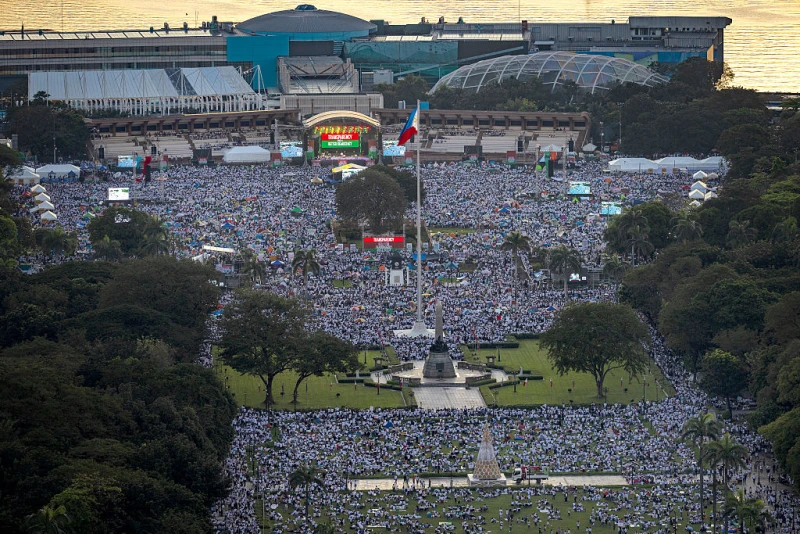
Members of Iglesia ni Cristo take part in a protest against corruption on Nov. 16, 2025 in Manila, Philippines. A powerful Philippine megachurch, Iglesia ni Cristo, mobilized over half a million members to join growing protests over alleged corruption in multibillion-peso flood control projects. Catholic leaders in the Philippines have also mobilized Catholics to participate in similar marches. / Credit: Ezra Acayan/Getty Images

CNA Staff, Nov 28, 2025 / 05:53 am (CNA).

Here is a roundup of Catholic world news from the past week that you might have missed. 

Filipino archbishop asks Catholics to attend protests against government corruption

Cardinal Pablo Virgilio David, the outgoing president of the Catholic Bishops’ Conference of the Philippines, has invited Filipinos across the country to attend rallies this weekend in Manila to protest government corruption. The protest comes on the heels of the Trillion Peso March held on Sept. 21, which drew hundreds of thousands.

Thousands of Filipinos are expected to participate in the march Sunday, according to Herald Malaysia Online. The protests come amid a growing political crisis and rising public anger over scandals and abuses of government funds.

Priest and security guard attacked in Trinidad 

A priest and a security guard at St. Benedict’s Roman Catholic Church in La Romaine, Trinidad, were the victims of an attack and robbery on Monday, Trinidad Express reported.

Five attackers cut the electricity, bound the security guard, entered the rectory, woke and tied up the priest Father Derek Anton, and stole various electronics and cash.

The crime is being investigated and the Archdiocese of Port of Spain has confirmed it. “At this time we ask you all for your prayers [for the victims] and for all victims of crime,” the archdiocese said in its statement.

Mozambique archbishop pleads for humanitarian support to aid displaced people

Archbishop Inacio Saure of Namula, Mozambique, has issued an urgent plea for humanitarian aid for more than 30,000 people who have been displaced in the Alua district of Memba.

Saure, who is also president of the Episcopal Conference of Mozambique told Vatican News that the people have fled their homes “are currently sheltering in the administrative post of Alua” due to recent terrorist incursions in Nampula province. The archbishop said he has instructed Caritas in Nampula to respond to the crisis. 

Catholic Church rallies in Thailand to assist victims of historic flooding

Historic flooding in southern Thailand has impacted over two million people, causing death and destruction and stranding many tourists. According to Vatican News, in response to the disaster Bishop Paul Trairong Multree of the Diocese of Surat Thani called a meeting Tuesday of Church-led relief groups.

“Our relief team will get working tomorrow morning immediately with [the Catholic Office for Emergency Relief and Refugees], bringing drinking water and essentials to the people affected,” Trairong reportedly told LiCAS News, adding that supplies are expected to arrive from Bangkok and other dioceses.

Tensions between Pakistanis and Afghans may erupt into new war, says Karachi priest

Escalating tensions between Pakistan and Afghanistan have created fear that a new war may be on the horizon, according to Father Mario Angelo Rodrigues, a priest of the Archdiocese of Karachi and rector of St. Patrick’s Catholic High School in Karachi.

He told Fides that resentments and fears have built in the wake of the influx of Afghani refugees and recent terrorist attacks. 

“To re-establish a climate of mutual trust and embark on a path to peace, the Pakistani government should accept the situation and grant residency to Afghan refugees who are living peacefully and have no links to terrorism, in the spirit of an open and pluralistic society,” the priest said.

He also noted that “the government in Kabul should cooperate in combating terrorism, our common enemy. As Pakistani Christians, we support paths of acceptance and brotherhood so that we can live in true peace within our society and with our neighbors.”

Nun who fights human trafficking reacts to new UN report on femicide

In the wake of a new UN report highlighting the high numbers of women killed by men and new forms of violence being caused by tech developments, Sister Abby Avelino, the international coordinator of Talitha Kum, an international group that fights human trafficking, told Vatican News that, “Digital violence is increasingly widespread, and the online world is now a major site of exploitation.” 

The UN report shows that more than 38% of women are estimated to have experienced online violence, while 85% have witnessed abuse directed at other women on digital platforms.

Read More
Catholic Charities gives Thanksgiving meals, winter coats to people in need #Catholic 
 
 Catholic Charities D.C. provides Thanksgiving meals to guests on Nov. 25, 2025. / Credit: Courtesy of Ralph Alswang for Catholic Charities D.C.

Washington, D.C. Newsroom, Nov 26, 2025 / 12:30 pm (CNA).
Catholic Charities D.C. in the Archdiocese of Washington teamed up with a metropolitan utility company this week to offer a Thanksgiving meal and winter supplies to low-income families and people experiencing homelessness.The Nov. 25 dinner, held at Pepco Co.’s  Edison Place Gallery, was provided through the St. Maria’s Meal Program. Numerous Catholic Charities affiliates in other parts of the country — including New York, Boston, and Cleveland — held similar events to provide food or resources to the needy during the Thanksgiving season.More than 300 guests came to the Washington, D.C. dinner, which included turkey and gravy, mashed potatoes, stuffing, collard greens, cranberry sauce, dinner rolls, and sweet potato pie. Guests were also offered winter coats, hats, socks, and toiletry kits.“Lord, please remind all of us here that we are all children of God and all have unique value, potential to soar, and immeasurable worth and dignity in your eyes — the only eyes that matter,” Jim Malloy, president and CEO of Catholic Charities D.C., said in a prayer before the dinner.“Help us to live out your Gospel, and as you told us in John 9, to do the works of your Father while it is day,” he prayed.Catholic Charities DC President and CEO James Malloy offers a prayer before a Thanksgiving meal Nov. 25, 2025. Credit: Courtesy of Ralph Alswang for Catholic Charities DC.The annual Thanksgiving dinner has been held for about 12 years. According to the most recent numbers from the federal government, the homelessness rate in the country is at an all-time high.Marie Maroun, a spokesperson for Catholic Charities D.C. and one of the 60 volunteers at the dinner, told CNA the event ensures a Thanksgiving meal for those experiencing homelessness or food insecurity, and “provides them with the dignity and respect that they definitely deserve.”Catholic Charities D.C. also provides food through food pantries and offers hot meals to those in need on Wednesdays.Eugene Brown, one of the guests, told CNA the meal was “excellent,” and said the regular meals are “helping in keeping our heads above water.”“God will bless the needy and not the greedy,” said Brown, who is Catholic.Malloy told CNA that providing hot meals helps “remind ourselves what’s important and who’s important.” He thanked the volunteers, including many of the high school students, who he said “find something very fundamental about their faith here.”“This is faith in action for them,” he said. Malloy said that when some in society treat those in need as though they are “expendable,” events like this “refute that.”“They’re created in the image of God,” he said. “They count.” Catholic Charities DC provides Thanksgiving meals to guests Nov. 25, 2025. Credit: Courtesy of Ralph Alswang for Catholic Charities DC.The most recent homelessness report from the Department of Housing & Urban Development (HUD) was published in December 2024 and the next annual report is expected in December 2025.In the 2024 report, HUD estimated that nearly 772,000 people were experiencing homelessness at the beginning of that year. The rate of homelessness increased by about 18% — representing 118,376 more people — in January 2024 when compared to January 2023.The 2024 report showed the highest number of people experiencing homelessness since HUD began collecting the data in 2007.Although more recent national numbers are not available, a report from the Washington D.C. Department of Human Services found a 9% decrease in the city’s homelessness from January 2024 to January 2025. However, it found there was only a 1% decrease in the city’s broader metropolitan area, with some nearby Virginia and Maryland counties seeing an uptick.President Donald Trump ordered removal of homeless encampments in Washington, D.C. in August 2025 and deployed National Guard troops to clear public spaces.

Catholic Charities gives Thanksgiving meals, winter coats to people in need #Catholic Catholic Charities D.C. provides Thanksgiving meals to guests on Nov. 25, 2025. / Credit: Courtesy of Ralph Alswang for Catholic Charities D.C. Washington, D.C. Newsroom, Nov 26, 2025 / 12:30 pm (CNA). Catholic Charities D.C. in the Archdiocese of Washington teamed up with a metropolitan utility company this week to offer a Thanksgiving meal and winter supplies to low-income families and people experiencing homelessness.The Nov. 25 dinner, held at Pepco Co.’s  Edison Place Gallery, was provided through the St. Maria’s Meal Program. Numerous Catholic Charities affiliates in other parts of the country — including New York, Boston, and Cleveland — held similar events to provide food or resources to the needy during the Thanksgiving season.More than 300 guests came to the Washington, D.C. dinner, which included turkey and gravy, mashed potatoes, stuffing, collard greens, cranberry sauce, dinner rolls, and sweet potato pie. Guests were also offered winter coats, hats, socks, and toiletry kits.“Lord, please remind all of us here that we are all children of God and all have unique value, potential to soar, and immeasurable worth and dignity in your eyes — the only eyes that matter,” Jim Malloy, president and CEO of Catholic Charities D.C., said in a prayer before the dinner.“Help us to live out your Gospel, and as you told us in John 9, to do the works of your Father while it is day,” he prayed.Catholic Charities DC President and CEO James Malloy offers a prayer before a Thanksgiving meal Nov. 25, 2025. Credit: Courtesy of Ralph Alswang for Catholic Charities DC.The annual Thanksgiving dinner has been held for about 12 years. According to the most recent numbers from the federal government, the homelessness rate in the country is at an all-time high.Marie Maroun, a spokesperson for Catholic Charities D.C. and one of the 60 volunteers at the dinner, told CNA the event ensures a Thanksgiving meal for those experiencing homelessness or food insecurity, and “provides them with the dignity and respect that they definitely deserve.”Catholic Charities D.C. also provides food through food pantries and offers hot meals to those in need on Wednesdays.Eugene Brown, one of the guests, told CNA the meal was “excellent,” and said the regular meals are “helping in keeping our heads above water.”“God will bless the needy and not the greedy,” said Brown, who is Catholic.Malloy told CNA that providing hot meals helps “remind ourselves what’s important and who’s important.” He thanked the volunteers, including many of the high school students, who he said “find something very fundamental about their faith here.”“This is faith in action for them,” he said. Malloy said that when some in society treat those in need as though they are “expendable,” events like this “refute that.”“They’re created in the image of God,” he said. “They count.” Catholic Charities DC provides Thanksgiving meals to guests Nov. 25, 2025. Credit: Courtesy of Ralph Alswang for Catholic Charities DC.The most recent homelessness report from the Department of Housing & Urban Development (HUD) was published in December 2024 and the next annual report is expected in December 2025.In the 2024 report, HUD estimated that nearly 772,000 people were experiencing homelessness at the beginning of that year. The rate of homelessness increased by about 18% — representing 118,376 more people — in January 2024 when compared to January 2023.The 2024 report showed the highest number of people experiencing homelessness since HUD began collecting the data in 2007.Although more recent national numbers are not available, a report from the Washington D.C. Department of Human Services found a 9% decrease in the city’s homelessness from January 2024 to January 2025. However, it found there was only a 1% decrease in the city’s broader metropolitan area, with some nearby Virginia and Maryland counties seeing an uptick.President Donald Trump ordered removal of homeless encampments in Washington, D.C. in August 2025 and deployed National Guard troops to clear public spaces.


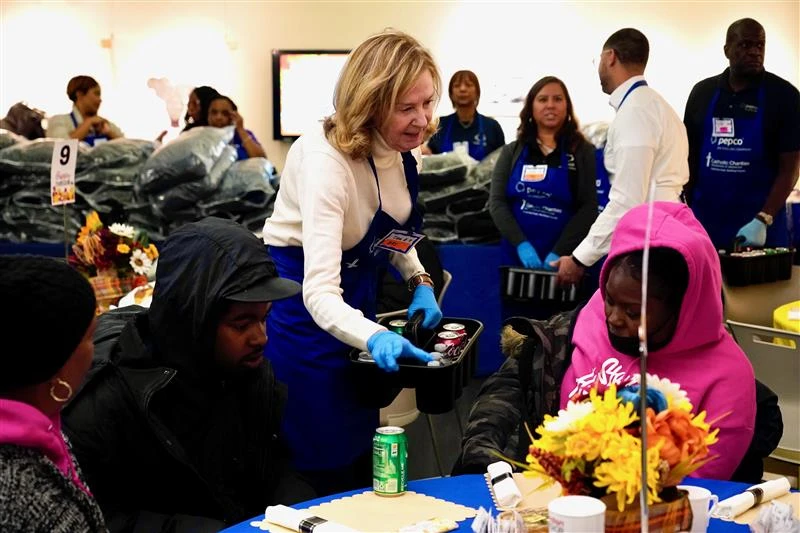
Catholic Charities D.C. provides Thanksgiving meals to guests on Nov. 25, 2025. / Credit: Courtesy of Ralph Alswang for Catholic Charities D.C.

Washington, D.C. Newsroom, Nov 26, 2025 / 12:30 pm (CNA).

Catholic Charities D.C. in the Archdiocese of Washington teamed up with a metropolitan utility company this week to offer a Thanksgiving meal and winter supplies to low-income families and people experiencing homelessness.

The Nov. 25 dinner, held at Pepco Co.’s  Edison Place Gallery, was provided through the St. Maria’s Meal Program. Numerous Catholic Charities affiliates in other parts of the country — including New York, Boston, and Cleveland — held similar events to provide food or resources to the needy during the Thanksgiving season.

More than 300 guests came to the Washington, D.C. dinner, which included turkey and gravy, mashed potatoes, stuffing, collard greens, cranberry sauce, dinner rolls, and sweet potato pie. Guests were also offered winter coats, hats, socks, and toiletry kits.

“Lord, please remind all of us here that we are all children of God and all have unique value, potential to soar, and immeasurable worth and dignity in your eyes — the only eyes that matter,” Jim Malloy, president and CEO of Catholic Charities D.C., said in a prayer before the dinner.

“Help us to live out your Gospel, and as you told us in John 9, to do the works of your Father while it is day,” he prayed.

Catholic Charities DC President and CEO James Malloy offers a prayer before a Thanksgiving meal Nov. 25, 2025. Credit: Courtesy of Ralph Alswang for Catholic Charities DC.

The annual Thanksgiving dinner has been held for about 12 years. According to the most recent numbers from the federal government, the homelessness rate in the country is at an all-time high.

Marie Maroun, a spokesperson for Catholic Charities D.C. and one of the 60 volunteers at the dinner, told CNA the event ensures a Thanksgiving meal for those experiencing homelessness or food insecurity, and “provides them with the dignity and respect that they definitely deserve.”

Catholic Charities D.C. also provides food through food pantries and offers hot meals to those in need on Wednesdays.

Eugene Brown, one of the guests, told CNA the meal was “excellent,” and said the regular meals are “helping in keeping our heads above water.”

“God will bless the needy and not the greedy,” said Brown, who is Catholic.

Malloy told CNA that providing hot meals helps “remind ourselves what’s important and who’s important.” He thanked the volunteers, including many of the high school students, who he said “find something very fundamental about their faith here.”

“This is faith in action for them,” he said. 

Malloy said that when some in society treat those in need as though they are “expendable,” events like this “refute that.”

“They’re created in the image of God,” he said. “They count.” 

Catholic Charities DC provides Thanksgiving meals to guests Nov. 25, 2025. Credit: Courtesy of Ralph Alswang for Catholic Charities DC.

The most recent homelessness report from the Department of Housing & Urban Development (HUD) was published in December 2024 and the next annual report is expected in December 2025.

In the 2024 report, HUD estimated that nearly 772,000 people were experiencing homelessness at the beginning of that year. The rate of homelessness increased by about 18% — representing 118,376 more people — in January 2024 when compared to January 2023.

The 2024 report showed the highest number of people experiencing homelessness since HUD began collecting the data in 2007.

Although more recent national numbers are not available, a report from the Washington D.C. Department of Human Services found a 9% decrease in the city’s homelessness from January 2024 to January 2025. However, it found there was only a 1% decrease in the city’s broader metropolitan area, with some nearby Virginia and Maryland counties seeing an uptick.

President Donald Trump ordered removal of homeless encampments in Washington, D.C. in August 2025 and deployed National Guard troops to clear public spaces.

Read More
DHS blasts order for improvements to migrant facility, says it houses ‘worst of the worst’ #Catholic 
 
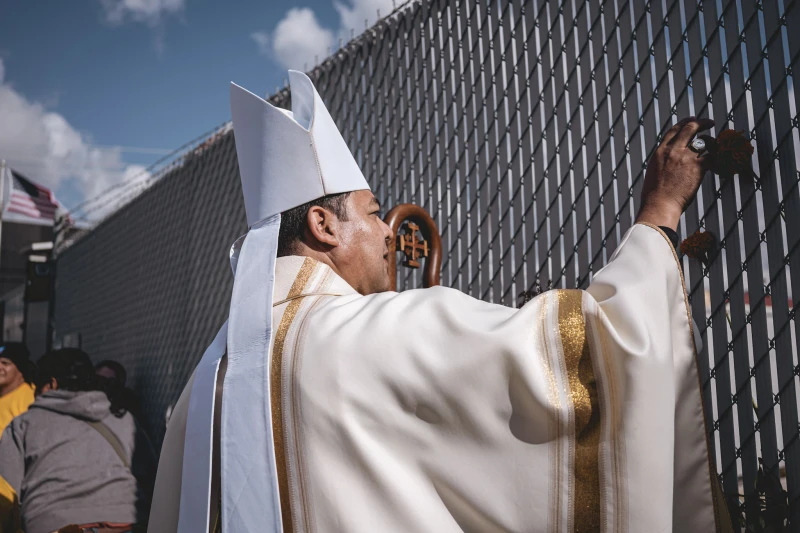
 Auxiliary Bishop Jose María García-Maldonado attempts to visit detainees at the Broadview, Illinois, immigration facility and was not admitted Nov. 1, 2025. / Credit: Bryan Sebastian, courtesy of Coalition for Spiritual and Public Leadership

Washington, D.C., Nov 7, 2025 / 18:40 pm (CNA).
The Trump administration this week denounced a Chicago-based federal judge’s ruling that mandated cleanliness and hygiene standards as well as adequate legal representation at a U.S. Immigration and Customs Enforcement (ICE) facility in Illinois.Government lawyers said Nov. 7 they are in compliance or are in the midst of complying with the judge’s conditions. The detainees’ attorneys, however, say they “are doubtful” the government is “actually in compliance” with some of the conditions, “including as to facility cleaning, the provision of food and water, and the provision of prescription medication.” The detainees’ attorneys asked the court to conduct an inspection with an expert and have the government provide immediate proof of compliance.Administration officials said an “activist judge” issued the temporary restraining order and based it on hoaxes, while religious and civil-rights advocates pressed for detainees’ access to the Eucharist. Access to CommunionA group of 19 spiritual leaders including six priests renewed a request to offer pastoral care and Communion at the Broadview facility in a Nov. 6 letter to ICE and asked to discuss “procedures by which our small delegation of religious ministers can be granted access.” The delegation bringing Communion was denied access Nov. 1.Scene from Nov. 1, 2025, Mass outside the Broadview facility near Chicago where immigration advocates allege federal authorities inhumanely treat detainees. Credit: Bryan Sebastian, courtesy of Coalition for Spiritual and Public LeadershipThe judge’s temporary restraining order followed an Oct. 30 lawsuit in which detainees claimed they were placed in unsanitary conditions, provided inadequate food and water, and unconstitutionally deprived of access to legal representation and spiritual care. The Department of Homeland Security (DHS) said ICE’s Broadview facility houses “criminal illegal aliens” whom it described as “some of the worst of the worst.”“Some of the worst of the worst including pedophiles, gang members, and rapists have been processed through the facility in recent weeks,” Tricia McLaughlin, assistant Homeland Security secretary for public affairs, said in a Nov. 5 statement.The list included Jose Manuel Escobar-Cardona, described by DHS as “a criminal illegal alien” from Honduras who was convicted of multiple charges of lewd or lascivious acts with a minor, assault, driving under the influence of liquor, making a false report, illegal reentry, and making a false report.Also named by DHS was Alfonso Batalla-Garcia, “a criminal illegal alien from Mexico, convicted of sex assault, kidnapping an adult to sexually assault, and homicide.”Other detainees named by DHS included migrants who were said to have been convicted of drug trafficking, kidnapping, first-degree murder, and weapons trafficking. Publicly reported individuals detained by ICE in November also included a day care worker at the Rayito De Sol center, a Chicago preschool where the woman was removed in front of children.Pope Leo XIV on Nov. 4 said: “Many people who’ve lived for years and years and years, never causing problems, have been deeply affected by what’s going on right now.” Leo invited authorities to allow pastoral workers to attend to the needs of detainees.He reminded that “Jesus says very clearly … at the end of the world, we’re going to be asked … how did you receive the foreigner? Did you receive him and welcome him or not? And I think that there’s a deep reflection that needs to be made in terms of what’s happening.”A detainee testified he spent six days at the Broadview ICE facility before Judge Robert Gettleman ordered bedding, three meals a day, free water, hygiene products, papers translated into Spanish, a clock in each hold room, and free phone service for detainees to talk to counsel. Gettleman also ordered DHS to list all detainees on the Locator Online Detainee Locator System of ICE.DHS says facilities such as Broadview are designed to serve only as short-term holding centers, typically for about 12 hours, where individuals are briefly held for processing before being moved to longer-term detention facilities.“Despite hoaxes spread by criminal illegal aliens, the complicit media, and now an activist judge, the ICE Broadview facility does not have subpar conditions,” McLaughlin said. She said detainees receive three meals a day, access to water, and proper medical care.Neither McLaughlin’s statement nor the judge’s order addressed the lawsuit’s claims that Broadview detainees have been unconstitutionally denied access to faith leaders and clergy.McLaughlin wrote on X that “religious organizations have ALWAYS been welcome to provide services to detainees in ICE detention facilities. Religious leaders may request access to facilities through proper channels and have those requests approved.”McLaughlin also responded to questions from CNA, saying dangerous conditions — including belligerent actions and “attacks,” such as the use of tear gas, by protesters — and Broadview’s status as a short-term “field office” have prevented ICE from accommodating requests by religious organizations seeking access to detainees there.“ICE staff has repeatedly informed religious organizations that, due to Broadview’s status as a field office and the ongoing threat to civilians, detainees, and officers, they are not able to accommodate these requests at this time,” McLaughlin told CNA. “Even before the attacks on the Broadview facility, it was not within standard operating procedure for religious services to be provided in a field office, as detainees are continuously brought in, processed, and transferred out.”Chicago faith leaders wrote to ICE Nov. 7: “We understand that in past years ministers were granted access to the Broadview ICE facility for pastoral purposes. We also note public statements by DHS acknowledging detainees’ rights to chaplaincy and religious resources, while noting that requests for entry may require advance approval.”‘Careful review’Bishop Robert E. Barron of the Diocese of Winona-Rochester, Minnesota, who serves on the Department of Justice’s Religious Liberty Commission, said on X that senior officials in the U.S. government “assured” him that detainees in immigration custody will have access to Catholic sacraments and that the situation is “under careful review.”The Catholic Legal Immigration Network (CLINIC) said in a email Nov. 7: “CLINIC is disturbed by these instances in which the human and constitutional right to religious practice is being restricted. We hope the administration follows up on its ‘careful review’ by rectifying this and taking further action.”Pope Leo’s recent exhortation Dilexi Te says: “The Church, like a mother, accompanies those who are walking. Where the world sees threats, she sees children; where walls are built, she builds bridges. She knows that her proclamation of the Gospel is credible only when it is translated into gestures of closeness and welcome. And she knows that in every rejected migrant, it is Christ himself who knocks at the door of the community.”

DHS blasts order for improvements to migrant facility, says it houses ‘worst of the worst’ #Catholic Auxiliary Bishop Jose María García-Maldonado attempts to visit detainees at the Broadview, Illinois, immigration facility and was not admitted Nov. 1, 2025. / Credit: Bryan Sebastian, courtesy of Coalition for Spiritual and Public Leadership Washington, D.C., Nov 7, 2025 / 18:40 pm (CNA). The Trump administration this week denounced a Chicago-based federal judge’s ruling that mandated cleanliness and hygiene standards as well as adequate legal representation at a U.S. Immigration and Customs Enforcement (ICE) facility in Illinois.Government lawyers said Nov. 7 they are in compliance or are in the midst of complying with the judge’s conditions. The detainees’ attorneys, however, say they “are doubtful” the government is “actually in compliance” with some of the conditions, “including as to facility cleaning, the provision of food and water, and the provision of prescription medication.” The detainees’ attorneys asked the court to conduct an inspection with an expert and have the government provide immediate proof of compliance.Administration officials said an “activist judge” issued the temporary restraining order and based it on hoaxes, while religious and civil-rights advocates pressed for detainees’ access to the Eucharist. Access to CommunionA group of 19 spiritual leaders including six priests renewed a request to offer pastoral care and Communion at the Broadview facility in a Nov. 6 letter to ICE and asked to discuss “procedures by which our small delegation of religious ministers can be granted access.” The delegation bringing Communion was denied access Nov. 1.Scene from Nov. 1, 2025, Mass outside the Broadview facility near Chicago where immigration advocates allege federal authorities inhumanely treat detainees. Credit: Bryan Sebastian, courtesy of Coalition for Spiritual and Public LeadershipThe judge’s temporary restraining order followed an Oct. 30 lawsuit in which detainees claimed they were placed in unsanitary conditions, provided inadequate food and water, and unconstitutionally deprived of access to legal representation and spiritual care. The Department of Homeland Security (DHS) said ICE’s Broadview facility houses “criminal illegal aliens” whom it described as “some of the worst of the worst.”“Some of the worst of the worst including pedophiles, gang members, and rapists have been processed through the facility in recent weeks,” Tricia McLaughlin, assistant Homeland Security secretary for public affairs, said in a Nov. 5 statement.The list included Jose Manuel Escobar-Cardona, described by DHS as “a criminal illegal alien” from Honduras who was convicted of multiple charges of lewd or lascivious acts with a minor, assault, driving under the influence of liquor, making a false report, illegal reentry, and making a false report.Also named by DHS was Alfonso Batalla-Garcia, “a criminal illegal alien from Mexico, convicted of sex assault, kidnapping an adult to sexually assault, and homicide.”Other detainees named by DHS included migrants who were said to have been convicted of drug trafficking, kidnapping, first-degree murder, and weapons trafficking. Publicly reported individuals detained by ICE in November also included a day care worker at the Rayito De Sol center, a Chicago preschool where the woman was removed in front of children.Pope Leo XIV on Nov. 4 said: “Many people who’ve lived for years and years and years, never causing problems, have been deeply affected by what’s going on right now.” Leo invited authorities to allow pastoral workers to attend to the needs of detainees.He reminded that “Jesus says very clearly … at the end of the world, we’re going to be asked … how did you receive the foreigner? Did you receive him and welcome him or not? And I think that there’s a deep reflection that needs to be made in terms of what’s happening.”A detainee testified he spent six days at the Broadview ICE facility before Judge Robert Gettleman ordered bedding, three meals a day, free water, hygiene products, papers translated into Spanish, a clock in each hold room, and free phone service for detainees to talk to counsel. Gettleman also ordered DHS to list all detainees on the Locator Online Detainee Locator System of ICE.DHS says facilities such as Broadview are designed to serve only as short-term holding centers, typically for about 12 hours, where individuals are briefly held for processing before being moved to longer-term detention facilities.“Despite hoaxes spread by criminal illegal aliens, the complicit media, and now an activist judge, the ICE Broadview facility does not have subpar conditions,” McLaughlin said. She said detainees receive three meals a day, access to water, and proper medical care.Neither McLaughlin’s statement nor the judge’s order addressed the lawsuit’s claims that Broadview detainees have been unconstitutionally denied access to faith leaders and clergy.McLaughlin wrote on X that “religious organizations have ALWAYS been welcome to provide services to detainees in ICE detention facilities. Religious leaders may request access to facilities through proper channels and have those requests approved.”McLaughlin also responded to questions from CNA, saying dangerous conditions — including belligerent actions and “attacks,” such as the use of tear gas, by protesters — and Broadview’s status as a short-term “field office” have prevented ICE from accommodating requests by religious organizations seeking access to detainees there.“ICE staff has repeatedly informed religious organizations that, due to Broadview’s status as a field office and the ongoing threat to civilians, detainees, and officers, they are not able to accommodate these requests at this time,” McLaughlin told CNA. “Even before the attacks on the Broadview facility, it was not within standard operating procedure for religious services to be provided in a field office, as detainees are continuously brought in, processed, and transferred out.”Chicago faith leaders wrote to ICE Nov. 7: “We understand that in past years ministers were granted access to the Broadview ICE facility for pastoral purposes. We also note public statements by DHS acknowledging detainees’ rights to chaplaincy and religious resources, while noting that requests for entry may require advance approval.”‘Careful review’Bishop Robert E. Barron of the Diocese of Winona-Rochester, Minnesota, who serves on the Department of Justice’s Religious Liberty Commission, said on X that senior officials in the U.S. government “assured” him that detainees in immigration custody will have access to Catholic sacraments and that the situation is “under careful review.”The Catholic Legal Immigration Network (CLINIC) said in a email Nov. 7: “CLINIC is disturbed by these instances in which the human and constitutional right to religious practice is being restricted. We hope the administration follows up on its ‘careful review’ by rectifying this and taking further action.”Pope Leo’s recent exhortation Dilexi Te says: “The Church, like a mother, accompanies those who are walking. Where the world sees threats, she sees children; where walls are built, she builds bridges. She knows that her proclamation of the Gospel is credible only when it is translated into gestures of closeness and welcome. And she knows that in every rejected migrant, it is Christ himself who knocks at the door of the community.”


Auxiliary Bishop Jose María García-Maldonado attempts to visit detainees at the Broadview, Illinois, immigration facility and was not admitted Nov. 1, 2025. / Credit: Bryan Sebastian, courtesy of Coalition for Spiritual and Public Leadership

Washington, D.C., Nov 7, 2025 / 18:40 pm (CNA).

The Trump administration this week denounced a Chicago-based federal judge’s ruling that mandated cleanliness and hygiene standards as well as adequate legal representation at a U.S. Immigration and Customs Enforcement (ICE) facility in Illinois.

Government lawyers said Nov. 7 they are in compliance or are in the midst of complying with the judge’s conditions. The detainees’ attorneys, however, say they “are doubtful” the government is “actually in compliance” with some of the conditions, “including as to facility cleaning, the provision of food and water, and the provision of prescription medication.” 

The detainees’ attorneys asked the court to conduct an inspection with an expert and have the government provide immediate proof of compliance.

Administration officials said an “activist judge” issued the temporary restraining order and based it on hoaxes, while religious and civil-rights advocates pressed for detainees’ access to the Eucharist. 

Access to Communion

A group of 19 spiritual leaders including six priests renewed a request to offer pastoral care and Communion at the Broadview facility in a Nov. 6 letter to ICE and asked to discuss “procedures by which our small delegation of religious ministers can be granted access.” The delegation bringing Communion was denied access Nov. 1.

Scene from Nov. 1, 2025, Mass outside the Broadview facility near Chicago where immigration advocates allege federal authorities inhumanely treat detainees. Credit: Bryan Sebastian, courtesy of Coalition for Spiritual and Public Leadership

The judge’s temporary restraining order followed an Oct. 30 lawsuit in which detainees claimed they were placed in unsanitary conditions, provided inadequate food and water, and unconstitutionally deprived of access to legal representation and spiritual care. The Department of Homeland Security (DHS) said ICE’s Broadview facility houses “criminal illegal aliens” whom it described as “some of the worst of the worst.”

“Some of the worst of the worst including pedophiles, gang members, and rapists have been processed through the facility in recent weeks,” Tricia McLaughlin, assistant Homeland Security secretary for public affairs, said in a Nov. 5 statement.

The list included Jose Manuel Escobar-Cardona, described by DHS as “a criminal illegal alien” from Honduras who was convicted of multiple charges of lewd or lascivious acts with a minor, assault, driving under the influence of liquor, making a false report, illegal reentry, and making a false report.

Also named by DHS was Alfonso Batalla-Garcia, “a criminal illegal alien from Mexico, convicted of sex assault, kidnapping an adult to sexually assault, and homicide.”

Other detainees named by DHS included migrants who were said to have been convicted of drug trafficking, kidnapping, first-degree murder, and weapons trafficking. 

Publicly reported individuals detained by ICE in November also included a day care worker at the Rayito De Sol center, a Chicago preschool where the woman was removed in front of children.

Pope Leo XIV on Nov. 4 said: “Many people who’ve lived for years and years and years, never causing problems, have been deeply affected by what’s going on right now.” Leo invited authorities to allow pastoral workers to attend to the needs of detainees.

He reminded that “Jesus says very clearly … at the end of the world, we’re going to be asked … how did you receive the foreigner? Did you receive him and welcome him or not? And I think that there’s a deep reflection that needs to be made in terms of what’s happening.”

A detainee testified he spent six days at the Broadview ICE facility before Judge Robert Gettleman ordered bedding, three meals a day, free water, hygiene products, papers translated into Spanish, a clock in each hold room, and free phone service for detainees to talk to counsel. Gettleman also ordered DHS to list all detainees on the Locator Online Detainee Locator System of ICE.

DHS says facilities such as Broadview are designed to serve only as short-term holding centers, typically for about 12 hours, where individuals are briefly held for processing before being moved to longer-term detention facilities.

“Despite hoaxes spread by criminal illegal aliens, the complicit media, and now an activist judge, the ICE Broadview facility does not have subpar conditions,” McLaughlin said. She said detainees receive three meals a day, access to water, and proper medical care.

Neither McLaughlin’s statement nor the judge’s order addressed the lawsuit’s claims that Broadview detainees have been unconstitutionally denied access to faith leaders and clergy.

McLaughlin wrote on X that “religious organizations have ALWAYS been welcome to provide services to detainees in ICE detention facilities. Religious leaders may request access to facilities through proper channels and have those requests approved.”

McLaughlin also responded to questions from CNA, saying dangerous conditions — including belligerent actions and “attacks,” such as the use of tear gas, by protesters — and Broadview’s status as a short-term “field office” have prevented ICE from accommodating requests by religious organizations seeking access to detainees there.

“ICE staff has repeatedly informed religious organizations that, due to Broadview’s status as a field office and the ongoing threat to civilians, detainees, and officers, they are not able to accommodate these requests at this time,” McLaughlin told CNA. “Even before the attacks on the Broadview facility, it was not within standard operating procedure for religious services to be provided in a field office, as detainees are continuously brought in, processed, and transferred out.”

Chicago faith leaders wrote to ICE Nov. 7: “We understand that in past years ministers were granted access to the Broadview ICE facility for pastoral purposes. We also note public statements by DHS acknowledging detainees’ rights to chaplaincy and religious resources, while noting that requests for entry may require advance approval.”

‘Careful review’

Bishop Robert E. Barron of the Diocese of Winona-Rochester, Minnesota, who serves on the Department of Justice’s Religious Liberty Commission, said on X that senior officials in the U.S. government “assured” him that detainees in immigration custody will have access to Catholic sacraments and that the situation is “under careful review.”

The Catholic Legal Immigration Network (CLINIC) said in a email Nov. 7: “CLINIC is disturbed by these instances in which the human and constitutional right to religious practice is being restricted. We hope the administration follows up on its ‘careful review’ by rectifying this and taking further action.”

Pope Leo’s recent exhortation Dilexi Te says: “The Church, like a mother, accompanies those who are walking. Where the world sees threats, she sees children; where walls are built, she builds bridges. She knows that her proclamation of the Gospel is credible only when it is translated into gestures of closeness and welcome. And she knows that in every rejected migrant, it is Christ himself who knocks at the door of the community.”

Read More
Catholics mobilize in Caribbean following Category 5 hurricane  #Catholic 
 
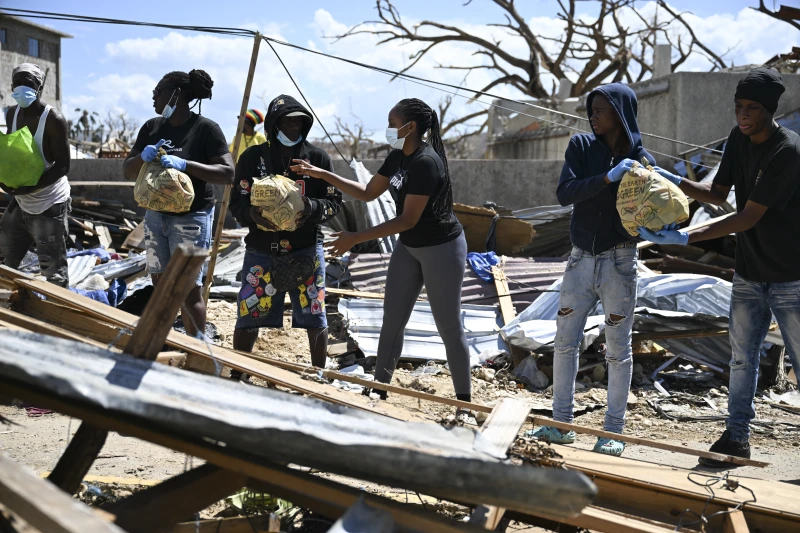
 Residents help move food supplies at a community center before distribution to the Whitehouse community in Westmoreland, Jamaica, one of the areas most severely affected by the passage of Hurricane Melissa, on Nov. 2, 2025. / Credit: Ricardo Makyn/AFP via Getty Images

Washington, D.C. Newsroom, Nov 6, 2025 / 14:15 pm (CNA).
Catholic leaders and agencies have mobilized to help communities left devastated after Hurricane Melissa hit Jamaica.The Category 5 hurricane swept through the Caribbean with sustained winds of 185 miles per hour and claimed up to 50 lives after making landfall on Oct. 28. Jamaica suffered the largest impact, but neighboring nations also experienced immense effects including flash flooding and landslides.In Jamaica, practically no buildings along the country’s southern coast remain intact. Areas have experienced structural failures, immense roof damage, floods, power outages, and communication disruptions. Families have a long road to recovery after many lost loved ones, property, possessions, and livelihoods.To help communities suffering from Hurricane Melissa’s aftermath, Catholic agencies are on the ground supporting relief efforts and fundraising across the globe to provide aid. Providing aid Dominican friars with St. Martin’s Missions, an initiative that supports communities in Jamaica and Grenada, are working to help communities most affected. Father Bede Mullens, OP, one of the friars working in Jamaica, told CNA they are based in Kingston, “which mercifully was left largely unscathed by the hurricane.”“Nonetheless, some of our poorer parishioners in August Town, an impoverished neighborhood, did lose roofs, walls, and in one case pretty much the whole house,” Mullens said. With the help of donations from across the globe, St. Martin’s will purchase and provide materials for repairs and food.Mullens explained that “after recent panic-buying, some food items are hard to come by, and food prices on the whole are set to go up in the coming months, as the part of the island hardest hit is a major agricultural area.”This Friday, Nov. 7, the friars will distribute 300 meals to students at the University of the West Indies in Mona, Jamaica, and to several less-well-off parishioners. Mullens said: “We are trying to arrange sponsorship from local benefactors for students in need to receive support for food and personal hygiene items.”Across the island the friars have been able to contact some parishes near Montego Bay, which suffered great damage. “One of the churches is currently operating as a shelter with just half a roof,” Mullens said.The friars have also coordinated provisions of basic building materials and essentials including water and baby food that will be transported to Sacred Heart Church near Montego Bay and St. Agnes Church in Chester Castle.When the roads reopen and the friars are able to make contact with more parishes in other areas, they plan to also assist their rebuilding efforts and support the local community needs.“There is, of course, a massive need for material assistance, but for us it is very important that St. Martin’s bears witness to our worldwide solidarity in the body of Christ,” Mullens said. “We belong to a Church that is at once truly Catholic and truly one, at once global and personal.”Franciscan Friars Charities (FFC), the charitable arm of the Province of Our Lady of Guadalupe, activated the Franciscan Relief Fund to help the people in western Jamaica recover from extensive damage.“The friars in Negril have quickly mobilized to assess the community’s needs after the storm,” FFC said in a statement. “Each day they ground their hearts in faith through morning prayer and daily Mass before heading out into the community to provide vital services.”The friars are serving warm meals daily at St. Anthony Kitchen, a soup kitchen in Negril. They anticipate a significant increase in the number of people coming to the kitchen, expecting approximately 400 to 500 people a day.The friars are cleaning the Revival Health Clinic, which provides basic medical care, and are looking into creating a mobile clinic to visit remote areas. They are also visiting parishioners, many of whom have lost their homes, and providing them with immediate relief including water and food.“Communicating with our friars in Negril has been difficult because there’s no electricity and the cellular services are down,” said Brother Jim Bok, OFM. “There’s just unbelievable destruction. It’s going to take years to recover. A tremendous amount of outside support will be needed to help deal with it.”Organizations respond with action Hospital Sisters Mission Outreach, an Illinois-based organization that partners with organizations, hospitals, and clinics around the world, is working directly with Food for the Poor and other organizations transporting and distributing aid.After learning there was an urgent need for diapers, Mission Outreach’s warehouse team mobilized to send out 4,000 it had available. It also shipped out a 40-foot container to Jamaica filled with requested medical supplies and equipment.A number of Catholic relief organizations including Cross Catholic Outreach (CCO) and Catholic Relief Services (CRS) are fundraising to send food, medicines, and housing supplies to ministry partners in Jamaica, the Dominican Republic, Haiti, and Cuba.CCO said it is “sending shipments of recovery supplies to the Compassionate Franciscan Sisters of the Poor and will airlift medical supplies into Montego Bay when conditions are safe enough to do so.” It is also working to help the Diocese of Mandeville to rebuild St. Theresa Kindergarten, which was destroyed in the storm.CRS is working to help on the ground with “a team of 100 staff in Haiti and local partners in Jamaica and the region,” the organization reported. “CRS and the Catholic Church are committed to walking with families through every phase of recovery — from immediate relief to long-term rebuilding. ”The U.S. State Department’s Bureau of Western Hemisphere Affairs will coordinate with the Catholic Church to distribute  million in humanitarian assistance. The funds will go directly to helping those impacted in eastern Cuba by the devastation of Hurricane Melissa.

Catholics mobilize in Caribbean following Category 5 hurricane  #Catholic Residents help move food supplies at a community center before distribution to the Whitehouse community in Westmoreland, Jamaica, one of the areas most severely affected by the passage of Hurricane Melissa, on Nov. 2, 2025. / Credit: Ricardo Makyn/AFP via Getty Images Washington, D.C. Newsroom, Nov 6, 2025 / 14:15 pm (CNA). Catholic leaders and agencies have mobilized to help communities left devastated after Hurricane Melissa hit Jamaica.The Category 5 hurricane swept through the Caribbean with sustained winds of 185 miles per hour and claimed up to 50 lives after making landfall on Oct. 28. Jamaica suffered the largest impact, but neighboring nations also experienced immense effects including flash flooding and landslides.In Jamaica, practically no buildings along the country’s southern coast remain intact. Areas have experienced structural failures, immense roof damage, floods, power outages, and communication disruptions. Families have a long road to recovery after many lost loved ones, property, possessions, and livelihoods.To help communities suffering from Hurricane Melissa’s aftermath, Catholic agencies are on the ground supporting relief efforts and fundraising across the globe to provide aid. Providing aid Dominican friars with St. Martin’s Missions, an initiative that supports communities in Jamaica and Grenada, are working to help communities most affected. Father Bede Mullens, OP, one of the friars working in Jamaica, told CNA they are based in Kingston, “which mercifully was left largely unscathed by the hurricane.”“Nonetheless, some of our poorer parishioners in August Town, an impoverished neighborhood, did lose roofs, walls, and in one case pretty much the whole house,” Mullens said. With the help of donations from across the globe, St. Martin’s will purchase and provide materials for repairs and food.Mullens explained that “after recent panic-buying, some food items are hard to come by, and food prices on the whole are set to go up in the coming months, as the part of the island hardest hit is a major agricultural area.”This Friday, Nov. 7, the friars will distribute 300 meals to students at the University of the West Indies in Mona, Jamaica, and to several less-well-off parishioners. Mullens said: “We are trying to arrange sponsorship from local benefactors for students in need to receive support for food and personal hygiene items.”Across the island the friars have been able to contact some parishes near Montego Bay, which suffered great damage. “One of the churches is currently operating as a shelter with just half a roof,” Mullens said.The friars have also coordinated provisions of basic building materials and essentials including water and baby food that will be transported to Sacred Heart Church near Montego Bay and St. Agnes Church in Chester Castle.When the roads reopen and the friars are able to make contact with more parishes in other areas, they plan to also assist their rebuilding efforts and support the local community needs.“There is, of course, a massive need for material assistance, but for us it is very important that St. Martin’s bears witness to our worldwide solidarity in the body of Christ,” Mullens said. “We belong to a Church that is at once truly Catholic and truly one, at once global and personal.”Franciscan Friars Charities (FFC), the charitable arm of the Province of Our Lady of Guadalupe, activated the Franciscan Relief Fund to help the people in western Jamaica recover from extensive damage.“The friars in Negril have quickly mobilized to assess the community’s needs after the storm,” FFC said in a statement. “Each day they ground their hearts in faith through morning prayer and daily Mass before heading out into the community to provide vital services.”The friars are serving warm meals daily at St. Anthony Kitchen, a soup kitchen in Negril. They anticipate a significant increase in the number of people coming to the kitchen, expecting approximately 400 to 500 people a day.The friars are cleaning the Revival Health Clinic, which provides basic medical care, and are looking into creating a mobile clinic to visit remote areas. They are also visiting parishioners, many of whom have lost their homes, and providing them with immediate relief including water and food.“Communicating with our friars in Negril has been difficult because there’s no electricity and the cellular services are down,” said Brother Jim Bok, OFM. “There’s just unbelievable destruction. It’s going to take years to recover. A tremendous amount of outside support will be needed to help deal with it.”Organizations respond with action Hospital Sisters Mission Outreach, an Illinois-based organization that partners with organizations, hospitals, and clinics around the world, is working directly with Food for the Poor and other organizations transporting and distributing aid.After learning there was an urgent need for diapers, Mission Outreach’s warehouse team mobilized to send out 4,000 it had available. It also shipped out a 40-foot container to Jamaica filled with requested medical supplies and equipment.A number of Catholic relief organizations including Cross Catholic Outreach (CCO) and Catholic Relief Services (CRS) are fundraising to send food, medicines, and housing supplies to ministry partners in Jamaica, the Dominican Republic, Haiti, and Cuba.CCO said it is “sending shipments of recovery supplies to the Compassionate Franciscan Sisters of the Poor and will airlift medical supplies into Montego Bay when conditions are safe enough to do so.” It is also working to help the Diocese of Mandeville to rebuild St. Theresa Kindergarten, which was destroyed in the storm.CRS is working to help on the ground with “a team of 100 staff in Haiti and local partners in Jamaica and the region,” the organization reported. “CRS and the Catholic Church are committed to walking with families through every phase of recovery — from immediate relief to long-term rebuilding. ”The U.S. State Department’s Bureau of Western Hemisphere Affairs will coordinate with the Catholic Church to distribute $3 million in humanitarian assistance. The funds will go directly to helping those impacted in eastern Cuba by the devastation of Hurricane Melissa.


Residents help move food supplies at a community center before distribution to the Whitehouse community in Westmoreland, Jamaica, one of the areas most severely affected by the passage of Hurricane Melissa, on Nov. 2, 2025. / Credit: Ricardo Makyn/AFP via Getty Images

Washington, D.C. Newsroom, Nov 6, 2025 / 14:15 pm (CNA).

Catholic leaders and agencies have mobilized to help communities left devastated after Hurricane Melissa hit Jamaica.

The Category 5 hurricane swept through the Caribbean with sustained winds of 185 miles per hour and claimed up to 50 lives after making landfall on Oct. 28. Jamaica suffered the largest impact, but neighboring nations also experienced immense effects including flash flooding and landslides.

In Jamaica, practically no buildings along the country’s southern coast remain intact. Areas have experienced structural failures, immense roof damage, floods, power outages, and communication disruptions. Families have a long road to recovery after many lost loved ones, property, possessions, and livelihoods.

To help communities suffering from Hurricane Melissa’s aftermath, Catholic agencies are on the ground supporting relief efforts and fundraising across the globe to provide aid. 

Providing aid 

Dominican friars with St. Martin’s Missions, an initiative that supports communities in Jamaica and Grenada, are working to help communities most affected. Father Bede Mullens, OP, one of the friars working in Jamaica, told CNA they are based in Kingston, “which mercifully was left largely unscathed by the hurricane.”

“Nonetheless, some of our poorer parishioners in August Town, an impoverished neighborhood, did lose roofs, walls, and in one case pretty much the whole house,” Mullens said. With the help of donations from across the globe, St. Martin’s will purchase and provide materials for repairs and food.

Mullens explained that “after recent panic-buying, some food items are hard to come by, and food prices on the whole are set to go up in the coming months, as the part of the island hardest hit is a major agricultural area.”

This Friday, Nov. 7, the friars will distribute 300 meals to students at the University of the West Indies in Mona, Jamaica, and to several less-well-off parishioners. Mullens said: “We are trying to arrange sponsorship from local benefactors for students in need to receive support for food and personal hygiene items.”

Across the island the friars have been able to contact some parishes near Montego Bay, which suffered great damage. “One of the churches is currently operating as a shelter with just half a roof,” Mullens said.

The friars have also coordinated provisions of basic building materials and essentials including water and baby food that will be transported to Sacred Heart Church near Montego Bay and St. Agnes Church in Chester Castle.

When the roads reopen and the friars are able to make contact with more parishes in other areas, they plan to also assist their rebuilding efforts and support the local community needs.

“There is, of course, a massive need for material assistance, but for us it is very important that St. Martin’s bears witness to our worldwide solidarity in the body of Christ,” Mullens said. “We belong to a Church that is at once truly Catholic and truly one, at once global and personal.”

Franciscan Friars Charities (FFC), the charitable arm of the Province of Our Lady of Guadalupe, activated the Franciscan Relief Fund to help the people in western Jamaica recover from extensive damage.

“The friars in Negril have quickly mobilized to assess the community’s needs after the storm,” FFC said in a statement. “Each day they ground their hearts in faith through morning prayer and daily Mass before heading out into the community to provide vital services.”

The friars are serving warm meals daily at St. Anthony Kitchen, a soup kitchen in Negril. They anticipate a significant increase in the number of people coming to the kitchen, expecting approximately 400 to 500 people a day.

The friars are cleaning the Revival Health Clinic, which provides basic medical care, and are looking into creating a mobile clinic to visit remote areas. They are also visiting parishioners, many of whom have lost their homes, and providing them with immediate relief including water and food.

“Communicating with our friars in Negril has been difficult because there’s no electricity and the cellular services are down,” said Brother Jim Bok, OFM. “There’s just unbelievable destruction. It’s going to take years to recover. A tremendous amount of outside support will be needed to help deal with it.”

Organizations respond with action 

Hospital Sisters Mission Outreach, an Illinois-based organization that partners with organizations, hospitals, and clinics around the world, is working directly with Food for the Poor and other organizations transporting and distributing aid.

After learning there was an urgent need for diapers, Mission Outreach’s warehouse team mobilized to send out 4,000 it had available. It also shipped out a 40-foot container to Jamaica filled with requested medical supplies and equipment.

A number of Catholic relief organizations including Cross Catholic Outreach (CCO) and Catholic Relief Services (CRS) are fundraising to send food, medicines, and housing supplies to ministry partners in Jamaica, the Dominican Republic, Haiti, and Cuba.

CCO said it is “sending shipments of recovery supplies to the Compassionate Franciscan Sisters of the Poor and will airlift medical supplies into Montego Bay when conditions are safe enough to do so.” It is also working to help the Diocese of Mandeville to rebuild St. Theresa Kindergarten, which was destroyed in the storm.

CRS is working to help on the ground with “a team of 100 staff in Haiti and local partners in Jamaica and the region,” the organization reported. “CRS and the Catholic Church are committed to walking with families through every phase of recovery — from immediate relief to long-term rebuilding. ”

The U.S. State Department’s Bureau of Western Hemisphere Affairs will coordinate with the Catholic Church to distribute $3 million in humanitarian assistance. The funds will go directly to helping those impacted in eastern Cuba by the devastation of Hurricane Melissa.

Read More
Preparing for death with the Sister Servants of Mary #Catholic 
 
 The Sister Servants of Mary hold a procession with the statue of Our Lady of the Assumption at Mary Health of the Sick Convalescent Hospital in Newbury Park, California. / Credit: Photo courtesy of the Servants of Mary, Ministers to the Sick

CNA Staff, Nov 2, 2025 / 06:00 am (CNA).
When a 93-year-old Catholic father from New Orleans had a stroke, he knew he was prepared to die.Clinton Jacob attended adoration and Mass daily and was “rarely without a prayer book or rosary in hand,” according to his daughter, Kim DeSopo.“[He] never spoke of death with fear or sadness,” she told CNA. “He would simply say, ‘I’ll be going home.’”But not everyone feels prepared for death.The Servants of Mary, Ministers to the Sick, is a Catholic community of sisters who dedicate their lives to caring for the sick and dying in New Orleans and around the world. As nurses, they are at the bedside of the dying through the long nights, whether their patients are lifelong Catholics or have never thought about religion.The sisters often encounter patients as well as family members who are struggling to accept “an illness or imminent death,” Sister Catherine Bussen, a Servant of Mary, told CNA.“Many times, there is a need for reconciliation within the family, for a return to their faith, for acceptance of their condition, etc.,” Bussen said.As medical professionals, the sisters provide physical treatment, but they also walk with their patients throughout their illnesses, encouraging patients and families “always with the hope of eternal life,” Bussen said. DeSopo, Jacob’s daughter, called the sisters for support. The next day, Bussen arrived at their doorstep, and every night for two weeks, she sat at Jacob’s bedside. Bussen’s presence was “a gift,” DeSopo said. “Sister Catherine brought peace and calm into a time filled with stress and sorrow.”“Her prayers, patience, and care provided comfort not only to my father but also to my mother, who could finally sleep knowing someone trustworthy and compassionate was by his side,” DeSopo said, recalling Bussen’s “selfless dedication” and “unwavering faith.” Bussen was with Jacob when he died on Sept. 26, 2024. She prepared his body, cleaning him and sprinkling him with holy water, and then prayed with his wife and daughter.“I will never forget the care and dignity she gave him, even after his final breath,” DeSopo said.Sister Catherine (left) and Sister Dorian Salvador (right) pray for the soul of Kim DeSopa’s father on Oct. 1, 2024, at St. Clement of Rome Church in Metairie, Louisiana. Credit: Photo courtesy of Kim DeSopa and Sister CatherineMary at the foot of the cross “I was sick and you visited me.”This Scripture verse, Matthew 25:36, summarizes the charism of the Servants of Mary, according to Bussen. When they care for the sick, they care for Christ.The sisters will care for anyone in need, preferably within the sick person’s own home. In those who are suffering, the sisters “discover Jesus carrying his cross,” Bussen explained. “By caring for the sick, we believe that we are caring for Christ himself, who still suffers today in the suffering mystical body of Christ,” she said.Sister Angélica Ramos cares for Mrs. Hura, a resident of Mary Health of the Sick Convalescent Hospital in Newbury Park, California. Credit: Photo courtesy of the Servants of Mary, Ministers to the SickFounded in Madrid, Spain, in the 1800s, the sisters care for the sick and dying in Louisiana, Kansas, and California as well as throughout Central and South America, Spain, France, England, Italy, Cameroon, the Philippines, and Indonesia. They run a hospital for the poor in Bamenda, Cameroon, as well as two missionary houses in Oaxaca, Mexico.The sisters look to Mary as an example as they accompany those who are suffering.“Although we are not able to take away someone’s cross, we are present to them, offering all to the Father, like Mary did at the cross of Jesus, that all suffering may be redemptive and fruitful,” Bussen said.“Every one of us sisters would tell you that it is an absolute privilege to be able to enter into the intimacy of a family’s home, listening to the dying, praying with them, and encouraging them on the final stage of their journey as their soul passes into eternity,” she said.Sister Servants of Mary Fatima Muñoz and Carmela Sanz (front) celebrate a May crowning in Kansas City, Kansas. Credit: Photo courtesy of the Servants of Mary, Ministers to the Sick“Our Catholic Christian faith is a beautiful comfort during these times because it is all about looking forward to the promised life to come, the whole goal of our lives, eternal life,” Bussen said.One woman from New Orleans received news no one wants to hear — she had a terminal illness. Though she was not religious, she knew she needed help and did not know who else to turn to, so she called the Servants of Mary.As they cared for her and helped her deal with her terminal diagnosis, the sisters learned the woman was “completely alone in the world,” said Bussen, who took care of her. Other people from the surrounding Catholic community volunteered to stay with her.During that time, the woman found a home in the Catholic Church and received the sacrament of baptism.Her “anxiety was transformed into peace,” said Bussen, who was with her as she died.“As the end drew near, she had a new faith family,” Bussen said. “She was no longer alone.”Remembering the dead The life of a sister Servant of Mary is “contemplative in action.” The sisters unite “our prayer life with our work — going about what we are doing, in all the business of daily life, in a prayerful spirit,” Bussen said.The sisters have time set aside for prayer and work, “but these two aspects cannot be separated from one another,” she continued. “The grace and light received in prayer flows into our work and ministry, and everything we experience in our ministry is taken to prayer.”The Servants of Mary, Ministers to the Sick care for the sick and the dying. Credit: Photo courtesy of the Servants of Mary, Ministers to the SickThroughout the year, the sisters take special care to remember the dead. In November especially, Bussen said the sisters “remember all our patients who have died with us by placing their names in our chapel and offering Masses for their eternal happiness.”“Even after a patient has passed,” she said, “and they no longer need physical care, our ministry continues by praying for their soul.”

Preparing for death with the Sister Servants of Mary #Catholic The Sister Servants of Mary hold a procession with the statue of Our Lady of the Assumption at Mary Health of the Sick Convalescent Hospital in Newbury Park, California. / Credit: Photo courtesy of the Servants of Mary, Ministers to the Sick CNA Staff, Nov 2, 2025 / 06:00 am (CNA). When a 93-year-old Catholic father from New Orleans had a stroke, he knew he was prepared to die.Clinton Jacob attended adoration and Mass daily and was “rarely without a prayer book or rosary in hand,” according to his daughter, Kim DeSopo.“[He] never spoke of death with fear or sadness,” she told CNA. “He would simply say, ‘I’ll be going home.’”But not everyone feels prepared for death.The Servants of Mary, Ministers to the Sick, is a Catholic community of sisters who dedicate their lives to caring for the sick and dying in New Orleans and around the world. As nurses, they are at the bedside of the dying through the long nights, whether their patients are lifelong Catholics or have never thought about religion.The sisters often encounter patients as well as family members who are struggling to accept “an illness or imminent death,” Sister Catherine Bussen, a Servant of Mary, told CNA.“Many times, there is a need for reconciliation within the family, for a return to their faith, for acceptance of their condition, etc.,” Bussen said.As medical professionals, the sisters provide physical treatment, but they also walk with their patients throughout their illnesses, encouraging patients and families “always with the hope of eternal life,” Bussen said. DeSopo, Jacob’s daughter, called the sisters for support. The next day, Bussen arrived at their doorstep, and every night for two weeks, she sat at Jacob’s bedside. Bussen’s presence was “a gift,” DeSopo said. “Sister Catherine brought peace and calm into a time filled with stress and sorrow.”“Her prayers, patience, and care provided comfort not only to my father but also to my mother, who could finally sleep knowing someone trustworthy and compassionate was by his side,” DeSopo said, recalling Bussen’s “selfless dedication” and “unwavering faith.” Bussen was with Jacob when he died on Sept. 26, 2024. She prepared his body, cleaning him and sprinkling him with holy water, and then prayed with his wife and daughter.“I will never forget the care and dignity she gave him, even after his final breath,” DeSopo said.Sister Catherine (left) and Sister Dorian Salvador (right) pray for the soul of Kim DeSopa’s father on Oct. 1, 2024, at St. Clement of Rome Church in Metairie, Louisiana. Credit: Photo courtesy of Kim DeSopa and Sister CatherineMary at the foot of the cross “I was sick and you visited me.”This Scripture verse, Matthew 25:36, summarizes the charism of the Servants of Mary, according to Bussen. When they care for the sick, they care for Christ.The sisters will care for anyone in need, preferably within the sick person’s own home. In those who are suffering, the sisters “discover Jesus carrying his cross,” Bussen explained. “By caring for the sick, we believe that we are caring for Christ himself, who still suffers today in the suffering mystical body of Christ,” she said.Sister Angélica Ramos cares for Mrs. Hura, a resident of Mary Health of the Sick Convalescent Hospital in Newbury Park, California. Credit: Photo courtesy of the Servants of Mary, Ministers to the SickFounded in Madrid, Spain, in the 1800s, the sisters care for the sick and dying in Louisiana, Kansas, and California as well as throughout Central and South America, Spain, France, England, Italy, Cameroon, the Philippines, and Indonesia. They run a hospital for the poor in Bamenda, Cameroon, as well as two missionary houses in Oaxaca, Mexico.The sisters look to Mary as an example as they accompany those who are suffering.“Although we are not able to take away someone’s cross, we are present to them, offering all to the Father, like Mary did at the cross of Jesus, that all suffering may be redemptive and fruitful,” Bussen said.“Every one of us sisters would tell you that it is an absolute privilege to be able to enter into the intimacy of a family’s home, listening to the dying, praying with them, and encouraging them on the final stage of their journey as their soul passes into eternity,” she said.Sister Servants of Mary Fatima Muñoz and Carmela Sanz (front) celebrate a May crowning in Kansas City, Kansas. Credit: Photo courtesy of the Servants of Mary, Ministers to the Sick“Our Catholic Christian faith is a beautiful comfort during these times because it is all about looking forward to the promised life to come, the whole goal of our lives, eternal life,” Bussen said.One woman from New Orleans received news no one wants to hear — she had a terminal illness. Though she was not religious, she knew she needed help and did not know who else to turn to, so she called the Servants of Mary.As they cared for her and helped her deal with her terminal diagnosis, the sisters learned the woman was “completely alone in the world,” said Bussen, who took care of her. Other people from the surrounding Catholic community volunteered to stay with her.During that time, the woman found a home in the Catholic Church and received the sacrament of baptism.Her “anxiety was transformed into peace,” said Bussen, who was with her as she died.“As the end drew near, she had a new faith family,” Bussen said. “She was no longer alone.”Remembering the dead The life of a sister Servant of Mary is “contemplative in action.” The sisters unite “our prayer life with our work — going about what we are doing, in all the business of daily life, in a prayerful spirit,” Bussen said.The sisters have time set aside for prayer and work, “but these two aspects cannot be separated from one another,” she continued. “The grace and light received in prayer flows into our work and ministry, and everything we experience in our ministry is taken to prayer.”The Servants of Mary, Ministers to the Sick care for the sick and the dying. Credit: Photo courtesy of the Servants of Mary, Ministers to the SickThroughout the year, the sisters take special care to remember the dead. In November especially, Bussen said the sisters “remember all our patients who have died with us by placing their names in our chapel and offering Masses for their eternal happiness.”“Even after a patient has passed,” she said, “and they no longer need physical care, our ministry continues by praying for their soul.”


The Sister Servants of Mary hold a procession with the statue of Our Lady of the Assumption at Mary Health of the Sick Convalescent Hospital in Newbury Park, California. / Credit: Photo courtesy of the Servants of Mary, Ministers to the Sick

CNA Staff, Nov 2, 2025 / 06:00 am (CNA).

When a 93-year-old Catholic father from New Orleans had a stroke, he knew he was prepared to die.

Clinton Jacob attended adoration and Mass daily and was “rarely without a prayer book or rosary in hand,” according to his daughter, Kim DeSopo.

“[He] never spoke of death with fear or sadness,” she told CNA. “He would simply say, ‘I’ll be going home.’”

But not everyone feels prepared for death.

The Servants of Mary, Ministers to the Sick, is a Catholic community of sisters who dedicate their lives to caring for the sick and dying in New Orleans and around the world. As nurses, they are at the bedside of the dying through the long nights, whether their patients are lifelong Catholics or have never thought about religion.

The sisters often encounter patients as well as family members who are struggling to accept “an illness or imminent death,” Sister Catherine Bussen, a Servant of Mary, told CNA.

“Many times, there is a need for reconciliation within the family, for a return to their faith, for acceptance of their condition, etc.,” Bussen said.

As medical professionals, the sisters provide physical treatment, but they also walk with their patients throughout their illnesses, encouraging patients and families “always with the hope of eternal life,” Bussen said. 

DeSopo, Jacob’s daughter, called the sisters for support. The next day, Bussen arrived at their doorstep, and every night for two weeks, she sat at Jacob’s bedside. 

Bussen’s presence was “a gift,” DeSopo said. “Sister Catherine brought peace and calm into a time filled with stress and sorrow.”

“Her prayers, patience, and care provided comfort not only to my father but also to my mother, who could finally sleep knowing someone trustworthy and compassionate was by his side,” DeSopo said, recalling Bussen’s “selfless dedication” and “unwavering faith.” 

Bussen was with Jacob when he died on Sept. 26, 2024. She prepared his body, cleaning him and sprinkling him with holy water, and then prayed with his wife and daughter.

“I will never forget the care and dignity she gave him, even after his final breath,” DeSopo said.

Sister Catherine (left) and Sister Dorian Salvador (right) pray for the soul of Kim DeSopa’s father on Oct. 1, 2024, at St. Clement of Rome Church in Metairie, Louisiana. Credit: Photo courtesy of Kim DeSopa and Sister Catherine

Mary at the foot of the cross 

“I was sick and you visited me.”

This Scripture verse, Matthew 25:36, summarizes the charism of the Servants of Mary, according to Bussen. 

When they care for the sick, they care for Christ.

The sisters will care for anyone in need, preferably within the sick person’s own home. In those who are suffering, the sisters “discover Jesus carrying his cross,” Bussen explained. 

“By caring for the sick, we believe that we are caring for Christ himself, who still suffers today in the suffering mystical body of Christ,” she said.

Sister Angélica Ramos cares for Mrs. Hura, a resident of Mary Health of the Sick Convalescent Hospital in Newbury Park, California. Credit: Photo courtesy of the Servants of Mary, Ministers to the Sick

Founded in Madrid, Spain, in the 1800s, the sisters care for the sick and dying in Louisiana, Kansas, and California as well as throughout Central and South America, Spain, France, England, Italy, Cameroon, the Philippines, and Indonesia. They run a hospital for the poor in Bamenda, Cameroon, as well as two missionary houses in Oaxaca, Mexico.

The sisters look to Mary as an example as they accompany those who are suffering.

“Although we are not able to take away someone’s cross, we are present to them, offering all to the Father, like Mary did at the cross of Jesus, that all suffering may be redemptive and fruitful,” Bussen said.

“Every one of us sisters would tell you that it is an absolute privilege to be able to enter into the intimacy of a family’s home, listening to the dying, praying with them, and encouraging them on the final stage of their journey as their soul passes into eternity,” she said.

Sister Servants of Mary Fatima Muñoz and Carmela Sanz (front) celebrate a May crowning in Kansas City, Kansas. Credit: Photo courtesy of the Servants of Mary, Ministers to the Sick

“Our Catholic Christian faith is a beautiful comfort during these times because it is all about looking forward to the promised life to come, the whole goal of our lives, eternal life,” Bussen said.

One woman from New Orleans received news no one wants to hear — she had a terminal illness. Though she was not religious, she knew she needed help and did not know who else to turn to, so she called the Servants of Mary.

As they cared for her and helped her deal with her terminal diagnosis, the sisters learned the woman was “completely alone in the world,” said Bussen, who took care of her. Other people from the surrounding Catholic community volunteered to stay with her.

During that time, the woman found a home in the Catholic Church and received the sacrament of baptism.

Her “anxiety was transformed into peace,” said Bussen, who was with her as she died.

“As the end drew near, she had a new faith family,” Bussen said. “She was no longer alone.”

Remembering the dead 

The life of a sister Servant of Mary is “contemplative in action.” 

The sisters unite “our prayer life with our work — going about what we are doing, in all the business of daily life, in a prayerful spirit,” Bussen said.

The sisters have time set aside for prayer and work, “but these two aspects cannot be separated from one another,” she continued. “The grace and light received in prayer flows into our work and ministry, and everything we experience in our ministry is taken to prayer.”

The Servants of Mary, Ministers to the Sick care for the sick and the dying. Credit: Photo courtesy of the Servants of Mary, Ministers to the Sick

Throughout the year, the sisters take special care to remember the dead. 

In November especially, Bussen said the sisters “remember all our patients who have died with us by placing their names in our chapel and offering Masses for their eternal happiness.”

“Even after a patient has passed,” she said, “and they no longer need physical care, our ministry continues by praying for their soul.”

Read More

Picture of the day


Coral (Favia favus), Ras Muhammad National Park, Red Sea, Egypt. This species of stony corals is massive and forms thickly encrusting dome-shaped colonial corals. There is a great diversity of form even among the same species. The corallites project slightly above the surface of the coral and each has its own wall. The septa and costae linked to the corallite wall are well developed and covered by fine teeth. The polyps only extend and feed during the night. Each one has a small number of tapering tentacles which often have a darker coloured tip; these are called stinger tentacles, or sweeper tentacles. They use these to sweep the water to see if any other coral is in its area; if so, then they begin to sting the other coral. This is commonly known as coral war. Each coral is trying to make sure it has enough room around it so it can continue to grow and have more surface area for its offspring.
 #ImageOfTheDay
Picture of the day
Coral (Favia favus), Ras Muhammad National Park, Red Sea, Egypt. This species of stony corals is massive and forms thickly encrusting dome-shaped colonial corals. There is a great diversity of form even among the same species. The corallites project slightly above the surface of the coral and each has its own wall. The septa and costae linked to the corallite wall are well developed and covered by fine teeth. The polyps only extend and feed during the night. Each one has a small number of tapering tentacles which often have a darker coloured tip; these are called stinger tentacles, or sweeper tentacles. They use these to sweep the water to see if any other coral is in its area; if so, then they begin to sting the other coral. This is commonly known as coral war. Each coral is trying to make sure it has enough room around it so it can continue to grow and have more surface area for its offspring.
Read More
Picture of the day


Fresh water collecting in the valleys between sand dunes in the Lençóis Maranhenses National Park in Brazil. A layer of rock beneath the sand prevents the rain water from dissipating during the rainy season, resulting in a broad expanse of lagoons.
 #ImageOfTheDay
Picture of the day
Fresh water collecting in the valleys between sand dunes in the Lençóis Maranhenses National Park in Brazil. A layer of rock beneath the sand prevents the rain water from dissipating during the rainy season, resulting in a broad expanse of lagoons.
Read More
Webb Finds Icy Disk

Webb has found crystalline water ice in a debris disk around a young, Sun-like star called HD 181327. Based on its presence in our own solar system, scientists have expected to see it in other star systems — but haven’t had sensitive enough instruments to provide definitive proof until now.

Read More
Picture of the day


(purge this page’s cache)


The submerged St. Nicholas Church in Mavrovo, North Macedonia. Built in 1850, the church served as the main village church of Mavrovo. With the construction of the hydroelectric power station in Mavrovo and the artificial Mavrovo Lake, the church got submerged under water in 1953.
 #ImageOfTheDay
Picture of the day
(purge this page’s cache)
The submerged St. Nicholas Church in Mavrovo, North Macedonia. Built in 1850, the church served as the main village church of Mavrovo. With the construction of the hydroelectric power station in Mavrovo and the artificial Mavrovo Lake, the church got submerged under water in 1953.
Read More