college students

University of Dallas panel explores American exceptionalism through a Catholic lens #Catholic In a standing-room-only event, college students lined the walls of a large room at the University of Dallas to hear three Catholic academics and an apologist  reflect on what makes America exceptional in a celebration marking the 250th anniversary of the founding of the United States.Liam Ritter, a junior and the founder of the university’s Young Americans for Freedom chapter, which hosted the discussion, told EWTN News that the March 4 panel of speakers served as the capstone of three days of celebrations at the university.The panel was comprised of University President Jonathan Sanford; Trent Horn, staff apologist with Catholic Answers; Burt Folsom, distinguished fellow at Hillsdale College and economic historian; and Susan Hanssen, associate professor of history at the University of Dallas.‘We have a population of people who know what is at stake’In response to Ritter’s question, “Why [is it] that our political regime has been so stable for so long,” Hanssen recalled America’s first immigrants. “I think the first thing that makes America exceptional, and its political regime exceptional, is the fact that America was first populated by people who fled the rise of the modern nation state and totalitarianism … and so we have a population of people who know what is at stake in political liberty," she said.“Theyʼve seen what happened to their ancestors,” she continued. “They remember the stories. And America has been blessed in its political constitution with the regime of liberty, which has made possible the flourishing of subsidiary communities and societies.”Hanssen said we should not take for granted today that we still “have a free people." “We need to listen to our latest immigrants … those who have fled Venezuela, those who have fled Iran, like my uncle, a Persian Jew, who refuses to call himself Iranian because he associates modern Iran with the regime of the Ayatollah.”‘Get married, have children, raise them well’Sanford said that though we are a nation of immigrants, “there won’t be enough to pull in to make up for” the continuing demographic decline.“Get married, have children, raise them well,” he said to chuckles from a receptive audience, which was mostly composed of college students.He encouraged the students not to focus on “one big step,” but rather, to take smaller steps: “Get up early. Pray. Exercise. Go through the day in an ordered fashion, give Caesar what is Caesarʼs, and God what is God’s.”“Do the little things thousands and thousands of times,” he said.“In order to exercise liberty properly,” he continued, one has to ask, "How should I live my life?” and then rely on the institutions that “help you do that.”He called the family the “foundational institution” of America. “Recover the family,” he said.In addition, “we need to see those institutions that mediate the virtues — schools, universities — that embrace fully the idea of what [the virtues] are.”Horn also encouraged students to focus on family relationships, telling them “get off the phones and the internet. They’re killing all of us. They’re rewiring our brains.”
 
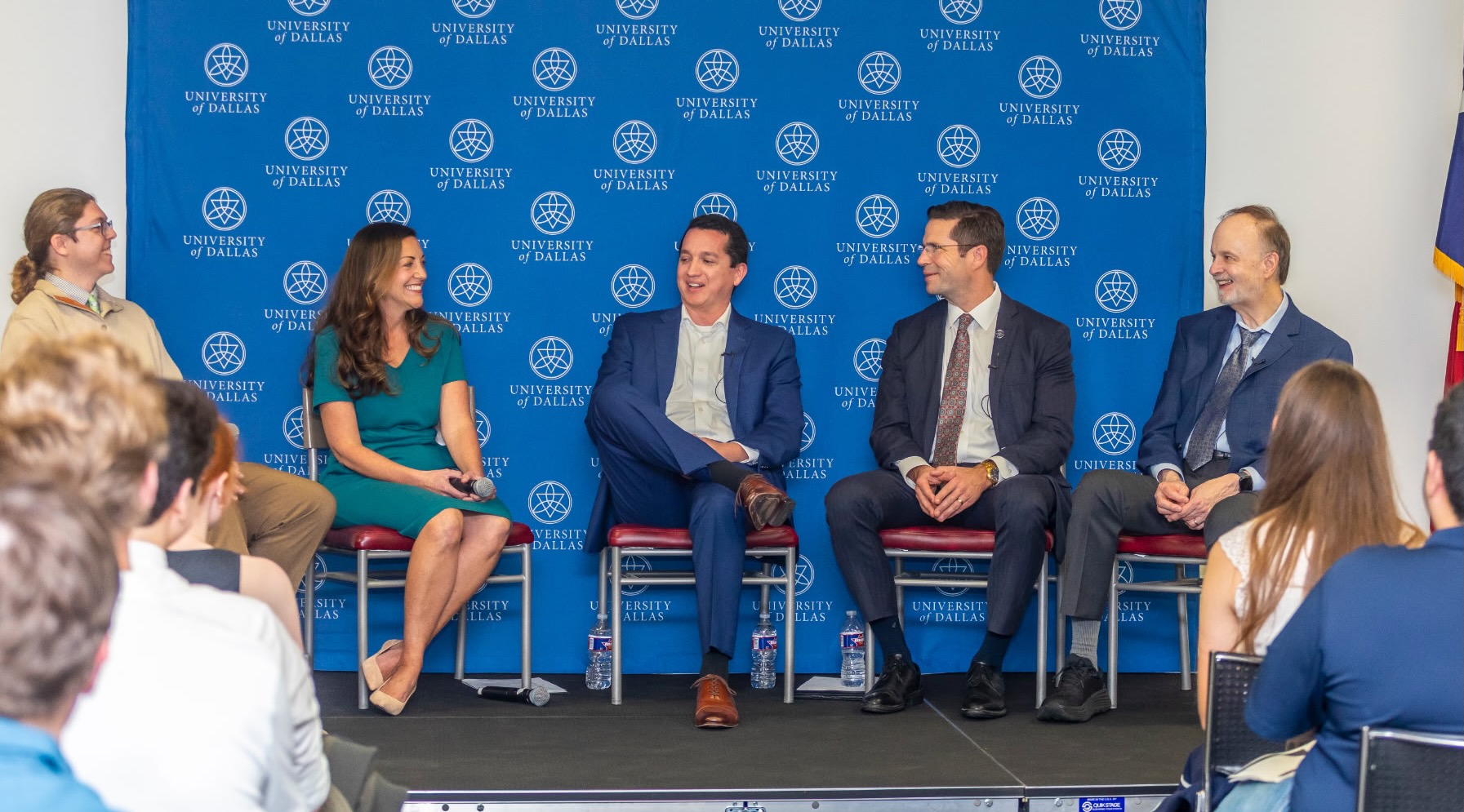
 Trent Horn (left), an apologist at Catholic Answers, and University of Dallas President Jonathan Sanford participate in a panel on American exceptionalism at the University of Dallas on March 4, 2026. | Credit: Courtesy of University of Dallas Young Americans for Freedom Chapter
 
 Of people currently in their 20s in America, "one in three will never have children,” he lamented, implying too much technology use is partly to blame.The Catholic Answers apologist pointed out, however, that though the Second Industrial Revolution “broke the family” by encouraging workers to move away from their homes and families to pursue careers, the internet “post-Covid,” in the age of “Zoom and telecommuting … might be good” because many people no longer have to choose between a job and staying near their extended families.“Maybe tech can help build up family networks,” he said.‘The greatest outpouring of economic development’ in historyRitter told EWTN news that he chose speakers who could address “the wonderful things the U.S. has contributed” to the world because “a lot of young people don’t have appropriate gratitude for the country.”Ritter asked Folsom, a historian who focuses on economics and industrial affairs, about what the professor believes the U.S. has contributed to world economics and world innovations.Folsom said that the generation after the Civil War, from 1865 to 1905, was responsible for “the greatest outpouring of economic development … in world history” and “gave us the rise of an America that became a world power” by World War I.He listed inventions that facilitated the rapid development of industry and infrastructure in the country during the Second Industrial Revolution, including the typewriter, the telephone, adding machines, the light bulb, electricity, factory-produced cars, and recording devices for music and movies, among other innovations.Through the Declaration of Independence and the U.S. Constitution, “the founders gave us the freedom” to develop these technologies, he said. “We had amazing infrastructure that allowed people to produce, and not have government get in their way.”The professor said the post-Civil War period could be eclipsed in the present day “because with artificial intelligence, this generation may yet be able to come up with more.”‘A responsibility for this political regime of freedom’At the conclusion of the panel discussion, Hanssen called the feeling in the room “electric, it’s teeming with patriotism. This isn’t a normal college campus.”Referring to Sanford’s earlier admonition to ”get married and have kids,” she said: “I agree, be fruitful and multiply … Preach the Gospel, and baptize in the name of Jesus, but also, go into politics!” she exclaimed.She encouraged the students to develop “the ability to love something so much that you would die for it: God, family, country.”“Recognize what is at stake. We have a responsibility for this political regime of freedom, to the immigrants who come here … to our children… to preserve the rule of law.”She concluded to loud applause: “So family; yes! Faith; yes, but to the barricades, ladies and gentlemen!"

University of Dallas panel explores American exceptionalism through a Catholic lens #Catholic In a standing-room-only event, college students lined the walls of a large room at the University of Dallas to hear three Catholic academics and an apologist  reflect on what makes America exceptional in a celebration marking the 250th anniversary of the founding of the United States.Liam Ritter, a junior and the founder of the university’s Young Americans for Freedom chapter, which hosted the discussion, told EWTN News that the March 4 panel of speakers served as the capstone of three days of celebrations at the university.The panel was comprised of University President Jonathan Sanford; Trent Horn, staff apologist with Catholic Answers; Burt Folsom, distinguished fellow at Hillsdale College and economic historian; and Susan Hanssen, associate professor of history at the University of Dallas.‘We have a population of people who know what is at stake’In response to Ritter’s question, “Why [is it] that our political regime has been so stable for so long,” Hanssen recalled America’s first immigrants. “I think the first thing that makes America exceptional, and its political regime exceptional, is the fact that America was first populated by people who fled the rise of the modern nation state and totalitarianism … and so we have a population of people who know what is at stake in political liberty," she said.“Theyʼve seen what happened to their ancestors,” she continued. “They remember the stories. And America has been blessed in its political constitution with the regime of liberty, which has made possible the flourishing of subsidiary communities and societies.”Hanssen said we should not take for granted today that we still “have a free people." “We need to listen to our latest immigrants … those who have fled Venezuela, those who have fled Iran, like my uncle, a Persian Jew, who refuses to call himself Iranian because he associates modern Iran with the regime of the Ayatollah.”‘Get married, have children, raise them well’Sanford said that though we are a nation of immigrants, “there won’t be enough to pull in to make up for” the continuing demographic decline.“Get married, have children, raise them well,” he said to chuckles from a receptive audience, which was mostly composed of college students.He encouraged the students not to focus on “one big step,” but rather, to take smaller steps: “Get up early. Pray. Exercise. Go through the day in an ordered fashion, give Caesar what is Caesarʼs, and God what is God’s.”“Do the little things thousands and thousands of times,” he said.“In order to exercise liberty properly,” he continued, one has to ask, "How should I live my life?” and then rely on the institutions that “help you do that.”He called the family the “foundational institution” of America. “Recover the family,” he said.In addition, “we need to see those institutions that mediate the virtues — schools, universities — that embrace fully the idea of what [the virtues] are.”Horn also encouraged students to focus on family relationships, telling them “get off the phones and the internet. They’re killing all of us. They’re rewiring our brains.” Trent Horn (left), an apologist at Catholic Answers, and University of Dallas President Jonathan Sanford participate in a panel on American exceptionalism at the University of Dallas on March 4, 2026. | Credit: Courtesy of University of Dallas Young Americans for Freedom Chapter Of people currently in their 20s in America, "one in three will never have children,” he lamented, implying too much technology use is partly to blame.The Catholic Answers apologist pointed out, however, that though the Second Industrial Revolution “broke the family” by encouraging workers to move away from their homes and families to pursue careers, the internet “post-Covid,” in the age of “Zoom and telecommuting … might be good” because many people no longer have to choose between a job and staying near their extended families.“Maybe tech can help build up family networks,” he said.‘The greatest outpouring of economic development’ in historyRitter told EWTN news that he chose speakers who could address “the wonderful things the U.S. has contributed” to the world because “a lot of young people don’t have appropriate gratitude for the country.”Ritter asked Folsom, a historian who focuses on economics and industrial affairs, about what the professor believes the U.S. has contributed to world economics and world innovations.Folsom said that the generation after the Civil War, from 1865 to 1905, was responsible for “the greatest outpouring of economic development … in world history” and “gave us the rise of an America that became a world power” by World War I.He listed inventions that facilitated the rapid development of industry and infrastructure in the country during the Second Industrial Revolution, including the typewriter, the telephone, adding machines, the light bulb, electricity, factory-produced cars, and recording devices for music and movies, among other innovations.Through the Declaration of Independence and the U.S. Constitution, “the founders gave us the freedom” to develop these technologies, he said. “We had amazing infrastructure that allowed people to produce, and not have government get in their way.”The professor said the post-Civil War period could be eclipsed in the present day “because with artificial intelligence, this generation may yet be able to come up with more.”‘A responsibility for this political regime of freedom’At the conclusion of the panel discussion, Hanssen called the feeling in the room “electric, it’s teeming with patriotism. This isn’t a normal college campus.”Referring to Sanford’s earlier admonition to ”get married and have kids,” she said: “I agree, be fruitful and multiply … Preach the Gospel, and baptize in the name of Jesus, but also, go into politics!” she exclaimed.She encouraged the students to develop “the ability to love something so much that you would die for it: God, family, country.”“Recognize what is at stake. We have a responsibility for this political regime of freedom, to the immigrants who come here … to our children… to preserve the rule of law.”She concluded to loud applause: “So family; yes! Faith; yes, but to the barricades, ladies and gentlemen!"

The speakers encouraged the college students to get married, have children, stay off the internet (unless it enables them to telework and stay near their extended families), and be political.

Read More
CubeSats’ Missions Begin – A pair of CubeSats designed by college students from around the world is deployed into Earth orbit from a small satellite orbital deployer on the outside of the International Space Station’s Kibo laboratory module. Students from Mexico, Italy, Thailand, Malaysia, and Japan designed the shoe-boxed sized satellites for a series of Earth observations and technology demonstrations.

A pair of CubeSats designed by college students from around the world is deployed into Earth orbit from a small satellite orbital deployer on the outside of the International Space Station’s Kibo laboratory module. Students from Mexico, Italy, Thailand, Malaysia, and Japan designed the shoe-boxed sized satellites for a series of Earth observations and technology demonstrations.

Read More
Catholic colleges among best and worst for pro-life support, report finds #Catholic Some Catholic colleges ranked among the best for pro-life support for women, while others were among the worst for their ties to abortion clinics, a recent report found.In an audit of more than 700 Christian colleges and universities, the Christian Schools Project found that 1 in 7 Christian colleges referred students to Planned Parenthood for health care or future jobs, among other pro-abortion “infractions.”The report by Demetree, a branch of Students for Life of America (SFLA), called the Catholic connection to the abortion industry “shocking.”“Most shockingly, a portion of Catholic schools have forsaken their Christian values,” the report read, citing the Catechism of the Catholic Church’s teaching on abortion.One in 10 Catholic colleges had ties to abortion clinics, and about 25% of all the infractions were by Catholic universities.“Despite this, Catholic schools also had 24 ‘A+’ schools: the most of any denomination,” the report continued.The lowest grade an institution could receive was an “F” and the highest an “A+.”Among the Catholic schools receiving an “F” was Villanova University in Pennsylvania — Pope Leo’s alma mater, where he was known for his involvement in the pro-life club in his days at the university.Other Catholic schools that received a “F” included Boston College in Massachusetts; Carroll College in Montana; Loyola Marymount University in California; Sacred Heart University in Connecticut; Santa Clara University in California; Seattle University in Washington; St. Catherine University in Minnesota; University of Detroit Mercy in Michigan; and University of San Diego in California. Catholic colleges that received a “D” grade included Mount Saint Mary’s University in California; Saint Louis University in Missouri; and St. John Fisher University in New York.Paradoxically, Catholic colleges were also among the best schools for pro-life values and made up more than half of the top 10 best schools in the report.These schools don’t just avoid ties to Planned Parenthood but provide pregnancy support for student mothers in need.
 
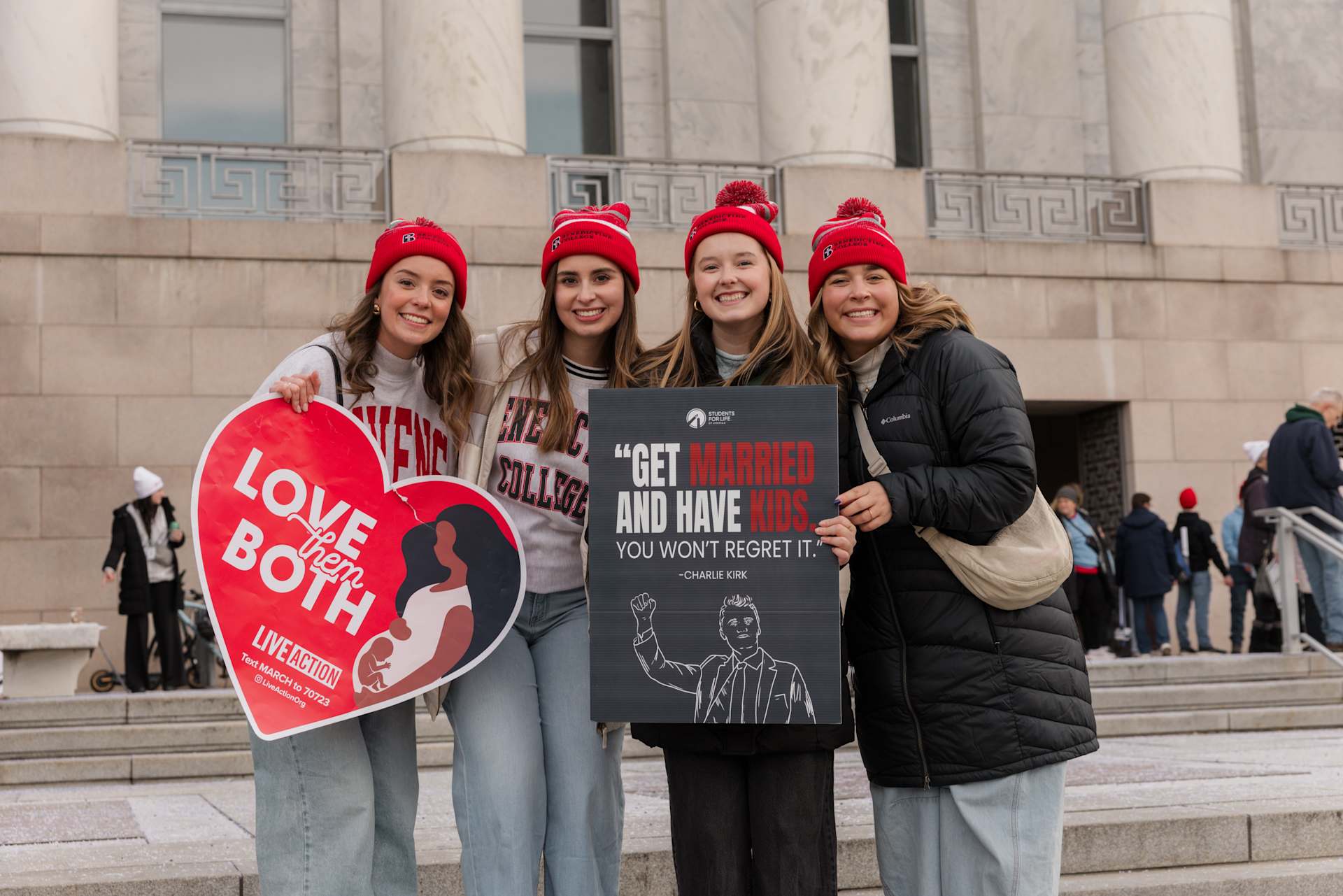
 Benedictine College students hold pro-life signs at the 2026 March for Life in Washington, D.C. | Credit: Isabella Wilcox/Benedictine College
 
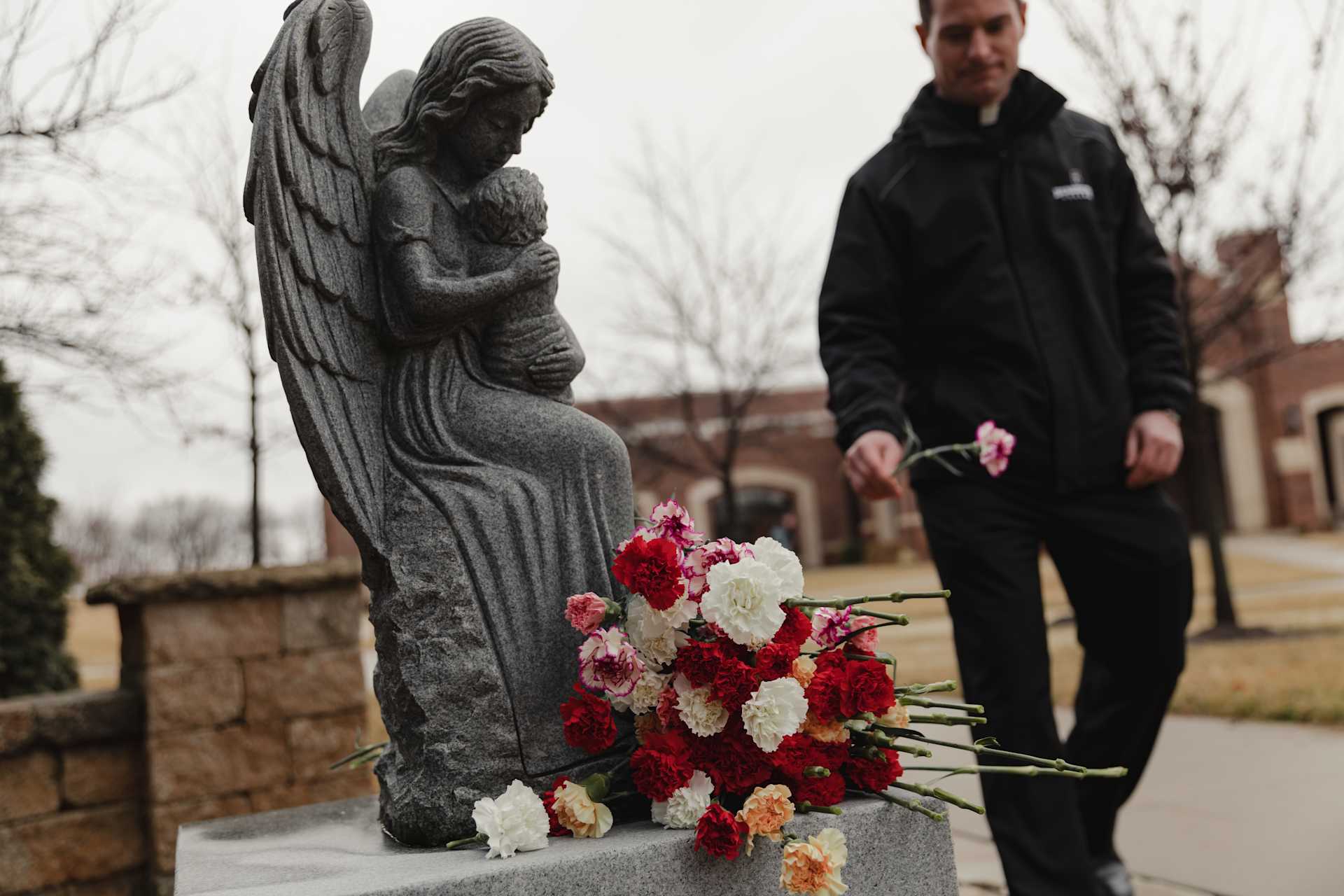
 The schools that leadAt the center of campus at Benedictine College in Atchison, Kansas, sits a statue of an angel holding a child.Installed in 2017, the Memorial to the Unborn is one of the “unique” aspects of pro-life culture on Benedictine’s campus, according to spokesman Steve Johnson.Each year, busloads of students travel to Washington, D.C., for the March for Life. But before they leave, they place roses before the memorial.
 
 Before Benedictine College students head off to the March for Life in Washington, D.C., they place roses on the campus memorial for unborn children. | Credit: Isabella Wilcox/Benedictine College
 
 The student-led pro-life group, Ravens Respect Life, is a “major player” for the culture on campus, according to Johnson. The club helps fundraise for the local pro-life pregnancy resource center, while the campus ministry service team organizes volunteering. The pro-life culture is woven into classes as well, according to Johnson.“We have a pro-life School of Nursing and our graduates take that position out into the world and the hospitals and clinics at which they work,” he said.The school is also looking to further expand its pro-life medical education.
 
 Every year, busloads of students from Benedictine College in Atchison, Kansas, head to the March for Life in Washington, D.C. | Credit: Isabella Wilcox/Benedictine College
 
 “We are in the process of opening a proposed School of Osteopathic medicine,” Johnson said. “This new school will be the most pro-life medical school in the country and will focus on treating the whole person as a human being and not just treating the ailment.”At the University of Mary in North Dakota, a young woman carrying a toddler crossed the stage at graduation, shaking hands with the president, Monsignor James Shea, who gave the beloved baby Lucia a kiss on the cheek.Katie O’Meara (Chihoski) is one of several students who have received the support they need to complete their education as part of the university’s recently-launched maternity home program, the St. Teresa of Calcutta Community for Mothers, at the University of Mary.
 
 Student mom Katie O’Meara (Chihoski) walks the stage with her toddler, Lucia, by her side at commencement in 2024. Father Dominic Bouck, chaplain at the university, is pictured at left. | Credit: Mike McCleary/University of Mary
 
 Per a Jan. 27 announcement, the university has plans for a new residence hall following record enrollment, including a dedicated wing of the future hall for the maternity home.At UMary, motherhood doesn’t have to compete with education.“This St. Teresa of Calcutta Community for Mothers is a concrete expression of the University of Mary’s commitment to building a culture of life,” Vice President for Student Development Reed Ruggles told EWTN News. “It ensures that motherhood and higher education are not competing paths but complementary vocations.”As for the March for Life, “we treat it like a pilgrimage,” said Ed Konieczka, assistant director of University Ministry at the college.The university sends hundreds of students each year and even provides scholarships to help with the cost.Father Dominic Bouck, the University of Mary chaplain and director of University Ministry, told EWTN News that it comes down to formation.“The University of Mary forms its students for the whole of their lives so that they can learn to live well, then take this formation into their communities after graduation,” Bouck said. “We form them to be servant leaders so that they can go out and serve generously to all who need aid. We teach them the sanctity of human life through the Benedictine value of respect for persons and teach them to form community wherever they are at.”“As a Christian, Catholic, and Benedictine institution, the sanctity of human life is core to our beliefs, and we are not afraid to show that in our mission,” he continued.Belmont Abbey College, which also ranked in the top 10, has its own maternity home, MiraVia, as previously reported by EWTN News.
 
 University of Mary students hold a banner at the March for Life in Washington, D.C., on Jan. 23, 2026. | Credit: University of Mary student photographer Regina Turner
 
 Why Christian Schools Project?Though schools like Benedictine, University of Mary, and others stand out for their pro-life work, the report found that many colleges fall short of their Christian values. Project leaders call on readers to reach out to colleges and encourage them to live out these values.“It’s simple: Either stop promoting abortion or stop claiming to be Christian,” said SFLA spokeswoman Mary Mobley.Over the years of doing Christian Schools Project, researchers have seen growth. Since 2024, “56 infractions have been remedied” thanks to the project, according to organizers.“For some schools, they may be unaware of their ties to abortion,” Mobley told EWTN News. “This report offers a chance for them to cut those ties — and to reaffirm their support for life by promoting pro-life resources.”But the project is about more than just cutting ties with abortion providers. 
 
 University of Mary student moms involved with the St. Teresa of Calcutta Community for Mothers, University of Mary’s program for moms. | Credit: Photo courtesy of University of Mary
 
 “Being pro-life doesn’t just mean being anti-abortion; it means coming alongside women and supporting them, providing them with the resources they need to choose life,” Mobley said.“Humans are made in the image of God, and because of that, they have inherent value and worth — and their lives cannot be disposed of for the convenience of others,” Mobley continued.“It’s vital that Christian schools come alongside pregnant and parenting women, showing them that they are valued, loved, and supported — offering them the resources they need to choose life,” Mobley said.
 
 University of Mary students attend the 2026 March for Life in Washington, D.C. | Credit: University of Mary student photographer Regina Turner

Catholic colleges among best and worst for pro-life support, report finds #Catholic Some Catholic colleges ranked among the best for pro-life support for women, while others were among the worst for their ties to abortion clinics, a recent report found.In an audit of more than 700 Christian colleges and universities, the Christian Schools Project found that 1 in 7 Christian colleges referred students to Planned Parenthood for health care or future jobs, among other pro-abortion “infractions.”The report by Demetree, a branch of Students for Life of America (SFLA), called the Catholic connection to the abortion industry “shocking.”“Most shockingly, a portion of Catholic schools have forsaken their Christian values,” the report read, citing the Catechism of the Catholic Church’s teaching on abortion.One in 10 Catholic colleges had ties to abortion clinics, and about 25% of all the infractions were by Catholic universities.“Despite this, Catholic schools also had 24 ‘A+’ schools: the most of any denomination,” the report continued.The lowest grade an institution could receive was an “F” and the highest an “A+.”Among the Catholic schools receiving an “F” was Villanova University in Pennsylvania — Pope Leo’s alma mater, where he was known for his involvement in the pro-life club in his days at the university.Other Catholic schools that received a “F” included Boston College in Massachusetts; Carroll College in Montana; Loyola Marymount University in California; Sacred Heart University in Connecticut; Santa Clara University in California; Seattle University in Washington; St. Catherine University in Minnesota; University of Detroit Mercy in Michigan; and University of San Diego in California. Catholic colleges that received a “D” grade included Mount Saint Mary’s University in California; Saint Louis University in Missouri; and St. John Fisher University in New York.Paradoxically, Catholic colleges were also among the best schools for pro-life values and made up more than half of the top 10 best schools in the report.These schools don’t just avoid ties to Planned Parenthood but provide pregnancy support for student mothers in need. Benedictine College students hold pro-life signs at the 2026 March for Life in Washington, D.C. | Credit: Isabella Wilcox/Benedictine College The schools that leadAt the center of campus at Benedictine College in Atchison, Kansas, sits a statue of an angel holding a child.Installed in 2017, the Memorial to the Unborn is one of the “unique” aspects of pro-life culture on Benedictine’s campus, according to spokesman Steve Johnson.Each year, busloads of students travel to Washington, D.C., for the March for Life. But before they leave, they place roses before the memorial. Before Benedictine College students head off to the March for Life in Washington, D.C., they place roses on the campus memorial for unborn children. | Credit: Isabella Wilcox/Benedictine College The student-led pro-life group, Ravens Respect Life, is a “major player” for the culture on campus, according to Johnson. The club helps fundraise for the local pro-life pregnancy resource center, while the campus ministry service team organizes volunteering. The pro-life culture is woven into classes as well, according to Johnson.“We have a pro-life School of Nursing and our graduates take that position out into the world and the hospitals and clinics at which they work,” he said.The school is also looking to further expand its pro-life medical education. Every year, busloads of students from Benedictine College in Atchison, Kansas, head to the March for Life in Washington, D.C. | Credit: Isabella Wilcox/Benedictine College “We are in the process of opening a proposed School of Osteopathic medicine,” Johnson said. “This new school will be the most pro-life medical school in the country and will focus on treating the whole person as a human being and not just treating the ailment.”At the University of Mary in North Dakota, a young woman carrying a toddler crossed the stage at graduation, shaking hands with the president, Monsignor James Shea, who gave the beloved baby Lucia a kiss on the cheek.Katie O’Meara (Chihoski) is one of several students who have received the support they need to complete their education as part of the university’s recently-launched maternity home program, the St. Teresa of Calcutta Community for Mothers, at the University of Mary. Student mom Katie O’Meara (Chihoski) walks the stage with her toddler, Lucia, by her side at commencement in 2024. Father Dominic Bouck, chaplain at the university, is pictured at left. | Credit: Mike McCleary/University of Mary Per a Jan. 27 announcement, the university has plans for a new residence hall following record enrollment, including a dedicated wing of the future hall for the maternity home.At UMary, motherhood doesn’t have to compete with education.“This St. Teresa of Calcutta Community for Mothers is a concrete expression of the University of Mary’s commitment to building a culture of life,” Vice President for Student Development Reed Ruggles told EWTN News. “It ensures that motherhood and higher education are not competing paths but complementary vocations.”As for the March for Life, “we treat it like a pilgrimage,” said Ed Konieczka, assistant director of University Ministry at the college.The university sends hundreds of students each year and even provides scholarships to help with the cost.Father Dominic Bouck, the University of Mary chaplain and director of University Ministry, told EWTN News that it comes down to formation.“The University of Mary forms its students for the whole of their lives so that they can learn to live well, then take this formation into their communities after graduation,” Bouck said. “We form them to be servant leaders so that they can go out and serve generously to all who need aid. We teach them the sanctity of human life through the Benedictine value of respect for persons and teach them to form community wherever they are at.”“As a Christian, Catholic, and Benedictine institution, the sanctity of human life is core to our beliefs, and we are not afraid to show that in our mission,” he continued.Belmont Abbey College, which also ranked in the top 10, has its own maternity home, MiraVia, as previously reported by EWTN News. University of Mary students hold a banner at the March for Life in Washington, D.C., on Jan. 23, 2026. | Credit: University of Mary student photographer Regina Turner Why Christian Schools Project?Though schools like Benedictine, University of Mary, and others stand out for their pro-life work, the report found that many colleges fall short of their Christian values. Project leaders call on readers to reach out to colleges and encourage them to live out these values.“It’s simple: Either stop promoting abortion or stop claiming to be Christian,” said SFLA spokeswoman Mary Mobley.Over the years of doing Christian Schools Project, researchers have seen growth. Since 2024, “56 infractions have been remedied” thanks to the project, according to organizers.“For some schools, they may be unaware of their ties to abortion,” Mobley told EWTN News. “This report offers a chance for them to cut those ties — and to reaffirm their support for life by promoting pro-life resources.”But the project is about more than just cutting ties with abortion providers. University of Mary student moms involved with the St. Teresa of Calcutta Community for Mothers, University of Mary’s program for moms. | Credit: Photo courtesy of University of Mary “Being pro-life doesn’t just mean being anti-abortion; it means coming alongside women and supporting them, providing them with the resources they need to choose life,” Mobley said.“Humans are made in the image of God, and because of that, they have inherent value and worth — and their lives cannot be disposed of for the convenience of others,” Mobley continued.“It’s vital that Christian schools come alongside pregnant and parenting women, showing them that they are valued, loved, and supported — offering them the resources they need to choose life,” Mobley said. University of Mary students attend the 2026 March for Life in Washington, D.C. | Credit: University of Mary student photographer Regina Turner

Some Catholic colleges ranked among the best for pro-life support for women, while others were among the worst for their ties to abortion clinics, according to a new report.
Read More