faithfulness

Students pray for Notre Dame’s Catholic identity after dispute over pro-abortion professor #Catholic Students at the University of Notre Dame gathered on Feb. 27 for a candlelit prayer service to offer thanksgiving for the university’s Catholic identity.The event was originally planned as a protest in response to the university’s appointment of abortion advocate Professor Susan Ostermann as the head of the Liu Institute for Asia and Asian Studies. After Ostermann withdrew from the position earlier this week, the student organizers turned the event into a prayer vigil offered “in thanksgiving and support for Notre Dame’s Catholic mission.”A group of about 150 students, community members, faculty and priests from the Congregation of Holy Cross met on the south quad of campus, where they were greeted by students Luke Woodyard and Gabe Ortner, the event’s organizers. After a blessing of candles, those present processed to the Grotto of Our Lady of Lourdes, where they prayed the Rosary.
 
 Students gather to pray the Rosary at the Grotto of Our Lady of Lourdes at the University of Notre Dame, Friday, Feb. 27, 2026 | Credit: Notre Dame Right to Life
 
 The event was co-sponsored by the major Catholic clubs on campus: Right to Life, Militia Immaculata, Children of Mary, the Knights of Columbus, and Students for Child-Oriented Policy.According to Woodyard, while a protest would have drawn a greater number of attendees, organizers agreed that changing the event to a prayer vigil would be a more appropriate response to the news of Ostermann’s withdrawal.“The big reason we changed the protest to a prayer vigil was because we won, we got Ostermann to not be appointed. And even though this was a victory in a battle, not the [larger] war, we can celebrate this victory now," Woodyard said.“If we came here with a bunch of protests, it would make us seem like we weren't grateful for the university listening to us," he added. "And we really are. We praise [President] Father [Robert] Dowd for any impact that he had on Ostermann withdrawing, and we pray for the future of Notre Dame.”Ostermann, whose appointment was announced in January, has publicly supported abortion on multiple occasions, calling it “freedom-enhancing” and “consistent with integral human development that emphasizes social justice and human dignity."She has also argued that the pro-life movement has its roots in “white supremacy and racism” and has described pregnancy resource centers “anti-abortion propaganda sites."Since the appointment was announced in January, the university has faced backlash from Catholics across the country, including students, alumni, faculty, and more than a dozen bishops. The university continued to defend Ostermann’s promotion amid the criticism, citing her expertise in Asian studies and her past research. When Ostermann withdrew from the position on Feb. 26, students were surprised at the unexpected reversal but grateful for the desired outcome.Maria Madigan, a sophomore who serves as the head of service for Notre Dame Right to Life, told EWTN News that the grateful and loving spirit of the prayer service was the same spirit in which the protest had been planned.“[The planned protest] was never filled with hate or any [kind of] malicious intent. …We love Notre Dame because of her Catholic mission and her identity," she said. "We wanted to protest the Ostermann appointment because we felt it that went against our mission. And then when Ostermann withdrew, the focus shifted, because… we want to think about having a positive vision going forward for Notre Dame.”Regarding Ostermann’s withdrawal, Woodyard said: “We don't know what happened behind the scenes — hopefully that will come out in the coming weeks — but what we do know is that she did withdraw, and so we're thankful for that, and that's why we're here, but at some point, we have to make sure this doesn't happen again.”Organizer Gabe Ortner emphasized that although the planned protest was turned into a prayer vigil, the defense of Notre Dame’s Catholic mission is far from over.“We have to recognize the work that Father Dowd has done in leading this university. He's clearly been working tirelessly on this with Bishop Rhoades, and I admire the direction that he seems to be taking Notre Dame in, and that gives me a lot of hope," Ortner said. "However, at the same time, there also seem to be particular members of the administration who do not entirely share the Catholic vision of Notre Dame," he said.“Ultimately, Notre Dame should be united in its Catholic identity among all of the members of administration, with no exception.”If the protest had gone forward, speakers would have included Anna Kelley,  president of the school's Right to Life group; Lucy Spence, editor-in-chief of the Irish Rover student newspaper; and Theo Austin, vice president of Students for Child-Oriented Policy.Students have expressed concern that the appointment shows a willingness of university administration — particularly on the part of Provost John McGreevy, who approved the appointment — to deviate from the university’s Catholic mission.Max McNiff, a student who attended the prayer vigil, shared his hopes that the controversy that precipitated Ostermann’s withdrawal would send a clear signal to the university.“I think this sets a sets a good precedent for stuff like this in the future. I think that the administration is going to be very cautious, and hopefully nothing like this will happen again.”“I think this also sets a precedent that researchers who are considered maybe ‘elite’ by secular academic standards, but who very manifestly publicly contradict Catholic doctrine [on matters] such as abortion, should not expect to come into leadership positions at Notre Dame," he said. Ultimately, however, students expressed their gratitude at the reversal of Ostermann’s appointment, calling it a “victory” in the battle for Notre Dame’s Catholic identity.“Having the opportunity to gather together and to thank God for his faithfulness, and the faithfulness of the university, is really beautiful, and I think you can see it in the passion of the students," Madigan said. "Everyone here knew it wasn’t a protest anymore, but they were still coming.”“We're all here because we care and we love this university and we want to uphold its Catholic mission and its pro-life mission as much as possible," she said. "And at the end of the day, whether one person showed up, or whether 200 people showed up, this was a prayer service, and it was to God, and the words that were said here were to him." "And that's what I really want the focus of this whole event to be on, praise and thanksgiving to the Lord for his faithfulness and to Our Lady for protecting her university.”

Students pray for Notre Dame’s Catholic identity after dispute over pro-abortion professor #Catholic Students at the University of Notre Dame gathered on Feb. 27 for a candlelit prayer service to offer thanksgiving for the university’s Catholic identity.The event was originally planned as a protest in response to the university’s appointment of abortion advocate Professor Susan Ostermann as the head of the Liu Institute for Asia and Asian Studies. After Ostermann withdrew from the position earlier this week, the student organizers turned the event into a prayer vigil offered “in thanksgiving and support for Notre Dame’s Catholic mission.”A group of about 150 students, community members, faculty and priests from the Congregation of Holy Cross met on the south quad of campus, where they were greeted by students Luke Woodyard and Gabe Ortner, the event’s organizers. After a blessing of candles, those present processed to the Grotto of Our Lady of Lourdes, where they prayed the Rosary. Students gather to pray the Rosary at the Grotto of Our Lady of Lourdes at the University of Notre Dame, Friday, Feb. 27, 2026 | Credit: Notre Dame Right to Life The event was co-sponsored by the major Catholic clubs on campus: Right to Life, Militia Immaculata, Children of Mary, the Knights of Columbus, and Students for Child-Oriented Policy.According to Woodyard, while a protest would have drawn a greater number of attendees, organizers agreed that changing the event to a prayer vigil would be a more appropriate response to the news of Ostermann’s withdrawal.“The big reason we changed the protest to a prayer vigil was because we won, we got Ostermann to not be appointed. And even though this was a victory in a battle, not the [larger] war, we can celebrate this victory now," Woodyard said.“If we came here with a bunch of protests, it would make us seem like we weren't grateful for the university listening to us," he added. "And we really are. We praise [President] Father [Robert] Dowd for any impact that he had on Ostermann withdrawing, and we pray for the future of Notre Dame.”Ostermann, whose appointment was announced in January, has publicly supported abortion on multiple occasions, calling it “freedom-enhancing” and “consistent with integral human development that emphasizes social justice and human dignity."She has also argued that the pro-life movement has its roots in “white supremacy and racism” and has described pregnancy resource centers “anti-abortion propaganda sites."Since the appointment was announced in January, the university has faced backlash from Catholics across the country, including students, alumni, faculty, and more than a dozen bishops. The university continued to defend Ostermann’s promotion amid the criticism, citing her expertise in Asian studies and her past research. When Ostermann withdrew from the position on Feb. 26, students were surprised at the unexpected reversal but grateful for the desired outcome.Maria Madigan, a sophomore who serves as the head of service for Notre Dame Right to Life, told EWTN News that the grateful and loving spirit of the prayer service was the same spirit in which the protest had been planned.“[The planned protest] was never filled with hate or any [kind of] malicious intent. …We love Notre Dame because of her Catholic mission and her identity," she said. "We wanted to protest the Ostermann appointment because we felt it that went against our mission. And then when Ostermann withdrew, the focus shifted, because… we want to think about having a positive vision going forward for Notre Dame.”Regarding Ostermann’s withdrawal, Woodyard said: “We don't know what happened behind the scenes — hopefully that will come out in the coming weeks — but what we do know is that she did withdraw, and so we're thankful for that, and that's why we're here, but at some point, we have to make sure this doesn't happen again.”Organizer Gabe Ortner emphasized that although the planned protest was turned into a prayer vigil, the defense of Notre Dame’s Catholic mission is far from over.“We have to recognize the work that Father Dowd has done in leading this university. He's clearly been working tirelessly on this with Bishop Rhoades, and I admire the direction that he seems to be taking Notre Dame in, and that gives me a lot of hope," Ortner said. "However, at the same time, there also seem to be particular members of the administration who do not entirely share the Catholic vision of Notre Dame," he said.“Ultimately, Notre Dame should be united in its Catholic identity among all of the members of administration, with no exception.”If the protest had gone forward, speakers would have included Anna Kelley,  president of the school's Right to Life group; Lucy Spence, editor-in-chief of the Irish Rover student newspaper; and Theo Austin, vice president of Students for Child-Oriented Policy.Students have expressed concern that the appointment shows a willingness of university administration — particularly on the part of Provost John McGreevy, who approved the appointment — to deviate from the university’s Catholic mission.Max McNiff, a student who attended the prayer vigil, shared his hopes that the controversy that precipitated Ostermann’s withdrawal would send a clear signal to the university.“I think this sets a sets a good precedent for stuff like this in the future. I think that the administration is going to be very cautious, and hopefully nothing like this will happen again.”“I think this also sets a precedent that researchers who are considered maybe ‘elite’ by secular academic standards, but who very manifestly publicly contradict Catholic doctrine [on matters] such as abortion, should not expect to come into leadership positions at Notre Dame," he said. Ultimately, however, students expressed their gratitude at the reversal of Ostermann’s appointment, calling it a “victory” in the battle for Notre Dame’s Catholic identity.“Having the opportunity to gather together and to thank God for his faithfulness, and the faithfulness of the university, is really beautiful, and I think you can see it in the passion of the students," Madigan said. "Everyone here knew it wasn’t a protest anymore, but they were still coming.”“We're all here because we care and we love this university and we want to uphold its Catholic mission and its pro-life mission as much as possible," she said. "And at the end of the day, whether one person showed up, or whether 200 people showed up, this was a prayer service, and it was to God, and the words that were said here were to him." "And that's what I really want the focus of this whole event to be on, praise and thanksgiving to the Lord for his faithfulness and to Our Lady for protecting her university.”

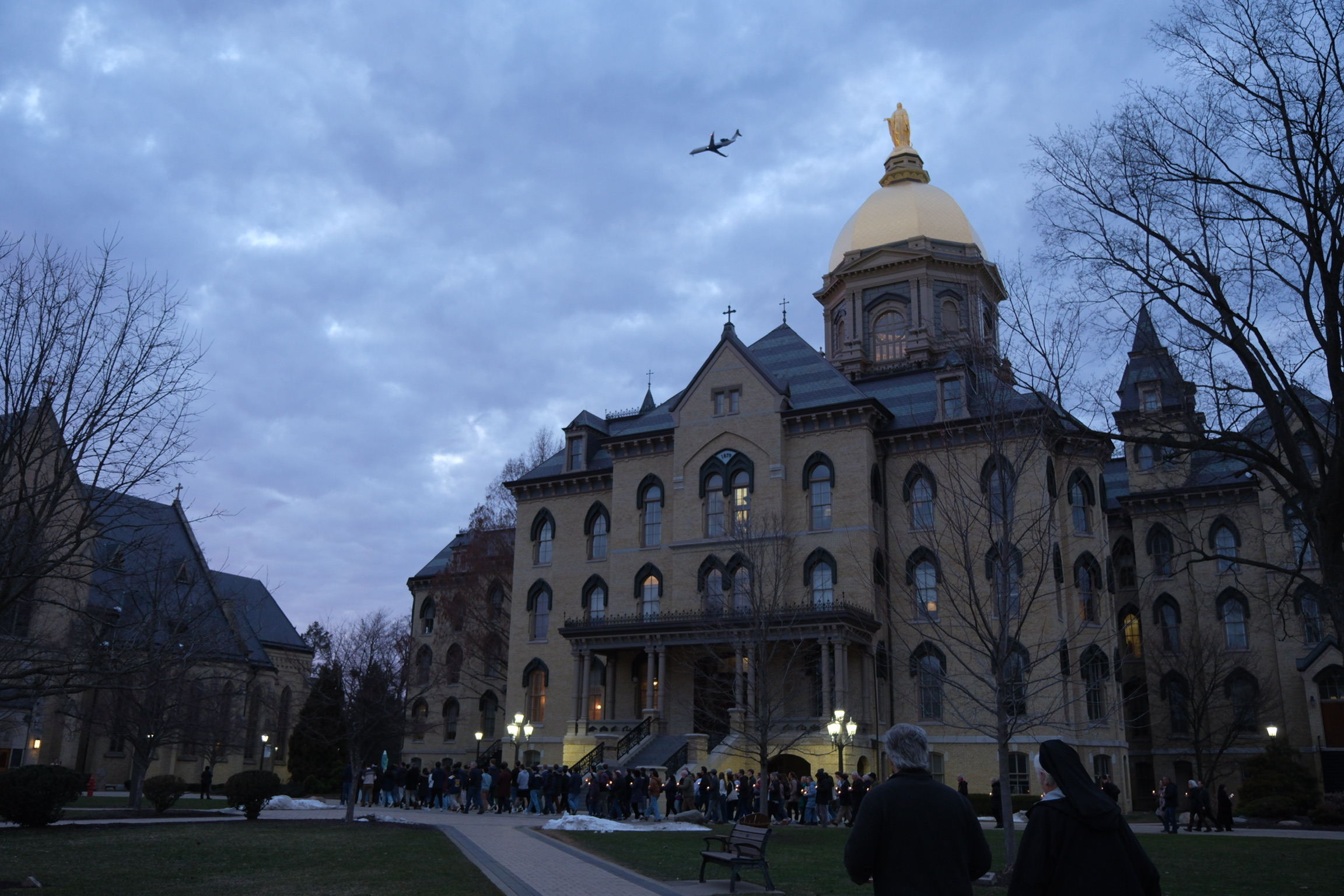
The event was originally planned as a protest in response to the university’s appointment of abortion advocate Professor Susan Ostermann as the head of the Liu Institute for Asia and Asian Studies.
Read More
Bishop offers guidance amid ‘staggering’ mental health crisis, especially among the young #Catholic “In talking to my pastors, it became crystal clear that there really is a crisis right now regarding mental health and emotional well-being, and in a special way for young people,” Bishop Michael Burbidge of the Diocese of Arlington, Virginia, told EWTN News in an interview discussing a pastoral letter he issued recently. “The scale and scope of this crisis are staggering,” he said in the letter titled “The Divine Physician and a Christian Approach to Mental Health and Wellbeing.” Burbidge explained that he hopes “to offer encouragement and guidance, in light of the teachings of Christ and the Gospel, to all who wish to confront and overcome the modern world’s challenges to mental health and well-being.”With depression now the leading cause of disability worldwide, and 1 in 5 American adults experiencing mental health challenges each year, according to the National Alliance on Mental Illness, which the bishop cites in his letter, Burbidge told EWTN News that “there’s a real pastoral need for mental health counseling, and my pastors told me they don’t have the expertise” that many families need.The importance of counselors with a Christian perspectiveMany Catholic parents and couples seek out counseling, he said, but often the counseling “isn’t coming from a Christian or Catholic understanding of the world, where persons are oriented to God and to authentic human relationships and the development of virtue.”Understanding the world through the lens of faith is “the crucial factor — even in circumstances where such faithfulness seems in the eyes of the wider world to be desperate, foolish, or even absurd. Faith and trust in God are shown to be the keys to everlasting health and well-being for humanity,” Burbidge wrote in his letter.Faith, he told EWTN News, “helps us to get a glimpse of heaven even now … If that’s not a part of the counseling being provided, it won’t bring about the healing we’re seeking.”Regarding efforts in his diocese, the bishop told EWTN News he formed a mental health commission about a year ago, on which sit experts in psychology, theology, and mental health counseling.He said with the commission’s help, he hopes to soon issue an extensive list of counselors who have been vetted and recommended for the Catholic faithful in his diocese.Father Charles Sikorsky, LC, the president of Divine Mercy University, a Catholic school that offers graduate degrees in psychology and clinical mental health and whose graduates work in various capacities in the Diocese of Arlington, told EWTN News that psychology cannot be addressed properly without a “a Christian view, a Catholic view of the person.”“We’re incarnational beings,” Sikorsky said, “so we need to address the human but also the spiritual dimension of the person, who needs to be treated in a holistic way.”“The word psyche comes from Greek and means soul,” he continued,” so psychology is the science of the soul, and Christ is the divine physician. Any way of looking at or treating people that doesn’t include the entirety of the interior, spiritual life is not going to work. If you reduce a human person to just biology or experiences, it’s not going to work.”Lack of community the ‘culprit’ in the crisisIn his letter, Burbidge named a lack of community as a culprit in the mental health crisis.“We must be willing to connect with others. We are made for community and find purpose when given the chance to cultivate authentic relationships with others and practice virtues like compassion,” he wrote.“As people of faith, Christians have a particular responsibility to address the stigmas that prevent people from seeking help and to remove barriers that keep so many stuck in patterns of isolation and misery,” he wrote.
 
 Bishop Michael Burbidge of Arlington, Virginia, recently issued the pastor letter “The Divine Physician and a Christian Approach to Mental Health and Wellbeing.” | Credit: Courtesy of the Diocese of Arlington
 
 Burbidge told EWTN News about community-building initiatives that leaders in his diocese have begun, especially since the isolation of the COVID-19 pandemic.“People learned quickly from COVID that being isolated, not being part of a caring fellowship, was a detriment to their growth and affected mental health,” he said.He described an increase in new programs throughout the Diocese of Arlington such as Bible studies, lectures, and programs such as That Man is You, a Catholic men’s leadership program.Sikorsky also cited a lack of connection and loneliness that are particularly prevalent in a society rife with “marriage and family breakdown” and in which technology separates people.“So many people are afraid to say they need help,” he said. “If the Church is what it needs to be and should be, it will be a place to experience a sense of belonging to something higher, where people can come to be loved and to be understood.”‘Suffering can be the cross’ that leads us to holinessThe bishop said that in addition to being in communion with others, those suffering from mental health problems must also realize they are beloved children of God, and their “severe distress, depression, or whatever it is, does not define who you are.”“You’re a child of God — that never changes,” Burbidge said. “Don’t identify yourself with that suffering.”“You don’t necessarily need to run away from the suffering, however,” he continued. “That could be the cross that can lead you to holiness. It doesn’t have to completely disappear for you to be well. Maybe you can get help, and still live a healthy, balanced life living with the anxiety or whatever it is you’re struggling with. If it causes a little suffering, it can be united to the Lord’s, and you can see it as a path to holiness.”Sikorsky echoed the bishop, telling EWTN News: “Our dignity is rooted in being children of God. Your dignity is much more than your struggle or the difficulties that you’ve had.”Burbidge is the latest American Catholic bishop to draw attention to the widening mental health crisis in the United States. In 2025, ahead of World Mental Health Day in October, the U.S. Conference of Catholic Bishops (USCCB) announced an addition to its ongoing National Catholic Mental Health Campaign.“As pastors, we want to emphasize this point to anyone who is suffering from mental illness or facing mental health challenges: Nobody and nothing can alter or diminish your God-given dignity. You are a beloved child of God, a God of healing and hope,” the U.S. bishops said at the time.

Bishop offers guidance amid ‘staggering’ mental health crisis, especially among the young #Catholic “In talking to my pastors, it became crystal clear that there really is a crisis right now regarding mental health and emotional well-being, and in a special way for young people,” Bishop Michael Burbidge of the Diocese of Arlington, Virginia, told EWTN News in an interview discussing a pastoral letter he issued recently. “The scale and scope of this crisis are staggering,” he said in the letter titled “The Divine Physician and a Christian Approach to Mental Health and Wellbeing.” Burbidge explained that he hopes “to offer encouragement and guidance, in light of the teachings of Christ and the Gospel, to all who wish to confront and overcome the modern world’s challenges to mental health and well-being.”With depression now the leading cause of disability worldwide, and 1 in 5 American adults experiencing mental health challenges each year, according to the National Alliance on Mental Illness, which the bishop cites in his letter, Burbidge told EWTN News that “there’s a real pastoral need for mental health counseling, and my pastors told me they don’t have the expertise” that many families need.The importance of counselors with a Christian perspectiveMany Catholic parents and couples seek out counseling, he said, but often the counseling “isn’t coming from a Christian or Catholic understanding of the world, where persons are oriented to God and to authentic human relationships and the development of virtue.”Understanding the world through the lens of faith is “the crucial factor — even in circumstances where such faithfulness seems in the eyes of the wider world to be desperate, foolish, or even absurd. Faith and trust in God are shown to be the keys to everlasting health and well-being for humanity,” Burbidge wrote in his letter.Faith, he told EWTN News, “helps us to get a glimpse of heaven even now … If that’s not a part of the counseling being provided, it won’t bring about the healing we’re seeking.”Regarding efforts in his diocese, the bishop told EWTN News he formed a mental health commission about a year ago, on which sit experts in psychology, theology, and mental health counseling.He said with the commission’s help, he hopes to soon issue an extensive list of counselors who have been vetted and recommended for the Catholic faithful in his diocese.Father Charles Sikorsky, LC, the president of Divine Mercy University, a Catholic school that offers graduate degrees in psychology and clinical mental health and whose graduates work in various capacities in the Diocese of Arlington, told EWTN News that psychology cannot be addressed properly without a “a Christian view, a Catholic view of the person.”“We’re incarnational beings,” Sikorsky said, “so we need to address the human but also the spiritual dimension of the person, who needs to be treated in a holistic way.”“The word psyche comes from Greek and means soul,” he continued,” so psychology is the science of the soul, and Christ is the divine physician. Any way of looking at or treating people that doesn’t include the entirety of the interior, spiritual life is not going to work. If you reduce a human person to just biology or experiences, it’s not going to work.”Lack of community the ‘culprit’ in the crisisIn his letter, Burbidge named a lack of community as a culprit in the mental health crisis.“We must be willing to connect with others. We are made for community and find purpose when given the chance to cultivate authentic relationships with others and practice virtues like compassion,” he wrote.“As people of faith, Christians have a particular responsibility to address the stigmas that prevent people from seeking help and to remove barriers that keep so many stuck in patterns of isolation and misery,” he wrote. Bishop Michael Burbidge of Arlington, Virginia, recently issued the pastor letter “The Divine Physician and a Christian Approach to Mental Health and Wellbeing.” | Credit: Courtesy of the Diocese of Arlington Burbidge told EWTN News about community-building initiatives that leaders in his diocese have begun, especially since the isolation of the COVID-19 pandemic.“People learned quickly from COVID that being isolated, not being part of a caring fellowship, was a detriment to their growth and affected mental health,” he said.He described an increase in new programs throughout the Diocese of Arlington such as Bible studies, lectures, and programs such as That Man is You, a Catholic men’s leadership program.Sikorsky also cited a lack of connection and loneliness that are particularly prevalent in a society rife with “marriage and family breakdown” and in which technology separates people.“So many people are afraid to say they need help,” he said. “If the Church is what it needs to be and should be, it will be a place to experience a sense of belonging to something higher, where people can come to be loved and to be understood.”‘Suffering can be the cross’ that leads us to holinessThe bishop said that in addition to being in communion with others, those suffering from mental health problems must also realize they are beloved children of God, and their “severe distress, depression, or whatever it is, does not define who you are.”“You’re a child of God — that never changes,” Burbidge said. “Don’t identify yourself with that suffering.”“You don’t necessarily need to run away from the suffering, however,” he continued. “That could be the cross that can lead you to holiness. It doesn’t have to completely disappear for you to be well. Maybe you can get help, and still live a healthy, balanced life living with the anxiety or whatever it is you’re struggling with. If it causes a little suffering, it can be united to the Lord’s, and you can see it as a path to holiness.”Sikorsky echoed the bishop, telling EWTN News: “Our dignity is rooted in being children of God. Your dignity is much more than your struggle or the difficulties that you’ve had.”Burbidge is the latest American Catholic bishop to draw attention to the widening mental health crisis in the United States. In 2025, ahead of World Mental Health Day in October, the U.S. Conference of Catholic Bishops (USCCB) announced an addition to its ongoing National Catholic Mental Health Campaign.“As pastors, we want to emphasize this point to anyone who is suffering from mental illness or facing mental health challenges: Nobody and nothing can alter or diminish your God-given dignity. You are a beloved child of God, a God of healing and hope,” the U.S. bishops said at the time.

In a recent pastoral letter, Bishop Michael Burbidge addressed what he sees as a “crisis” in mental health among Catholics, especially the young, and seeks to remove stigma over seeking help.

Read More