![‘God wants to cover us in robes of grace,’ Catholic fashion writer says #Catholic According to Catholic author Mary Harper, the way we dress can be a way to express faith, human dignity, and personal identity.Harper, author of “The Liturgical Style Guide,” in which she explores how faith should influence how we dress, noted that the Bible shows the symbolic importance of clothing: “It’s actually pretty amazing how, throughout both the Old Testament and the New … clothing is mentioned over 100 times... The majority of times, it’s meant to be a sign of God’s mercy and providence.”This symbolism appears from the very beginning of the Bible, she said in a recent interview posted by the Archdiocese of Miami.
Mary Harper, author of “The Liturgical Style Guide,” explores how faith can influence even everyday dress. | Credit: Archdiocese of Miami
After original sin, Adam and Eve tried to cover themselves by sewing together fig leaves, which Harper called “flimsy.”“What does God do? He literally slaughters an animal, the first sacrifice in Scripture. He covers them in leather garments because he wants them to have something that’s worthy, something that’s good, something that’s actually going to protect them and be lasting,” she explained.According to Harper, this biblical image helps us understand human dignity. “God wants to cover us in robes of grace,” she said, also recalling the parable of the prodigal son, when the father “puts a robe on him and a ring on him, as a reminder of his goodness and his dignity and his identity.”That’s why even something as ordinary as getting dressed every day can have a spiritual dimension. “Even through something that we do every day — getting dressed for the day — the Lord is speaking his providence over you. He desires to lavish you in grace. Even getting dressed in the morning is a way to remember putting on Christ, putting on your baptismal garment again, remembering who you are and who you’re called to be in Christ,” she pointed out.Harper grew up Catholic in New Orleans. She earned her master’s and bachelor’s degrees in theology from Ave Maria University and is the founder of LiturgicalStyle.com, a project dedicated to reflecting on the theological significance of clothing based on the Bible, the stories of the saints, and the liturgical calendar.She also writes for litanynyc.com a Catholic made-to-measure clothing company that seeks to apply the Church’s social teaching in its production process.Clothing as a form of Christian witness“Whether I intend it or not, my clothing is going to communicate something. You wear a school uniform, it tells you what school you go to; priests put on vestments that tell you about the liturgical season. Well, there’s great power in that,” she said.From that perspective, she added, clothing can become a form of Christian witness. “I have the capacity to communicate the Gospel through my very garments, through intentionality, creativity, and beauty.”The author also cautioned that the Christian view of modesty avoids two extremes: absolute individualism and fear of the body.“One extreme is, I can wear whatever I want, I don’t care what anyone else thinks about it. At the same time, we don’t want to get to the point of, ‘I don’t know how to dress myself well, and I’m so scared of doing the wrong thing … [and] nothing can show because my body is bad,’” she explained.“The Church has never said that,” Harper added, noting that Christian teaching on the goodness of the human body is developed in depth in St. John Paul II’s theology of the body.More than strict rules, she argued, the key lies in discerning: “What is it that I want to communicate through what I’m wearing?” Harper also explained that modesty involves considering the context and the activity.“It is my responsibility to wear something that makes sense for the activity at hand, for the environment that I’m in, and that allows me to be fully present. That’s a service to everyone around me and to myself,” she stated, citing as an example the impracticality of wearing flip flops to hike in the Rocky Mountains.Drawing inspiration from the saintsHarper also proposed a creative idea for living out one’s faith in everyday life: finding inspiration in the saints when choosing what to wear.This does not mean, she clarified, that we imitate them literally. “I’m not telling you to go around wearing a Carmelite habit,” she joked.Rather, she suggested small symbolic gestures: “If you have Western boots, you can say you’re wearing them in honor of St. Teresa of the Andes,” who loved horseback riding. Or “when you wear jeans, you can think of her, because she just loved to be this great adventurer and going into the mountains” and “I’m going to ask her to pray for me."Creativity and freedom in the Christian lifeFor Harper, the relationship between faith and clothing should not become a source of scrupulosity or pressure.“Sometimes we can get so caught up saying, ‘If I’m a ‘real Catholic,’ then I’m going to dress in this particular way.’ I think it’s really easy to get kind of scrupulous when it comes to clothing,” she reflected.Instead, she recommended bringing the matter to prayer and discernment with trusted individuals. “If you have any concern about, ‘Am I dressing in a way that is good?’, talk to someone who knows your heart,” she advised.Finally, Harper encouraged living out Christian creativity in these everyday details as well: “The Holy Spirit is creative."“When you get dressed for the day, if you just say, ‘Come, Holy Spirit,’ he’s going to show up. It’s going to be awesome and joyful, and it’ll be more fun.”This story was first published by ACI Prensa, the Spanish-language sister service of EWTN News. It has been translated and adapted by EWTN News English.](https://unitedyam.com/wp-content/uploads/2026/03/god-wants-to-cover-us-in-robes-of-grace-catholic-fashion-writer-says-catholic-according-to-catholic-author-mary-harper-the-way-we-dress-can-be-a-way-to-express-faith-human-dignit.webp)

Mary Harper explains the positive dimension of choosing what to wear and what it can express, urging Catholics to invite the Holy Spirit into their fashion choices.

Mary Harper explains the positive dimension of choosing what to wear and what it can express, urging Catholics to invite the Holy Spirit into their fashion choices.
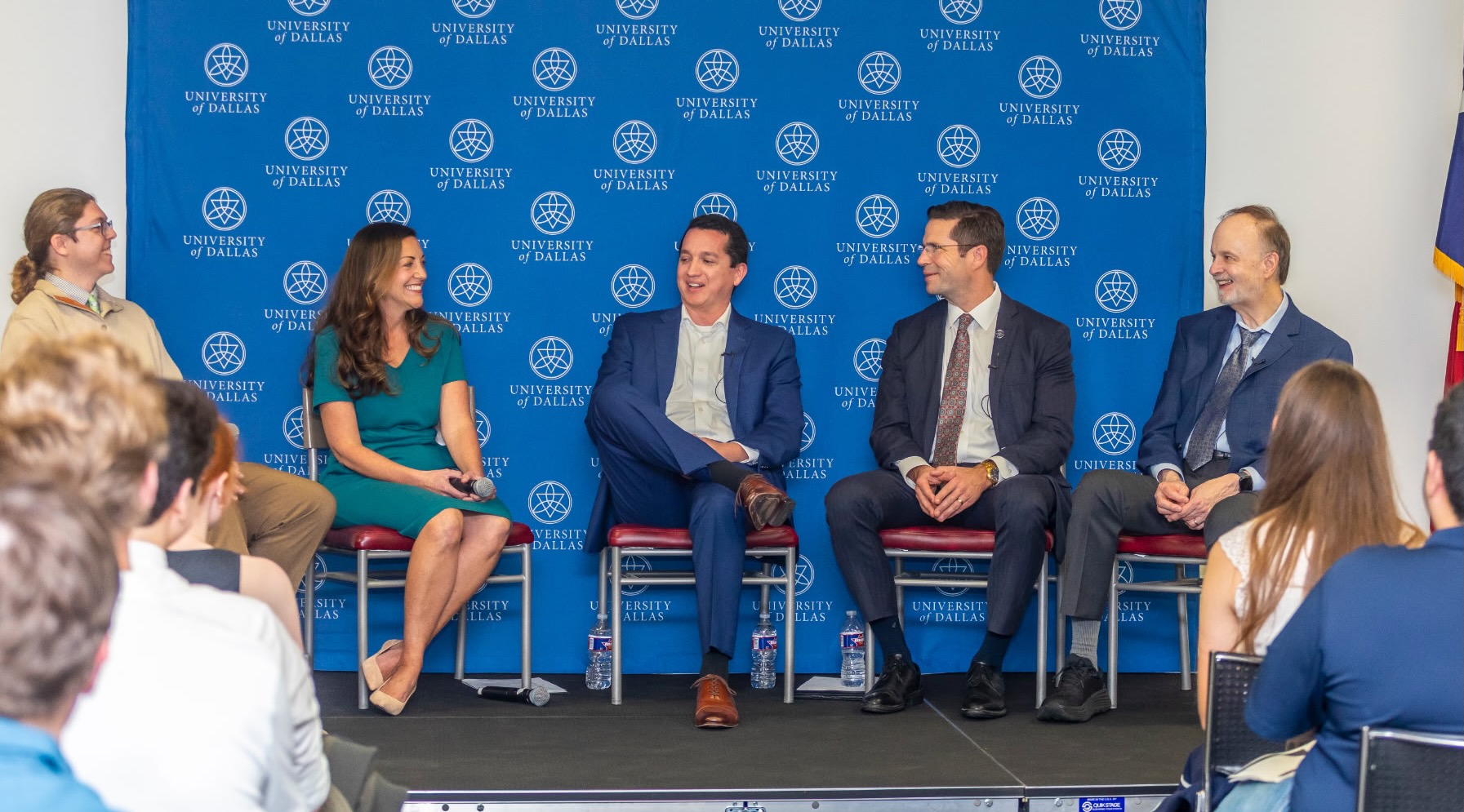
![University of Dallas panel explores American exceptionalism through a Catholic lens #Catholic In a standing-room-only event, college students lined the walls of a large room at the University of Dallas to hear three Catholic academics and an apologist reflect on what makes America exceptional in a celebration marking the 250th anniversary of the founding of the United States.Liam Ritter, a junior and the founder of the university’s Young Americans for Freedom chapter, which hosted the discussion, told EWTN News that the March 4 panel of speakers served as the capstone of three days of celebrations at the university.The panel was comprised of University President Jonathan Sanford; Trent Horn, staff apologist with Catholic Answers; Burt Folsom, distinguished fellow at Hillsdale College and economic historian; and Susan Hanssen, associate professor of history at the University of Dallas.‘We have a population of people who know what is at stake’In response to Ritter’s question, “Why [is it] that our political regime has been so stable for so long,” Hanssen recalled America’s first immigrants. “I think the first thing that makes America exceptional, and its political regime exceptional, is the fact that America was first populated by people who fled the rise of the modern nation state and totalitarianism … and so we have a population of people who know what is at stake in political liberty," she said.“Theyʼve seen what happened to their ancestors,” she continued. “They remember the stories. And America has been blessed in its political constitution with the regime of liberty, which has made possible the flourishing of subsidiary communities and societies.”Hanssen said we should not take for granted today that we still “have a free people." “We need to listen to our latest immigrants … those who have fled Venezuela, those who have fled Iran, like my uncle, a Persian Jew, who refuses to call himself Iranian because he associates modern Iran with the regime of the Ayatollah.”‘Get married, have children, raise them well’Sanford said that though we are a nation of immigrants, “there won’t be enough to pull in to make up for” the continuing demographic decline.“Get married, have children, raise them well,” he said to chuckles from a receptive audience, which was mostly composed of college students.He encouraged the students not to focus on “one big step,” but rather, to take smaller steps: “Get up early. Pray. Exercise. Go through the day in an ordered fashion, give Caesar what is Caesarʼs, and God what is God’s.”“Do the little things thousands and thousands of times,” he said.“In order to exercise liberty properly,” he continued, one has to ask, "How should I live my life?” and then rely on the institutions that “help you do that.”He called the family the “foundational institution” of America. “Recover the family,” he said.In addition, “we need to see those institutions that mediate the virtues — schools, universities — that embrace fully the idea of what [the virtues] are.”Horn also encouraged students to focus on family relationships, telling them “get off the phones and the internet. They’re killing all of us. They’re rewiring our brains.”
Trent Horn (left), an apologist at Catholic Answers, and University of Dallas President Jonathan Sanford participate in a panel on American exceptionalism at the University of Dallas on March 4, 2026. | Credit: Courtesy of University of Dallas Young Americans for Freedom Chapter
Of people currently in their 20s in America, "one in three will never have children,” he lamented, implying too much technology use is partly to blame.The Catholic Answers apologist pointed out, however, that though the Second Industrial Revolution “broke the family” by encouraging workers to move away from their homes and families to pursue careers, the internet “post-Covid,” in the age of “Zoom and telecommuting … might be good” because many people no longer have to choose between a job and staying near their extended families.“Maybe tech can help build up family networks,” he said.‘The greatest outpouring of economic development’ in historyRitter told EWTN news that he chose speakers who could address “the wonderful things the U.S. has contributed” to the world because “a lot of young people don’t have appropriate gratitude for the country.”Ritter asked Folsom, a historian who focuses on economics and industrial affairs, about what the professor believes the U.S. has contributed to world economics and world innovations.Folsom said that the generation after the Civil War, from 1865 to 1905, was responsible for “the greatest outpouring of economic development … in world history” and “gave us the rise of an America that became a world power” by World War I.He listed inventions that facilitated the rapid development of industry and infrastructure in the country during the Second Industrial Revolution, including the typewriter, the telephone, adding machines, the light bulb, electricity, factory-produced cars, and recording devices for music and movies, among other innovations.Through the Declaration of Independence and the U.S. Constitution, “the founders gave us the freedom” to develop these technologies, he said. “We had amazing infrastructure that allowed people to produce, and not have government get in their way.”The professor said the post-Civil War period could be eclipsed in the present day “because with artificial intelligence, this generation may yet be able to come up with more.”‘A responsibility for this political regime of freedom’At the conclusion of the panel discussion, Hanssen called the feeling in the room “electric, it’s teeming with patriotism. This isn’t a normal college campus.”Referring to Sanford’s earlier admonition to ”get married and have kids,” she said: “I agree, be fruitful and multiply … Preach the Gospel, and baptize in the name of Jesus, but also, go into politics!” she exclaimed.She encouraged the students to develop “the ability to love something so much that you would die for it: God, family, country.”“Recognize what is at stake. We have a responsibility for this political regime of freedom, to the immigrants who come here … to our children… to preserve the rule of law.”She concluded to loud applause: “So family; yes! Faith; yes, but to the barricades, ladies and gentlemen!"](https://unitedyam.com/wp-content/uploads/2026/03/university-of-dallas-panel-explores-american-exceptionalism-through-a-catholic-lens-catholic-in-a-standing-room-only-event-college-students-lined-the-walls-of-a-large-room-at-the-university-of-dalla.jpg)
The speakers encouraged the college students to get married, have children, stay off the internet (unless it enables them to telework and stay near their extended families), and be political.


In northwest Australia, the Great Sandy Desert holds great geological interest as a zone of active sand dune movement. While a variety of dune forms appear across the region, this astronaut photograph features numerous linear dunes (about 25 meters high) separated in a roughly regular fashion (0.5 to 1.5 kilometers apart).
Read More