humility

Catholic thinkers, tech experts reflect on promise and perils of AI at New York Encounter #Catholic NEW YORK — How can Catholic social teaching guide us in weighing the benefits of artificial intelligence against the dangers it poses to human dignity? That question animated a wide-ranging discussion among Catholic thinkers and technology experts at the New York Encounter on Saturday.Citing Pope Leo XIV’s call to use AI responsibly as well as the Church’s historic defense of human dignity in the face of modern technology, Davide Bolchini, moderator and dean of the Luddy School of Informatics at Indiana University, opened the discussion before an audience of several hundred people gathered for the three-day cultural conference in New York City.“The pope encouraged us to use AI responsibly, to use it in a way that helps us grow, not to let it work against us, but to let it work with us, not to substitute human intelligence, not to replace our judgment of what’s right … our ability of authentic wonder,” Bolchini said.With technology rapidly advancing, Bolchini asked, how can the Church stay ahead of these challenges?Chuck Rossi, an engineer at Meta who is developing AI-driven content moderation technology at the technology conglomerate, which includes Facebook and Instagram, argued that in his work, developments in AI have been instrumental in safeguarding human beings from harm. AI systems, he said, can examine 2.5 billion pieces of of shared online content per hour, filtering harmful material including nudity and sexual activity, bullying and harassment, child endanger, dangerous organizations, fake accounts, hateful conduct, restricted goods and services, spam, suicide and self-injury, violence and incitement, and violent and graphic content.“That’s my world,” he said. “It’s a very, very hard problem. If we miss 0.1% of 2. 5 billion, that’s millions of things that we didn’t want to be seeing. But we do an excellent job, and we have for years — we’re one of the best at it,” Rossi said.Using AI also protects human content moderators from being exposed to disturbing material, as they were in the past.“The good thing that we are giving back to humans is you never have to do this horrible work,” he said.Paul Scherz, professor of theology at the University of Notre Dame, acknowledged the benefits of AI, which he said included advances in medicine and efficiency for tasks like billing (“Nobody wants to do billing,” he said).But Scherz warned of the dangers of relying on technology to do what is intrinsically human.“We are really starting to turn to AI as people more broadly for these relational aspects, which would be tragic because there is something in that human-to-human connection, the ‘I/thou connection,’ as Martin Buber called it, that is irreplaceable by a machine,” Scherz said. He noted that AI has even moved into ministry, with the rise of Catholic apps relying on bots to offer catechesis.Scherz also cautioned that substituting AI for human interaction and intelligence risks eroding our skills, whether in relationships or in professional life.“My fear is as we use these chatbots more and more we will lose those person-to-person skills. We’ll no longer be able to engage one another as well, or have the patience and virtue to deeply love and encounter one another,” Scherz said.In addition, relying on AI in our work, for example, when a doctor consults AI to make a diagnosis, will result in our “de-skilling,” he said. “We know that people, when they’re using automated systems, they tend to just become biased and complacent and just approve the automated system. They lose their skills,” he said, adding that airline pilots who rely too much on autopilot are more prone to making errors.Louis Kim, former vice president of personal systems and AI at Hewlett-Packard who is currently pursuing graduate studies in theology and health care, pointed out that it’s not possible to know today what skills will be required in the future.“My personal view is I often find that predictions of impacted technology are largely unconsciously based on what we know of the current paradigm and structure and technologies,” Kim said.“There are going to be skills needed to control AI that are going to be different,” he said.Kim also called for “humility” in discussions about AI’s potential to affect human relationships.“Let’s ask ourselves about the quality of our current human relationships, whether it’s in the workplace, in toxic cultures, sometimes at home — even at conferences, at your next break, as you go around talking to this person [or] that person, how many times that person is looking over your shoulder for the more important person to talk to?” he said.Our moral formation, he said, will continue to shape the quality of our encounters with others.

Catholic thinkers, tech experts reflect on promise and perils of AI at New York Encounter #Catholic NEW YORK — How can Catholic social teaching guide us in weighing the benefits of artificial intelligence against the dangers it poses to human dignity? That question animated a wide-ranging discussion among Catholic thinkers and technology experts at the New York Encounter on Saturday.Citing Pope Leo XIV’s call to use AI responsibly as well as the Church’s historic defense of human dignity in the face of modern technology, Davide Bolchini, moderator and dean of the Luddy School of Informatics at Indiana University, opened the discussion before an audience of several hundred people gathered for the three-day cultural conference in New York City.“The pope encouraged us to use AI responsibly, to use it in a way that helps us grow, not to let it work against us, but to let it work with us, not to substitute human intelligence, not to replace our judgment of what’s right … our ability of authentic wonder,” Bolchini said.With technology rapidly advancing, Bolchini asked, how can the Church stay ahead of these challenges?Chuck Rossi, an engineer at Meta who is developing AI-driven content moderation technology at the technology conglomerate, which includes Facebook and Instagram, argued that in his work, developments in AI have been instrumental in safeguarding human beings from harm. AI systems, he said, can examine 2.5 billion pieces of of shared online content per hour, filtering harmful material including nudity and sexual activity, bullying and harassment, child endanger, dangerous organizations, fake accounts, hateful conduct, restricted goods and services, spam, suicide and self-injury, violence and incitement, and violent and graphic content.“That’s my world,” he said. “It’s a very, very hard problem. If we miss 0.1% of 2. 5 billion, that’s millions of things that we didn’t want to be seeing. But we do an excellent job, and we have for years — we’re one of the best at it,” Rossi said.Using AI also protects human content moderators from being exposed to disturbing material, as they were in the past.“The good thing that we are giving back to humans is you never have to do this horrible work,” he said.Paul Scherz, professor of theology at the University of Notre Dame, acknowledged the benefits of AI, which he said included advances in medicine and efficiency for tasks like billing (“Nobody wants to do billing,” he said).But Scherz warned of the dangers of relying on technology to do what is intrinsically human.“We are really starting to turn to AI as people more broadly for these relational aspects, which would be tragic because there is something in that human-to-human connection, the ‘I/thou connection,’ as Martin Buber called it, that is irreplaceable by a machine,” Scherz said. He noted that AI has even moved into ministry, with the rise of Catholic apps relying on bots to offer catechesis.Scherz also cautioned that substituting AI for human interaction and intelligence risks eroding our skills, whether in relationships or in professional life.“My fear is as we use these chatbots more and more we will lose those person-to-person skills. We’ll no longer be able to engage one another as well, or have the patience and virtue to deeply love and encounter one another,” Scherz said.In addition, relying on AI in our work, for example, when a doctor consults AI to make a diagnosis, will result in our “de-skilling,” he said. “We know that people, when they’re using automated systems, they tend to just become biased and complacent and just approve the automated system. They lose their skills,” he said, adding that airline pilots who rely too much on autopilot are more prone to making errors.Louis Kim, former vice president of personal systems and AI at Hewlett-Packard who is currently pursuing graduate studies in theology and health care, pointed out that it’s not possible to know today what skills will be required in the future.“My personal view is I often find that predictions of impacted technology are largely unconsciously based on what we know of the current paradigm and structure and technologies,” Kim said.“There are going to be skills needed to control AI that are going to be different,” he said.Kim also called for “humility” in discussions about AI’s potential to affect human relationships.“Let’s ask ourselves about the quality of our current human relationships, whether it’s in the workplace, in toxic cultures, sometimes at home — even at conferences, at your next break, as you go around talking to this person [or] that person, how many times that person is looking over your shoulder for the more important person to talk to?” he said.Our moral formation, he said, will continue to shape the quality of our encounters with others.

“The pope encouraged us to use AI responsibly, to use it in a way that helps us grow, not to let it work against us, ” said Davide Bolchini, the moderator of an AI panel at the weekend conference.

Read More
Archbishop Lori issues pastoral letter on political life in honor of 250th anniversary of the U.S. #Catholic Archbishop William Lori of Baltimore urged Catholics to foster a political culture grounded in Christ by prioritizing human dignity and genuine encounter amid partisan divisions.“In Charity and Truth: Toward a Renewed Political Culture,” released in anticipation of the 250th anniversary of the Declaration of Independence, is among the nine pastoral letters and reflections Lori has written as archbishop of Baltimore. The Feb. 9 letter explored how the anniversary can be “a moment of grace” and one of “responsibility.”The U.S. can both take pride in its achievements and “the vibrancy of our Catholic faith” while also recognizing “the fractures, wounds, and crises that mark both our national life and, sadly, even at times our ecclesial life,” Lori wrote.“As our nation approaches the 250th anniversary of the signing of the Declaration of Independence, we find ourselves invited into a moment of profound reflection and renewal,” Lori said. “Anniversaries are not merely occasions for nostalgia or celebration. Authentic remembrance always orients us toward renewal; it calls us to consider not only who we have been and who we are becoming — but, by God’s grace, who we are called to be.”The letter draws on teachings from the popes, the Second Vatican Council, the Constitution, and the lives of the saints.Addressing political discourse from a Catholic viewThe letter highlighted the U.S. political atmosphere, noting that “political discourse has become more vitriolic than usual.” Lori called for synodal listening, civic virtue, and patriotic charity — as exemplified by Blessed Michael McGivney — to renew public life with truth, responsibility, and hope.McGivney, founder of the Knights of Columbus, served immigrant families and addressed their economic insecurity and exclusion. Lori said genuine charity, unity, fraternity, and patriotic love should guide how Catholics engage with migrants and support their dignity and inclusion.
 
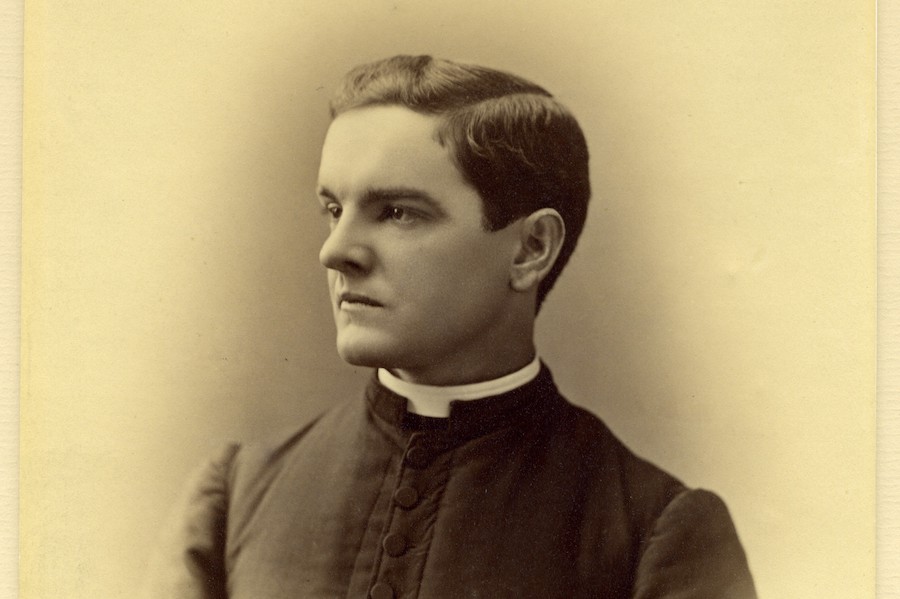
 Father Michael McGivney. | Credit: John Tierney/Father McGivney Guild
 
 Lori said ideological and cultural polarization “has produced an epidemic of loneliness and isolation — an aching sense of being unmoored, misunderstood, or unheard.”Lori wrote: “Synodality is, at its heart, a commitment to listening with humility, speaking with honesty, and discerning with the Holy Spirit — all while walking together, not apart.”“Such unity does not mean uniformity, nor does it eliminate disagreement,” Lori said. “Rather, it reflects a deeper truth. Our communion in Christ precedes our differences.”Synodality “does not dissolve disagreement. It expects it, because diverse people will inevitably see the world from different angles,” Lori said. The letter detailed what “synodality in politics looks like,” including a renewed willingness to listen, a refusal to demonize, a commitment to discernment, and a shared journey.Our world also needs “a new kind of politics — one that begins not with power but with the truth of the human person revealed in Jesus Christ,” Lori said. “Christ, in his incarnation, affirms the goodness of the human body and the meaning of human history.”According to Lori, this new type of politics includes resisting the idolatry of ideology. It must also honor the inherent dignity of every human life from conception to natural death, protect the vulnerable and the marginalized, engage in dialogue rather than accusation, and place the common good above partisan loyalty.A “mature Catholic political presence will” always defend human life in all its stages, advocate for the poor and the vulnerable, insist on racial and social justice, promote peace and reject violence, and uphold religious freedom for all, Lori said.In order to build a better political culture, “we must learn once more how to encounter, by stepping outside our ideological comfort zones, seeking out conversations with those on the margins or those with differing points of view, healing the wounds that divide us, committing ourselves to forgiveness,” Lori said.Virtue in public lifeLori called on U.S. citizens to employ the cardinal virtues in public life to create a “healthy political engagement.”People can use prudence by “evaluating policies not by slogans or emotional appeal but by their actual impact on human dignity,” Lori said. The virtue “helps us to see clearly, to judge wisely, and to act firmly.”Justice “is foundational to political life,” Lori said. “It is the virtue that moves us to honor the dignity of every human person and to recognize that each person has rights that must be protected and responsibilities that must be fulfilled.”Fortitude “strengthens us to pursue what is right despite fear, intimidation, or difficulty,” Lori said. “It empowers each of us to resist the pressure to conform to divisive rhetoric, to endure criticism when standing for truth, and to advocate for the vulnerable even when it is politically inconvenient.”Lastly, temperance “moderates our impulses and helps us resist the allure of excess,” Lori said. “In political culture, temperance is perhaps the virtue most needed today. Temperance invites us to slow down, to choose words carefully, to avoid rash judgments, and to discipline the desire to ‘win’ at the expense of relationship, truth, or the common good.”RenewalLori called for renewal ahead of the 250th anniversary of the U.S. He invited all Catholics and all people of goodwill to commit themselves to a renewed political culture and to answer the call of hope.The letter concluded by detailing “a path forward” on how to renew political culture, including: renewing prayer for the nation, practicing civil dialogue, rejecting hatred and violence, serving the common good, forming consciences, and encountering those different from oneself.“In the midst of political upheaval, the Church does not withdraw from public life, nor does she align herself with any partisan identity,” Lori said. “She remains what she has always been: a sacrament of unity, a beacon of hope, and a teacher of truth.”“Her mission is not to win elections but to form saints. Not to secure power but to proclaim the Gospel. Not to mirror the divisions of society but to heal them,” Lori said.“Our nation needs Catholics who embody this mission — women and men whose lives witness to the dignity of every human person, whose love bridges divides, whose courage resists hatred, and whose faith insists that despair does not have the final word. The civic landscape may look dark at times, but the Church has lived through darker times and emerged stronger, purified, and more faithful. So, too, can our nation,” he said.

Archbishop Lori issues pastoral letter on political life in honor of 250th anniversary of the U.S. #Catholic Archbishop William Lori of Baltimore urged Catholics to foster a political culture grounded in Christ by prioritizing human dignity and genuine encounter amid partisan divisions.“In Charity and Truth: Toward a Renewed Political Culture,” released in anticipation of the 250th anniversary of the Declaration of Independence, is among the nine pastoral letters and reflections Lori has written as archbishop of Baltimore. The Feb. 9 letter explored how the anniversary can be “a moment of grace” and one of “responsibility.”The U.S. can both take pride in its achievements and “the vibrancy of our Catholic faith” while also recognizing “the fractures, wounds, and crises that mark both our national life and, sadly, even at times our ecclesial life,” Lori wrote.“As our nation approaches the 250th anniversary of the signing of the Declaration of Independence, we find ourselves invited into a moment of profound reflection and renewal,” Lori said. “Anniversaries are not merely occasions for nostalgia or celebration. Authentic remembrance always orients us toward renewal; it calls us to consider not only who we have been and who we are becoming — but, by God’s grace, who we are called to be.”The letter draws on teachings from the popes, the Second Vatican Council, the Constitution, and the lives of the saints.Addressing political discourse from a Catholic viewThe letter highlighted the U.S. political atmosphere, noting that “political discourse has become more vitriolic than usual.” Lori called for synodal listening, civic virtue, and patriotic charity — as exemplified by Blessed Michael McGivney — to renew public life with truth, responsibility, and hope.McGivney, founder of the Knights of Columbus, served immigrant families and addressed their economic insecurity and exclusion. Lori said genuine charity, unity, fraternity, and patriotic love should guide how Catholics engage with migrants and support their dignity and inclusion. Father Michael McGivney. | Credit: John Tierney/Father McGivney Guild Lori said ideological and cultural polarization “has produced an epidemic of loneliness and isolation — an aching sense of being unmoored, misunderstood, or unheard.”Lori wrote: “Synodality is, at its heart, a commitment to listening with humility, speaking with honesty, and discerning with the Holy Spirit — all while walking together, not apart.”“Such unity does not mean uniformity, nor does it eliminate disagreement,” Lori said. “Rather, it reflects a deeper truth. Our communion in Christ precedes our differences.”Synodality “does not dissolve disagreement. It expects it, because diverse people will inevitably see the world from different angles,” Lori said. The letter detailed what “synodality in politics looks like,” including a renewed willingness to listen, a refusal to demonize, a commitment to discernment, and a shared journey.Our world also needs “a new kind of politics — one that begins not with power but with the truth of the human person revealed in Jesus Christ,” Lori said. “Christ, in his incarnation, affirms the goodness of the human body and the meaning of human history.”According to Lori, this new type of politics includes resisting the idolatry of ideology. It must also honor the inherent dignity of every human life from conception to natural death, protect the vulnerable and the marginalized, engage in dialogue rather than accusation, and place the common good above partisan loyalty.A “mature Catholic political presence will” always defend human life in all its stages, advocate for the poor and the vulnerable, insist on racial and social justice, promote peace and reject violence, and uphold religious freedom for all, Lori said.In order to build a better political culture, “we must learn once more how to encounter, by stepping outside our ideological comfort zones, seeking out conversations with those on the margins or those with differing points of view, healing the wounds that divide us, committing ourselves to forgiveness,” Lori said.Virtue in public lifeLori called on U.S. citizens to employ the cardinal virtues in public life to create a “healthy political engagement.”People can use prudence by “evaluating policies not by slogans or emotional appeal but by their actual impact on human dignity,” Lori said. The virtue “helps us to see clearly, to judge wisely, and to act firmly.”Justice “is foundational to political life,” Lori said. “It is the virtue that moves us to honor the dignity of every human person and to recognize that each person has rights that must be protected and responsibilities that must be fulfilled.”Fortitude “strengthens us to pursue what is right despite fear, intimidation, or difficulty,” Lori said. “It empowers each of us to resist the pressure to conform to divisive rhetoric, to endure criticism when standing for truth, and to advocate for the vulnerable even when it is politically inconvenient.”Lastly, temperance “moderates our impulses and helps us resist the allure of excess,” Lori said. “In political culture, temperance is perhaps the virtue most needed today. Temperance invites us to slow down, to choose words carefully, to avoid rash judgments, and to discipline the desire to ‘win’ at the expense of relationship, truth, or the common good.”RenewalLori called for renewal ahead of the 250th anniversary of the U.S. He invited all Catholics and all people of goodwill to commit themselves to a renewed political culture and to answer the call of hope.The letter concluded by detailing “a path forward” on how to renew political culture, including: renewing prayer for the nation, practicing civil dialogue, rejecting hatred and violence, serving the common good, forming consciences, and encountering those different from oneself.“In the midst of political upheaval, the Church does not withdraw from public life, nor does she align herself with any partisan identity,” Lori said. “She remains what she has always been: a sacrament of unity, a beacon of hope, and a teacher of truth.”“Her mission is not to win elections but to form saints. Not to secure power but to proclaim the Gospel. Not to mirror the divisions of society but to heal them,” Lori said.“Our nation needs Catholics who embody this mission — women and men whose lives witness to the dignity of every human person, whose love bridges divides, whose courage resists hatred, and whose faith insists that despair does not have the final word. The civic landscape may look dark at times, but the Church has lived through darker times and emerged stronger, purified, and more faithful. So, too, can our nation,” he said.

Archbishop William Lori urged Catholics to approach public life with synodal listening and civic virtue, drawing on Blessed Michael McGivney’s example of serving immigrant families.

Read More
U.S. government reminds public schools to allow prayer #Catholic Public schools in the United States are required by the U.S. Constitution to allow students and staff to pray, the government said this week, with the Trump administration reminding educators that they must neither impose nor generally forbid prayer in school facilities. The government issued the guidance on Feb. 5, with U.S. Department of Education Office of the Secretary Chief Counsel Josh Kleinfeld writing that schools in general should “allow the individuals who make up a public school community to act and speak in accordance with their faith.”Schools must adopt a “stance of neutrality” regarding faith, the guidance says, with educators required to allow personal religious conduct so long as it does not infringe upon the rights of other students and the school itself does not show favoritism to one religion or another.U.S. President Donald Trump announced the guidance ahead of its release on Feb. 5, telling attendees at the 2026 National Prayer Breakfast that he expected the document to incur lawsuits. “We’ll win it,” Trump anticipated. Students, employees allowed to express religious beliefsDetailing a history of Supreme Court decisions involving free speech and religious expression in schools, the guidance offers “concrete scenarios” in which schools are required to accommodate religious expression.Among them include instances where students “pray privately and quietly by themselves” and cases where students “dress in accordance with their religious faith,” such as wearing crosses, yarmulkes, or headscarfs. Support for religious student groupsSchools are also required to support religious student groups “on the same terms” they support nonreligious groups. Public schools “may not sponsor or organize compulsory prayer” at school functions, the guidance notes, but schools are also required to allow participants to engage in prayer at such events provided they do not coerce other attendees or “speak on behalf of the school.” Teachers and staff themselves, meanwhile, “do not forfeit their First Amendment rights at the schoolhouse gate and need not pray behind closed doors.” School employees “must be permitted to pray while at work on the same terms as students.”The guidance distances itself from what it described as the “legally unsound” principle of a “wall of separation” between church and state.Rather, it advances what it says is “a stance of neutrality among and accommodation toward all faiths, and hostility toward none,” which it describes as “deeply rooted in our nation’s history, traditions, and constitutional law.”Though the guidance itself is ultimately reflective of years of settled court precedent, it offers another indication of the Trump administration’s proactive support for religious liberty and practice in the U.S.At the 2026 National Prayer Breakfast, Trump announced that the government will hold an event, titled “Rededicate 250,” on the National Mall in Washington, D.C., on May 17 “to rededicate America as one nation under God.”“We’re inviting Americans from all across the country to come together on our National Mall to pray, to give thanks,” he said.In May 2025 the president established the Religious Liberty Commission,  which has held hearings on religious liberty in education and the military.In December 2025, meanwhile, Trump became the first president in U.S. history to officially recognize the feast of the Immaculate Conception, acknowledging it as a “holy day honoring the faith, humility, and love of Mary, mother of Jesus and one of the greatest figures in the Bible.”

U.S. government reminds public schools to allow prayer #Catholic Public schools in the United States are required by the U.S. Constitution to allow students and staff to pray, the government said this week, with the Trump administration reminding educators that they must neither impose nor generally forbid prayer in school facilities. The government issued the guidance on Feb. 5, with U.S. Department of Education Office of the Secretary Chief Counsel Josh Kleinfeld writing that schools in general should “allow the individuals who make up a public school community to act and speak in accordance with their faith.”Schools must adopt a “stance of neutrality” regarding faith, the guidance says, with educators required to allow personal religious conduct so long as it does not infringe upon the rights of other students and the school itself does not show favoritism to one religion or another.U.S. President Donald Trump announced the guidance ahead of its release on Feb. 5, telling attendees at the 2026 National Prayer Breakfast that he expected the document to incur lawsuits. “We’ll win it,” Trump anticipated. Students, employees allowed to express religious beliefsDetailing a history of Supreme Court decisions involving free speech and religious expression in schools, the guidance offers “concrete scenarios” in which schools are required to accommodate religious expression.Among them include instances where students “pray privately and quietly by themselves” and cases where students “dress in accordance with their religious faith,” such as wearing crosses, yarmulkes, or headscarfs. Support for religious student groupsSchools are also required to support religious student groups “on the same terms” they support nonreligious groups. Public schools “may not sponsor or organize compulsory prayer” at school functions, the guidance notes, but schools are also required to allow participants to engage in prayer at such events provided they do not coerce other attendees or “speak on behalf of the school.” Teachers and staff themselves, meanwhile, “do not forfeit their First Amendment rights at the schoolhouse gate and need not pray behind closed doors.” School employees “must be permitted to pray while at work on the same terms as students.”The guidance distances itself from what it described as the “legally unsound” principle of a “wall of separation” between church and state.Rather, it advances what it says is “a stance of neutrality among and accommodation toward all faiths, and hostility toward none,” which it describes as “deeply rooted in our nation’s history, traditions, and constitutional law.”Though the guidance itself is ultimately reflective of years of settled court precedent, it offers another indication of the Trump administration’s proactive support for religious liberty and practice in the U.S.At the 2026 National Prayer Breakfast, Trump announced that the government will hold an event, titled “Rededicate 250,” on the National Mall in Washington, D.C., on May 17 “to rededicate America as one nation under God.”“We’re inviting Americans from all across the country to come together on our National Mall to pray, to give thanks,” he said.In May 2025 the president established the Religious Liberty Commission, which has held hearings on religious liberty in education and the military.In December 2025, meanwhile, Trump became the first president in U.S. history to officially recognize the feast of the Immaculate Conception, acknowledging it as a “holy day honoring the faith, humility, and love of Mary, mother of Jesus and one of the greatest figures in the Bible.”

Public schools in the United States are required by the U.S. Constitution to allow students and staff to pray, the government said this week.

Read More