kingdom

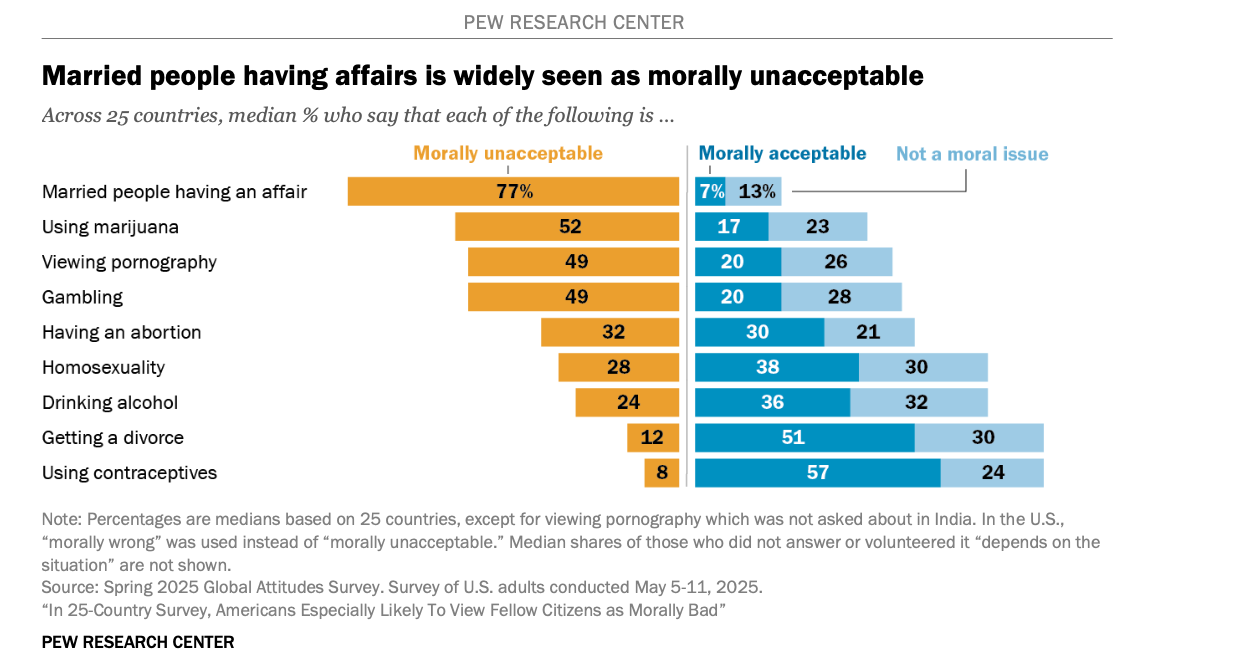
Pew report examines how people rate fellow citizens’ morals #Catholic A Pew Research Center study found ​​Americans are more likely than people in other countries to question the morality of their fellow citizens.The report, “In 25-Country Survey, Americans Especially Likely To View Fellow Citizens as Morally Bad,” explores how adults in 25 countries rate the morality of others in their nation. It also examines if people consider different behaviors to be morally wrong including drinking alcohol, gambling, having extramarital affairs, using marijuana, viewing pornography, having abortions, homosexuality, getting divorces, and using contraceptives.The research was based on data from participants in Argentina, Australia, Brazil, Canada, France, Germany, Greece, Hungary, India, Indonesia, Israel, Italy, Japan, Kenya, Mexico, Netherlands, Nigeria, Poland, South Africa, South Korea, Spain, Sweden, Turkey, the United Kingdom, and the United States.Surveys conducted outside the U.S. were based on nationally representative surveys of 28,333 adults conducted from Jan. 8 to April 26, 2025. In the U.S., Pew surveyed 3,605 adults who are members of the Center’s American Trends Panel (ATP) from March 24–30, 2025.
 
 A March 2026 Pew report, “In 25-Country Survey, Americans Especially Likely To View Fellow Citizens as Morally Bad,” explores if adults in 25 countries consider nine behaviors to be morally unacceptable or acceptable. | Credit: Courtesy of Pew Research Center
 
 The report also includes some findings from a separate ATP survey of 8,937 U.S. adults conducted from May 5–11, 2025. The margin of sampling error for the full sample of 3,605 respondents is plus or minus 1.9 percentage points.According to the research, 47% of U.S. adults reported Americans have “very good” or “somewhat good” morals and ethics, which was the lowest of all countries. The majority of adults in Canada and Indonesia (92%) said the same of the people in their countries.Most and least accepted behaviors across the globeGetting a divorce and the use of contraception were found to be the most widely accepted of the nine behaviors. Only 12% of adults overall said getting a divorce is morally wrong, and 8% said using contraceptives is. The only countries with a slight majority that believe getting a divorce is morally unacceptable are India with 65% holding this view and Nigeria with 55%.Of the nine behaviors Pew asked participants about, married people having affairs had the strongest overall disapproval. Across the 25 countries, a median of 77% of adults said married people having affairs is morally unacceptable, with at least half of adults in every country holding this view.U.S. adults were among those to be most likely to condemn extramarital affairs as immoral. Nine in 10 Americans said having an affair is morally wrong, similar to the share of people in Indonesia and in Turkey (92%) who believe the same.
 
 A March 2026 Pew report, “In 25-Country Survey, Americans Especially Likely To View Fellow Citizens as Morally Bad,” explores how adults in 25 countries rate the morality of others in their country. | Credit: Courtesy of Pew Research Center
 
 Adults in Germany (55%) and France (53%) are among the least likely to believe having an affair is morally unacceptable.Behaviors with least international consensusThe report found that for most behaviors asked about, there is not an international consensus if they are morally acceptable or not.In the Latin American and African countries surveyed, half or more of adults said they believe abortions are morally unacceptable, but in most European countries, the vast majority of adults view abortions as either morally acceptable or not a moral issue at all. In the U.S., the group was fairly split with 47% reporting it is morally unacceptable to have an abortion.In the U.S., adults are the most accepting of using marijuana and gambling. Only 23% of Americans said using marijuana is morally unacceptable, and 29% said the same in regard to gambling. In most other countries surveyed, more than 40% of adults said they consider gambling and marijuana use to be morally wrong.In 10 countries, a majority said gambling is morally wrong, including 89% in Indonesia and 71% in Italy. In Australia, 25% said gambling is morally acceptable, and 43% do not see gambling as a moral issue.In the U.S., 39% of adults reported homosexuality is morally wrong, which was found to be much more than those who hold the same belief in Germany (5%) or Sweden (5%). In other nations including Indonesia (93%) and Nigeria (96%), the majority reported it is morally wrong.In regard to drinking alcohol, the majority of adults in Indonesia (83%) reported it is a morally unacceptable act. In contrast, only 7% of adults in Australia and Sweden reported the same. In the U.S., a small share of 16% said it is morally unacceptable.What factors affect views of behaviors?According to the report, a number of factors seem to affect how adults view the morality of behaviors including political party, religion, and gender.Democrats and independents who lean toward the Democratic Party are more likely than Republicans and Republican leaners to rate fellow Americans as morally and ethically bad (60% vs. 46%).Pew examined citizens’ stances based on religious belief and found those who said religion is very important in their lives were more likely to view the behaviors as morally wrong.In 13 of the 25 countries surveyed, the research looked specifically at the differences between Protestants and Catholics. The report detailed that Protestants are typically more likely than Catholics in the same country to believe homosexuality is wrong. In the U.S., 59% of Protestants reported homosexuality is morally wrong, while 34% of Catholics did.There is a large variation between Christians in different countries. The majority of Christians surveyed in Africa, Latin America, and the U.S. said having an abortion is morally wrong, but across Europe, the share of Christians who hold this view ranges from 40% in Spain to 7% in Sweden.Gender is also a factor in how people view moral behaviors. Women tend to be more likely than men to believe some behaviors are morally unacceptable. In nearly every country surveyed, women were more likely than men to say that viewing pornography is wrong. In contrast, men were more likely than women to report homosexuality is morally unacceptable. Overall, older adults were more likely than younger adults to report the behaviors are morally unacceptable. This is the case with using marijuana in 19 of the 25 surveyed countries. In Germany, adults ages 40 and older are twice as likely as younger adults to believe marijuana use is morally wrong, with 30% of older adults holding this belief and 15% of younger adults.

Pew report examines how people rate fellow citizens’ morals #Catholic A Pew Research Center study found ​​Americans are more likely than people in other countries to question the morality of their fellow citizens.The report, “In 25-Country Survey, Americans Especially Likely To View Fellow Citizens as Morally Bad,” explores how adults in 25 countries rate the morality of others in their nation. It also examines if people consider different behaviors to be morally wrong including drinking alcohol, gambling, having extramarital affairs, using marijuana, viewing pornography, having abortions, homosexuality, getting divorces, and using contraceptives.The research was based on data from participants in Argentina, Australia, Brazil, Canada, France, Germany, Greece, Hungary, India, Indonesia, Israel, Italy, Japan, Kenya, Mexico, Netherlands, Nigeria, Poland, South Africa, South Korea, Spain, Sweden, Turkey, the United Kingdom, and the United States.Surveys conducted outside the U.S. were based on nationally representative surveys of 28,333 adults conducted from Jan. 8 to April 26, 2025. In the U.S., Pew surveyed 3,605 adults who are members of the Center’s American Trends Panel (ATP) from March 24–30, 2025. A March 2026 Pew report, “In 25-Country Survey, Americans Especially Likely To View Fellow Citizens as Morally Bad,” explores if adults in 25 countries consider nine behaviors to be morally unacceptable or acceptable. | Credit: Courtesy of Pew Research Center The report also includes some findings from a separate ATP survey of 8,937 U.S. adults conducted from May 5–11, 2025. The margin of sampling error for the full sample of 3,605 respondents is plus or minus 1.9 percentage points.According to the research, 47% of U.S. adults reported Americans have “very good” or “somewhat good” morals and ethics, which was the lowest of all countries. The majority of adults in Canada and Indonesia (92%) said the same of the people in their countries.Most and least accepted behaviors across the globeGetting a divorce and the use of contraception were found to be the most widely accepted of the nine behaviors. Only 12% of adults overall said getting a divorce is morally wrong, and 8% said using contraceptives is. The only countries with a slight majority that believe getting a divorce is morally unacceptable are India with 65% holding this view and Nigeria with 55%.Of the nine behaviors Pew asked participants about, married people having affairs had the strongest overall disapproval. Across the 25 countries, a median of 77% of adults said married people having affairs is morally unacceptable, with at least half of adults in every country holding this view.U.S. adults were among those to be most likely to condemn extramarital affairs as immoral. Nine in 10 Americans said having an affair is morally wrong, similar to the share of people in Indonesia and in Turkey (92%) who believe the same. A March 2026 Pew report, “In 25-Country Survey, Americans Especially Likely To View Fellow Citizens as Morally Bad,” explores how adults in 25 countries rate the morality of others in their country. | Credit: Courtesy of Pew Research Center Adults in Germany (55%) and France (53%) are among the least likely to believe having an affair is morally unacceptable.Behaviors with least international consensusThe report found that for most behaviors asked about, there is not an international consensus if they are morally acceptable or not.In the Latin American and African countries surveyed, half or more of adults said they believe abortions are morally unacceptable, but in most European countries, the vast majority of adults view abortions as either morally acceptable or not a moral issue at all. In the U.S., the group was fairly split with 47% reporting it is morally unacceptable to have an abortion.In the U.S., adults are the most accepting of using marijuana and gambling. Only 23% of Americans said using marijuana is morally unacceptable, and 29% said the same in regard to gambling. In most other countries surveyed, more than 40% of adults said they consider gambling and marijuana use to be morally wrong.In 10 countries, a majority said gambling is morally wrong, including 89% in Indonesia and 71% in Italy. In Australia, 25% said gambling is morally acceptable, and 43% do not see gambling as a moral issue.In the U.S., 39% of adults reported homosexuality is morally wrong, which was found to be much more than those who hold the same belief in Germany (5%) or Sweden (5%). In other nations including Indonesia (93%) and Nigeria (96%), the majority reported it is morally wrong.In regard to drinking alcohol, the majority of adults in Indonesia (83%) reported it is a morally unacceptable act. In contrast, only 7% of adults in Australia and Sweden reported the same. In the U.S., a small share of 16% said it is morally unacceptable.What factors affect views of behaviors?According to the report, a number of factors seem to affect how adults view the morality of behaviors including political party, religion, and gender.Democrats and independents who lean toward the Democratic Party are more likely than Republicans and Republican leaners to rate fellow Americans as morally and ethically bad (60% vs. 46%).Pew examined citizens’ stances based on religious belief and found those who said religion is very important in their lives were more likely to view the behaviors as morally wrong.In 13 of the 25 countries surveyed, the research looked specifically at the differences between Protestants and Catholics. The report detailed that Protestants are typically more likely than Catholics in the same country to believe homosexuality is wrong. In the U.S., 59% of Protestants reported homosexuality is morally wrong, while 34% of Catholics did.There is a large variation between Christians in different countries. The majority of Christians surveyed in Africa, Latin America, and the U.S. said having an abortion is morally wrong, but across Europe, the share of Christians who hold this view ranges from 40% in Spain to 7% in Sweden.Gender is also a factor in how people view moral behaviors. Women tend to be more likely than men to believe some behaviors are morally unacceptable. In nearly every country surveyed, women were more likely than men to say that viewing pornography is wrong. In contrast, men were more likely than women to report homosexuality is morally unacceptable. Overall, older adults were more likely than younger adults to report the behaviors are morally unacceptable. This is the case with using marijuana in 19 of the 25 surveyed countries. In Germany, adults ages 40 and older are twice as likely as younger adults to believe marijuana use is morally wrong, with 30% of older adults holding this belief and 15% of younger adults.

U.S. adults were among those most likely to condemn extramarital affairs as immoral in a study of 25 countries.

Read More
Meta blocks AI chatbot from discussing abortion with minors #Catholic Meta blocks AI chatbot from discussing abortion with minorsMeta won’t allow its AI chatbot to discuss abortion with minors, according to a report from the progressive outlet Mother Jones.Citing internal Meta documents, Mother Jones reported that Meta’s chatbot policy guidelines for interactions with minors prevent the chatbot from advising them on “content that provides advice or opinion" about "sexual health” or offering information helping them obtain an abortion.According to the report, a Meta spokesperson disputed claims of bias, saying that “any claims of enforcement based on group affiliation or advocacy are baseless” and that the company allows "posts and ads promoting health care services like abortion, as well as discussion and debate around them, as long as they follow our policies. We also give people the opportunity to appeal decisions if they think we’ve got it wrong.”When asked about the leaked documents, a company spokesperson told EWTN News: "Our AIs are trained to engage in age-appropriate discussions with teens, and to connect them with expert resources and support when appropriate." "They provide factual information on sexual health but refrain from offering advice or opinions. We continuously review and improve our protections so that teens have access to helpful information with default safeguards in place.”The Meta spokesperson also responded to advertisement censorship claims.“Every organization and individual on our platforms is subject to the same set of rules, and any claims of enforcement based on group affiliation or advocacy are baseless," the spokesperson said. United Kingdom assisted suicide bill falters as local measures advanceA national assisted suicide bill is failing to pass in the United Kingdom this week, even as local measures advance.According to a statement by the advocacy group Right to Life UK, on Feb. 26 the national bill was “widely pronounced as dead by commentators after it was revealed that it will 'almost certainly' run out of time”In Wales, the regional parliament voted on Feb. 24 in favor of the National Health Service to oversee assisted suicide if the Terminally Ill Adults Bill passes in the House of Lords.Archbishop Mark O'Toole of Cardiff-Menevia called the vote “a sad day for Wales’s most vulnerable" in a Feb. 25 statement.The island of Jersey similarly passed a law to legalize assisted suicide in a 32-to-16 vote on Feb. 26 by members of the States Assembly. The measure applies to “mentally competent” adults with terminal illnesses and who have been residents of Jersey for 12 months. Before the bill can become law, it will need royal assent.Ohio Appeals Court upholds ban on aborted baby burial requirementOhio judges on Wednesday upheld a ban on a law requiring abortion clinics to dispose of the remains of babies via burial or cremation.The appellate court in Cincinnati upheld a lower court ruling permanently blocking the law.Ohio in 2023 passed a constitutional amendment enshrining a right to abortion.Executive Director of Ohio Right to Life Carrie Snyder condemned the decision.“It’s unfortunate, but not a surprise, that the First District Court of Appeals sided with the abortion industry to stop Ohio’s fetal remains law from taking effect. Sadly, clinics will continue treating these precious little ones like garbage to be disposed of as cheaply as possible,” Snyder said in a Feb. 26 statement. “This really underscores that abortion is not health care, and that clinics are going to do everything within their power to boost their profit margin.”A Planned Parenthood spokeswoman, meanwhile, celebrated the decision, claiming the burial law was "cruel" and "nothing more than an opportunity to shame and stigmatize" women who get abortions.Texas attorney general sues mail-in abortion company for alleged illegal shipmentsTexas Attorney General Ken Paxton sued mail-in abortion company Aid Access along with California abortionist Remy Coeytaux and abortionist and founder of Aid Access Rebecca Gomperts for allegedly illegally shipping abortion drugs to Texas.Aid Access’s website advertises its shipping to all states including Texas, according to Paxton’s press release.“These unlawful shipments have had real and devastating consequences for Texas families,” the press release read. “In 2025, a Nueces County man allegedly used abortion-inducing drugs obtained from an out-of-state provider to secretly poison his girlfriend, resulting in the death of their unborn child.”“Every unborn child is a life worth protecting,” Paxton said, adding that he will “relentlessly enforce our state’s pro-life laws against Aid Access and other radicals like it.”

Meta blocks AI chatbot from discussing abortion with minors #Catholic Meta blocks AI chatbot from discussing abortion with minorsMeta won’t allow its AI chatbot to discuss abortion with minors, according to a report from the progressive outlet Mother Jones.Citing internal Meta documents, Mother Jones reported that Meta’s chatbot policy guidelines for interactions with minors prevent the chatbot from advising them on “content that provides advice or opinion" about "sexual health” or offering information helping them obtain an abortion.According to the report, a Meta spokesperson disputed claims of bias, saying that “any claims of enforcement based on group affiliation or advocacy are baseless” and that the company allows "posts and ads promoting health care services like abortion, as well as discussion and debate around them, as long as they follow our policies. We also give people the opportunity to appeal decisions if they think we’ve got it wrong.”When asked about the leaked documents, a company spokesperson told EWTN News: "Our AIs are trained to engage in age-appropriate discussions with teens, and to connect them with expert resources and support when appropriate." "They provide factual information on sexual health but refrain from offering advice or opinions. We continuously review and improve our protections so that teens have access to helpful information with default safeguards in place.”The Meta spokesperson also responded to advertisement censorship claims.“Every organization and individual on our platforms is subject to the same set of rules, and any claims of enforcement based on group affiliation or advocacy are baseless," the spokesperson said. United Kingdom assisted suicide bill falters as local measures advanceA national assisted suicide bill is failing to pass in the United Kingdom this week, even as local measures advance.According to a statement by the advocacy group Right to Life UK, on Feb. 26 the national bill was “widely pronounced as dead by commentators after it was revealed that it will 'almost certainly' run out of time”In Wales, the regional parliament voted on Feb. 24 in favor of the National Health Service to oversee assisted suicide if the Terminally Ill Adults Bill passes in the House of Lords.Archbishop Mark O'Toole of Cardiff-Menevia called the vote “a sad day for Wales’s most vulnerable" in a Feb. 25 statement.The island of Jersey similarly passed a law to legalize assisted suicide in a 32-to-16 vote on Feb. 26 by members of the States Assembly. The measure applies to “mentally competent” adults with terminal illnesses and who have been residents of Jersey for 12 months. Before the bill can become law, it will need royal assent.Ohio Appeals Court upholds ban on aborted baby burial requirementOhio judges on Wednesday upheld a ban on a law requiring abortion clinics to dispose of the remains of babies via burial or cremation.The appellate court in Cincinnati upheld a lower court ruling permanently blocking the law.Ohio in 2023 passed a constitutional amendment enshrining a right to abortion.Executive Director of Ohio Right to Life Carrie Snyder condemned the decision.“It’s unfortunate, but not a surprise, that the First District Court of Appeals sided with the abortion industry to stop Ohio’s fetal remains law from taking effect. Sadly, clinics will continue treating these precious little ones like garbage to be disposed of as cheaply as possible,” Snyder said in a Feb. 26 statement. “This really underscores that abortion is not health care, and that clinics are going to do everything within their power to boost their profit margin.”A Planned Parenthood spokeswoman, meanwhile, celebrated the decision, claiming the burial law was "cruel" and "nothing more than an opportunity to shame and stigmatize" women who get abortions.Texas attorney general sues mail-in abortion company for alleged illegal shipmentsTexas Attorney General Ken Paxton sued mail-in abortion company Aid Access along with California abortionist Remy Coeytaux and abortionist and founder of Aid Access Rebecca Gomperts for allegedly illegally shipping abortion drugs to Texas.Aid Access’s website advertises its shipping to all states including Texas, according to Paxton’s press release.“These unlawful shipments have had real and devastating consequences for Texas families,” the press release read. “In 2025, a Nueces County man allegedly used abortion-inducing drugs obtained from an out-of-state provider to secretly poison his girlfriend, resulting in the death of their unborn child.”“Every unborn child is a life worth protecting,” Paxton said, adding that he will “relentlessly enforce our state’s pro-life laws against Aid Access and other radicals like it.”

A roundup of recent pro-life and abortion-related news.

Read More
Catholic convert Eva Vlaardingerbroek on censorship and immigration in Europe #Catholic Catholic Dutch political commentator and activist Eva Vlaardingerbroek said “the rule of law is dead” in Europe and detailed the issues of censorship and immigration on the continent.Vlaardingerbroek is an attorney and Catholic convert who has been outspoken about European immigration, national sovereignty, and free speech. Recently, the U.K. government banned her from entering the country due to her outspoken views.“Out of the blue, I saw that I had received an email from the U.K. government,” she told Raymond Arroyo on EWTN’s “The World Over with Raymond Arroyo.” It was “just a couple of sentences saying that my ETA, which is the travel authorization that Europeans need to travel to the U.K., had been revoked.”The reason they stated “was that I am ‘not conducive to the public good,’” she said. Vlaardingerbroek said she believes the ban occurred because she criticized the prime minister of the United Kingdom, Keir Starmer, on social media three days before receiving the email.The situation shows that “the rule of law is dead in Europe,” Vlaardingerbroek said. “Because if you get a notification like that out of the blue, you have no ability, no means to defend yourself … I  don’t have a criminal record. I didn’t commit a crime.”“I got converted to Catholicism in the United Kingdom, so I have a couple of really dear friends there. Now, I’m no longer able to go because I say the wrong things, apparently. That is the state of Europe right now … They either throw you in jail or they make sure that you can’t enter the country. That’s what happens in the United Kingdom if you go against the grain,” she said.European immigrationVlaardingerbroek has also been outspoken about illegal immigration in Europe and said that mass immigration has destabilized Europe and led to spikes in violent crimes.“Anyone with two eyes can see that it’s true,” she said. Everyone who lives here, apart from maybe people living in ivory towers or in areas where there are no immigrants, everyone who lives in the real world knows that it’s true.”“I will continue speaking the truth about what I see happening to this beautiful continent of ours because it’s being destroyed,” she said. “We see churches burning down every week here in Europe, and that’s not a coincidence. That didn’t happen for hundreds of years, and suddenly now … they’re burning down faster than I can count.”“You can break the law coming here. It’s not being punished. In fact, it’s rewarded because people get to stay, people get free housing, people get free health care, and they’re able to just roam around even awaiting whether they are going to get their asylum approved or not.”“The governments and the legal system seem to be working hand in hand” and the “judges are complicit,” Vlaardingerbroek said. In Europe, the migrants that commit crimes are not held accountable because judges believe “they are traumatized because they come from a war zone” or due to their “their mental state.”“Then what ends up happening is these immigrants who rape, kill, and assault the native population, they just don’t get any real prison time, and they definitely do not get deported,” she said.“I think that this is a holdover from World War II,” she continued. Institutions including the European Union have “given evil one face and one face only” and “they refuse to see the difference between a Nazi and a conservative Christian.”“To them, it’s all the same, and that’s the way that they treat us,” she said. “I don’t think they’re afraid to acknowledge it. I think they honestly don’t care. I mean, the churches that are being burned down in France that we see, that’s a physical thing unfolding in front of our eyes.”The burning of churches “is powerful imagery that should wake people up to something else, something invisible, which is the agenda that is being carried out here to erode Christianity,” Vlaardingerbroek said.When the European Union discusses European culture, identity, and history, “they never mention Christianity,” Vlaardingerbroek said.“They actively removed it from their documents. They talk about the Enlightenment, but Christianity is never mentioned. They are actively eroding and erasing Christianity here in Europe because it threatens their agenda, because these people see [themselves] as God,” she said.U.S. immigrationAs debates over Immigration and Customs Enforcement (ICE) and law enforcement continue in the U.S, Vlaardingerbroek also discussed the status of immigration on this side of the pond.“As a Catholic, of course, we can be charitable. Nobody’s saying that we cannot allow some immigration or that we cannot help those in need. That is, of course, a Catholic ideal. That is a Catholic value … That’s what our legal system reflects,” she said.“That doesn’t mean, however, that when you come here illegally, which is what happens the majority of the time, and you break [the] laws, that we have to sit by and watch that happen.”ICE agents “are doing their job,” Vlaardingerbroek said. “They are enforcing the law. I think it’s a disgrace the way that they are being treated.”“I wish actually that here in Europe, we would have our version of ICE and that they would … send back home the people who come here illegally and who do not belong in these countries and who actively fight everything that we stand for, both in America and here in Europe,” Vlaardingerbroek said.

Catholic convert Eva Vlaardingerbroek on censorship and immigration in Europe #Catholic Catholic Dutch political commentator and activist Eva Vlaardingerbroek said “the rule of law is dead” in Europe and detailed the issues of censorship and immigration on the continent.Vlaardingerbroek is an attorney and Catholic convert who has been outspoken about European immigration, national sovereignty, and free speech. Recently, the U.K. government banned her from entering the country due to her outspoken views.“Out of the blue, I saw that I had received an email from the U.K. government,” she told Raymond Arroyo on EWTN’s “The World Over with Raymond Arroyo.” It was “just a couple of sentences saying that my ETA, which is the travel authorization that Europeans need to travel to the U.K., had been revoked.”The reason they stated “was that I am ‘not conducive to the public good,’” she said. Vlaardingerbroek said she believes the ban occurred because she criticized the prime minister of the United Kingdom, Keir Starmer, on social media three days before receiving the email.The situation shows that “the rule of law is dead in Europe,” Vlaardingerbroek said. “Because if you get a notification like that out of the blue, you have no ability, no means to defend yourself … I  don’t have a criminal record. I didn’t commit a crime.”“I got converted to Catholicism in the United Kingdom, so I have a couple of really dear friends there. Now, I’m no longer able to go because I say the wrong things, apparently. That is the state of Europe right now … They either throw you in jail or they make sure that you can’t enter the country. That’s what happens in the United Kingdom if you go against the grain,” she said.European immigrationVlaardingerbroek has also been outspoken about illegal immigration in Europe and said that mass immigration has destabilized Europe and led to spikes in violent crimes.“Anyone with two eyes can see that it’s true,” she said. Everyone who lives here, apart from maybe people living in ivory towers or in areas where there are no immigrants, everyone who lives in the real world knows that it’s true.”“I will continue speaking the truth about what I see happening to this beautiful continent of ours because it’s being destroyed,” she said. “We see churches burning down every week here in Europe, and that’s not a coincidence. That didn’t happen for hundreds of years, and suddenly now … they’re burning down faster than I can count.”“You can break the law coming here. It’s not being punished. In fact, it’s rewarded because people get to stay, people get free housing, people get free health care, and they’re able to just roam around even awaiting whether they are going to get their asylum approved or not.”“The governments and the legal system seem to be working hand in hand” and the “judges are complicit,” Vlaardingerbroek said. In Europe, the migrants that commit crimes are not held accountable because judges believe “they are traumatized because they come from a war zone” or due to their “their mental state.”“Then what ends up happening is these immigrants who rape, kill, and assault the native population, they just don’t get any real prison time, and they definitely do not get deported,” she said.“I think that this is a holdover from World War II,” she continued. Institutions including the European Union have “given evil one face and one face only” and “they refuse to see the difference between a Nazi and a conservative Christian.”“To them, it’s all the same, and that’s the way that they treat us,” she said. “I don’t think they’re afraid to acknowledge it. I think they honestly don’t care. I mean, the churches that are being burned down in France that we see, that’s a physical thing unfolding in front of our eyes.”The burning of churches “is powerful imagery that should wake people up to something else, something invisible, which is the agenda that is being carried out here to erode Christianity,” Vlaardingerbroek said.When the European Union discusses European culture, identity, and history, “they never mention Christianity,” Vlaardingerbroek said.“They actively removed it from their documents. They talk about the Enlightenment, but Christianity is never mentioned. They are actively eroding and erasing Christianity here in Europe because it threatens their agenda, because these people see [themselves] as God,” she said.U.S. immigrationAs debates over Immigration and Customs Enforcement (ICE) and law enforcement continue in the U.S, Vlaardingerbroek also discussed the status of immigration on this side of the pond.“As a Catholic, of course, we can be charitable. Nobody’s saying that we cannot allow some immigration or that we cannot help those in need. That is, of course, a Catholic ideal. That is a Catholic value … That’s what our legal system reflects,” she said.“That doesn’t mean, however, that when you come here illegally, which is what happens the majority of the time, and you break [the] laws, that we have to sit by and watch that happen.”ICE agents “are doing their job,” Vlaardingerbroek said. “They are enforcing the law. I think it’s a disgrace the way that they are being treated.”“I wish actually that here in Europe, we would have our version of ICE and that they would … send back home the people who come here illegally and who do not belong in these countries and who actively fight everything that we stand for, both in America and here in Europe,” Vlaardingerbroek said.

Catholic convert Eva Vlaardingerbroek discussed immigration and the state of free speech in Europe on EWTN’s “The World Over with Raymond Arroyo.”

Read More