Latin America

Pew report examines how people rate fellow citizens’ morals #Catholic A Pew Research Center study found ​​Americans are more likely than people in other countries to question the morality of their fellow citizens.The report, “In 25-Country Survey, Americans Especially Likely To View Fellow Citizens as Morally Bad,” explores how adults in 25 countries rate the morality of others in their nation. It also examines if people consider different behaviors to be morally wrong including drinking alcohol, gambling, having extramarital affairs, using marijuana, viewing pornography, having abortions, homosexuality, getting divorces, and using contraceptives.The research was based on data from participants in Argentina, Australia, Brazil, Canada, France, Germany, Greece, Hungary, India, Indonesia, Israel, Italy, Japan, Kenya, Mexico, Netherlands, Nigeria, Poland, South Africa, South Korea, Spain, Sweden, Turkey, the United Kingdom, and the United States.Surveys conducted outside the U.S. were based on nationally representative surveys of 28,333 adults conducted from Jan. 8 to April 26, 2025. In the U.S., Pew surveyed 3,605 adults who are members of the Center’s American Trends Panel (ATP) from March 24–30, 2025.
 
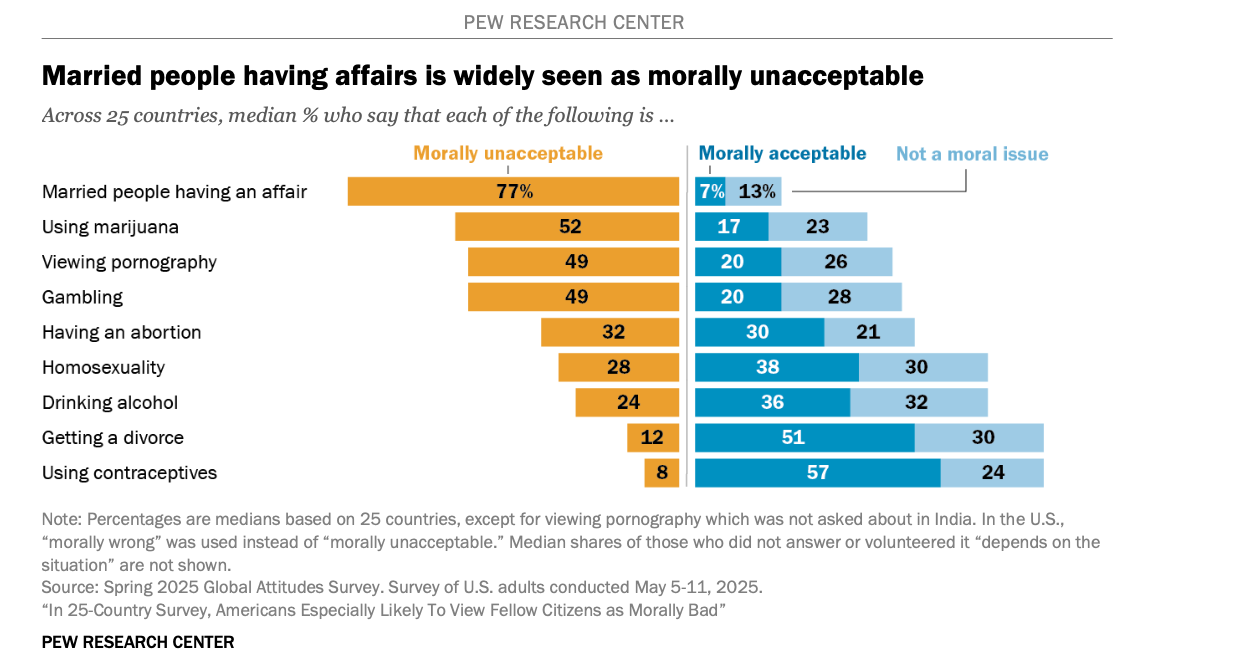
 A March 2026 Pew report, “In 25-Country Survey, Americans Especially Likely To View Fellow Citizens as Morally Bad,” explores if adults in 25 countries consider nine behaviors to be morally unacceptable or acceptable. | Credit: Courtesy of Pew Research Center
 
 The report also includes some findings from a separate ATP survey of 8,937 U.S. adults conducted from May 5–11, 2025. The margin of sampling error for the full sample of 3,605 respondents is plus or minus 1.9 percentage points.According to the research, 47% of U.S. adults reported Americans have “very good” or “somewhat good” morals and ethics, which was the lowest of all countries. The majority of adults in Canada and Indonesia (92%) said the same of the people in their countries.Most and least accepted behaviors across the globeGetting a divorce and the use of contraception were found to be the most widely accepted of the nine behaviors. Only 12% of adults overall said getting a divorce is morally wrong, and 8% said using contraceptives is. The only countries with a slight majority that believe getting a divorce is morally unacceptable are India with 65% holding this view and Nigeria with 55%.Of the nine behaviors Pew asked participants about, married people having affairs had the strongest overall disapproval. Across the 25 countries, a median of 77% of adults said married people having affairs is morally unacceptable, with at least half of adults in every country holding this view.U.S. adults were among those to be most likely to condemn extramarital affairs as immoral. Nine in 10 Americans said having an affair is morally wrong, similar to the share of people in Indonesia and in Turkey (92%) who believe the same.
 
 A March 2026 Pew report, “In 25-Country Survey, Americans Especially Likely To View Fellow Citizens as Morally Bad,” explores how adults in 25 countries rate the morality of others in their country. | Credit: Courtesy of Pew Research Center
 
 Adults in Germany (55%) and France (53%) are among the least likely to believe having an affair is morally unacceptable.Behaviors with least international consensusThe report found that for most behaviors asked about, there is not an international consensus if they are morally acceptable or not.In the Latin American and African countries surveyed, half or more of adults said they believe abortions are morally unacceptable, but in most European countries, the vast majority of adults view abortions as either morally acceptable or not a moral issue at all. In the U.S., the group was fairly split with 47% reporting it is morally unacceptable to have an abortion.In the U.S., adults are the most accepting of using marijuana and gambling. Only 23% of Americans said using marijuana is morally unacceptable, and 29% said the same in regard to gambling. In most other countries surveyed, more than 40% of adults said they consider gambling and marijuana use to be morally wrong.In 10 countries, a majority said gambling is morally wrong, including 89% in Indonesia and 71% in Italy. In Australia, 25% said gambling is morally acceptable, and 43% do not see gambling as a moral issue.In the U.S., 39% of adults reported homosexuality is morally wrong, which was found to be much more than those who hold the same belief in Germany (5%) or Sweden (5%). In other nations including Indonesia (93%) and Nigeria (96%), the majority reported it is morally wrong.In regard to drinking alcohol, the majority of adults in Indonesia (83%) reported it is a morally unacceptable act. In contrast, only 7% of adults in Australia and Sweden reported the same. In the U.S., a small share of 16% said it is morally unacceptable.What factors affect views of behaviors?According to the report, a number of factors seem to affect how adults view the morality of behaviors including political party, religion, and gender.Democrats and independents who lean toward the Democratic Party are more likely than Republicans and Republican leaners to rate fellow Americans as morally and ethically bad (60% vs. 46%).Pew examined citizens’ stances based on religious belief and found those who said religion is very important in their lives were more likely to view the behaviors as morally wrong.In 13 of the 25 countries surveyed, the research looked specifically at the differences between Protestants and Catholics. The report detailed that Protestants are typically more likely than Catholics in the same country to believe homosexuality is wrong. In the U.S., 59% of Protestants reported homosexuality is morally wrong, while 34% of Catholics did.There is a large variation between Christians in different countries. The majority of Christians surveyed in Africa, Latin America, and the U.S. said having an abortion is morally wrong, but across Europe, the share of Christians who hold this view ranges from 40% in Spain to 7% in Sweden.Gender is also a factor in how people view moral behaviors. Women tend to be more likely than men to believe some behaviors are morally unacceptable. In nearly every country surveyed, women were more likely than men to say that viewing pornography is wrong. In contrast, men were more likely than women to report homosexuality is morally unacceptable. Overall, older adults were more likely than younger adults to report the behaviors are morally unacceptable. This is the case with using marijuana in 19 of the 25 surveyed countries. In Germany, adults ages 40 and older are twice as likely as younger adults to believe marijuana use is morally wrong, with 30% of older adults holding this belief and 15% of younger adults.

Pew report examines how people rate fellow citizens’ morals #Catholic A Pew Research Center study found ​​Americans are more likely than people in other countries to question the morality of their fellow citizens.The report, “In 25-Country Survey, Americans Especially Likely To View Fellow Citizens as Morally Bad,” explores how adults in 25 countries rate the morality of others in their nation. It also examines if people consider different behaviors to be morally wrong including drinking alcohol, gambling, having extramarital affairs, using marijuana, viewing pornography, having abortions, homosexuality, getting divorces, and using contraceptives.The research was based on data from participants in Argentina, Australia, Brazil, Canada, France, Germany, Greece, Hungary, India, Indonesia, Israel, Italy, Japan, Kenya, Mexico, Netherlands, Nigeria, Poland, South Africa, South Korea, Spain, Sweden, Turkey, the United Kingdom, and the United States.Surveys conducted outside the U.S. were based on nationally representative surveys of 28,333 adults conducted from Jan. 8 to April 26, 2025. In the U.S., Pew surveyed 3,605 adults who are members of the Center’s American Trends Panel (ATP) from March 24–30, 2025. A March 2026 Pew report, “In 25-Country Survey, Americans Especially Likely To View Fellow Citizens as Morally Bad,” explores if adults in 25 countries consider nine behaviors to be morally unacceptable or acceptable. | Credit: Courtesy of Pew Research Center The report also includes some findings from a separate ATP survey of 8,937 U.S. adults conducted from May 5–11, 2025. The margin of sampling error for the full sample of 3,605 respondents is plus or minus 1.9 percentage points.According to the research, 47% of U.S. adults reported Americans have “very good” or “somewhat good” morals and ethics, which was the lowest of all countries. The majority of adults in Canada and Indonesia (92%) said the same of the people in their countries.Most and least accepted behaviors across the globeGetting a divorce and the use of contraception were found to be the most widely accepted of the nine behaviors. Only 12% of adults overall said getting a divorce is morally wrong, and 8% said using contraceptives is. The only countries with a slight majority that believe getting a divorce is morally unacceptable are India with 65% holding this view and Nigeria with 55%.Of the nine behaviors Pew asked participants about, married people having affairs had the strongest overall disapproval. Across the 25 countries, a median of 77% of adults said married people having affairs is morally unacceptable, with at least half of adults in every country holding this view.U.S. adults were among those to be most likely to condemn extramarital affairs as immoral. Nine in 10 Americans said having an affair is morally wrong, similar to the share of people in Indonesia and in Turkey (92%) who believe the same. A March 2026 Pew report, “In 25-Country Survey, Americans Especially Likely To View Fellow Citizens as Morally Bad,” explores how adults in 25 countries rate the morality of others in their country. | Credit: Courtesy of Pew Research Center Adults in Germany (55%) and France (53%) are among the least likely to believe having an affair is morally unacceptable.Behaviors with least international consensusThe report found that for most behaviors asked about, there is not an international consensus if they are morally acceptable or not.In the Latin American and African countries surveyed, half or more of adults said they believe abortions are morally unacceptable, but in most European countries, the vast majority of adults view abortions as either morally acceptable or not a moral issue at all. In the U.S., the group was fairly split with 47% reporting it is morally unacceptable to have an abortion.In the U.S., adults are the most accepting of using marijuana and gambling. Only 23% of Americans said using marijuana is morally unacceptable, and 29% said the same in regard to gambling. In most other countries surveyed, more than 40% of adults said they consider gambling and marijuana use to be morally wrong.In 10 countries, a majority said gambling is morally wrong, including 89% in Indonesia and 71% in Italy. In Australia, 25% said gambling is morally acceptable, and 43% do not see gambling as a moral issue.In the U.S., 39% of adults reported homosexuality is morally wrong, which was found to be much more than those who hold the same belief in Germany (5%) or Sweden (5%). In other nations including Indonesia (93%) and Nigeria (96%), the majority reported it is morally wrong.In regard to drinking alcohol, the majority of adults in Indonesia (83%) reported it is a morally unacceptable act. In contrast, only 7% of adults in Australia and Sweden reported the same. In the U.S., a small share of 16% said it is morally unacceptable.What factors affect views of behaviors?According to the report, a number of factors seem to affect how adults view the morality of behaviors including political party, religion, and gender.Democrats and independents who lean toward the Democratic Party are more likely than Republicans and Republican leaners to rate fellow Americans as morally and ethically bad (60% vs. 46%).Pew examined citizens’ stances based on religious belief and found those who said religion is very important in their lives were more likely to view the behaviors as morally wrong.In 13 of the 25 countries surveyed, the research looked specifically at the differences between Protestants and Catholics. The report detailed that Protestants are typically more likely than Catholics in the same country to believe homosexuality is wrong. In the U.S., 59% of Protestants reported homosexuality is morally wrong, while 34% of Catholics did.There is a large variation between Christians in different countries. The majority of Christians surveyed in Africa, Latin America, and the U.S. said having an abortion is morally wrong, but across Europe, the share of Christians who hold this view ranges from 40% in Spain to 7% in Sweden.Gender is also a factor in how people view moral behaviors. Women tend to be more likely than men to believe some behaviors are morally unacceptable. In nearly every country surveyed, women were more likely than men to say that viewing pornography is wrong. In contrast, men were more likely than women to report homosexuality is morally unacceptable. Overall, older adults were more likely than younger adults to report the behaviors are morally unacceptable. This is the case with using marijuana in 19 of the 25 surveyed countries. In Germany, adults ages 40 and older are twice as likely as younger adults to believe marijuana use is morally wrong, with 30% of older adults holding this belief and 15% of younger adults.

U.S. adults were among those most likely to condemn extramarital affairs as immoral in a study of 25 countries.

Read More
Bishop explains how Our Lady of Guadalupe can reach postmodern Silicon Valley #Catholic In a world marked by secularization and cultural fragmentation, Our Lady of Guadalupe remains a privileged path for proclaiming the Gospel, said Bishop Óscar Cantú of San Jose, California, as he shared how a recent event dedicated to the Virgin Mary illuminates the mission of the Church in the heart of Silicon Valley.During the recent “Theological and Pastoral Congress on the Guadalupe Event,” held in Mexico, the prelate described his diocese as a former valley of fruit orchards now transformed into the heart of global technology, home to world-class companies such as Google, Apple, Hewlett-Packard, and Nvidia.There, Cantú explained, people from India, China, Latin America, Africa, and many other countries live together, bringing with them their religions or their religious “indifference.”He spoke of “a strong secularization” there, calling it a “society that proudly proclaims itself postmodern, without need for God or religion.” He added that many “no longer have the time or space for religion” and that they “prefer modern practices” such as yoga or meditation, which they call mindfulness, which is “meditation without transcendence.”The bishop wants the pastoral and spiritual preparation for the 50th anniversary of the Diocese of San José in 2031 to be marked by Our Lady of Guadalupe, who he hopes will serve as a point of reference and model.Using Our Lady of Guadalupe’s methodology in Silicon ValleyThe bishop posed a direct challenge to priests, deacons, religious, and laity of his diocese: “How can we apply the methodology of Our Lady of Guadalupe, which she used 500 years ago in Mexico, now, in Silicon Valley, in a postmodern world?”He said the Spanish friars “did not have much success in evangelizing” because they arrived with the conquistadors, who used aggression and force. “But Our Lady had a great success that the friars could not have imagined. Millions of hearts were touched and transformed in a short time.”Cantú enumerated the key elements of this Guadalupan pedagogy, beginning with beauty and maternal tenderness of her words to Juan Diego: “‘My dearest Juan Diego, the littlest of my sons.’ Whose heart made of stone like we have in our Silicon Valley wouldn’t melt with those words?” he asked. He also emphasized how Mary “spoke to him in his language, not in Spanish. She used the symbolism of the Indigenous people, a codex that bore witness to what she recounted, which bore witness to what Juan Diego later told the other Indigenous people.” He recalled the Christological way the Virgin introduced herself, identifying herself as “the Mother of the God by whom we live,” and how she thus introduced “the beauty of truth” in contrast to the old logic of human sacrifice.Another element that Cantú emphasized is the role of the laity and, in particular, the poor. He highlighted that the Virgin involves Juan Diego in the mission of the Church when she tells him: “It is necessary that you go to the bishop.” He commented that “participation brings dignity and is an expression of dignity,” and that aspects of synodality are already evident in Guadalupe: participation and a voice within the ecclesial community.The bishop noted that Juan Diego’s participation does not create a separate structure, because “we shouldn’t create a parallel Church but rather everything should be under the authority, the structure that the Son of the Virgin left us, which is a hierarchical Church, with respect for the magisterium, but the magisterium, in turn, with the participation and listening of everyone, everyone, everyone.” For this reason, he defined it as “a hierarchical and synodal Church.”Among the elements the prelate highlighted is the concept of the sacred little house as a Church of mercy, a house where wounded humanity is welcomed: a “little house of love and compassion.”Our Lady of Guadalupe resonates with migrant communitiesCantú explained that in his diocese, faith has remained alive thanks to refugees and immigrants: Hispanics, Filipinos, Vietnamese, Indians, and Africans, many of them with histories of having to leave their native lands and discrimination.The Virgin of Guadalupe becomes a bridge of identity and solace there, not only for Mexicans, he noted. To illustrate this, he recounted an experience in a trilingual parish (Vietnamese, Filipino, and Hispanic) during a Mass in honor of Our Lady of Guadalupe.The bishop arrived prepared to celebrate Mass in Spanish with the Hispanic community, but discovered that about half of those present were Vietnamese, so he decided to preach by including his own story as the son of Mexican immigrants in Texas.“In Texas, many times Americans didn’t see me purely as American because my parents were born in another country, and at home they spoke Spanish; and when I went to visit my cousins ​​in Monterrey, they also didn’t see me as Mexican, so, well, I felt like a bit of an outsider.”As he shared this experience of not belonging, Cantú observed the faces of the Vietnamese faithful: “I saw in their faces that they understood, as refugees who left their country 30 or 40 years ago, that perhaps they never had the opportunity to learn the language well, to fully understand American politics or culture, that for the rest of their lives they felt like guests. And it was, I believe, at that moment that they identified with Juan Diego, whom the Virgin received in her little house.”This story was first published by ACI Prensa, the Spanish-language sister service of EWTN News. It has been translated and adapted by EWTN News English.

Bishop explains how Our Lady of Guadalupe can reach postmodern Silicon Valley #Catholic In a world marked by secularization and cultural fragmentation, Our Lady of Guadalupe remains a privileged path for proclaiming the Gospel, said Bishop Óscar Cantú of San Jose, California, as he shared how a recent event dedicated to the Virgin Mary illuminates the mission of the Church in the heart of Silicon Valley.During the recent “Theological and Pastoral Congress on the Guadalupe Event,” held in Mexico, the prelate described his diocese as a former valley of fruit orchards now transformed into the heart of global technology, home to world-class companies such as Google, Apple, Hewlett-Packard, and Nvidia.There, Cantú explained, people from India, China, Latin America, Africa, and many other countries live together, bringing with them their religions or their religious “indifference.”He spoke of “a strong secularization” there, calling it a “society that proudly proclaims itself postmodern, without need for God or religion.” He added that many “no longer have the time or space for religion” and that they “prefer modern practices” such as yoga or meditation, which they call mindfulness, which is “meditation without transcendence.”The bishop wants the pastoral and spiritual preparation for the 50th anniversary of the Diocese of San José in 2031 to be marked by Our Lady of Guadalupe, who he hopes will serve as a point of reference and model.Using Our Lady of Guadalupe’s methodology in Silicon ValleyThe bishop posed a direct challenge to priests, deacons, religious, and laity of his diocese: “How can we apply the methodology of Our Lady of Guadalupe, which she used 500 years ago in Mexico, now, in Silicon Valley, in a postmodern world?”He said the Spanish friars “did not have much success in evangelizing” because they arrived with the conquistadors, who used aggression and force. “But Our Lady had a great success that the friars could not have imagined. Millions of hearts were touched and transformed in a short time.”Cantú enumerated the key elements of this Guadalupan pedagogy, beginning with beauty and maternal tenderness of her words to Juan Diego: “‘My dearest Juan Diego, the littlest of my sons.’ Whose heart made of stone like we have in our Silicon Valley wouldn’t melt with those words?” he asked. He also emphasized how Mary “spoke to him in his language, not in Spanish. She used the symbolism of the Indigenous people, a codex that bore witness to what she recounted, which bore witness to what Juan Diego later told the other Indigenous people.” He recalled the Christological way the Virgin introduced herself, identifying herself as “the Mother of the God by whom we live,” and how she thus introduced “the beauty of truth” in contrast to the old logic of human sacrifice.Another element that Cantú emphasized is the role of the laity and, in particular, the poor. He highlighted that the Virgin involves Juan Diego in the mission of the Church when she tells him: “It is necessary that you go to the bishop.” He commented that “participation brings dignity and is an expression of dignity,” and that aspects of synodality are already evident in Guadalupe: participation and a voice within the ecclesial community.The bishop noted that Juan Diego’s participation does not create a separate structure, because “we shouldn’t create a parallel Church but rather everything should be under the authority, the structure that the Son of the Virgin left us, which is a hierarchical Church, with respect for the magisterium, but the magisterium, in turn, with the participation and listening of everyone, everyone, everyone.” For this reason, he defined it as “a hierarchical and synodal Church.”Among the elements the prelate highlighted is the concept of the sacred little house as a Church of mercy, a house where wounded humanity is welcomed: a “little house of love and compassion.”Our Lady of Guadalupe resonates with migrant communitiesCantú explained that in his diocese, faith has remained alive thanks to refugees and immigrants: Hispanics, Filipinos, Vietnamese, Indians, and Africans, many of them with histories of having to leave their native lands and discrimination.The Virgin of Guadalupe becomes a bridge of identity and solace there, not only for Mexicans, he noted. To illustrate this, he recounted an experience in a trilingual parish (Vietnamese, Filipino, and Hispanic) during a Mass in honor of Our Lady of Guadalupe.The bishop arrived prepared to celebrate Mass in Spanish with the Hispanic community, but discovered that about half of those present were Vietnamese, so he decided to preach by including his own story as the son of Mexican immigrants in Texas.“In Texas, many times Americans didn’t see me purely as American because my parents were born in another country, and at home they spoke Spanish; and when I went to visit my cousins ​​in Monterrey, they also didn’t see me as Mexican, so, well, I felt like a bit of an outsider.”As he shared this experience of not belonging, Cantú observed the faces of the Vietnamese faithful: “I saw in their faces that they understood, as refugees who left their country 30 or 40 years ago, that perhaps they never had the opportunity to learn the language well, to fully understand American politics or culture, that for the rest of their lives they felt like guests. And it was, I believe, at that moment that they identified with Juan Diego, whom the Virgin received in her little house.”This story was first published by ACI Prensa, the Spanish-language sister service of EWTN News. It has been translated and adapted by EWTN News English.

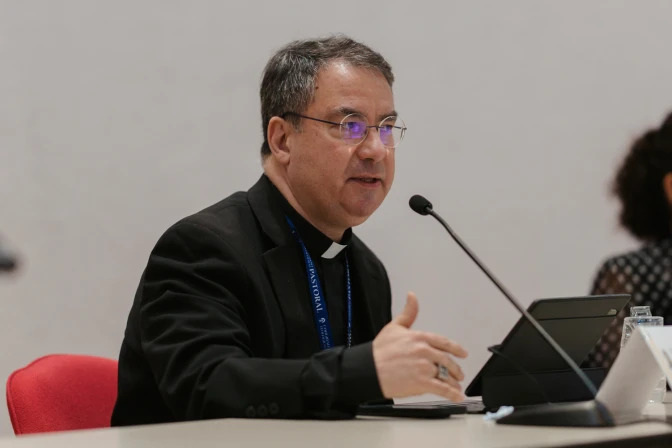
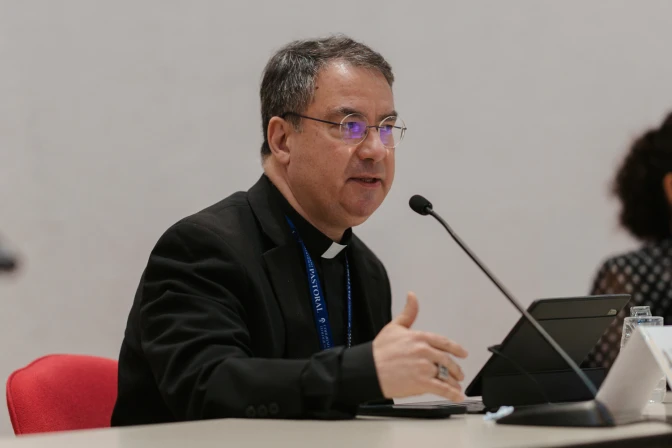
Bishop Óscar Cantú of San Jose, California, explains how the highly secularized society there can receive the message and imagery of Our Lady of Guadalupe in a way that is meaningful to them.
Read More
10 things to know about St. Frances Xavier Cabrini #Catholic A statue of St. Frances Xavier Cabrini, the first American saint, will replace a statue of Christopher Columbus at Arrigo Park in Chicago — an area known as Little Italy — Chicago Park District officials announced Feb. 18.Cabrini, who served poor Italian immigrants in Chicago, received roughly 38% of the almost 4,000 votes cast during an online contest to pick three nominees for the honor.The park district is now looking for artists who want to create the statue and are asking that applications be submitted by March 1.Here are 10 things to know about this beloved Catholic saint:1. She was the first American citizen to be canonized.Though born in Italy, Frances Xavier Cabrini became a naturalized U.S. citizen in 1909. In 1946, she was canonized by Pope Pius XII, becoming the first American citizen to be declared a saint.2. She originally wanted to be a missionary to China.Inspired by St. Francis Xavier, Cabrini hoped to evangelize in China. Instead, Pope Leo XIII directed her westward, telling her to serve immigrants in the United States, “not to the East, but to the West.”3. She arrived in New York with almost nothing.In 1889, Cabrini landed in New York City with six fellow sisters and limited resources. What awaited her was not a warm welcome but housing instability and overwhelming poverty among Italian immigrants.4. She founded the Missionary Sisters of the Sacred Heart.In 1880, she established the Missionary Sisters of the Sacred Heart of Jesus, a religious order dedicated to education, health care, and missionary work. The order continues its work worldwide today.5. She built an empire of schools and hospitals.By the time of her death, Cabrini had founded nearly 70 institutions, including orphanages, schools, and hospitals across the United States, Europe, and Latin America.6. She served Italian immigrants during a time of intense prejudice.In the late 19th and early 20th centuries, Italian immigrants faced widespread discrimination in America. Cabrini advocated fiercely for their dignity, education, and health care.7. She became a U.S. citizen in 1909.Cabrini’s naturalization reflected her long-term commitment to serving American communities, particularly in cities like New York and Chicago.8. She died in Chicago in 1917.Cabrini passed away on Dec. 22, 1917, in Chicago after years of tireless travel and work. The doctor attributed her death to chronic endocarditis, or heart disease. Her body is preserved for veneration at the National Shrine of St. Frances Xavier Cabrini.9. She is the patron saint of immigrants.In 1950, Pope Pius XII officially named her the patron saint of immigrants, recognizing her lifelong dedication to displaced and marginalized communities.10. Her legacy remains visible across the U.S.Hospitals, schools, and institutions bearing her name continue her mission of faith-driven service and education.

10 things to know about St. Frances Xavier Cabrini #Catholic A statue of St. Frances Xavier Cabrini, the first American saint, will replace a statue of Christopher Columbus at Arrigo Park in Chicago — an area known as Little Italy — Chicago Park District officials announced Feb. 18.Cabrini, who served poor Italian immigrants in Chicago, received roughly 38% of the almost 4,000 votes cast during an online contest to pick three nominees for the honor.The park district is now looking for artists who want to create the statue and are asking that applications be submitted by March 1.Here are 10 things to know about this beloved Catholic saint:1. She was the first American citizen to be canonized.Though born in Italy, Frances Xavier Cabrini became a naturalized U.S. citizen in 1909. In 1946, she was canonized by Pope Pius XII, becoming the first American citizen to be declared a saint.2. She originally wanted to be a missionary to China.Inspired by St. Francis Xavier, Cabrini hoped to evangelize in China. Instead, Pope Leo XIII directed her westward, telling her to serve immigrants in the United States, “not to the East, but to the West.”3. She arrived in New York with almost nothing.In 1889, Cabrini landed in New York City with six fellow sisters and limited resources. What awaited her was not a warm welcome but housing instability and overwhelming poverty among Italian immigrants.4. She founded the Missionary Sisters of the Sacred Heart.In 1880, she established the Missionary Sisters of the Sacred Heart of Jesus, a religious order dedicated to education, health care, and missionary work. The order continues its work worldwide today.5. She built an empire of schools and hospitals.By the time of her death, Cabrini had founded nearly 70 institutions, including orphanages, schools, and hospitals across the United States, Europe, and Latin America.6. She served Italian immigrants during a time of intense prejudice.In the late 19th and early 20th centuries, Italian immigrants faced widespread discrimination in America. Cabrini advocated fiercely for their dignity, education, and health care.7. She became a U.S. citizen in 1909.Cabrini’s naturalization reflected her long-term commitment to serving American communities, particularly in cities like New York and Chicago.8. She died in Chicago in 1917.Cabrini passed away on Dec. 22, 1917, in Chicago after years of tireless travel and work. The doctor attributed her death to chronic endocarditis, or heart disease. Her body is preserved for veneration at the National Shrine of St. Frances Xavier Cabrini.9. She is the patron saint of immigrants.In 1950, Pope Pius XII officially named her the patron saint of immigrants, recognizing her lifelong dedication to displaced and marginalized communities.10. Her legacy remains visible across the U.S.Hospitals, schools, and institutions bearing her name continue her mission of faith-driven service and education.

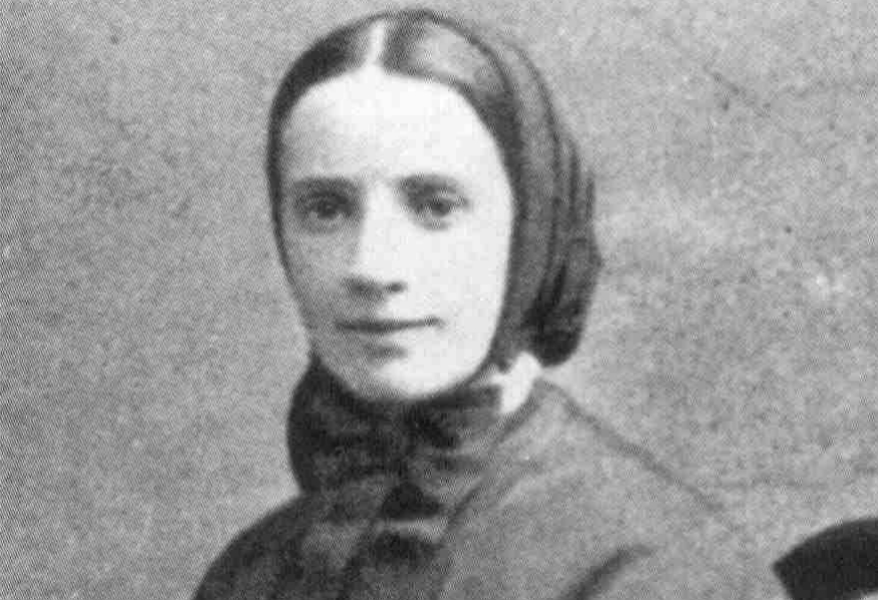
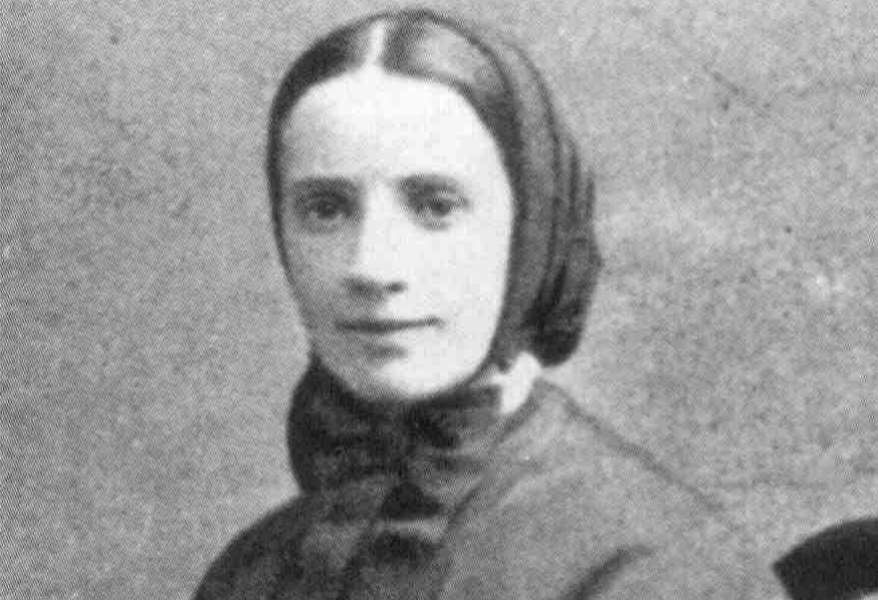
St. Frances Xavier Cabrini was the first American citizen to be canonized and is the patron saint of immigrants. A new statue of her will be erected in Chicago’s Little Italy.
Read More
Replica of Manila’s famed ‘Black Nazarene’ arrives in Los Angeles Archdiocese #Catholic The centuries-old devotion to Nuestro Padre Jesús Nazareno of Quiapo, Manila, in the Philippines has formally reached the U.S. West Coast as an official replica of the revered image was turned over to the Archdiocese of Los Angeles and entrusted to Holy Family Parish in Artesia and the archdiocese’s Filipino ministry.The replica, gifted by the Minor Basilica and National Shrine of Jesús Nazareno in Manila, will be enthroned at Holy Family Parish and serve as a pilgrim image, visiting parishes across the archdiocese’s five pastoral regions as part of a broader evangelization initiative.
 
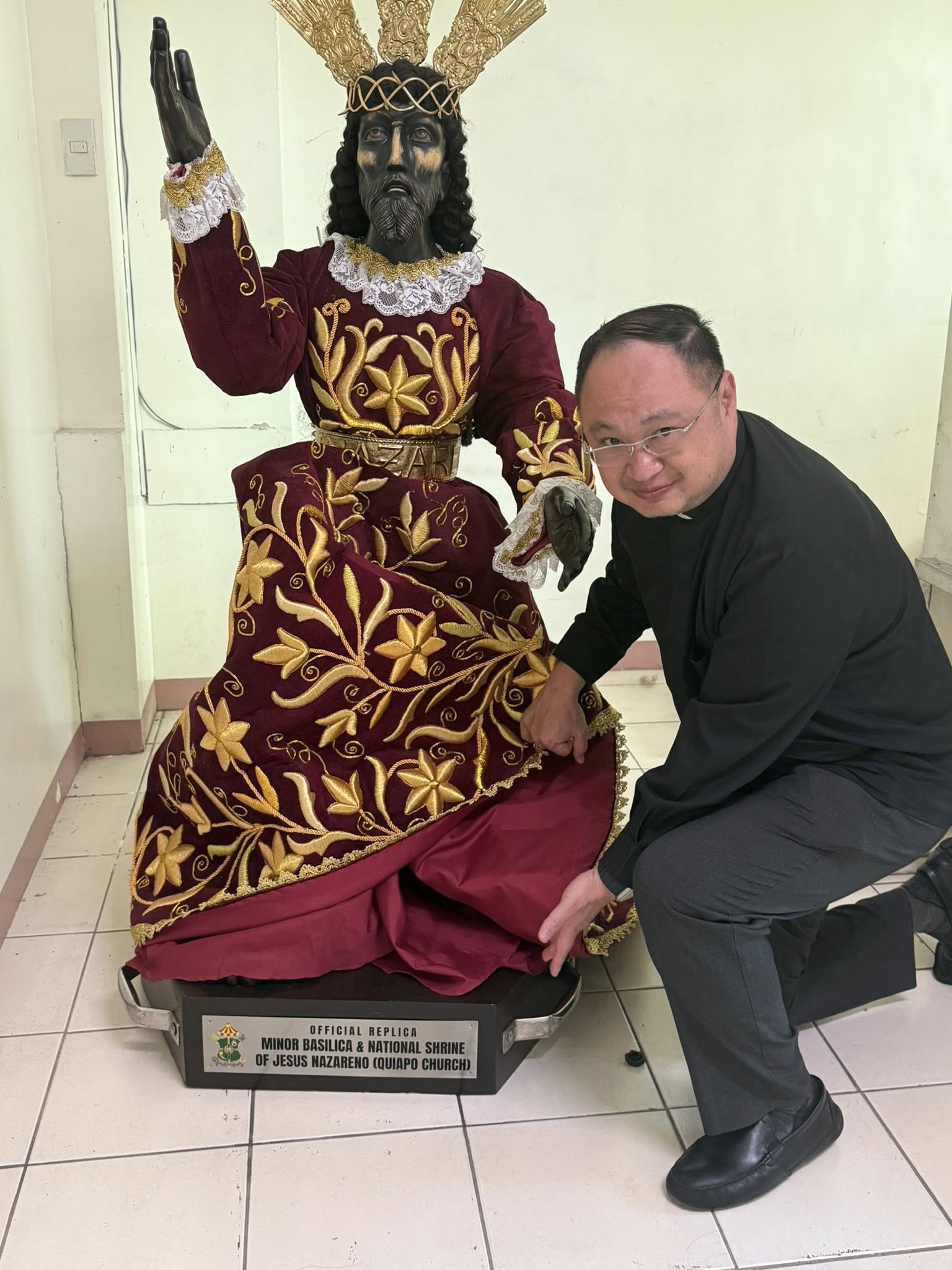
 Father John Cordero displays the official replica of the Jesús Nazareno from Manila’s Quiapo Church in 2025. | Credit: Holy Family Catholic Church Artesia
 
 The arrival of the image marks the fruit of an evangelization effort spearheaded by then-rector of Quiapo Church, now Bishop Rufino Sescon of Balanga, Bataan. According to Father John Cordero of the Marian Missionaries of the Holy Cross, pastor of Holy Family Parish, the development unfolded providentially.“The real starting point of this development was the evangelization initiative of the National Shrine of Jesús Nazareno in Manila, spearheaded by then-rector and now bishop of Balanga, Rufino ‘Jun’ Sescon,” Cordero told EWTN News.The replica was initially offered to the Archdiocese of Los Angeles through Father Rodel Balagtas, priest liaison to the Filipino Ministry. Although another parish had first expressed willingness to host the image, no final arrangements had been made.Months later, Sescon personally contacted Cordero — a former graduate school classmate — to reestablish communication between Quiapo Church and a receiving parish. What seemed at first a closed matter reopened, and Cordero discerned that the parish could accommodate the image by converting a religious goods store in the vestibule into a shrine.“I noticed something that had slipped my attention: We have space,” Cordero said. After consultation with Filipino Ministry leaders, including its president and parishioner Noel Motus, the parish agreed to receive the image. “It is a gift from the national shrine, and our parish was merely chosen to be the caretakers.”Formal reception and MassSescon will celebrate the Mass marking the official arrival and reception of the replica in Los Angeles on Feb. 14. Later this year, the image will also be brought to the annual Religious Education Congress, further expanding its exposure to thousands of catechists and ministry leaders.Bishop Oscar Solis of Salt Lake City — the first Filipino-born bishop to lead a diocese in the United States — is also scheduled to celebrate a Mass in connection with the image’s visit.While there was no prior organized clamor among parishioners for a Nazareno image, Cordero said the parishioners’ response after learning that their parish will be the home of the replica has been one of “sheer joy,” with Filipino and Hispanic faithful alike rallying around the new shrine.“As a pastor explaining this new devotion to my multicultural parish, I would like to point to our mutual interconnectedness with this image,” he said. “This is primarily an image of Jesus, the focal point of our Christian unity.”Historical connectionsThe original image of the Jesús Nazareno, which arrived in Manila from Mexico in 1606, bears deep historical ties to both the Philippines and the Americas. California itself was once part of Mexico, and devotion to Jesús Nazareno has long-standing roots throughout Latin America.“The image, touched by hundreds of millions of pilgrims throughout its four centuries of devotional history, connects us with the everyday faith stories of all who identify with the suffering of Our Lord,” Cordero said.In a gesture underscoring that spiritual continuity, “like the Galileans who were content with touching the tassels of the cloak of Jesus for their healing,” Cordero requested Father Jade Licuanan, the current Quiapo Basilica rector, to have the replica be touched to the original image in Quiapo before being shipped to the United States. Cordero described this as an “intimate act of blessing and sending.”Mass devotion in ManilaThe devotion to the image once known as the “Black Nazarene” is among the largest Catholic expressions of popular piety in the world. Each January, millions of barefoot devotees join the Traslación procession in Manila, accompanying the dark wooden image of Christ carrying the cross through the streets of Quiapo.
 
 Manila’s feast of the Black Nazarene draws 9.6 million devotees
 
 Cordero, who recently visited the basilica, described the scale of devotion as “mind-boggling,” noting that even hourly Masses draw thousands of worshippers.Now, he believes, the image comes to Los Angeles at a providential moment.“Amid a sociopolitical climate marked by fear and division, this symbol of our connection in the Lord and with one another, embodied in this rustic image of Jesus carrying the cross, offers us consolation and mission,” he said.Citing the U.S. bishops’ pastoral letter “A Treasured Presence,” which describes Filipino Catholics as a vital but often unseen minority in the United States, Cordero said the Nazareno highlights the “prophetic resiliency and joy” they bring to the Church.“The Jesús Nazareno reassures us that we are not alone in bearing our crosses,” he said. “In this strange new world, our Catholic faith has been our familiar refuge of connection, support, and strength.”Revitalizing faithBalagtas said he hopes the popular Filipino icon that has a rich tradition in Latin America will help revitalize the faith of the people of the largest and most ethnically diverse archdiocese in the United States, thanks to the vibrant devotion of Filipino Catholics. 
 
 Father John Cordero, MMHC, signs the “Memorandum of Agreement” formalizing Holy Family Parish’s reception of the official replica of the Jesús Nazareno on behalf of the Filipino Ministry of the Archdiocese of Los Angeles, as Father Jade Licuanan, rector of the Basilica and National Shrine of Jesús Nazareno in Manila, looks on in 2025. | Credit: Holy Family Catholic Church Artesia
 
 “The people who are filling the pews of the churches in the Archdiocese of Los Angeles, as in other dioceses, are Filipino Catholics.”From Quiapo, Manila’s narrow streets, where millions gather each year for the Traslación, to the sprawling parishes of Southern California, the cross-bearing Christ now stands in a new land — inviting the faithful not only to venerate but also to follow him.

Replica of Manila’s famed ‘Black Nazarene’ arrives in Los Angeles Archdiocese #Catholic The centuries-old devotion to Nuestro Padre Jesús Nazareno of Quiapo, Manila, in the Philippines has formally reached the U.S. West Coast as an official replica of the revered image was turned over to the Archdiocese of Los Angeles and entrusted to Holy Family Parish in Artesia and the archdiocese’s Filipino ministry.The replica, gifted by the Minor Basilica and National Shrine of Jesús Nazareno in Manila, will be enthroned at Holy Family Parish and serve as a pilgrim image, visiting parishes across the archdiocese’s five pastoral regions as part of a broader evangelization initiative. Father John Cordero displays the official replica of the Jesús Nazareno from Manila’s Quiapo Church in 2025. | Credit: Holy Family Catholic Church Artesia The arrival of the image marks the fruit of an evangelization effort spearheaded by then-rector of Quiapo Church, now Bishop Rufino Sescon of Balanga, Bataan. According to Father John Cordero of the Marian Missionaries of the Holy Cross, pastor of Holy Family Parish, the development unfolded providentially.“The real starting point of this development was the evangelization initiative of the National Shrine of Jesús Nazareno in Manila, spearheaded by then-rector and now bishop of Balanga, Rufino ‘Jun’ Sescon,” Cordero told EWTN News.The replica was initially offered to the Archdiocese of Los Angeles through Father Rodel Balagtas, priest liaison to the Filipino Ministry. Although another parish had first expressed willingness to host the image, no final arrangements had been made.Months later, Sescon personally contacted Cordero — a former graduate school classmate — to reestablish communication between Quiapo Church and a receiving parish. What seemed at first a closed matter reopened, and Cordero discerned that the parish could accommodate the image by converting a religious goods store in the vestibule into a shrine.“I noticed something that had slipped my attention: We have space,” Cordero said. After consultation with Filipino Ministry leaders, including its president and parishioner Noel Motus, the parish agreed to receive the image. “It is a gift from the national shrine, and our parish was merely chosen to be the caretakers.”Formal reception and MassSescon will celebrate the Mass marking the official arrival and reception of the replica in Los Angeles on Feb. 14. Later this year, the image will also be brought to the annual Religious Education Congress, further expanding its exposure to thousands of catechists and ministry leaders.Bishop Oscar Solis of Salt Lake City — the first Filipino-born bishop to lead a diocese in the United States — is also scheduled to celebrate a Mass in connection with the image’s visit.While there was no prior organized clamor among parishioners for a Nazareno image, Cordero said the parishioners’ response after learning that their parish will be the home of the replica has been one of “sheer joy,” with Filipino and Hispanic faithful alike rallying around the new shrine.“As a pastor explaining this new devotion to my multicultural parish, I would like to point to our mutual interconnectedness with this image,” he said. “This is primarily an image of Jesus, the focal point of our Christian unity.”Historical connectionsThe original image of the Jesús Nazareno, which arrived in Manila from Mexico in 1606, bears deep historical ties to both the Philippines and the Americas. California itself was once part of Mexico, and devotion to Jesús Nazareno has long-standing roots throughout Latin America.“The image, touched by hundreds of millions of pilgrims throughout its four centuries of devotional history, connects us with the everyday faith stories of all who identify with the suffering of Our Lord,” Cordero said.In a gesture underscoring that spiritual continuity, “like the Galileans who were content with touching the tassels of the cloak of Jesus for their healing,” Cordero requested Father Jade Licuanan, the current Quiapo Basilica rector, to have the replica be touched to the original image in Quiapo before being shipped to the United States. Cordero described this as an “intimate act of blessing and sending.”Mass devotion in ManilaThe devotion to the image once known as the “Black Nazarene” is among the largest Catholic expressions of popular piety in the world. Each January, millions of barefoot devotees join the Traslación procession in Manila, accompanying the dark wooden image of Christ carrying the cross through the streets of Quiapo. Manila’s feast of the Black Nazarene draws 9.6 million devotees Cordero, who recently visited the basilica, described the scale of devotion as “mind-boggling,” noting that even hourly Masses draw thousands of worshippers.Now, he believes, the image comes to Los Angeles at a providential moment.“Amid a sociopolitical climate marked by fear and division, this symbol of our connection in the Lord and with one another, embodied in this rustic image of Jesus carrying the cross, offers us consolation and mission,” he said.Citing the U.S. bishops’ pastoral letter “A Treasured Presence,” which describes Filipino Catholics as a vital but often unseen minority in the United States, Cordero said the Nazareno highlights the “prophetic resiliency and joy” they bring to the Church.“The Jesús Nazareno reassures us that we are not alone in bearing our crosses,” he said. “In this strange new world, our Catholic faith has been our familiar refuge of connection, support, and strength.”Revitalizing faithBalagtas said he hopes the popular Filipino icon that has a rich tradition in Latin America will help revitalize the faith of the people of the largest and most ethnically diverse archdiocese in the United States, thanks to the vibrant devotion of Filipino Catholics. Father John Cordero, MMHC, signs the “Memorandum of Agreement” formalizing Holy Family Parish’s reception of the official replica of the Jesús Nazareno on behalf of the Filipino Ministry of the Archdiocese of Los Angeles, as Father Jade Licuanan, rector of the Basilica and National Shrine of Jesús Nazareno in Manila, looks on in 2025. | Credit: Holy Family Catholic Church Artesia “The people who are filling the pews of the churches in the Archdiocese of Los Angeles, as in other dioceses, are Filipino Catholics.”From Quiapo, Manila’s narrow streets, where millions gather each year for the Traslación, to the sprawling parishes of Southern California, the cross-bearing Christ now stands in a new land — inviting the faithful not only to venerate but also to follow him.

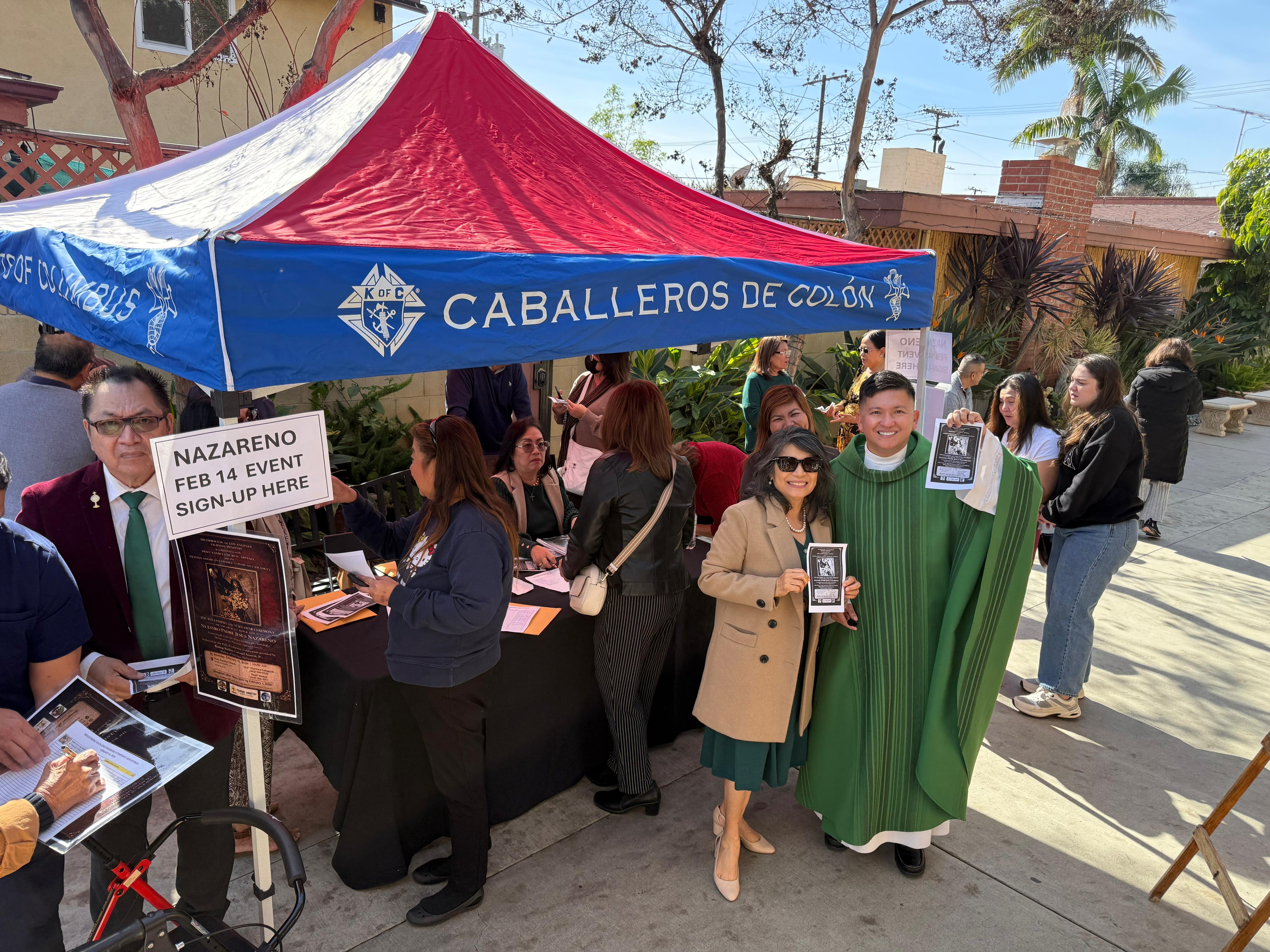
An official replica of Manila’s centuries-old Jesús Nazareno image has been entrusted to Holy Family Parish in Artesia, California, bringing one of the world’s largest Catholic devotions to the U.S.
Read More