Paradigm

Catholic thinkers, tech experts reflect on promise and perils of AI at New York Encounter #Catholic NEW YORK — How can Catholic social teaching guide us in weighing the benefits of artificial intelligence against the dangers it poses to human dignity? That question animated a wide-ranging discussion among Catholic thinkers and technology experts at the New York Encounter on Saturday.Citing Pope Leo XIV’s call to use AI responsibly as well as the Church’s historic defense of human dignity in the face of modern technology, Davide Bolchini, moderator and dean of the Luddy School of Informatics at Indiana University, opened the discussion before an audience of several hundred people gathered for the three-day cultural conference in New York City.“The pope encouraged us to use AI responsibly, to use it in a way that helps us grow, not to let it work against us, but to let it work with us, not to substitute human intelligence, not to replace our judgment of what’s right … our ability of authentic wonder,” Bolchini said.With technology rapidly advancing, Bolchini asked, how can the Church stay ahead of these challenges?Chuck Rossi, an engineer at Meta who is developing AI-driven content moderation technology at the technology conglomerate, which includes Facebook and Instagram, argued that in his work, developments in AI have been instrumental in safeguarding human beings from harm. AI systems, he said, can examine 2.5 billion pieces of of shared online content per hour, filtering harmful material including nudity and sexual activity, bullying and harassment, child endanger, dangerous organizations, fake accounts, hateful conduct, restricted goods and services, spam, suicide and self-injury, violence and incitement, and violent and graphic content.“That’s my world,” he said. “It’s a very, very hard problem. If we miss 0.1% of 2. 5 billion, that’s millions of things that we didn’t want to be seeing. But we do an excellent job, and we have for years — we’re one of the best at it,” Rossi said.Using AI also protects human content moderators from being exposed to disturbing material, as they were in the past.“The good thing that we are giving back to humans is you never have to do this horrible work,” he said.Paul Scherz, professor of theology at the University of Notre Dame, acknowledged the benefits of AI, which he said included advances in medicine and efficiency for tasks like billing (“Nobody wants to do billing,” he said).But Scherz warned of the dangers of relying on technology to do what is intrinsically human.“We are really starting to turn to AI as people more broadly for these relational aspects, which would be tragic because there is something in that human-to-human connection, the ‘I/thou connection,’ as Martin Buber called it, that is irreplaceable by a machine,” Scherz said. He noted that AI has even moved into ministry, with the rise of Catholic apps relying on bots to offer catechesis.Scherz also cautioned that substituting AI for human interaction and intelligence risks eroding our skills, whether in relationships or in professional life.“My fear is as we use these chatbots more and more we will lose those person-to-person skills. We’ll no longer be able to engage one another as well, or have the patience and virtue to deeply love and encounter one another,” Scherz said.In addition, relying on AI in our work, for example, when a doctor consults AI to make a diagnosis, will result in our “de-skilling,” he said. “We know that people, when they’re using automated systems, they tend to just become biased and complacent and just approve the automated system. They lose their skills,” he said, adding that airline pilots who rely too much on autopilot are more prone to making errors.Louis Kim, former vice president of personal systems and AI at Hewlett-Packard who is currently pursuing graduate studies in theology and health care, pointed out that it’s not possible to know today what skills will be required in the future.“My personal view is I often find that predictions of impacted technology are largely unconsciously based on what we know of the current paradigm and structure and technologies,” Kim said.“There are going to be skills needed to control AI that are going to be different,” he said.Kim also called for “humility” in discussions about AI’s potential to affect human relationships.“Let’s ask ourselves about the quality of our current human relationships, whether it’s in the workplace, in toxic cultures, sometimes at home — even at conferences, at your next break, as you go around talking to this person [or] that person, how many times that person is looking over your shoulder for the more important person to talk to?” he said.Our moral formation, he said, will continue to shape the quality of our encounters with others.

Catholic thinkers, tech experts reflect on promise and perils of AI at New York Encounter #Catholic NEW YORK — How can Catholic social teaching guide us in weighing the benefits of artificial intelligence against the dangers it poses to human dignity? That question animated a wide-ranging discussion among Catholic thinkers and technology experts at the New York Encounter on Saturday.Citing Pope Leo XIV’s call to use AI responsibly as well as the Church’s historic defense of human dignity in the face of modern technology, Davide Bolchini, moderator and dean of the Luddy School of Informatics at Indiana University, opened the discussion before an audience of several hundred people gathered for the three-day cultural conference in New York City.“The pope encouraged us to use AI responsibly, to use it in a way that helps us grow, not to let it work against us, but to let it work with us, not to substitute human intelligence, not to replace our judgment of what’s right … our ability of authentic wonder,” Bolchini said.With technology rapidly advancing, Bolchini asked, how can the Church stay ahead of these challenges?Chuck Rossi, an engineer at Meta who is developing AI-driven content moderation technology at the technology conglomerate, which includes Facebook and Instagram, argued that in his work, developments in AI have been instrumental in safeguarding human beings from harm. AI systems, he said, can examine 2.5 billion pieces of of shared online content per hour, filtering harmful material including nudity and sexual activity, bullying and harassment, child endanger, dangerous organizations, fake accounts, hateful conduct, restricted goods and services, spam, suicide and self-injury, violence and incitement, and violent and graphic content.“That’s my world,” he said. “It’s a very, very hard problem. If we miss 0.1% of 2. 5 billion, that’s millions of things that we didn’t want to be seeing. But we do an excellent job, and we have for years — we’re one of the best at it,” Rossi said.Using AI also protects human content moderators from being exposed to disturbing material, as they were in the past.“The good thing that we are giving back to humans is you never have to do this horrible work,” he said.Paul Scherz, professor of theology at the University of Notre Dame, acknowledged the benefits of AI, which he said included advances in medicine and efficiency for tasks like billing (“Nobody wants to do billing,” he said).But Scherz warned of the dangers of relying on technology to do what is intrinsically human.“We are really starting to turn to AI as people more broadly for these relational aspects, which would be tragic because there is something in that human-to-human connection, the ‘I/thou connection,’ as Martin Buber called it, that is irreplaceable by a machine,” Scherz said. He noted that AI has even moved into ministry, with the rise of Catholic apps relying on bots to offer catechesis.Scherz also cautioned that substituting AI for human interaction and intelligence risks eroding our skills, whether in relationships or in professional life.“My fear is as we use these chatbots more and more we will lose those person-to-person skills. We’ll no longer be able to engage one another as well, or have the patience and virtue to deeply love and encounter one another,” Scherz said.In addition, relying on AI in our work, for example, when a doctor consults AI to make a diagnosis, will result in our “de-skilling,” he said. “We know that people, when they’re using automated systems, they tend to just become biased and complacent and just approve the automated system. They lose their skills,” he said, adding that airline pilots who rely too much on autopilot are more prone to making errors.Louis Kim, former vice president of personal systems and AI at Hewlett-Packard who is currently pursuing graduate studies in theology and health care, pointed out that it’s not possible to know today what skills will be required in the future.“My personal view is I often find that predictions of impacted technology are largely unconsciously based on what we know of the current paradigm and structure and technologies,” Kim said.“There are going to be skills needed to control AI that are going to be different,” he said.Kim also called for “humility” in discussions about AI’s potential to affect human relationships.“Let’s ask ourselves about the quality of our current human relationships, whether it’s in the workplace, in toxic cultures, sometimes at home — even at conferences, at your next break, as you go around talking to this person [or] that person, how many times that person is looking over your shoulder for the more important person to talk to?” he said.Our moral formation, he said, will continue to shape the quality of our encounters with others.

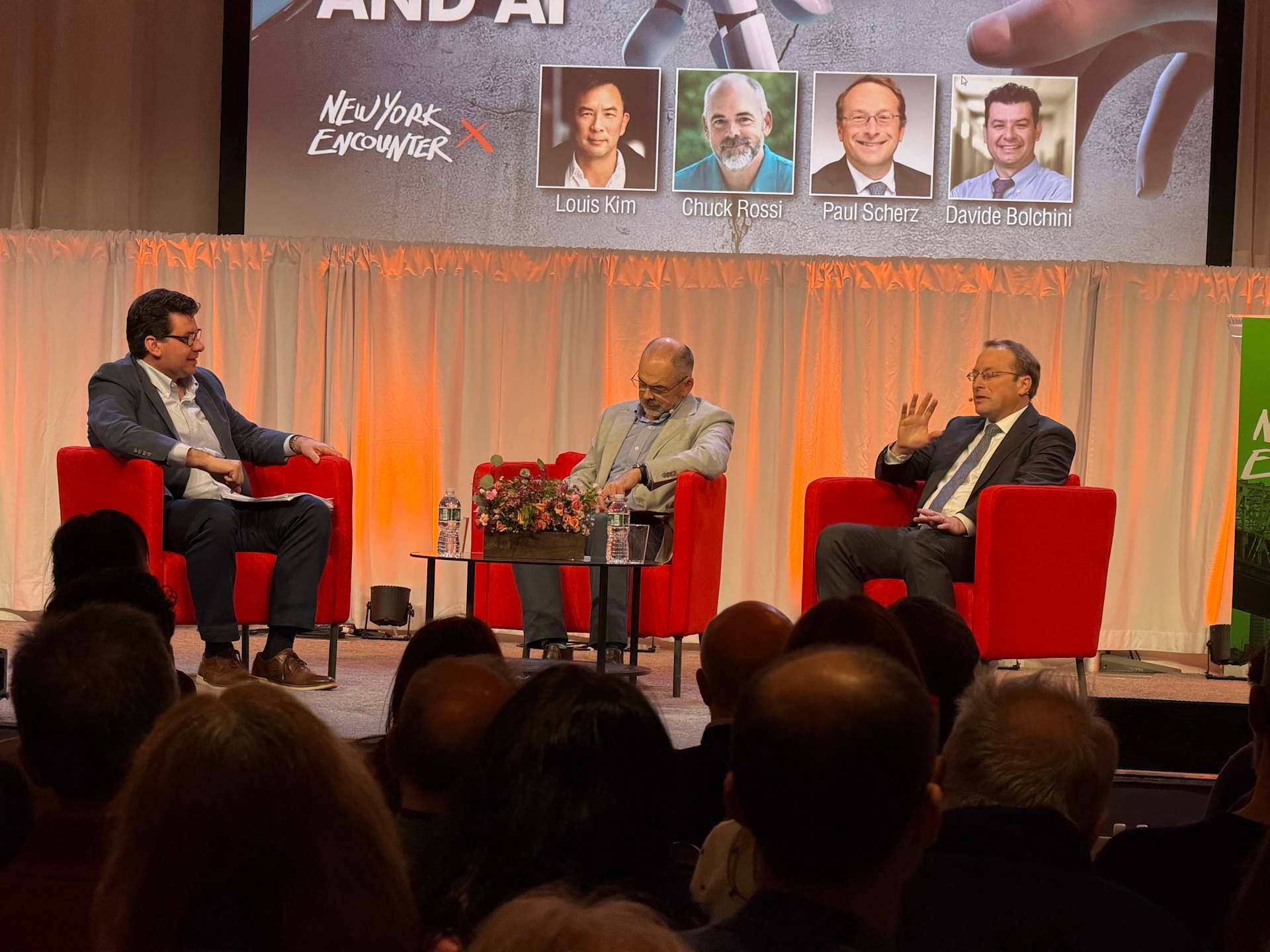
“The pope encouraged us to use AI responsibly, to use it in a way that helps us grow, not to let it work against us, ” said Davide Bolchini, the moderator of an AI panel at the weekend conference.
Read More
Catholic women discuss beauty, difficulty, redemptive nature of Church’s teachings on sexuality #Catholic 
 
 Keynote speakers at “The Beauty of Truth: Navigating Society Today as a Catholic Woman” conference, held Jan. 9-10, 2026, in Houston (left to right): Erika Bachiochi, Mary Eberstadt, Angela Franks, Pia de Solenni, and Leah Sargeant. | Credit: Photo courtesy of the University of St. Thomas

Jan 18, 2026 / 10:26 am (CNA).
This past week, nearly a quarter of U.S. states sued the federal government for defining biological sex as binary, the U.S. Supreme Court heard arguments for and against legally allowing males to compete against females in sports, and a Vatican official called surrogacy a “new form of colonialism” that commodifies women and their children.These are just the latest legal and cultural effects of a “mass cultural confusion” surrounding the meaning and purpose of the human body, and particularly women’s bodies, according to Leah Jacobson, program coordinator of the Catholic Women’s and Gender Studies Program at the University of St. Thomas in Houston.On Jan. 9–10, the program sponsored a symposium titled “The Beauty of Truth: Navigating Society Today as a Catholic Woman,” which brought together a group of Catholic women who have used their gifts of intellect and faith to serve as what Jacobson calls an “antidote” to the “chaos and confusion” of the cultural moment.The speakers presented on a wide range of topics concerned with the beauty, truth, and necessity of the Church’s teachings on human sexuality, while also acknowledging how difficult living according to those teachings can sometimes be.‘Each of these acts is an act of human subtraction’In one of the first talks, writer Mary Eberstadt argued that the question “Who am I?” became harder to answer due to the widespread use of the birth control pill, which has led to huge increases in abortion, divorce, fatherlessness, single parenthood, and childlessness. “Each of these acts is an act of human subtraction,” Eberstadt said. “I’m not trying to make a point about morality, but arithmetic.”“The number of people we can call our own” became smaller, she said. While she acknowledged that not everyone has been affected equally, “members of our species share a collective environment. Just as toxic waste affects everyone," she said, the reduction in the number of human connections “amounts to a massive disturbance to the human ecosystem,” leading to a crisis of human identity.This reduction in the number of people in an individual's life, she argued, resulted in widespread confusion over gender identity and the meaning and purpose of the body.Eberstadt also attributed the decline in religiosity to the smaller number of human connections modern people have.“The sexual revolution subtracted the number of role models,” she said. “Many children have no siblings, no cousins, no aunts or uncles, no father; yet that is how humans conduct social learning.”“Without children, adults are less likely to go to church,” she said. “Without birth, we lose knowledge of the transcendent. Without an earthly father, it is hard to grasp the paradigm of a heavenly father.”‘A love deficit’“Living without God is not liberating people,” she continued. “It’s tearing some individuals apart, making people miserable and lonely.”When the sexual revolution made sex "recreational and not procreative, what it produced above all is a love deficit,” Eberstadt said.At the same time, secularization produced “troubled, disconnected souls drifting through society without gravity, shattering the ability to answer ‘Who am I?’”“The Church is the answer to the love deficit because Church teachings about who we are and what we’re here for are true,” she said.She concluded with a final note on hope, saying “it is easy to feel embattled, but we must never lose sight of the faces of the sexual revolution’s victims,” she said, “who are sending up primal screams for a world more ordered than many of today’s people now know; more ordered to mercy, to community and redemption.”The Church’s teachings were ’truly beautiful’ but 'very, very hard to live'Erika Bachiochi, a legal scholar and fellow at the Ethics and Public Policy Center who has taught a class for the graduate program, shared her experience as a mother of seven who tried to live according to the Church’s “difficult” teachings.As her children began to arrive at “a breakneck pace” and each pregnancy was “a bit of a crucible,” Bachiochi said being a mother was “very hard” for her, partly due to wounds from her youth (among other troubles, her own mother had been married and divorced three times), and partly because of a lack of community. Echoing Eberstadt’s “arithmetic” problem, Bachiochi described having very few examples of Catholic family life and a very small support system.Bachiochi said she believes God heals us from our wounds through our “particular vocations,” however.Of motherhood, she said: “I think God really healed me through being faithful to teachings that I found quite hard, but truly beautiful. I was intellectually convinced by them and found them spiritually beautiful, but found them to be very, very hard to live.” “Motherhood has served to heal me profoundly," she said, encouraging young mothers to have faith that though it might be difficult now, there is an “amazing future” awaiting them. “It’s really an incredible gift that Church has given me … the gift of obedience,” she said. She also said by God’s grace, she was given an “excellent husband” and has found that “just as the Church promises, that leaning into motherhood, into the little things, the daily needs, the constant requests for my attention, has truly been a school of virtue.” The Catholic Women’s and Gender Studies Program is a new part of the Nesti Center for Faith and Culture at the University of St. Thomas, a recognized Catholic cultural center of the Vatican’s Dicastery for Culture and Education.

Catholic women discuss beauty, difficulty, redemptive nature of Church’s teachings on sexuality #Catholic Keynote speakers at “The Beauty of Truth: Navigating Society Today as a Catholic Woman” conference, held Jan. 9-10, 2026, in Houston (left to right): Erika Bachiochi, Mary Eberstadt, Angela Franks, Pia de Solenni, and Leah Sargeant. | Credit: Photo courtesy of the University of St. Thomas Jan 18, 2026 / 10:26 am (CNA). This past week, nearly a quarter of U.S. states sued the federal government for defining biological sex as binary, the U.S. Supreme Court heard arguments for and against legally allowing males to compete against females in sports, and a Vatican official called surrogacy a “new form of colonialism” that commodifies women and their children.These are just the latest legal and cultural effects of a “mass cultural confusion” surrounding the meaning and purpose of the human body, and particularly women’s bodies, according to Leah Jacobson, program coordinator of the Catholic Women’s and Gender Studies Program at the University of St. Thomas in Houston.On Jan. 9–10, the program sponsored a symposium titled “The Beauty of Truth: Navigating Society Today as a Catholic Woman,” which brought together a group of Catholic women who have used their gifts of intellect and faith to serve as what Jacobson calls an “antidote” to the “chaos and confusion” of the cultural moment.The speakers presented on a wide range of topics concerned with the beauty, truth, and necessity of the Church’s teachings on human sexuality, while also acknowledging how difficult living according to those teachings can sometimes be.‘Each of these acts is an act of human subtraction’In one of the first talks, writer Mary Eberstadt argued that the question “Who am I?” became harder to answer due to the widespread use of the birth control pill, which has led to huge increases in abortion, divorce, fatherlessness, single parenthood, and childlessness. “Each of these acts is an act of human subtraction,” Eberstadt said. “I’m not trying to make a point about morality, but arithmetic.”“The number of people we can call our own” became smaller, she said. While she acknowledged that not everyone has been affected equally, “members of our species share a collective environment. Just as toxic waste affects everyone," she said, the reduction in the number of human connections “amounts to a massive disturbance to the human ecosystem,” leading to a crisis of human identity.This reduction in the number of people in an individual's life, she argued, resulted in widespread confusion over gender identity and the meaning and purpose of the body.Eberstadt also attributed the decline in religiosity to the smaller number of human connections modern people have.“The sexual revolution subtracted the number of role models,” she said. “Many children have no siblings, no cousins, no aunts or uncles, no father; yet that is how humans conduct social learning.”“Without children, adults are less likely to go to church,” she said. “Without birth, we lose knowledge of the transcendent. Without an earthly father, it is hard to grasp the paradigm of a heavenly father.”‘A love deficit’“Living without God is not liberating people,” she continued. “It’s tearing some individuals apart, making people miserable and lonely.”When the sexual revolution made sex "recreational and not procreative, what it produced above all is a love deficit,” Eberstadt said.At the same time, secularization produced “troubled, disconnected souls drifting through society without gravity, shattering the ability to answer ‘Who am I?’”“The Church is the answer to the love deficit because Church teachings about who we are and what we’re here for are true,” she said.She concluded with a final note on hope, saying “it is easy to feel embattled, but we must never lose sight of the faces of the sexual revolution’s victims,” she said, “who are sending up primal screams for a world more ordered than many of today’s people now know; more ordered to mercy, to community and redemption.”The Church’s teachings were ’truly beautiful’ but 'very, very hard to live'Erika Bachiochi, a legal scholar and fellow at the Ethics and Public Policy Center who has taught a class for the graduate program, shared her experience as a mother of seven who tried to live according to the Church’s “difficult” teachings.As her children began to arrive at “a breakneck pace” and each pregnancy was “a bit of a crucible,” Bachiochi said being a mother was “very hard” for her, partly due to wounds from her youth (among other troubles, her own mother had been married and divorced three times), and partly because of a lack of community. Echoing Eberstadt’s “arithmetic” problem, Bachiochi described having very few examples of Catholic family life and a very small support system.Bachiochi said she believes God heals us from our wounds through our “particular vocations,” however.Of motherhood, she said: “I think God really healed me through being faithful to teachings that I found quite hard, but truly beautiful. I was intellectually convinced by them and found them spiritually beautiful, but found them to be very, very hard to live.” “Motherhood has served to heal me profoundly," she said, encouraging young mothers to have faith that though it might be difficult now, there is an “amazing future” awaiting them. “It’s really an incredible gift that Church has given me … the gift of obedience,” she said. She also said by God’s grace, she was given an “excellent husband” and has found that “just as the Church promises, that leaning into motherhood, into the little things, the daily needs, the constant requests for my attention, has truly been a school of virtue.” The Catholic Women’s and Gender Studies Program is a new part of the Nesti Center for Faith and Culture at the University of St. Thomas, a recognized Catholic cultural center of the Vatican’s Dicastery for Culture and Education.


Keynote speakers at “The Beauty of Truth: Navigating Society Today as a Catholic Woman” conference, held Jan. 9-10, 2026, in Houston (left to right): Erika Bachiochi, Mary Eberstadt, Angela Franks, Pia de Solenni, and Leah Sargeant. | Credit: Photo courtesy of the University of St. Thomas

Jan 18, 2026 / 10:26 am (CNA).

This past week, nearly a quarter of U.S. states sued the federal government for defining biological sex as binary, the U.S. Supreme Court heard arguments for and against legally allowing males to compete against females in sports, and a Vatican official called surrogacy a “new form of colonialism” that commodifies women and their children.

These are just the latest legal and cultural effects of a “mass cultural confusion” surrounding the meaning and purpose of the human body, and particularly women’s bodies, according to Leah Jacobson, program coordinator of the Catholic Women’s and Gender Studies Program at the University of St. Thomas in Houston.

On Jan. 9–10, the program sponsored a symposium titled “The Beauty of Truth: Navigating Society Today as a Catholic Woman,” which brought together a group of Catholic women who have used their gifts of intellect and faith to serve as what Jacobson calls an “antidote” to the “chaos and confusion” of the cultural moment.

The speakers presented on a wide range of topics concerned with the beauty, truth, and necessity of the Church’s teachings on human sexuality, while also acknowledging how difficult living according to those teachings can sometimes be.

‘Each of these acts is an act of human subtraction’

In one of the first talks, writer Mary Eberstadt argued that the question “Who am I?” became harder to answer due to the widespread use of the birth control pill, which has led to huge increases in abortion, divorce, fatherlessness, single parenthood, and childlessness.

“Each of these acts is an act of human subtraction,” Eberstadt said. “I’m not trying to make a point about morality, but arithmetic.”

“The number of people we can call our own” became smaller, she said.

While she acknowledged that not everyone has been affected equally, “members of our species share a collective environment. Just as toxic waste affects everyone," she said, the reduction in the number of human connections “amounts to a massive disturbance to the human ecosystem,” leading to a crisis of human identity.

This reduction in the number of people in an individual's life, she argued, resulted in widespread confusion over gender identity and the meaning and purpose of the body.

Eberstadt also attributed the decline in religiosity to the smaller number of human connections modern people have.

“The sexual revolution subtracted the number of role models,” she said. “Many children have no siblings, no cousins, no aunts or uncles, no father; yet that is how humans conduct social learning.”

“Without children, adults are less likely to go to church,” she said. “Without birth, we lose knowledge of the transcendent. Without an earthly father, it is hard to grasp the paradigm of a heavenly father.”

‘A love deficit’

“Living without God is not liberating people,” she continued. “It’s tearing some individuals apart, making people miserable and lonely.”

When the sexual revolution made sex "recreational and not procreative, what it produced above all is a love deficit,” Eberstadt said.

At the same time, secularization produced “troubled, disconnected souls drifting through society without gravity, shattering the ability to answer ‘Who am I?’”

“The Church is the answer to the love deficit because Church teachings about who we are and what we’re here for are true,” she said.

She concluded with a final note on hope, saying “it is easy to feel embattled, but we must never lose sight of the faces of the sexual revolution’s victims,” she said, “who are sending up primal screams for a world more ordered than many of today’s people now know; more ordered to mercy, to community and redemption.”

The Church’s teachings were ’truly beautiful’ but 'very, very hard to live'

Erika Bachiochi, a legal scholar and fellow at the Ethics and Public Policy Center who has taught a class for the graduate program, shared her experience as a mother of seven who tried to live according to the Church’s “difficult” teachings.

As her children began to arrive at “a breakneck pace” and each pregnancy was “a bit of a crucible,” Bachiochi said being a mother was “very hard” for her, partly due to wounds from her youth (among other troubles, her own mother had been married and divorced three times), and partly because of a lack of community.

Echoing Eberstadt’s “arithmetic” problem, Bachiochi described having very few examples of Catholic family life and a very small support system.

Bachiochi said she believes God heals us from our wounds through our “particular vocations,” however.

Of motherhood, she said: “I think God really healed me through being faithful to teachings that I found quite hard, but truly beautiful. I was intellectually convinced by them and found them spiritually beautiful, but found them to be very, very hard to live.”

“Motherhood has served to heal me profoundly," she said, encouraging young mothers to have faith that though it might be difficult now, there is an “amazing future” awaiting them.

“It’s really an incredible gift that Church has given me … the gift of obedience,” she said.

She also said by God’s grace, she was given an “excellent husband” and has found that “just as the Church promises, that leaning into motherhood, into the little things, the daily needs, the constant requests for my attention, has truly been a school of virtue.”

The Catholic Women’s and Gender Studies Program is a new part of the Nesti Center for Faith and Culture at the University of St. Thomas, a recognized Catholic cultural center of the Vatican’s Dicastery for Culture and Education.

Read More