regional

Pakistani Christians join Muslims for Ramadan meals amid Iran war fallout #Catholic LAHORE, Pakistan — White bedsheets for Muslim worshippers were laid on the grassy lawn outside the Dominican Peace Center in Punjab an hour before the annual interfaith iftar — the fast-breaking meal during Ramadan.The aroma of crispy pakoras (fritters), dried dates, rose-flavored Rooh Afza, and dahi bhallay (lentil dumplings in yogurt) drew guests to the dining tables after they finished reciting their iftar prayers in Lahore, the provincial capital.Dominican Father James Channan, director of the center, has hosted such interfaith gatherings for 25 years in a country where religious tensions have periodically turned violent.
 
 Dominican Father James Channan speaks at a combined International Women’s Day and interfaith iftar program at the Dominican Peace Center in Lahore, Pakistan, on March 8, 2026. | Credit: Kamran Chaudhry
 
 “Table friendships are very important in our context. People attending such forums highlight them on social media, reaching millions,” he told EWTN News at the sidelines of the program, timed with International Women’s Day on March 8.“The combined meals and prayer services have helped curb trends of church attacks that followed U.S. wars in Muslim countries.”Pakistani Christians have faced multiple terrorist attacks since October 2001, after the United States — seen by many Pakistani Muslims as a Christian nation — launched its military campaign in Afghanistan.“It’s a bitter past. Churches and Christian settlements were considered soft targets. The ongoing conflicts are not crusades; they are wars of interest,” Channan said.Interfaith meals continue despite unrestInterfaith gatherings continued this year even as protests against U.S. and Israeli strikes on Iran left 26 dead in Pakistan.Church leaders joined clerics in prayers for peace and shared meals at mosques, church premises, and hotels across six dioceses and one apostolic vicariate, as Middle East air travel disruption and rising fuel prices added regional tension.Many Pakistanis view the United States and Western Europe as Christian nations, and some militant groups target local Christians as linked to these “Christian countries.”Communal tensions have also erupted locally. In May 2024, a mob attacked 74-year-old Christian Nazir Masih over alleged blasphemy in Sargodha. He later died of his injuries. In August 2023, violence in Jaranwala destroyed 26 churches and 80 Christian homes following allegations of Quran desecration.In a Feb. 17 message, Archbishop Joseph Arshad of Rawalpindi-Islamabad invited Christians and Muslims to offer special prayers for peace as Lent and Ramadan coincided this year. He encouraged people of both faiths “to visit one another, exchange greetings with respect, and unite in serving vulnerable segments of society.”Joint events across PakistanIn Multan, over 82 participants attended a Feb. 28 iftar jointly organized by the Catholic Commission for Inter-Religious Dialogue and Ecumenism; Saiban-e-Pakistan, a state peace initiative; and the Centre of Excellence on Countering Violent Extremism.A day earlier in Lahore, Channan and four Catholic priests attended the fast-breaking event at the Badshahi Mosque, the country’s second-largest mosque. He presented a framed photo of Abdul Khabeer Azad, the mosque’s “khateeb” (prayer leader), who met Pope Leo XIV in October 2025 at the “Christian-Muslim Dialogue and Daring Peace” conference in Rome organized by the Community of Sant’Egidio.
 
 Guests share the interfaith iftar meal at the Dominican Peace Center in Lahore on March 8, 2026. | Credit: Kamran Chaudhry
 
 Among 120 guests at the Dominican iftar was Muslim speaker Shehzad Qaiser. The event, held in collaboration with groups including the Seventh-day Adventist Church, highlighted ongoing social challenges.The head of external affairs at Sundas Foundation, which supports patients with blood disorders, agreed that Christians face discrimination in some offices and some Muslims refuse the food prepared by Christians.“It is very important to share our common practices, joys, and sorrows. Religious leaders have the duty to raise awareness. Sadly some mistake local Christians as ‘kafir’ (infidels),” Qaiser said.“During Ramadan, people distribute free meals to everyone without asking their religion. Blood donors don’t discriminate either. This is the real spirit of Ramadan and Lent.”

Pakistani Christians join Muslims for Ramadan meals amid Iran war fallout #Catholic LAHORE, Pakistan — White bedsheets for Muslim worshippers were laid on the grassy lawn outside the Dominican Peace Center in Punjab an hour before the annual interfaith iftar — the fast-breaking meal during Ramadan.The aroma of crispy pakoras (fritters), dried dates, rose-flavored Rooh Afza, and dahi bhallay (lentil dumplings in yogurt) drew guests to the dining tables after they finished reciting their iftar prayers in Lahore, the provincial capital.Dominican Father James Channan, director of the center, has hosted such interfaith gatherings for 25 years in a country where religious tensions have periodically turned violent. Dominican Father James Channan speaks at a combined International Women’s Day and interfaith iftar program at the Dominican Peace Center in Lahore, Pakistan, on March 8, 2026. | Credit: Kamran Chaudhry “Table friendships are very important in our context. People attending such forums highlight them on social media, reaching millions,” he told EWTN News at the sidelines of the program, timed with International Women’s Day on March 8.“The combined meals and prayer services have helped curb trends of church attacks that followed U.S. wars in Muslim countries.”Pakistani Christians have faced multiple terrorist attacks since October 2001, after the United States — seen by many Pakistani Muslims as a Christian nation — launched its military campaign in Afghanistan.“It’s a bitter past. Churches and Christian settlements were considered soft targets. The ongoing conflicts are not crusades; they are wars of interest,” Channan said.Interfaith meals continue despite unrestInterfaith gatherings continued this year even as protests against U.S. and Israeli strikes on Iran left 26 dead in Pakistan.Church leaders joined clerics in prayers for peace and shared meals at mosques, church premises, and hotels across six dioceses and one apostolic vicariate, as Middle East air travel disruption and rising fuel prices added regional tension.Many Pakistanis view the United States and Western Europe as Christian nations, and some militant groups target local Christians as linked to these “Christian countries.”Communal tensions have also erupted locally. In May 2024, a mob attacked 74-year-old Christian Nazir Masih over alleged blasphemy in Sargodha. He later died of his injuries. In August 2023, violence in Jaranwala destroyed 26 churches and 80 Christian homes following allegations of Quran desecration.In a Feb. 17 message, Archbishop Joseph Arshad of Rawalpindi-Islamabad invited Christians and Muslims to offer special prayers for peace as Lent and Ramadan coincided this year. He encouraged people of both faiths “to visit one another, exchange greetings with respect, and unite in serving vulnerable segments of society.”Joint events across PakistanIn Multan, over 82 participants attended a Feb. 28 iftar jointly organized by the Catholic Commission for Inter-Religious Dialogue and Ecumenism; Saiban-e-Pakistan, a state peace initiative; and the Centre of Excellence on Countering Violent Extremism.A day earlier in Lahore, Channan and four Catholic priests attended the fast-breaking event at the Badshahi Mosque, the country’s second-largest mosque. He presented a framed photo of Abdul Khabeer Azad, the mosque’s “khateeb” (prayer leader), who met Pope Leo XIV in October 2025 at the “Christian-Muslim Dialogue and Daring Peace” conference in Rome organized by the Community of Sant’Egidio. Guests share the interfaith iftar meal at the Dominican Peace Center in Lahore on March 8, 2026. | Credit: Kamran Chaudhry Among 120 guests at the Dominican iftar was Muslim speaker Shehzad Qaiser. The event, held in collaboration with groups including the Seventh-day Adventist Church, highlighted ongoing social challenges.The head of external affairs at Sundas Foundation, which supports patients with blood disorders, agreed that Christians face discrimination in some offices and some Muslims refuse the food prepared by Christians.“It is very important to share our common practices, joys, and sorrows. Religious leaders have the duty to raise awareness. Sadly some mistake local Christians as ‘kafir’ (infidels),” Qaiser said.“During Ramadan, people distribute free meals to everyone without asking their religion. Blood donors don’t discriminate either. This is the real spirit of Ramadan and Lent.”

Church leaders and Muslim clerics shared Ramadan fast-breaking meals across six Pakistani dioceses this year as the overlap of Lent and Ramadan inspired joint prayers for peace.

Read More
Maryland high school seniors arrive home safely after being stuck in Middle East during hostilities #Catholic A group of high schoolers from a Maryland boys' school found themselves in the crosshairs of international conflict in the Middle East this week, turning what was meant to be a brief layover in Abu Dhabi into a multi-day ordeal amid escalating hostilities between Iran, Israel, and the United States.The group — 18 seniors and two faculty members from the Heights School in Potomac, Maryland, just outside of Washington, D.C. — had departed on the afternoon of Feb. 27 for a cultural exchange trip to Thailand.The voyage was part of the school’s yearly Crescite Trips, where students in grades 9-12 participate during the first week of March in local seminars as well as domestic and international trips intended for the students’ growth.The group was scheduled for a two-hour layover in the United Arab Emirates after their 12-hour flight when regional airspace slammed shut following U.S.-Israeli strikes on Iran and Iranʼs retaliatory missile barrages.Initially, all flights were cancelled, but soon the airport was closed and had to be evacuated. According to Aidan Korn, a student on the trip, the group was seated at the gate for their next flight when they learned it had been suspended because “the war had begun.”“It was scary at first. We were sitting by a giant window at the gate and all of our phones started going off at the same time. I saw texts from friends in the U.S. asking if I was alive,” he said. “We saw military men running with guns through the airport.”Korn said the two faculty chaperones, Justin Myers and Dan Sushinsky, told them to get away from the windows and seek shelter in the airport bathroom. They learned later that a drone was intercepted above the airport, and the debris killed one person and injured several others.Myers and Sushinksy, both seasoned teachers as well as college counselors at the Heights, immediately called headmaster Alvaro de Vicente, who told EWTN News he called “everyone I know to help” the boys.De Vicente said the teachers and boys registered through the state department website for U.S. citizens stuck in the Middle East.The teachers “did an incredible job keeping the boys calm, safe, and engaged,” said de Vicente. He described the men as “real pros in handling a situation no teacher can prepare for.”“This is not what we do. We donʼt prepare for this!” he said.Bryson Begg, another senior on the trip, agreed, telling EWTN News that the teachers were "incredible. Their number-one priority was our safety. They cared for us so much.”Begg described a “confidence” that Myers and Sushinksy emanated that they would all get home safely. “We had this sense that they’ve got it.”The teachers instructed the boys to be cautious and not to post anything on social media that could compromise their security, Korn said.Myers told EWTN News the situation felt chaotic at first, as thousands of people with canceled flights tried to find hotels using airline-provided vouchers. Initially, the group was split up and assigned to different hotels, which they deemed unacceptable, so he and Sushinsky decided to stay the night in the airport, hoping a flight would open up while they waited.The airport was then closed and everyone was ordered to evacuate. After several hours, with the help of several airport employees, Myers said they were able to find a hotel for all 20 of them. When they boarded the bus, again amidst the chaos of thousands of evacuating travelers, the driver asked Myers where the hotel was, and they figured out the directions there together.Myers said either he or Sushinsky was on the phone almost constantly with the State Department, parents, de Vicente, Heights alumni who lived in the area, and  the U.S. embassy. Myers, who has taught at the Heights for over 30 years and has led many trips, told EWTN News it was “an unusually good group” of boys. "All of our top students were on this trip. They were very brave.”“They were probably not as scared as they should have been! And now that they’re home safe, they’re saying it was the best trip ever!” he laughed.Once at the hotel, he and Sushinsky held group meetings at set times each day, where they ate together, played games, prayed the rosary, and told funny stories. The leaders also made themselves available at set times each day to talk with any boys who wanted to.Begg said the teachers made sure the boys kept their bags packed and ready to go at all times in case they had to rush to the airport to catch an available flight out.Korn told EWTN News the hotel’s doors were initially zip tied shut, but as the days went on, they were occasionally allowed to venture outside briefly. On one of these occasions, Begg said he was praying the rosary when warning sirens went off, and the hotel staff urgently called him back inside.“Most of the time it felt perfectly safe,” Myers said. “We saw some drones a couple of times; saw them intercepted, mostly at night. We’d watch the news and they’d make it worse than it is. They kept showing the same building being hit.”“It was not like what was being shown on TV. People in the city were going about their daily lives.”Nevertheless, the boys spent most of their time indoors eating (“The hotel had really nice food,” said Korn), working out at the gym, watching movies in the presidential suite, where two of the students were staying, and even playing hide and seek throughout the hotel.Thanks to a Heights alumnus who lives there, the group (with all the parents’ permission) was able to go to the beach one day, and on a desert excursion to an oasis, where they rode camels, according to Begg.‘An overwhelming feeling of comfort’By 4:30 a.m. on Feb. 28, Karen Korn, Aidan’s mother, told EWTN News she was awakened by the dozens of notifications on her phone from the boys as well as other parents.“I’m so humbled by and grateful to the amount of people that reached out to us, who were praying,” she said. “I truly believe that was what got us through. It’s unbelievable how many people were praying.”“We had people praying 24 hours a day; priests at every church around us that had holy hours and said Masses for them … even outside of this area.”She described “an overwhelming feeling of comfort” knowing how many prayers were being said for the young men. While praying on Sunday, she said she saw an image of Jesus wrapping his arms around the boys, keeping them safe.‘Men fully alive’Begg, who has attended the Heights since 3rd grade, credited de Vicente for working “tirelessly to help us.”“He is the pinnacle of what a Heights man is. ‘Men fully alive’ is our motto, and he’s the epitome of that. He’s strong in his beliefs, and cared for us so much. He waited in the airport for hours before we arrived. It was incredibly heartwarming to see that.”“He was right at the front of the group of parents at the airport with a big smile on his face, welcoming us home. We all shook his hand.”De Vicente said he was “thankful to the United Arab Emirates government” for hosting the boys, providing them the hotel and transportation. He also said he was "thankful to our government for being able to get them out.”The boys left on a charter flight — one arranged by the U.S. State Department filled with other American families — and returned safely to Dulles Airport on the afternoon of Thursday, March 5.
 
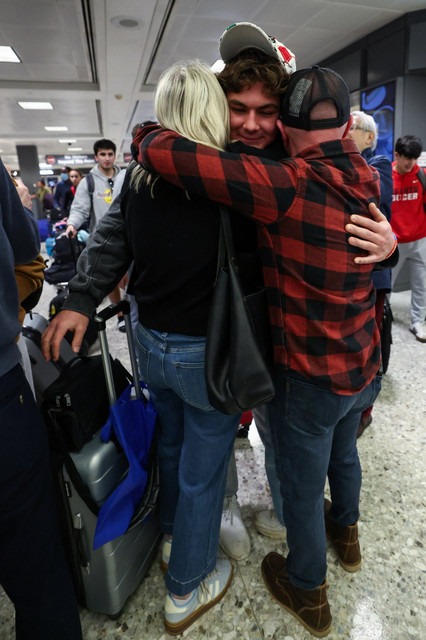
 Aidan Korn hugs his parents, Karen and Jason Korn, at Dulles Airport in Virginia upon his safe return, Thursday, March 5, 2026 | Credit: Courtesy of the Korn family
 
 The Heights School, an independent day school for grades 3-12, teaches boys “with a Christian spirit and in accord with the teachings of the Catholic Church” and the Personal Prelature of Opus Dei “provides chaplains for the school and oversees its program of classes in Catholic doctrine,” according to its website.Over the years, the school has drawn politically conservative families, including the sons of prominent politicians such as former senator and presidential candidate Rick Santorum as well as Maggie Gallagher, president of the National Organization for Marriage, among others.

Maryland high school seniors arrive home safely after being stuck in Middle East during hostilities #Catholic A group of high schoolers from a Maryland boys' school found themselves in the crosshairs of international conflict in the Middle East this week, turning what was meant to be a brief layover in Abu Dhabi into a multi-day ordeal amid escalating hostilities between Iran, Israel, and the United States.The group — 18 seniors and two faculty members from the Heights School in Potomac, Maryland, just outside of Washington, D.C. — had departed on the afternoon of Feb. 27 for a cultural exchange trip to Thailand.The voyage was part of the school’s yearly Crescite Trips, where students in grades 9-12 participate during the first week of March in local seminars as well as domestic and international trips intended for the students’ growth.The group was scheduled for a two-hour layover in the United Arab Emirates after their 12-hour flight when regional airspace slammed shut following U.S.-Israeli strikes on Iran and Iranʼs retaliatory missile barrages.Initially, all flights were cancelled, but soon the airport was closed and had to be evacuated. According to Aidan Korn, a student on the trip, the group was seated at the gate for their next flight when they learned it had been suspended because “the war had begun.”“It was scary at first. We were sitting by a giant window at the gate and all of our phones started going off at the same time. I saw texts from friends in the U.S. asking if I was alive,” he said. “We saw military men running with guns through the airport.”Korn said the two faculty chaperones, Justin Myers and Dan Sushinsky, told them to get away from the windows and seek shelter in the airport bathroom. They learned later that a drone was intercepted above the airport, and the debris killed one person and injured several others.Myers and Sushinksy, both seasoned teachers as well as college counselors at the Heights, immediately called headmaster Alvaro de Vicente, who told EWTN News he called “everyone I know to help” the boys.De Vicente said the teachers and boys registered through the state department website for U.S. citizens stuck in the Middle East.The teachers “did an incredible job keeping the boys calm, safe, and engaged,” said de Vicente. He described the men as “real pros in handling a situation no teacher can prepare for.”“This is not what we do. We donʼt prepare for this!” he said.Bryson Begg, another senior on the trip, agreed, telling EWTN News that the teachers were "incredible. Their number-one priority was our safety. They cared for us so much.”Begg described a “confidence” that Myers and Sushinksy emanated that they would all get home safely. “We had this sense that they’ve got it.”The teachers instructed the boys to be cautious and not to post anything on social media that could compromise their security, Korn said.Myers told EWTN News the situation felt chaotic at first, as thousands of people with canceled flights tried to find hotels using airline-provided vouchers. Initially, the group was split up and assigned to different hotels, which they deemed unacceptable, so he and Sushinsky decided to stay the night in the airport, hoping a flight would open up while they waited.The airport was then closed and everyone was ordered to evacuate. After several hours, with the help of several airport employees, Myers said they were able to find a hotel for all 20 of them. When they boarded the bus, again amidst the chaos of thousands of evacuating travelers, the driver asked Myers where the hotel was, and they figured out the directions there together.Myers said either he or Sushinsky was on the phone almost constantly with the State Department, parents, de Vicente, Heights alumni who lived in the area, and  the U.S. embassy. Myers, who has taught at the Heights for over 30 years and has led many trips, told EWTN News it was “an unusually good group” of boys. "All of our top students were on this trip. They were very brave.”“They were probably not as scared as they should have been! And now that they’re home safe, they’re saying it was the best trip ever!” he laughed.Once at the hotel, he and Sushinsky held group meetings at set times each day, where they ate together, played games, prayed the rosary, and told funny stories. The leaders also made themselves available at set times each day to talk with any boys who wanted to.Begg said the teachers made sure the boys kept their bags packed and ready to go at all times in case they had to rush to the airport to catch an available flight out.Korn told EWTN News the hotel’s doors were initially zip tied shut, but as the days went on, they were occasionally allowed to venture outside briefly. On one of these occasions, Begg said he was praying the rosary when warning sirens went off, and the hotel staff urgently called him back inside.“Most of the time it felt perfectly safe,” Myers said. “We saw some drones a couple of times; saw them intercepted, mostly at night. We’d watch the news and they’d make it worse than it is. They kept showing the same building being hit.”“It was not like what was being shown on TV. People in the city were going about their daily lives.”Nevertheless, the boys spent most of their time indoors eating (“The hotel had really nice food,” said Korn), working out at the gym, watching movies in the presidential suite, where two of the students were staying, and even playing hide and seek throughout the hotel.Thanks to a Heights alumnus who lives there, the group (with all the parents’ permission) was able to go to the beach one day, and on a desert excursion to an oasis, where they rode camels, according to Begg.‘An overwhelming feeling of comfort’By 4:30 a.m. on Feb. 28, Karen Korn, Aidan’s mother, told EWTN News she was awakened by the dozens of notifications on her phone from the boys as well as other parents.“I’m so humbled by and grateful to the amount of people that reached out to us, who were praying,” she said. “I truly believe that was what got us through. It’s unbelievable how many people were praying.”“We had people praying 24 hours a day; priests at every church around us that had holy hours and said Masses for them … even outside of this area.”She described “an overwhelming feeling of comfort” knowing how many prayers were being said for the young men. While praying on Sunday, she said she saw an image of Jesus wrapping his arms around the boys, keeping them safe.‘Men fully alive’Begg, who has attended the Heights since 3rd grade, credited de Vicente for working “tirelessly to help us.”“He is the pinnacle of what a Heights man is. ‘Men fully alive’ is our motto, and he’s the epitome of that. He’s strong in his beliefs, and cared for us so much. He waited in the airport for hours before we arrived. It was incredibly heartwarming to see that.”“He was right at the front of the group of parents at the airport with a big smile on his face, welcoming us home. We all shook his hand.”De Vicente said he was “thankful to the United Arab Emirates government” for hosting the boys, providing them the hotel and transportation. He also said he was "thankful to our government for being able to get them out.”The boys left on a charter flight — one arranged by the U.S. State Department filled with other American families — and returned safely to Dulles Airport on the afternoon of Thursday, March 5. Aidan Korn hugs his parents, Karen and Jason Korn, at Dulles Airport in Virginia upon his safe return, Thursday, March 5, 2026 | Credit: Courtesy of the Korn family The Heights School, an independent day school for grades 3-12, teaches boys “with a Christian spirit and in accord with the teachings of the Catholic Church” and the Personal Prelature of Opus Dei “provides chaplains for the school and oversees its program of classes in Catholic doctrine,” according to its website.Over the years, the school has drawn politically conservative families, including the sons of prominent politicians such as former senator and presidential candidate Rick Santorum as well as Maggie Gallagher, president of the National Organization for Marriage, among others.

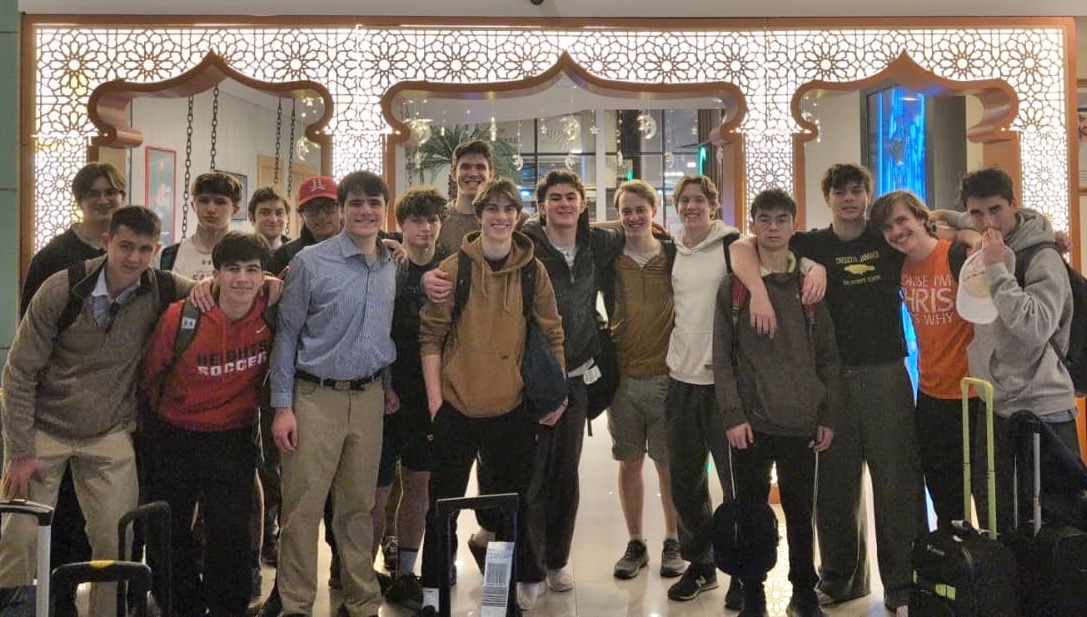
A group of high school seniors and their teacher chaperones spoke with EWTN News about being stuck in the Middle East during the beginning of hostilities there last week.

Read More
Meta blocks AI chatbot from discussing abortion with minors #Catholic Meta blocks AI chatbot from discussing abortion with minorsMeta won’t allow its AI chatbot to discuss abortion with minors, according to a report from the progressive outlet Mother Jones.Citing internal Meta documents, Mother Jones reported that Meta’s chatbot policy guidelines for interactions with minors prevent the chatbot from advising them on “content that provides advice or opinion" about "sexual health” or offering information helping them obtain an abortion.According to the report, a Meta spokesperson disputed claims of bias, saying that “any claims of enforcement based on group affiliation or advocacy are baseless” and that the company allows "posts and ads promoting health care services like abortion, as well as discussion and debate around them, as long as they follow our policies. We also give people the opportunity to appeal decisions if they think we’ve got it wrong.”When asked about the leaked documents, a company spokesperson told EWTN News: "Our AIs are trained to engage in age-appropriate discussions with teens, and to connect them with expert resources and support when appropriate." "They provide factual information on sexual health but refrain from offering advice or opinions. We continuously review and improve our protections so that teens have access to helpful information with default safeguards in place.”The Meta spokesperson also responded to advertisement censorship claims.“Every organization and individual on our platforms is subject to the same set of rules, and any claims of enforcement based on group affiliation or advocacy are baseless," the spokesperson said. United Kingdom assisted suicide bill falters as local measures advanceA national assisted suicide bill is failing to pass in the United Kingdom this week, even as local measures advance.According to a statement by the advocacy group Right to Life UK, on Feb. 26 the national bill was “widely pronounced as dead by commentators after it was revealed that it will 'almost certainly' run out of time”In Wales, the regional parliament voted on Feb. 24 in favor of the National Health Service to oversee assisted suicide if the Terminally Ill Adults Bill passes in the House of Lords.Archbishop Mark O'Toole of Cardiff-Menevia called the vote “a sad day for Wales’s most vulnerable" in a Feb. 25 statement.The island of Jersey similarly passed a law to legalize assisted suicide in a 32-to-16 vote on Feb. 26 by members of the States Assembly. The measure applies to “mentally competent” adults with terminal illnesses and who have been residents of Jersey for 12 months. Before the bill can become law, it will need royal assent.Ohio Appeals Court upholds ban on aborted baby burial requirementOhio judges on Wednesday upheld a ban on a law requiring abortion clinics to dispose of the remains of babies via burial or cremation.The appellate court in Cincinnati upheld a lower court ruling permanently blocking the law.Ohio in 2023 passed a constitutional amendment enshrining a right to abortion.Executive Director of Ohio Right to Life Carrie Snyder condemned the decision.“It’s unfortunate, but not a surprise, that the First District Court of Appeals sided with the abortion industry to stop Ohio’s fetal remains law from taking effect. Sadly, clinics will continue treating these precious little ones like garbage to be disposed of as cheaply as possible,” Snyder said in a Feb. 26 statement. “This really underscores that abortion is not health care, and that clinics are going to do everything within their power to boost their profit margin.”A Planned Parenthood spokeswoman, meanwhile, celebrated the decision, claiming the burial law was "cruel" and "nothing more than an opportunity to shame and stigmatize" women who get abortions.Texas attorney general sues mail-in abortion company for alleged illegal shipmentsTexas Attorney General Ken Paxton sued mail-in abortion company Aid Access along with California abortionist Remy Coeytaux and abortionist and founder of Aid Access Rebecca Gomperts for allegedly illegally shipping abortion drugs to Texas.Aid Access’s website advertises its shipping to all states including Texas, according to Paxton’s press release.“These unlawful shipments have had real and devastating consequences for Texas families,” the press release read. “In 2025, a Nueces County man allegedly used abortion-inducing drugs obtained from an out-of-state provider to secretly poison his girlfriend, resulting in the death of their unborn child.”“Every unborn child is a life worth protecting,” Paxton said, adding that he will “relentlessly enforce our state’s pro-life laws against Aid Access and other radicals like it.”

Meta blocks AI chatbot from discussing abortion with minors #Catholic Meta blocks AI chatbot from discussing abortion with minorsMeta won’t allow its AI chatbot to discuss abortion with minors, according to a report from the progressive outlet Mother Jones.Citing internal Meta documents, Mother Jones reported that Meta’s chatbot policy guidelines for interactions with minors prevent the chatbot from advising them on “content that provides advice or opinion" about "sexual health” or offering information helping them obtain an abortion.According to the report, a Meta spokesperson disputed claims of bias, saying that “any claims of enforcement based on group affiliation or advocacy are baseless” and that the company allows "posts and ads promoting health care services like abortion, as well as discussion and debate around them, as long as they follow our policies. We also give people the opportunity to appeal decisions if they think we’ve got it wrong.”When asked about the leaked documents, a company spokesperson told EWTN News: "Our AIs are trained to engage in age-appropriate discussions with teens, and to connect them with expert resources and support when appropriate." "They provide factual information on sexual health but refrain from offering advice or opinions. We continuously review and improve our protections so that teens have access to helpful information with default safeguards in place.”The Meta spokesperson also responded to advertisement censorship claims.“Every organization and individual on our platforms is subject to the same set of rules, and any claims of enforcement based on group affiliation or advocacy are baseless," the spokesperson said. United Kingdom assisted suicide bill falters as local measures advanceA national assisted suicide bill is failing to pass in the United Kingdom this week, even as local measures advance.According to a statement by the advocacy group Right to Life UK, on Feb. 26 the national bill was “widely pronounced as dead by commentators after it was revealed that it will 'almost certainly' run out of time”In Wales, the regional parliament voted on Feb. 24 in favor of the National Health Service to oversee assisted suicide if the Terminally Ill Adults Bill passes in the House of Lords.Archbishop Mark O'Toole of Cardiff-Menevia called the vote “a sad day for Wales’s most vulnerable" in a Feb. 25 statement.The island of Jersey similarly passed a law to legalize assisted suicide in a 32-to-16 vote on Feb. 26 by members of the States Assembly. The measure applies to “mentally competent” adults with terminal illnesses and who have been residents of Jersey for 12 months. Before the bill can become law, it will need royal assent.Ohio Appeals Court upholds ban on aborted baby burial requirementOhio judges on Wednesday upheld a ban on a law requiring abortion clinics to dispose of the remains of babies via burial or cremation.The appellate court in Cincinnati upheld a lower court ruling permanently blocking the law.Ohio in 2023 passed a constitutional amendment enshrining a right to abortion.Executive Director of Ohio Right to Life Carrie Snyder condemned the decision.“It’s unfortunate, but not a surprise, that the First District Court of Appeals sided with the abortion industry to stop Ohio’s fetal remains law from taking effect. Sadly, clinics will continue treating these precious little ones like garbage to be disposed of as cheaply as possible,” Snyder said in a Feb. 26 statement. “This really underscores that abortion is not health care, and that clinics are going to do everything within their power to boost their profit margin.”A Planned Parenthood spokeswoman, meanwhile, celebrated the decision, claiming the burial law was "cruel" and "nothing more than an opportunity to shame and stigmatize" women who get abortions.Texas attorney general sues mail-in abortion company for alleged illegal shipmentsTexas Attorney General Ken Paxton sued mail-in abortion company Aid Access along with California abortionist Remy Coeytaux and abortionist and founder of Aid Access Rebecca Gomperts for allegedly illegally shipping abortion drugs to Texas.Aid Access’s website advertises its shipping to all states including Texas, according to Paxton’s press release.“These unlawful shipments have had real and devastating consequences for Texas families,” the press release read. “In 2025, a Nueces County man allegedly used abortion-inducing drugs obtained from an out-of-state provider to secretly poison his girlfriend, resulting in the death of their unborn child.”“Every unborn child is a life worth protecting,” Paxton said, adding that he will “relentlessly enforce our state’s pro-life laws against Aid Access and other radicals like it.”

A roundup of recent pro-life and abortion-related news.

Read More