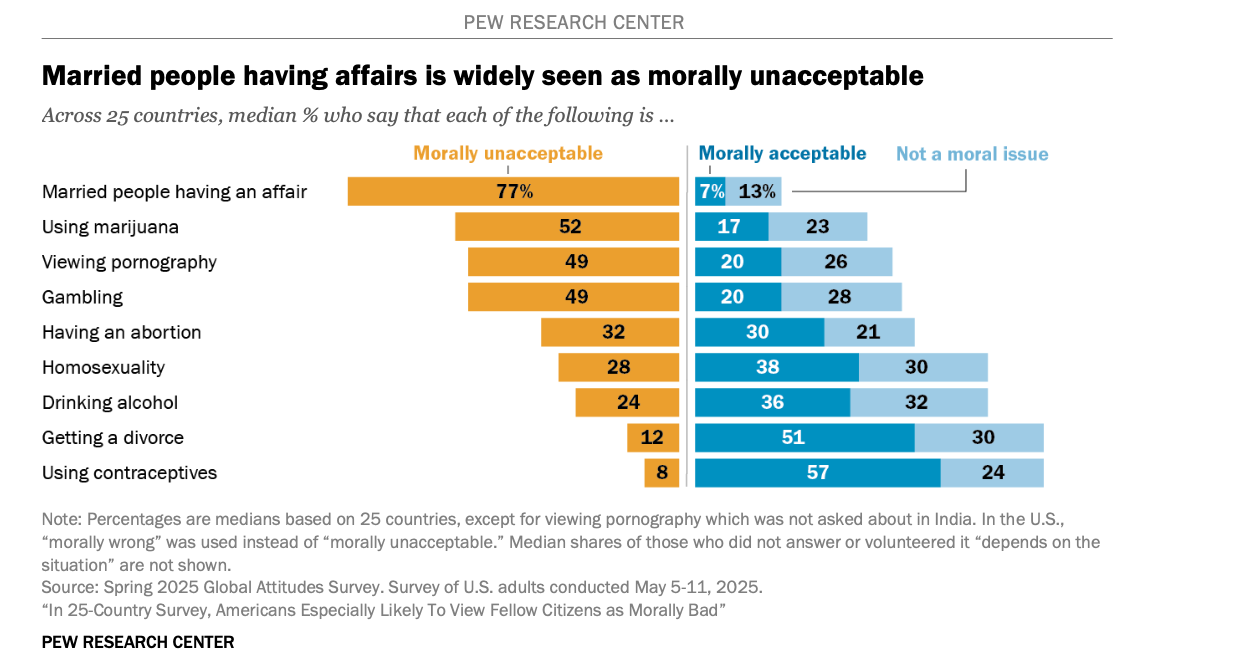
Read More Pew report examines how people rate fellow citizens’ morals #Catholic A Pew Research Center study found Americans are more likely than people in other countries to question the morality of their fellow citizens.The report, “In 25-Country Survey, Americans Especially Likely To View Fellow Citizens as Morally Bad,” explores how adults in 25 countries rate the morality of others in their nation. It also examines if people consider different behaviors to be morally wrong including drinking alcohol, gambling, having extramarital affairs, using marijuana, viewing pornography, having abortions, homosexuality, getting divorces, and using contraceptives.The research was based on data from participants in Argentina, Australia, Brazil, Canada, France, Germany, Greece, Hungary, India, Indonesia, Israel, Italy, Japan, Kenya, Mexico, Netherlands, Nigeria, Poland, South Africa, South Korea, Spain, Sweden, Turkey, the United Kingdom, and the United States.Surveys conducted outside the U.S. were based on nationally representative surveys of 28,333 adults conducted from Jan. 8 to April 26, 2025. In the U.S., Pew surveyed 3,605 adults who are members of the Center’s American Trends Panel (ATP) from March 24–30, 2025. A March 2026 Pew report, “In 25-Country Survey, Americans Especially Likely To View Fellow Citizens as Morally Bad,” explores if adults in 25 countries consider nine behaviors to be morally unacceptable or acceptable. | Credit: Courtesy of Pew Research Center The report also includes some findings from a separate ATP survey of 8,937 U.S. adults conducted from May 5–11, 2025. The margin of sampling error for the full sample of 3,605 respondents is plus or minus 1.9 percentage points.According to the research, 47% of U.S. adults reported Americans have “very good” or “somewhat good” morals and ethics, which was the lowest of all countries. The majority of adults in Canada and Indonesia (92%) said the same of the people in their countries.Most and least accepted behaviors across the globeGetting a divorce and the use of contraception were found to be the most widely accepted of the nine behaviors. Only 12% of adults overall said getting a divorce is morally wrong, and 8% said using contraceptives is. The only countries with a slight majority that believe getting a divorce is morally unacceptable are India with 65% holding this view and Nigeria with 55%.Of the nine behaviors Pew asked participants about, married people having affairs had the strongest overall disapproval. Across the 25 countries, a median of 77% of adults said married people having affairs is morally unacceptable, with at least half of adults in every country holding this view.U.S. adults were among those to be most likely to condemn extramarital affairs as immoral. Nine in 10 Americans said having an affair is morally wrong, similar to the share of people in Indonesia and in Turkey (92%) who believe the same. A March 2026 Pew report, “In 25-Country Survey, Americans Especially Likely To View Fellow Citizens as Morally Bad,” explores how adults in 25 countries rate the morality of others in their country. | Credit: Courtesy of Pew Research Center Adults in Germany (55%) and France (53%) are among the least likely to believe having an affair is morally unacceptable.Behaviors with least international consensusThe report found that for most behaviors asked about, there is not an international consensus if they are morally acceptable or not.In the Latin American and African countries surveyed, half or more of adults said they believe abortions are morally unacceptable, but in most European countries, the vast majority of adults view abortions as either morally acceptable or not a moral issue at all. In the U.S., the group was fairly split with 47% reporting it is morally unacceptable to have an abortion.In the U.S., adults are the most accepting of using marijuana and gambling. Only 23% of Americans said using marijuana is morally unacceptable, and 29% said the same in regard to gambling. In most other countries surveyed, more than 40% of adults said they consider gambling and marijuana use to be morally wrong.In 10 countries, a majority said gambling is morally wrong, including 89% in Indonesia and 71% in Italy. In Australia, 25% said gambling is morally acceptable, and 43% do not see gambling as a moral issue.In the U.S., 39% of adults reported homosexuality is morally wrong, which was found to be much more than those who hold the same belief in Germany (5%) or Sweden (5%). In other nations including Indonesia (93%) and Nigeria (96%), the majority reported it is morally wrong.In regard to drinking alcohol, the majority of adults in Indonesia (83%) reported it is a morally unacceptable act. In contrast, only 7% of adults in Australia and Sweden reported the same. In the U.S., a small share of 16% said it is morally unacceptable.What factors affect views of behaviors?According to the report, a number of factors seem to affect how adults view the morality of behaviors including political party, religion, and gender.Democrats and independents who lean toward the Democratic Party are more likely than Republicans and Republican leaners to rate fellow Americans as morally and ethically bad (60% vs. 46%).Pew examined citizens’ stances based on religious belief and found those who said religion is very important in their lives were more likely to view the behaviors as morally wrong.In 13 of the 25 countries surveyed, the research looked specifically at the differences between Protestants and Catholics. The report detailed that Protestants are typically more likely than Catholics in the same country to believe homosexuality is wrong. In the U.S., 59% of Protestants reported homosexuality is morally wrong, while 34% of Catholics did.There is a large variation between Christians in different countries. The majority of Christians surveyed in Africa, Latin America, and the U.S. said having an abortion is morally wrong, but across Europe, the share of Christians who hold this view ranges from 40% in Spain to 7% in Sweden.Gender is also a factor in how people view moral behaviors. Women tend to be more likely than men to believe some behaviors are morally unacceptable. In nearly every country surveyed, women were more likely than men to say that viewing pornography is wrong. In contrast, men were more likely than women to report homosexuality is morally unacceptable. Overall, older adults were more likely than younger adults to report the behaviors are morally unacceptable. This is the case with using marijuana in 19 of the 25 surveyed countries. In Germany, adults ages 40 and older are twice as likely as younger adults to believe marijuana use is morally wrong, with 30% of older adults holding this belief and 15% of younger adults. unitedyam March 5, 2026 U.S. adults were among those most likely to condemn extramarital affairs as immoral in a study of 25 countries. Read More

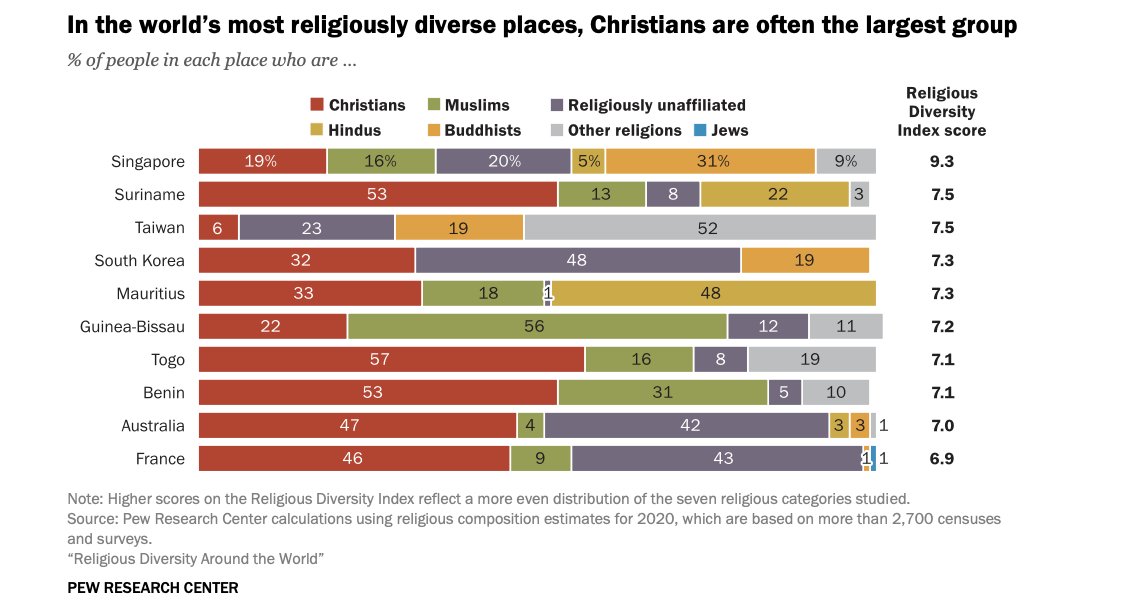
Read More Pew report finds Christians are often largest group in the world’s most religiously diverse places #Catholic The Pew Research Center released a report examining the most and least religiously diverse countries and territories across the globe.The Feb. 12 report found that the United States is not among the 10 most religiously diverse countries in the world, but when examining only the 10 most populous nations, the U.S. ranks first in religious diversity.The report, “Religious Diversity Around the World,” describes levels of religious diversity in 201 countries and territories. It measures how evenly each country’s population is distributed among seven groups including Christians, Muslims, Hindus, Buddhists, Jews, adherents of all other religions, and people with no religious affiliation.The research is part of the Pew-Templeton Global Religious Futures project, which analyzes religious change and its impact on societies around the world.Most of the analysis is from Pew’s Religious Diversity Index (RDI). Pew calculated the religious diversity of 201 areas that together are home to 99.98% of the world’s population based on the size of seven religious groups to give them scores for religious diversity. In the world’s most religiously diverse places, Christians are often the largest group, a Feb. 12, 2026, Pew Research Center report finds. | Credit: Courtesy of Pew Research Center Overall, religious diversity levels around the world did not substantially change between 2010 and 2020, as the religious composition of most countries remained fairly stable, the report said. The research found that while some places around the world have diverse populations of religious groups, it is more common for nations to primarily consist of a single religious group.In 194 countries and territories, 50% or more of the population falls into one religious category, the report said. This includes 43 places where at least 95% of the population is in the same religious group. These places are predominantly Muslim (25), Christian (17), or Buddhist (1).Most religiously diverse countriesThe research found that Singapore is the most religiously diverse country overall, while the United States ranks 32nd.In the world’s most religiously diverse places, Christians are often the largest group. Out of the 10 most religiously diverse counties overall, half have a majority Christian population, the report said.Singapore is the world’s most religiously diverse country as of 2020, with Buddhists (31%) as the largest religious group, the report said. Its population also includes substantial shares of religiously unaffiliated people (20%), Christians (19%), Muslims (16%), Hindus (5%), and adherents of all other religions (9%), the report said.Most of the other places in the top 10 are in the Asia-Pacific region or sub-Saharan Africa region including Suriname, Taiwan, South Korea, Mauritius, Guinea-Bissau, Togo, Benin, Australia, and France. A Pew Research Center report Feb. 12, 2026, identifies 10 countries where 90% of the population falls most evenly into a pair of religious categories. | Credit: Courtesy of Pew Research Center France is the only European country in the top 10 list. Its population is largely Christian (46%) and religiously unaffiliated (43%). In Suriname, another country in the top 10, about half of its residents (53%) are Christians and the rest are mainly Hindus (22%), Muslims (13%), and religiously unaffiliated people (8%). Christians are also the largest groups in Togo (57%), Benin (53%), and Australia (47%), which all fall in the top 10 most diverse places, the report said.Least religiously diverse countriesThe Middle East-North Africa region was found to be the least diverse of the regions Pew studied, with a population that is 94% Muslim. This region includes five of the world’s 10 least religiously diverse countries and territories.Eight of the least religiously diverse places have populations that are almost entirely Muslim, including Tunisia, Iraq, Western Sahara, Morocco, Iran, Somalia, Afghanistan, and Yemen, which all have a Muslim population of more than 99%, the report said.The other two countries with the least diverse scores were found to have very high majorities of Christians including Moldova and Timor-Lester, which both have populations made up of 99.5% of Christians.U.S. ranks high for religious diversity among largest nationsThe United States is not among the 10 most religiously diverse countries in the world, ranking 32nd overall. However, the U.S. is the most religiously diverse nation among the most populous countries, each of which has a population of at least 120 million. It is followed by Nigeria, Russia, India, and Brazil, the report said.Christians make up an estimated 64% of the U.S. population as of 2020, while religiously unaffiliated people account for about 30%, the report said. The remaining 6% are Muslims, Hindus, Buddhists, Jews, and people who practice other religions, the report said.The research showed the growth of religiously unaffiliated people and the decline of the Christian majority by 14% in the U.S. yielded an increase in the country’s religious diversity between 2010 and 2020.Nigeria is the second-most religiously diverse of the largely populated countries and is among the nations where 90% of the population is fairly evenly divided between two religious categories, the report said. The most populous religious groups in Nigeria are Muslims (56%) and Christians (43%), the report said.Out of the other nine countries where most of the population falls most into a pair of religious categories, seven include Christianity among the two religious groups. Eritrea, Bosnia-Herzegovina, Uruguay, Estonia, Chad, Ivory Coast, and Ethiopia, all include Christianity and one other group as their top religious groups as of 2020, the report said.Pakistan was found to be the least religiously diverse among the most populous countries, with Muslims making up a high majority (97%) of its residents. unitedyam February 12, 2026 Among the most populous nations, the U.S. ranks first in religious diversity. Singapore is the most religiously diverse country overall, and the U.S. ranks 32nd. Read More