Trump Administration

Priest walks from Illinois to New York against ‘inhumane’ immigration enforcement #Catholic 
 
 Father Gary Graf walks down a rural road during his trek across America in support of immigrants on Friday, Oct. 17, 2025. / Credit: Photo courtesy of Father Gary Graf

CNA Staff, Nov 24, 2025 / 06:00 am (CNA).
After a month and a half of walking an average of 17 miles a day, 67-year-old Father Gary Graf said he is starting to get “a little pain in one shin,” but his broken ribs are “getting much better.”On Oct. 6, Graf, a Catholic priest from Chicago, began a journey on foot from Pope Leo XIV’s childhood home in Dolton, Illinois, to New York City to bring attention to the plight of immigrants amid the sometimes “inhumane” ways the Trump administration is treating them during its immigration enforcement actions.He hopes to arrive at the Statue of Liberty on Ellis Island, where his own great-grandparents entered the country as immigrants, by Dec. 2.Father Gary Graf speaks to a fellow American at Red Horse Tavern in Pleasant Gap, Pennsylvania, Tuesday, Nov. 11, 2025. Credit: Photo courtesy of Father Gary GrafA few weeks ago, when visiting a parish in Indiana, he was invited to ride a horse. He fell off as it galloped and broke several ribs, which led him to take one day off to recover. That day, friends walked in his stead.Graf, the pastor of the mostly Hispanic Our Lady of the Heights Catholic Church in Chicago Heights and a longtime member of Priests for Justice for Immigrants, has committed his life to helping immigrants. Ordained in 1984, he spent five years as a priest in Mexico serving a people “with whom I fell deeply in love.”He told CNA that after initially feeling helpless watching the raids taking place against his beloved community in his hometown of Chicago, he “felt a call that was directly from above” to start walking.Father Gary Graf poses before a sunrise near Fremont, Ohio, Tuesday, Oct. 21, 2025. Credit: Photo courtesy of Father Gary GrafWithin weeks, he was on the road. He first spoke to an old friend about his idea, who immediately connected him with Lauren Foley, the head of a public relations firm. She “immediately embraced the idea,” and between her help and that of some “young people who understand social media,” a website as well as social media accounts were set up to chronicle his journey and to share the stories of immigrant families.Of the immigrants on whose behalf he is walking, Graf said: “I look to help people who get up every single morning to work and raise their families. If I can do this small gesture on their behalf, what a blessing it is, what a privilege.”Asked about the most profound insight he has gained thus far, Graf said his long days walking through the wide expanse of rural America have helped him understand better the ways of people who did not grow up in a multicultural city like he did.“We have to reverently appreciate and try to connect with those whose lives we’re passing through,” he said.As he has spoken with people in diners along his path, Graf has developed “a greater sensitivity,” discovering that “there’s not a lot of animosity against the immigrant.”Many of the people he has met simply do not know any, he said.Along the way, he has also experienced unity with Christians from other denominations, as well as with those without religious faith, who all care about the humane treatment of human beings.“I have seen so much goodness,” he said. “This has brought so many of us together: people from many different faith traditions, or none. This is an opportunity given to us.”During his quiet walks through rural farmland, he has marveled at the amount of labor it took to build the many roads, bridges, and overpasses he has seen. “I’m sure the hands of many immigrants helped build these things,” he reflected.Graf said he is delighted that both the U.S. Conference of Catholic Bishops and Pope Leo XIV addressed the immigration enforcement situation in the past week. The U.S. bishops issued a special message during its Fall Plenary Assembly two weeks ago, calling for “a meaningful reform of our nation’s immigration laws and procedures.” The bishops argued that “human dignity and national security are not in conflict. Both are possible if people of goodwill work together.”The pope echoed the bishops’ message. On Nov. 18, he acknowledged to reporters that “every country has a right to determine who and how and when people enter.”“But when people are living good lives, and many of them for 10, 15, 20 years, to treat them in a way that is extremely disrespectful, to say the least — and there’s been some violence, unfortunately — I think that the bishops have been very clear in what they said.”“I think that I would just invite all people in the United States to listen to them,” the pope said. “Both the pope and the bishops used the word ‘indiscriminate’ to talk about the way people are being singled out and aggressively having their wrists zip-tied behind their backs as their faces are pushed to the ground in front of their children,” Graf said. “It is indeed indiscriminate. This reflects dishonesty on the administration’s part,” he said. “They said they were going after the ‘worst of the worst,’ criminals, but this isn’t the case, at least in Chicago. They’re grabbing people first and asking questions later.”“The violent way many of these people are being treated is amoral and un-American,” he said.Like the pope and the American bishops, Graf said he hopes the federal government will establish a more humane immigration system that respects the dignity of immigrants as well as the rule of law and the country’s right to regulate its borders.“I am not a politician,” he said. “My job is to mediate, to speak up, in God’s name, in the united name of the Church. But can we look for a way for those who are fulfilling their responsibilities; for them to one day receive the rights of citizens?” The priest, who appeared on “EWTN News Nightly” in October, said he has been “impressed by the media” and is grateful his message is being spread. “If we don’t hear the whole truth, the incredible ignorance and darkness we live in can paralyze us, and keep us from doing what we ought to do,” he said.

Priest walks from Illinois to New York against ‘inhumane’ immigration enforcement #Catholic Father Gary Graf walks down a rural road during his trek across America in support of immigrants on Friday, Oct. 17, 2025. / Credit: Photo courtesy of Father Gary Graf CNA Staff, Nov 24, 2025 / 06:00 am (CNA). After a month and a half of walking an average of 17 miles a day, 67-year-old Father Gary Graf said he is starting to get “a little pain in one shin,” but his broken ribs are “getting much better.”On Oct. 6, Graf, a Catholic priest from Chicago, began a journey on foot from Pope Leo XIV’s childhood home in Dolton, Illinois, to New York City to bring attention to the plight of immigrants amid the sometimes “inhumane” ways the Trump administration is treating them during its immigration enforcement actions.He hopes to arrive at the Statue of Liberty on Ellis Island, where his own great-grandparents entered the country as immigrants, by Dec. 2.Father Gary Graf speaks to a fellow American at Red Horse Tavern in Pleasant Gap, Pennsylvania, Tuesday, Nov. 11, 2025. Credit: Photo courtesy of Father Gary GrafA few weeks ago, when visiting a parish in Indiana, he was invited to ride a horse. He fell off as it galloped and broke several ribs, which led him to take one day off to recover. That day, friends walked in his stead.Graf, the pastor of the mostly Hispanic Our Lady of the Heights Catholic Church in Chicago Heights and a longtime member of Priests for Justice for Immigrants, has committed his life to helping immigrants. Ordained in 1984, he spent five years as a priest in Mexico serving a people “with whom I fell deeply in love.”He told CNA that after initially feeling helpless watching the raids taking place against his beloved community in his hometown of Chicago, he “felt a call that was directly from above” to start walking.Father Gary Graf poses before a sunrise near Fremont, Ohio, Tuesday, Oct. 21, 2025. Credit: Photo courtesy of Father Gary GrafWithin weeks, he was on the road. He first spoke to an old friend about his idea, who immediately connected him with Lauren Foley, the head of a public relations firm. She “immediately embraced the idea,” and between her help and that of some “young people who understand social media,” a website as well as social media accounts were set up to chronicle his journey and to share the stories of immigrant families.Of the immigrants on whose behalf he is walking, Graf said: “I look to help people who get up every single morning to work and raise their families. If I can do this small gesture on their behalf, what a blessing it is, what a privilege.”Asked about the most profound insight he has gained thus far, Graf said his long days walking through the wide expanse of rural America have helped him understand better the ways of people who did not grow up in a multicultural city like he did.“We have to reverently appreciate and try to connect with those whose lives we’re passing through,” he said.As he has spoken with people in diners along his path, Graf has developed “a greater sensitivity,” discovering that “there’s not a lot of animosity against the immigrant.”Many of the people he has met simply do not know any, he said.Along the way, he has also experienced unity with Christians from other denominations, as well as with those without religious faith, who all care about the humane treatment of human beings.“I have seen so much goodness,” he said. “This has brought so many of us together: people from many different faith traditions, or none. This is an opportunity given to us.”During his quiet walks through rural farmland, he has marveled at the amount of labor it took to build the many roads, bridges, and overpasses he has seen. “I’m sure the hands of many immigrants helped build these things,” he reflected.Graf said he is delighted that both the U.S. Conference of Catholic Bishops and Pope Leo XIV addressed the immigration enforcement situation in the past week. The U.S. bishops issued a special message during its Fall Plenary Assembly two weeks ago, calling for “a meaningful reform of our nation’s immigration laws and procedures.” The bishops argued that “human dignity and national security are not in conflict. Both are possible if people of goodwill work together.”The pope echoed the bishops’ message. On Nov. 18, he acknowledged to reporters that “every country has a right to determine who and how and when people enter.”“But when people are living good lives, and many of them for 10, 15, 20 years, to treat them in a way that is extremely disrespectful, to say the least — and there’s been some violence, unfortunately — I think that the bishops have been very clear in what they said.”“I think that I would just invite all people in the United States to listen to them,” the pope said. “Both the pope and the bishops used the word ‘indiscriminate’ to talk about the way people are being singled out and aggressively having their wrists zip-tied behind their backs as their faces are pushed to the ground in front of their children,” Graf said. “It is indeed indiscriminate. This reflects dishonesty on the administration’s part,” he said. “They said they were going after the ‘worst of the worst,’ criminals, but this isn’t the case, at least in Chicago. They’re grabbing people first and asking questions later.”“The violent way many of these people are being treated is amoral and un-American,” he said.Like the pope and the American bishops, Graf said he hopes the federal government will establish a more humane immigration system that respects the dignity of immigrants as well as the rule of law and the country’s right to regulate its borders.“I am not a politician,” he said. “My job is to mediate, to speak up, in God’s name, in the united name of the Church. But can we look for a way for those who are fulfilling their responsibilities; for them to one day receive the rights of citizens?” The priest, who appeared on “EWTN News Nightly” in October, said he has been “impressed by the media” and is grateful his message is being spread. “If we don’t hear the whole truth, the incredible ignorance and darkness we live in can paralyze us, and keep us from doing what we ought to do,” he said.


Father Gary Graf walks down a rural road during his trek across America in support of immigrants on Friday, Oct. 17, 2025. / Credit: Photo courtesy of Father Gary Graf

CNA Staff, Nov 24, 2025 / 06:00 am (CNA).

After a month and a half of walking an average of 17 miles a day, 67-year-old Father Gary Graf said he is starting to get “a little pain in one shin,” but his broken ribs are “getting much better.”

On Oct. 6, Graf, a Catholic priest from Chicago, began a journey on foot from Pope Leo XIV’s childhood home in Dolton, Illinois, to New York City to bring attention to the plight of immigrants amid the sometimes “inhumane” ways the Trump administration is treating them during its immigration enforcement actions.

He hopes to arrive at the Statue of Liberty on Ellis Island, where his own great-grandparents entered the country as immigrants, by Dec. 2.

Father Gary Graf speaks to a fellow American at Red Horse Tavern in Pleasant Gap, Pennsylvania, Tuesday, Nov. 11, 2025. Credit: Photo courtesy of Father Gary Graf

A few weeks ago, when visiting a parish in Indiana, he was invited to ride a horse. He fell off as it galloped and broke several ribs, which led him to take one day off to recover. That day, friends walked in his stead.

Graf, the pastor of the mostly Hispanic Our Lady of the Heights Catholic Church in Chicago Heights and a longtime member of Priests for Justice for Immigrants, has committed his life to helping immigrants. Ordained in 1984, he spent five years as a priest in Mexico serving a people “with whom I fell deeply in love.”

He told CNA that after initially feeling helpless watching the raids taking place against his beloved community in his hometown of Chicago, he “felt a call that was directly from above” to start walking.

Father Gary Graf poses before a sunrise near Fremont, Ohio, Tuesday, Oct. 21, 2025. Credit: Photo courtesy of Father Gary Graf

Within weeks, he was on the road. He first spoke to an old friend about his idea, who immediately connected him with Lauren Foley, the head of a public relations firm. She “immediately embraced the idea,” and between her help and that of some “young people who understand social media,” a website as well as social media accounts were set up to chronicle his journey and to share the stories of immigrant families.

Of the immigrants on whose behalf he is walking, Graf said: “I look to help people who get up every single morning to work and raise their families. If I can do this small gesture on their behalf, what a blessing it is, what a privilege.”

Asked about the most profound insight he has gained thus far, Graf said his long days walking through the wide expanse of rural America have helped him understand better the ways of people who did not grow up in a multicultural city like he did.

“We have to reverently appreciate and try to connect with those whose lives we’re passing through,” he said.

As he has spoken with people in diners along his path, Graf has developed “a greater sensitivity,” discovering that “there’s not a lot of animosity against the immigrant.”

Many of the people he has met simply do not know any, he said.

Along the way, he has also experienced unity with Christians from other denominations, as well as with those without religious faith, who all care about the humane treatment of human beings.

“I have seen so much goodness,” he said. “This has brought so many of us together: people from many different faith traditions, or none. This is an opportunity given to us.”

During his quiet walks through rural farmland, he has marveled at the amount of labor it took to build the many roads, bridges, and overpasses he has seen. 

“I’m sure the hands of many immigrants helped build these things,” he reflected.

Graf said he is delighted that both the U.S. Conference of Catholic Bishops and Pope Leo XIV addressed the immigration enforcement situation in the past week. 

The U.S. bishops issued a special message during its Fall Plenary Assembly two weeks ago, calling for “a meaningful reform of our nation’s immigration laws and procedures.” The bishops argued that “human dignity and national security are not in conflict. Both are possible if people of goodwill work together.”

The pope echoed the bishops’ message. On Nov. 18, he acknowledged to reporters that “every country has a right to determine who and how and when people enter.”

“But when people are living good lives, and many of them for 10, 15, 20 years, to treat them in a way that is extremely disrespectful, to say the least — and there’s been some violence, unfortunately — I think that the bishops have been very clear in what they said.”

“I think that I would just invite all people in the United States to listen to them,” the pope said. 

“Both the pope and the bishops used the word ‘indiscriminate’ to talk about the way people are being singled out and aggressively having their wrists zip-tied behind their backs as their faces are pushed to the ground in front of their children,” Graf said. 

“It is indeed indiscriminate. This reflects dishonesty on the administration’s part,” he said. “They said they were going after the ‘worst of the worst,’ criminals, but this isn’t the case, at least in Chicago. They’re grabbing people first and asking questions later.”

“The violent way many of these people are being treated is amoral and un-American,” he said.

Like the pope and the American bishops, Graf said he hopes the federal government will establish a more humane immigration system that respects the dignity of immigrants as well as the rule of law and the country’s right to regulate its borders.

“I am not a politician,” he said. “My job is to mediate, to speak up, in God’s name, in the united name of the Church. But can we look for a way for those who are fulfilling their responsibilities; for them to one day receive the rights of citizens?” 

The priest, who appeared on “EWTN News Nightly” in October, said he has been “impressed by the media” and is grateful his message is being spread. 

“If we don’t hear the whole truth, the incredible ignorance and darkness we live in can paralyze us, and keep us from doing what we ought to do,” he said.

Read More
Trump signs executive order prioritizing faith-based participation in foster care #Catholic 
 
 President Donald Trump signs an executive order related to foster care and foster parents on Nov. 13, 2025. / Credit: Alliance Defending Freedom

CNA Staff, Nov 15, 2025 / 10:00 am (CNA).
U.S. President Donald Trump signed an executive order Thursday that aims to improve the nation’s foster care system, including the modernization of the current child welfare system, the development of partnerships with private sector organizations, and prioritizing the participation of those with sincerely held religious beliefs.The executive order issued Nov. 13 states that the Trump administration is “dedicated to empowering mothers and fathers to raise their children in safe and loving homes.”The order says current problems with the foster care system include overworked caseworkers, antiquated information systems, and policies that “prohibit qualified families from serving children in need as foster and adoptive parents because of their sincerely-held religious beliefs or adherence to basic biological truths.”The legal group Alliance Defending Freedom (ADF) has represented Christian families who were barred from serving as foster parents because of their faith, suing on behalf of Brian and Katy Wuoti and Bryan and Rebecca Gantt after the Vermont Department for Children and Families informed the two families that their belief that persons cannot change biological sex and that marriage is only between a man and a woman precluded them from serving as foster parents in the state.Despite describing the Wuotis and the Gantts as “amazing,” “wonderful,” and “welcoming,” state officials revoked the couples’ foster care licenses after they expressed those beliefs. The state said these beliefs made them “unqualified” to parent any child, regardless of the child’s age, beliefs, or identity. ADF Senior Counsel Johannes Widmalm-Delphonse, who represents the Wuotis, Gantts, and other Christian families who are prohibited from fostering in lawsuits in Massachusetts, Oregon, Vermont, and Washington, told CNA that he hopes the executive order will lead to the states “prioritizing the best interests of children rather than ideological agendas.”In the face of shortages of foster families, he said the states should be “pursuing a big tent, welcoming as many loving families as possible. But they’re doing the opposite while children who need foster care are sleeping in unlicensed  group homes, police stations, and hospitals.” Trump’s executive order directs the department of Health and Human Services, the White House Faith Office, and the Office of Intergovernmental Affairs to “take appropriate action to address state and local policies and practices that inappropriately prohibit participation in federally-funded child-welfare programs by qualified individuals or organizations based upon their sincerely-held religious beliefs or moral convictions.” It also directs those agencies to “increase partnerships between agencies and faith-based organizations and houses of worship to serve families” involved with the foster care system. Widmalm-Delphonse told CNA it is “difficult to say how the states will respond” to the executive order, indicating that he hopes either the order or the pending lawsuits will lead to changes in their “discriminatory” policies against families of faith.  “The path the states should take is obvious: It’s a win-win when you open up foster care to people of faith and put the interests of children first,” he said.

Trump signs executive order prioritizing faith-based participation in foster care #Catholic President Donald Trump signs an executive order related to foster care and foster parents on Nov. 13, 2025. / Credit: Alliance Defending Freedom CNA Staff, Nov 15, 2025 / 10:00 am (CNA). U.S. President Donald Trump signed an executive order Thursday that aims to improve the nation’s foster care system, including the modernization of the current child welfare system, the development of partnerships with private sector organizations, and prioritizing the participation of those with sincerely held religious beliefs.The executive order issued Nov. 13 states that the Trump administration is “dedicated to empowering mothers and fathers to raise their children in safe and loving homes.”The order says current problems with the foster care system include overworked caseworkers, antiquated information systems, and policies that “prohibit qualified families from serving children in need as foster and adoptive parents because of their sincerely-held religious beliefs or adherence to basic biological truths.”The legal group Alliance Defending Freedom (ADF) has represented Christian families who were barred from serving as foster parents because of their faith, suing on behalf of Brian and Katy Wuoti and Bryan and Rebecca Gantt after the Vermont Department for Children and Families informed the two families that their belief that persons cannot change biological sex and that marriage is only between a man and a woman precluded them from serving as foster parents in the state.Despite describing the Wuotis and the Gantts as “amazing,” “wonderful,” and “welcoming,” state officials revoked the couples’ foster care licenses after they expressed those beliefs. The state said these beliefs made them “unqualified” to parent any child, regardless of the child’s age, beliefs, or identity. ADF Senior Counsel Johannes Widmalm-Delphonse, who represents the Wuotis, Gantts, and other Christian families who are prohibited from fostering in lawsuits in Massachusetts, Oregon, Vermont, and Washington, told CNA that he hopes the executive order will lead to the states “prioritizing the best interests of children rather than ideological agendas.”In the face of shortages of foster families, he said the states should be “pursuing a big tent, welcoming as many loving families as possible. But they’re doing the opposite while children who need foster care are sleeping in unlicensed  group homes, police stations, and hospitals.” Trump’s executive order directs the department of Health and Human Services, the White House Faith Office, and the Office of Intergovernmental Affairs to “take appropriate action to address state and local policies and practices that inappropriately prohibit participation in federally-funded child-welfare programs by qualified individuals or organizations based upon their sincerely-held religious beliefs or moral convictions.” It also directs those agencies to “increase partnerships between agencies and faith-based organizations and houses of worship to serve families” involved with the foster care system. Widmalm-Delphonse told CNA it is “difficult to say how the states will respond” to the executive order, indicating that he hopes either the order or the pending lawsuits will lead to changes in their “discriminatory” policies against families of faith.  “The path the states should take is obvious: It’s a win-win when you open up foster care to people of faith and put the interests of children first,” he said.


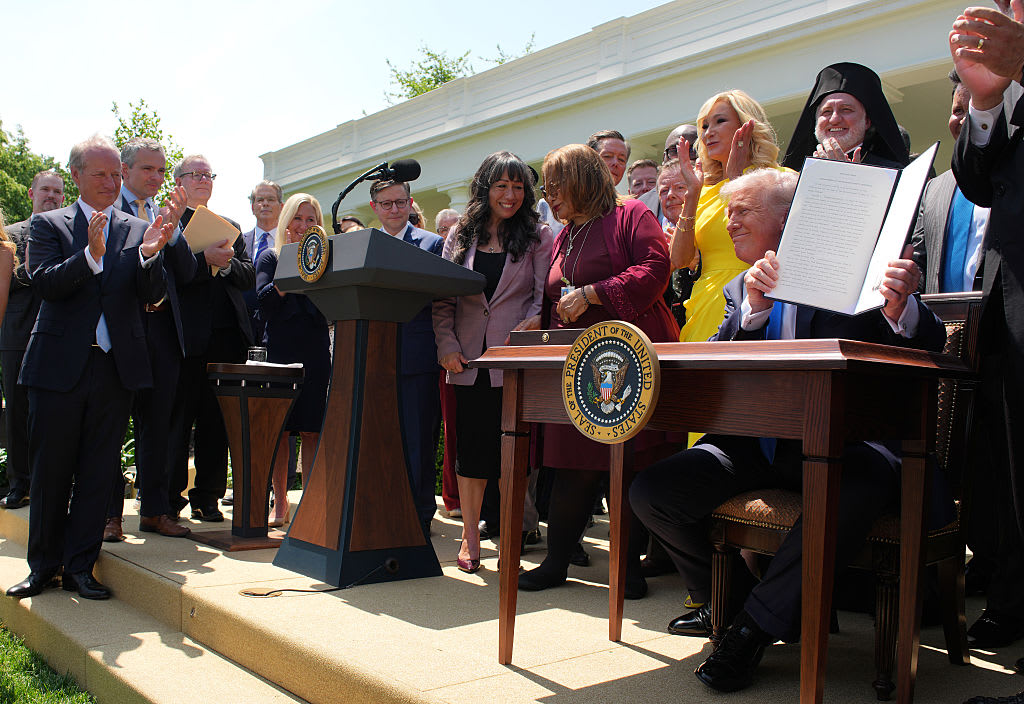
President Donald Trump signs an executive order related to foster care and foster parents on Nov. 13, 2025. / Credit: Alliance Defending Freedom

CNA Staff, Nov 15, 2025 / 10:00 am (CNA).

U.S. President Donald Trump signed an executive order Thursday that aims to improve the nation’s foster care system, including the modernization of the current child welfare system, the development of partnerships with private sector organizations, and prioritizing the participation of those with sincerely held religious beliefs.

The executive order issued Nov. 13 states that the Trump administration is “dedicated to empowering mothers and fathers to raise their children in safe and loving homes.”

The order says current problems with the foster care system include overworked caseworkers, antiquated information systems, and policies that “prohibit qualified families from serving children in need as foster and adoptive parents because of their sincerely-held religious beliefs or adherence to basic biological truths.”

The legal group Alliance Defending Freedom (ADF) has represented Christian families who were barred from serving as foster parents because of their faith, suing on behalf of Brian and Katy Wuoti and Bryan and Rebecca Gantt after the Vermont Department for Children and Families informed the two families that their belief that persons cannot change biological sex and that marriage is only between a man and a woman precluded them from serving as foster parents in the state.

Despite describing the Wuotis and the Gantts as “amazing,” “wonderful,” and “welcoming,” state officials revoked the couples’ foster care licenses after they expressed those beliefs. The state said these beliefs made them “unqualified” to parent any child, regardless of the child’s age, beliefs, or identity. 

ADF Senior Counsel Johannes Widmalm-Delphonse, who represents the Wuotis, Gantts, and other Christian families who are prohibited from fostering in lawsuits in Massachusetts, Oregon, Vermont, and Washington, told CNA that he hopes the executive order will lead to the states “prioritizing the best interests of children rather than ideological agendas.”

In the face of shortages of foster families, he said the states should be “pursuing a big tent, welcoming as many loving families as possible. But they’re doing the opposite while children who need foster care are sleeping in unlicensed  group homes, police stations, and hospitals.” 

Trump’s executive order directs the department of Health and Human Services, the White House Faith Office, and the Office of Intergovernmental Affairs to “take appropriate action to address state and local policies and practices that inappropriately prohibit participation in federally-funded child-welfare programs by qualified individuals or organizations based upon their sincerely-held religious beliefs or moral convictions.” 

It also directs those agencies to “increase partnerships between agencies and faith-based organizations and houses of worship to serve families” involved with the foster care system. 

Widmalm-Delphonse told CNA it is “difficult to say how the states will respond” to the executive order, indicating that he hopes either the order or the pending lawsuits will lead to changes in their “discriminatory” policies against families of faith.  

“The path the states should take is obvious: It’s a win-win when you open up foster care to people of faith and put the interests of children first,” he said.

Read More
CatholicVote report examines moral implications of immigration enforcement #Catholic 
 
 A person detained is taken to a parking lot on the far north side of the city before being transferred to an Immigration and Customs Enforcement facility in Chicago on Oct. 31, 2025. / Credit: Jamie Kelter Davis/Getty Images

Washington, D.C. Newsroom, Nov 13, 2025 / 18:26 pm (CNA).
The Catholic advocacy organization CatholicVote has released a report examining the Trump administration’s immigration enforcement efforts, concluding Christians must balance charity toward the immigrant with the common good of the receiving state.The report, titled “Immigration Enforcement and the Christian Conscience,” comes on the heels of the special message on immigration released by the U.S. Conference of Catholic Bishops (USCCB) at its fall plenary meeting this past week. “A faithful Catholic approach to immigration begins not with politics but with people. Compassion, hospitality, and solidarity with the poor are not optional virtues,” CatholicVote President and CEO Kelsey Reinhardt said in a press release accompanying the report. “They are at the center of the Gospel,” she added. “Yet, mercy and justice travel together. One without the other distorts both.”The report by author Benjamin Mann labels the Biden administration’s border policies as “reckless” and credits them for resulting in human trafficking, sexual exploitation of immigrants without legal status, and rampant drug cartels. “Catholics who advocate strong but humane immigration enforcement are sometimes accused of disobeying their bishops or the pope, and even violating Church teaching,” the report states. “Properly speaking, there is no such thing as an official ‘Catholic position’ on the practical details of immigration policy.”The report says that “despite what some Church leaders in America have indicated, a faithful Catholic can support strong and humane immigration law enforcement — by means such as physical barriers, detention, and deportation — without violating the teaching of the Church.” The report asserts that Catholic teaching on immigration has been distorted by “an ideological immigration lobby” within the Church that “has sought to present amnesty, minimal law enforcement, and more legal immigration as the only acceptable position for Catholics.” “This is not an act of disobedience or disrespect toward the Church hierarchy but a legitimate difference of opinion according to magisterial teaching,” the report says. “The truth is that faithful Catholics can certainly disagree with the anti-enforcement position — even if some bishops happen to share the policy preferences of these activists. Such disagreement is not a dissent from Church teaching,” the document continues, citing “recent popes” as having said the Catholic Church “has no ‘official position’ on the practical details of issues like immigration policy.” “Rather, our faith teaches a set of broad moral principles about immigration, and their application in public life is a matter of practical judgment for laypersons,” the report said.The CatholicVote document further argues that “it is actually immoral in the eyes of the Church for a country to accept immigrants to the detriment of its own citizens,” citing paragraph 1903 of the Catechism of the Catholic Church, which states: “Authority is exercised legitimately only when it seeks the common good of the group concerned and if it employs morally licit means to attain it. If rulers were to enact unjust laws or take measures contrary to the moral order, such arrangements would not be binding in conscience. In such a case, ‘authority breaks down completely and results in shameful abuse.’”

CatholicVote report examines moral implications of immigration enforcement #Catholic A person detained is taken to a parking lot on the far north side of the city before being transferred to an Immigration and Customs Enforcement facility in Chicago on Oct. 31, 2025. / Credit: Jamie Kelter Davis/Getty Images Washington, D.C. Newsroom, Nov 13, 2025 / 18:26 pm (CNA). The Catholic advocacy organization CatholicVote has released a report examining the Trump administration’s immigration enforcement efforts, concluding Christians must balance charity toward the immigrant with the common good of the receiving state.The report, titled “Immigration Enforcement and the Christian Conscience,” comes on the heels of the special message on immigration released by the U.S. Conference of Catholic Bishops (USCCB) at its fall plenary meeting this past week. “A faithful Catholic approach to immigration begins not with politics but with people. Compassion, hospitality, and solidarity with the poor are not optional virtues,” CatholicVote President and CEO Kelsey Reinhardt said in a press release accompanying the report. “They are at the center of the Gospel,” she added. “Yet, mercy and justice travel together. One without the other distorts both.”The report by author Benjamin Mann labels the Biden administration’s border policies as “reckless” and credits them for resulting in human trafficking, sexual exploitation of immigrants without legal status, and rampant drug cartels. “Catholics who advocate strong but humane immigration enforcement are sometimes accused of disobeying their bishops or the pope, and even violating Church teaching,” the report states. “Properly speaking, there is no such thing as an official ‘Catholic position’ on the practical details of immigration policy.”The report says that “despite what some Church leaders in America have indicated, a faithful Catholic can support strong and humane immigration law enforcement — by means such as physical barriers, detention, and deportation — without violating the teaching of the Church.” The report asserts that Catholic teaching on immigration has been distorted by “an ideological immigration lobby” within the Church that “has sought to present amnesty, minimal law enforcement, and more legal immigration as the only acceptable position for Catholics.” “This is not an act of disobedience or disrespect toward the Church hierarchy but a legitimate difference of opinion according to magisterial teaching,” the report says. “The truth is that faithful Catholics can certainly disagree with the anti-enforcement position — even if some bishops happen to share the policy preferences of these activists. Such disagreement is not a dissent from Church teaching,” the document continues, citing “recent popes” as having said the Catholic Church “has no ‘official position’ on the practical details of issues like immigration policy.” “Rather, our faith teaches a set of broad moral principles about immigration, and their application in public life is a matter of practical judgment for laypersons,” the report said.The CatholicVote document further argues that “it is actually immoral in the eyes of the Church for a country to accept immigrants to the detriment of its own citizens,” citing paragraph 1903 of the Catechism of the Catholic Church, which states: “Authority is exercised legitimately only when it seeks the common good of the group concerned and if it employs morally licit means to attain it. If rulers were to enact unjust laws or take measures contrary to the moral order, such arrangements would not be binding in conscience. In such a case, ‘authority breaks down completely and results in shameful abuse.’”


A person detained is taken to a parking lot on the far north side of the city before being transferred to an Immigration and Customs Enforcement facility in Chicago on Oct. 31, 2025. / Credit: Jamie Kelter Davis/Getty Images

Washington, D.C. Newsroom, Nov 13, 2025 / 18:26 pm (CNA).

The Catholic advocacy organization CatholicVote has released a report examining the Trump administration’s immigration enforcement efforts, concluding Christians must balance charity toward the immigrant with the common good of the receiving state.

The report, titled “Immigration Enforcement and the Christian Conscience,” comes on the heels of the special message on immigration released by the U.S. Conference of Catholic Bishops (USCCB) at its fall plenary meeting this past week. 

“A faithful Catholic approach to immigration begins not with politics but with people. Compassion, hospitality, and solidarity with the poor are not optional virtues,” CatholicVote President and CEO Kelsey Reinhardt said in a press release accompanying the report.

“They are at the center of the Gospel,” she added. “Yet, mercy and justice travel together. One without the other distorts both.”

The report by author Benjamin Mann labels the Biden administration’s border policies as “reckless” and credits them for resulting in human trafficking, sexual exploitation of immigrants without legal status, and rampant drug cartels. 

“Catholics who advocate strong but humane immigration enforcement are sometimes accused of disobeying their bishops or the pope, and even violating Church teaching,” the report states. “Properly speaking, there is no such thing as an official ‘Catholic position’ on the practical details of immigration policy.”

The report says that “despite what some Church leaders in America have indicated, a faithful Catholic can support strong and humane immigration law enforcement — by means such as physical barriers, detention, and deportation — without violating the teaching of the Church.” 

The report asserts that Catholic teaching on immigration has been distorted by “an ideological immigration lobby” within the Church that “has sought to present amnesty, minimal law enforcement, and more legal immigration as the only acceptable position for Catholics.” 

“This is not an act of disobedience or disrespect toward the Church hierarchy but a legitimate difference of opinion according to magisterial teaching,” the report says. 

“The truth is that faithful Catholics can certainly disagree with the anti-enforcement position — even if some bishops happen to share the policy preferences of these activists. Such disagreement is not a dissent from Church teaching,” the document continues, citing “recent popes” as having said the Catholic Church “has no ‘official position’ on the practical details of issues like immigration policy.” 

“Rather, our faith teaches a set of broad moral principles about immigration, and their application in public life is a matter of practical judgment for laypersons,” the report said.

The CatholicVote document further argues that “it is actually immoral in the eyes of the Church for a country to accept immigrants to the detriment of its own citizens,” citing paragraph 1903 of the Catechism of the Catholic Church, which states: “Authority is exercised legitimately only when it seeks the common good of the group concerned and if it employs morally licit means to attain it. If rulers were to enact unjust laws or take measures contrary to the moral order, such arrangements would not be binding in conscience. In such a case, ‘authority breaks down completely and results in shameful abuse.’”

Read More
DHS blasts order for improvements to migrant facility, says it houses ‘worst of the worst’ #Catholic 
 
 Auxiliary Bishop Jose María García-Maldonado attempts to visit detainees at the Broadview, Illinois, immigration facility and was not admitted Nov. 1, 2025. / Credit: Bryan Sebastian, courtesy of Coalition for Spiritual and Public Leadership

Washington, D.C., Nov 7, 2025 / 18:40 pm (CNA).
The Trump administration this week denounced a Chicago-based federal judge’s ruling that mandated cleanliness and hygiene standards as well as adequate legal representation at a U.S. Immigration and Customs Enforcement (ICE) facility in Illinois.Government lawyers said Nov. 7 they are in compliance or are in the midst of complying with the judge’s conditions. The detainees’ attorneys, however, say they “are doubtful” the government is “actually in compliance” with some of the conditions, “including as to facility cleaning, the provision of food and water, and the provision of prescription medication.” The detainees’ attorneys asked the court to conduct an inspection with an expert and have the government provide immediate proof of compliance.Administration officials said an “activist judge” issued the temporary restraining order and based it on hoaxes, while religious and civil-rights advocates pressed for detainees’ access to the Eucharist. Access to CommunionA group of 19 spiritual leaders including six priests renewed a request to offer pastoral care and Communion at the Broadview facility in a Nov. 6 letter to ICE and asked to discuss “procedures by which our small delegation of religious ministers can be granted access.” The delegation bringing Communion was denied access Nov. 1.Scene from Nov. 1, 2025, Mass outside the Broadview facility near Chicago where immigration advocates allege federal authorities inhumanely treat detainees. Credit: Bryan Sebastian, courtesy of Coalition for Spiritual and Public LeadershipThe judge’s temporary restraining order followed an Oct. 30 lawsuit in which detainees claimed they were placed in unsanitary conditions, provided inadequate food and water, and unconstitutionally deprived of access to legal representation and spiritual care. The Department of Homeland Security (DHS) said ICE’s Broadview facility houses “criminal illegal aliens” whom it described as “some of the worst of the worst.”“Some of the worst of the worst including pedophiles, gang members, and rapists have been processed through the facility in recent weeks,” Tricia McLaughlin, assistant Homeland Security secretary for public affairs, said in a Nov. 5 statement.The list included Jose Manuel Escobar-Cardona, described by DHS as “a criminal illegal alien” from Honduras who was convicted of multiple charges of lewd or lascivious acts with a minor, assault, driving under the influence of liquor, making a false report, illegal reentry, and making a false report.Also named by DHS was Alfonso Batalla-Garcia, “a criminal illegal alien from Mexico, convicted of sex assault, kidnapping an adult to sexually assault, and homicide.”Other detainees named by DHS included migrants who were said to have been convicted of drug trafficking, kidnapping, first-degree murder, and weapons trafficking. Publicly reported individuals detained by ICE in November also included a day care worker at the Rayito De Sol center, a Chicago preschool where the woman was removed in front of children.Pope Leo XIV on Nov. 4 said: “Many people who’ve lived for years and years and years, never causing problems, have been deeply affected by what’s going on right now.” Leo invited authorities to allow pastoral workers to attend to the needs of detainees.He reminded that “Jesus says very clearly … at the end of the world, we’re going to be asked … how did you receive the foreigner? Did you receive him and welcome him or not? And I think that there’s a deep reflection that needs to be made in terms of what’s happening.”A detainee testified he spent six days at the Broadview ICE facility before Judge Robert Gettleman ordered bedding, three meals a day, free water, hygiene products, papers translated into Spanish, a clock in each hold room, and free phone service for detainees to talk to counsel. Gettleman also ordered DHS to list all detainees on the Locator Online Detainee Locator System of ICE.DHS says facilities such as Broadview are designed to serve only as short-term holding centers, typically for about 12 hours, where individuals are briefly held for processing before being moved to longer-term detention facilities.“Despite hoaxes spread by criminal illegal aliens, the complicit media, and now an activist judge, the ICE Broadview facility does not have subpar conditions,” McLaughlin said. She said detainees receive three meals a day, access to water, and proper medical care.Neither McLaughlin’s statement nor the judge’s order addressed the lawsuit’s claims that Broadview detainees have been unconstitutionally denied access to faith leaders and clergy.McLaughlin wrote on X that “religious organizations have ALWAYS been welcome to provide services to detainees in ICE detention facilities. Religious leaders may request access to facilities through proper channels and have those requests approved.”McLaughlin also responded to questions from CNA, saying dangerous conditions — including belligerent actions and “attacks,” such as the use of tear gas, by protesters — and Broadview’s status as a short-term “field office” have prevented ICE from accommodating requests by religious organizations seeking access to detainees there.“ICE staff has repeatedly informed religious organizations that, due to Broadview’s status as a field office and the ongoing threat to civilians, detainees, and officers, they are not able to accommodate these requests at this time,” McLaughlin told CNA. “Even before the attacks on the Broadview facility, it was not within standard operating procedure for religious services to be provided in a field office, as detainees are continuously brought in, processed, and transferred out.”Chicago faith leaders wrote to ICE Nov. 7: “We understand that in past years ministers were granted access to the Broadview ICE facility for pastoral purposes. We also note public statements by DHS acknowledging detainees’ rights to chaplaincy and religious resources, while noting that requests for entry may require advance approval.”‘Careful review’Bishop Robert E. Barron of the Diocese of Winona-Rochester, Minnesota, who serves on the Department of Justice’s Religious Liberty Commission, said on X that senior officials in the U.S. government “assured” him that detainees in immigration custody will have access to Catholic sacraments and that the situation is “under careful review.”The Catholic Legal Immigration Network (CLINIC) said in a email Nov. 7: “CLINIC is disturbed by these instances in which the human and constitutional right to religious practice is being restricted. We hope the administration follows up on its ‘careful review’ by rectifying this and taking further action.”Pope Leo’s recent exhortation Dilexi Te says: “The Church, like a mother, accompanies those who are walking. Where the world sees threats, she sees children; where walls are built, she builds bridges. She knows that her proclamation of the Gospel is credible only when it is translated into gestures of closeness and welcome. And she knows that in every rejected migrant, it is Christ himself who knocks at the door of the community.”

DHS blasts order for improvements to migrant facility, says it houses ‘worst of the worst’ #Catholic Auxiliary Bishop Jose María García-Maldonado attempts to visit detainees at the Broadview, Illinois, immigration facility and was not admitted Nov. 1, 2025. / Credit: Bryan Sebastian, courtesy of Coalition for Spiritual and Public Leadership Washington, D.C., Nov 7, 2025 / 18:40 pm (CNA). The Trump administration this week denounced a Chicago-based federal judge’s ruling that mandated cleanliness and hygiene standards as well as adequate legal representation at a U.S. Immigration and Customs Enforcement (ICE) facility in Illinois.Government lawyers said Nov. 7 they are in compliance or are in the midst of complying with the judge’s conditions. The detainees’ attorneys, however, say they “are doubtful” the government is “actually in compliance” with some of the conditions, “including as to facility cleaning, the provision of food and water, and the provision of prescription medication.” The detainees’ attorneys asked the court to conduct an inspection with an expert and have the government provide immediate proof of compliance.Administration officials said an “activist judge” issued the temporary restraining order and based it on hoaxes, while religious and civil-rights advocates pressed for detainees’ access to the Eucharist. Access to CommunionA group of 19 spiritual leaders including six priests renewed a request to offer pastoral care and Communion at the Broadview facility in a Nov. 6 letter to ICE and asked to discuss “procedures by which our small delegation of religious ministers can be granted access.” The delegation bringing Communion was denied access Nov. 1.Scene from Nov. 1, 2025, Mass outside the Broadview facility near Chicago where immigration advocates allege federal authorities inhumanely treat detainees. Credit: Bryan Sebastian, courtesy of Coalition for Spiritual and Public LeadershipThe judge’s temporary restraining order followed an Oct. 30 lawsuit in which detainees claimed they were placed in unsanitary conditions, provided inadequate food and water, and unconstitutionally deprived of access to legal representation and spiritual care. The Department of Homeland Security (DHS) said ICE’s Broadview facility houses “criminal illegal aliens” whom it described as “some of the worst of the worst.”“Some of the worst of the worst including pedophiles, gang members, and rapists have been processed through the facility in recent weeks,” Tricia McLaughlin, assistant Homeland Security secretary for public affairs, said in a Nov. 5 statement.The list included Jose Manuel Escobar-Cardona, described by DHS as “a criminal illegal alien” from Honduras who was convicted of multiple charges of lewd or lascivious acts with a minor, assault, driving under the influence of liquor, making a false report, illegal reentry, and making a false report.Also named by DHS was Alfonso Batalla-Garcia, “a criminal illegal alien from Mexico, convicted of sex assault, kidnapping an adult to sexually assault, and homicide.”Other detainees named by DHS included migrants who were said to have been convicted of drug trafficking, kidnapping, first-degree murder, and weapons trafficking. Publicly reported individuals detained by ICE in November also included a day care worker at the Rayito De Sol center, a Chicago preschool where the woman was removed in front of children.Pope Leo XIV on Nov. 4 said: “Many people who’ve lived for years and years and years, never causing problems, have been deeply affected by what’s going on right now.” Leo invited authorities to allow pastoral workers to attend to the needs of detainees.He reminded that “Jesus says very clearly … at the end of the world, we’re going to be asked … how did you receive the foreigner? Did you receive him and welcome him or not? And I think that there’s a deep reflection that needs to be made in terms of what’s happening.”A detainee testified he spent six days at the Broadview ICE facility before Judge Robert Gettleman ordered bedding, three meals a day, free water, hygiene products, papers translated into Spanish, a clock in each hold room, and free phone service for detainees to talk to counsel. Gettleman also ordered DHS to list all detainees on the Locator Online Detainee Locator System of ICE.DHS says facilities such as Broadview are designed to serve only as short-term holding centers, typically for about 12 hours, where individuals are briefly held for processing before being moved to longer-term detention facilities.“Despite hoaxes spread by criminal illegal aliens, the complicit media, and now an activist judge, the ICE Broadview facility does not have subpar conditions,” McLaughlin said. She said detainees receive three meals a day, access to water, and proper medical care.Neither McLaughlin’s statement nor the judge’s order addressed the lawsuit’s claims that Broadview detainees have been unconstitutionally denied access to faith leaders and clergy.McLaughlin wrote on X that “religious organizations have ALWAYS been welcome to provide services to detainees in ICE detention facilities. Religious leaders may request access to facilities through proper channels and have those requests approved.”McLaughlin also responded to questions from CNA, saying dangerous conditions — including belligerent actions and “attacks,” such as the use of tear gas, by protesters — and Broadview’s status as a short-term “field office” have prevented ICE from accommodating requests by religious organizations seeking access to detainees there.“ICE staff has repeatedly informed religious organizations that, due to Broadview’s status as a field office and the ongoing threat to civilians, detainees, and officers, they are not able to accommodate these requests at this time,” McLaughlin told CNA. “Even before the attacks on the Broadview facility, it was not within standard operating procedure for religious services to be provided in a field office, as detainees are continuously brought in, processed, and transferred out.”Chicago faith leaders wrote to ICE Nov. 7: “We understand that in past years ministers were granted access to the Broadview ICE facility for pastoral purposes. We also note public statements by DHS acknowledging detainees’ rights to chaplaincy and religious resources, while noting that requests for entry may require advance approval.”‘Careful review’Bishop Robert E. Barron of the Diocese of Winona-Rochester, Minnesota, who serves on the Department of Justice’s Religious Liberty Commission, said on X that senior officials in the U.S. government “assured” him that detainees in immigration custody will have access to Catholic sacraments and that the situation is “under careful review.”The Catholic Legal Immigration Network (CLINIC) said in a email Nov. 7: “CLINIC is disturbed by these instances in which the human and constitutional right to religious practice is being restricted. We hope the administration follows up on its ‘careful review’ by rectifying this and taking further action.”Pope Leo’s recent exhortation Dilexi Te says: “The Church, like a mother, accompanies those who are walking. Where the world sees threats, she sees children; where walls are built, she builds bridges. She knows that her proclamation of the Gospel is credible only when it is translated into gestures of closeness and welcome. And she knows that in every rejected migrant, it is Christ himself who knocks at the door of the community.”


Auxiliary Bishop Jose María García-Maldonado attempts to visit detainees at the Broadview, Illinois, immigration facility and was not admitted Nov. 1, 2025. / Credit: Bryan Sebastian, courtesy of Coalition for Spiritual and Public Leadership

Washington, D.C., Nov 7, 2025 / 18:40 pm (CNA).

The Trump administration this week denounced a Chicago-based federal judge’s ruling that mandated cleanliness and hygiene standards as well as adequate legal representation at a U.S. Immigration and Customs Enforcement (ICE) facility in Illinois.

Government lawyers said Nov. 7 they are in compliance or are in the midst of complying with the judge’s conditions. The detainees’ attorneys, however, say they “are doubtful” the government is “actually in compliance” with some of the conditions, “including as to facility cleaning, the provision of food and water, and the provision of prescription medication.” 

The detainees’ attorneys asked the court to conduct an inspection with an expert and have the government provide immediate proof of compliance.

Administration officials said an “activist judge” issued the temporary restraining order and based it on hoaxes, while religious and civil-rights advocates pressed for detainees’ access to the Eucharist. 

Access to Communion

A group of 19 spiritual leaders including six priests renewed a request to offer pastoral care and Communion at the Broadview facility in a Nov. 6 letter to ICE and asked to discuss “procedures by which our small delegation of religious ministers can be granted access.” The delegation bringing Communion was denied access Nov. 1.

Scene from Nov. 1, 2025, Mass outside the Broadview facility near Chicago where immigration advocates allege federal authorities inhumanely treat detainees. Credit: Bryan Sebastian, courtesy of Coalition for Spiritual and Public Leadership

The judge’s temporary restraining order followed an Oct. 30 lawsuit in which detainees claimed they were placed in unsanitary conditions, provided inadequate food and water, and unconstitutionally deprived of access to legal representation and spiritual care. The Department of Homeland Security (DHS) said ICE’s Broadview facility houses “criminal illegal aliens” whom it described as “some of the worst of the worst.”

“Some of the worst of the worst including pedophiles, gang members, and rapists have been processed through the facility in recent weeks,” Tricia McLaughlin, assistant Homeland Security secretary for public affairs, said in a Nov. 5 statement.

The list included Jose Manuel Escobar-Cardona, described by DHS as “a criminal illegal alien” from Honduras who was convicted of multiple charges of lewd or lascivious acts with a minor, assault, driving under the influence of liquor, making a false report, illegal reentry, and making a false report.

Also named by DHS was Alfonso Batalla-Garcia, “a criminal illegal alien from Mexico, convicted of sex assault, kidnapping an adult to sexually assault, and homicide.”

Other detainees named by DHS included migrants who were said to have been convicted of drug trafficking, kidnapping, first-degree murder, and weapons trafficking. 

Publicly reported individuals detained by ICE in November also included a day care worker at the Rayito De Sol center, a Chicago preschool where the woman was removed in front of children.

Pope Leo XIV on Nov. 4 said: “Many people who’ve lived for years and years and years, never causing problems, have been deeply affected by what’s going on right now.” Leo invited authorities to allow pastoral workers to attend to the needs of detainees.

He reminded that “Jesus says very clearly … at the end of the world, we’re going to be asked … how did you receive the foreigner? Did you receive him and welcome him or not? And I think that there’s a deep reflection that needs to be made in terms of what’s happening.”

A detainee testified he spent six days at the Broadview ICE facility before Judge Robert Gettleman ordered bedding, three meals a day, free water, hygiene products, papers translated into Spanish, a clock in each hold room, and free phone service for detainees to talk to counsel. Gettleman also ordered DHS to list all detainees on the Locator Online Detainee Locator System of ICE.

DHS says facilities such as Broadview are designed to serve only as short-term holding centers, typically for about 12 hours, where individuals are briefly held for processing before being moved to longer-term detention facilities.

“Despite hoaxes spread by criminal illegal aliens, the complicit media, and now an activist judge, the ICE Broadview facility does not have subpar conditions,” McLaughlin said. She said detainees receive three meals a day, access to water, and proper medical care.

Neither McLaughlin’s statement nor the judge’s order addressed the lawsuit’s claims that Broadview detainees have been unconstitutionally denied access to faith leaders and clergy.

McLaughlin wrote on X that “religious organizations have ALWAYS been welcome to provide services to detainees in ICE detention facilities. Religious leaders may request access to facilities through proper channels and have those requests approved.”

McLaughlin also responded to questions from CNA, saying dangerous conditions — including belligerent actions and “attacks,” such as the use of tear gas, by protesters — and Broadview’s status as a short-term “field office” have prevented ICE from accommodating requests by religious organizations seeking access to detainees there.

“ICE staff has repeatedly informed religious organizations that, due to Broadview’s status as a field office and the ongoing threat to civilians, detainees, and officers, they are not able to accommodate these requests at this time,” McLaughlin told CNA. “Even before the attacks on the Broadview facility, it was not within standard operating procedure for religious services to be provided in a field office, as detainees are continuously brought in, processed, and transferred out.”

Chicago faith leaders wrote to ICE Nov. 7: “We understand that in past years ministers were granted access to the Broadview ICE facility for pastoral purposes. We also note public statements by DHS acknowledging detainees’ rights to chaplaincy and religious resources, while noting that requests for entry may require advance approval.”

‘Careful review’

Bishop Robert E. Barron of the Diocese of Winona-Rochester, Minnesota, who serves on the Department of Justice’s Religious Liberty Commission, said on X that senior officials in the U.S. government “assured” him that detainees in immigration custody will have access to Catholic sacraments and that the situation is “under careful review.”

The Catholic Legal Immigration Network (CLINIC) said in a email Nov. 7: “CLINIC is disturbed by these instances in which the human and constitutional right to religious practice is being restricted. We hope the administration follows up on its ‘careful review’ by rectifying this and taking further action.”

Pope Leo’s recent exhortation Dilexi Te says: “The Church, like a mother, accompanies those who are walking. Where the world sees threats, she sees children; where walls are built, she builds bridges. She knows that her proclamation of the Gospel is credible only when it is translated into gestures of closeness and welcome. And she knows that in every rejected migrant, it is Christ himself who knocks at the door of the community.”

Read More
‘This is our faith in action:’ Catholic groups expand food aid amid SNAP cuts #Catholic 
 
 Volunteers prepare and distribute food to families coming through the drive-through distribution site at the Catholic Charities Diocese of Galveston-Houston Guadalupe Center, a food pantry near central Houston. / Credit: Photo courtesy of Catholic Charities of the Archdiocese of Galveston-Houston

CNA Staff, Nov 7, 2025 / 17:40 pm (CNA).
As federal food benefits have been frozen during the government shutdown, Catholic dioceses and charities around the country are holding emergency food drives and launching fundraising efforts.Supplemental Nutrition Assistance Program (SNAP) benefits will resume once the government passes a bill to fund the federal government — but, more than a month into the shutdown, there is no set end date in sight.  Two federal district judges at the end of October moved to compel the Trump administration to pay for SNAP benefits, but because Congress has not yet authorized funding for federal government operations, the Trump administration asked an appeals court on Friday to block the orders and continue with partial SNAP payments.The pause in SNAP benefits is estimated to affect about 42 million Americans.In St. Louis, food pantries saw an influx of people in need. In response, parishes across the archdiocese are holding emergency food drives for the first two weekends of November. Nearly 300,000 people in the area could “lose access to vital food benefits,” Archbishop Mitchell Rozanski said in a letter to pastors, whom he asked to “respond with love and generosity to this urgent need.” “We are called to be people of faith and action,” Rozanski said. “And so, I ask the good people of our archdiocese to come together to help our neighbors who are in danger of going without their ‘daily food.’”The archdiocese is working with the local Catholic Charities and the Society of St. Vincent de Paul to ensure that food pantries are full. Julie Komanetsky, a spokesperson for the Society of St. Vincent de Paul in St. Louis, said the food drives are “bringing great results for our food pantries.” “This is our faith in action,” she told CNA. “Like the story of the good Samaritan who sees the victim and cares for him, Catholics see that people need to be fed and they are responding. They are answering God’s call to be good Samaritans rather than indifferent bystanders!”   So far, the parish food drives have been “very successful and will help keep our pantries stocked and able to support the need,” Komanetsky said.“Our hope for this effort is to keep all within the boundaries of our archdiocese from going hungry during this difficult time in our country,” she continued. “This is our united Catholic effort to let all people know that we see them, we hear their needs, and we will help.”“Pope Leo tells us: Faith cannot be separated from love for the poor,” she continued. “This effort is a testament of our faith and our love.” St. Louis is not the only archdiocese finding creative solutions to the SNAP crisis. In Connecticut, Hartford Archbishop Christopher Coyne has released 0,000 of emergency funding to food banks. Coyne said the funding is being contributed “in the spirit of Jesus’ command to serve our brothers and sisters in need.”“The Catholic Church provides relief and hope for God’s children,” Coyne said in a statement. “It’s what we have done for over 2,000 years and what we continue to do today.”Volunteers load food into a car at a drive-through distribution site in Houston. Credit: Photo courtesy of Catholic Charities of the Archdiocese of Galveston-HoustonThe Archdiocese of Galveston-Houston Catholic Charities is seeing a similar rise in need. Across its three food pantries Catholic Charities is extending hours and increasing distribution. “Many families across our service area are struggling, worried about missing paychecks or not being able to put food on the table,” Cynthia Nunes Colbert, who heads the Catholic Charities of the Archdiocese of Galveston-Houston, told CNA. The group is also offering emergency rental assistance to federal workers and is reaching out to the wider community for support by encouraging food drives, volunteering, and donations, Catholic Charities told CNA. “Whether it’s through financial donations, food drives, or volunteering, together we can provide hope and stability during these uncertain times,” Colbert said.As part of a nationwide effort, Catholic Charities USA launched a fundraising effort in light of the funding cuts. The funds raised will go directly toward buying and sending food to Catholic Charities groups across the country to support ministries such as food pantries and soup kitchens. For families who rely on food assistance programs, this a “catastrophic moment” said CCUSA President and CEO Kerry Alys Robinson. The government shutdown “has created incredibly serious, real-life consequences for millions of people, from furloughed federal workers to those living in poverty who will now struggle even more to provide for their families,” Robinson said in a recent statement.

‘This is our faith in action:’ Catholic groups expand food aid amid SNAP cuts #Catholic Volunteers prepare and distribute food to families coming through the drive-through distribution site at the Catholic Charities Diocese of Galveston-Houston Guadalupe Center, a food pantry near central Houston. / Credit: Photo courtesy of Catholic Charities of the Archdiocese of Galveston-Houston CNA Staff, Nov 7, 2025 / 17:40 pm (CNA). As federal food benefits have been frozen during the government shutdown, Catholic dioceses and charities around the country are holding emergency food drives and launching fundraising efforts.Supplemental Nutrition Assistance Program (SNAP) benefits will resume once the government passes a bill to fund the federal government — but, more than a month into the shutdown, there is no set end date in sight.  Two federal district judges at the end of October moved to compel the Trump administration to pay for SNAP benefits, but because Congress has not yet authorized funding for federal government operations, the Trump administration asked an appeals court on Friday to block the orders and continue with partial SNAP payments.The pause in SNAP benefits is estimated to affect about 42 million Americans.In St. Louis, food pantries saw an influx of people in need. In response, parishes across the archdiocese are holding emergency food drives for the first two weekends of November. Nearly 300,000 people in the area could “lose access to vital food benefits,” Archbishop Mitchell Rozanski said in a letter to pastors, whom he asked to “respond with love and generosity to this urgent need.” “We are called to be people of faith and action,” Rozanski said. “And so, I ask the good people of our archdiocese to come together to help our neighbors who are in danger of going without their ‘daily food.’”The archdiocese is working with the local Catholic Charities and the Society of St. Vincent de Paul to ensure that food pantries are full. Julie Komanetsky, a spokesperson for the Society of St. Vincent de Paul in St. Louis, said the food drives are “bringing great results for our food pantries.” “This is our faith in action,” she told CNA. “Like the story of the good Samaritan who sees the victim and cares for him, Catholics see that people need to be fed and they are responding. They are answering God’s call to be good Samaritans rather than indifferent bystanders!”   So far, the parish food drives have been “very successful and will help keep our pantries stocked and able to support the need,” Komanetsky said.“Our hope for this effort is to keep all within the boundaries of our archdiocese from going hungry during this difficult time in our country,” she continued. “This is our united Catholic effort to let all people know that we see them, we hear their needs, and we will help.”“Pope Leo tells us: Faith cannot be separated from love for the poor,” she continued. “This effort is a testament of our faith and our love.” St. Louis is not the only archdiocese finding creative solutions to the SNAP crisis. In Connecticut, Hartford Archbishop Christopher Coyne has released $500,000 of emergency funding to food banks. Coyne said the funding is being contributed “in the spirit of Jesus’ command to serve our brothers and sisters in need.”“The Catholic Church provides relief and hope for God’s children,” Coyne said in a statement. “It’s what we have done for over 2,000 years and what we continue to do today.”Volunteers load food into a car at a drive-through distribution site in Houston. Credit: Photo courtesy of Catholic Charities of the Archdiocese of Galveston-HoustonThe Archdiocese of Galveston-Houston Catholic Charities is seeing a similar rise in need. Across its three food pantries Catholic Charities is extending hours and increasing distribution. “Many families across our service area are struggling, worried about missing paychecks or not being able to put food on the table,” Cynthia Nunes Colbert, who heads the Catholic Charities of the Archdiocese of Galveston-Houston, told CNA. The group is also offering emergency rental assistance to federal workers and is reaching out to the wider community for support by encouraging food drives, volunteering, and donations, Catholic Charities told CNA. “Whether it’s through financial donations, food drives, or volunteering, together we can provide hope and stability during these uncertain times,” Colbert said.As part of a nationwide effort, Catholic Charities USA launched a fundraising effort in light of the funding cuts. The funds raised will go directly toward buying and sending food to Catholic Charities groups across the country to support ministries such as food pantries and soup kitchens. For families who rely on food assistance programs, this a “catastrophic moment” said CCUSA President and CEO Kerry Alys Robinson. The government shutdown “has created incredibly serious, real-life consequences for millions of people, from furloughed federal workers to those living in poverty who will now struggle even more to provide for their families,” Robinson said in a recent statement.


Volunteers prepare and distribute food to families coming through the drive-through distribution site at the Catholic Charities Diocese of Galveston-Houston Guadalupe Center, a food pantry near central Houston. / Credit: Photo courtesy of Catholic Charities of the Archdiocese of Galveston-Houston

CNA Staff, Nov 7, 2025 / 17:40 pm (CNA).

As federal food benefits have been frozen during the government shutdown, Catholic dioceses and charities around the country are holding emergency food drives and launching fundraising efforts.

Supplemental Nutrition Assistance Program (SNAP) benefits will resume once the government passes a bill to fund the federal government — but, more than a month into the shutdown, there is no set end date in sight.  

Two federal district judges at the end of October moved to compel the Trump administration to pay for SNAP benefits, but because Congress has not yet authorized funding for federal government operations, the Trump administration asked an appeals court on Friday to block the orders and continue with partial SNAP payments.

The pause in SNAP benefits is estimated to affect about 42 million Americans.

In St. Louis, food pantries saw an influx of people in need. In response, parishes across the archdiocese are holding emergency food drives for the first two weekends of November. 

Nearly 300,000 people in the area could “lose access to vital food benefits,” Archbishop Mitchell Rozanski said in a letter to pastors, whom he asked to “respond with love and generosity to this urgent need.” 

“We are called to be people of faith and action,” Rozanski said. “And so, I ask the good people of our archdiocese to come together to help our neighbors who are in danger of going without their ‘daily food.’”

The archdiocese is working with the local Catholic Charities and the Society of St. Vincent de Paul to ensure that food pantries are full. 

Julie Komanetsky, a spokesperson for the Society of St. Vincent de Paul in St. Louis, said the food drives are “bringing great results for our food pantries.” 

“This is our faith in action,” she told CNA. “Like the story of the good Samaritan who sees the victim and cares for him, Catholics see that people need to be fed and they are responding. They are answering God’s call to be good Samaritans rather than indifferent bystanders!”   

So far, the parish food drives have been “very successful and will help keep our pantries stocked and able to support the need,” Komanetsky said.

“Our hope for this effort is to keep all within the boundaries of our archdiocese from going hungry during this difficult time in our country,” she continued. “This is our united Catholic effort to let all people know that we see them, we hear their needs, and we will help.”

“Pope Leo tells us: Faith cannot be separated from love for the poor,” she continued. “This effort is a testament of our faith and our love.” 

St. Louis is not the only archdiocese finding creative solutions to the SNAP crisis. In Connecticut, Hartford Archbishop Christopher Coyne has released $500,000 of emergency funding to food banks. 

Coyne said the funding is being contributed “in the spirit of Jesus’ command to serve our brothers and sisters in need.”

“The Catholic Church provides relief and hope for God’s children,” Coyne said in a statement. “It’s what we have done for over 2,000 years and what we continue to do today.”

Volunteers load food into a car at a drive-through distribution site in Houston. Credit: Photo courtesy of Catholic Charities of the Archdiocese of Galveston-Houston

The Archdiocese of Galveston-Houston Catholic Charities is seeing a similar rise in need. Across its three food pantries Catholic Charities is extending hours and increasing distribution. 

“Many families across our service area are struggling, worried about missing paychecks or not being able to put food on the table,” Cynthia Nunes Colbert, who heads the Catholic Charities of the Archdiocese of Galveston-Houston, told CNA. 

The group is also offering emergency rental assistance to federal workers and is reaching out to the wider community for support by encouraging food drives, volunteering, and donations, Catholic Charities told CNA. 

“Whether it’s through financial donations, food drives, or volunteering, together we can provide hope and stability during these uncertain times,” Colbert said.

As part of a nationwide effort, Catholic Charities USA launched a fundraising effort in light of the funding cuts. The funds raised will go directly toward buying and sending food to Catholic Charities groups across the country to support ministries such as food pantries and soup kitchens. 

For families who rely on food assistance programs, this a “catastrophic moment” said CCUSA President and CEO Kerry Alys Robinson. 

The government shutdown “has created incredibly serious, real-life consequences for millions of people, from furloughed federal workers to those living in poverty who will now struggle even more to provide for their families,” Robinson said in a recent statement.

Read More
Poll: 7 in 10 voters support requiring doctor’s visit for abortion pills #Catholic 
 
 null / Credit: SibRapid/Shutterstock

Denver, Colorado, Nov 1, 2025 / 07:19 am (CNA).
Here is a roundup of recent pro-life and abortion-related news.7 in 10 voters support requiring doctor’s visit for abortion pills More than 7 in 10 voters believe a doctor’s visit should be required for a chemical abortion prescription, a recent poll found. The McLaughlin & Associates poll of 1,600 participants found that 71% of voters approved of a proposal “requiring a doctor’s visit in order for the chemical abortion drug to be prescribed to terminate an unwanted pregnancy.” The poll also found that 30% of voters had “significant concerns” about the safety of the abortion pill.  Current federal regulations allow providers to prescribe abortion drugs through telehealth and send them by mail. States like California even allow anonymous prescription of the abortion pill, and states including New York and California have “shield laws” that protect abortion providers who ship drugs into states where it is illegal. SBA Pro-Life America President Marjorie Dannenfelser said this week, “The harmful impact of Biden’s FDA removing safeguards on abortion drugs, like in-person doctor visits, is an issue that overwhelmingly unites voters of all stripes.”“As a growing body of research indicates these drugs are far more dangerous than advertised, and new horror stories emerge day after day of women coerced and drugged against their will, landing in the ER and even dying along with their babies, Americans’ concerns are more than valid,” she said in an Oct. 28 statement.Dannenfelser urged the Trump administration to “heed the emerging science and the will of the people and immediately reinstate in-person doctor visits.” Texas AG Paxton secures win in Yelp’s targeting of pregnancy centersTexas Attorney General Ken Paxton secured an appellate court victory against Yelp, Inc. for allegedly adding misleading notices to pro-life pregnancy centers. Paxton filed the lawsuit after misleading notices were attached to the pages of crisis pregnancy centers. The 15th U.S. Court of Appeals reversed a lower court’s dismissal, which had concluded that Texas did not have jurisdiction over Yelp because it is based in California. The 15th U.S. Court of Appeals concluded this week that the company is still “subject to specific jurisdiction in Texas” and that the concern is relevant to other states as well. “As evidenced by the number of attorneys general who signed the letter sent to Yelp, several states share Texas’s interest in ensuring that Crisis Pregnancy Centers are not the targets of actionable misleading statements,” Justice April Farris wrote in the opinion. Paxton said in a statement that Yelp tried to “steer users away from pro-life resources,” noting that Texas will keep Yelp accountable. Paxton pledged to “continue to defend pro-life organizations that serve Texans and make sure that women and families are receiving accurate information about our state’s resources.”Virginia superintendent denies that staff facilitated student abortionsA Virginia public school district has denied allegations that staff at a high school facilitated student abortions without parental consent or knowledge.In an Oct. 16 letter to families and staff at Centreville High School, Fairfax County Superintendent Michelle Reid said that internal investigations found that the “allegations are likely untrue” as “new details have emerged.” In the wake of an investigative report by a local blogger and accusations by a teacher on staff, Virginia Gov. Glenn Youngkin instructed police to launch a criminal investigation. U.S. Senator Bill Cassidy, chairman of the Senate Health, Education, Labor and Pension Committee as well as the U.S. Department of Education also launched investigations. Reid said that “such behavior would never be acceptable” in the school district, which “is fully cooperating with these government investigations.” Planned Parenthood Wisconsin resumes abortionsAfter a temporary pause this month, Wisconsin Planned Parenthood resumed providing abortions in the state by giving up its designation as an “essential community provider” under the Affordable Care Act. Planned Parenthood Wisconsin stopped offering abortions on Oct. 1, after President Donald Trump cut federal Medicaid funding for abortion providers. The yearlong pause is designed to prevent federal tax dollars from subsidizing organizations that provide abortions. Heather Weininger, executive director of Wisconsin Right to Life, said, “Planned Parenthood’s abortion-first business model underscores why taxpayer funding should never support organizations that make abortion a priority.”“Women in difficult circumstances deserve compassionate, life-affirming care — the kind of support the pro-life movement is committed to offering,” she said in an Oct. 27 statement.  Ohio cuts medicaid contract with Planned Parenthood Ohio has terminated Medicaid provider contracts with Planned Parenthood, preventing state funds from going to the abortion giant there.The Ohio Department of Medicaid cited Trump’s recent yearlong pause on Medicaid reimbursements to abortion providers as the reason for termination. Planned Parenthood has since requested a hearing with the department to oppose the termination. Whether the state’s decision to end the agreement will extend longer than the federal pause is unclear.

Poll: 7 in 10 voters support requiring doctor’s visit for abortion pills #Catholic null / Credit: SibRapid/Shutterstock Denver, Colorado, Nov 1, 2025 / 07:19 am (CNA). Here is a roundup of recent pro-life and abortion-related news.7 in 10 voters support requiring doctor’s visit for abortion pills More than 7 in 10 voters believe a doctor’s visit should be required for a chemical abortion prescription, a recent poll found. The McLaughlin & Associates poll of 1,600 participants found that 71% of voters approved of a proposal “requiring a doctor’s visit in order for the chemical abortion drug to be prescribed to terminate an unwanted pregnancy.” The poll also found that 30% of voters had “significant concerns” about the safety of the abortion pill.  Current federal regulations allow providers to prescribe abortion drugs through telehealth and send them by mail. States like California even allow anonymous prescription of the abortion pill, and states including New York and California have “shield laws” that protect abortion providers who ship drugs into states where it is illegal. SBA Pro-Life America President Marjorie Dannenfelser said this week, “The harmful impact of Biden’s FDA removing safeguards on abortion drugs, like in-person doctor visits, is an issue that overwhelmingly unites voters of all stripes.”“As a growing body of research indicates these drugs are far more dangerous than advertised, and new horror stories emerge day after day of women coerced and drugged against their will, landing in the ER and even dying along with their babies, Americans’ concerns are more than valid,” she said in an Oct. 28 statement.Dannenfelser urged the Trump administration to “heed the emerging science and the will of the people and immediately reinstate in-person doctor visits.” Texas AG Paxton secures win in Yelp’s targeting of pregnancy centersTexas Attorney General Ken Paxton secured an appellate court victory against Yelp, Inc. for allegedly adding misleading notices to pro-life pregnancy centers. Paxton filed the lawsuit after misleading notices were attached to the pages of crisis pregnancy centers. The 15th U.S. Court of Appeals reversed a lower court’s dismissal, which had concluded that Texas did not have jurisdiction over Yelp because it is based in California. The 15th U.S. Court of Appeals concluded this week that the company is still “subject to specific jurisdiction in Texas” and that the concern is relevant to other states as well. “As evidenced by the number of attorneys general who signed the letter sent to Yelp, several states share Texas’s interest in ensuring that Crisis Pregnancy Centers are not the targets of actionable misleading statements,” Justice April Farris wrote in the opinion. Paxton said in a statement that Yelp tried to “steer users away from pro-life resources,” noting that Texas will keep Yelp accountable. Paxton pledged to “continue to defend pro-life organizations that serve Texans and make sure that women and families are receiving accurate information about our state’s resources.”Virginia superintendent denies that staff facilitated student abortionsA Virginia public school district has denied allegations that staff at a high school facilitated student abortions without parental consent or knowledge.In an Oct. 16 letter to families and staff at Centreville High School, Fairfax County Superintendent Michelle Reid said that internal investigations found that the “allegations are likely untrue” as “new details have emerged.” In the wake of an investigative report by a local blogger and accusations by a teacher on staff, Virginia Gov. Glenn Youngkin instructed police to launch a criminal investigation. U.S. Senator Bill Cassidy, chairman of the Senate Health, Education, Labor and Pension Committee as well as the U.S. Department of Education also launched investigations. Reid said that “such behavior would never be acceptable” in the school district, which “is fully cooperating with these government investigations.” Planned Parenthood Wisconsin resumes abortionsAfter a temporary pause this month, Wisconsin Planned Parenthood resumed providing abortions in the state by giving up its designation as an “essential community provider” under the Affordable Care Act. Planned Parenthood Wisconsin stopped offering abortions on Oct. 1, after President Donald Trump cut federal Medicaid funding for abortion providers. The yearlong pause is designed to prevent federal tax dollars from subsidizing organizations that provide abortions. Heather Weininger, executive director of Wisconsin Right to Life, said, “Planned Parenthood’s abortion-first business model underscores why taxpayer funding should never support organizations that make abortion a priority.”“Women in difficult circumstances deserve compassionate, life-affirming care — the kind of support the pro-life movement is committed to offering,” she said in an Oct. 27 statement.  Ohio cuts medicaid contract with Planned Parenthood Ohio has terminated Medicaid provider contracts with Planned Parenthood, preventing state funds from going to the abortion giant there.The Ohio Department of Medicaid cited Trump’s recent yearlong pause on Medicaid reimbursements to abortion providers as the reason for termination. Planned Parenthood has since requested a hearing with the department to oppose the termination. Whether the state’s decision to end the agreement will extend longer than the federal pause is unclear.


null / Credit: SibRapid/Shutterstock

Denver, Colorado, Nov 1, 2025 / 07:19 am (CNA).

Here is a roundup of recent pro-life and abortion-related news.

7 in 10 voters support requiring doctor’s visit for abortion pills 

More than 7 in 10 voters believe a doctor’s visit should be required for a chemical abortion prescription, a recent poll found. 

The McLaughlin & Associates poll of 1,600 participants found that 71% of voters approved of a proposal “requiring a doctor’s visit in order for the chemical abortion drug to be prescribed to terminate an unwanted pregnancy.” 

The poll also found that 30% of voters had “significant concerns” about the safety of the abortion pill.  

Current federal regulations allow providers to prescribe abortion drugs through telehealth and send them by mail. 

States like California even allow anonymous prescription of the abortion pill, and states including New York and California have “shield laws” that protect abortion providers who ship drugs into states where it is illegal. 

SBA Pro-Life America President Marjorie Dannenfelser said this week, “The harmful impact of Biden’s FDA removing safeguards on abortion drugs, like in-person doctor visits, is an issue that overwhelmingly unites voters of all stripes.”

“As a growing body of research indicates these drugs are far more dangerous than advertised, and new horror stories emerge day after day of women coerced and drugged against their will, landing in the ER and even dying along with their babies, Americans’ concerns are more than valid,” she said in an Oct. 28 statement.

Dannenfelser urged the Trump administration to “heed the emerging science and the will of the people and immediately reinstate in-person doctor visits.” 

Texas AG Paxton secures win in Yelp’s targeting of pregnancy centers

Texas Attorney General Ken Paxton secured an appellate court victory against Yelp, Inc. for allegedly adding misleading notices to pro-life pregnancy centers. 

Paxton filed the lawsuit after misleading notices were attached to the pages of crisis pregnancy centers. The 15th U.S. Court of Appeals reversed a lower court’s dismissal, which had concluded that Texas did not have jurisdiction over Yelp because it is based in California. 

The 15th U.S. Court of Appeals concluded this week that the company is still “subject to specific jurisdiction in Texas” and that the concern is relevant to other states as well. 

“As evidenced by the number of attorneys general who signed the letter sent to Yelp, several states share Texas’s interest in ensuring that Crisis Pregnancy Centers are not the targets of actionable misleading statements,” Justice April Farris wrote in the opinion

Paxton said in a statement that Yelp tried to “steer users away from pro-life resources,” noting that Texas will keep Yelp accountable. 

Paxton pledged to “continue to defend pro-life organizations that serve Texans and make sure that women and families are receiving accurate information about our state’s resources.”

Virginia superintendent denies that staff facilitated student abortions

A Virginia public school district has denied allegations that staff at a high school facilitated student abortions without parental consent or knowledge.

In an Oct. 16 letter to families and staff at Centreville High School, Fairfax County Superintendent Michelle Reid said that internal investigations found that the “allegations are likely untrue” as “new details have emerged.” 

In the wake of an investigative report by a local blogger and accusations by a teacher on staff, Virginia Gov. Glenn Youngkin instructed police to launch a criminal investigation. U.S. Senator Bill Cassidy, chairman of the Senate Health, Education, Labor and Pension Committee as well as the U.S. Department of Education also launched investigations. 

Reid said that “such behavior would never be acceptable” in the school district, which “is fully cooperating with these government investigations.” 

Planned Parenthood Wisconsin resumes abortions

After a temporary pause this month, Wisconsin Planned Parenthood resumed providing abortions in the state by giving up its designation as an “essential community provider” under the Affordable Care Act. 

Planned Parenthood Wisconsin stopped offering abortions on Oct. 1, after President Donald Trump cut federal Medicaid funding for abortion providers. The yearlong pause is designed to prevent federal tax dollars from subsidizing organizations that provide abortions. 

Heather Weininger, executive director of Wisconsin Right to Life, said, “Planned Parenthood’s abortion-first business model underscores why taxpayer funding should never support organizations that make abortion a priority.”

“Women in difficult circumstances deserve compassionate, life-affirming care — the kind of support the pro-life movement is committed to offering,” she said in an Oct. 27 statement.  

Ohio cuts medicaid contract with Planned Parenthood 

Ohio has terminated Medicaid provider contracts with Planned Parenthood, preventing state funds from going to the abortion giant there.

The Ohio Department of Medicaid cited Trump’s recent yearlong pause on Medicaid reimbursements to abortion providers as the reason for termination. Planned Parenthood has since requested a hearing with the department to oppose the termination. Whether the state’s decision to end the agreement will extend longer than the federal pause is unclear.

Read More
Trump administration’s move to end annual hunger report meets criticism #Catholic 
 
 U.S. Agriculture Secretary Brooke Rollins hosts a USDA all-staff meeting on May 23, 2025, in Washington, D.C. Rollins announced the termination of household food insecurity reports in September 2025. / Credit: USDAgov, Public domain, via Wikimedia Commons

Washington, D.C. Newsroom, Oct 20, 2025 / 05:20 am (CNA).
The Trump administration’s recent decision to cease publishing an annual U.S. Department of Agriculture report on household food insecurity is being met with strong criticism by the Catholic Health Association of the United States, anti-hunger activists, and academics.The last USDA food insecurity report, covering 2024 data, is set for release Oct. 22. On Sept. 20, the USDA, led by Secretary of Agriculture Brooke Rollins, who was appointed by President Donald Trump, announced the termination of future “Household Food Security Reports,” which were first published in 1995 during the administration of then-President Bill Clinton.“These redundant, costly, politicized, and extraneous studies do nothing more than fearmonger,” the USDA said in a published statement.The USDA questioned the legitimacy of the annual reports, saying food insecurity trends have remained virtually unchanged since 1995, “regardless of an over 87% increase in SNAP spending between 2019–2023.”SNAP is an acronym for “Supplemental Nutrition Assistance Program,” which according to the USDA “provides food benefits to low-income families to enhance their grocery budget so they can afford the nutritious food essential to health and well-being.” SNAP was formerly known as the “Food Stamp Program.”The Trump administration explained its decision for discontinuing the reports, saying: “For 30 years, this study — initially created by the Clinton administration as a means to support the increase of SNAP eligibility and benefit allotments — failed to present anything more than subjective, liberal fodder.”Responses to terminating the report“I don’t think collecting data about food insecurity across the country is ‘liberal fodder,’” said Lisa Smith, vice president of advocacy and public policy for the Catholic Health Association of the United States, which generally aligns with Church teaching but has clashed with the U.S. bishops in the past on health care issues, such as the Affordable Care Act. “When you don’t have the data, it makes it more difficult to know where the keys areas of need are.”The end of the annual food security report “is going to impact the health of low-income communities,” Smith said. Smith’s concerns were echoed by Colleen Heflin, a professor of public administration and international affairs at Syracuse University and co-author of “Food for Thought: Understanding Older Adult Food Insecurity,” a book published last month along with Madonna Harrington Meyer, a sociology professor at Syracuse.“Without national data from the Current Population Survey on food insecurity, it will no longer be possible to track year-to-year variation in food insecurity due to changing economic and policy conditions,” Heflin said. “This lack of data will make it harder for Catholic charities and other community-based organizations to effectively address food insecurity without a consistent and comprehensive understanding of how food insecurity is changing for different demographic and geographic communities.”Like Smith, Heflin dismissed the Trump administration’s claim that the reports were little more than liberal, redundant fearmongering.“Food insecurity data collection has been a bipartisan issue since the Reagan administration,” since the 1980s, Heflin said. Referring to the Trump administration’s plan to end the annual report, Heflin said she found “both the decision and the justification provided quite shocking and without merit.”James Ziliak, a professor of microeconomics and founding director of the Center for Poverty Research at the University of Kentucky, told CNA that eliminating the USDA household food security reports could reduce public and policy awareness of hunger needs and hinder private-sector responses, such as those by Catholic health and social service organizations.“This report was one of the most widely watched barometers of economic well-being among low- and moderate-income households in the U.S. and provided key information for policymakers, charitable organizations, and researchers,” Ziliak said in an email.Like Smith and Heflin, Ziliak said he did not accept the Trump administration’s explanation for ending publication of the annual report.“This is absolutely not justified, and the timing is especially harmful to public policy as the economy slows down and major cuts are being implemented in the largest federal food assistance program,” he said, referring to SNAP.

Trump administration’s move to end annual hunger report meets criticism #Catholic U.S. Agriculture Secretary Brooke Rollins hosts a USDA all-staff meeting on May 23, 2025, in Washington, D.C. Rollins announced the termination of household food insecurity reports in September 2025. / Credit: USDAgov, Public domain, via Wikimedia Commons Washington, D.C. Newsroom, Oct 20, 2025 / 05:20 am (CNA). The Trump administration’s recent decision to cease publishing an annual U.S. Department of Agriculture report on household food insecurity is being met with strong criticism by the Catholic Health Association of the United States, anti-hunger activists, and academics.The last USDA food insecurity report, covering 2024 data, is set for release Oct. 22. On Sept. 20, the USDA, led by Secretary of Agriculture Brooke Rollins, who was appointed by President Donald Trump, announced the termination of future “Household Food Security Reports,” which were first published in 1995 during the administration of then-President Bill Clinton.“These redundant, costly, politicized, and extraneous studies do nothing more than fearmonger,” the USDA said in a published statement.The USDA questioned the legitimacy of the annual reports, saying food insecurity trends have remained virtually unchanged since 1995, “regardless of an over 87% increase in SNAP spending between 2019–2023.”SNAP is an acronym for “Supplemental Nutrition Assistance Program,” which according to the USDA “provides food benefits to low-income families to enhance their grocery budget so they can afford the nutritious food essential to health and well-being.” SNAP was formerly known as the “Food Stamp Program.”The Trump administration explained its decision for discontinuing the reports, saying: “For 30 years, this study — initially created by the Clinton administration as a means to support the increase of SNAP eligibility and benefit allotments — failed to present anything more than subjective, liberal fodder.”Responses to terminating the report“I don’t think collecting data about food insecurity across the country is ‘liberal fodder,’” said Lisa Smith, vice president of advocacy and public policy for the Catholic Health Association of the United States, which generally aligns with Church teaching but has clashed with the U.S. bishops in the past on health care issues, such as the Affordable Care Act. “When you don’t have the data, it makes it more difficult to know where the keys areas of need are.”The end of the annual food security report “is going to impact the health of low-income communities,” Smith said. Smith’s concerns were echoed by Colleen Heflin, a professor of public administration and international affairs at Syracuse University and co-author of “Food for Thought: Understanding Older Adult Food Insecurity,” a book published last month along with Madonna Harrington Meyer, a sociology professor at Syracuse.“Without national data from the Current Population Survey on food insecurity, it will no longer be possible to track year-to-year variation in food insecurity due to changing economic and policy conditions,” Heflin said. “This lack of data will make it harder for Catholic charities and other community-based organizations to effectively address food insecurity without a consistent and comprehensive understanding of how food insecurity is changing for different demographic and geographic communities.”Like Smith, Heflin dismissed the Trump administration’s claim that the reports were little more than liberal, redundant fearmongering.“Food insecurity data collection has been a bipartisan issue since the Reagan administration,” since the 1980s, Heflin said. Referring to the Trump administration’s plan to end the annual report, Heflin said she found “both the decision and the justification provided quite shocking and without merit.”James Ziliak, a professor of microeconomics and founding director of the Center for Poverty Research at the University of Kentucky, told CNA that eliminating the USDA household food security reports could reduce public and policy awareness of hunger needs and hinder private-sector responses, such as those by Catholic health and social service organizations.“This report was one of the most widely watched barometers of economic well-being among low- and moderate-income households in the U.S. and provided key information for policymakers, charitable organizations, and researchers,” Ziliak said in an email.Like Smith and Heflin, Ziliak said he did not accept the Trump administration’s explanation for ending publication of the annual report.“This is absolutely not justified, and the timing is especially harmful to public policy as the economy slows down and major cuts are being implemented in the largest federal food assistance program,” he said, referring to SNAP.


U.S. Agriculture Secretary Brooke Rollins hosts a USDA all-staff meeting on May 23, 2025, in Washington, D.C. Rollins announced the termination of household food insecurity reports in September 2025. / Credit: USDAgov, Public domain, via Wikimedia Commons

Washington, D.C. Newsroom, Oct 20, 2025 / 05:20 am (CNA).

The Trump administration’s recent decision to cease publishing an annual U.S. Department of Agriculture report on household food insecurity is being met with strong criticism by the Catholic Health Association of the United States, anti-hunger activists, and academics.

The last USDA food insecurity report, covering 2024 data, is set for release Oct. 22. On Sept. 20, the USDA, led by Secretary of Agriculture Brooke Rollins, who was appointed by President Donald Trump, announced the termination of future “Household Food Security Reports,” which were first published in 1995 during the administration of then-President Bill Clinton.

“These redundant, costly, politicized, and extraneous studies do nothing more than fearmonger,” the USDA said in a published statement.

The USDA questioned the legitimacy of the annual reports, saying food insecurity trends have remained virtually unchanged since 1995, “regardless of an over 87% increase in SNAP spending between 2019–2023.”

SNAP is an acronym for “Supplemental Nutrition Assistance Program,” which according to the USDA “provides food benefits to low-income families to enhance their grocery budget so they can afford the nutritious food essential to health and well-being.” SNAP was formerly known as the “Food Stamp Program.”

The Trump administration explained its decision for discontinuing the reports, saying: “For 30 years, this study — initially created by the Clinton administration as a means to support the increase of SNAP eligibility and benefit allotments — failed to present anything more than subjective, liberal fodder.”

Responses to terminating the report

“I don’t think collecting data about food insecurity across the country is ‘liberal fodder,’” said Lisa Smith, vice president of advocacy and public policy for the Catholic Health Association of the United States, which generally aligns with Church teaching but has clashed with the U.S. bishops in the past on health care issues, such as the Affordable Care Act. “When you don’t have the data, it makes it more difficult to know where the keys areas of need are.”

The end of the annual food security report “is going to impact the health of low-income communities,” Smith said. Smith’s concerns were echoed by Colleen Heflin, a professor of public administration and international affairs at Syracuse University and co-author of “Food for Thought: Understanding Older Adult Food Insecurity,” a book published last month along with Madonna Harrington Meyer, a sociology professor at Syracuse.

“Without national data from the Current Population Survey on food insecurity, it will no longer be possible to track year-to-year variation in food insecurity due to changing economic and policy conditions,” Heflin said. “This lack of data will make it harder for Catholic charities and other community-based organizations to effectively address food insecurity without a consistent and comprehensive understanding of how food insecurity is changing for different demographic and geographic communities.”

Like Smith, Heflin dismissed the Trump administration’s claim that the reports were little more than liberal, redundant fearmongering.

“Food insecurity data collection has been a bipartisan issue since the Reagan administration,” since the 1980s, Heflin said. Referring to the Trump administration’s plan to end the annual report, Heflin said she found “both the decision and the justification provided quite shocking and without merit.”

James Ziliak, a professor of microeconomics and founding director of the Center for Poverty Research at the University of Kentucky, told CNA that eliminating the USDA household food security reports could reduce public and policy awareness of hunger needs and hinder private-sector responses, such as those by Catholic health and social service organizations.

“This report was one of the most widely watched barometers of economic well-being among low- and moderate-income households in the U.S. and provided key information for policymakers, charitable organizations, and researchers,” Ziliak said in an email.

Like Smith and Heflin, Ziliak said he did not accept the Trump administration’s explanation for ending publication of the annual report.

“This is absolutely not justified, and the timing is especially harmful to public policy as the economy slows down and major cuts are being implemented in the largest federal food assistance program,” he said, referring to SNAP.

Read More
U.S. bishops warn of looming court order in Obama-era immigration program #Catholic 
 
 A DACA protest sign is waved outside of the White House. / null

CNA Staff, Oct 18, 2025 / 09:00 am (CNA).
The U.S. Conference of Catholic Bishops (USCCB) released an update this week on the Deferred Action for Childhood Arrivals (DACA) program highlighting the threat a looming court order may pose to the legal privileges of some immigrants in Texas.Immigrants covered by DACA who move to or from Texas could quickly face the loss of their work authorization under the new court order, according to the bishops' Department of Migration and Refugee Services.Launched in 2012 through executive action by then-President Barack Obama, DACA offers work authorization and temporary protection from deportation to undocumented immigrants brought to the U.S. as minors. The first Trump administration tried to end the program but was blocked from doing so in 2020 by the U.S. Supreme Court. While President Donald Trump has indicated a willingness to work with Democrats on the status of DACA beneficiaries, the program continues to be subject to litigation, with the latest developments centering on the Texas v. United States case.In that case, Texas sued the federal government claiming that DACA was illegally created without statutory authority, as it was formed through executive action rather than legislation passed by Congress.In January, the Fifth Circuit Court of Appeals largely upheld the U.S. district court’s declaration that DACA is unlawful, but narrowed the scope to Texas, separating deportation protections from work authorization. This means, in theory, that DACA's core shield against removal could remain available nationwide for current recipients and new applicants, while work permits might be preserved for most — except in Texas. Impending implementation The USCCB's Oct. 14 advisory comes as the district court prepares to implement the ruling upheld by the appeals court. On Sept. 29 the U.S. Department of Justice issued guidance concerning how the order should be implemented. Andrew Arthur, a former immigration judge and a fellow at the Center for Immigration Studies, told CNA that the key takeaway from the USCCB’s update is a “warning” to DACA recipients “who live in Texas.”"[A]nyone who has DACA or is eligible to receive it would need to consider the implications of moving to or from Texas," the USCCB update states, pointing out that relocation could trigger revocation of employment authorization with just 15 days' notice. For Texas's approximately 90,000 DACA recipients — the second-largest population after California's 145,000 — the implications could be stark, according to the bishops. Under the order, if it is implemented according to the U.S. government’s proposals, DACA recipients who live in Texas could receive "forbearance from removal" (deferred deportation) but lose "lawful presence" status, disqualifying them from work permits and benefits like in-state tuition or driver's licenses. To be eligible for DACA, applicants must have arrived before age 16, resided continuously since June 15, 2007, and been under the age of 31 as of June 15, 2012. There are approximately 530,000 DACA participants nationwide according to KFF, formerly the Kaiser Family Foundation. The KFF estimates that up to 1.1 million individuals meet DACA eligibility criteria.

U.S. bishops warn of looming court order in Obama-era immigration program #Catholic A DACA protest sign is waved outside of the White House. / null CNA Staff, Oct 18, 2025 / 09:00 am (CNA). The U.S. Conference of Catholic Bishops (USCCB) released an update this week on the Deferred Action for Childhood Arrivals (DACA) program highlighting the threat a looming court order may pose to the legal privileges of some immigrants in Texas.Immigrants covered by DACA who move to or from Texas could quickly face the loss of their work authorization under the new court order, according to the bishops’ Department of Migration and Refugee Services.Launched in 2012 through executive action by then-President Barack Obama, DACA offers work authorization and temporary protection from deportation to undocumented immigrants brought to the U.S. as minors. The first Trump administration tried to end the program but was blocked from doing so in 2020 by the U.S. Supreme Court. While President Donald Trump has indicated a willingness to work with Democrats on the status of DACA beneficiaries, the program continues to be subject to litigation, with the latest developments centering on the Texas v. United States case.In that case, Texas sued the federal government claiming that DACA was illegally created without statutory authority, as it was formed through executive action rather than legislation passed by Congress.In January, the Fifth Circuit Court of Appeals largely upheld the U.S. district court’s declaration that DACA is unlawful, but narrowed the scope to Texas, separating deportation protections from work authorization. This means, in theory, that DACA’s core shield against removal could remain available nationwide for current recipients and new applicants, while work permits might be preserved for most — except in Texas. Impending implementation The USCCB’s Oct. 14 advisory comes as the district court prepares to implement the ruling upheld by the appeals court. On Sept. 29 the U.S. Department of Justice issued guidance concerning how the order should be implemented. Andrew Arthur, a former immigration judge and a fellow at the Center for Immigration Studies, told CNA that the key takeaway from the USCCB’s update is a “warning” to DACA recipients “who live in Texas.””[A]nyone who has DACA or is eligible to receive it would need to consider the implications of moving to or from Texas,” the USCCB update states, pointing out that relocation could trigger revocation of employment authorization with just 15 days’ notice. For Texas’s approximately 90,000 DACA recipients — the second-largest population after California’s 145,000 — the implications could be stark, according to the bishops. Under the order, if it is implemented according to the U.S. government’s proposals, DACA recipients who live in Texas could receive “forbearance from removal” (deferred deportation) but lose “lawful presence” status, disqualifying them from work permits and benefits like in-state tuition or driver’s licenses. To be eligible for DACA, applicants must have arrived before age 16, resided continuously since June 15, 2007, and been under the age of 31 as of June 15, 2012. There are approximately 530,000 DACA participants nationwide according to KFF, formerly the Kaiser Family Foundation. The KFF estimates that up to 1.1 million individuals meet DACA eligibility criteria.


A DACA protest sign is waved outside of the White House. / null

CNA Staff, Oct 18, 2025 / 09:00 am (CNA).

The U.S. Conference of Catholic Bishops (USCCB) released an update this week on the Deferred Action for Childhood Arrivals (DACA) program highlighting the threat a looming court order may pose to the legal privileges of some immigrants in Texas.

Immigrants covered by DACA who move to or from Texas could quickly face the loss of their work authorization under the new court order, according to the bishops’ Department of Migration and Refugee Services.

Launched in 2012 through executive action by then-President Barack Obama, DACA offers work authorization and temporary protection from deportation to undocumented immigrants brought to the U.S. as minors. 

The first Trump administration tried to end the program but was blocked from doing so in 2020 by the U.S. Supreme Court. While President Donald Trump has indicated a willingness to work with Democrats on the status of DACA beneficiaries, the program continues to be subject to litigation, with the latest developments centering on the Texas v. United States case.

In that case, Texas sued the federal government claiming that DACA was illegally created without statutory authority, as it was formed through executive action rather than legislation passed by Congress.

In January, the Fifth Circuit Court of Appeals largely upheld the U.S. district court’s declaration that DACA is unlawful, but narrowed the scope to Texas, separating deportation protections from work authorization. This means, in theory, that DACA’s core shield against removal could remain available nationwide for current recipients and new applicants, while work permits might be preserved for most — except in Texas. 

Impending implementation 

The USCCB’s Oct. 14 advisory comes as the district court prepares to implement the ruling upheld by the appeals court. On Sept. 29 the U.S. Department of Justice issued guidance concerning how the order should be implemented. 

Andrew Arthur, a former immigration judge and a fellow at the Center for Immigration Studies, told CNA that the key takeaway from the USCCB’s update is a “warning” to DACA recipients “who live in Texas.”

“[A]nyone who has DACA or is eligible to receive it would need to consider the implications of moving to or from Texas,” the USCCB update states, pointing out that relocation could trigger revocation of employment authorization with just 15 days’ notice. 

For Texas’s approximately 90,000 DACA recipients — the second-largest population after California’s 145,000 — the implications could be stark, according to the bishops. 

Under the order, if it is implemented according to the U.S. government’s proposals, DACA recipients who live in Texas could receive “forbearance from removal” (deferred deportation) but lose “lawful presence” status, disqualifying them from work permits and benefits like in-state tuition or driver’s licenses. 

To be eligible for DACA, applicants must have arrived before age 16, resided continuously since June 15, 2007, and been under the age of 31 as of June 15, 2012. There are approximately 530,000 DACA participants nationwide according to KFF, formerly the Kaiser Family Foundation. The KFF estimates that up to 1.1 million individuals meet DACA eligibility criteria.

Read More
Trump administration expands IVF and other fertility treatment coverage #Catholic 
 
 The Trump administration will expand access to in vitro fertilization drugs and procedures. / Credit: sejianni/Shutterstock

CNA Staff, Oct 16, 2025 / 18:53 pm (CNA).
President Donald Trump is expanding access to in vitro fertilization and other fertility treatments by partnering with pharmaceutical companies and expanding insurance options. According to a White House announcement on Oct. 16, the Trump administration is working with major pharmaceutical companies to bring IVF drugs to the U.S. at lower prices. The administration is also expanding insurance coverage for fertility care.The agreement with leading pharmaceutical group EMD Serono will make IVF drugs available “at very, very heavily reduced prices — prices that you won’t even believe,” Trump said on Thursday in a livestream from the Oval Office. According to the announcement, women who buy directly from TrumpRx.gov, a website that will launch in January 2026, will get a discount equivalent to 796% of the negotiated price for GONAL-F, a widely used fertility drug.The FDA will also be expediting its review of an IVF drug that is not yet available in the U.S., which Trump said “would directly compete against a much more expensive option that currently has a monopoly in the American market, and this will bring down costs very significantly.”In addition, the Trump administration will enable employers to offer separate plans for fertility issues, comparable to the standard life, dental, and vision plans typically available from employers.“This will make all fertility care, including IVF, far more affordable and accessible,” Trump said. “And by providing coverage at every step of the way, it will reduce the number of people who ultimately need to resort to IVF, because couples will be able to identify and address problems early.” “The result will be healthier pregnancies, healthier babies, and many more beautiful American children,” Trump continued. These fertility benefits will include both IVF and other fertility treatments “that address the root causes of infertility,” according to the Oct. 16 announcement. “There’s no deeper happiness and joy [than] raising children, and now millions of Americans struggling with infertility will have a new chance to share the greatest experience of them all,” Trump said. IVF is a fertility treatment opposed by the Catholic Church in which doctors fuse sperm and eggs in a laboratory to create human embryos and implant them in the mother’s womb. To maximize efficiency, doctors create excess human embryos and freeze them. Undesired embryos are routinely destroyed or used in scientific research.Lila Rose, a devout Catholic and founder of the pro-life group Live Action, condemned the administration’s action, noting that “IVF kills more babies than abortion.”“Millions of embryos are frozen, discarded, or destroyed,” Rose said in a post on X on Oct. 16.“Only 7% of embryos created survive to birth,” she said. IVF is “not a solution to fertility struggles.”      In response to Trump’s announcement, the March for Life celebrated the White House’s focus on children and fertility, while cautioning the administration to protect human life at all its stages, even as embryos. “March for Life appreciates that President Trump has heard and is responding to so many Americans who dream of becoming parents,” the March for Life said in a statement shared with CNA. “The desire for parenthood is natural and good. Children are a blessing. Life is a gift. The White House’s announcement today is rooted in these core truths.” The March for Life noted that “every human life is precious — no matter the circumstances” and urged policymakers to protect human life. “We continue to encourage any federal government policymaking surrounding IVF to prioritize protecting human life in its earliest stages and to fully align with basic standards of medical ethics,” the statement read. The group also welcomed “the administration’s commitment to making groundbreaking advancements in restorative reproductive medicine more accessible and available to American women.”  Catholic institutes such as the Saint Paul VI Institute have pioneered a form of restorative reproductive medicine called NaProTechnology. “Naprotech” aims to discover and address the root cause of fertility issues via treatment and surgery if necessary. Some conditions that can affect fertility include endometriosis — which affects nearly 1 in 10 women — and polycystic ovarian syndrome (PCOS), the leading cause of infertility.“RRM aims to resolve rather than ignore underlying medical issues, increasing health and wellness while also restoring fertility, and responding to the beautiful desire for children while avoiding any collateral loss of human life,” March for Life stated.

Trump administration expands IVF and other fertility treatment coverage #Catholic The Trump administration will expand access to in vitro fertilization drugs and procedures. / Credit: sejianni/Shutterstock CNA Staff, Oct 16, 2025 / 18:53 pm (CNA). President Donald Trump is expanding access to in vitro fertilization and other fertility treatments by partnering with pharmaceutical companies and expanding insurance options. According to a White House announcement on Oct. 16, the Trump administration is working with major pharmaceutical companies to bring IVF drugs to the U.S. at lower prices. The administration is also expanding insurance coverage for fertility care.The agreement with leading pharmaceutical group EMD Serono will make IVF drugs available “at very, very heavily reduced prices — prices that you won’t even believe,” Trump said on Thursday in a livestream from the Oval Office. According to the announcement, women who buy directly from TrumpRx.gov, a website that will launch in January 2026, will get a discount equivalent to 796% of the negotiated price for GONAL-F, a widely used fertility drug.The FDA will also be expediting its review of an IVF drug that is not yet available in the U.S., which Trump said “would directly compete against a much more expensive option that currently has a monopoly in the American market, and this will bring down costs very significantly.”In addition, the Trump administration will enable employers to offer separate plans for fertility issues, comparable to the standard life, dental, and vision plans typically available from employers.“This will make all fertility care, including IVF, far more affordable and accessible,” Trump said. “And by providing coverage at every step of the way, it will reduce the number of people who ultimately need to resort to IVF, because couples will be able to identify and address problems early.” “The result will be healthier pregnancies, healthier babies, and many more beautiful American children,” Trump continued. These fertility benefits will include both IVF and other fertility treatments “that address the root causes of infertility,” according to the Oct. 16 announcement. “There’s no deeper happiness and joy [than] raising children, and now millions of Americans struggling with infertility will have a new chance to share the greatest experience of them all,” Trump said. IVF is a fertility treatment opposed by the Catholic Church in which doctors fuse sperm and eggs in a laboratory to create human embryos and implant them in the mother’s womb. To maximize efficiency, doctors create excess human embryos and freeze them. Undesired embryos are routinely destroyed or used in scientific research.Lila Rose, a devout Catholic and founder of the pro-life group Live Action, condemned the administration’s action, noting that “IVF kills more babies than abortion.”“Millions of embryos are frozen, discarded, or destroyed,” Rose said in a post on X on Oct. 16.“Only 7% of embryos created survive to birth,” she said. IVF is “not a solution to fertility struggles.”      In response to Trump’s announcement, the March for Life celebrated the White House’s focus on children and fertility, while cautioning the administration to protect human life at all its stages, even as embryos. “March for Life appreciates that President Trump has heard and is responding to so many Americans who dream of becoming parents,” the March for Life said in a statement shared with CNA. “The desire for parenthood is natural and good. Children are a blessing. Life is a gift. The White House’s announcement today is rooted in these core truths.” The March for Life noted that “every human life is precious — no matter the circumstances” and urged policymakers to protect human life. “We continue to encourage any federal government policymaking surrounding IVF to prioritize protecting human life in its earliest stages and to fully align with basic standards of medical ethics,” the statement read. The group also welcomed “the administration’s commitment to making groundbreaking advancements in restorative reproductive medicine more accessible and available to American women.”  Catholic institutes such as the Saint Paul VI Institute have pioneered a form of restorative reproductive medicine called NaProTechnology. “Naprotech” aims to discover and address the root cause of fertility issues via treatment and surgery if necessary. Some conditions that can affect fertility include endometriosis — which affects nearly 1 in 10 women — and polycystic ovarian syndrome (PCOS), the leading cause of infertility.“RRM aims to resolve rather than ignore underlying medical issues, increasing health and wellness while also restoring fertility, and responding to the beautiful desire for children while avoiding any collateral loss of human life,” March for Life stated.


The Trump administration will expand access to in vitro fertilization drugs and procedures. / Credit: sejianni/Shutterstock

CNA Staff, Oct 16, 2025 / 18:53 pm (CNA).

President Donald Trump is expanding access to in vitro fertilization and other fertility treatments by partnering with pharmaceutical companies and expanding insurance options. 

According to a White House announcement on Oct. 16, the Trump administration is working with major pharmaceutical companies to bring IVF drugs to the U.S. at lower prices. The administration is also expanding insurance coverage for fertility care.

The agreement with leading pharmaceutical group EMD Serono will make IVF drugs available “at very, very heavily reduced prices — prices that you won’t even believe,” Trump said on Thursday in a livestream from the Oval Office. 

According to the announcement, women who buy directly from TrumpRx.gov, a website that will launch in January 2026, will get a discount equivalent to 796% of the negotiated price for GONAL-F, a widely used fertility drug.

The FDA will also be expediting its review of an IVF drug that is not yet available in the U.S., which Trump said “would directly compete against a much more expensive option that currently has a monopoly in the American market, and this will bring down costs very significantly.”

In addition, the Trump administration will enable employers to offer separate plans for fertility issues, comparable to the standard life, dental, and vision plans typically available from employers.

“This will make all fertility care, including IVF, far more affordable and accessible,” Trump said. “And by providing coverage at every step of the way, it will reduce the number of people who ultimately need to resort to IVF, because couples will be able to identify and address problems early.” 

“The result will be healthier pregnancies, healthier babies, and many more beautiful American children,” Trump continued. 

These fertility benefits will include both IVF and other fertility treatments “that address the root causes of infertility,” according to the Oct. 16 announcement. 

“There’s no deeper happiness and joy [than] raising children, and now millions of Americans struggling with infertility will have a new chance to share the greatest experience of them all,” Trump said. 

IVF is a fertility treatment opposed by the Catholic Church in which doctors fuse sperm and eggs in a laboratory to create human embryos and implant them in the mother’s womb. To maximize efficiency, doctors create excess human embryos and freeze them. Undesired embryos are routinely destroyed or used in scientific research.

Lila Rose, a devout Catholic and founder of the pro-life group Live Action, condemned the administration’s action, noting that “IVF kills more babies than abortion.”

“Millions of embryos are frozen, discarded, or destroyed,” Rose said in a post on X on Oct. 16.

“Only 7% of embryos created survive to birth,” she said. IVF is “not a solution to fertility struggles.”      

In response to Trump’s announcement, the March for Life celebrated the White House’s focus on children and fertility, while cautioning the administration to protect human life at all its stages, even as embryos. 

“March for Life appreciates that President Trump has heard and is responding to so many Americans who dream of becoming parents,” the March for Life said in a statement shared with CNA. “The desire for parenthood is natural and good. Children are a blessing. Life is a gift. The White House’s announcement today is rooted in these core truths.” 

The March for Life noted that “every human life is precious — no matter the circumstances” and urged policymakers to protect human life. 

“We continue to encourage any federal government policymaking surrounding IVF to prioritize protecting human life in its earliest stages and to fully align with basic standards of medical ethics,” the statement read. 

The group also welcomed “the administration’s commitment to making groundbreaking advancements in restorative reproductive medicine more accessible and available to American women.”  

Catholic institutes such as the Saint Paul VI Institute have pioneered a form of restorative reproductive medicine called NaProTechnology. “Naprotech” aims to discover and address the root cause of fertility issues via treatment and surgery if necessary. Some conditions that can affect fertility include endometriosis — which affects nearly 1 in 10 women — and polycystic ovarian syndrome (PCOS), the leading cause of infertility.

“RRM aims to resolve rather than ignore underlying medical issues, increasing health and wellness while also restoring fertility, and responding to the beautiful desire for children while avoiding any collateral loss of human life,” March for Life stated.

Read More
Israelis, Gazan Christians, Catholics in U.S. weigh in on historic peace deal #Catholic 
 
 Daniel Ayalon, former Israeli ambassador to the U.S. and former foreign policy adviser to Prime Minister Benjamin Netanyahu, speaks with “EWTN News Nightly” anchor Veronica Dudo on Oct. 10, 2025.  / Credit: “EWTN News Nightly”

Washington, D.C. Newsroom, Oct 11, 2025 / 08:00 am (CNA).
Former Israeli government officials, representatives for the Latin Patriarchate of Jerusalem, and Catholic advocates for Israel in the U.S. spoke with EWTN News this week following the historic peace deal brokered by the Trump administration between Israel and Hamas. News of the peace agreement came as “a joy for the entire population of Gaza, for the families of the hostages, and for our parish, our little parish there in Gaza,” according to Farid Jabran, the public and government affairs adviser for the Latin Patriarchate of Jerusalem.In an Oct. 10 interview with “EWTN News Nightly,” Jabran noted there is still an air of “expectation” as the region waits to “see what happens.”Jabran revealed that Latin Patriarch Cardinal Pierbattista Pizzaballa had spoken to the pastor of Gaza’s only Catholic Church, Father Gabriel Romanelli. “They are all very happy that they are not hearing more bombings,” Jabran said of the Gazan parish community. “They expect a better future, but still they wait to see what is going to happen … They’re all waiting to see what happens after the release of the hostages.” “The Catholic Church, as the patriarch, as the pope, as many said, will give anything in its power to to offer assistance, to offer good services when it’s asked to do so,” said Jabran, noting that the Latin Patriarchate has “big plans for Gaza,” including the construction of a new hospital in the southern region of the enclave. “We’ll have more details on that that will be supported by the Italian Conference of Catholic Bishops and the Latin Patriarchate,” he revealed, adding: “We are planning to create field hospitals in several places and to work on schools and education for the children, not only for the Christian community [but] for everyone.”Breaking down the peace deal In an Oct. 10 appearance on “EWTN News Nightly,” Daniel Ayalon, former Israeli ambassador to the U.S. and former foreign policy adviser to Prime Minister Benjamin Netanyahu, shared how the historic peace deal brokered by the Trump administration will play out in the coming days. Though both Israel and Hamas signed on to the first phase of the peace plan set out by the Trump administration on Wednesday, reports of ongoing bombardment from the IDF in northern Gaza was reported on Friday morning. Avalon explained that “there was a threat that the IDF depicted, and they had to take care of it.” “We have enough experience with Hamas that even though they agree on a ceasefire, they continue their aggression,” he told “EWTN News Nightly” anchor Veronica Dudo. “But we adhere, or Israel adheres to the agreement and to the ceasefire terms … We started right on time, and we are now back off the former position, and hopefully we will see our hostages within the next 72 hours.” President Donald Trump announced on Truth Social on Wednesday that both parties had agreed to the first phase of his 20-point peace plan for the Middle East, in which he noted: “ALL of the hostages will be released very soon, and Israel will withdraw their troops to an agreed-upon line as the first steps toward a strong, durable, and everlasting peace.”“I think that we should all acknowledge the leadership and the negotiation capabilities of President Trump and his team,” Ayalon said. “I believe that they found the right moment to really bring together an assembly of protagonists in the region that could really be instrumental, namely, Turkey, Qatar, and Egypt, that put a lot of pressure on Hamas that was not there before.” Given that the first phase goes according to plan, Ayalon said, Israel will release its Palestinian prisoners, and IDF troops will continue to withdraw, allowing Gazans to return to their homes. After which, he said, comes the precarious task of disarming Hamas, which will include dismantling its vast network of tunnels. This task, he predicted, could take several months. “I think the people of Gaza deserve this,” Ayalon reflected. “After these two horrendous years … they were actually held hostage by Hamas, which used them as cannon fodder or as human shields.” The former ambassador further expressed hope that Gazans ensure “no more terror organizations will grow there to a monstrous dimension, as we did with Hamas.”Looking ahead, Ayalon expressed hope for a broader normalization of relations between Israel and its Arab neighbors, such as Saudi Arabia and others, as well as other major Islamic countries such as Indonesia or Pakistan, to take place alongside reconstruction. He also floated the start of “a political process with the Palestinians,” noting Hamas will no longer govern the enclave. “It probably will be the Palestinian Authority,” he said, noting that under the agreement the governing body is mandated to promote peaceful coexistence and to “do away with terror” and indoctrination in its schools. “Then we can talk about real peace between Israel and the Palestinians, which may be a cornerstone of a much broader peace with the region,” he said, adding: “And we all deserve it — the world deserves it, and I think it will be to the benefit and the prosperity of all here.”Remembering Oct. 7On the two-year anniversary of the Oct. 7, 2023, Hamas attacks on Israel, Philos Catholic Director Simone Rizkallah told CNA: “This is not a day to discuss U.S. foreign policy or to analyze political dynamics.” Even with the Trump administration’s efforts in the background to make a peace deal between the Hamas terrorist group and Israel, Rizkallah emphasized, “Oct. 7 is a day to live out the beatitude ‘Blessed are they who mourn.’” Philos Catholic is an arm of the U.S-based nonprofit organization, the Philos Project, which works to foster Catholic-Jewish relations. Over 1,200 Israelis and 22 Americans were confirmed killed, and thousands more wounded in the wake of Hamas’ large-scale surprise attack on Israel. An additional 251 were taken hostage into the Gaza Strip.“We mourn with the Jewish people and with Israel as if we are mourning for our own selves — because, in truth, we are,” she said. “To stand with our Jewish brothers and sisters today is not a political act, and it is certainly not a partisan one. The Church is not a political entity. This is about faith and the culture that faith gives birth to.”According to Rizkhallah: “To speak up and stand with our Jewish friends is not sentimental — it is an act of spiritual realism and solidarity with our own people in the faith.” To do so, she continued, is not a partisan act but a “part of orthodox Catholic theology, rooted in the heart of the Church’s self-understanding.”Catholics, she urged, should “incarnate this love by showing up in the flesh” for their Jewish friends and neighbors. “Call your Jewish friends,” she said. “Reach out to your local synagogue or Jewish community center. Drop off white roses in the wake of antisemitic attacks — a symbol of Christian resistance to hatred, inspired by the White Rose movement that opposed Nazi Germany.”Philos Catholic will host an event commemorating the 60th anniversary of Nostra Aetate this year at the Saint John Paul II National Shrine in Washington, D.C., which will be available to attend both in person and virtually.

Israelis, Gazan Christians, Catholics in U.S. weigh in on historic peace deal #Catholic Daniel Ayalon, former Israeli ambassador to the U.S. and former foreign policy adviser to Prime Minister Benjamin Netanyahu, speaks with “EWTN News Nightly” anchor Veronica Dudo on Oct. 10, 2025.  / Credit: “EWTN News Nightly” Washington, D.C. Newsroom, Oct 11, 2025 / 08:00 am (CNA). Former Israeli government officials, representatives for the Latin Patriarchate of Jerusalem, and Catholic advocates for Israel in the U.S. spoke with EWTN News this week following the historic peace deal brokered by the Trump administration between Israel and Hamas. News of the peace agreement came as “a joy for the entire population of Gaza, for the families of the hostages, and for our parish, our little parish there in Gaza,” according to Farid Jabran, the public and government affairs adviser for the Latin Patriarchate of Jerusalem.In an Oct. 10 interview with “EWTN News Nightly,” Jabran noted there is still an air of “expectation” as the region waits to “see what happens.”Jabran revealed that Latin Patriarch Cardinal Pierbattista Pizzaballa had spoken to the pastor of Gaza’s only Catholic Church, Father Gabriel Romanelli. “They are all very happy that they are not hearing more bombings,” Jabran said of the Gazan parish community. “They expect a better future, but still they wait to see what is going to happen … They’re all waiting to see what happens after the release of the hostages.” “The Catholic Church, as the patriarch, as the pope, as many said, will give anything in its power to to offer assistance, to offer good services when it’s asked to do so,” said Jabran, noting that the Latin Patriarchate has “big plans for Gaza,” including the construction of a new hospital in the southern region of the enclave. “We’ll have more details on that that will be supported by the Italian Conference of Catholic Bishops and the Latin Patriarchate,” he revealed, adding: “We are planning to create field hospitals in several places and to work on schools and education for the children, not only for the Christian community [but] for everyone.”Breaking down the peace deal In an Oct. 10 appearance on “EWTN News Nightly,” Daniel Ayalon, former Israeli ambassador to the U.S. and former foreign policy adviser to Prime Minister Benjamin Netanyahu, shared how the historic peace deal brokered by the Trump administration will play out in the coming days. Though both Israel and Hamas signed on to the first phase of the peace plan set out by the Trump administration on Wednesday, reports of ongoing bombardment from the IDF in northern Gaza was reported on Friday morning. Avalon explained that “there was a threat that the IDF depicted, and they had to take care of it.” “We have enough experience with Hamas that even though they agree on a ceasefire, they continue their aggression,” he told “EWTN News Nightly” anchor Veronica Dudo. “But we adhere, or Israel adheres to the agreement and to the ceasefire terms … We started right on time, and we are now back off the former position, and hopefully we will see our hostages within the next 72 hours.” President Donald Trump announced on Truth Social on Wednesday that both parties had agreed to the first phase of his 20-point peace plan for the Middle East, in which he noted: “ALL of the hostages will be released very soon, and Israel will withdraw their troops to an agreed-upon line as the first steps toward a strong, durable, and everlasting peace.”“I think that we should all acknowledge the leadership and the negotiation capabilities of President Trump and his team,” Ayalon said. “I believe that they found the right moment to really bring together an assembly of protagonists in the region that could really be instrumental, namely, Turkey, Qatar, and Egypt, that put a lot of pressure on Hamas that was not there before.” Given that the first phase goes according to plan, Ayalon said, Israel will release its Palestinian prisoners, and IDF troops will continue to withdraw, allowing Gazans to return to their homes. After which, he said, comes the precarious task of disarming Hamas, which will include dismantling its vast network of tunnels. This task, he predicted, could take several months. “I think the people of Gaza deserve this,” Ayalon reflected. “After these two horrendous years … they were actually held hostage by Hamas, which used them as cannon fodder or as human shields.” The former ambassador further expressed hope that Gazans ensure “no more terror organizations will grow there to a monstrous dimension, as we did with Hamas.”Looking ahead, Ayalon expressed hope for a broader normalization of relations between Israel and its Arab neighbors, such as Saudi Arabia and others, as well as other major Islamic countries such as Indonesia or Pakistan, to take place alongside reconstruction. He also floated the start of “a political process with the Palestinians,” noting Hamas will no longer govern the enclave. “It probably will be the Palestinian Authority,” he said, noting that under the agreement the governing body is mandated to promote peaceful coexistence and to “do away with terror” and indoctrination in its schools. “Then we can talk about real peace between Israel and the Palestinians, which may be a cornerstone of a much broader peace with the region,” he said, adding: “And we all deserve it — the world deserves it, and I think it will be to the benefit and the prosperity of all here.”Remembering Oct. 7On the two-year anniversary of the Oct. 7, 2023, Hamas attacks on Israel, Philos Catholic Director Simone Rizkallah told CNA: “This is not a day to discuss U.S. foreign policy or to analyze political dynamics.” Even with the Trump administration’s efforts in the background to make a peace deal between the Hamas terrorist group and Israel, Rizkallah emphasized, “Oct. 7 is a day to live out the beatitude ‘Blessed are they who mourn.’” Philos Catholic is an arm of the U.S-based nonprofit organization, the Philos Project, which works to foster Catholic-Jewish relations. Over 1,200 Israelis and 22 Americans were confirmed killed, and thousands more wounded in the wake of Hamas’ large-scale surprise attack on Israel. An additional 251 were taken hostage into the Gaza Strip.“We mourn with the Jewish people and with Israel as if we are mourning for our own selves — because, in truth, we are,” she said. “To stand with our Jewish brothers and sisters today is not a political act, and it is certainly not a partisan one. The Church is not a political entity. This is about faith and the culture that faith gives birth to.”According to Rizkhallah: “To speak up and stand with our Jewish friends is not sentimental — it is an act of spiritual realism and solidarity with our own people in the faith.” To do so, she continued, is not a partisan act but a “part of orthodox Catholic theology, rooted in the heart of the Church’s self-understanding.”Catholics, she urged, should “incarnate this love by showing up in the flesh” for their Jewish friends and neighbors. “Call your Jewish friends,” she said. “Reach out to your local synagogue or Jewish community center. Drop off white roses in the wake of antisemitic attacks — a symbol of Christian resistance to hatred, inspired by the White Rose movement that opposed Nazi Germany.”Philos Catholic will host an event commemorating the 60th anniversary of Nostra Aetate this year at the Saint John Paul II National Shrine in Washington, D.C., which will be available to attend both in person and virtually.


Daniel Ayalon, former Israeli ambassador to the U.S. and former foreign policy adviser to Prime Minister Benjamin Netanyahu, speaks with “EWTN News Nightly” anchor Veronica Dudo on Oct. 10, 2025.  / Credit: “EWTN News Nightly”

Washington, D.C. Newsroom, Oct 11, 2025 / 08:00 am (CNA).

Former Israeli government officials, representatives for the Latin Patriarchate of Jerusalem, and Catholic advocates for Israel in the U.S. spoke with EWTN News this week following the historic peace deal brokered by the Trump administration between Israel and Hamas. 

News of the peace agreement came as “a joy for the entire population of Gaza, for the families of the hostages, and for our parish, our little parish there in Gaza,” according to Farid Jabran, the public and government affairs adviser for the Latin Patriarchate of Jerusalem.

In an Oct. 10 interview with “EWTN News Nightly,” Jabran noted there is still an air of “expectation” as the region waits to “see what happens.”

Jabran revealed that Latin Patriarch Cardinal Pierbattista Pizzaballa had spoken to the pastor of Gaza’s only Catholic Church, Father Gabriel Romanelli.

“They are all very happy that they are not hearing more bombings,” Jabran said of the Gazan parish community. “They expect a better future, but still they wait to see what is going to happen … They’re all waiting to see what happens after the release of the hostages.” 

“The Catholic Church, as the patriarch, as the pope, as many said, will give anything in its power to to offer assistance, to offer good services when it’s asked to do so,” said Jabran, noting that the Latin Patriarchate has “big plans for Gaza,” including the construction of a new hospital in the southern region of the enclave. 

“We’ll have more details on that that will be supported by the Italian Conference of Catholic Bishops and the Latin Patriarchate,” he revealed, adding: “We are planning to create field hospitals in several places and to work on schools and education for the children, not only for the Christian community [but] for everyone.”

Breaking down the peace deal 

In an Oct. 10 appearance on “EWTN News Nightly,” Daniel Ayalon, former Israeli ambassador to the U.S. and former foreign policy adviser to Prime Minister Benjamin Netanyahu, shared how the historic peace deal brokered by the Trump administration will play out in the coming days. 

Though both Israel and Hamas signed on to the first phase of the peace plan set out by the Trump administration on Wednesday, reports of ongoing bombardment from the IDF in northern Gaza was reported on Friday morning. Avalon explained that “there was a threat that the IDF depicted, and they had to take care of it.” 

“We have enough experience with Hamas that even though they agree on a ceasefire, they continue their aggression,” he told “EWTN News Nightly” anchor Veronica Dudo. “But we adhere, or Israel adheres to the agreement and to the ceasefire terms … We started right on time, and we are now back off the former position, and hopefully we will see our hostages within the next 72 hours.” 

President Donald Trump announced on Truth Social on Wednesday that both parties had agreed to the first phase of his 20-point peace plan for the Middle East, in which he noted: “ALL of the hostages will be released very soon, and Israel will withdraw their troops to an agreed-upon line as the first steps toward a strong, durable, and everlasting peace.”

“I think that we should all acknowledge the leadership and the negotiation capabilities of President Trump and his team,” Ayalon said. “I believe that they found the right moment to really bring together an assembly of protagonists in the region that could really be instrumental, namely, Turkey, Qatar, and Egypt, that put a lot of pressure on Hamas that was not there before.” 

Given that the first phase goes according to plan, Ayalon said, Israel will release its Palestinian prisoners, and IDF troops will continue to withdraw, allowing Gazans to return to their homes. After which, he said, comes the precarious task of disarming Hamas, which will include dismantling its vast network of tunnels. This task, he predicted, could take several months. 

“I think the people of Gaza deserve this,” Ayalon reflected. “After these two horrendous years … they were actually held hostage by Hamas, which used them as cannon fodder or as human shields.” The former ambassador further expressed hope that Gazans ensure “no more terror organizations will grow there to a monstrous dimension, as we did with Hamas.”

Looking ahead, Ayalon expressed hope for a broader normalization of relations between Israel and its Arab neighbors, such as Saudi Arabia and others, as well as other major Islamic countries such as Indonesia or Pakistan, to take place alongside reconstruction. He also floated the start of “a political process with the Palestinians,” noting Hamas will no longer govern the enclave. “It probably will be the Palestinian Authority,” he said, noting that under the agreement the governing body is mandated to promote peaceful coexistence and to “do away with terror” and indoctrination in its schools. 

“Then we can talk about real peace between Israel and the Palestinians, which may be a cornerstone of a much broader peace with the region,” he said, adding: “And we all deserve it — the world deserves it, and I think it will be to the benefit and the prosperity of all here.”

Remembering Oct. 7

On the two-year anniversary of the Oct. 7, 2023, Hamas attacks on Israel, Philos Catholic Director Simone Rizkallah told CNA: “This is not a day to discuss U.S. foreign policy or to analyze political dynamics.”

Even with the Trump administration’s efforts in the background to make a peace deal between the Hamas terrorist group and Israel, Rizkallah emphasized, “Oct. 7 is a day to live out the beatitude ‘Blessed are they who mourn.’” 

Philos Catholic is an arm of the U.S-based nonprofit organization, the Philos Project, which works to foster Catholic-Jewish relations. 

Over 1,200 Israelis and 22 Americans were confirmed killed, and thousands more wounded in the wake of Hamas’ large-scale surprise attack on Israel. An additional 251 were taken hostage into the Gaza Strip.

“We mourn with the Jewish people and with Israel as if we are mourning for our own selves — because, in truth, we are,” she said. “To stand with our Jewish brothers and sisters today is not a political act, and it is certainly not a partisan one. The Church is not a political entity. This is about faith and the culture that faith gives birth to.”

According to Rizkhallah: “To speak up and stand with our Jewish friends is not sentimental — it is an act of spiritual realism and solidarity with our own people in the faith.” To do so, she continued, is not a partisan act but a “part of orthodox Catholic theology, rooted in the heart of the Church’s self-understanding.”

Catholics, she urged, should “incarnate this love by showing up in the flesh” for their Jewish friends and neighbors. “Call your Jewish friends,” she said. “Reach out to your local synagogue or Jewish community center. Drop off white roses in the wake of antisemitic attacks — a symbol of Christian resistance to hatred, inspired by the White Rose movement that opposed Nazi Germany.”

Philos Catholic will host an event commemorating the 60th anniversary of Nostra Aetate this year at the Saint John Paul II National Shrine in Washington, D.C., which will be available to attend both in person and virtually.

Read More
Washington state drops effort to make priests violate seal of confession in reporting law #Catholic 
 
 null / Credit: Brian A Jackson/Shutterstock

CNA Staff, Oct 10, 2025 / 14:37 pm (CNA).
Officials in Washington state have agreed to back off a controversial effort to force priests there to violate the seal of confession as part of a mandatory abuse reporting law. A motion filed in federal district court on Oct. 10 affirmed that state and local governments would stop attempting to require priests to report child abuse learned during the sacrament of reconciliation.The state attorney general’s office on Oct. 10 said in a press release that clergy would remain mandatory reporters under state law, but prosecutors would agree “not to enforce reporting requirements for information clergy learn solely through confession or its equivalent in other faiths.”The agreement brings an end to a high-profile and controversial effort by Washington government leaders to violate one of the Catholic Church’s most sacred and inviolable directives, one that requires priests to maintain absolute secrecy over what they learn during confession or else face excommunication. Washington’s revised mandatory reporting law, passed by the state Legislature earlier this year and signed by Gov. Robert Ferguson, added clergy to the list of mandatory abuse reporters in the state. But it didn’t include an exemption for information learned in the confessional, explicitly leaving priests out of a “privileged communication” exception afforded to other professionals.The state’s bishops successfully blocked the law in federal court in July, though the threat of the statute still loomed if the state government was successful at appeal. In the July ruling, District Judge David Estudillo said there was “no question” that the law burdened the free exercise of religion.“In situations where [priests] hear confessions related to child abuse or neglect, [the rule] places them in the position of either complying with the requirements of their faith or violating the law,” the judge wrote.The state’s reversal on Oct. 10 brought cheers from religious liberty advocates, including the Becket Fund for Religious Liberty, which represented state bishops in their suit against the state government. “Washington was wise to walk away from this draconian law and allow Catholic clergy to continue ministering to the faithful,” Becket CEO and President Mark Rienzi said. “This is a victory for religious freedom and for common sense. Priests should never be forced to make the impossible choice of betraying their sacred vows or going to jail.” Alliance Defending Freedom senior counsel John Bursch on Friday said the legal advocacy group was “pleased the state agreed to swiftly restore the constitutionally protected freedom of churches and priests.” The legal group had represented Orthodox churches and a priest in their own suit. “Washington was targeting priests by compelling them to break the sacred confidentiality of confession while protecting other confidential communications, like those between attorneys and their clients. That’s rank religious discrimination,” Bursch said. On X, the Washington State Catholic Conference said that Church leaders in the state “consistently supported the law’s broader goal of strengthening protections for minors.” Church leaders “asked only for a narrow exemption to protect the sacrament of confession,” the conference said. “In every other setting other than the confessional, the Church has long supported — and continues to support — mandatory reporting,” the conference added. “We’re grateful Washington ultimately recognized it can prevent abuse without forcing priests to violate their sacred vows.”The legal fight had drawn the backing of a wide variety of supporters and backers, including the Trump administration, Bishop Robert Barron, and a global priests’ group, among numerous others.Well ahead of the law’s passage, Spokane Bishop Thomas Daly had promised Catholics in the state that priests would face prison time rather than violate the seal of confession. “I want to assure you that your shepherds, bishop and priests, are committed to keeping the seal of confession — even to the point of going to jail,” Daly told the faithful in April 2023.The Washington bishops, meanwhile, noted on Oct. 10 that the Catholic Church has upheld the sanctity of confession “for centuries.” “Priests have been imprisoned, tortured, and even killed for upholding the seal of confession,” the state Catholic conference said. “Penitents today need the same assurance that their participation in a holy sacrament will remain free from government interference.”

Washington state drops effort to make priests violate seal of confession in reporting law #Catholic null / Credit: Brian A Jackson/Shutterstock CNA Staff, Oct 10, 2025 / 14:37 pm (CNA). Officials in Washington state have agreed to back off a controversial effort to force priests there to violate the seal of confession as part of a mandatory abuse reporting law. A motion filed in federal district court on Oct. 10 affirmed that state and local governments would stop attempting to require priests to report child abuse learned during the sacrament of reconciliation.The state attorney general’s office on Oct. 10 said in a press release that clergy would remain mandatory reporters under state law, but prosecutors would agree “not to enforce reporting requirements for information clergy learn solely through confession or its equivalent in other faiths.”The agreement brings an end to a high-profile and controversial effort by Washington government leaders to violate one of the Catholic Church’s most sacred and inviolable directives, one that requires priests to maintain absolute secrecy over what they learn during confession or else face excommunication. Washington’s revised mandatory reporting law, passed by the state Legislature earlier this year and signed by Gov. Robert Ferguson, added clergy to the list of mandatory abuse reporters in the state. But it didn’t include an exemption for information learned in the confessional, explicitly leaving priests out of a “privileged communication” exception afforded to other professionals.The state’s bishops successfully blocked the law in federal court in July, though the threat of the statute still loomed if the state government was successful at appeal. In the July ruling, District Judge David Estudillo said there was “no question” that the law burdened the free exercise of religion.“In situations where [priests] hear confessions related to child abuse or neglect, [the rule] places them in the position of either complying with the requirements of their faith or violating the law,” the judge wrote.The state’s reversal on Oct. 10 brought cheers from religious liberty advocates, including the Becket Fund for Religious Liberty, which represented state bishops in their suit against the state government. “Washington was wise to walk away from this draconian law and allow Catholic clergy to continue ministering to the faithful,” Becket CEO and President Mark Rienzi said. “This is a victory for religious freedom and for common sense. Priests should never be forced to make the impossible choice of betraying their sacred vows or going to jail.” Alliance Defending Freedom senior counsel John Bursch on Friday said the legal advocacy group was “pleased the state agreed to swiftly restore the constitutionally protected freedom of churches and priests.” The legal group had represented Orthodox churches and a priest in their own suit. “Washington was targeting priests by compelling them to break the sacred confidentiality of confession while protecting other confidential communications, like those between attorneys and their clients. That’s rank religious discrimination,” Bursch said. On X, the Washington State Catholic Conference said that Church leaders in the state “consistently supported the law’s broader goal of strengthening protections for minors.” Church leaders “asked only for a narrow exemption to protect the sacrament of confession,” the conference said. “In every other setting other than the confessional, the Church has long supported — and continues to support — mandatory reporting,” the conference added. “We’re grateful Washington ultimately recognized it can prevent abuse without forcing priests to violate their sacred vows.”The legal fight had drawn the backing of a wide variety of supporters and backers, including the Trump administration, Bishop Robert Barron, and a global priests’ group, among numerous others.Well ahead of the law’s passage, Spokane Bishop Thomas Daly had promised Catholics in the state that priests would face prison time rather than violate the seal of confession. “I want to assure you that your shepherds, bishop and priests, are committed to keeping the seal of confession — even to the point of going to jail,” Daly told the faithful in April 2023.The Washington bishops, meanwhile, noted on Oct. 10 that the Catholic Church has upheld the sanctity of confession “for centuries.” “Priests have been imprisoned, tortured, and even killed for upholding the seal of confession,” the state Catholic conference said. “Penitents today need the same assurance that their participation in a holy sacrament will remain free from government interference.”


null / Credit: Brian A Jackson/Shutterstock

CNA Staff, Oct 10, 2025 / 14:37 pm (CNA).

Officials in Washington state have agreed to back off a controversial effort to force priests there to violate the seal of confession as part of a mandatory abuse reporting law.

A motion filed in federal district court on Oct. 10 affirmed that state and local governments would stop attempting to require priests to report child abuse learned during the sacrament of reconciliation.

The state attorney general’s office on Oct. 10 said in a press release that clergy would remain mandatory reporters under state law, but prosecutors would agree “not to enforce reporting requirements for information clergy learn solely through confession or its equivalent in other faiths.”

The agreement brings an end to a high-profile and controversial effort by Washington government leaders to violate one of the Catholic Church’s most sacred and inviolable directives, one that requires priests to maintain absolute secrecy over what they learn during confession or else face excommunication.

Washington’s revised mandatory reporting law, passed by the state Legislature earlier this year and signed by Gov. Robert Ferguson, added clergy to the list of mandatory abuse reporters in the state. But it didn’t include an exemption for information learned in the confessional, explicitly leaving priests out of a “privileged communication” exception afforded to other professionals.

The state’s bishops successfully blocked the law in federal court in July, though the threat of the statute still loomed if the state government was successful at appeal.

In the July ruling, District Judge David Estudillo said there was “no question” that the law burdened the free exercise of religion.

“In situations where [priests] hear confessions related to child abuse or neglect, [the rule] places them in the position of either complying with the requirements of their faith or violating the law,” the judge wrote.

The state’s reversal on Oct. 10 brought cheers from religious liberty advocates, including the Becket Fund for Religious Liberty, which represented state bishops in their suit against the state government.

“Washington was wise to walk away from this draconian law and allow Catholic clergy to continue ministering to the faithful,” Becket CEO and President Mark Rienzi said.

“This is a victory for religious freedom and for common sense. Priests should never be forced to make the impossible choice of betraying their sacred vows or going to jail.”

Alliance Defending Freedom senior counsel John Bursch on Friday said the legal advocacy group was “pleased the state agreed to swiftly restore the constitutionally protected freedom of churches and priests.” The legal group had represented Orthodox churches and a priest in their own suit.

“Washington was targeting priests by compelling them to break the sacred confidentiality of confession while protecting other confidential communications, like those between attorneys and their clients. That’s rank religious discrimination,” Bursch said.

On X, the Washington State Catholic Conference said that Church leaders in the state “consistently supported the law’s broader goal of strengthening protections for minors.”

Church leaders “asked only for a narrow exemption to protect the sacrament of confession,” the conference said.

“In every other setting other than the confessional, the Church has long supported — and continues to support — mandatory reporting,” the conference added. “We’re grateful Washington ultimately recognized it can prevent abuse without forcing priests to violate their sacred vows.”

The legal fight had drawn the backing of a wide variety of supporters and backers, including the Trump administration, Bishop Robert Barron, and a global priests’ group, among numerous others.

Well ahead of the law’s passage, Spokane Bishop Thomas Daly had promised Catholics in the state that priests would face prison time rather than violate the seal of confession. “I want to assure you that your shepherds, bishop and priests, are committed to keeping the seal of confession — even to the point of going to jail,” Daly told the faithful in April 2023.

The Washington bishops, meanwhile, noted on Oct. 10 that the Catholic Church has upheld the sanctity of confession “for centuries.”

“Priests have been imprisoned, tortured, and even killed for upholding the seal of confession,” the state Catholic conference said. “Penitents today need the same assurance that their participation in a holy sacrament will remain free from government interference.”

Read More