Uruguay

Pew report finds Christians are often largest group in the world’s most religiously diverse places #Catholic The Pew Research Center released a report examining the most and least religiously diverse countries and territories across the globe.The Feb. 12 report found that the United States is not among the 10 most religiously diverse countries in the world, but when examining only the 10 most populous nations, the U.S. ranks first in religious diversity.The report, “Religious Diversity Around the World,” describes levels of religious diversity in 201 countries and territories. It measures how evenly each country’s population is distributed among seven groups including Christians, Muslims, Hindus, Buddhists, Jews, adherents of all other religions, and people with no religious affiliation.The research is part of the Pew-Templeton Global Religious Futures project, which analyzes religious change and its impact on societies around the world.Most of the analysis is from Pew’s Religious Diversity Index (RDI). Pew calculated the religious diversity of 201 areas that together are home to 99.98% of the world’s population based on the size of seven religious groups to give them scores for religious diversity.
 
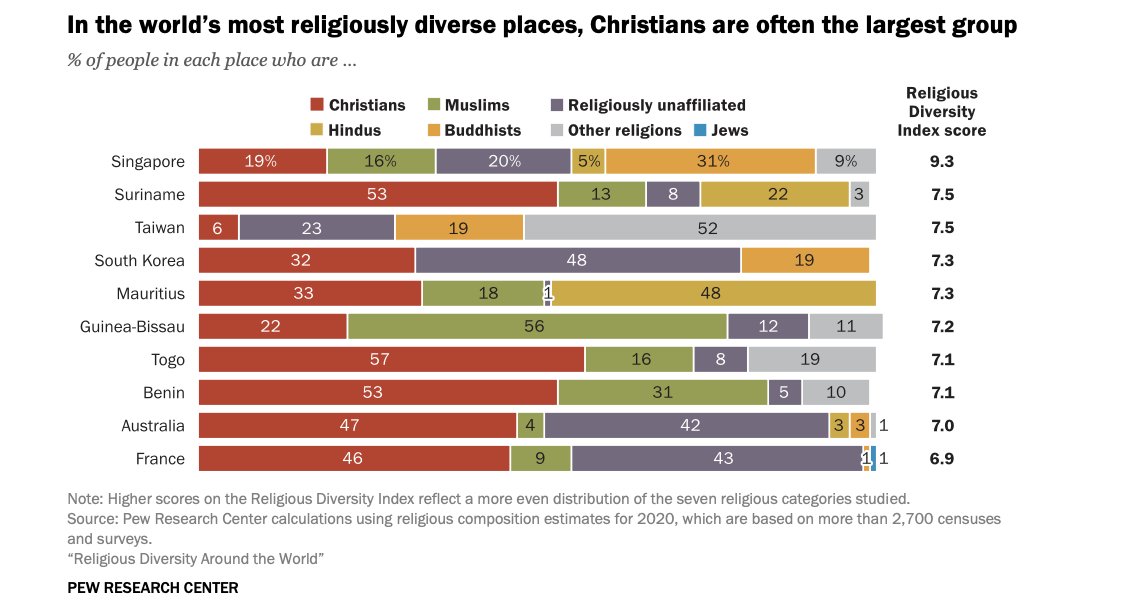
 In the world’s most religiously diverse places, Christians are often the largest group, a Feb. 12, 2026, Pew Research Center report finds. | Credit: Courtesy of Pew Research Center
 
 Overall, religious diversity levels around the world did not substantially change  between 2010 and 2020, as the religious composition of most countries remained fairly stable, the report said. The research found that while some places around the world have diverse populations of religious groups, it is more common for nations to primarily consist of a single religious group.In 194 countries and territories, 50% or more of the population falls into one religious category, the report said. This includes 43 places where at least 95% of the population is in the same religious group. These places are predominantly Muslim (25), Christian (17), or Buddhist (1).Most religiously diverse countriesThe research found that Singapore is the most religiously diverse country overall, while the United States ranks 32nd.In the world’s most religiously diverse places, Christians are often the largest group. Out of the 10 most religiously diverse counties overall, half have a majority Christian population, the report said.Singapore is the world’s most religiously diverse country as of 2020, with Buddhists (31%) as the largest religious group, the report said. Its population also includes substantial shares of religiously unaffiliated people (20%), Christians (19%), Muslims (16%), Hindus (5%), and adherents of all other religions (9%), the report said.Most of the other places in the top 10 are in the Asia-Pacific region or sub-Saharan Africa region including Suriname, Taiwan, South Korea, Mauritius, Guinea-Bissau, Togo, Benin, Australia, and France.
 
 A Pew Research Center report Feb. 12, 2026, identifies 10 countries where 90% of the population falls most evenly into a pair of religious categories. | Credit: Courtesy of Pew Research Center
 
 France is the only European country in the top 10 list. Its population is largely Christian (46%) and religiously unaffiliated (43%). In Suriname, another country in the top 10, about half of its residents (53%) are Christians and the rest are mainly Hindus (22%), Muslims (13%), and religiously unaffiliated people (8%). Christians are also the largest groups in Togo (57%), Benin (53%), and Australia (47%), which all fall in the top 10 most diverse places, the report said.Least religiously diverse countriesThe Middle East-North Africa region was found to be the least diverse of the regions Pew studied, with a population that is 94% Muslim. This region includes five of the world’s 10 least religiously diverse countries and territories.Eight of the least religiously diverse places have populations that are almost entirely Muslim, including Tunisia, Iraq, Western Sahara, Morocco, Iran, Somalia, Afghanistan, and Yemen, which all have a Muslim population of more than 99%, the report said.The other two countries with the least diverse scores were found to have very high majorities of Christians including Moldova and Timor-Lester, which both have populations made up of 99.5% of Christians.U.S. ranks high for religious diversity among largest nationsThe United States is not among the 10 most religiously diverse countries in the world, ranking 32nd overall. However, the U.S. is the most religiously diverse nation among the most populous countries, each of which has a population of at least 120 million. It is followed by Nigeria, Russia, India, and Brazil, the report said.Christians make up an estimated 64% of the U.S. population as of 2020, while religiously unaffiliated people account for about 30%, the report said. The remaining 6% are Muslims, Hindus, Buddhists, Jews, and people who practice other religions, the report said.The research showed the growth of religiously unaffiliated people and the decline of the Christian majority by 14% in the U.S. yielded an increase in the country’s religious diversity between 2010 and 2020.Nigeria is the second-most religiously diverse of the largely populated countries and is among the nations where 90% of the population is fairly evenly divided between two religious categories, the report said. The most populous religious groups in Nigeria are Muslims (56%) and Christians (43%), the report said.Out of the other nine countries where most of the population falls most into a pair of religious categories, seven include Christianity among the two religious groups. Eritrea, Bosnia-Herzegovina, Uruguay, Estonia, Chad, Ivory Coast, and Ethiopia, all include Christianity and one other group as their top religious groups as of 2020, the report said.Pakistan was found to be the least religiously diverse among the most populous countries, with Muslims making up a high majority (97%) of its residents.

Pew report finds Christians are often largest group in the world’s most religiously diverse places #Catholic The Pew Research Center released a report examining the most and least religiously diverse countries and territories across the globe.The Feb. 12 report found that the United States is not among the 10 most religiously diverse countries in the world, but when examining only the 10 most populous nations, the U.S. ranks first in religious diversity.The report, “Religious Diversity Around the World,” describes levels of religious diversity in 201 countries and territories. It measures how evenly each country’s population is distributed among seven groups including Christians, Muslims, Hindus, Buddhists, Jews, adherents of all other religions, and people with no religious affiliation.The research is part of the Pew-Templeton Global Religious Futures project, which analyzes religious change and its impact on societies around the world.Most of the analysis is from Pew’s Religious Diversity Index (RDI). Pew calculated the religious diversity of 201 areas that together are home to 99.98% of the world’s population based on the size of seven religious groups to give them scores for religious diversity. In the world’s most religiously diverse places, Christians are often the largest group, a Feb. 12, 2026, Pew Research Center report finds. | Credit: Courtesy of Pew Research Center Overall, religious diversity levels around the world did not substantially change  between 2010 and 2020, as the religious composition of most countries remained fairly stable, the report said. The research found that while some places around the world have diverse populations of religious groups, it is more common for nations to primarily consist of a single religious group.In 194 countries and territories, 50% or more of the population falls into one religious category, the report said. This includes 43 places where at least 95% of the population is in the same religious group. These places are predominantly Muslim (25), Christian (17), or Buddhist (1).Most religiously diverse countriesThe research found that Singapore is the most religiously diverse country overall, while the United States ranks 32nd.In the world’s most religiously diverse places, Christians are often the largest group. Out of the 10 most religiously diverse counties overall, half have a majority Christian population, the report said.Singapore is the world’s most religiously diverse country as of 2020, with Buddhists (31%) as the largest religious group, the report said. Its population also includes substantial shares of religiously unaffiliated people (20%), Christians (19%), Muslims (16%), Hindus (5%), and adherents of all other religions (9%), the report said.Most of the other places in the top 10 are in the Asia-Pacific region or sub-Saharan Africa region including Suriname, Taiwan, South Korea, Mauritius, Guinea-Bissau, Togo, Benin, Australia, and France. A Pew Research Center report Feb. 12, 2026, identifies 10 countries where 90% of the population falls most evenly into a pair of religious categories. | Credit: Courtesy of Pew Research Center France is the only European country in the top 10 list. Its population is largely Christian (46%) and religiously unaffiliated (43%). In Suriname, another country in the top 10, about half of its residents (53%) are Christians and the rest are mainly Hindus (22%), Muslims (13%), and religiously unaffiliated people (8%). Christians are also the largest groups in Togo (57%), Benin (53%), and Australia (47%), which all fall in the top 10 most diverse places, the report said.Least religiously diverse countriesThe Middle East-North Africa region was found to be the least diverse of the regions Pew studied, with a population that is 94% Muslim. This region includes five of the world’s 10 least religiously diverse countries and territories.Eight of the least religiously diverse places have populations that are almost entirely Muslim, including Tunisia, Iraq, Western Sahara, Morocco, Iran, Somalia, Afghanistan, and Yemen, which all have a Muslim population of more than 99%, the report said.The other two countries with the least diverse scores were found to have very high majorities of Christians including Moldova and Timor-Lester, which both have populations made up of 99.5% of Christians.U.S. ranks high for religious diversity among largest nationsThe United States is not among the 10 most religiously diverse countries in the world, ranking 32nd overall. However, the U.S. is the most religiously diverse nation among the most populous countries, each of which has a population of at least 120 million. It is followed by Nigeria, Russia, India, and Brazil, the report said.Christians make up an estimated 64% of the U.S. population as of 2020, while religiously unaffiliated people account for about 30%, the report said. The remaining 6% are Muslims, Hindus, Buddhists, Jews, and people who practice other religions, the report said.The research showed the growth of religiously unaffiliated people and the decline of the Christian majority by 14% in the U.S. yielded an increase in the country’s religious diversity between 2010 and 2020.Nigeria is the second-most religiously diverse of the largely populated countries and is among the nations where 90% of the population is fairly evenly divided between two religious categories, the report said. The most populous religious groups in Nigeria are Muslims (56%) and Christians (43%), the report said.Out of the other nine countries where most of the population falls most into a pair of religious categories, seven include Christianity among the two religious groups. Eritrea, Bosnia-Herzegovina, Uruguay, Estonia, Chad, Ivory Coast, and Ethiopia, all include Christianity and one other group as their top religious groups as of 2020, the report said.Pakistan was found to be the least religiously diverse among the most populous countries, with Muslims making up a high majority (97%) of its residents.

Among the most populous nations, the U.S. ranks first in religious diversity. Singapore is the most religiously diverse country overall, and the U.S. ranks 32nd.

Read More
2025 saw expanded access to physician-assisted suicide  #Catholic 
 
 Empty wheelchairs used during the Nov. 4, 2025, anti-assisted suicide event in Rome. / Credit: Courtesy of ProVita & Famiglia

Washington, D.C. Newsroom, Dec 28, 2025 / 07:00 am (CNA).
Despite opposition from advocacy groups and Catholic leaders, multiple states and countries advanced legislation in 2025 to expand access to physician-assisted suicide.Delaware Delaware Gov. Matt Meyer signed a bill in May legalizing physician-assisted suicide for terminally ill adults with a prognosis of six months or less to live. The law will go into effect on Jan. 1, 2026, allowing patients to self-administer lethal medication. After the bill was signed, several disability and patient advocacy groups filed a lawsuit in the U.S. District Court in Delaware on Dec. 8 alleging that the law discriminates against people with disabilities. Illinois The House passed a bill in May to legalize physician-assisted suicide in Illinois, and it stalled in the Senate during the regular session. After it was taken up during the fall veto session, senators passed it on Oct. 31. The bill, which allows doctors to give terminally ill patients life-ending drugs if they request them, was signed into law by Gov. JB Pritzker on Dec. 12. The law “ignores the very real failures in access to quality care that drive vulnerable people to despair,” according to the Catholic Conference of Illinois.Illinois joined states that permit the practice including California, Colorado, Delaware, Hawaii, Maine, Montana, New Jersey, New Mexico, Oregon, Vermont, and Washington, as well as the District of Columbia.New York The New York State Assembly advanced an assisted suicide measure in May, which Cardinal Timothy Dolan called “a disaster waiting to happen.” Despite calls from Catholic bishops, the New York Legislature passed the “Medical Aid in Dying Act” in June.The legislation is expected to be signed by New York Gov. Kathy Hochul.ColoradoAssisted suicide has been legal in Colorado since 2016. In June 2025, a coalition of advocacy groups sued the state over its assisted suicide law, claiming the statute is unconstitutional for allegedly discriminating against those who suffer from disabilities. The suit was filed on June 30 in U.S. district court by organizations including Not Dead Yet and the Institute for Patients’ Rights. It calls Colorado’s assisted suicide regime “a deadly and discriminatory system that steers people with life-threatening disabilities away from necessary lifesaving and preserving mental health care.” FranceThe National Assembly approved a bill in May that would allow certain terminally ill adults to receive lethal medication. The bill passed with 305 votes in favor and 199 against. In a statement released after the vote, the French Bishops’ Conference expressed its “deep concern” over the so-called “right to assistance in dying.” United KingdomBritish lawmakers in the House of Commons passed a bill in June to legalize assisted suicide for terminally ill patients in England and Wales. In order to become law, the bill must pass the second chamber of Parliament, the unelected House of Lords. The Lords can amend legislation, but because the bill has the support of the Commons, it is likely to pass.Uruguay Legislators in Uruguay passed a bill in August to legalize euthanasia in the country. In October, Uruguay’s Parliament approved the “Dignified Death Bill,” making the bill law and allowing adults in the terminal stage of a disease to request euthanasia. Canada A Cardus Health report released in September found the legalization of medical assistance in dying (MAID) in Canada led to disproportionately high rates of premature deaths among vulnerable groups.MAID passed in 2012 with safeguards and provisions that the report said Canada has not upheld. It said: “Those who died from MAID were more likely to have been living with a disability than those who did not die from MAID, even though both groups had similar medical conditions and experienced diminished capability.”People suffering from mental illness are also dying by assisted suicide at disproportionate rates, the report said. 

2025 saw expanded access to physician-assisted suicide  #Catholic Empty wheelchairs used during the Nov. 4, 2025, anti-assisted suicide event in Rome. / Credit: Courtesy of ProVita & Famiglia Washington, D.C. Newsroom, Dec 28, 2025 / 07:00 am (CNA). Despite opposition from advocacy groups and Catholic leaders, multiple states and countries advanced legislation in 2025 to expand access to physician-assisted suicide.Delaware Delaware Gov. Matt Meyer signed a bill in May legalizing physician-assisted suicide for terminally ill adults with a prognosis of six months or less to live. The law will go into effect on Jan. 1, 2026, allowing patients to self-administer lethal medication. After the bill was signed, several disability and patient advocacy groups filed a lawsuit in the U.S. District Court in Delaware on Dec. 8 alleging that the law discriminates against people with disabilities. Illinois The House passed a bill in May to legalize physician-assisted suicide in Illinois, and it stalled in the Senate during the regular session. After it was taken up during the fall veto session, senators passed it on Oct. 31. The bill, which allows doctors to give terminally ill patients life-ending drugs if they request them, was signed into law by Gov. JB Pritzker on Dec. 12. The law “ignores the very real failures in access to quality care that drive vulnerable people to despair,” according to the Catholic Conference of Illinois.Illinois joined states that permit the practice including California, Colorado, Delaware, Hawaii, Maine, Montana, New Jersey, New Mexico, Oregon, Vermont, and Washington, as well as the District of Columbia.New York The New York State Assembly advanced an assisted suicide measure in May, which Cardinal Timothy Dolan called “a disaster waiting to happen.” Despite calls from Catholic bishops, the New York Legislature passed the “Medical Aid in Dying Act” in June.The legislation is expected to be signed by New York Gov. Kathy Hochul.ColoradoAssisted suicide has been legal in Colorado since 2016. In June 2025, a coalition of advocacy groups sued the state over its assisted suicide law, claiming the statute is unconstitutional for allegedly discriminating against those who suffer from disabilities. The suit was filed on June 30 in U.S. district court by organizations including Not Dead Yet and the Institute for Patients’ Rights. It calls Colorado’s assisted suicide regime “a deadly and discriminatory system that steers people with life-threatening disabilities away from necessary lifesaving and preserving mental health care.” FranceThe National Assembly approved a bill in May that would allow certain terminally ill adults to receive lethal medication. The bill passed with 305 votes in favor and 199 against. In a statement released after the vote, the French Bishops’ Conference expressed its “deep concern” over the so-called “right to assistance in dying.” United KingdomBritish lawmakers in the House of Commons passed a bill in June to legalize assisted suicide for terminally ill patients in England and Wales. In order to become law, the bill must pass the second chamber of Parliament, the unelected House of Lords. The Lords can amend legislation, but because the bill has the support of the Commons, it is likely to pass.Uruguay Legislators in Uruguay passed a bill in August to legalize euthanasia in the country. In October, Uruguay’s Parliament approved the “Dignified Death Bill,” making the bill law and allowing adults in the terminal stage of a disease to request euthanasia. Canada A Cardus Health report released in September found the legalization of medical assistance in dying (MAID) in Canada led to disproportionately high rates of premature deaths among vulnerable groups.MAID passed in 2012 with safeguards and provisions that the report said Canada has not upheld. It said: “Those who died from MAID were more likely to have been living with a disability than those who did not die from MAID, even though both groups had similar medical conditions and experienced diminished capability.”People suffering from mental illness are also dying by assisted suicide at disproportionate rates, the report said. 


Empty wheelchairs used during the Nov. 4, 2025, anti-assisted suicide event in Rome. / Credit: Courtesy of ProVita & Famiglia

Washington, D.C. Newsroom, Dec 28, 2025 / 07:00 am (CNA).

Despite opposition from advocacy groups and Catholic leaders, multiple states and countries advanced legislation in 2025 to expand access to physician-assisted suicide.

Delaware 

Delaware Gov. Matt Meyer signed a bill in May legalizing physician-assisted suicide for terminally ill adults with a prognosis of six months or less to live. The law will go into effect on Jan. 1, 2026, allowing patients to self-administer lethal medication. 

After the bill was signed, several disability and patient advocacy groups filed a lawsuit in the U.S. District Court in Delaware on Dec. 8 alleging that the law discriminates against people with disabilities. 

Illinois 

The House passed a bill in May to legalize physician-assisted suicide in Illinois, and it stalled in the Senate during the regular session. After it was taken up during the fall veto session, senators passed it on Oct. 31. 

The bill, which allows doctors to give terminally ill patients life-ending drugs if they request them, was signed into law by Gov. JB Pritzker on Dec. 12. The law “ignores the very real failures in access to quality care that drive vulnerable people to despair,” according to the Catholic Conference of Illinois.

Illinois joined states that permit the practice including California, Colorado, Delaware, Hawaii, Maine, Montana, New Jersey, New Mexico, Oregon, Vermont, and Washington, as well as the District of Columbia.

New York 

The New York State Assembly advanced an assisted suicide measure in May, which Cardinal Timothy Dolan called “a disaster waiting to happen.” Despite calls from Catholic bishops, the New York Legislature passed the “Medical Aid in Dying Act” in June.

The legislation is expected to be signed by New York Gov. Kathy Hochul.

Colorado

Assisted suicide has been legal in Colorado since 2016. In June 2025, a coalition of advocacy groups sued the state over its assisted suicide law, claiming the statute is unconstitutional for allegedly discriminating against those who suffer from disabilities. 

The suit was filed on June 30 in U.S. district court by organizations including Not Dead Yet and the Institute for Patients’ Rights. It calls Colorado’s assisted suicide regime “a deadly and discriminatory system that steers people with life-threatening disabilities away from necessary lifesaving and preserving mental health care.” 

France

The National Assembly approved a bill in May that would allow certain terminally ill adults to receive lethal medication. The bill passed with 305 votes in favor and 199 against. 

In a statement released after the vote, the French Bishops’ Conference expressed its “deep concern” over the so-called “right to assistance in dying.” 

United Kingdom

British lawmakers in the House of Commons passed a bill in June to legalize assisted suicide for terminally ill patients in England and Wales. 

In order to become law, the bill must pass the second chamber of Parliament, the unelected House of Lords. The Lords can amend legislation, but because the bill has the support of the Commons, it is likely to pass.

Uruguay 

Legislators in Uruguay passed a bill in August to legalize euthanasia in the country. In October, Uruguay’s Parliament approved the “Dignified Death Bill,” making the bill law and allowing adults in the terminal stage of a disease to request euthanasia. 

Canada 

A Cardus Health report released in September found the legalization of medical assistance in dying (MAID) in Canada led to disproportionately high rates of premature deaths among vulnerable groups.

MAID passed in 2012 with safeguards and provisions that the report said Canada has not upheld. It said: “Those who died from MAID were more likely to have been living with a disability than those who did not die from MAID, even though both groups had similar medical conditions and experienced diminished capability.”

People suffering from mental illness are also dying by assisted suicide at disproportionate rates, the report said. 

Read More