O Most Amiable Child Jesus,
You Who said: �Ask and you shall receive,�
graciously hear my petition
and grant me the favor I ask of You,
if it be for Your Greater Honor and Glory
and for the good of my soul.
Beloved: We have this confidence in him that if we ask anything according to his will, he hears us. And if we know that he hears us in regard to whatever we ask, we know that what we have asked him for is ours. If anyone sees his brother sinning, if the sin is not deadly, he should pray to God and he will give him life. This is only for those whose sin is not deadly. There is such a thing as deadly sin, about which I do not say that you should pray. All wrongdoing is sin, but there is sin that is not deadly.
We know that anyone begotten by God does not sin; but the one begotten by God he protects, and the Evil One cannot touch him. We know that we belong to God, and the whole world is under the power of the Evil One. We also know that the Son of God has come and has given us discernment to know the one who is true. And we are in the one who is true, in his Son Jesus Christ. He is the true God and eternal life. Children, be on your guard against idols.
From the Gospel according to John 3:22-30
Jesus and his disciples went into the region of Judea, where he spent some time with them baptizing. John was also baptizing in Aenon near Salim, because there was an abundance of water there, and people came to be baptized, for John had not yet been imprisoned. Now a dispute arose between the disciples of John and a Jew about ceremonial washings. So they came to John and said to him, “Rabbi, the one who was with you across the Jordan, to whom you testified, here he is baptizing and everyone is coming to him.” John answered and said, “No one can receive anything except what has been given from heaven. You yourselves can testify that I said that I am not the Christ, but that I was sent before him. The one who has the bride is the bridegroom; the best man, who stands and listens for him, rejoices greatly at the bridegroom’s voice. So this joy of mine has been made complete. He must increase; I must decrease.”
“Repent, for the kingdom of heaven is at hand” (v. 17). This is the main message of all Jesus’ sermons: to tell us that the kingdom of heaven is at hand. What does this mean? The kingdom of heaven means the reign of God, that is, the way in which God reigns through his relationship with us. Jesus tells us that the kingdom of heaven is at hand, that God is near. Here is the novelty, the first message: God is not far from us. The One who dwells in heaven has come down to earth; he became man. He has torn down walls and shortened distances. We ourselves did not deserve this: he came down to meet us. Now this nearness of God to his people is one of the ways he has done things since the beginning, even of the Old Testament. He said to his people: “Imagine: what nation has its gods so near to it as I am near to you?” (cf. Dt 4:7). And this nearness became flesh in Jesus. (Pope Francis, Homily, Sunday of the Word of God, 26 January 2020)
Church employee Francisco Paredes, 46, was handcuffed by ICE Dec. 4, 2025. | Credit: Photo courtesy of Francisco Paredes
Jan 9, 2026 / 15:01 pm (CNA).
U.S. Immigration and Customs Enforcement (ICE) agents surveilled St. Gabriel the Archangel Catholic Church in Hopkins, Minnesota, on Epiphany after deporting the parish’s beloved maintenance worker to Mexico five weeks earlier.
The Trump administration last year eliminated a federal policy that generally prohibited immigration enforcement in “sensitive locations” such as schools, churches, and hospitals. Attendance at St. Gabriel’s Spanish Mass has dropped by half since the solemnity of the Immaculate Conception, and parishioners have expressed fear of churchgoing about eight miles from where an ICE agent shot and killed U.S. citizen Renee Good on Jan. 7.
Father Paul Haverstock, pastor of St. Gabriel’s, said he had vested for the 1 p.m. Spanish Mass Jan. 4 when a parishioner told him about men wearing ski masks in a car outside the church. He said he was disturbed to receive the report, went to the sacristy to get his cellphone, and placed it next to his chair in the sanctuary.
“If there is an incident of agents coming in, I want to make sure that it’s recorded, and I want a clear recording of me letting the agents know that we’re in the middle of a religious service,” Haverstock said.
It didn’t come to that, but ICE’s presence outside has impeded parishioners’ free exercise of religion, Haverstock said. ICE agents camped outside the church felt like “a violation,” he said.
“Who wouldn’t feel intimidated by that?” he said.
“It felt like a violation of our constitutional rights, felt like a violation of civilization and good manners. It felt like we were not living in the United States of America but in some third world, violent place, somewhere else,” Haverstock said. “Yeah, it feels like we’re in a war zone here.”
The U.S. Department of Homeland Security did not immediately respond to a request for comment.
Arrest of church employee
Church employee Francisco Paredes, 46, was handcuffed by ICE Dec. 4, 2025. Eight federal vehicles pulled into a large parking lot adjacent to St. Gabriel’s on 13th Avenue South after Paredes picked up coffee on his way to work, Paredes said, and he was driven to a processing facility.
About 2,000 immigration enforcement agents have come to Minnesota, according to government officials. On Jan. 4, “they were definitely out in front of the church, waiting in front of the church,” Hopkins Mayor Patrick Hanlon said in an interview.
Hanlon said he wants ICE to obey the laws of Hopkins, a community of about 19,000 people known for its lively "Mainstreet" and arts scene, and summertime Raspberry Festival.
Mayor Patrick Hanlon of Hopkins, Minnesota, says ICE agents were in front of St. Gabriel’s Church on Jan. 4, 2026. | Credit: Photo courtesy of Patrick Hanlon
Hanlon made an Instagram reel following theshooting of Good urging ICE to obey Hopkins’ traffic rules and other laws.
Archbishop Bernard Hebda in his statement after Good’s death pleaded for “all people of goodwill to join me in prayer for the person who was killed, for their loved ones, and for our community.”
‘Surveilling us’
After observing ICE monitoring the church during Sunday Mass, Haverstock called Hebda and the mayor.
Haverstock told them: “They had out-of-state license plates, and they were just sitting outside our doors for a while.” He added: “They came to our church, and even though they didn’t enter, they were apparently surveilling us.”
Until Paredes’ arrest and before ICE parked outside St. Gabriel’s, more than 400 people had usually attended the Spanish Mass, Haverstock said. Haverstock said he is considering offering a temporary Sunday Mass dispensation in his parish for those who are afraid.
“I think if I don’t give them a dispensation, hardly any of them will be here anyway because of the fear factor. So out of consideration for their circumstances and their souls, I think it’s likely I will give a dispensation for this coming Sunday, but I feel torn because we need God in this situation,” Haverstock said.
‘We’ve united to help our immigrant brothers and sisters’
ICE’s presence has been “a real interference with our parishioners’ right to worship and come to Mass,” Haverstock said.
“They’re also terrorizing anybody of goodwill just by their presence, masks, and idling outside of a church. It’s frightening. I was frightened when I heard that they were there. I was frightened for the safety of the people in the church, including myself, and I was especially frightened for my immigrants,” he said.
Haverstock said he was “really blessed to see that our parish has not split on political lines in this situation, but we’ve united to help our immigrant brothers and sisters.”
‘Too afraid’
Fear is palpable, Haverstock said, with “people being detained, even after showing IDs, and people being harassed, even if they’re here legally.”
When maintenance employee Paredes was deported, “it really got my attention,” Haverstock said.
Paredes, who sang in the church choir and had lived in the U.S. for 25 years with one conviction for driving under the influence, said he spent about a month incarcerated in the ICE detention system before being sent to Mexico. He said he had asked to make a phone call when he was arrested and was denied for several days so his U.S.-citizen daughter didn’t know his whereabouts. Paredes spent Christmas imprisoned and said he had no access to any religious services.
Francisco Paredes, center, works at St. Gabriel Catholic Church in Hopkins, Minnesota, before being deported to Mexico on Dec. 4, 2025. | Credit: Photo courtesy of Francisco Paredes
In the Bloomington, Minnesota, immigration office, Paredes, who lacked legal permission to live in the U.S., said he was in a cell with 40 people. There was only one bathroom for the men to share, and “anyone can see when you go to the bathroom,” Paredes said.
After about seven hours later, Paredes said he was transferred to the Crow Wing County Jail in Brainerd, Minnesota. Paredes said a government-financed plane later took him to Laredo, Texas, where he was imprisoned in the Webb County Detention Center.
“They treat people like an animal,” Paredes said. “I was there!”
Paredes said no hot meals were provided, only a sandwich, an orange, crackers, and water. In a large warehouse-like building, “we sleep on the floor. No blanket. They treat you like an animal,” Paredes said.
When President Donald Trump talks about deporting “the worst of the worst,” Paredes said, “he doesn’t have any idea. All the people I met in the prison, they are hardworking people.”
Haverstock said he misses Paredes, who was a “wonderful worker and one of those rare, fully bilingual people, so that was a huge help to have him around.”
“We should be firmly resolved to do our part to obtain justice, not just for ourselves but for our brothers and sisters, and not even just those in the Church, but anyone’s who’s being persecuted, who happens to be our neighbor,” Haverstock said. “Families should not be separated except for extremely grave reasons. And I can say from my personal experience, from what I’ve seen, and from what I’ve heard, that these deportations and this massive push by ICE is not just targeting drug cartels and violent criminals and repeat offenders of major crimes, but it’s targeting moms and dads and families who have committed, in some cases, no crime except entering our country illegally, and separating a family because of that is unjust.”
At the end of Mass, Haverstock invites parishioners to learn how to “help immigrants in the parish who have been negatively impacted by recent events” and join an ad hoc team “to serve our brothers and sisters through works of mercy.”
Haverstock said the parish has used the same petition in the Prayer of the Faithful for several weeks: “For immigrants living in fear, for families that have been separated, and for wise immigration reform in our land, let us pray to the Lord.”
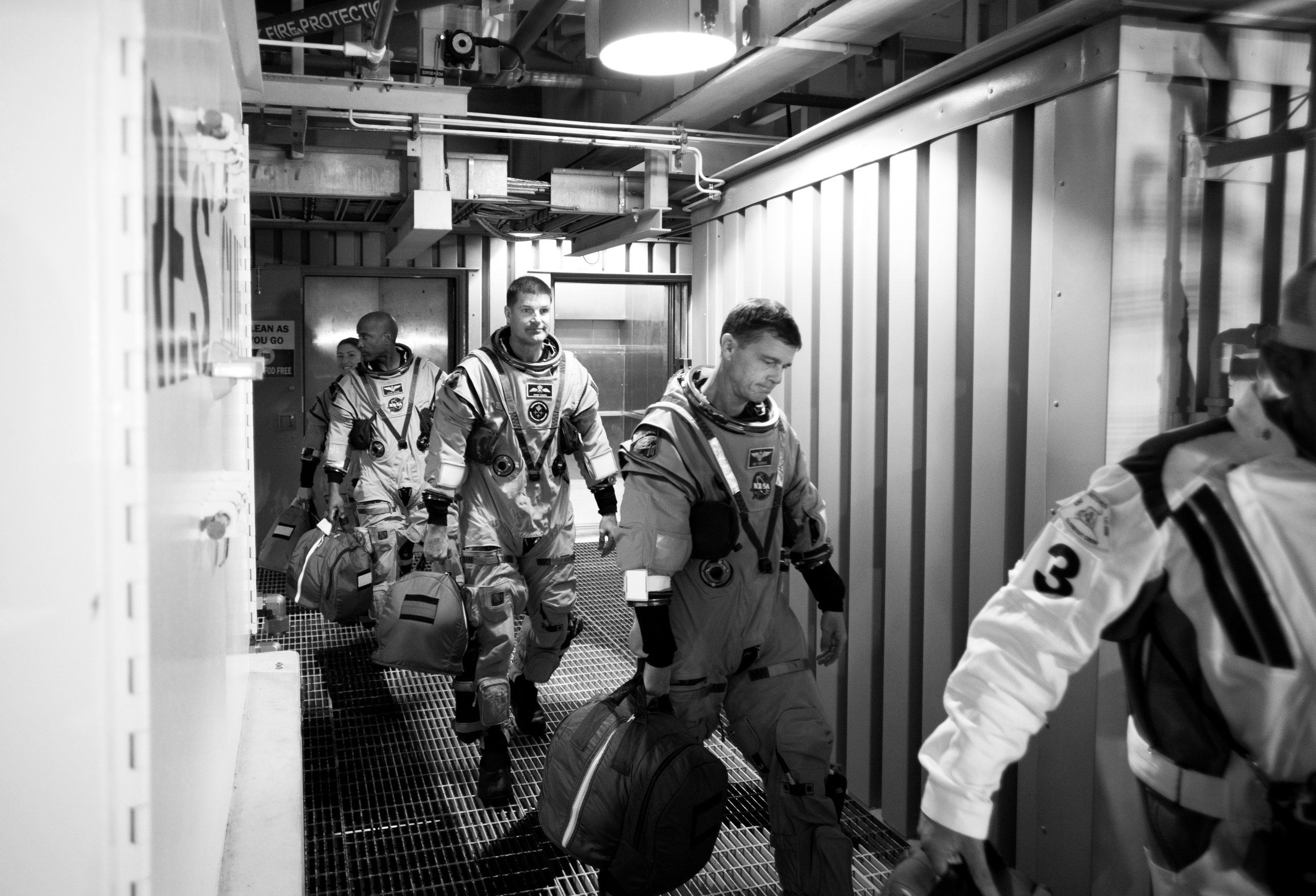
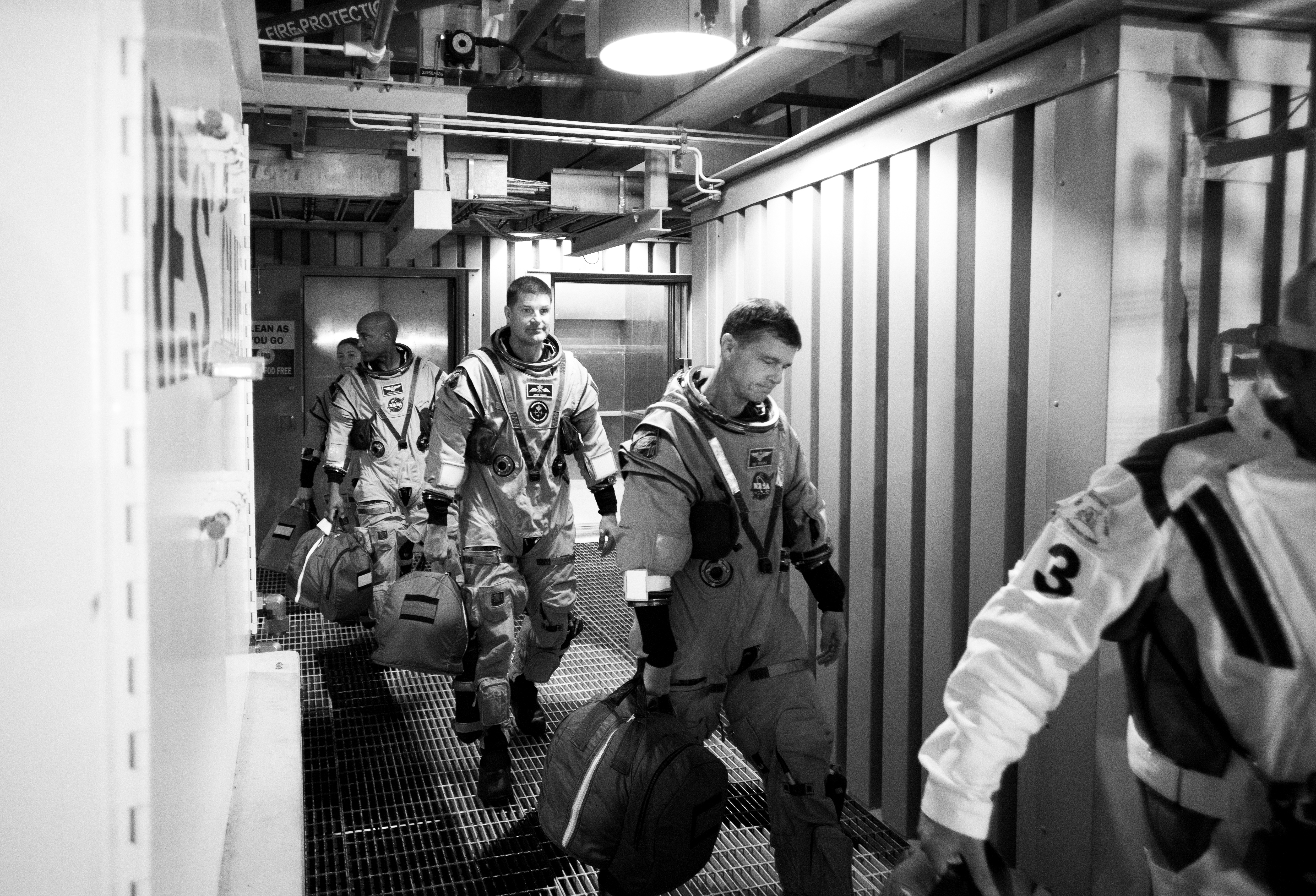
Artemis II crewmembers (left to right) NASA astronauts Christina Koch, mission specialist; and Victor Glover, pilot; CSA (Canadian Space Agency) astronaut Jeremy Hansen, mission specialist; and NASA astronaut Reid Wiseman, commander are led to the crew access arm as they prepare to board their Orion spacecraft atop NASA’s Space Launch System rocket during the Artemis II countdown demonstration test on Dec. 20, 2025.
The U.S. Supreme Court is being asked to block the state of California from allowing schools to hide student “gender transitions” from parents amid an ongoing federal lawsuit.
The Thomas More Society, a Chicago-based legal group, asked the high court to intervene in the case Mirabelli v. Bonta while the dispute works its way through a federal appeals court.
The suit was originally brought by two Christian teachers in California. U.S. District Court Judge Roger Benitez on Dec. 22, 2025, issued a ruling in the class action lawsuit, striking down the secretive school gender policies on First Amendment grounds and holding that parents “have a right” to the “gender information” of their children, while teachers themselves also have the right to provide parents with that information.
In a Jan. 5 ruling, however, the U.S. Court of Appeals for the 9th Circuit blocked Benitez’s order, holding in part that the “public interest in protecting students and avoiding confusion among schoolteachers and administrators” justified a stay.
In an emergency application to the Supreme Court, lawyers with the Thomas More Society argued that the rights of parents, and the health and safety of children, are “too precious” to wait for the appeal to play out.
The high court should strike down the block by the appeals court, the attorneys said, in part because it “strips parents of their core authority with respect to an issue with significant religious and developmental impact.”
Disputes over hiding a student’s “gender identity” from parents have played out in schools around the country in recent years. LGBT advocates claim that teachers and administrators should be allowed to hide student “transitions” in order to keep children safe from parents who may not “affirm” an LGBT identity.
Critics have countered that parents have a right to know important and health-related decisions of their children, particularly concerning “gender identity” beliefs, which often compel young people to seek out drugs and surgeries.
The debate has reached the highest levels of U.S. government. The U.S. Department of Health and Human Services in August 2025 directed U.S. states to remove gender ideology material from their curricula or face the loss of federal funding, while in February of that year the Department of Education launched an investigation into several Virginia school districts to determine if they violated federal orders forbidding schools from supporting the so-called “transition” of children.
Thomas More Society attorney Paul Jonna this week said California’s “parental deception scheme” is “keeping families in the dark and causing irreparable harm,” necessitating the intervention of the Supreme Court.
“The state is inserting itself unconstitutionally between parents and children, forcing schools to deceive families, and punishing teachers who tell the truth,” he said, adding that “no parent should learn their child was in crisis because the government ordered schools to keep secrets.”
Pope Leo XIV addresses ambassadors and other diplomatic representatives to the Holy See in the Apostolic Palace on Jan. 9, 2026. | Credit: Vatican Media
Jan 9, 2026 / 10:17 am (CNA).
Pope Leo XIV condemned the weakening of international multilateralism and the increased use of force in a speech to diplomats at the Vatican on Friday.
He also said states should respect fundamental human rights, such as religious freedom and freedom of speech, and comply with international humanitarian law in the lengthiest speech to date of his pontificate.
“A diplomacy that promotes dialogue and seeks consensus among all parties is being replaced by a diplomacy based on force, by either individuals or groups of allies. War is back in vogue and a zeal for war is spreading,” he told ambassadors and other diplomatic representatives to the Holy See in the Apostolic Palace on Jan. 9. Currently, 184 states have diplomatic relations with the Holy See.
“Peace is no longer sought as a gift and a desirable good in itself,” the pontiff continued. “Instead, peace is sought through weapons as a condition for asserting one’s own dominion. This gravely threatens the rule of law, which is the foundation of all peaceful civil coexistence.”
The Holy Father called for concern for the common good of peoples to take precedence over “the defense of partisan interests” amid escalating tensions, pointing in particular to Venezuela, for which he reiterated an appeal “to respect the will of the Venezuelan people, and to safeguard the human and civil rights of all.”
Leo framed his speech, part of the annual new year greeting to the diplomatic corps, within St. Augustine of Hippo’s work of Christian philosophy “De Civitate Dei” (“City of God”).
“The ‘City of God’ does not propose a political program. Instead, it offers valuable reflections on fundamental issues concerning social and political life, such as the search for a more just and peaceful coexistence among peoples. Augustine also warns of the grave dangers to political life arising from false representations of history, excessive nationalism and the distortion of the ideal of the political leader,” the pope said.
He called “City of God,” written in the fifth century, highly relevant to the present time, marked by widespread migration and the “profound readjustment of geopolitical balances and cultural paradigms.”
Pope Leo XIV greets ambassadors and other diplomatic representatives to the Holy See in the Apostolic Palace on Jan. 9, 2026. | Credit: Vatican Media
Human rights short-circuited
Leo lamented what he called a “short circuit” of human rights around the world today, especially the right to life.
“We firmly reiterate that the protection of the right to life constitutes the indispensable foundation of every other human right. A society is healthy and truly progresses only when it safeguards the sanctity of human life and works actively to promote it,” he said.
He also called out the restriction of the right to freedom of expression, freedom of conscience, religious freedom, and the right to life in favor of other “so-called new rights,” so that “the very framework of human rights is losing its vitality and creating space for force and oppression.”
“This occurs when each right becomes self-referential, and especially when it becomes disconnected from reality, nature, and truth,” he added.
Christian persecution
Pope Leo said Christian persecution is one of the most widespread human rights crises today, with over 380 million believers around the world suffering high or extreme levels of discrimination, violence, and oppression.
He recalled the victims of religiously motivated violence in Bangladesh, in the Sahel region, in Nigeria, and those killed or injured in the terrorist attack on the parish of St. Elias in Damascus in June.
The pontiff also decried “a subtle form of religious discrimination against Christians” taking place even in Christian-majority countries in Europe and the Americas.
“There, they are sometimes restricted in their ability to proclaim the truths of the Gospel for political or ideological reasons, especially when they defend the dignity of the weakest, the unborn, refugees and migrants, or promote the family,” he said.
Leo also called for respect for the freedom of other religious communities and the rejection of all forms of antisemitism.
Pope Leo XIV greets ambassadors and other diplomatic representatives to the Holy See in the Hall of the Blessing in the Apostolic Palace on Jan. 9, 2026. | Credit: Vatican Media
The meaning of words
The Holy Father also spoke about debates over the meaning of words and how they are tied to attacks on freedom of expression.
“Rediscovering the meaning of words is perhaps one of the primary challenges of our time. When words lose their connection to reality, and reality itself becomes debatable and ultimately incommunicable,” he said.
“We should also note the paradox that this weakening of language is often invoked in the name of freedom of expression itself. However, on closer inspection, the opposite is true, for freedom of speech and expression is guaranteed precisely by the certainty of language and the fact that every term is anchored in the truth,” he noted.
He called it painful to see the space for genuine freedom of expression rapidly shrink, especially in the West.
“At the same time, a new Orwellian-style language is developing which, in an attempt to be increasingly inclusive, ends up excluding those who do not conform to the ideologies that are fueling it,” he said.
A consequence of this, Leo said, is that the freedom of conscience, another fundamental human right, is increasingly questioned by states.
The freedom of conscience, which “establishes a balance between the collective interest and individual dignity,” protects individuals “to refuse legal or professional obligations that conflict with moral, ethical, or religious principles deeply rooted in their personal lives,” such as military service, abortion, or euthanasia.
“Conscientious objection is not rebellion but an act of fidelity to oneself,” he underlined.
Life and the family
Pope Leo urged states to protect the institution of the family as “the vocation to love and to life” manifested in the “exclusive and indissoluble union between a woman and a man” and implying a “fundamental ethical imperative for enabling families to welcome and fully care for unborn life.”
Noting the increasing priority of raising birth rates, he emphasized life as a gift to be cherished and said “we categorically reject any practice that denies or exploits the origin of life and its development,” including abortion and surrogacy.
He added that the Holy See is also concerned about projects aimed at financing cross-border mobility to increase access to abortion and “considers it deplorable that public resources are allocated to suppress life rather than being invested to support mothers and families.”
Pope Leo XIV poses with ambassadors and other diplomatic representatives to the Holy See in the Sistine Chapel on Jan. 9, 2026. | Credit: Vatican Media
For the sick and elderly, “civil society and states also have a responsibility to respond concretely to situations of vulnerability, offering solutions to human suffering, such as palliative care, and promoting policies of authentic solidarity rather than encouraging deceptive forms of compassion such as euthanasia,” he said.
The pontiff underlined the inalienable dignity of every person and that migrants, as people, have “inalienable rights that must be respected in every situation.”
“I renew the Holy See’s hope that the actions taken by states against criminality and human trafficking will not become a pretext for undermining the dignity of migrants and refugees,” he said.
Pride and self-love
Leo recalled that in Augustine’s “City of God,” the saint interprets events and history according to a model of two cities. The city of God is characterized by God’s unconditional love and love for one’s neighbor, especially the poor, while the earthly city “is centered on pride and self-love (‘amor sui’), on the thirst for worldly power and glory that leads to destruction.”
“While St. Augustine highlights the coexistence of the heavenly and earthly cities until the end of time, our era seems somewhat inclined to deny the city of God its ‘right of citizenship,’” the pope noted.
“Yet, as Augustine notes, ‘Great is the folly of pride in those individuals who think that the supreme good can be found in this life and that they can become happy by their own resources,’” Leo said. “Pride obscures both reality itself and our empathy towards others. It is no coincidence that pride is always at the root of every conflict.”
President Donald Trump ordered the arrest of Venezuelan President Nicolás Maduro, toppling a brutal totalitarian regime. But he’s only getting started.
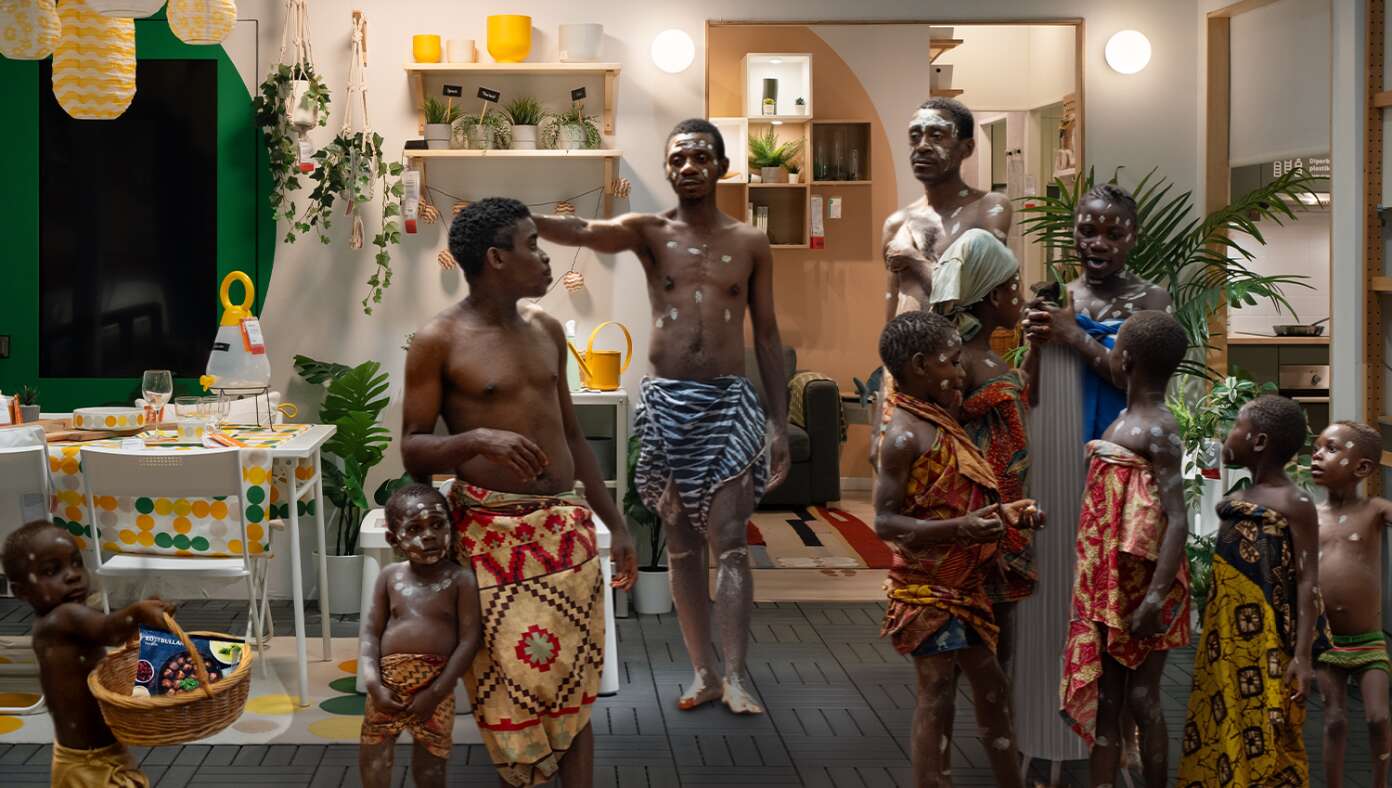
COSTA MESA, CA — A team of anthropologists hard at work completing a field study announced that they had discovered a previously uncontacted native tribe in a remote area of IKEA.