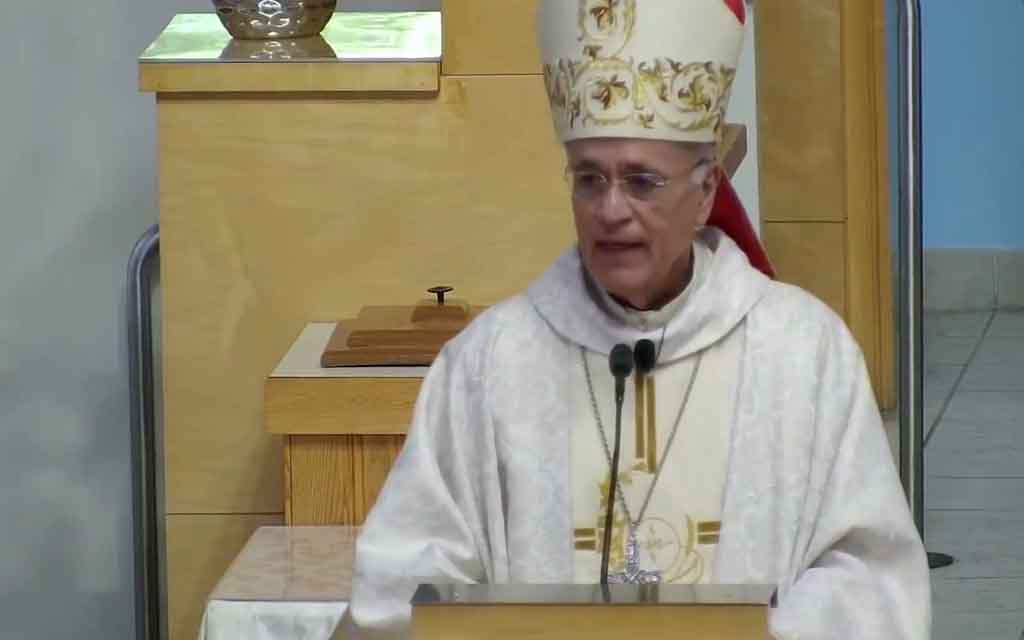
Forced to leave Nicaragua in April 2019 for defending protesters opposing the regime of President Daniel Ortega and his wife and vice president, Rosario Murillo, during a crackdown that left more than 350 people dead, exiled Auxiliary Bishop Silvio Báez of Managua decried the “irrationality” and “cruelty” of the countryʼs dictatorship.
“One of the most tragic characteristics of this dictatorship is its irrationality. Along with that irrationality is cruelty. But the irrationality of this system is shocking,” Báez said in an interview with the Nicaraguan newspaper Confidencial.
The interview took place in Madrid, Spain, where he had recently traveled to attend a conference in Ávila. The exiled bishop resides in Miami.
On April 18, 2018, in response to the brutal repression unleashed by the dictatorship, he had said: “I call upon Daniel Ortega and his wife to stop the violence and repression. Do not jeopardize the countryʼs peace. Learn to listen, engage in dialogue, and have the maturity to correct so many errors. For the sake of Nicaragua, be sensible!”
The bishop said this message “has become even more relevant today. I would repeat it to their faces, the very same thing I told them eight years ago: Be sensible!”
“So much blood has been shed, so many lives sacrificed, so much pain. And that has an infinite cost. I hope that all of this is not in vain, and I trust that the Lord will gather all that blood, all that pain, and all that struggle into his gracious hands, and that it may serve as a deposit for a new chapter in Nicaragua’s history,” he said.
Since 2018, the Nicaraguan dictatorship has relentlessly persecuted the Catholic Church in the country, keeping priests under tight surveillance, expelling religious sisters, confiscating Church funds and property, banning ordinations, and exiling bishops.
Báez celebrates Mass every Sunday at St. Agatha Parish in Miami where the pastor and the parochial vicar — Fathers Marcos Antonio Somarriba and Edwing Román — are also Nicaraguan exiles.
‘God is never on the side of a pharaoh’
Báez noted that “in Nicaragua, there is a dictatorship that kills, persecutes, exiles, confiscates, lies, and manipulates, one that resembles the authoritarian and totalitarian regimes found in the Bible. In sacred Scripture, the reality of oppression, slavery, and injustice is more present than one might think,” he explained.
The prelate highlighted that “the history of the people in the Bible begins with a state of oppression where there is a pharaoh who decides who lives and who dies, holds the people in slavery, and uses that people for his own ends of enrichment and grandeur.”
Nevertheless, he said God “hears the cry of the oppressed, sees the suffering of the poor, and feels for them. He is a God who does not remain indifferent. He comes down into history. And the way God came down into history in the Book of Exodus was by calling Moses, who liberates the people of Israel by the power of God and leads them to the Promised Land.”
Today, the bishop continued, “Pharaoh still exists, and what we believers must live out and hold as a deep conviction is that our God, the God of the Bible, the God and Father of Jesus Christ, is never on the side of a pharaoh.”
The silence of the Church
After denouncing the silencing of individuals and the media as a crime against human dignity, Báez addressed the silence within the Catholic Church.
“Within the Church, there exists a negative silence, keeping quiet to avoid trouble or difficulties with power groups, the established system, or those currently in power. The easiest thing to do is to be silent. And the Church succumbs to this temptation when it remains silent,” he charged.
“As the community of Jesus, we are called to be a courageous, transparent community, a community of the Word. We are not a community of silence,” he said, noting that there is also a positive silence rooted in prayer and prudence, where one silences “every human word in order to listen to the Lord.”
“During my final days in Managua, I spoke some words that many remember: ‘A crucified people will always rise again,’ because the paschal icon of the cross reveals to us the same truth found in exile. For God, there is no final moment when everything comes to an end. A new light can always shine in the darkness,” he said.
Bishop Rolando Álvarez
Báez recalled Bishop Rolando Álvarez, bishop of Matagalpa and apostolic administrator of Estelí, one of the four exiled Nicaraguan prelates.
Álvarez was unjustly accused of treason and sentenced to 26 years and four months in prison following a trial riddled with irregularities before being deported in January 2024.
Báez said he suffered “greatly over the tragedy Rolando went through in Nicaragua, and I find satisfaction in the fact that besides praying for him every day, I also did everything within my power. I raised my voice in various U.S. states and with different media outlets” so that “he would not suffer in prison and would be released.”
A bishop in exile
Reflecting on Pope Francis’ decision that Báez should leave Nicaragua in 2019, the bishop admitted that accepting it “was very painful. I argued with Pope Francis at length, but he was convinced it was for the best.”
“He told me, ‘I don’t want another martyr bishop in Central America.’ He took me by the arm there in Rome and said, ‘Listen to me; I know what I’m talking about.’ After a long discussion, I finally realized there was no point in arguing with the Holy Father, and I recognized the affection and kindness with which he was trying to save me from an attack and a death that were highly likely,” he recounted.
Regarding his ministry while in exile, Báez said that “it is a challenge to pastoral creativity. You are where your heart is, not where your feet are. And I have discovered during these years of exile that not being physically present does not necessarily mean being far away.”
One example of this work is that, on the last Monday of every month, more than 200 exiled Nicaraguan priests meet via Zoom, a gathering he said that has the approval of Pope Leo XIV and in which another exiled bishop, Carlos Enrique Herrera, president of the Nicaraguan Bishops' Conference, also participates.
“It‘s the clergy in exile, but that is one of the dimensions in which I carry out my episcopal ministry of being close to the priests,” he stated.
Pope Leo XIV and hope for Nicaragua
In August 2025, Pope Leo XIV met with exiled bishops, including Báez, who stated that the Holy Father “has a very detailed knowledge of the situation in Nicaragua. He knows what is going on, he knows the situation of the Church, he was aware of our own situation, and I believe he is going to make decisions.”
“Pope Leo is very thoughtful; he is a man of God and deeply spiritual. He is a wise man who knows how to listen and does not let himself be guided by impulse. I am certain that Nicaragua, the Church in Nicaragua, the priests, and the bishops, are in his mind and in his heart,” the prelate stated.
The bishop acknowledged that, given the climate of persecution in Nicaragua, he has at times felt afraid, but he said the important thing is to take action and not let “fear paralyze or silence you.”
“Sometimes, fear also helps us perceive things more clearly. The important thing is that it doesnʼt hold you back,” he added.
The prelate stressed that the source of hope is faith in God: “When all paths are closed, when everything seems dark, faith in God gives you the inner strength to say, ‘No, it’s not all over.’ A new beginning is possible, one that is brighter than discouragement or sadness; we must not let fear block us, hem us in, cause us to give up, or silence our voices.”
Báez said he believes change in Nicaragua depends on the people who are still there and that he dreams of a country where “we can share our ideas and our resources without fear, and in a spirit of solidarity and fairness; where we can build a homeland where no one feels excluded, where thinking differently is not a crime; a country with true peace founded on social justice.”
“And I believe,” he affirmed, “that it is possible. I am certain we will achieve it.”
“The homeland lives in your heart. And I love Nicaragua.”
This story was first published by ACI Prensa, the Spanish-language sister service of EWTN News. It has been translated and adapted by EWTN News English.
Nicaraguan bishop: Irrationality and cruelty are tragic characteristics of the dictatorship – #Catholic –
Forced to leave Nicaragua in April 2019 for defending protesters opposing the regime of President Daniel Ortega and his wife and vice president, Rosario Murillo, during a crackdown that left more than 350 people dead, exiled Auxiliary Bishop Silvio Báez of Managua decried the “irrationality” and “cruelty” of the countryʼs dictatorship.
“One of the most tragic characteristics of this dictatorship is its irrationality. Along with that irrationality is cruelty. But the irrationality of this system is shocking,” Báez said in an interview with the Nicaraguan newspaper Confidencial.
The interview took place in Madrid, Spain, where he had recently traveled to attend a conference in Ávila. The exiled bishop resides in Miami.
On April 18, 2018, in response to the brutal repression unleashed by the dictatorship, he had said: “I call upon Daniel Ortega and his wife to stop the violence and repression. Do not jeopardize the countryʼs peace. Learn to listen, engage in dialogue, and have the maturity to correct so many errors. For the sake of Nicaragua, be sensible!”
The bishop said this message “has become even more relevant today. I would repeat it to their faces, the very same thing I told them eight years ago: Be sensible!”
“So much blood has been shed, so many lives sacrificed, so much pain. And that has an infinite cost. I hope that all of this is not in vain, and I trust that the Lord will gather all that blood, all that pain, and all that struggle into his gracious hands, and that it may serve as a deposit for a new chapter in Nicaragua’s history,” he said.
Since 2018, the Nicaraguan dictatorship has relentlessly persecuted the Catholic Church in the country, keeping priests under tight surveillance, expelling religious sisters, confiscating Church funds and property, banning ordinations, and exiling bishops.
Báez celebrates Mass every Sunday at St. Agatha Parish in Miami where the pastor and the parochial vicar — Fathers Marcos Antonio Somarriba and Edwing Román — are also Nicaraguan exiles.
‘God is never on the side of a pharaoh’
Báez noted that “in Nicaragua, there is a dictatorship that kills, persecutes, exiles, confiscates, lies, and manipulates, one that resembles the authoritarian and totalitarian regimes found in the Bible. In sacred Scripture, the reality of oppression, slavery, and injustice is more present than one might think,” he explained.
The prelate highlighted that “the history of the people in the Bible begins with a state of oppression where there is a pharaoh who decides who lives and who dies, holds the people in slavery, and uses that people for his own ends of enrichment and grandeur.”
Nevertheless, he said God “hears the cry of the oppressed, sees the suffering of the poor, and feels for them. He is a God who does not remain indifferent. He comes down into history. And the way God came down into history in the Book of Exodus was by calling Moses, who liberates the people of Israel by the power of God and leads them to the Promised Land.”
Today, the bishop continued, “Pharaoh still exists, and what we believers must live out and hold as a deep conviction is that our God, the God of the Bible, the God and Father of Jesus Christ, is never on the side of a pharaoh.”
The silence of the Church
After denouncing the silencing of individuals and the media as a crime against human dignity, Báez addressed the silence within the Catholic Church.
“Within the Church, there exists a negative silence, keeping quiet to avoid trouble or difficulties with power groups, the established system, or those currently in power. The easiest thing to do is to be silent. And the Church succumbs to this temptation when it remains silent,” he charged.
“As the community of Jesus, we are called to be a courageous, transparent community, a community of the Word. We are not a community of silence,” he said, noting that there is also a positive silence rooted in prayer and prudence, where one silences “every human word in order to listen to the Lord.”
“During my final days in Managua, I spoke some words that many remember: ‘A crucified people will always rise again,’ because the paschal icon of the cross reveals to us the same truth found in exile. For God, there is no final moment when everything comes to an end. A new light can always shine in the darkness,” he said.
Bishop Rolando Álvarez
Báez recalled Bishop Rolando Álvarez, bishop of Matagalpa and apostolic administrator of Estelí, one of the four exiled Nicaraguan prelates.
Álvarez was unjustly accused of treason and sentenced to 26 years and four months in prison following a trial riddled with irregularities before being deported in January 2024.
Báez said he suffered “greatly over the tragedy Rolando went through in Nicaragua, and I find satisfaction in the fact that besides praying for him every day, I also did everything within my power. I raised my voice in various U.S. states and with different media outlets” so that “he would not suffer in prison and would be released.”
A bishop in exile
Reflecting on Pope Francis’ decision that Báez should leave Nicaragua in 2019, the bishop admitted that accepting it “was very painful. I argued with Pope Francis at length, but he was convinced it was for the best.”
“He told me, ‘I don’t want another martyr bishop in Central America.’ He took me by the arm there in Rome and said, ‘Listen to me; I know what I’m talking about.’ After a long discussion, I finally realized there was no point in arguing with the Holy Father, and I recognized the affection and kindness with which he was trying to save me from an attack and a death that were highly likely,” he recounted.
Regarding his ministry while in exile, Báez said that “it is a challenge to pastoral creativity. You are where your heart is, not where your feet are. And I have discovered during these years of exile that not being physically present does not necessarily mean being far away.”
One example of this work is that, on the last Monday of every month, more than 200 exiled Nicaraguan priests meet via Zoom, a gathering he said that has the approval of Pope Leo XIV and in which another exiled bishop, Carlos Enrique Herrera, president of the Nicaraguan Bishops' Conference, also participates.
“It‘s the clergy in exile, but that is one of the dimensions in which I carry out my episcopal ministry of being close to the priests,” he stated.
Pope Leo XIV and hope for Nicaragua
In August 2025, Pope Leo XIV met with exiled bishops, including Báez, who stated that the Holy Father “has a very detailed knowledge of the situation in Nicaragua. He knows what is going on, he knows the situation of the Church, he was aware of our own situation, and I believe he is going to make decisions.”
“Pope Leo is very thoughtful; he is a man of God and deeply spiritual. He is a wise man who knows how to listen and does not let himself be guided by impulse. I am certain that Nicaragua, the Church in Nicaragua, the priests, and the bishops, are in his mind and in his heart,” the prelate stated.
The bishop acknowledged that, given the climate of persecution in Nicaragua, he has at times felt afraid, but he said the important thing is to take action and not let “fear paralyze or silence you.”
“Sometimes, fear also helps us perceive things more clearly. The important thing is that it doesnʼt hold you back,” he added.
The prelate stressed that the source of hope is faith in God: “When all paths are closed, when everything seems dark, faith in God gives you the inner strength to say, ‘No, it’s not all over.’ A new beginning is possible, one that is brighter than discouragement or sadness; we must not let fear block us, hem us in, cause us to give up, or silence our voices.”
Báez said he believes change in Nicaragua depends on the people who are still there and that he dreams of a country where “we can share our ideas and our resources without fear, and in a spirit of solidarity and fairness; where we can build a homeland where no one feels excluded, where thinking differently is not a crime; a country with true peace founded on social justice.”
“And I believe,” he affirmed, “that it is possible. I am certain we will achieve it.”
“The homeland lives in your heart. And I love Nicaragua.”
This story was first published by ACI Prensa, the Spanish-language sister service of EWTN News. It has been translated and adapted by EWTN News English.
Silvio Báez, the exiled auxiliary bishop of Managua, decried the persecution of the Church in Nicaragua but also expressed his hope that change is possible, placing his trust in Jesus Christ.