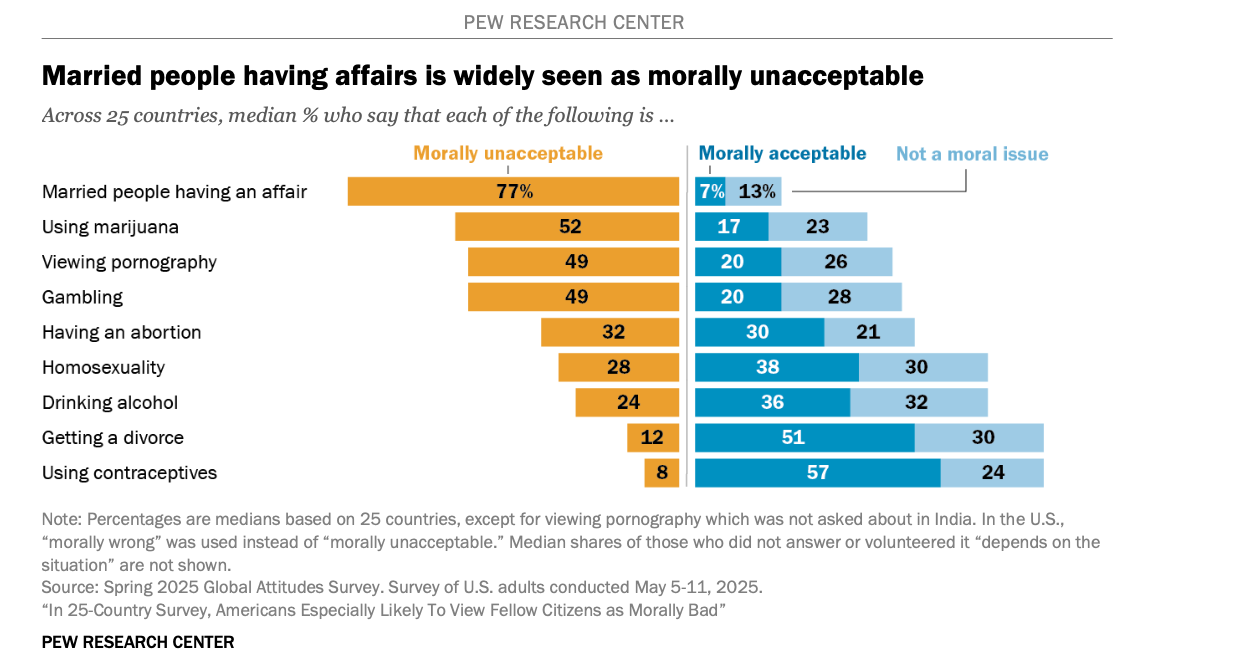
Read More Pew report examines how people rate fellow citizens’ morals #Catholic A Pew Research Center study found Americans are more likely than people in other countries to question the morality of their fellow citizens.The report, “In 25-Country Survey, Americans Especially Likely To View Fellow Citizens as Morally Bad,” explores how adults in 25 countries rate the morality of others in their nation. It also examines if people consider different behaviors to be morally wrong including drinking alcohol, gambling, having extramarital affairs, using marijuana, viewing pornography, having abortions, homosexuality, getting divorces, and using contraceptives.The research was based on data from participants in Argentina, Australia, Brazil, Canada, France, Germany, Greece, Hungary, India, Indonesia, Israel, Italy, Japan, Kenya, Mexico, Netherlands, Nigeria, Poland, South Africa, South Korea, Spain, Sweden, Turkey, the United Kingdom, and the United States.Surveys conducted outside the U.S. were based on nationally representative surveys of 28,333 adults conducted from Jan. 8 to April 26, 2025. In the U.S., Pew surveyed 3,605 adults who are members of the Center’s American Trends Panel (ATP) from March 24–30, 2025. A March 2026 Pew report, “In 25-Country Survey, Americans Especially Likely To View Fellow Citizens as Morally Bad,” explores if adults in 25 countries consider nine behaviors to be morally unacceptable or acceptable. | Credit: Courtesy of Pew Research Center The report also includes some findings from a separate ATP survey of 8,937 U.S. adults conducted from May 5–11, 2025. The margin of sampling error for the full sample of 3,605 respondents is plus or minus 1.9 percentage points.According to the research, 47% of U.S. adults reported Americans have “very good” or “somewhat good” morals and ethics, which was the lowest of all countries. The majority of adults in Canada and Indonesia (92%) said the same of the people in their countries.Most and least accepted behaviors across the globeGetting a divorce and the use of contraception were found to be the most widely accepted of the nine behaviors. Only 12% of adults overall said getting a divorce is morally wrong, and 8% said using contraceptives is. The only countries with a slight majority that believe getting a divorce is morally unacceptable are India with 65% holding this view and Nigeria with 55%.Of the nine behaviors Pew asked participants about, married people having affairs had the strongest overall disapproval. Across the 25 countries, a median of 77% of adults said married people having affairs is morally unacceptable, with at least half of adults in every country holding this view.U.S. adults were among those to be most likely to condemn extramarital affairs as immoral. Nine in 10 Americans said having an affair is morally wrong, similar to the share of people in Indonesia and in Turkey (92%) who believe the same. A March 2026 Pew report, “In 25-Country Survey, Americans Especially Likely To View Fellow Citizens as Morally Bad,” explores how adults in 25 countries rate the morality of others in their country. | Credit: Courtesy of Pew Research Center Adults in Germany (55%) and France (53%) are among the least likely to believe having an affair is morally unacceptable.Behaviors with least international consensusThe report found that for most behaviors asked about, there is not an international consensus if they are morally acceptable or not.In the Latin American and African countries surveyed, half or more of adults said they believe abortions are morally unacceptable, but in most European countries, the vast majority of adults view abortions as either morally acceptable or not a moral issue at all. In the U.S., the group was fairly split with 47% reporting it is morally unacceptable to have an abortion.In the U.S., adults are the most accepting of using marijuana and gambling. Only 23% of Americans said using marijuana is morally unacceptable, and 29% said the same in regard to gambling. In most other countries surveyed, more than 40% of adults said they consider gambling and marijuana use to be morally wrong.In 10 countries, a majority said gambling is morally wrong, including 89% in Indonesia and 71% in Italy. In Australia, 25% said gambling is morally acceptable, and 43% do not see gambling as a moral issue.In the U.S., 39% of adults reported homosexuality is morally wrong, which was found to be much more than those who hold the same belief in Germany (5%) or Sweden (5%). In other nations including Indonesia (93%) and Nigeria (96%), the majority reported it is morally wrong.In regard to drinking alcohol, the majority of adults in Indonesia (83%) reported it is a morally unacceptable act. In contrast, only 7% of adults in Australia and Sweden reported the same. In the U.S., a small share of 16% said it is morally unacceptable.What factors affect views of behaviors?According to the report, a number of factors seem to affect how adults view the morality of behaviors including political party, religion, and gender.Democrats and independents who lean toward the Democratic Party are more likely than Republicans and Republican leaners to rate fellow Americans as morally and ethically bad (60% vs. 46%).Pew examined citizens’ stances based on religious belief and found those who said religion is very important in their lives were more likely to view the behaviors as morally wrong.In 13 of the 25 countries surveyed, the research looked specifically at the differences between Protestants and Catholics. The report detailed that Protestants are typically more likely than Catholics in the same country to believe homosexuality is wrong. In the U.S., 59% of Protestants reported homosexuality is morally wrong, while 34% of Catholics did.There is a large variation between Christians in different countries. The majority of Christians surveyed in Africa, Latin America, and the U.S. said having an abortion is morally wrong, but across Europe, the share of Christians who hold this view ranges from 40% in Spain to 7% in Sweden.Gender is also a factor in how people view moral behaviors. Women tend to be more likely than men to believe some behaviors are morally unacceptable. In nearly every country surveyed, women were more likely than men to say that viewing pornography is wrong. In contrast, men were more likely than women to report homosexuality is morally unacceptable. Overall, older adults were more likely than younger adults to report the behaviors are morally unacceptable. This is the case with using marijuana in 19 of the 25 surveyed countries. In Germany, adults ages 40 and older are twice as likely as younger adults to believe marijuana use is morally wrong, with 30% of older adults holding this belief and 15% of younger adults. unitedyam March 5, 2026 U.S. adults were among those most likely to condemn extramarital affairs as immoral in a study of 25 countries. Read More

Read More Servant of God Sister Thea Bowman’s voice needed ‘more than ever’ #Catholic African American Servant of God Sister Thea Bowman’s ability to bridge divides shines as a witness needed today, according to those who knew her, and her cause for canonization may create a pathway for other African Americans on their ways to sainthood.More than three decades after her death, Bowman should be remembered for “her charism, gifts, prophetic voice, charismatic personality, and real strong commitment to the Church — truly being Catholic,” Bishop Joseph Kopacz of the Diocese of Jackson, Mississippi, told EWTN News.Bowman, the granddaughter of a slave, challenged the Church in the 20th century to confront its history of racial exclusion and to embrace Black Catholics through her work as a scholar, teacher, and speaker.The Diocese of Jackson officially closed its proceedings regarding her potential sainthood on Feb. 9 after Kopacz opened her cause in November 2018. The records are now being sent to the Dicastery for the Causes of Saints at the Vatican.“People around the world will be very excited and will celebrate what we hope will be the occasion of her canonization. And that’s because people, Catholic and non-Catholics alike, are drawn to her story,” Veryl Miles, law professor and leader of the Sister Thea Bowman Committee at The Catholic University of America, told EWTN News.Sister Thea’s life and legacyBowman was born Dec. 29, 1937, in Yazoo City, Mississippi, and was given the name Bertha Elizabeth Bowman. While her family was Methodist, Bowman was called to the Catholic faith at a young age.“At 9 years old, she told her parents she wanted to be Catholic. The sisters who were teaching at the school, the parish where she was, had such an impact on her. Then six years later, she joined their religious community,” Kopacz said.She joined the Franciscan Sisters of Perpetual Adoration at age 15 and enrolled in Viterbo University, which was run by the Franciscan sisters. Three years into formation, she took the religious name Thea, which means “of God” and is a version of her father’s name, Theon.“She was so focused on serving the Lord as a religious, and in this community, because they loved her as a young child,” Kopaz said. Bowman knew: “This is who I know. This is who I love. This is where I want to be.”She was the first and only African American woman in her religious community, often facing racism both within and beyond the Church, leading her to become an advocate for the dignity of Black people, their culture, and Black Catholic spirituality.Bowman went on to study at The Catholic University of America, earning a doctorate in English in 1972. Bowman helped found the National Black Sisters’ Conference and taught the university’s first Black literature course.Bowman, who taught for many years, was “a master teacher,” Franciscan Sister of Perpetual Adoration Charlene Smith, a close friend of Bowman’s and co-author of her biography “Thea’s Song,” told EWTN News.Smith and Bowman met in 1954 in La Crosse, Wisconsin, at St. Rose Convent. “She was just like me. We both wanted to be Franciscans, we both wanted to teach, and we both wanted to major in English in college, and we did all three of those things,” Smith said.After having moved away for graduate school, Bowman returned to La Crosse to teach in the English Department at Viterbo University. Smith also returned to serve as the school’s dean of students.“When I got back to La Crosse, they told me that I should beware of Sister Thea Bowman because she was ‘the most powerful woman on campus.’ They didn’t know that we were really good friends,” Smith said.“Being the dean, I was able to go to any classroom. I would go to Thea’s classrooms, and she would always come bounding in with a song, and she would get everybody into a really good mood,” Smith said.Bowman would also teach at parishes about Black liturgy and music. Eventually she starting to speak at a national level, becoming the first African American woman to address the U.S. bishops’ conference.She often used music to help evangelize and bridge interracial divides, and became a major contributor to the development of “Lead Me, Guide Me,” the Black Catholic hymnal published in 1987.Smith reflected on Bowman’s “marvelous” and “magnetic” personality. “We were invited to a dinner at a hotel, and she was going to give a speech. We got there early, so we went to sit down in the lobby … a pianist from Argentina was playing songs from ‘Porgy and Bess,’ and Thea got up and started singing ‘Summertime.’”“She got a standing ovation and an encore,” Smith said. “I think one of the greatest gifts, graces, in my life was my friendship with her. She was very kind to me, and she was very kind to all the people that she met.”At age 54, on March 30, 1990, Bowman died of breast cancer. She was buried at Elmwood Cemetery in Memphis, Tennessee, alongside her parents.Impact of Bowman’s causeBowman’s journey toward sainthood could have an especially effective impact today with the present division in the nation, as she would preach how we are “all human beings, and we should love everybody,” Smith said.“She was not interested in the melting pot at all,” Smith said. “She was more interested in a salad bowl because she said: ‘In a salad, people keep their identity, whereas in a melting pot, they’re all mushed together.’”Bowman “welcomed all in the universal body of Christ” Kopacz said. “She said the Church needs to truly be actively universal, and embrace different cultures and all the gifts that people bring.”“So today, more than ever, that voice is needed in our society as we can get more divisive,” Kopacz said. “I just think it’s perfect for our time and our Church.”“Her message is so universal,” Miles said. Especially “understanding the relationship between faith and identity among its members.”“She really understood and articulated so beautifully that we are people of faith and we are people of identities. The Church is a global church. There’s so many different people who are part of this Church — people of different races, different ethnicities, and nationalities.”‘An impetus’ for other African Americans on their way to sainthoodCurrently, there are no canonized African American saints, but the Church honors Black saints from other nations, including St. Josephine Bakhita, St. Martin de Porres, St. Monica of Hippo, and St. Augustine of Hippo, among others.Bowman is among seven African American Catholics with active canonization causes — dubbed the “Saintly Seven.” The group also includes Venerable Pierre Toussaint, Venerable Mother Mary Lange, Venerable Mother Henriette Delille, Venerable Father Augustus Tolton, Servant of God Julia Greeley, and Servant of God Friar Martin de Porres Maria Ward.Even before her potential canonization, Bowman will “draw attention” to the group, Kopacz said. If she becomes venerable, which the bishop expects she will, he believes Bowman “will be an impetus” for the causes of other African Americans to move forward. “She’s going to be an important part, and she’ll move the other causes along,” he said.Since people “can relate” to Bowman’s story as it “is so contemporary and so special,” Miles said she also hopes the other stories of the seven Catholics “will become highlighted” by her cause.“People will be more interested in finding out about the other African Americans who are in the process of canonization, because their stories are very special and very unique, too,” Miles said. unitedyam March 1, 2026 Bowman’s ability to see the dignity of each individual, and embrace all gifts and cultures, is an essential message for Catholics and non-Catholics alike. Read More