audience

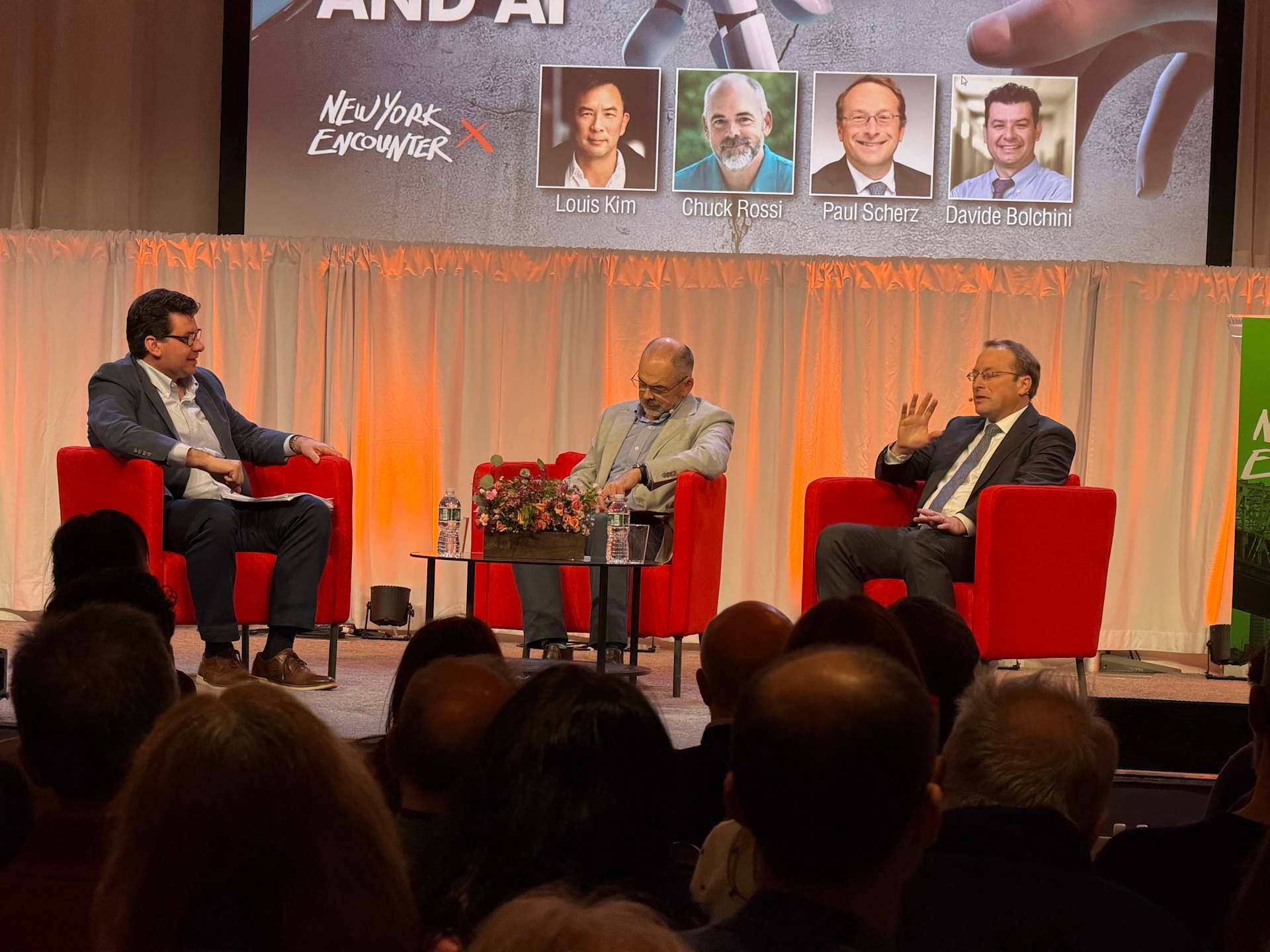
Catholic thinkers, tech experts reflect on promise and perils of AI at New York Encounter #Catholic NEW YORK — How can Catholic social teaching guide us in weighing the benefits of artificial intelligence against the dangers it poses to human dignity? That question animated a wide-ranging discussion among Catholic thinkers and technology experts at the New York Encounter on Saturday.Citing Pope Leo XIV’s call to use AI responsibly as well as the Church’s historic defense of human dignity in the face of modern technology, Davide Bolchini, moderator and dean of the Luddy School of Informatics at Indiana University, opened the discussion before an audience of several hundred people gathered for the three-day cultural conference in New York City.“The pope encouraged us to use AI responsibly, to use it in a way that helps us grow, not to let it work against us, but to let it work with us, not to substitute human intelligence, not to replace our judgment of what’s right … our ability of authentic wonder,” Bolchini said.With technology rapidly advancing, Bolchini asked, how can the Church stay ahead of these challenges?Chuck Rossi, an engineer at Meta who is developing AI-driven content moderation technology at the technology conglomerate, which includes Facebook and Instagram, argued that in his work, developments in AI have been instrumental in safeguarding human beings from harm. AI systems, he said, can examine 2.5 billion pieces of of shared online content per hour, filtering harmful material including nudity and sexual activity, bullying and harassment, child endanger, dangerous organizations, fake accounts, hateful conduct, restricted goods and services, spam, suicide and self-injury, violence and incitement, and violent and graphic content.“That’s my world,” he said. “It’s a very, very hard problem. If we miss 0.1% of 2. 5 billion, that’s millions of things that we didn’t want to be seeing. But we do an excellent job, and we have for years — we’re one of the best at it,” Rossi said.Using AI also protects human content moderators from being exposed to disturbing material, as they were in the past.“The good thing that we are giving back to humans is you never have to do this horrible work,” he said.Paul Scherz, professor of theology at the University of Notre Dame, acknowledged the benefits of AI, which he said included advances in medicine and efficiency for tasks like billing (“Nobody wants to do billing,” he said).But Scherz warned of the dangers of relying on technology to do what is intrinsically human.“We are really starting to turn to AI as people more broadly for these relational aspects, which would be tragic because there is something in that human-to-human connection, the ‘I/thou connection,’ as Martin Buber called it, that is irreplaceable by a machine,” Scherz said. He noted that AI has even moved into ministry, with the rise of Catholic apps relying on bots to offer catechesis.Scherz also cautioned that substituting AI for human interaction and intelligence risks eroding our skills, whether in relationships or in professional life.“My fear is as we use these chatbots more and more we will lose those person-to-person skills. We’ll no longer be able to engage one another as well, or have the patience and virtue to deeply love and encounter one another,” Scherz said.In addition, relying on AI in our work, for example, when a doctor consults AI to make a diagnosis, will result in our “de-skilling,” he said. “We know that people, when they’re using automated systems, they tend to just become biased and complacent and just approve the automated system. They lose their skills,” he said, adding that airline pilots who rely too much on autopilot are more prone to making errors.Louis Kim, former vice president of personal systems and AI at Hewlett-Packard who is currently pursuing graduate studies in theology and health care, pointed out that it’s not possible to know today what skills will be required in the future.“My personal view is I often find that predictions of impacted technology are largely unconsciously based on what we know of the current paradigm and structure and technologies,” Kim said.“There are going to be skills needed to control AI that are going to be different,” he said.Kim also called for “humility” in discussions about AI’s potential to affect human relationships.“Let’s ask ourselves about the quality of our current human relationships, whether it’s in the workplace, in toxic cultures, sometimes at home — even at conferences, at your next break, as you go around talking to this person [or] that person, how many times that person is looking over your shoulder for the more important person to talk to?” he said.Our moral formation, he said, will continue to shape the quality of our encounters with others.

Catholic thinkers, tech experts reflect on promise and perils of AI at New York Encounter #Catholic NEW YORK — How can Catholic social teaching guide us in weighing the benefits of artificial intelligence against the dangers it poses to human dignity? That question animated a wide-ranging discussion among Catholic thinkers and technology experts at the New York Encounter on Saturday.Citing Pope Leo XIV’s call to use AI responsibly as well as the Church’s historic defense of human dignity in the face of modern technology, Davide Bolchini, moderator and dean of the Luddy School of Informatics at Indiana University, opened the discussion before an audience of several hundred people gathered for the three-day cultural conference in New York City.“The pope encouraged us to use AI responsibly, to use it in a way that helps us grow, not to let it work against us, but to let it work with us, not to substitute human intelligence, not to replace our judgment of what’s right … our ability of authentic wonder,” Bolchini said.With technology rapidly advancing, Bolchini asked, how can the Church stay ahead of these challenges?Chuck Rossi, an engineer at Meta who is developing AI-driven content moderation technology at the technology conglomerate, which includes Facebook and Instagram, argued that in his work, developments in AI have been instrumental in safeguarding human beings from harm. AI systems, he said, can examine 2.5 billion pieces of of shared online content per hour, filtering harmful material including nudity and sexual activity, bullying and harassment, child endanger, dangerous organizations, fake accounts, hateful conduct, restricted goods and services, spam, suicide and self-injury, violence and incitement, and violent and graphic content.“That’s my world,” he said. “It’s a very, very hard problem. If we miss 0.1% of 2. 5 billion, that’s millions of things that we didn’t want to be seeing. But we do an excellent job, and we have for years — we’re one of the best at it,” Rossi said.Using AI also protects human content moderators from being exposed to disturbing material, as they were in the past.“The good thing that we are giving back to humans is you never have to do this horrible work,” he said.Paul Scherz, professor of theology at the University of Notre Dame, acknowledged the benefits of AI, which he said included advances in medicine and efficiency for tasks like billing (“Nobody wants to do billing,” he said).But Scherz warned of the dangers of relying on technology to do what is intrinsically human.“We are really starting to turn to AI as people more broadly for these relational aspects, which would be tragic because there is something in that human-to-human connection, the ‘I/thou connection,’ as Martin Buber called it, that is irreplaceable by a machine,” Scherz said. He noted that AI has even moved into ministry, with the rise of Catholic apps relying on bots to offer catechesis.Scherz also cautioned that substituting AI for human interaction and intelligence risks eroding our skills, whether in relationships or in professional life.“My fear is as we use these chatbots more and more we will lose those person-to-person skills. We’ll no longer be able to engage one another as well, or have the patience and virtue to deeply love and encounter one another,” Scherz said.In addition, relying on AI in our work, for example, when a doctor consults AI to make a diagnosis, will result in our “de-skilling,” he said. “We know that people, when they’re using automated systems, they tend to just become biased and complacent and just approve the automated system. They lose their skills,” he said, adding that airline pilots who rely too much on autopilot are more prone to making errors.Louis Kim, former vice president of personal systems and AI at Hewlett-Packard who is currently pursuing graduate studies in theology and health care, pointed out that it’s not possible to know today what skills will be required in the future.“My personal view is I often find that predictions of impacted technology are largely unconsciously based on what we know of the current paradigm and structure and technologies,” Kim said.“There are going to be skills needed to control AI that are going to be different,” he said.Kim also called for “humility” in discussions about AI’s potential to affect human relationships.“Let’s ask ourselves about the quality of our current human relationships, whether it’s in the workplace, in toxic cultures, sometimes at home — even at conferences, at your next break, as you go around talking to this person [or] that person, how many times that person is looking over your shoulder for the more important person to talk to?” he said.Our moral formation, he said, will continue to shape the quality of our encounters with others.

“The pope encouraged us to use AI responsibly, to use it in a way that helps us grow, not to let it work against us, ” said Davide Bolchini, the moderator of an AI panel at the weekend conference.
Read More
Arthur Brooks at SEEK26: ‘Your job isn’t to win arguments, it’s to win a soul’ #Catholic 
 
 Arthur Brooks gives a keynote address at SEEK 2026 on Jan. 4, 2026, in Columbus, Ohio. | Credit: Madalaine Elhabbal/CNA

Jan 6, 2026 / 12:29 pm (CNA).
New York Times bestselling author and Harvard professor Arthur Brooks encouraged attendees at SEEK 2026 to resist the temptation as missionaries to “fight fire with fire.”In his Jan. 4 keynote speech in Columbus, Ohio, Brooks said the world “is not just a cold world” but “a world that attacks you.” In this context, he said, it can be challenging not to fight back.However, he said, “your job isn’t to win arguments, it’s to win a soul.”Brooks teaches at the Harvard Kennedy School and Harvard Business School and has written multiple books on finding happiness and meaning in life, including “From Strength to Strength” and “Build the Life You Want,” which he coauthored with Oprah Winfrey. He also writes a column for The Free Press.Some 26,000 attendees have gathered through Jan. 5 in Columbus, Denver, and Fort Worth, Texas, for the SEEK 2026 conference organized by FOCUS.“The spirit of the missionary will take you into the heart of a culture war,” Brooks said. “And in that culture war, you won’t win with violence … as you can win with love.” Brooks recounted his experience giving a talk in Manchester, New Hampshire, in 2014 for an audience he said was “a very ideologically oriented group.”According to Brooks, he was the only speaker out of the 15 present who was not a presidential candidate. He said that during his address, he told his audience: “You’ve been hearing from political candidates who want your vote. And what they’re telling you is that you’re right and the people who disagree with you are stupid people and hate America, but I want you to remember something. Those people, they’re your neighbors, and they’re your family … It’s not that they hate America, it’s that they disagree with you.”When acting as a missionary, he said, the goal is to persuade people. “If you want to persuade them, you can’t do that with hatred, because nobody has ever been insulted into agreement,” Brooks said.‘Entering mission territory’Brooks concluded by telling about a retreat center that he and his wife, Ester, visit when they give marriage preparation. Inside the chapel of the retreat center, he said, there is a sign over the door to exit the chapel that reads: “You are now entering mission territory.”“So as you leave this beautiful, beautiful gathering tomorrow, the signs on the door of your hotel or this conference facility, any place that you find yourself as you leave this city, and effectively for the last time tomorrow, is that you’re entering mission territory,” Brooks said. “Let’s set the world on fire together.”Katie Tangeman, a sophomore at Northwest Missouri State University, said she came away from Brooks’ talk motivated to “just take a step back whenever I’m feeling frustrated or annoyed with somebody, or if they’re attacking me, to just see them as a beloved son or daughter of God and approach them with love instead of the contempt and hate that [Brooks] was talking about.”“Because that’s not being a good Christian,” she added.“I want to say the biggest thing I took away from Arthur Brooks’ talk tonight, his keynote speech, [is] that you can change the trajectory of how a conversation goes by battling it with kindness in a way,” said Andrew Stuart, an agricultural business major, also at Northwest Missouri State.

Arthur Brooks at SEEK26: ‘Your job isn’t to win arguments, it’s to win a soul’ #Catholic Arthur Brooks gives a keynote address at SEEK 2026 on Jan. 4, 2026, in Columbus, Ohio. | Credit: Madalaine Elhabbal/CNA Jan 6, 2026 / 12:29 pm (CNA). New York Times bestselling author and Harvard professor Arthur Brooks encouraged attendees at SEEK 2026 to resist the temptation as missionaries to “fight fire with fire.”In his Jan. 4 keynote speech in Columbus, Ohio, Brooks said the world “is not just a cold world” but “a world that attacks you.” In this context, he said, it can be challenging not to fight back.However, he said, “your job isn’t to win arguments, it’s to win a soul.”Brooks teaches at the Harvard Kennedy School and Harvard Business School and has written multiple books on finding happiness and meaning in life, including “From Strength to Strength” and “Build the Life You Want,” which he coauthored with Oprah Winfrey. He also writes a column for The Free Press.Some 26,000 attendees have gathered through Jan. 5 in Columbus, Denver, and Fort Worth, Texas, for the SEEK 2026 conference organized by FOCUS.“The spirit of the missionary will take you into the heart of a culture war,” Brooks said. “And in that culture war, you won’t win with violence … as you can win with love.” Brooks recounted his experience giving a talk in Manchester, New Hampshire, in 2014 for an audience he said was “a very ideologically oriented group.”According to Brooks, he was the only speaker out of the 15 present who was not a presidential candidate. He said that during his address, he told his audience: “You’ve been hearing from political candidates who want your vote. And what they’re telling you is that you’re right and the people who disagree with you are stupid people and hate America, but I want you to remember something. Those people, they’re your neighbors, and they’re your family … It’s not that they hate America, it’s that they disagree with you.”When acting as a missionary, he said, the goal is to persuade people. “If you want to persuade them, you can’t do that with hatred, because nobody has ever been insulted into agreement,” Brooks said.‘Entering mission territory’Brooks concluded by telling about a retreat center that he and his wife, Ester, visit when they give marriage preparation. Inside the chapel of the retreat center, he said, there is a sign over the door to exit the chapel that reads: “You are now entering mission territory.”“So as you leave this beautiful, beautiful gathering tomorrow, the signs on the door of your hotel or this conference facility, any place that you find yourself as you leave this city, and effectively for the last time tomorrow, is that you’re entering mission territory,” Brooks said. “Let’s set the world on fire together.”Katie Tangeman, a sophomore at Northwest Missouri State University, said she came away from Brooks’ talk motivated to “just take a step back whenever I’m feeling frustrated or annoyed with somebody, or if they’re attacking me, to just see them as a beloved son or daughter of God and approach them with love instead of the contempt and hate that [Brooks] was talking about.”“Because that’s not being a good Christian,” she added.“I want to say the biggest thing I took away from Arthur Brooks’ talk tonight, his keynote speech, [is] that you can change the trajectory of how a conversation goes by battling it with kindness in a way,” said Andrew Stuart, an agricultural business major, also at Northwest Missouri State.


Arthur Brooks gives a keynote address at SEEK 2026 on Jan. 4, 2026, in Columbus, Ohio. | Credit: Madalaine Elhabbal/CNA

Jan 6, 2026 / 12:29 pm (CNA).

New York Times bestselling author and Harvard professor Arthur Brooks encouraged attendees at SEEK 2026 to resist the temptation as missionaries to “fight fire with fire.”

In his Jan. 4 keynote speech in Columbus, Ohio, Brooks said the world “is not just a cold world” but “a world that attacks you.” In this context, he said, it can be challenging not to fight back.

However, he said, “your job isn’t to win arguments, it’s to win a soul.”

Brooks teaches at the Harvard Kennedy School and Harvard Business School and has written multiple books on finding happiness and meaning in life, including “From Strength to Strength” and “Build the Life You Want,” which he coauthored with Oprah Winfrey. He also writes a column for The Free Press.

Some 26,000 attendees have gathered through Jan. 5 in Columbus, Denver, and Fort Worth, Texas, for the SEEK 2026 conference organized by FOCUS.

“The spirit of the missionary will take you into the heart of a culture war,” Brooks said. “And in that culture war, you won’t win with violence … as you can win with love.” Brooks recounted his experience giving a talk in Manchester, New Hampshire, in 2014 for an audience he said was “a very ideologically oriented group.”

According to Brooks, he was the only speaker out of the 15 present who was not a presidential candidate. He said that during his address, he told his audience: “You’ve been hearing from political candidates who want your vote. And what they’re telling you is that you’re right and the people who disagree with you are stupid people and hate America, but I want you to remember something. Those people, they’re your neighbors, and they’re your family … It’s not that they hate America, it’s that they disagree with you.”

When acting as a missionary, he said, the goal is to persuade people. “If you want to persuade them, you can’t do that with hatred, because nobody has ever been insulted into agreement,” Brooks said.

‘Entering mission territory’

Brooks concluded by telling about a retreat center that he and his wife, Ester, visit when they give marriage preparation. Inside the chapel of the retreat center, he said, there is a sign over the door to exit the chapel that reads: “You are now entering mission territory.”

“So as you leave this beautiful, beautiful gathering tomorrow, the signs on the door of your hotel or this conference facility, any place that you find yourself as you leave this city, and effectively for the last time tomorrow, is that you’re entering mission territory,” Brooks said. “Let’s set the world on fire together.”

Katie Tangeman, a sophomore at Northwest Missouri State University, said she came away from Brooks’ talk motivated to “just take a step back whenever I’m feeling frustrated or annoyed with somebody, or if they’re attacking me, to just see them as a beloved son or daughter of God and approach them with love instead of the contempt and hate that [Brooks] was talking about.”

“Because that’s not being a good Christian,” she added.

“I want to say the biggest thing I took away from Arthur Brooks’ talk tonight, his keynote speech, [is] that you can change the trajectory of how a conversation goes by battling it with kindness in a way,” said Andrew Stuart, an agricultural business major, also at Northwest Missouri State.

Read More
‘As men, you’re called to act!’ speaker says to a packed room of young men at SEEK 2026 #Catholic 
 
 John Bishop, founder of Forge, speaks to hundreds of young men at the SEEK 2026 conference in the Diocese of Fort Worth, Texas, on Jan. 2, 2026. | Credit: Amira Abuzeid/CNA

Jan 6, 2026 / 07:00 am (CNA).
Hundreds of young men at the SEEK 2026 conference in the Fort Worth, Texas, Diocese this weekend filled a cavernous room to learn about what it means to be a man formed by “Jesus Christ and his Church.”John Bishop, founder and executive director of Forge, an organization that supports the family with an emphasis on masculinity, told the young men that “you are much more than your animalistic desires. Live something higher for someone higher.”In his talk titled “God Made Men,” Bishop spoke about how when Adam, the first man, “opened his eyes, he had never seen a woman before. She was completely naked.”“It was a great day for Adam,” Bishop said to waves of laughter. “Adam was the Elon Musk of the garden.”Taking a more serious tone, Bishop asked: “How would Adam see Eve? In his theology of the body, Pope John Paul II said Eve’s body was a manifestation of her soul. Eve had a perfect body, but when Adam saw her naked body, he didn’t lust over her.”“He realized who she was and who he was: made to make a gift of himself to her,” he said.Bishop then turned to what happened next: “What did Adam do as the snake came into the garden?” he asked.“Nothing! The most common, toxic, nauseating sin that runs rampant throughout men in the world is that we don’t do a damn thing.”“When we see our brothers walking into sin, we twiddle our thumbs. When we see our daughters walking out wearing next to nothing, we say nothing. When we’re grandfathers seeing the culture going in a bad way, we watch football,” he said.‘The image of God lives in a man fully alive’“You’re called to act!” Bishop admonished the group. “You might be filled with doubt … but it might be time for you to take the first step.”“The image of God lives in a man fully alive … Study after study shows that when a good man acts and doesn’t hold anything back, when he follows Christ with all [he is], … when he gives himself over [to Christ], the effect of that one man’s life multiplies beyond anything that we can understand,” he said.Hundreds of young men listen to John Bishop’s talk on masculinity on Jan. 2, 2026, at the SEEK conference in Grapevine, Texas. | Credit: Amira Abuzeid/CNAPatricio Parra, a sophomore at Texas A&M University, told CNA that he enjoyed Bishop’s talk because he and his friends have noticed how “society says it’s toxic to be masculine.”Parra said a New York Times journalist asked him and his friends after the talk why his generation of men was so invested in the faith.“There’s a striving for men to want to be men again,” he told her. “As a society, we see male role models on YouTube, but they are deformed. Recently, there aren’t a lot of good masculine models to follow.”Parra said what stood out to him the most after Bishop’s talk was the idea that Adam saw Eve’s physical beauty as the same as her internal beauty and recognized her dignity.“We have to strive to be as masculine as that,” Parra said.He said he took to heart three pieces of advice Bishop gave the men in the audience.First: “There’s no glory without the cross, no sainthood without suffering; so suffer a little bit. Make your body go through hard things,” Parra recalled. “Everything we suffer now will bring fruit for others, including our children someday, who will want to emulate us.”Next, Parra said Bishop advised that young men invest in solid, masculine friendships where they encourage one another toward sainthood.Last, Bishop told his listeners to be like St. Joseph, who, after Adam, was “one of the most manly men in Scripture.”“Joseph never said a word. We just know what he did,” Parra said. “We should do the same: just be quiet and act.”Parra demonstrated a hand motion he and his other friends from Texas A&M invented to go with the words “Zip it and act!” He made a zipper motion across his mouth and then the letter “A” with his fingers.“Don’t just talk about asking a girl out; do it!” he said enthusiastically. “Don’t just think about seminary; go do it!”

‘As men, you’re called to act!’ speaker says to a packed room of young men at SEEK 2026 #Catholic John Bishop, founder of Forge, speaks to hundreds of young men at the SEEK 2026 conference in the Diocese of Fort Worth, Texas, on Jan. 2, 2026. | Credit: Amira Abuzeid/CNA Jan 6, 2026 / 07:00 am (CNA). Hundreds of young men at the SEEK 2026 conference in the Fort Worth, Texas, Diocese this weekend filled a cavernous room to learn about what it means to be a man formed by “Jesus Christ and his Church.”John Bishop, founder and executive director of Forge, an organization that supports the family with an emphasis on masculinity, told the young men that “you are much more than your animalistic desires. Live something higher for someone higher.”In his talk titled “God Made Men,” Bishop spoke about how when Adam, the first man, “opened his eyes, he had never seen a woman before. She was completely naked.”“It was a great day for Adam,” Bishop said to waves of laughter. “Adam was the Elon Musk of the garden.”Taking a more serious tone, Bishop asked: “How would Adam see Eve? In his theology of the body, Pope John Paul II said Eve’s body was a manifestation of her soul. Eve had a perfect body, but when Adam saw her naked body, he didn’t lust over her.”“He realized who she was and who he was: made to make a gift of himself to her,” he said.Bishop then turned to what happened next: “What did Adam do as the snake came into the garden?” he asked.“Nothing! The most common, toxic, nauseating sin that runs rampant throughout men in the world is that we don’t do a damn thing.”“When we see our brothers walking into sin, we twiddle our thumbs. When we see our daughters walking out wearing next to nothing, we say nothing. When we’re grandfathers seeing the culture going in a bad way, we watch football,” he said.‘The image of God lives in a man fully alive’“You’re called to act!” Bishop admonished the group. “You might be filled with doubt … but it might be time for you to take the first step.”“The image of God lives in a man fully alive … Study after study shows that when a good man acts and doesn’t hold anything back, when he follows Christ with all [he is], … when he gives himself over [to Christ], the effect of that one man’s life multiplies beyond anything that we can understand,” he said.Hundreds of young men listen to John Bishop’s talk on masculinity on Jan. 2, 2026, at the SEEK conference in Grapevine, Texas. | Credit: Amira Abuzeid/CNAPatricio Parra, a sophomore at Texas A&M University, told CNA that he enjoyed Bishop’s talk because he and his friends have noticed how “society says it’s toxic to be masculine.”Parra said a New York Times journalist asked him and his friends after the talk why his generation of men was so invested in the faith.“There’s a striving for men to want to be men again,” he told her. “As a society, we see male role models on YouTube, but they are deformed. Recently, there aren’t a lot of good masculine models to follow.”Parra said what stood out to him the most after Bishop’s talk was the idea that Adam saw Eve’s physical beauty as the same as her internal beauty and recognized her dignity.“We have to strive to be as masculine as that,” Parra said.He said he took to heart three pieces of advice Bishop gave the men in the audience.First: “There’s no glory without the cross, no sainthood without suffering; so suffer a little bit. Make your body go through hard things,” Parra recalled. “Everything we suffer now will bring fruit for others, including our children someday, who will want to emulate us.”Next, Parra said Bishop advised that young men invest in solid, masculine friendships where they encourage one another toward sainthood.Last, Bishop told his listeners to be like St. Joseph, who, after Adam, was “one of the most manly men in Scripture.”“Joseph never said a word. We just know what he did,” Parra said. “We should do the same: just be quiet and act.”Parra demonstrated a hand motion he and his other friends from Texas A&M invented to go with the words “Zip it and act!” He made a zipper motion across his mouth and then the letter “A” with his fingers.“Don’t just talk about asking a girl out; do it!” he said enthusiastically. “Don’t just think about seminary; go do it!”


John Bishop, founder of Forge, speaks to hundreds of young men at the SEEK 2026 conference in the Diocese of Fort Worth, Texas, on Jan. 2, 2026. | Credit: Amira Abuzeid/CNA

Jan 6, 2026 / 07:00 am (CNA).

Hundreds of young men at the SEEK 2026 conference in the Fort Worth, Texas, Diocese this weekend filled a cavernous room to learn about what it means to be a man formed by “Jesus Christ and his Church.”

John Bishop, founder and executive director of Forge, an organization that supports the family with an emphasis on masculinity, told the young men that “you are much more than your animalistic desires. Live something higher for someone higher.”

In his talk titled “God Made Men,” Bishop spoke about how when Adam, the first man, “opened his eyes, he had never seen a woman before. She was completely naked.”

“It was a great day for Adam,” Bishop said to waves of laughter. “Adam was the Elon Musk of the garden.”

Taking a more serious tone, Bishop asked: “How would Adam see Eve? In his theology of the body, Pope John Paul II said Eve’s body was a manifestation of her soul. Eve had a perfect body, but when Adam saw her naked body, he didn’t lust over her.”

“He realized who she was and who he was: made to make a gift of himself to her,” he said.

Bishop then turned to what happened next: “What did Adam do as the snake came into the garden?” he asked.

“Nothing! The most common, toxic, nauseating sin that runs rampant throughout men in the world is that we don’t do a damn thing.”

“When we see our brothers walking into sin, we twiddle our thumbs. When we see our daughters walking out wearing next to nothing, we say nothing. When we’re grandfathers seeing the culture going in a bad way, we watch football,” he said.

‘The image of God lives in a man fully alive’

“You’re called to act!” Bishop admonished the group. “You might be filled with doubt … but it might be time for you to take the first step.”

“The image of God lives in a man fully alive … Study after study shows that when a good man acts and doesn’t hold anything back, when he follows Christ with all [he is], … when he gives himself over [to Christ], the effect of that one man’s life multiplies beyond anything that we can understand,” he said.

Hundreds of young men listen to John Bishop’s talk on masculinity on Jan. 2, 2026, at the SEEK conference in Grapevine, Texas. | Credit: Amira Abuzeid/CNA

Patricio Parra, a sophomore at Texas A&M University, told CNA that he enjoyed Bishop’s talk because he and his friends have noticed how “society says it’s toxic to be masculine.”

Parra said a New York Times journalist asked him and his friends after the talk why his generation of men was so invested in the faith.

“There’s a striving for men to want to be men again,” he told her. “As a society, we see male role models on YouTube, but they are deformed. Recently, there aren’t a lot of good masculine models to follow.”

Parra said what stood out to him the most after Bishop’s talk was the idea that Adam saw Eve’s physical beauty as the same as her internal beauty and recognized her dignity.

“We have to strive to be as masculine as that,” Parra said.

He said he took to heart three pieces of advice Bishop gave the men in the audience.

First: “There’s no glory without the cross, no sainthood without suffering; so suffer a little bit. Make your body go through hard things,” Parra recalled. “Everything we suffer now will bring fruit for others, including our children someday, who will want to emulate us.”

Next, Parra said Bishop advised that young men invest in solid, masculine friendships where they encourage one another toward sainthood.

Last, Bishop told his listeners to be like St. Joseph, who, after Adam, was “one of the most manly men in Scripture.”

“Joseph never said a word. We just know what he did,” Parra said. “We should do the same: just be quiet and act.”

Parra demonstrated a hand motion he and his other friends from Texas A&M invented to go with the words “Zip it and act!” He made a zipper motion across his mouth and then the letter “A” with his fingers.

“Don’t just talk about asking a girl out; do it!” he said enthusiastically. “Don’t just think about seminary; go do it!”

Read More
Catholic singles seek faithful connections at huge SEEK 2026 speed dating event #Catholic 
 
 Young Catholics gather for a possibly record-breaking large speed dating event in Columbus, Ohio, on Jan. 4, 2026. | Credit: Gigi Duncan/EWTN News / null

Jan 5, 2026 / 16:41 pm (CNA).
“Do you believe in miracles, or should we start with coffee?”Young Catholics gathered for a possibly record-breaking large speed dating event in Columbus, Ohio, on Jan. 4. About 2,500 students participated in speed dating at SEEK 2026, reflecting both a thirst for genuine connection and a willingness to step outside of comfort zones in pursuit of meaningful relationships. At a time when dating culture often seems dominated by casual hookups, social media pressures, and uncertainty, SEEK 2026 participants explored a wide range of topics, from personal faith to vocational discernment. The event broke the world record for the largest speed dating event based on earlier entries in Guinness World Records.About 26,000 people attended the SEEK 2026 conference held simultaneously in Columbus, Denver, and Fort Worth, Texas, organized by  FOCUS, a Catholic group that sends missionaries to college campuses and parishes.In Columbus, which drew about 16,000 attendees, Emily Wilson, a Catholic author and YouTuber, offered students a framework for approaching dating with clarity and purpose ahead of the speed dating event on Jan. 4. 6 principles for intentional Catholic dating Wilson emphasized six key points for navigating dating with freedom, dignity, and an ultimate focus on God.1. Go on one date — and let others do the same.“Dating is the process of discernment,” Wilson said. “You do not need to know if you’re going to marry someone before saying yes to a second date. Jesus wants you to be calm.” The idea is simple: Allow yourself and others to explore relationships without pressure, gossip, or unrealistic expectations. 2. Use the word “date” and be clear and intentional.Clarity matters, especially in an age where sending a “WYD” (what are you doing?) text has become common. “If you want to stand out, be clear. Use the word ‘date,’” Wilson told the audience. “Call her. Say, ‘I’d love to take you on a date.’ Yes, it’s a risk, but many marriages begin with that courage.”3. If God calls you to marriage, college is not the only place to meet your spouse.Wilson encouraged young people to resist the “ring by spring” pressures. “Focus on becoming the most beautiful version of yourself — the person God is calling you to be right now,” she said. God’s timing, she emphasized, is unique for everyone.4. Let go of the idea that your future spouse will perfectly match your type.While attraction is important, deeper qualities matter most. “When life gets hard,” Wilson noted, one will not be so fixated on physical appearance but rather be thanking God that their spouse is so “selfless, giving, kind, loving, virtuous, and holy.”5. Guard your heart.“Peace in dating comes from making hard choices to protect your heart,” she said, quoting Philippians 4:7: “The peace of God, which surpasses all understanding, will guard your hearts and minds in Christ Jesus.” Making intentional decisions is a form of self-respect, not aggression.6. Do not apologize for your standards.Wilson urged students to stand firm in their faith and virtues: “Say it with confidence. ‘I’m looking for a virtuous Catholic who loves the Eucharist, desires the sacraments, and wants a faithful marriage.’ There is nothing to apologize for.”Breaking records, building connectionsThe “Catholic Speed Dating Event with Candid” drew lines stretching across several exhibit halls down the Greater Columbus Convention Center. Students repeatedly noted that such spaces provide rare, faith-aligned opportunities to meet new people without immediate expectation.Participants described the speed dating event as both countercultural and reassuring — a response to frustrations many feel with modern dating. For Clemson University student Jonathan Brinker, the shared Catholic identity immediately changed the tone of conversations. “It was nice to meet people who have similar values,” he said. “That makes the conversation deeper and more meaningful.”That sense of ease stood out for Shippensburg University student Joseph Striggle as well. “Events like this help you realize dating isn’t as intimidating as it’s made out to be,” he said. “It’s just having a normal conversation with another person.”His classmate, Tom Gehman, said the event addressed deeper concerns about today’s dating culture. “A lot of people don’t share the same worldview or end goals, especially when it comes to faith and relationships,” he noted. “People want reassurance that there are other people who share their values.” Expressing a strong dislike of social media, Gehman added that he desires “to meet someone face-to-face and ask them out directly,” calling the event “good practice” for doing so.Students from Western Kentucky University echoed this sentiment as well as an emphasis on lowering pressure while remaining intentional. “Going on a first date doesn’t mean you have to marry that person,” Mary Pikar said. “It’s just about getting to know each other.” Karley Solorzano added that high expectations can sometimes lead to inaction. “We overthink dating, especially as Catholics,” she said. “Events like this can give us a way to take chances and trust that God can surprise us.”For some students, simply being surrounded by others who take faith seriously was encouraging. Seton Hall University student Emily Castillo said observing faithful behavior — even in her male friendships — gave her hope. “Seeing that makes me think what it could be like with someone who genuinely loves and cares for me,” she said. Maria Notario added: “A shared faith allows relationships to go deeper than surface-level connections. Everyone [at the event] is single and Catholic; there’s at least some foundation there.”Short conversations also proved meaningful. Kylee Jackels from Winona State University said having a designated space to meet people — even for a few minutes at a time — mattered. “It’s valuable to have a low-pressure environment where people can actually talk,” she said. “There aren’t many single Christians where I’m from,” Lindsay Moen added. “It was nice to be in this space with similar people without crazy expectations.” The two students did see immediate results, however, as their friend was asked out on a date while waiting in line for the event to begin.Others said the event helped them step outside their comfort zones. Anna Whittenburg of Bowling Green State University referenced Emily Wilson’s earlier point of maintaining standards, sharing that this was something she kept in mind before going into the speed dating event. “Hearing that reaffirmed by someone like Emily Wilson made a difference. I don’t have to apologize for wanting a good, healthy Catholic relationship,” she said. Her twin sister, Elaina, added that the experience was practical as well as affirming: “It was a good way to practice talking to new people.”For University of Alabama student Jay Zito, this event challenged initial hesitation. “We were kind of dragged into it by a friend,” he admitted. “But I’m glad we were. In an age where men can be fearful of approaching women for several reasons, this space gave people permission to try and make meaningful connections.” His friend Landon McClellan added that the in-person nature of the event was crucial. “Hookup culture is everywhere today, and things like social media, filters, and AI mess with expectations and confidence,” he said. “Dating doesn’t have to be scary; it can be a really good thing that will lead to sacramental marriages.”Candid Dating, a platform co-founded by Taylor O’Brien, led the speed dating event. Candid hosts weekly virtual speed dating for Catholic singles, and SEEK provided a chance to create real connections in person. “Success can look different for everyone. For some, it’s gaining experience and confidence in talking to others — men or women,” O’Brien said. “For others, it might be building the courage to ask for someone’s number or feeling secure and confident present themselves as a whole person.”She added that another goal for some could be marriage, reflecting the previous year’s several couples who have since become engaged. Hope for the futureWilson said the weekend confirmed what she has seen in her work with Catholic singles: a deep desire for holy, intentional relationships. “There has been a real breakdown in communication, and a lot of fear has crept in,” she said. That fear, she described, is not from the Lord but rather the enemy who “wants us stuck in panic or overwhelm” so that we don’t “step into what the Lord desires for us.”Drawing on her experience with Sacred Spark, a Catholic dating platform she co-founded, Wilson expressed optimism. “We now have tens of thousands of Catholic singles on the app who are intentionally seeking meaningful relationships, even if it starts digitally — just making that initial connection.”She added that in the coming years, “we’re going to see a revival of beautiful sacramental marriages, with Catholic singles who are intentional, communicative, open, honest, and clear.”“After things have become as complicated as they have, there’s really nowhere to go but up,” she said. “For these young Catholics desiring relationships, I really stand on hope.”

Catholic singles seek faithful connections at huge SEEK 2026 speed dating event #Catholic Young Catholics gather for a possibly record-breaking large speed dating event in Columbus, Ohio, on Jan. 4, 2026. | Credit: Gigi Duncan/EWTN News / null Jan 5, 2026 / 16:41 pm (CNA). “Do you believe in miracles, or should we start with coffee?”Young Catholics gathered for a possibly record-breaking large speed dating event in Columbus, Ohio, on Jan. 4. About 2,500 students participated in speed dating at SEEK 2026, reflecting both a thirst for genuine connection and a willingness to step outside of comfort zones in pursuit of meaningful relationships. At a time when dating culture often seems dominated by casual hookups, social media pressures, and uncertainty, SEEK 2026 participants explored a wide range of topics, from personal faith to vocational discernment. The event broke the world record for the largest speed dating event based on earlier entries in Guinness World Records.About 26,000 people attended the SEEK 2026 conference held simultaneously in Columbus, Denver, and Fort Worth, Texas, organized by  FOCUS, a Catholic group that sends missionaries to college campuses and parishes.In Columbus, which drew about 16,000 attendees, Emily Wilson, a Catholic author and YouTuber, offered students a framework for approaching dating with clarity and purpose ahead of the speed dating event on Jan. 4. 6 principles for intentional Catholic dating Wilson emphasized six key points for navigating dating with freedom, dignity, and an ultimate focus on God.1. Go on one date — and let others do the same.“Dating is the process of discernment,” Wilson said. “You do not need to know if you’re going to marry someone before saying yes to a second date. Jesus wants you to be calm.” The idea is simple: Allow yourself and others to explore relationships without pressure, gossip, or unrealistic expectations. 2. Use the word “date” and be clear and intentional.Clarity matters, especially in an age where sending a “WYD” (what are you doing?) text has become common. “If you want to stand out, be clear. Use the word ‘date,’” Wilson told the audience. “Call her. Say, ‘I’d love to take you on a date.’ Yes, it’s a risk, but many marriages begin with that courage.”3. If God calls you to marriage, college is not the only place to meet your spouse.Wilson encouraged young people to resist the “ring by spring” pressures. “Focus on becoming the most beautiful version of yourself — the person God is calling you to be right now,” she said. God’s timing, she emphasized, is unique for everyone.4. Let go of the idea that your future spouse will perfectly match your type.While attraction is important, deeper qualities matter most. “When life gets hard,” Wilson noted, one will not be so fixated on physical appearance but rather be thanking God that their spouse is so “selfless, giving, kind, loving, virtuous, and holy.”5. Guard your heart.“Peace in dating comes from making hard choices to protect your heart,” she said, quoting Philippians 4:7: “The peace of God, which surpasses all understanding, will guard your hearts and minds in Christ Jesus.” Making intentional decisions is a form of self-respect, not aggression.6. Do not apologize for your standards.Wilson urged students to stand firm in their faith and virtues: “Say it with confidence. ‘I’m looking for a virtuous Catholic who loves the Eucharist, desires the sacraments, and wants a faithful marriage.’ There is nothing to apologize for.”Breaking records, building connectionsThe “Catholic Speed Dating Event with Candid” drew lines stretching across several exhibit halls down the Greater Columbus Convention Center. Students repeatedly noted that such spaces provide rare, faith-aligned opportunities to meet new people without immediate expectation.Participants described the speed dating event as both countercultural and reassuring — a response to frustrations many feel with modern dating. For Clemson University student Jonathan Brinker, the shared Catholic identity immediately changed the tone of conversations. “It was nice to meet people who have similar values,” he said. “That makes the conversation deeper and more meaningful.”That sense of ease stood out for Shippensburg University student Joseph Striggle as well. “Events like this help you realize dating isn’t as intimidating as it’s made out to be,” he said. “It’s just having a normal conversation with another person.”His classmate, Tom Gehman, said the event addressed deeper concerns about today’s dating culture. “A lot of people don’t share the same worldview or end goals, especially when it comes to faith and relationships,” he noted. “People want reassurance that there are other people who share their values.” Expressing a strong dislike of social media, Gehman added that he desires “to meet someone face-to-face and ask them out directly,” calling the event “good practice” for doing so.Students from Western Kentucky University echoed this sentiment as well as an emphasis on lowering pressure while remaining intentional. “Going on a first date doesn’t mean you have to marry that person,” Mary Pikar said. “It’s just about getting to know each other.” Karley Solorzano added that high expectations can sometimes lead to inaction. “We overthink dating, especially as Catholics,” she said. “Events like this can give us a way to take chances and trust that God can surprise us.”For some students, simply being surrounded by others who take faith seriously was encouraging. Seton Hall University student Emily Castillo said observing faithful behavior — even in her male friendships — gave her hope. “Seeing that makes me think what it could be like with someone who genuinely loves and cares for me,” she said. Maria Notario added: “A shared faith allows relationships to go deeper than surface-level connections. Everyone [at the event] is single and Catholic; there’s at least some foundation there.”Short conversations also proved meaningful. Kylee Jackels from Winona State University said having a designated space to meet people — even for a few minutes at a time — mattered. “It’s valuable to have a low-pressure environment where people can actually talk,” she said. “There aren’t many single Christians where I’m from,” Lindsay Moen added. “It was nice to be in this space with similar people without crazy expectations.” The two students did see immediate results, however, as their friend was asked out on a date while waiting in line for the event to begin.Others said the event helped them step outside their comfort zones. Anna Whittenburg of Bowling Green State University referenced Emily Wilson’s earlier point of maintaining standards, sharing that this was something she kept in mind before going into the speed dating event. “Hearing that reaffirmed by someone like Emily Wilson made a difference. I don’t have to apologize for wanting a good, healthy Catholic relationship,” she said. Her twin sister, Elaina, added that the experience was practical as well as affirming: “It was a good way to practice talking to new people.”For University of Alabama student Jay Zito, this event challenged initial hesitation. “We were kind of dragged into it by a friend,” he admitted. “But I’m glad we were. In an age where men can be fearful of approaching women for several reasons, this space gave people permission to try and make meaningful connections.” His friend Landon McClellan added that the in-person nature of the event was crucial. “Hookup culture is everywhere today, and things like social media, filters, and AI mess with expectations and confidence,” he said. “Dating doesn’t have to be scary; it can be a really good thing that will lead to sacramental marriages.”Candid Dating, a platform co-founded by Taylor O’Brien, led the speed dating event. Candid hosts weekly virtual speed dating for Catholic singles, and SEEK provided a chance to create real connections in person. “Success can look different for everyone. For some, it’s gaining experience and confidence in talking to others — men or women,” O’Brien said. “For others, it might be building the courage to ask for someone’s number or feeling secure and confident present themselves as a whole person.”She added that another goal for some could be marriage, reflecting the previous year’s several couples who have since become engaged. Hope for the futureWilson said the weekend confirmed what she has seen in her work with Catholic singles: a deep desire for holy, intentional relationships. “There has been a real breakdown in communication, and a lot of fear has crept in,” she said. That fear, she described, is not from the Lord but rather the enemy who “wants us stuck in panic or overwhelm” so that we don’t “step into what the Lord desires for us.”Drawing on her experience with Sacred Spark, a Catholic dating platform she co-founded, Wilson expressed optimism. “We now have tens of thousands of Catholic singles on the app who are intentionally seeking meaningful relationships, even if it starts digitally — just making that initial connection.”She added that in the coming years, “we’re going to see a revival of beautiful sacramental marriages, with Catholic singles who are intentional, communicative, open, honest, and clear.”“After things have become as complicated as they have, there’s really nowhere to go but up,” she said. “For these young Catholics desiring relationships, I really stand on hope.”


Young Catholics gather for a possibly record-breaking large speed dating event in Columbus, Ohio, on Jan. 4, 2026. | Credit: Gigi Duncan/EWTN News / null

Jan 5, 2026 / 16:41 pm (CNA).

“Do you believe in miracles, or should we start with coffee?”

Young Catholics gathered for a possibly record-breaking large speed dating event in Columbus, Ohio, on Jan. 4. 

About 2,500 students participated in speed dating at SEEK 2026, reflecting both a thirst for genuine connection and a willingness to step outside of comfort zones in pursuit of meaningful relationships. At a time when dating culture often seems dominated by casual hookups, social media pressures, and uncertainty, SEEK 2026 participants explored a wide range of topics, from personal faith to vocational discernment. 

The event broke the world record for the largest speed dating event based on earlier entries in Guinness World Records.

About 26,000 people attended the SEEK 2026 conference held simultaneously in Columbus, Denver, and Fort Worth, Texas, organized by  FOCUS, a Catholic group that sends missionaries to college campuses and parishes.

In Columbus, which drew about 16,000 attendees, Emily Wilson, a Catholic author and YouTuber, offered students a framework for approaching dating with clarity and purpose ahead of the speed dating event on Jan. 4. 

6 principles for intentional Catholic dating

Wilson emphasized six key points for navigating dating with freedom, dignity, and an ultimate focus on God.

1. Go on one date — and let others do the same.

“Dating is the process of discernment,” Wilson said. “You do not need to know if you’re going to marry someone before saying yes to a second date. Jesus wants you to be calm.” The idea is simple: Allow yourself and others to explore relationships without pressure, gossip, or unrealistic expectations. 

2. Use the word “date” and be clear and intentional.

Clarity matters, especially in an age where sending a “WYD” (what are you doing?) text has become common. “If you want to stand out, be clear. Use the word ‘date,’” Wilson told the audience. “Call her. Say, ‘I’d love to take you on a date.’ Yes, it’s a risk, but many marriages begin with that courage.”

3. If God calls you to marriage, college is not the only place to meet your spouse.

Wilson encouraged young people to resist the “ring by spring” pressures. “Focus on becoming the most beautiful version of yourself — the person God is calling you to be right now,” she said. God’s timing, she emphasized, is unique for everyone.

4. Let go of the idea that your future spouse will perfectly match your type.

While attraction is important, deeper qualities matter most. “When life gets hard,” Wilson noted, one will not be so fixated on physical appearance but rather be thanking God that their spouse is so “selfless, giving, kind, loving, virtuous, and holy.”

5. Guard your heart.

“Peace in dating comes from making hard choices to protect your heart,” she said, quoting Philippians 4:7: “The peace of God, which surpasses all understanding, will guard your hearts and minds in Christ Jesus.” Making intentional decisions is a form of self-respect, not aggression.

6. Do not apologize for your standards.

Wilson urged students to stand firm in their faith and virtues: “Say it with confidence. ‘I’m looking for a virtuous Catholic who loves the Eucharist, desires the sacraments, and wants a faithful marriage.’ There is nothing to apologize for.”

Breaking records, building connections

The “Catholic Speed Dating Event with Candid” drew lines stretching across several exhibit halls down the Greater Columbus Convention Center. Students repeatedly noted that such spaces provide rare, faith-aligned opportunities to meet new people without immediate expectation.

Participants described the speed dating event as both countercultural and reassuring — a response to frustrations many feel with modern dating. For Clemson University student Jonathan Brinker, the shared Catholic identity immediately changed the tone of conversations. “It was nice to meet people who have similar values,” he said. “That makes the conversation deeper and more meaningful.”

That sense of ease stood out for Shippensburg University student Joseph Striggle as well. “Events like this help you realize dating isn’t as intimidating as it’s made out to be,” he said. “It’s just having a normal conversation with another person.”

His classmate, Tom Gehman, said the event addressed deeper concerns about today’s dating culture. “A lot of people don’t share the same worldview or end goals, especially when it comes to faith and relationships,” he noted. “People want reassurance that there are other people who share their values.”

Expressing a strong dislike of social media, Gehman added that he desires “to meet someone face-to-face and ask them out directly,” calling the event “good practice” for doing so.

Students from Western Kentucky University echoed this sentiment as well as an emphasis on lowering pressure while remaining intentional. “Going on a first date doesn’t mean you have to marry that person,” Mary Pikar said. “It’s just about getting to know each other.”

Karley Solorzano added that high expectations can sometimes lead to inaction. “We overthink dating, especially as Catholics,” she said. “Events like this can give us a way to take chances and trust that God can surprise us.”

For some students, simply being surrounded by others who take faith seriously was encouraging. Seton Hall University student Emily Castillo said observing faithful behavior — even in her male friendships — gave her hope. “Seeing that makes me think what it could be like with someone who genuinely loves and cares for me,” she said.

Maria Notario added: “A shared faith allows relationships to go deeper than surface-level connections. Everyone [at the event] is single and Catholic; there’s at least some foundation there.”

Short conversations also proved meaningful. Kylee Jackels from Winona State University said having a designated space to meet people — even for a few minutes at a time — mattered. “It’s valuable to have a low-pressure environment where people can actually talk,” she said.

“There aren’t many single Christians where I’m from,” Lindsay Moen added. “It was nice to be in this space with similar people without crazy expectations.” The two students did see immediate results, however, as their friend was asked out on a date while waiting in line for the event to begin.

Others said the event helped them step outside their comfort zones. Anna Whittenburg of Bowling Green State University referenced Emily Wilson’s earlier point of maintaining standards, sharing that this was something she kept in mind before going into the speed dating event.

“Hearing that reaffirmed by someone like Emily Wilson made a difference. I don’t have to apologize for wanting a good, healthy Catholic relationship,” she said. Her twin sister, Elaina, added that the experience was practical as well as affirming: “It was a good way to practice talking to new people.”

For University of Alabama student Jay Zito, this event challenged initial hesitation. “We were kind of dragged into it by a friend,” he admitted. “But I’m glad we were. In an age where men can be fearful of approaching women for several reasons, this space gave people permission to try and make meaningful connections.”

His friend Landon McClellan added that the in-person nature of the event was crucial. “Hookup culture is everywhere today, and things like social media, filters, and AI mess with expectations and confidence,” he said. “Dating doesn’t have to be scary; it can be a really good thing that will lead to sacramental marriages.”

Candid Dating, a platform co-founded by Taylor O’Brien, led the speed dating event. Candid hosts weekly virtual speed dating for Catholic singles, and SEEK provided a chance to create real connections in person. 

“Success can look different for everyone. For some, it’s gaining experience and confidence in talking to others — men or women,” O’Brien said. “For others, it might be building the courage to ask for someone’s number or feeling secure and confident present themselves as a whole person.”

She added that another goal for some could be marriage, reflecting the previous year’s several couples who have since become engaged. 

Hope for the future

Wilson said the weekend confirmed what she has seen in her work with Catholic singles: a deep desire for holy, intentional relationships. 

“There has been a real breakdown in communication, and a lot of fear has crept in,” she said. That fear, she described, is not from the Lord but rather the enemy who “wants us stuck in panic or overwhelm” so that we don’t “step into what the Lord desires for us.”

Drawing on her experience with Sacred Spark, a Catholic dating platform she co-founded, Wilson expressed optimism. “We now have tens of thousands of Catholic singles on the app who are intentionally seeking meaningful relationships, even if it starts digitally — just making that initial connection.”

She added that in the coming years, “we’re going to see a revival of beautiful sacramental marriages, with Catholic singles who are intentional, communicative, open, honest, and clear.”

“After things have become as complicated as they have, there’s really nowhere to go but up,” she said. “For these young Catholics desiring relationships, I really stand on hope.”

Read More