![Catholic, Orthodox bishops join in dialogue and prayer at Washington, D.C., conference #Catholic Catholic and Eastern Orthodox bishops exchanged dialogue and joined together in prayer at an ecumenical conference in Washington, D.C., this week with a hope that one day the Eastern and Western churches will be reunited.The conference, held at the retreat house for the St. John Paul II National Shrine on July 13–15, was organized by the Orientale Lumen Foundation. Jack Figel, an Eastern Catholic who founded the group, named it after St. John Paul II’s apostolic letter expressing hope for reunification.Speakers included the secretary for the Vatican Dicastery for Promoting Christian Unity, Archbishop Flavio Pace; the primate of the Orthodox Church in America, Metropolitan Tikhon Mollard; Cardinal Seán Patrick OʼMalley; Greek Orthodox Bishop Anthony Vrame; and Romanian Catholic Bishop John Michael Botean.“I grew up with — I lived with — the tension between East and West my whole life,” Figel told EWTN News.A reunification, Figel said, “all depends on the Holy Spirit.” He said: “It is going to be a miracle and it’s going to be on God’s time.”The conference included speeches by both Catholic and Orthodox bishops and joint panels. Prayer services were held in the Eastern form in which bishops from both traditions participated: a moleben to the Holy Spirit on Monday, daily vespers on Tuesday, and the Akathist to the Mother of God on Wednesday.Theological hurdlesRecent popes have had friendly relations with Eastern Orthodox patriarchs, and ongoing study by the Joint International Commission for Theological Dialogue between the Roman Catholic Church and the Orthodox Church is seeking to resolve theological disputes.In 2024, the commission set up two subcommittees to analyze two major points of contention: one for papal infallibility and the other for the Filioque.Papal infallibility refers to Vatican I’s teaching that the pope can infallibly define doctrines. The Filioque — Latin for “and the Son” — refers to the West adding the phrase in the Nicene Creed “the Holy Spirit … who proceeds from the Father ‘and the Son.’” Catholics argue this clarifies the Latin translation of the Creed, which was originally in Greek; but many Orthodox see it as changing the understanding of the Trinity.Vrame told EWTN News these theological issues continue to be a hurdle toward Catholic and Orthodox communion.The No. 1 issueSpeaking from the Orthodox perspective, he said papal infallibility and supremacy is the No. 1 issue. Although Orthodox acknowledge Ecumenical Patriarch Bartholomew as “first among equals” among patriarchs, “our governance structure allows for each national Church to govern itself,” he said.Dialogue with Rome, Vrame said, must address questions of “how do we begin to understand any claims of universal jurisdiction of the papacy” and “how do we understand any form of papal infallibility.” He said the Catholic embrace of synodality could improve dialogue on this issue.He said a major question is what unity would look like and pointed toward Rome’s relationship with Eastern Catholics as a possible example, saying they are “in communion with Rome,” but “Rome allowed them to retain their distinctive rites and practices.” However, he noted historical complications with Rome’s past attempts to Latinize Eastern Catholics and a major question to settle is: “What would unity do?”Mollard also told EWTN News “the whole question of primacy and synodality” remains a major issue, along with “centuries of separation,” which he said “doesn’t help either.”Pace told EWTN News that the subcommittee addressing infallibility has to “prepare a very good draft” on the matter that the full committee made up of Catholic and Orthodox leaders “can discuss and approve.”Steps toward unityAs the hierarchy tries to work out millennium-old theological disputes, Mollard said another step is “trying to get from the theological [dialogue] to the implementation” of a stronger relationship but warned “everyone’s afraid to do anything.”“We do have to practice these things,” he said in his speech. “Let’s work together and see if we can find our unity in Christ … [and] work on the structures that could bring that about more formally.”“Prayer and humility are always good,” Mollard said.He told EWTN News that some steps could be jointly “caring for the poor” or “feeding the hungry,” which is “the most direct way that collaboration can take place” at this time. In his speech, O’Malley called for joint prayer and study sessions, joint pastoral letters and statements, and joint works of mercy.Figel suggested Catholic and Orthodox parishes should “pray once a month for unity for at least 10 or 15 minutes.”Ultimately, Vrame said full unity and communion would be expressed “in the Eucharist” if all issues are resolved.“We don’t share the Eucharist,” he said. “That would be the culminating moment.”Dialogue and the laityMany bishops said dialogue and bonds should take place among laity too, with Botean saying in his speech that ecumenism cannot just be “at the level of academics.”“Without the face-to-face stuff, … we’re going to get nowhere,” he said. “And if our competition is the internet, we have more driving us apart than together.”Botean warned against hostile and uncharitable exchanges, many of which occur on social media, saying: “When we become unloving because of our faith, we’re on the wrong track.”Lizbeth Moncada, a senior at Florida Atlantic University who attended the conference, told EWTN News that she has “a lot of friends who are Eastern Orthodox and Oriental Orthodox” but agreed that online dialogue can often be “polarizing.”She said exchanges online can be “very disheartening” and she has “wanted to stop engaging in these conversations” at times. Yet, she said discussions like what occurred at the conference are “encouraging.”Andrew Likoudis of the ecumenical Likoudis Legacy Foundation, told EWTN News: “I try not to even engage in online discourse because of how toxic it is.” Yet, he said “the discourse here is much healthier” and allows Catholics and Orthodox Christians to “cross theological boundaries and retain the integrity of our own traditions without compromise.”Vrame, commenting on dialogue, said “beating up on somebody else is not very Christian … no matter what you think of their position.” He said people can have “respectful disagreements … without having to beat up on somebody,” saying that’s “no way to show love for your neighbor.”He said it’s good that people are passionate about their faith but posed the question: “Are we passionate in a way that reflects Christ and Christianity?”](https://unitedyam.com/wp-content/uploads/2026/07/catholic-orthodox-bishops-join-in-dialogue-and-prayer-at-washington-d-c-conference-catholic-catholic-and-eastern-orthodox-bishops-exchanged-dialogue-and-joined-together-in-prayer-at-an-ecumenical-scaled.jpg "Catholic, Orthodox bishops join in dialogue and prayer at Washington, D.C., conference #Catholic Catholic and Eastern Orthodox bishops exchanged dialogue and joined together in prayer at an ecumenical conference in Washington, D.C., this week with a hope that one day the Eastern and Western churches will be reunited.The conference, held at the retreat house for the St. John Paul II National Shrine on July 13–15, was organized by the Orientale Lumen Foundation. Jack Figel, an Eastern Catholic who founded the group, named it after St. John Paul II’s apostolic letter expressing hope for reunification.Speakers included the secretary for the Vatican Dicastery for Promoting Christian Unity, Archbishop Flavio Pace; the primate of the Orthodox Church in America, Metropolitan Tikhon Mollard; Cardinal Seán Patrick OʼMalley; Greek Orthodox Bishop Anthony Vrame; and Romanian Catholic Bishop John Michael Botean.“I grew up with — I lived with — the tension between East and West my whole life,” Figel told EWTN News.A reunification, Figel said, “all depends on the Holy Spirit.” He said: “It is going to be a miracle and it’s going to be on God’s time.”The conference included speeches by both Catholic and Orthodox bishops and joint panels. Prayer services were held in the Eastern form in which bishops from both traditions participated: a moleben to the Holy Spirit on Monday, daily vespers on Tuesday, and the Akathist to the Mother of God on Wednesday.Theological hurdlesRecent popes have had friendly relations with Eastern Orthodox patriarchs, and ongoing study by the Joint International Commission for Theological Dialogue between the Roman Catholic Church and the Orthodox Church is seeking to resolve theological disputes.In 2024, the commission set up two subcommittees to analyze two major points of contention: one for papal infallibility and the other for the Filioque.Papal infallibility refers to Vatican I’s teaching that the pope can infallibly define doctrines. The Filioque — Latin for “and the Son” — refers to the West adding the phrase in the Nicene Creed “the Holy Spirit … who proceeds from the Father ‘and the Son.’” Catholics argue this clarifies the Latin translation of the Creed, which was originally in Greek; but many Orthodox see it as changing the understanding of the Trinity.Vrame told EWTN News these theological issues continue to be a hurdle toward Catholic and Orthodox communion.The No. 1 issueSpeaking from the Orthodox perspective, he said papal infallibility and supremacy is the No. 1 issue. Although Orthodox acknowledge Ecumenical Patriarch Bartholomew as “first among equals” among patriarchs, “our governance structure allows for each national Church to govern itself,” he said.Dialogue with Rome, Vrame said, must address questions of “how do we begin to understand any claims of universal jurisdiction of the papacy” and “how do we understand any form of papal infallibility.” He said the Catholic embrace of synodality could improve dialogue on this issue.He said a major question is what unity would look like and pointed toward Rome’s relationship with Eastern Catholics as a possible example, saying they are “in communion with Rome,” but “Rome allowed them to retain their distinctive rites and practices.” However, he noted historical complications with Rome’s past attempts to Latinize Eastern Catholics and a major question to settle is: “What would unity do?”Mollard also told EWTN News “the whole question of primacy and synodality” remains a major issue, along with “centuries of separation,” which he said “doesn’t help either.”Pace told EWTN News that the subcommittee addressing infallibility has to “prepare a very good draft” on the matter that the full committee made up of Catholic and Orthodox leaders “can discuss and approve.”Steps toward unityAs the hierarchy tries to work out millennium-old theological disputes, Mollard said another step is “trying to get from the theological [dialogue] to the implementation” of a stronger relationship but warned “everyone’s afraid to do anything.”“We do have to practice these things,” he said in his speech. “Let’s work together and see if we can find our unity in Christ … [and] work on the structures that could bring that about more formally.”“Prayer and humility are always good,” Mollard said.He told EWTN News that some steps could be jointly “caring for the poor” or “feeding the hungry,” which is “the most direct way that collaboration can take place” at this time. In his speech, O’Malley called for joint prayer and study sessions, joint pastoral letters and statements, and joint works of mercy.Figel suggested Catholic and Orthodox parishes should “pray once a month for unity for at least 10 or 15 minutes.”Ultimately, Vrame said full unity and communion would be expressed “in the Eucharist” if all issues are resolved.“We don’t share the Eucharist,” he said. “That would be the culminating moment.”Dialogue and the laityMany bishops said dialogue and bonds should take place among laity too, with Botean saying in his speech that ecumenism cannot just be “at the level of academics.”“Without the face-to-face stuff, … we’re going to get nowhere,” he said. “And if our competition is the internet, we have more driving us apart than together.”Botean warned against hostile and uncharitable exchanges, many of which occur on social media, saying: “When we become unloving because of our faith, we’re on the wrong track.”Lizbeth Moncada, a senior at Florida Atlantic University who attended the conference, told EWTN News that she has “a lot of friends who are Eastern Orthodox and Oriental Orthodox” but agreed that online dialogue can often be “polarizing.”She said exchanges online can be “very disheartening” and she has “wanted to stop engaging in these conversations” at times. Yet, she said discussions like what occurred at the conference are “encouraging.”Andrew Likoudis of the ecumenical Likoudis Legacy Foundation, told EWTN News: “I try not to even engage in online discourse because of how toxic it is.” Yet, he said “the discourse here is much healthier” and allows Catholics and Orthodox Christians to “cross theological boundaries and retain the integrity of our own traditions without compromise.”Vrame, commenting on dialogue, said “beating up on somebody else is not very Christian … no matter what you think of their position.” He said people can have “respectful disagreements … without having to beat up on somebody,” saying that’s “no way to show love for your neighbor.”He said it’s good that people are passionate about their faith but posed the question: “Are we passionate in a way that reflects Christ and Christianity?”")

Catholic and Orthodox bishops discussed steps toward unity and the importance of cooperation and friendly dialogue.
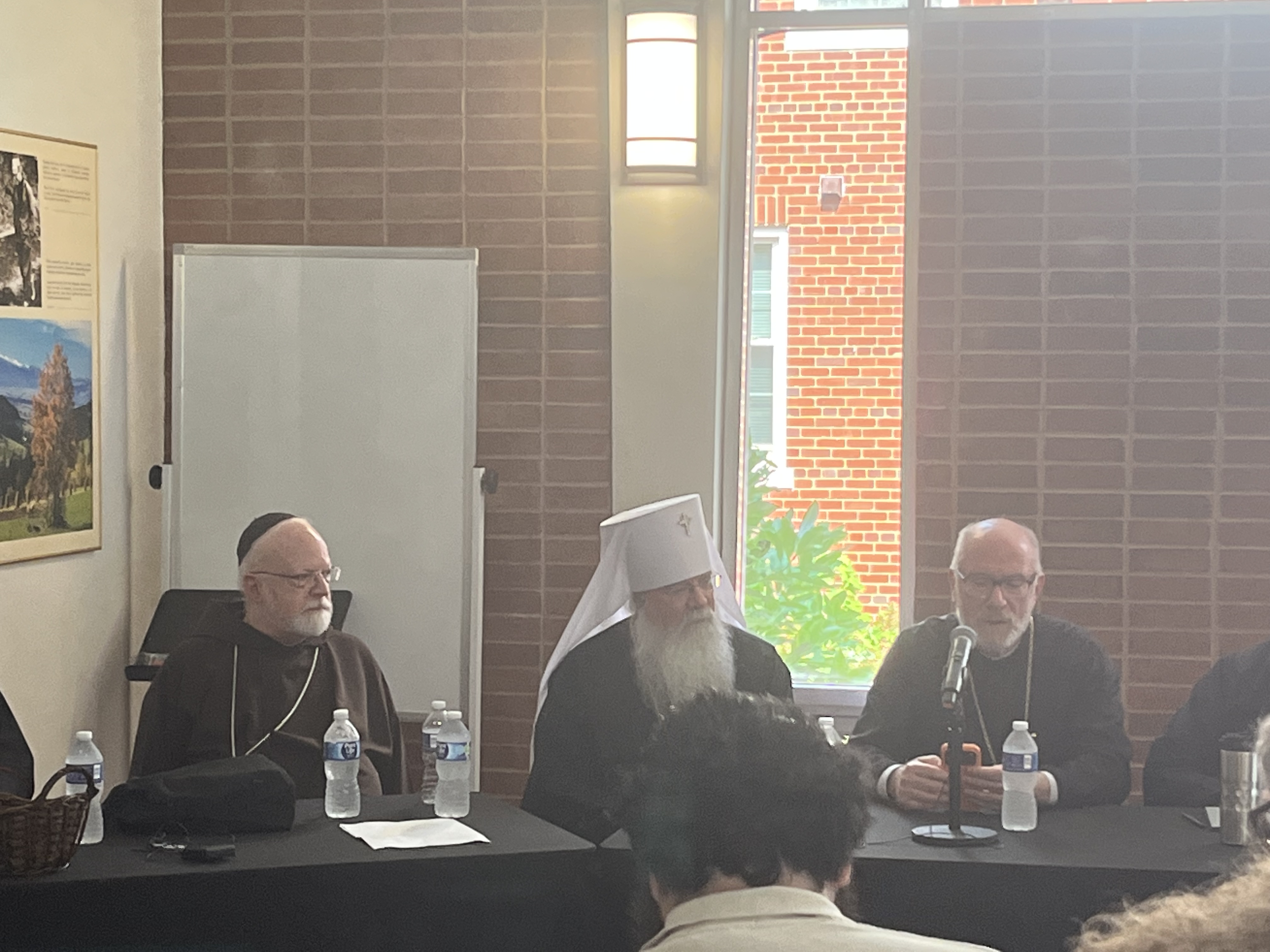
Catholic and Orthodox bishops discussed steps toward unity and the importance of cooperation and friendly dialogue.
The national director of the Pastoral Affairs Department of Catholic Secretariat of Nigeria (CSN) said the Church’s commitment to young people requires creating and maintaining safe environments.