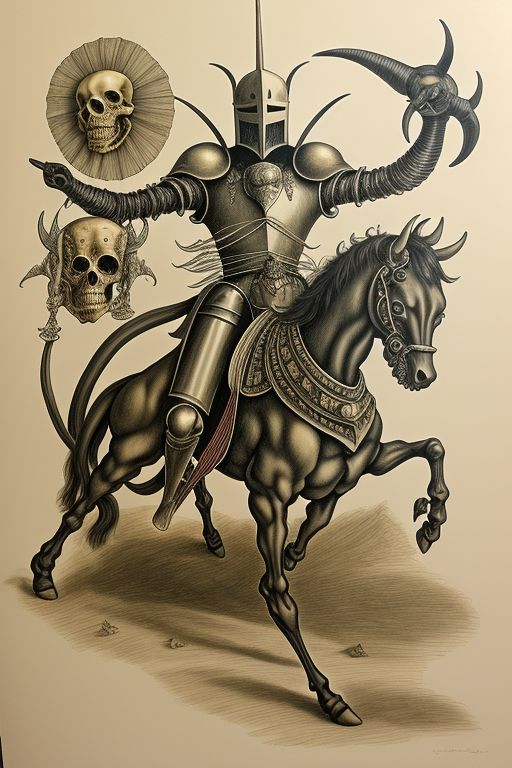
Devil

How the St. Benedict medal became a shield against the powers of darkness #Catholic Temptations in a fallen city, memories of a beautiful woman, a poisoned chalice, the attacks of an envious priest, curses from a pagan priest, a rock that won’t budge and another that falls on a young monk, a kitchen in flames, a dragon that lurks to devour a fleeing monk, threats from Gothic warlords, and the prospect of a destroyed monastery.These are some of the attacks that St. Benedict, whose feast the Catholic Church celebrates on July 11, endured throughout his life.Benedict even had to use force to manifest his authority as abbot over his monks oppressed by the enemy, as related in Father Robert Nixon’s book “The Cross and Medal of Saint Benedict: A Mystical Sign of Divine Power” (TAN, 2024):“Benedict found this monk outside wandering around aimlessly when he should have been in the oratory in prayer. With a certain degree of paternal severity and charitable discipline, he reprimanded him for his lack of wisdom and discernment and struck him with his staff. At this, the monk fell down, motionless. And after that, the devil … never troubled him again. It was as if the staff of Benedict had not struck the hapless monk but had rather driven away the wicked tempter himself!” (p. 14).St. Benedict has come to be recognized for the power of his actions against the enemy, alongside St. Michael the Archangel, as a major protector against evil — particularly through the medal that bears his image.Nixon’s book offers an overview of how the medal rose to prominence as a Catholic devotion and received papal approval, couching it within the story of St. Benedict’s life and the rise of his order of monks.The St. Benedict medalIf you’ve seen the back of a St. Benedict medal, you may have noticed a series of letters. The first set is arranged in and around the shape of the cross: C S P B C S S M L N D S M D. The next set is arranged in a circle around the cross: V R S N S M V S M Q L I V B.This arrangement first came to serious attention in the year 1647 in relation to the Benedictine Abbey of Metten in Bavaria, Germany, when it was believed to have prevented a series of diabolic attacks.Although some of the laity already had medals with these letters engraved, no one at the time understood their meaning. It was only in researching the library’s manuscripts that a 15th-century illustration of St. Benedict pointed to the full prayer they abbreviated:“Cross of our Holy Father Benedict. May the cross be light to me. May the dragon not be a leader to me. Get behind me, Satan: Never persuade me to vain things. What you like is evil; may you yourself drink your venom!”Due to a widespread story of the medal preventing the effect of curses and bringing about exorcisms and healings, which Nixon details in his book, its use spread across Europe, with Pope Benedict XIV approving an official blessing for it and granting it indulgences in 1741.The great father of modern Benedictine monasticism, Dom Prosper Guéranger, speculated why God would grant so many favors to those who invoke his help through St. Benedict’s medal. In an age when “rationalism is so rife,” God has deigned to offer help to those “who put their confidence in the sacred signs marked on the medal” with “strong and simple” faith (Guéranger, “The Medal or Cross of St. Benedict,” author’s preface). It’s as if to laugh at the devil and his plans to pull people away from God through the alleged sophistication of the modern world, overcoming them with simple signs pointing us to the cross and the protection of a holy monk.Of course, the medal should not be used in a superstitious way. It expresses our faith and confidence in God, which conquers the power of the enemy through the blood of Christ. Within God’s plan of salvation, there are certain key defenders of God’s people. St. Benedict proved himself as one over his own monks in spiritual combat. Through the efficacy of his medal, he has manifested himself as a fatherly defender of all who invoke his help.Throughout history, the monastic life has served as a constant beacon calling us to greater conversion of life and prayer. Turning to St. Benedict can lead us to embrace some of his spiritual principles, such as humility, obedience, stability, hospitality, the prayerful reading of Scripture in “lectio divina,” and viewing our work as a means of honoring God.While St. Benedict faced trials in his life as a monk, we all face trials and attacks from the enemy in the Christian life. Sacramentals can help us in our journey of faith, including our efforts to keep evil far away.St. Benedict medals and rosaries with the medal affixed can be purchased at religious gift stores and can be blessed after purchase. Medals are also available at EWTN’s Religious Catalogue site.This story was first published by the National Catholic Register, the sister partner of EWTN News, and has been adapted by EWTN News.

How the St. Benedict medal became a shield against the powers of darkness #Catholic Temptations in a fallen city, memories of a beautiful woman, a poisoned chalice, the attacks of an envious priest, curses from a pagan priest, a rock that won’t budge and another that falls on a young monk, a kitchen in flames, a dragon that lurks to devour a fleeing monk, threats from Gothic warlords, and the prospect of a destroyed monastery.These are some of the attacks that St. Benedict, whose feast the Catholic Church celebrates on July 11, endured throughout his life.Benedict even had to use force to manifest his authority as abbot over his monks oppressed by the enemy, as related in Father Robert Nixon’s book “The Cross and Medal of Saint Benedict: A Mystical Sign of Divine Power” (TAN, 2024):“Benedict found this monk outside wandering around aimlessly when he should have been in the oratory in prayer. With a certain degree of paternal severity and charitable discipline, he reprimanded him for his lack of wisdom and discernment and struck him with his staff. At this, the monk fell down, motionless. And after that, the devil … never troubled him again. It was as if the staff of Benedict had not struck the hapless monk but had rather driven away the wicked tempter himself!” (p. 14).St. Benedict has come to be recognized for the power of his actions against the enemy, alongside St. Michael the Archangel, as a major protector against evil — particularly through the medal that bears his image.Nixon’s book offers an overview of how the medal rose to prominence as a Catholic devotion and received papal approval, couching it within the story of St. Benedict’s life and the rise of his order of monks.The St. Benedict medalIf you’ve seen the back of a St. Benedict medal, you may have noticed a series of letters. The first set is arranged in and around the shape of the cross: C S P B C S S M L N D S M D. The next set is arranged in a circle around the cross: V R S N S M V S M Q L I V B.This arrangement first came to serious attention in the year 1647 in relation to the Benedictine Abbey of Metten in Bavaria, Germany, when it was believed to have prevented a series of diabolic attacks.Although some of the laity already had medals with these letters engraved, no one at the time understood their meaning. It was only in researching the library’s manuscripts that a 15th-century illustration of St. Benedict pointed to the full prayer they abbreviated:“Cross of our Holy Father Benedict. May the cross be light to me. May the dragon not be a leader to me. Get behind me, Satan: Never persuade me to vain things. What you like is evil; may you yourself drink your venom!”Due to a widespread story of the medal preventing the effect of curses and bringing about exorcisms and healings, which Nixon details in his book, its use spread across Europe, with Pope Benedict XIV approving an official blessing for it and granting it indulgences in 1741.The great father of modern Benedictine monasticism, Dom Prosper Guéranger, speculated why God would grant so many favors to those who invoke his help through St. Benedict’s medal. In an age when “rationalism is so rife,” God has deigned to offer help to those “who put their confidence in the sacred signs marked on the medal” with “strong and simple” faith (Guéranger, “The Medal or Cross of St. Benedict,” author’s preface). It’s as if to laugh at the devil and his plans to pull people away from God through the alleged sophistication of the modern world, overcoming them with simple signs pointing us to the cross and the protection of a holy monk.Of course, the medal should not be used in a superstitious way. It expresses our faith and confidence in God, which conquers the power of the enemy through the blood of Christ. Within God’s plan of salvation, there are certain key defenders of God’s people. St. Benedict proved himself as one over his own monks in spiritual combat. Through the efficacy of his medal, he has manifested himself as a fatherly defender of all who invoke his help.Throughout history, the monastic life has served as a constant beacon calling us to greater conversion of life and prayer. Turning to St. Benedict can lead us to embrace some of his spiritual principles, such as humility, obedience, stability, hospitality, the prayerful reading of Scripture in “lectio divina,” and viewing our work as a means of honoring God.While St. Benedict faced trials in his life as a monk, we all face trials and attacks from the enemy in the Christian life. Sacramentals can help us in our journey of faith, including our efforts to keep evil far away.St. Benedict medals and rosaries with the medal affixed can be purchased at religious gift stores and can be blessed after purchase. Medals are also available at EWTN’s Religious Catalogue site.This story was first published by the National Catholic Register, the sister partner of EWTN News, and has been adapted by EWTN News.

St. Benedict, whose feast the Catholic Church celebrates on July 11, endured constant attacks from the enemy throughout his life.

Read More
97-year-old cardinal, tortured under communism, climbs Medjugorje’s Apparition Hill #Catholic Cardinal Ernest Simoni, 97, who was tortured by Albaniaʼs communist regime, climbed Apparition Hill in Medjugorje on June 23, the day before the 45th anniversary of the start of the alleged apparitions.Six young people claimed to have seen the Virgin Mary for the first time on June 24, 1981, the feast day of St. John the Baptist, on Mount Podbrdo. Since then, some of those visionaries say they still receive messages from the Mother of God on a daily basis.Following a lengthy investigation, the Dicastery for the Doctrine of the Faith approved a document in 2024 titled The Queen of Peace, which acknowledges the spiritual fruits that have been borne, finds no obstacles in the alleged messages received, and makes no pronouncement regarding the supernatural nature of the phenomena.Assisted by young people from the Cenacolo Community, who carried the cardinal part of the way as he was seated on a litter, the Albanian cardinal traversed a portion of the rocky path on foot, though not without difficulty.
 
 Members of the Cenacolo Community carry Cardinal Simoni in Medjugorje. | Credit: Courtesy of Maria Vision Medjugorje
 
 Along the way, he blessed those present who stopped to greet him. Upon reaching the summit of the mountain, he prayed the rosary beside the statue of the Virgin Mary and blessed the water with which he sprinkled the crowd before returning.The footage of this pilgrimage, provided by María Visión Medjugorje, bears witness to the determination of the cardinal who, as a priest, endured the communist dictatorship of Enver Hoxha, the man who proclaimed Albania to be “the first atheist state in the world."A priest twice sentenced to deathBorn in 1928 in the village of Troshani, the young Simoni underwent formation with the Franciscans from 1938 to 1948, until a bloody religious persecution eliminated the communityʼs superiors and forced him to continue his formation in secret.In 1956, he was ordained a priest at St. Stephenʼs Cathedral in the Archdiocese of Shkodrë-Pult. Seven years later, after celebrating Christmas Eve Mass on Dec. 24, 1963, he was arrested by four agents and informed that he would be executed by hanging, accused of having celebrated a Mass for the repose of the soul of recently assassinated U.S. President John F. Kennedy at the behest of St. Paul VI. According to his own account, an attempt was made to entrap him by placing another prisoner in his cell who began complaining about the Communist Party. News of his preaching about love for oneʼs enemies while in prison reached the dictator, who decided to commute his sentence to 28 years of forced labor. During those years, he continued to celebrate Mass and exercise his priestly ministry clandestinely.In 1973, he was once again sentenced to death, accused of inciting a rebellion. However, exonerating testimony prevented the immediate execution of the sentence, and he remained in prison for another 18 years until his release in 1981.He continued his pastoral work in secret for another nine years, until the fall of the communist regime in 1990. “The Lord has helped me to serve so many people and to reconcile many, driving hatred and the devil away from the hearts of men,” he stated upon concluding his testimony before Pope Francis in October 2016.A month later, Simoni was created a cardinal at the consistory held on Nov. 19, 2016.This story was first published by ACI Prensa, the Spanish-language sister service of EWTN News. It has been translated and adapted by EWTN News English.

97-year-old cardinal, tortured under communism, climbs Medjugorje’s Apparition Hill #Catholic Cardinal Ernest Simoni, 97, who was tortured by Albaniaʼs communist regime, climbed Apparition Hill in Medjugorje on June 23, the day before the 45th anniversary of the start of the alleged apparitions.Six young people claimed to have seen the Virgin Mary for the first time on June 24, 1981, the feast day of St. John the Baptist, on Mount Podbrdo. Since then, some of those visionaries say they still receive messages from the Mother of God on a daily basis.Following a lengthy investigation, the Dicastery for the Doctrine of the Faith approved a document in 2024 titled The Queen of Peace, which acknowledges the spiritual fruits that have been borne, finds no obstacles in the alleged messages received, and makes no pronouncement regarding the supernatural nature of the phenomena.Assisted by young people from the Cenacolo Community, who carried the cardinal part of the way as he was seated on a litter, the Albanian cardinal traversed a portion of the rocky path on foot, though not without difficulty. Members of the Cenacolo Community carry Cardinal Simoni in Medjugorje. | Credit: Courtesy of Maria Vision Medjugorje Along the way, he blessed those present who stopped to greet him. Upon reaching the summit of the mountain, he prayed the rosary beside the statue of the Virgin Mary and blessed the water with which he sprinkled the crowd before returning.The footage of this pilgrimage, provided by María Visión Medjugorje, bears witness to the determination of the cardinal who, as a priest, endured the communist dictatorship of Enver Hoxha, the man who proclaimed Albania to be “the first atheist state in the world."A priest twice sentenced to deathBorn in 1928 in the village of Troshani, the young Simoni underwent formation with the Franciscans from 1938 to 1948, until a bloody religious persecution eliminated the communityʼs superiors and forced him to continue his formation in secret.In 1956, he was ordained a priest at St. Stephenʼs Cathedral in the Archdiocese of Shkodrë-Pult. Seven years later, after celebrating Christmas Eve Mass on Dec. 24, 1963, he was arrested by four agents and informed that he would be executed by hanging, accused of having celebrated a Mass for the repose of the soul of recently assassinated U.S. President John F. Kennedy at the behest of St. Paul VI. According to his own account, an attempt was made to entrap him by placing another prisoner in his cell who began complaining about the Communist Party. News of his preaching about love for oneʼs enemies while in prison reached the dictator, who decided to commute his sentence to 28 years of forced labor. During those years, he continued to celebrate Mass and exercise his priestly ministry clandestinely.In 1973, he was once again sentenced to death, accused of inciting a rebellion. However, exonerating testimony prevented the immediate execution of the sentence, and he remained in prison for another 18 years until his release in 1981.He continued his pastoral work in secret for another nine years, until the fall of the communist regime in 1990. “The Lord has helped me to serve so many people and to reconcile many, driving hatred and the devil away from the hearts of men,” he stated upon concluding his testimony before Pope Francis in October 2016.A month later, Simoni was created a cardinal at the consistory held on Nov. 19, 2016.This story was first published by ACI Prensa, the Spanish-language sister service of EWTN News. It has been translated and adapted by EWTN News English.

In an act of great devotion, the elderly cardinal reached the top with assistance, prayed the rosary and blessed those present with holy water.

Read More