laughter

The Hillbilly Thomists hit the road with new album ‘Strange Land’ #Catholic Between ministering to their communities and traveling down the southern interstate from Macon, Georgia, to Birmingham, Alabama, the Dominican friars of The Hillbilly Thomists are balancing full-time religious life with the whirlwind of a regional tour.The music group’s latest project, “Strange Land,” was released as a surprise drop just a couple of days into their summer tour, offering listeners a blend of deep theological reflection and traditional Americana music.The surprise drop decision was driven largely by their demanding schedules. After writing and recording the tracks a year prior, the postproduction process had to fit around their primary duties as “hounds of the Lord.”“The postproduction process just takes a while because we are all full-time preachers and teachers and chaplains and pastors,” said Dominican Father Justin Bolger, who spoke with the National Catholic Register, the sister news partner of EWTN News, along with his band brothers while on the road.“After this kind of two-week stint that we do in the summer, the music takes a backseat to that … So it kind of came out when it came out.”Musically, “Strange Land” ranges from spiritual anthems like “In-A-My Soul” and “Gloria” to playfully titled tracks like “Garrigou” and “Good Old Elvis.”Dominican Father Thomas Joseph White, one of the founding members of the band who also serves as rector at the Angelicum in Rome, noted that the variety reflects the band’s distinct personalities while remaining grounded in shared themes.“There are some themes that show up, like pilgrimage and hope and struggle, that are in all the songs,” he explained. “It’s very consistent with what we’ve done on other albums, and it just comes out organically or naturally from our songwriting.”The record marks a step forward in technical execution for the ensemble. White described the album as representing a “slightly higher echelon of musical sophistication,” aided by tighter harmonies and complex arrangements. Unlike previous albums where the friars handled all engineering themselves in retreat houses, they hired a professional recording engineer for “Strange Land.” “It frees up more of the band to just focus on the music and to collaborate and just have that be the focus,” Bolger added.That spirit of collaboration is rooted deeply in their shared Dominican vocation. “We’ve known each other for years, and we’re all united in the Dominican order, so it just makes for a real atmosphere of ease,” said Dominican Father Jonah Teller, describing the mutual trust involved when bringing personal songs to the group.
 
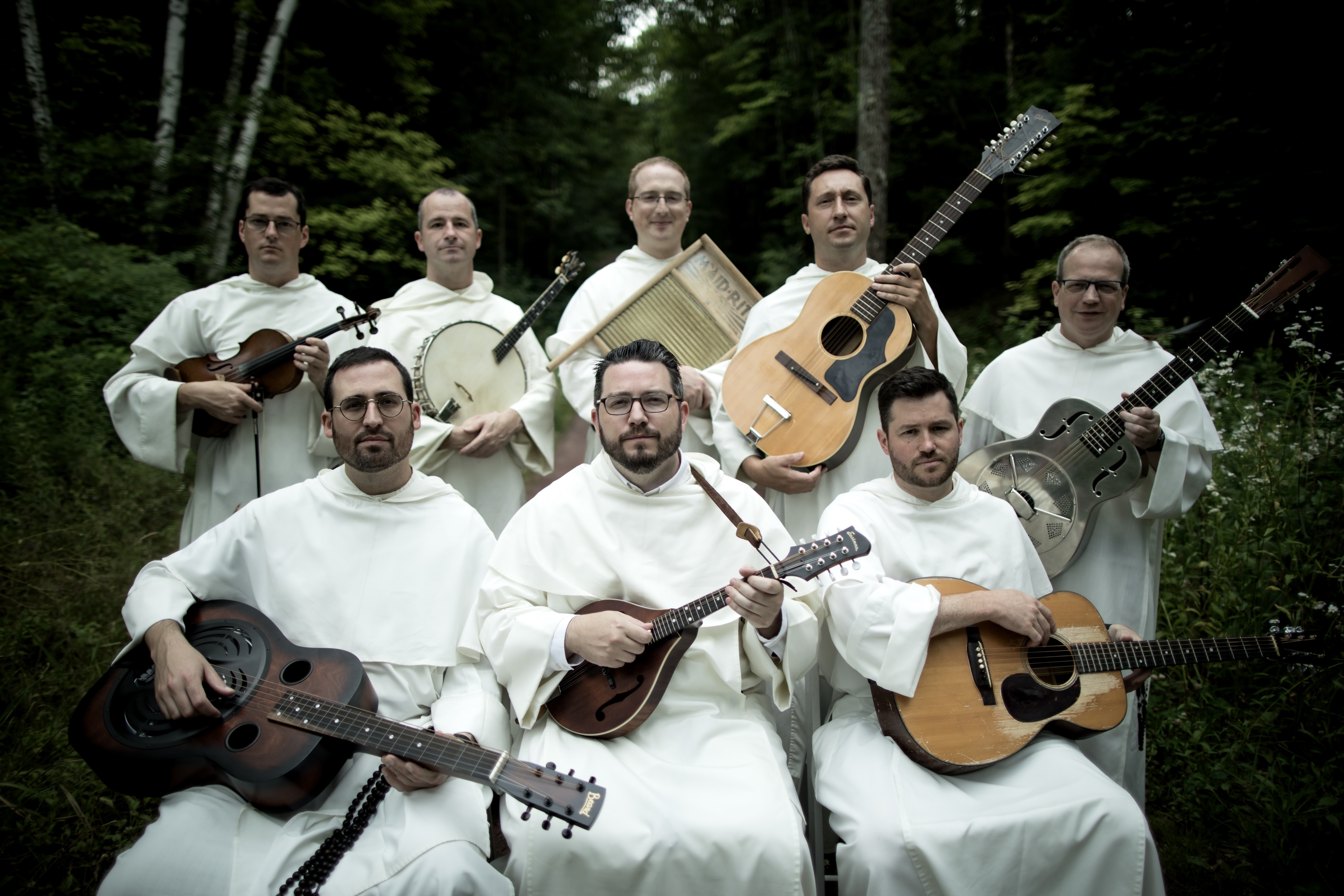
 The Hillbilly Thomists have released a new album called “Strange Land.” | Photo courtesy of the Hillbilly Thomists
 
 As the band’s popularity grows, so does a devoted grassroots fan base. White observed a natural overlap between people interested in Catholic intellectual life — such as participants in the Thomistic Institute — and fans of their bluegrass music. That enthusiasm has even spilled over into unofficial merchandise crafted by fans. At recent shows, custom fan art has begun to emerge, including T-shirts designed by a college student featuring torch-bearing dogs alongside the caption “I’m a dog for my Lord,” as well as custom “Good Tree” hats.“You do see some kind of fan art emerge at these shows, which is charming,” Bolger noted. White deadpanned that the order was engaged in a “very serious lawsuit” to confiscate the student’s assets and protect its intellectual property, prompting laughter from the rest of the band.The group’s reach has extended all the way to the Vatican. Recalling a past meeting with Pope Leo XIV, White shared that while most gifts were set aside, the pontiff asked to keep The Hillbilly Thomists’ CDs close by. “So I don’t know if he listens to them, but I do know he made the point of keeping them,” White joked, adding: “It’s unclear at this point in time whether any of our lyrics will be quoted in forthcoming encyclicals, but there’s some speculation.”When asked about playing traditional American folk and bluegrass music, especially as the nation celebrates 250 years of independence, singer and mandolin player Dominican Father Austin Litke pointed out the unique place the band occupies within the genre.“The Christian part of American culture has not always been predominantly Catholic,” Litke noted.“To be able to take up that form of music and infuse it with Catholic doctrine, Catholic culture, and certainly Thomistic culture … we hope is part of the genius of the creativity that’s come out of our fraternal work.”The 11-show tour concludes on Saturday, Aug. 8, fittingly on the feast of St. Dominic, with a performance alongside the Dominican Sisters of St. Cecilia at the Dominican Campus in Nashville, Tennessee.As for how fans can support the new release, Bolger kept his message simple: “Let all the old people and the young people know that they can find it on Spotify.”This story was first published by the National Catholic Register, the sister partner of EWTN News, and has been adapted by EWTN News.

The Hillbilly Thomists hit the road with new album ‘Strange Land’ #Catholic Between ministering to their communities and traveling down the southern interstate from Macon, Georgia, to Birmingham, Alabama, the Dominican friars of The Hillbilly Thomists are balancing full-time religious life with the whirlwind of a regional tour.The music group’s latest project, “Strange Land,” was released as a surprise drop just a couple of days into their summer tour, offering listeners a blend of deep theological reflection and traditional Americana music.The surprise drop decision was driven largely by their demanding schedules. After writing and recording the tracks a year prior, the postproduction process had to fit around their primary duties as “hounds of the Lord.”“The postproduction process just takes a while because we are all full-time preachers and teachers and chaplains and pastors,” said Dominican Father Justin Bolger, who spoke with the National Catholic Register, the sister news partner of EWTN News, along with his band brothers while on the road.“After this kind of two-week stint that we do in the summer, the music takes a backseat to that … So it kind of came out when it came out.”Musically, “Strange Land” ranges from spiritual anthems like “In-A-My Soul” and “Gloria” to playfully titled tracks like “Garrigou” and “Good Old Elvis.”Dominican Father Thomas Joseph White, one of the founding members of the band who also serves as rector at the Angelicum in Rome, noted that the variety reflects the band’s distinct personalities while remaining grounded in shared themes.“There are some themes that show up, like pilgrimage and hope and struggle, that are in all the songs,” he explained. “It’s very consistent with what we’ve done on other albums, and it just comes out organically or naturally from our songwriting.”The record marks a step forward in technical execution for the ensemble. White described the album as representing a “slightly higher echelon of musical sophistication,” aided by tighter harmonies and complex arrangements. Unlike previous albums where the friars handled all engineering themselves in retreat houses, they hired a professional recording engineer for “Strange Land.” “It frees up more of the band to just focus on the music and to collaborate and just have that be the focus,” Bolger added.That spirit of collaboration is rooted deeply in their shared Dominican vocation. “We’ve known each other for years, and we’re all united in the Dominican order, so it just makes for a real atmosphere of ease,” said Dominican Father Jonah Teller, describing the mutual trust involved when bringing personal songs to the group. The Hillbilly Thomists have released a new album called “Strange Land.” | Photo courtesy of the Hillbilly Thomists As the band’s popularity grows, so does a devoted grassroots fan base. White observed a natural overlap between people interested in Catholic intellectual life — such as participants in the Thomistic Institute — and fans of their bluegrass music. That enthusiasm has even spilled over into unofficial merchandise crafted by fans. At recent shows, custom fan art has begun to emerge, including T-shirts designed by a college student featuring torch-bearing dogs alongside the caption “I’m a dog for my Lord,” as well as custom “Good Tree” hats.“You do see some kind of fan art emerge at these shows, which is charming,” Bolger noted. White deadpanned that the order was engaged in a “very serious lawsuit” to confiscate the student’s assets and protect its intellectual property, prompting laughter from the rest of the band.The group’s reach has extended all the way to the Vatican. Recalling a past meeting with Pope Leo XIV, White shared that while most gifts were set aside, the pontiff asked to keep The Hillbilly Thomists’ CDs close by. “So I don’t know if he listens to them, but I do know he made the point of keeping them,” White joked, adding: “It’s unclear at this point in time whether any of our lyrics will be quoted in forthcoming encyclicals, but there’s some speculation.”When asked about playing traditional American folk and bluegrass music, especially as the nation celebrates 250 years of independence, singer and mandolin player Dominican Father Austin Litke pointed out the unique place the band occupies within the genre.“The Christian part of American culture has not always been predominantly Catholic,” Litke noted.“To be able to take up that form of music and infuse it with Catholic doctrine, Catholic culture, and certainly Thomistic culture … we hope is part of the genius of the creativity that’s come out of our fraternal work.”The 11-show tour concludes on Saturday, Aug. 8, fittingly on the feast of St. Dominic, with a performance alongside the Dominican Sisters of St. Cecilia at the Dominican Campus in Nashville, Tennessee.As for how fans can support the new release, Bolger kept his message simple: “Let all the old people and the young people know that they can find it on Spotify.”This story was first published by the National Catholic Register, the sister partner of EWTN News, and has been adapted by EWTN News.

The music group’s latest project was released as a surprise drop just a couple of days into their summer tour.

Read More
Sicar: The retreat transforming the lives of young people in Latin America #Catholic The Sicar retreat (“Sychar” in the English Bible) has given rise to one of the most notable youth evangelization experiences in Latin America. It came about through a process of discernment by a Mexican religious in her own search for God, a dynamic movement that today reaches thousands of young people.With over 30 years of consecrated life, Mother María Elena Martínez has dedicated her life to the spiritual formation of young people and adults through “Mary, Mother of Love,” a private association of the faithful she founded in Mexico in 2015.The community is centered on retreats making a spiritual impact, such as Emmaus, which is held in parishes and correctional facilities, and Sicar, which is aimed specifically at young adults.
 
 Mother María Elena Martínez. | Credit: Photo courtesy of Mother María Elena Martínez
 
 Her life, marked from childhood by a quest for God, would ultimately become bound up in an initiative that is active today in several Latin American countries, including Mexico, Guatemala, Paraguay, Argentina, and Peru.“I remember as a little girl I had a great thirst for God,” she shared in an interview with ACI Prensa, the Spanish-language sister service of EWTN News.That initial calling deepened over time. At age 11, she recalled, a desire to please Jesus arose within her. “A desire for purity … I wanted to live a life of virginity,” she noted, explaining that she prayed insistently to the Virgin Mary, asking for that consecration.
 
 Mother María Elena Martínez in front of an oasis. | Credit: Photo courtesy of Mother María Elena Martínez
 
 However, her path was neither immediate nor direct. “Religious life wasn’t something that particularly appealed to me,” she admitted. In her youth, she went through various experiences ranging from completing a degree in translating to exploring broader spiritual concerns, which eventually led her to try out consecrated life with the Missionaries of Charity.Some time later, she tried cloistered contemplative life. “I wanted something more interior, deeper,” she confessed.A concern arises: ‘What about the young people?’The Sicar retreat did not originate as a planned initiative but rather as a pastoral response that only gradually took shape. According to Mother María Elena, for years many people approached her with the same concern: “What about the young people?” “Do something for the young people,” they would tell her.
 
 Sicar team members in Mexico. | Credit: Photo courtesy of Mother María Elena Martínez
 
 The Gospel account of the Samaritan woman began to take center stage in her prayer and discernment. Jesus’ dialogue at the well of Sychar — “If you knew the gift of God” (cf. Jn 4:1-42) — served as the starting point for helping young people discover Christ. “The passage about the Samaritan woman was so rich, so rich, that I could draw so much from it,” she explained.The decisive step came in 2016, when the first Sicar retreat was held. Mother María Elena remembered it as the beginning of something small and simple yet deeply meaningful. Young people with prior experience in movements like Emmaus were the first to participate.
 
 Sicar Mexico. | Credit: Photo courtesy of Mother María Elena Martínez
 
 Sicar began to expand. After establishing itself in cities such as Mexico City, Tehuacán, and Tecamachalco (in the state of Puebla), as well as San Luis de la Paz (Guanajuato state), Veracruz, Mérida (Yucatán state), and Cuernavaca (Morelos state), the initiative began to cross borders beyond Mexico. The first retreat in Guatemala took place in 2017; Buenos Aires in 2018; Paraguay in 2022; and in Peru in 2023.“It has been growing in many places, rescuing so many young people,” Mother María Elena said with gratitude.In Mexico, 38 Sicar retreats have been held with an average of 50 participants each, amounting to nearly 2,000 young people. In Peru, where the initiative arrived in 2023, seven retreats have already taken place with around 70 participants each, reaching approximately 490 people.
 
 Sicar Mexico. | Credit: Photo courtesy of Mother María Elena Martínez
 
 Ottmar Ricalde, a Sicar volunteer in Mexico, noted that “Sicar means and has meant so much over these past 10 years.” “I could write and speak about all the stories, all the laughter, and all the tears, but the most important thing of all is the love of God that has been a gift to me,” he stated.“My life was always focused on pleasing others, but when I met God and realized how much he loves me, I began wanting to please him,” he said.In Paraguay, Sicar coordinator Fátima Correa highlighted that the experience “was a time of growth and renewal. It allowed us to view our history with fresh eyes.”
 
 Sicar Paraguay 2026 team members. | Credit: Sicar Paraguay
 
 “It was a retreat organized by young people for young people, where every testimony reflected realities many of us could relate to,” she added.A couple from Argentina who participated in the retreat and are now married say that Sicar marked a turning point in their lives. “We arrived as boyfriend and girlfriend and returned with completely transformed hearts … today, we feel that one of the greatest fruits was our marriage.”A growing community in PeruSicar arrived in Peru in 2023 and has since established a growing community.Geraldine Spihlman, director of Sicar in Peru, explained that the initiative arose after a need was identified within youth ministry. “When young people reached the age of 24 or 25, they no longer had a place to continue their journey of faith,” she noted.Following contact with Mother María Elena, it was decided to launch the initiative in Lima, which holds two retreats a year: in May and November.Spihlman highlighted that the most visible fruit is the community: “Many young people have discovered that it’s hard to go it alone but that everything is easier in community. It is a community where you can see how they love one another.”Instagram post‘God’s mercy knows no bounds’One of the most common fruits of these retreats is a shift in how one views others.In personal encounters, transformation occurs not only for those receiving the retreat but also for those who put it on. “God’s mercy knows no bounds,” Mother María Elena stated. “You look at people with eyes of mercy. You no longer judge the person; instead, you see them as a child of God,” she explained.Eros Acevedo, another team member, said the retreat “was an encounter with God that changed everything … I arrived bearing wounds, and his presence touched them. I left renewed.”
 
 Sicar Peru team members, May 2026. | Credit: Sicar Peru
 
 Rafael Mansilla, 27, said Sicar taught him to persevere in the faith. “Faith is not a flame that goes out but a steady flame,” he said.Dina Dávila shared that the retreat was the instrument God used to call her. “The love I have experienced in the community is overwhelming,” she added.‘A living Jesus’Through the retreats, Mother María Elena explained, people are invited to encounter “a living Jesus.” “God continues to act; he continues to perform miracles every day,” she affirmed. She said she lives one day at a time. “Each day I tell the Lord, ‘For one more day, I say yes to you.’”
 
 Participants in a Sicar retreat in Mexico. | Credit: Sicar Mexico
 
 The Sicar retreat, born of a contemplative reading of the Gospel, continues to spread wherever young people seek meaning, healing, and an experience of mature faith.Today, the young “Samaritans” who have lived this experience carry with them the words that marked their encounter with God: “Whoever drinks of the water that I will give him shall never thirst” (Jn 4:14).This story was first published by ACI Prensa, the Spanish-language sister service of EWTN News. It has been translated and adapted by EWTN News English.

Sicar: The retreat transforming the lives of young people in Latin America #Catholic The Sicar retreat (“Sychar” in the English Bible) has given rise to one of the most notable youth evangelization experiences in Latin America. It came about through a process of discernment by a Mexican religious in her own search for God, a dynamic movement that today reaches thousands of young people.With over 30 years of consecrated life, Mother María Elena Martínez has dedicated her life to the spiritual formation of young people and adults through “Mary, Mother of Love,” a private association of the faithful she founded in Mexico in 2015.The community is centered on retreats making a spiritual impact, such as Emmaus, which is held in parishes and correctional facilities, and Sicar, which is aimed specifically at young adults. Mother María Elena Martínez. | Credit: Photo courtesy of Mother María Elena Martínez Her life, marked from childhood by a quest for God, would ultimately become bound up in an initiative that is active today in several Latin American countries, including Mexico, Guatemala, Paraguay, Argentina, and Peru.“I remember as a little girl I had a great thirst for God,” she shared in an interview with ACI Prensa, the Spanish-language sister service of EWTN News.That initial calling deepened over time. At age 11, she recalled, a desire to please Jesus arose within her. “A desire for purity … I wanted to live a life of virginity,” she noted, explaining that she prayed insistently to the Virgin Mary, asking for that consecration. Mother María Elena Martínez in front of an oasis. | Credit: Photo courtesy of Mother María Elena Martínez However, her path was neither immediate nor direct. “Religious life wasn’t something that particularly appealed to me,” she admitted. In her youth, she went through various experiences ranging from completing a degree in translating to exploring broader spiritual concerns, which eventually led her to try out consecrated life with the Missionaries of Charity.Some time later, she tried cloistered contemplative life. “I wanted something more interior, deeper,” she confessed.A concern arises: ‘What about the young people?’The Sicar retreat did not originate as a planned initiative but rather as a pastoral response that only gradually took shape. According to Mother María Elena, for years many people approached her with the same concern: “What about the young people?” “Do something for the young people,” they would tell her. Sicar team members in Mexico. | Credit: Photo courtesy of Mother María Elena Martínez The Gospel account of the Samaritan woman began to take center stage in her prayer and discernment. Jesus’ dialogue at the well of Sychar — “If you knew the gift of God” (cf. Jn 4:1-42) — served as the starting point for helping young people discover Christ. “The passage about the Samaritan woman was so rich, so rich, that I could draw so much from it,” she explained.The decisive step came in 2016, when the first Sicar retreat was held. Mother María Elena remembered it as the beginning of something small and simple yet deeply meaningful. Young people with prior experience in movements like Emmaus were the first to participate. Sicar Mexico. | Credit: Photo courtesy of Mother María Elena Martínez Sicar began to expand. After establishing itself in cities such as Mexico City, Tehuacán, and Tecamachalco (in the state of Puebla), as well as San Luis de la Paz (Guanajuato state), Veracruz, Mérida (Yucatán state), and Cuernavaca (Morelos state), the initiative began to cross borders beyond Mexico. The first retreat in Guatemala took place in 2017; Buenos Aires in 2018; Paraguay in 2022; and in Peru in 2023.“It has been growing in many places, rescuing so many young people,” Mother María Elena said with gratitude.In Mexico, 38 Sicar retreats have been held with an average of 50 participants each, amounting to nearly 2,000 young people. In Peru, where the initiative arrived in 2023, seven retreats have already taken place with around 70 participants each, reaching approximately 490 people. Sicar Mexico. | Credit: Photo courtesy of Mother María Elena Martínez Ottmar Ricalde, a Sicar volunteer in Mexico, noted that “Sicar means and has meant so much over these past 10 years.” “I could write and speak about all the stories, all the laughter, and all the tears, but the most important thing of all is the love of God that has been a gift to me,” he stated.“My life was always focused on pleasing others, but when I met God and realized how much he loves me, I began wanting to please him,” he said.In Paraguay, Sicar coordinator Fátima Correa highlighted that the experience “was a time of growth and renewal. It allowed us to view our history with fresh eyes.” Sicar Paraguay 2026 team members. | Credit: Sicar Paraguay “It was a retreat organized by young people for young people, where every testimony reflected realities many of us could relate to,” she added.A couple from Argentina who participated in the retreat and are now married say that Sicar marked a turning point in their lives. “We arrived as boyfriend and girlfriend and returned with completely transformed hearts … today, we feel that one of the greatest fruits was our marriage.”A growing community in PeruSicar arrived in Peru in 2023 and has since established a growing community.Geraldine Spihlman, director of Sicar in Peru, explained that the initiative arose after a need was identified within youth ministry. “When young people reached the age of 24 or 25, they no longer had a place to continue their journey of faith,” she noted.Following contact with Mother María Elena, it was decided to launch the initiative in Lima, which holds two retreats a year: in May and November.Spihlman highlighted that the most visible fruit is the community: “Many young people have discovered that it’s hard to go it alone but that everything is easier in community. It is a community where you can see how they love one another.”Instagram post‘God’s mercy knows no bounds’One of the most common fruits of these retreats is a shift in how one views others.In personal encounters, transformation occurs not only for those receiving the retreat but also for those who put it on. “God’s mercy knows no bounds,” Mother María Elena stated. “You look at people with eyes of mercy. You no longer judge the person; instead, you see them as a child of God,” she explained.Eros Acevedo, another team member, said the retreat “was an encounter with God that changed everything … I arrived bearing wounds, and his presence touched them. I left renewed.” Sicar Peru team members, May 2026. | Credit: Sicar Peru Rafael Mansilla, 27, said Sicar taught him to persevere in the faith. “Faith is not a flame that goes out but a steady flame,” he said.Dina Dávila shared that the retreat was the instrument God used to call her. “The love I have experienced in the community is overwhelming,” she added.‘A living Jesus’Through the retreats, Mother María Elena explained, people are invited to encounter “a living Jesus.” “God continues to act; he continues to perform miracles every day,” she affirmed. She said she lives one day at a time. “Each day I tell the Lord, ‘For one more day, I say yes to you.’” Participants in a Sicar retreat in Mexico. | Credit: Sicar Mexico The Sicar retreat, born of a contemplative reading of the Gospel, continues to spread wherever young people seek meaning, healing, and an experience of mature faith.Today, the young “Samaritans” who have lived this experience carry with them the words that marked their encounter with God: “Whoever drinks of the water that I will give him shall never thirst” (Jn 4:14).This story was first published by ACI Prensa, the Spanish-language sister service of EWTN News. It has been translated and adapted by EWTN News English.

Through her own spiritual journey seeking God, Mother María Elena Martínez founded a community and a retreat movement that is touching the lives of thousands of young people in Latin America.

Read More