plane

Pope Leo XIV says debate with Trump is ‘not in my interest at all’ #Catholic ABOARD THE PAPAL PLANE — Pope Leo XIV arrived in Angola after a two-and-a-half-hour flight from Cameroon on April 18, using the short journey to reject suggestions that his recent remarks about war were aimed at U.S. President Donald Trump while reflecting on the pastoral focus of his African trip.In a brief in-flight press conference with journalists, the pope addressed the interpretation of some of his recent speeches as a response to criticism from Trump, who had accused him of weakness in foreign policy.“[T]hereʼs been a certain narrative that has not been accurate in all of its aspects, but because of the political situation created when on the first day of the trip, the President of the United States made some comments about myself,” the pope said.“Much of what has been written since then has been more commentary on commentary, trying to interpret what has been said.”He pointed in particular to his address at the April 16 prayer meeting for peace in Cameroon.“Just one little example, the talk that I gave at the prayer meeting for peace a couple days ago was prepared two weeks ago, well before the president ever commented on myself and on the message of peace that I am promoting,” he said.“And yet, as it happens, it was looked at as if I was trying to debate again the president, which is not in my interest at all.”Leo XIV said he intends instead to continue proclaiming the Gospel and promoting peace.“So we go on the journey, we continue proclaiming the Gospel message,” he said.He added that the liturgies during the trip have highlighted what it means to follow Christ, promote fraternity, and seek justice and peace.The pope also said the broader African journey has been shaped by themes that emerged at the start of the trip in Algeria, especially the figure of St. Augustine.“I was personally very pleased, as you know, we began the trip in Algeria with the theme of Saint Augustine, and yesterday at the Catholic University, we had the blessing of that beautiful monument that they had prepared with a map of Africa and Saint Augustine at the center,” he said.“And so in one sense, it expresses part of what this trip is about.”Leo XIV emphasized that his primary purpose in Africa is to accompany Catholics.“And I primarily come to Africa as pastor, as the head of the Catholic Church, to be with, to celebrate with, to encourage and accompany all of the Catholics throughout Africa.”He also referred to a meeting with imams in Cameroon, describing it in general terms as part of the Church’s continuing commitment to interreligious dialogue, understanding, and peace-building.He concluded his main remarks by thanking journalists for their work and expressing hope that God would continue to bless the journey.Responding later to a French journalist, Leo XIV expressed gratitude for the reception he received in Cameroon.“I would just like to thank everyone in Cameroon for the wonderful welcome, the great enthusiasm, the joy of the people,” he said.“It was absolutely fantastic, the experience … how wonderful it is to experience what it means to be a follower of Jesus Christ and to celebrate our faith together.”The pope’s flight took him from Yaoundé to Luanda, crossing over Cameroon, Equatorial Guinea, Gabon, the Democratic Republic of Congo, and Angola. Angola is the third and penultimate stop of his African journey.The Catholic Church has longstanding ties with Angola. Formal relations date back centuries, including the 1608 appointment of Antonio Manuel Nyunda as the first ambassador to Rome from the then-Kingdom of Kongo. More recently, in 2019, the Holy See and Angola signed an agreement recognizing the legal personality of the Catholic Church and defining its property rights.This story was first published by ACI Stampa, the Italian-language sister service of EWTN News. It has been translated and adapted by EWTN News English.

Pope Leo XIV says debate with Trump is ‘not in my interest at all’ #Catholic ABOARD THE PAPAL PLANE — Pope Leo XIV arrived in Angola after a two-and-a-half-hour flight from Cameroon on April 18, using the short journey to reject suggestions that his recent remarks about war were aimed at U.S. President Donald Trump while reflecting on the pastoral focus of his African trip.In a brief in-flight press conference with journalists, the pope addressed the interpretation of some of his recent speeches as a response to criticism from Trump, who had accused him of weakness in foreign policy.“[T]hereʼs been a certain narrative that has not been accurate in all of its aspects, but because of the political situation created when on the first day of the trip, the President of the United States made some comments about myself,” the pope said.“Much of what has been written since then has been more commentary on commentary, trying to interpret what has been said.”He pointed in particular to his address at the April 16 prayer meeting for peace in Cameroon.“Just one little example, the talk that I gave at the prayer meeting for peace a couple days ago was prepared two weeks ago, well before the president ever commented on myself and on the message of peace that I am promoting,” he said.“And yet, as it happens, it was looked at as if I was trying to debate again the president, which is not in my interest at all.”Leo XIV said he intends instead to continue proclaiming the Gospel and promoting peace.“So we go on the journey, we continue proclaiming the Gospel message,” he said.He added that the liturgies during the trip have highlighted what it means to follow Christ, promote fraternity, and seek justice and peace.The pope also said the broader African journey has been shaped by themes that emerged at the start of the trip in Algeria, especially the figure of St. Augustine.“I was personally very pleased, as you know, we began the trip in Algeria with the theme of Saint Augustine, and yesterday at the Catholic University, we had the blessing of that beautiful monument that they had prepared with a map of Africa and Saint Augustine at the center,” he said.“And so in one sense, it expresses part of what this trip is about.”Leo XIV emphasized that his primary purpose in Africa is to accompany Catholics.“And I primarily come to Africa as pastor, as the head of the Catholic Church, to be with, to celebrate with, to encourage and accompany all of the Catholics throughout Africa.”He also referred to a meeting with imams in Cameroon, describing it in general terms as part of the Church’s continuing commitment to interreligious dialogue, understanding, and peace-building.He concluded his main remarks by thanking journalists for their work and expressing hope that God would continue to bless the journey.Responding later to a French journalist, Leo XIV expressed gratitude for the reception he received in Cameroon.“I would just like to thank everyone in Cameroon for the wonderful welcome, the great enthusiasm, the joy of the people,” he said.“It was absolutely fantastic, the experience … how wonderful it is to experience what it means to be a follower of Jesus Christ and to celebrate our faith together.”The pope’s flight took him from Yaoundé to Luanda, crossing over Cameroon, Equatorial Guinea, Gabon, the Democratic Republic of Congo, and Angola. Angola is the third and penultimate stop of his African journey.The Catholic Church has longstanding ties with Angola. Formal relations date back centuries, including the 1608 appointment of Antonio Manuel Nyunda as the first ambassador to Rome from the then-Kingdom of Kongo. More recently, in 2019, the Holy See and Angola signed an agreement recognizing the legal personality of the Catholic Church and defining its property rights.This story was first published by ACI Stampa, the Italian-language sister service of EWTN News. It has been translated and adapted by EWTN News English.

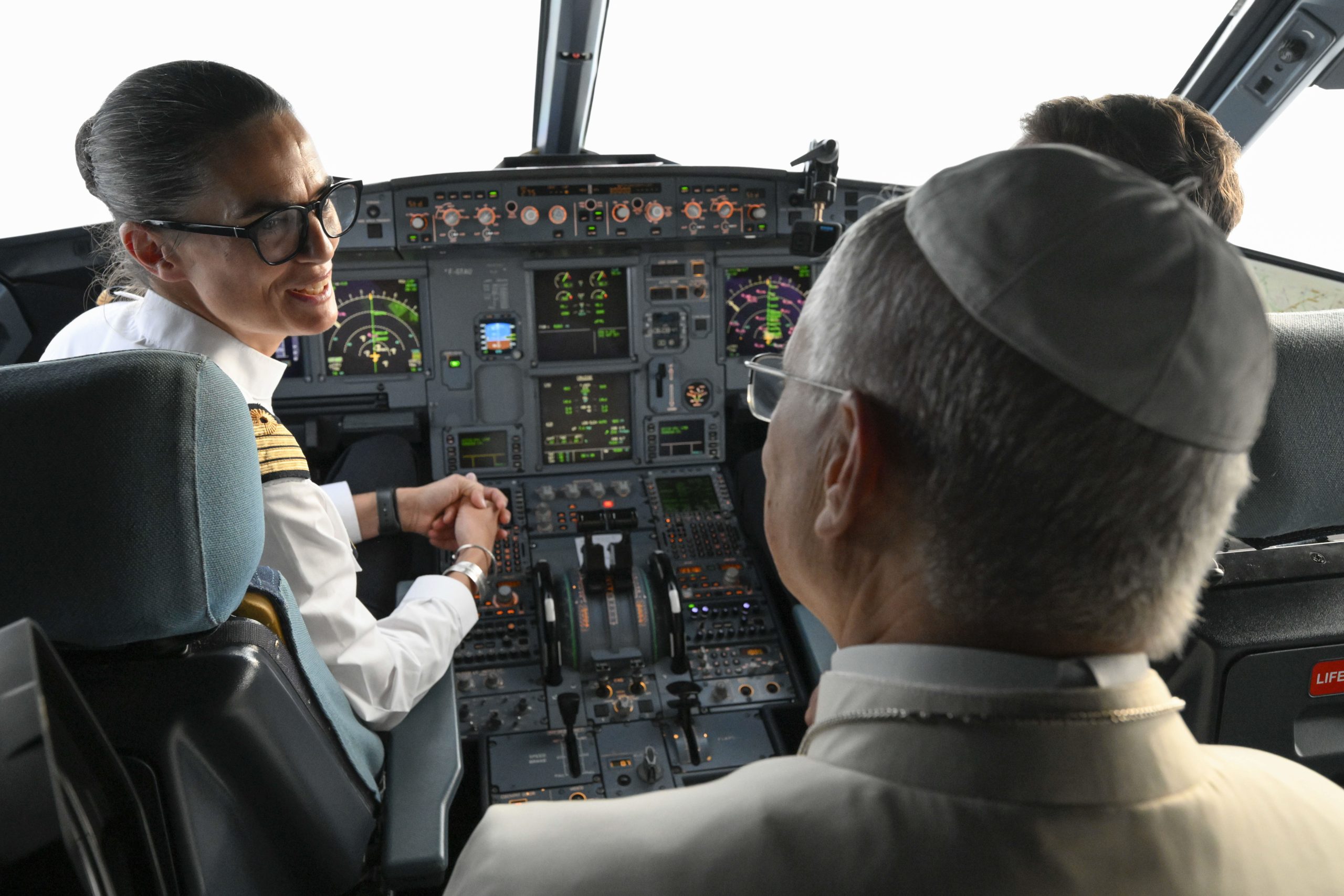
En route from Cameroon to Angola, the pope said his mission in Africa is pastoral and rejected suggestions that his recent remarks were aimed at President Donald Trump.

Read More
EWTN News explains: Why does the pope visit mosques on papal trips? #Catholic For more than a quarter-century, popes have periodically visited Islamic mosques as part of official voyages and papal visits. The tradition began with Pope John Paul II, who in 2001 became the first pope in history known to have entered a mosque when he visited the Great Mosque of Damascus in the capital of Syria. The subsequent Popes Benedict XVI, Francis, and Leo XIV have all paid visits to mosques to hold ecumenical dialogues and host diplomatic meetings. Yet the practice is not without some controversy. Indeed, Leo XIVʼs visit to the Great Mosque of Algiers on April 13 drew some backlash on social media by critics incredulous over the leader of the Catholic Church visiting a major Islamic holy site. (This was Leoʼs second visit to a mosque; he also visited the famed “Blue Mosque” in Istanbul in late 2025.) 
 
 Pope Leo XIV stands with Rector Mohamed Mamoun Al Qasimi at the Great Mosque in Algiers, Monday, April 13, 2026. | Credit: Vatican Media
 
 So why do popes make visits to mosques, courting controversy and criticism for making a point to go to holy sites of another religion? ‘We can live together in peace’Pope Leo XIV himself addressed criticism directed toward him on April 15 on board the papal plane after leaving Algiers bound for Cameroon. “I think the visit to the mosque was significant [and showed] that although we have different beliefs, we have different ways of worshipping, we have different ways of living, we can [still] live together in peace,” the Holy Father said.  “I think that to promote that kind of image is something which the world needs to hear today,” he said, arguing that such visits show that “together we can continue to offer in our witness as we continue on this apostolic voyage.”Gabriel Said Reynolds, a theology professor at the University of Notre Dame who has written multiple works on the Quran and its relationship to Christianity, told EWTN News that interpreting papal visits to mosques should include an understanding of “the Churchʼs vision of God in the world.” “What is God’s relationship to the world? That’s been important to all of the recent popes,” he said.Reynolds pointed out that an Islamic mosque is “fundamentally different from a church.” “A Catholic church is a sort of temple in which God is present in the tabernacle — body, blood, soul, and divinity,” he said. “It’s a sacred space in the deepest sense of the word.”“What Muslims would say of a mosque is fundamentally different,” he said. “A mosque is for communal prayer, but the communal prayer that takes place in a mosque is no different than the ritual prayer that’s more often done at home.” He likened a mosque to a “gathering place” with just a few features that set it apart as a distinct site — such as a pulpit for occasional sermons and an alcove that denotes the direction of Mecca to which Muslims orient themselves during prayer. Reynolds said popes visit mosques in no small part as a “pastoral concern” for Christians living in majority-Muslim countries, such as Algeria. “Algerian society is thoroughly Islamic,” he said. “It’s not generally marked by notions of rights and responsibilities and citizenship in the same way the U.S. is. Cultivating positive relationships with Muslim leaders is absolutely essential for Christians.”Reynolds said the Churchʼs view about human dignity has “fundamental implications with its relationship toward non-Christians.” He pointed out, for instance, that the pope “could show up at an atheist convention and meet the people there and have dialogue with them.”“John 3:16 says God loves the world,” he said. “It’s not that God loves believers and doesn’t love the unbelievers. All people are children of God, according to Catholic teaching.”The declaration Nostra Aetate, meanwhile — issued by the Second Vatican Council in 1965 to address Catholicismʼs relationship with non-Christians — affirmed that the Church “regards [Muslims] with esteem.”The document points out that although Muslims “do not acknowledge Jesus as God,” they still “adore the one God” and “revere [Jesus] as a prophet” while giving honor to the Virgin Mother as well. The Second Vatican Council acknowledged that “in the course of centuries not a few quarrels and hostilities have arisen” between Christians and Muslims, but the document “urge[d] all to forget the past and to work sincerely for mutual understanding.”It further called on religious adherents to “preserve as well as to promote together for the benefit of all mankind social justice and moral welfare, as well as peace and freedom.”

EWTN News explains: Why does the pope visit mosques on papal trips? #Catholic For more than a quarter-century, popes have periodically visited Islamic mosques as part of official voyages and papal visits. The tradition began with Pope John Paul II, who in 2001 became the first pope in history known to have entered a mosque when he visited the Great Mosque of Damascus in the capital of Syria. The subsequent Popes Benedict XVI, Francis, and Leo XIV have all paid visits to mosques to hold ecumenical dialogues and host diplomatic meetings. Yet the practice is not without some controversy. Indeed, Leo XIVʼs visit to the Great Mosque of Algiers on April 13 drew some backlash on social media by critics incredulous over the leader of the Catholic Church visiting a major Islamic holy site. (This was Leoʼs second visit to a mosque; he also visited the famed “Blue Mosque” in Istanbul in late 2025.) Pope Leo XIV stands with Rector Mohamed Mamoun Al Qasimi at the Great Mosque in Algiers, Monday, April 13, 2026. | Credit: Vatican Media So why do popes make visits to mosques, courting controversy and criticism for making a point to go to holy sites of another religion? ‘We can live together in peace’Pope Leo XIV himself addressed criticism directed toward him on April 15 on board the papal plane after leaving Algiers bound for Cameroon. “I think the visit to the mosque was significant [and showed] that although we have different beliefs, we have different ways of worshipping, we have different ways of living, we can [still] live together in peace,” the Holy Father said.  “I think that to promote that kind of image is something which the world needs to hear today,” he said, arguing that such visits show that “together we can continue to offer in our witness as we continue on this apostolic voyage.”Gabriel Said Reynolds, a theology professor at the University of Notre Dame who has written multiple works on the Quran and its relationship to Christianity, told EWTN News that interpreting papal visits to mosques should include an understanding of “the Churchʼs vision of God in the world.” “What is God’s relationship to the world? That’s been important to all of the recent popes,” he said.Reynolds pointed out that an Islamic mosque is “fundamentally different from a church.” “A Catholic church is a sort of temple in which God is present in the tabernacle — body, blood, soul, and divinity,” he said. “It’s a sacred space in the deepest sense of the word.”“What Muslims would say of a mosque is fundamentally different,” he said. “A mosque is for communal prayer, but the communal prayer that takes place in a mosque is no different than the ritual prayer that’s more often done at home.” He likened a mosque to a “gathering place” with just a few features that set it apart as a distinct site — such as a pulpit for occasional sermons and an alcove that denotes the direction of Mecca to which Muslims orient themselves during prayer. Reynolds said popes visit mosques in no small part as a “pastoral concern” for Christians living in majority-Muslim countries, such as Algeria. “Algerian society is thoroughly Islamic,” he said. “It’s not generally marked by notions of rights and responsibilities and citizenship in the same way the U.S. is. Cultivating positive relationships with Muslim leaders is absolutely essential for Christians.”Reynolds said the Churchʼs view about human dignity has “fundamental implications with its relationship toward non-Christians.” He pointed out, for instance, that the pope “could show up at an atheist convention and meet the people there and have dialogue with them.”“John 3:16 says God loves the world,” he said. “It’s not that God loves believers and doesn’t love the unbelievers. All people are children of God, according to Catholic teaching.”The declaration Nostra Aetate, meanwhile — issued by the Second Vatican Council in 1965 to address Catholicismʼs relationship with non-Christians — affirmed that the Church “regards [Muslims] with esteem.”The document points out that although Muslims “do not acknowledge Jesus as God,” they still “adore the one God” and “revere [Jesus] as a prophet” while giving honor to the Virgin Mother as well. The Second Vatican Council acknowledged that “in the course of centuries not a few quarrels and hostilities have arisen” between Christians and Muslims, but the document “urge[d] all to forget the past and to work sincerely for mutual understanding.”It further called on religious adherents to “preserve as well as to promote together for the benefit of all mankind social justice and moral welfare, as well as peace and freedom.”

Why do popes make visits to Islamic mosques, courting controversy and criticism by taking part in events at holy sites of another religion?

Read More
Pope Leo XIV arrives in Cameroon for second leg of Africa trip #Catholic YAOUNDE, Cameroon — Pope Leo XIV arrived Wednesday in Yaoundé, the capital of Cameroon, after a five-hour flight. While meeting with journalists aboard the papal plane, he delivered a brief address, thanking the Algerian authorities and reflecting on the first leg of the journey.Leo, speaking in English, expressed his “gratitude to all the authorities in Algeria, who made this visit possible. As youʼve seen, theyʼve even granted us the full honor of an escort as we fly over Algerian airspace.”This, the pope said, is “a sign of the goodness, of the generosity, of the respect that the Algerian people and the Algerian government have wished to show to the Holy See, to myself. And so I want to say a word of thanks to them, as well as a word of thanks to the very small but very significant presence of the Catholic Church in Algeria.”The pontiff then reflected on the journey.“We had, as you know,” he said, “some very special visits both in the Basilica Notre Dame dʼAfrique as well as in Annaba yesterday, in the Basilica of St. Augustine on the hill overlooking both the modern city of Annaba and the ruins of the ancient Roman city of Ippona. And that in itself, I would say, is also symbolically significant, because St. Augustine, who was bishop, as you know, of Hippo for more than 30 years, actually is a figure which is very much from the past and speaks to us of tradition, speaks to us of the life, the Church, as the Church grew in the early centuries.”Continuing to speak about St. Augustine, Leo said that he is “a very important figure today as his writings, his teaching, his spirituality, his invitation to search for God and to search for truth is something that is very much needed today — a message that is very real for all of us today, as believers in Jesus Christ, but for all people. And as youʼve seen, even the people of Algeria, the vast majority of whom are not Christian, they very much honor and respect the memory of St. Augustine as one of the great sons of their land.""So it was a special blessing for me personally to return once again to Annaba yesterday," he said, "but also to offer to the Church and the world a vision that St. Augustine offers us in terms of the search for God and the struggle to build community, to seek for unity among all peoples and respect for all peoples in spite of the differences.”The pope concluded: “In two days in Algeria I think weʼve really had a wonderful opportunity to, if you will, continue to build bridges, to promote dialogue. I think the visit to the mosque was significant and to say that it showed that although we have different beliefs, we have different ways of worshipping, we have different ways of living, we can live together in peace. And so I think that promoting that kind of image is something which the world needs to hear today, and that together we can continue to offer in our witness through as we continue on this apostolic voyage.”Pope Leo XIV is the third pope to visit Cameroon.Leo will first meet with 92-year-old President Biya, elected to an eighth term and in power for 40 years. After his address to the diplomatic corps — a standard stop at the beginning of every trip — the pope will visit the Ngul Zamba orphanage, a historic point of reference for the care and education of orphaned children and minors in situations of serious social vulnerability.In addition to Yaoundé, Leo XIV will also visit the city of Bamenda, around 230 miles from the capital, at the center of the Anglophone crisis — a complex situation in which English-speaking separatists have also called for the formation of their own state.The pope will also visit Douala, Cameroon’s economic capital, thus touching all the major realities of the country before departing for Angola on April 18.

Pope Leo XIV arrives in Cameroon for second leg of Africa trip #Catholic YAOUNDE, Cameroon — Pope Leo XIV arrived Wednesday in Yaoundé, the capital of Cameroon, after a five-hour flight. While meeting with journalists aboard the papal plane, he delivered a brief address, thanking the Algerian authorities and reflecting on the first leg of the journey.Leo, speaking in English, expressed his “gratitude to all the authorities in Algeria, who made this visit possible. As youʼve seen, theyʼve even granted us the full honor of an escort as we fly over Algerian airspace.”This, the pope said, is “a sign of the goodness, of the generosity, of the respect that the Algerian people and the Algerian government have wished to show to the Holy See, to myself. And so I want to say a word of thanks to them, as well as a word of thanks to the very small but very significant presence of the Catholic Church in Algeria.”The pontiff then reflected on the journey.“We had, as you know,” he said, “some very special visits both in the Basilica Notre Dame dʼAfrique as well as in Annaba yesterday, in the Basilica of St. Augustine on the hill overlooking both the modern city of Annaba and the ruins of the ancient Roman city of Ippona. And that in itself, I would say, is also symbolically significant, because St. Augustine, who was bishop, as you know, of Hippo for more than 30 years, actually is a figure which is very much from the past and speaks to us of tradition, speaks to us of the life, the Church, as the Church grew in the early centuries.”Continuing to speak about St. Augustine, Leo said that he is “a very important figure today as his writings, his teaching, his spirituality, his invitation to search for God and to search for truth is something that is very much needed today — a message that is very real for all of us today, as believers in Jesus Christ, but for all people. And as youʼve seen, even the people of Algeria, the vast majority of whom are not Christian, they very much honor and respect the memory of St. Augustine as one of the great sons of their land.""So it was a special blessing for me personally to return once again to Annaba yesterday," he said, "but also to offer to the Church and the world a vision that St. Augustine offers us in terms of the search for God and the struggle to build community, to seek for unity among all peoples and respect for all peoples in spite of the differences.”The pope concluded: “In two days in Algeria I think weʼve really had a wonderful opportunity to, if you will, continue to build bridges, to promote dialogue. I think the visit to the mosque was significant and to say that it showed that although we have different beliefs, we have different ways of worshipping, we have different ways of living, we can live together in peace. And so I think that promoting that kind of image is something which the world needs to hear today, and that together we can continue to offer in our witness through as we continue on this apostolic voyage.”Pope Leo XIV is the third pope to visit Cameroon.Leo will first meet with 92-year-old President Biya, elected to an eighth term and in power for 40 years. After his address to the diplomatic corps — a standard stop at the beginning of every trip — the pope will visit the Ngul Zamba orphanage, a historic point of reference for the care and education of orphaned children and minors in situations of serious social vulnerability.In addition to Yaoundé, Leo XIV will also visit the city of Bamenda, around 230 miles from the capital, at the center of the Anglophone crisis — a complex situation in which English-speaking separatists have also called for the formation of their own state.The pope will also visit Douala, Cameroon’s economic capital, thus touching all the major realities of the country before departing for Angola on April 18.

Reflecting on the visit to Algeria, the pope described it as “a wonderful opportunity to continue building bridges and promoting dialogue.”

Read More