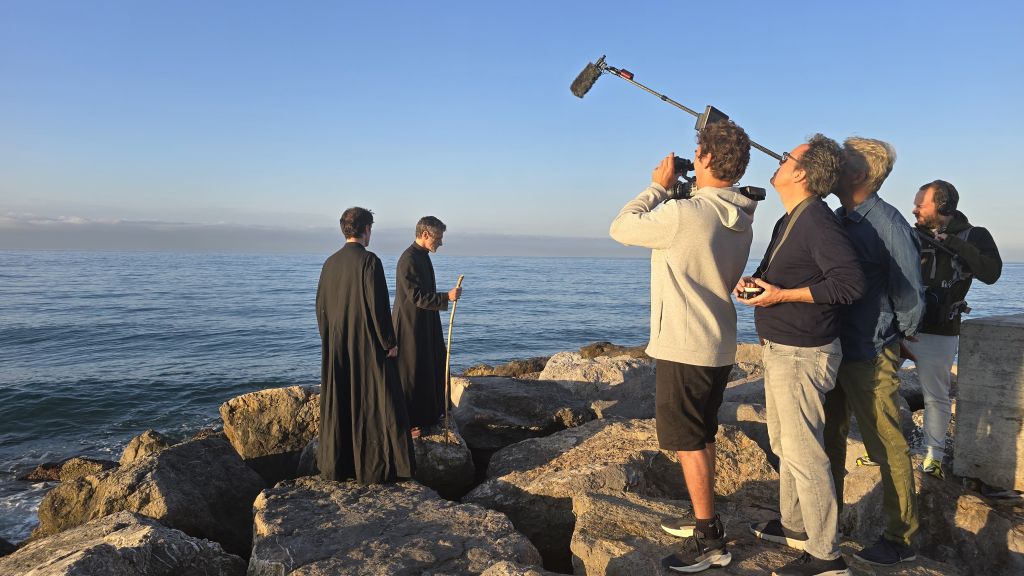
Read More EWTN to air film on St. Peter Claver, slave of the slaves #Catholic St. Peter Claver was a Spanish Jesuit priest who dedicated his life to the care of African slaves. On Sept. 9 — the saint’s feast day — EWTN will release an original docudrama on his life titled “Saint Peter Claver — Slave of the Slaves.”The docudrama was filmed on location in Spain, Colombia, and Cape Verde and uses interviews and dramatizations to present the life of Claver, who tirelessly ministered to the spiritual and physical needs of African slaves in Cartagena, Colombia, for 40 years.The film will air on EWTN TV and EWTN+ on Sept. 9 at 9:30 p.m. ET and re-air on Sept. 12 at 8 p.m. ET. At this time, the program will not air on YouTube. A behind-the-scenes look at the making of “Saint Peter Claver — Slave of the Slaves.” | Credit: EWTN Who was St. Peter Claver?Born on June 26, 1580, in Catalonia, Spain, Claver grew up in a devout Catholic farming family. He attended the University of Barcelona and at age 20 joined the Jesuits.During his studies as a novice, Claver met an older lay Jesuit brother, Alphonsus Rodriguez. It was Rodriguez who encouraged Claver to become a missionary in the Spanish colonies in the Americas.In 1610, Claver traveled from Spain to Cartagena, Colombia, where he was ordained a priest five years later.At that time, the African slave trade had been in place for several decades in the Americas, and Cartagena was one of the busiest slave ports in the Spanish empire.While there, Claver witnessed the cruelty with which the slaves were treated firsthand, despite Pope Paul III’s repeated condemnations of slavery. It is estimated that tens of thousands of enslaved Africans passed through Cartagena during Claver’s ministry.Moved by their suffering, Claver worked to bring both bodily and spiritual aid to the slaves. Despite his own health problems and the language barrier, he dedicated himself to his vocation.Claver would meet slave ships upon arrival in the harbor and board them to care for the poorly treated passengers on board who had made the journey from Africa in diseased and cramped conditions over the course of several months. He would tend to the sick — bringing food, water, and medicine — and treat wounds and illnesses. He would immediately baptize babies and those near death.After a slave was sold, Claver would continue to visit the individual, providing physical and spiritual support.When it came to catechesis, due to the language barrier, Claver used pictorial representations of the Gospel stories he was teaching.Throughout his ministry, Claver lived on small amounts of food and sleep. His lifestyle led to several miraculous occurrences, including when he healed the sick with the touch of his cloak or appeared surrounded by a supernatural light during his hospital visits.After suffering for several years from poor health, Claver died on Sept. 8, 1654. He had baptized and taught the faith to more than 300,000 slaves during his 40 years in Colombia.He was beatified by Pius IX on July 16, 1850, and canonized along with his friend St. Alphonsus Rodriguez on Jan. 15, 1888, by Pope Leo XIII.Claver is the patron saint of enslaved peoples, African missions, and interracial justice, and one of several patron saints of Colombia. unitedyam September 9, 2026September 9, 2026 “Saint Peter Claver — Slave of the Slaves” will air on EWTN on Sept. 9. Read More
Read More Catholic legal group criticizes Trump’s birthright-citizenship order as bishops plan to monitor #Catholic A Catholic legal group criticized President Donald Trump’s executive orders to restrict birthright citizenship, and the U.S. Conference of Catholic Bishops (USCCB) is reviewing and monitoring them.The executive orders issued Aug. 6 direct the government to stop allowing foreign visitors to enter the United States on short‑term visas for the purpose of giving birth and impose a narrower limit on birthright citizenship after the U.S. Supreme Court struck down a broader attempt to end citizenship for children born to people in the country temporarily or unlawfully.One executive order would end automatic birthright citizenship for the children of parents who are not U.S. citizens and engage in a commercial transaction or fraudulent activity to ensure the mother is inside U.S. territory to give birth. It also would end birthright citizenship for a child born of a parent considered an “alien enemy,” including members of terrorist organizations.A second executive order titled “Ending Birth Tourism” authorizes federal departments to implement rules that prevent the entry of pregnant foreign women seeking to give birth in the United States and allow removal if they enter the country. The order refers to noncitizens entering the U.S. for the purpose of giving birth on American soil and efforts from a foreign national to coordinate such entries.Under existing State Department guidance, consular officers can deny a B‑1/B‑2 visitor visa if they believe the applicant’s primary purpose is to give birth in the U.S. to obtain citizenship for the child.Anna Gallagher, executive director of the Catholic Legal Immigration Network (CLINIC), criticized the birthright citizenship executive order in a statement to EWTN News.“The Supreme Court has already spoken: birthright citizenship is guaranteed by the Constitution,” Gallagher said.“This latest attempt by the Trump administration to circumvent settled law only creates needless fear and uncertainty for immigrant families,” she added. “Catholic social teaching calls us to uphold the dignity of every person and welcome the stranger — not seek new ways to exclude them.”The USCCB has not taken a clear position on the executive orders yet, but it is monitoring how they are enforced and potential judicial proceedings.“The USCCB supports the application of constitutional principles and the rule of law in a manner consistent with the God-given dignity of every human person,” USCCB spokesperson Chieko Noguchi told EWTN News.“We’re reviewing the executive orders and will continue to monitor for administrative actions taken and possible judicial proceedings concerning their implementation,” she said.In June, the Supreme Court ruled the 14th Amendment of the Constitution protects automatic birthright citizenship with few exceptions. The protection extends to children who are born to people who are in the country unlawfully.Although the majority opinion did not directly address “birth tourism,” it did clearly say birthright citizenship applies to the children of parents who are “unlawfully or temporarily present” in the country.The “birth tourism” concern appeared in the dissents authored by both Justice Samuel Alito and Justice Clarence Thomas.Alito, in his dissent, wrote that he believed the majority’s opinion protects birthright citizenship to “the children of ‘birth tourists,’” though saying he does not not agree with the ruling.Thomas wrote in his dissent that people have taken advantage of birthright citizenship through “birth tourism” and said there are companies that “collect large fees from wealthy foreigners to facilitate their trips to give birth in the United States.”However, in the majority opinion, Chief Justice John Roberts wrote that words like “temporary” and “lawful” do not appear in the citizenship clause of the 14th Amendment: “For a simple reason: they did not matter.”Ashley Feasley, a legal expert for the Immigration Law and Policy Initiative at The Catholic University of America, told EWTN News she believes the executive orders are “an attempt to undermine” the Supreme Court.“Although they will almost certainly face legal challenge, in the interim they will place a profound burden on some of the most vulnerable migrants, pregnant women, and on the officers who work diligently to defend our borders,” she said.“Requiring Department of Homeland Security officials to interrogate women, many of whom have legal visas, about their pregnancies, even turning them away from ports of entry without clearly defined criteria for doing so, risks harming both woman and unborn child and diverts DHS officers' attention from the vital missions of border security and trade facilitation,” Feasley said. Legal challenges have not yet been filed. unitedyam August 7, 2026August 8, 2026 The Catholic Legal Immigration Network (CLINIC) criticized an executive order targeting birthright citizenship. The U.S. Catholic bishops are reviewing and monitoring the order. Read More