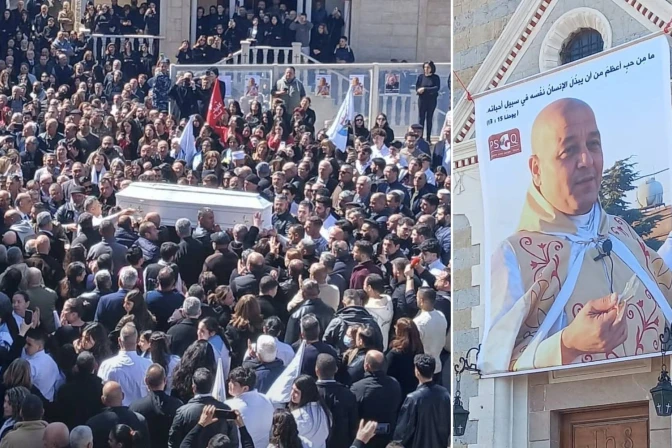
Thousands of people gathered March 11 in the border town of Qlayaa in southern Lebanon to bid farewell to Father Pierre al-Rahi, a Maronite priest who died after being wounded in an Israeli attack during the recent offensive in the region.
The funeral was held at St. George’s Church and drew crowds of local families, displaced people who had sought refuge in the area, Maronite priests from across the country, and civil authorities, according to The Eastern Church.
Many of those present felt “as if they were burying their own father,” a reflection of the close relationship the priest had forged with the community over the years.
Al-Rahi was the parish priest of St. George’s Church in Qlayaa, a predominantly Christian village of about 8,000 inhabitants, near the border with Israel.
The parish became the center of his ministry within the Maronite Church, an Eastern Catholic Church in full communion with the pope and the Maronite patriarchate in Bkerke.
A shepherd who chose to stay with his flock
Amid the escalating violence in southern Lebanon, the priest reiterated his decision to remain with his community, even as many residents of the region were forced to flee their homes.
In one of his last television interviews, according to the National Catholic Register, the sister partner of EWTN News, he stated that he would stay there “until death.”
Southern Lebanon’s Christian communities have refused to comply with Israeli evacuation orders fearing that if they left they would never get their land back, as it would be occupied by some group — whether it be Israelis or other local groups.
In his last public statement, reported by France24 on March 8 from the steps of his parish, the priest explained the spirit with which the Christian community was facing the crisis.
“We are obliged to stay despite the danger, when we defend our land, and we do so peacefully. None of us carry weapons. We all bring peace, kindness, and love. All the churches are gathered, all the religions together … it can only be for peace.”
On March 9, hours before he died, al-Rahi addressed his community again with words that today resonate with many as a spiritual testament: “You know that we are walking the path of the Passion; there is death, and after it, resurrection with Our Lord Jesus Christ … I am ready to die in my house, because this is my house.”
He died while helping the wounded
The priest died in Marjayoun Hospital after suffering shrapnel wounds during a shelling of a house in Qlayaa.
According to María Lozano, project director for the Aid to the Church in Need (ACN) foundation, the priest died while trying to help victims of the first strike.
“Father Pierre went to see how he could help the wounded … and that’s when a second projectile hit and killed him,” she explained.
“He was a very dedicated person, very dedicated to his people,” Lozano added in an interview with ACI Prensa, the Spanish-language sister service of EWTN News.
The ACN project director explained that the Christian communities in southern Lebanon “had decided to stay despite the war, saying: ‘We are a Christian population and we have nothing to do with this war and we don’t want to leave.’”
‘The father of the community’
French journalist Nathalie Duplan, who specializes in the Middle East, described the priest as a figure deeply beloved by the villagers.
“He truly was the father of the community, a symbol,” she stated in an interview with ACI Prensa. “He used to say something incredible: ‘Yes, there is death, but I am not afraid, because after death there is resurrection.’”
According to The Eastern Church, testimonies gathered after his death consistently describe al-Rahi as a man who was approachable, present, and deeply committed to his people.
He was frequently seen on the streets of Qlayaa, visiting the sick, accompanying families at births and funerals, and knowing children by name.
Al-Rahi was born in 1975 in the village of Dibeh in northern Lebanon and was ordained a Maronite priest in the early 2000s.
His most significant pastoral assignment was at St. George’s Parish in Qlayaa, where he served for many years.
For many villagers, his death symbolizes the determination of southern Lebanese Christians to remain in their land despite the violence. As he himself said in one of his last public statements: “We are here, in our land.”
His name in Arabic, al-Rahi, means “the shepherd,” an interesting fact that Pope Leo XIV highlighted this week: “Father Pierre was a true shepherd who always remained with his people with the love and sacrifice of Jesus, the Good Shepherd.”
This story was first published by ACI Prensa, the Spanish-language sister service of EWTN News. It has been translated and adapted by EWTN News English.
Who was Father Pierre al-Rahi, the Maronite priest who died helping the wounded in Lebanon? – #Catholic –
Thousands of people gathered March 11 in the border town of Qlayaa in southern Lebanon to bid farewell to Father Pierre al-Rahi, a Maronite priest who died after being wounded in an Israeli attack during the recent offensive in the region.
The funeral was held at St. George’s Church and drew crowds of local families, displaced people who had sought refuge in the area, Maronite priests from across the country, and civil authorities, according to The Eastern Church.
Many of those present felt “as if they were burying their own father,” a reflection of the close relationship the priest had forged with the community over the years.
Al-Rahi was the parish priest of St. George’s Church in Qlayaa, a predominantly Christian village of about 8,000 inhabitants, near the border with Israel.
The parish became the center of his ministry within the Maronite Church, an Eastern Catholic Church in full communion with the pope and the Maronite patriarchate in Bkerke.
A shepherd who chose to stay with his flock
Amid the escalating violence in southern Lebanon, the priest reiterated his decision to remain with his community, even as many residents of the region were forced to flee their homes.
In one of his last television interviews, according to the National Catholic Register, the sister partner of EWTN News, he stated that he would stay there “until death.”
Southern Lebanon’s Christian communities have refused to comply with Israeli evacuation orders fearing that if they left they would never get their land back, as it would be occupied by some group — whether it be Israelis or other local groups.
In his last public statement, reported by France24 on March 8 from the steps of his parish, the priest explained the spirit with which the Christian community was facing the crisis.
“We are obliged to stay despite the danger, when we defend our land, and we do so peacefully. None of us carry weapons. We all bring peace, kindness, and love. All the churches are gathered, all the religions together … it can only be for peace.”
On March 9, hours before he died, al-Rahi addressed his community again with words that today resonate with many as a spiritual testament: “You know that we are walking the path of the Passion; there is death, and after it, resurrection with Our Lord Jesus Christ … I am ready to die in my house, because this is my house.”
He died while helping the wounded
The priest died in Marjayoun Hospital after suffering shrapnel wounds during a shelling of a house in Qlayaa.
According to María Lozano, project director for the Aid to the Church in Need (ACN) foundation, the priest died while trying to help victims of the first strike.
“Father Pierre went to see how he could help the wounded … and that’s when a second projectile hit and killed him,” she explained.
“He was a very dedicated person, very dedicated to his people,” Lozano added in an interview with ACI Prensa, the Spanish-language sister service of EWTN News.
The ACN project director explained that the Christian communities in southern Lebanon “had decided to stay despite the war, saying: ‘We are a Christian population and we have nothing to do with this war and we don’t want to leave.’”
‘The father of the community’
French journalist Nathalie Duplan, who specializes in the Middle East, described the priest as a figure deeply beloved by the villagers.
“He truly was the father of the community, a symbol,” she stated in an interview with ACI Prensa. “He used to say something incredible: ‘Yes, there is death, but I am not afraid, because after death there is resurrection.’”
According to The Eastern Church, testimonies gathered after his death consistently describe al-Rahi as a man who was approachable, present, and deeply committed to his people.
He was frequently seen on the streets of Qlayaa, visiting the sick, accompanying families at births and funerals, and knowing children by name.
Al-Rahi was born in 1975 in the village of Dibeh in northern Lebanon and was ordained a Maronite priest in the early 2000s.
His most significant pastoral assignment was at St. George’s Parish in Qlayaa, where he served for many years.
For many villagers, his death symbolizes the determination of southern Lebanese Christians to remain in their land despite the violence. As he himself said in one of his last public statements: “We are here, in our land.”
His name in Arabic, al-Rahi, means “the shepherd,” an interesting fact that Pope Leo XIV highlighted this week: “Father Pierre was a true shepherd who always remained with his people with the love and sacrifice of Jesus, the Good Shepherd.”
This story was first published by ACI Prensa, the Spanish-language sister service of EWTN News. It has been translated and adapted by EWTN News English.
Amid a new Israeli military incursion into southern Lebanon, a local parish priest embodied Christ in the way he lived and died.