Day: February 15, 2026

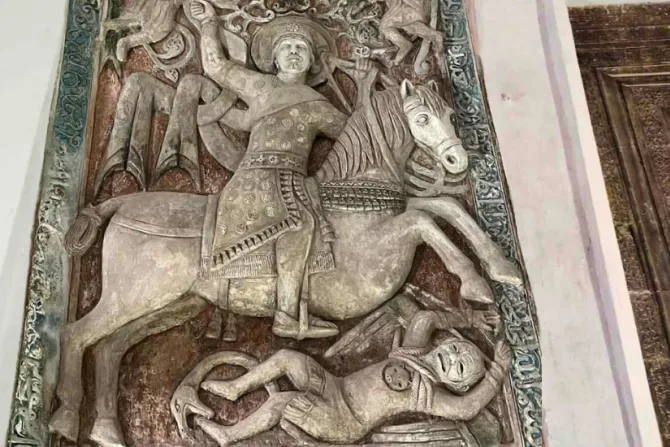
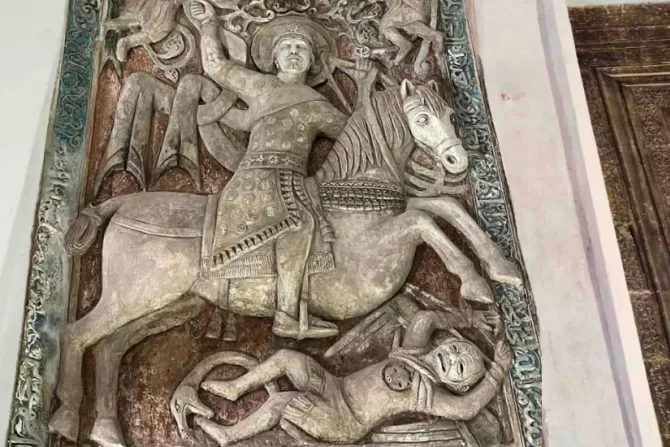
Historic murals in Iraq emerge from the ruins of ISIS destruction – #Catholic – Restoration work is progressing rapidly on two 13th-century historic mural reliefs at the ancient Mar Behnam and Sarah Monastery in Iraq. The effort is being led by the monastery’s administration in collaboration with the French organization Mesopotamia after the artworks suffered extensive destruction at the hands of ISIS.The monastery was featured in an EWTN News special on Iraq marking 10 years since the rise of ISIS and examining Christianity in Iraq a decade after the extremist group’s occupation. The report highlighted both the destruction inflicted on Christian heritage and the steady efforts toward restoration, with Mar Behnam Monastery standing as a visible sign of endurance and renewal.The murals, depicting the “Martyrdom of Mar Behnam” and “Saint Sarah,” face one another inside the monastery church and are considered unique in both scale and artistic detail. No other monastery today contains comparable works in terms of size, age, and creative intricacy. They have long been objects of popular devotion in addition to their historical value, as Chorbishop Mazen Mattoka, the monastery’s superior, explained to ACI MENA, the Arabic-language sister service of EWTN News.
 
 Father Mazen Mattoka, superior of the ancient Mar Behnam and Sarah Monastery in Iraq. | Credit: Photo courtesy of Father Mazen Mattoka
 
 ISIS militants devastated the two plaster murals in an attempt to erase Christian heritage and obliterate artworks that had withstood centuries of challenges. Despite the severity of the damage and the high cost of restoration, multiple coordinated efforts, which Mattoka describes as guided by divine providence, have worked to lift the dust and darkness of ISIS from the sacred images.Mattoka believes providence led French journalist Pascal Makosian to visit the monastery and recognize the profound pain caused by the vandalism. Through his organization, Mesopotamia, Makosian undertook the restoration project under the sponsorship of the Syriac Catholic Archdiocese of Mosul, in consultation with the Nineveh Antiquities Inspectorate and with the work of local artists.The murals are distinguished by rich symbolic colors: royal blue framing the inscriptions as a symbol of heaven; red signifying martyrdom; and green representing continuity and eternal life. Their uniqueness is further deepened by encoded theological meaning. At the center, Mar Behnam is depicted mounted on his horse; below him appears a scene symbolizing the defeat of evil; and above, two angels carry the martyred saint into the kingdom, representing resurrection.The mural of St. Sarah measures approximately 2 meters (6.6 feet) in height and nearly 1 meter (3.3 feet) in width, appearing modest beside the larger Mar Behnam mural, which extends nearly 4 meters (13.1 feet) in length and 2 meters (6.6 feet) in width. Both are framed by inscriptions in Arabic and Syriac, according to Mattoka.Extensive damageThe two plaster murals suffered destruction estimated at nearly 80%, according to sculptor Thabet Michael, head of the restoration team. He explained that ISIS left little more than the outer frame intact, from which the restoration process began.Michael had participated in the previous restoration of the murals in 2011, gaining experience that proved essential in confronting current challenges — particularly the complete disfigurement of sculptural features and the erasure of facial details.He praised the French team’s study of the murals and their history, as well as the preparation of a comprehensive photographic archive. By consulting the oldest available images — including photographs taken by foreign travelers in 1904, despite their lack of color and facial detail — restorers were able to approximate the original appearance as closely as possible.Approaching the originalThe restoration was carried out using the same original raw materials — gypsum mixed with lime — with additional elements to enhance cohesion and durability. The murals’ original colors, which had faded over centuries, were restored using comparable pigments. Surviving fragments of colored sections were analyzed to achieve shades closest to the original work, created by Syriac artists of Tikriti origin known for their mastery of sculpture, calligraphy, and ornamental design.Michael emphasized the necessity of returning to historical sources and studying them carefully in order to reach satisfactory results in restoring any historic artwork. He added that the completed work reflects the Atabeg artistic style prevalent at the time of the murals’ creation, blended with local Iraqi elements and inspired by Assyrian civilization.This story was first published by ACI MENA, the Arabic-language sister service of EWTN News. It has been translated and adapted by EWTN News.

Historic murals in Iraq emerge from the ruins of ISIS destruction – #Catholic – Restoration work is progressing rapidly on two 13th-century historic mural reliefs at the ancient Mar Behnam and Sarah Monastery in Iraq. The effort is being led by the monastery’s administration in collaboration with the French organization Mesopotamia after the artworks suffered extensive destruction at the hands of ISIS.The monastery was featured in an EWTN News special on Iraq marking 10 years since the rise of ISIS and examining Christianity in Iraq a decade after the extremist group’s occupation. The report highlighted both the destruction inflicted on Christian heritage and the steady efforts toward restoration, with Mar Behnam Monastery standing as a visible sign of endurance and renewal.The murals, depicting the “Martyrdom of Mar Behnam” and “Saint Sarah,” face one another inside the monastery church and are considered unique in both scale and artistic detail. No other monastery today contains comparable works in terms of size, age, and creative intricacy. They have long been objects of popular devotion in addition to their historical value, as Chorbishop Mazen Mattoka, the monastery’s superior, explained to ACI MENA, the Arabic-language sister service of EWTN News. Father Mazen Mattoka, superior of the ancient Mar Behnam and Sarah Monastery in Iraq. | Credit: Photo courtesy of Father Mazen Mattoka ISIS militants devastated the two plaster murals in an attempt to erase Christian heritage and obliterate artworks that had withstood centuries of challenges. Despite the severity of the damage and the high cost of restoration, multiple coordinated efforts, which Mattoka describes as guided by divine providence, have worked to lift the dust and darkness of ISIS from the sacred images.Mattoka believes providence led French journalist Pascal Makosian to visit the monastery and recognize the profound pain caused by the vandalism. Through his organization, Mesopotamia, Makosian undertook the restoration project under the sponsorship of the Syriac Catholic Archdiocese of Mosul, in consultation with the Nineveh Antiquities Inspectorate and with the work of local artists.The murals are distinguished by rich symbolic colors: royal blue framing the inscriptions as a symbol of heaven; red signifying martyrdom; and green representing continuity and eternal life. Their uniqueness is further deepened by encoded theological meaning. At the center, Mar Behnam is depicted mounted on his horse; below him appears a scene symbolizing the defeat of evil; and above, two angels carry the martyred saint into the kingdom, representing resurrection.The mural of St. Sarah measures approximately 2 meters (6.6 feet) in height and nearly 1 meter (3.3 feet) in width, appearing modest beside the larger Mar Behnam mural, which extends nearly 4 meters (13.1 feet) in length and 2 meters (6.6 feet) in width. Both are framed by inscriptions in Arabic and Syriac, according to Mattoka.Extensive damageThe two plaster murals suffered destruction estimated at nearly 80%, according to sculptor Thabet Michael, head of the restoration team. He explained that ISIS left little more than the outer frame intact, from which the restoration process began.Michael had participated in the previous restoration of the murals in 2011, gaining experience that proved essential in confronting current challenges — particularly the complete disfigurement of sculptural features and the erasure of facial details.He praised the French team’s study of the murals and their history, as well as the preparation of a comprehensive photographic archive. By consulting the oldest available images — including photographs taken by foreign travelers in 1904, despite their lack of color and facial detail — restorers were able to approximate the original appearance as closely as possible.Approaching the originalThe restoration was carried out using the same original raw materials — gypsum mixed with lime — with additional elements to enhance cohesion and durability. The murals’ original colors, which had faded over centuries, were restored using comparable pigments. Surviving fragments of colored sections were analyzed to achieve shades closest to the original work, created by Syriac artists of Tikriti origin known for their mastery of sculpture, calligraphy, and ornamental design.Michael emphasized the necessity of returning to historical sources and studying them carefully in order to reach satisfactory results in restoring any historic artwork. He added that the completed work reflects the Atabeg artistic style prevalent at the time of the murals’ creation, blended with local Iraqi elements and inspired by Assyrian civilization.This story was first published by ACI MENA, the Arabic-language sister service of EWTN News. It has been translated and adapted by EWTN News.

Restoration work is progressing rapidly on two 13th-century historic mural reliefs at the ancient Mar Behnam and Sarah Monastery.
Read More
The Good Maharaja who sheltered Polish children during World War II – #Catholic – The 1941 Sikorski-Mayski agreement between the Soviet Union and Poland resulted in the release of tens of thousands of Polish prisoners of war held in the Gulag and other Soviet camps. Their number included thousands of displaced children, many of whom were orphans. No one wanted these children; they couldn’t return to Nazi-occupied Poland, and the Soviet Union didn’t want them. Thanks to one man from a small princely state in India, their future became secured.The unexpected intervention of Jam Sahib Digvijaysinhji, the maharaja of Nawanagar, known as “the Good Maharaja,” provided these children a home in his personal estate at Balachadi.Digvijaysinhji had been educated at Malvern College in England and was part of Winston Churchill’s Imperial War Cabinet.  “He was an extraordinary man, and to the Polish people, he became a national hero … an Indian Oskar Schindler,” former Malvern College teacher and housemaster Andrew Murtagh wrote of Digvijaysinhji.Father Piotr Wiśniowski, chaplain of EWTN Poland, told EWTN News: “The Good Maharaja, Jam Sahib Digvijaysinhji, wrote himself into history through extraordinary humanity. When he welcomed Polish orphans to Balachadi, he said: ‘You are no longer refugees. From today, you are the children of Nawanagar, and I am your Bapu — your father.’ These words were not a public-relations gesture but a pledge to take responsibility for the most vulnerable.”
 
 During World War II, the unexpected intervention of the maharaja of Nawanagar, Jamsaheb Digvijaysinghji, known as “the Good Maharaja,” provided hundreds of Polish children a home at his personal estate in India. | Credit: Public domain
 
 The Poles amnestied by Stalin following the Sikorski-Mayski agreement formed the 40,000-strong Anders Army, which played a vital role in Allied war efforts. But the Polish children — Catholic and Jewish, many of whom were orphaned or had lost a parent — were the unwanted detritus of war. They had been detained in camps and temporary orphanages, often left to die of illness or starvation. Many were sons and daughters of the estimated 22,000 Polish soldiers and civilians murdered by Soviet forces in the Katyn Woods massacre.Responsibility for this humanitarian catastrophe shifted to the Polish government in exile and to British government officials. Many nations were unwilling to offer shelter to the children. The agreed-upon solution was to relocate the refugees to India.Digvijaysinhji moved quickly to alleviate the humanitarian crisis. His state was the first to host 500 Polish children. Other Indian states followed his kindness.“After 1941, when Polish refugees were freed from Soviet captivity, Poland was a nation devastated by war, unable to care even for its own children,” Wiśniowski told EWTN News. “The maharaja understood that tragedy and said, ‘If God has sent me these children, it is my duty to care for them.’ That is why Poland remains grateful to him — for lives saved, dignity restored, and for the witness that mercy knows no borders of nations or cultures.”At first, foster homes were suggested, but the Polish government was opposed to separating the already traumatized children. Other options, such as schools and convents, proved unworkable. The viceroy of India set up The Polish Children’s Fund, supported by the archbishop of Delhi and the mother superior of the Convent of Jesus and Mary. The group raised funds among private donors including the Tata family.
 
 Children from Polish orphanages, USSR, 1941-1942. | Credit: Photo from the collection of Wiesław Stypuła
 
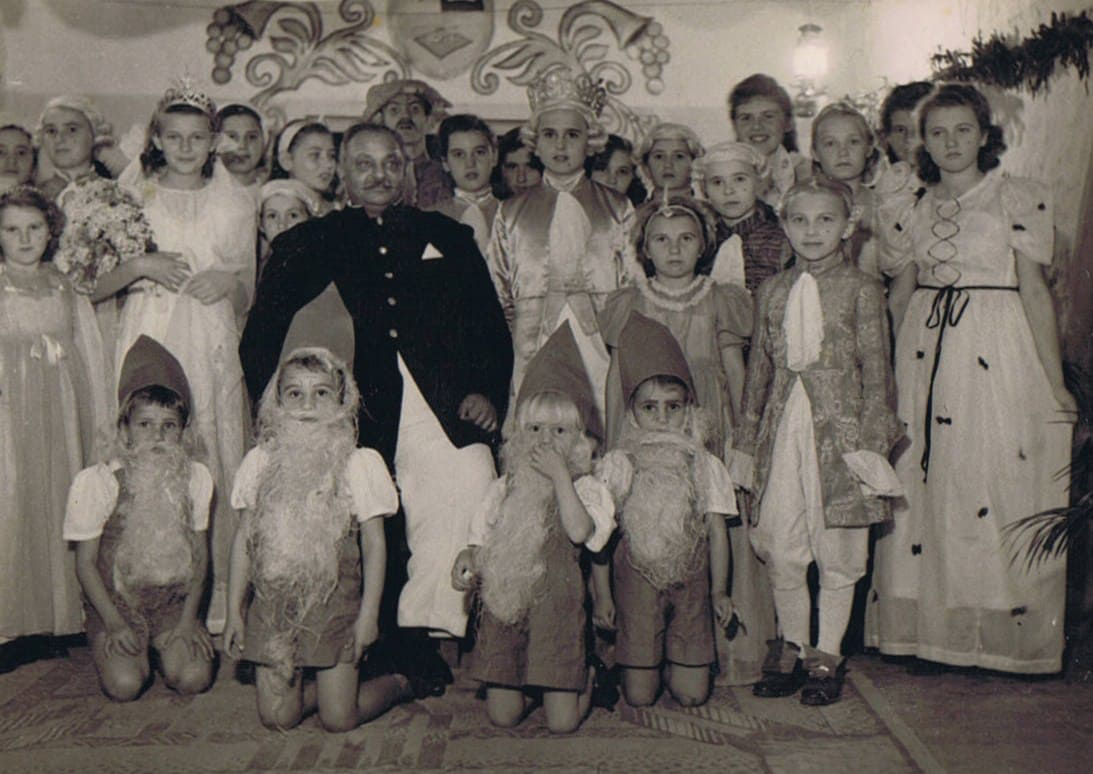
 Anuradha Bhattacharjee in “The Second Homeland: Polish Refugees in India” explains how India — though not sovereign at the time and not at all prosperous — became the first country in the world to accept and offer sanctuary at its own cost to the hapless Polish population rendered homeless and subsequently stateless.“The first Polish children were hosted in Balachadi in Nawanagar state and were maintained by charitable funds raised in India, subscribed to by several Indian princes and wealthy individuals. They were settled at a camp near Balachadi when no place for the children could be found in the whole of British India. The state of Nawanagar took the bold step of adopting the children to prevent their forcible repatriation to Soviet-occupied Poland at the end of the second world war.”By December 1942, around 640 children had made the 1,500-kilometer (932-mile) arduous journey in trucks from Ashgabat in Turkmenistan to Balachadi. According to accounts, they were extremely thin and miserable, their clothes hanging about their frames, and this was after having already been fed for a few months.Digvijaysinhji converted the guesthouse of his Balachadi palace into a school with a special library shelved with Polish books. The children often put on plays with Digvijaysinhji in attendance. Among their Polish caregivers were Father Franciszek Pluta, who was later denounced by the communists as an international kidnapper after relocating some of the children to the United States, as well as scoutmaster Zdzisław Peszkowski, a survivor of the Katyn Woods massacre who was ordained a priest after World War II. Peszkowski campaigned for the truth about Katyn for the rest of his life and was a contemporary and close associate of St. John Paul II.In the camp the children enjoyed the outdoor life, the beach, and the climate. They camped and played soccer, hockey, and volleyball.
 
 Father Franciszek Pluta celebrates a field Mass during the land evacuation from the Soviet Union to India. | Credit: Photo courtesy of Koło Polaków z Niechciał z Niechciał
 
 At the end of the war, many children feared living under communist rule, having suffered deportation to Siberia from the Soviet regime. Only those children who wanted to return to Poland were required to go back. Eighty-one children were relocated to the United States to build new lives there with the help of Catholic missionaries. Twelve Jewish children were relocated to Haifa in 1943.In 1989, following the fall of communism in Poland, the kindness and generosity of Digvijaysinhji was formally recognized by the Polish government. In 2012, a park in Warsaw was named the “Square of the Good Maharaja” and a monument was erected. He was also posthumously given the Commander’s Cross of the Order of Merit of the Republic of Poland.

The Good Maharaja who sheltered Polish children during World War II – #Catholic – The 1941 Sikorski-Mayski agreement between the Soviet Union and Poland resulted in the release of tens of thousands of Polish prisoners of war held in the Gulag and other Soviet camps. Their number included thousands of displaced children, many of whom were orphans. No one wanted these children; they couldn’t return to Nazi-occupied Poland, and the Soviet Union didn’t want them. Thanks to one man from a small princely state in India, their future became secured.The unexpected intervention of Jam Sahib Digvijaysinhji, the maharaja of Nawanagar, known as “the Good Maharaja,” provided these children a home in his personal estate at Balachadi.Digvijaysinhji had been educated at Malvern College in England and was part of Winston Churchill’s Imperial War Cabinet.  “He was an extraordinary man, and to the Polish people, he became a national hero … an Indian Oskar Schindler,” former Malvern College teacher and housemaster Andrew Murtagh wrote of Digvijaysinhji.Father Piotr Wiśniowski, chaplain of EWTN Poland, told EWTN News: “The Good Maharaja, Jam Sahib Digvijaysinhji, wrote himself into history through extraordinary humanity. When he welcomed Polish orphans to Balachadi, he said: ‘You are no longer refugees. From today, you are the children of Nawanagar, and I am your Bapu — your father.’ These words were not a public-relations gesture but a pledge to take responsibility for the most vulnerable.” During World War II, the unexpected intervention of the maharaja of Nawanagar, Jamsaheb Digvijaysinghji, known as “the Good Maharaja,” provided hundreds of Polish children a home at his personal estate in India. | Credit: Public domain The Poles amnestied by Stalin following the Sikorski-Mayski agreement formed the 40,000-strong Anders Army, which played a vital role in Allied war efforts. But the Polish children — Catholic and Jewish, many of whom were orphaned or had lost a parent — were the unwanted detritus of war. They had been detained in camps and temporary orphanages, often left to die of illness or starvation. Many were sons and daughters of the estimated 22,000 Polish soldiers and civilians murdered by Soviet forces in the Katyn Woods massacre.Responsibility for this humanitarian catastrophe shifted to the Polish government in exile and to British government officials. Many nations were unwilling to offer shelter to the children. The agreed-upon solution was to relocate the refugees to India.Digvijaysinhji moved quickly to alleviate the humanitarian crisis. His state was the first to host 500 Polish children. Other Indian states followed his kindness.“After 1941, when Polish refugees were freed from Soviet captivity, Poland was a nation devastated by war, unable to care even for its own children,” Wiśniowski told EWTN News. “The maharaja understood that tragedy and said, ‘If God has sent me these children, it is my duty to care for them.’ That is why Poland remains grateful to him — for lives saved, dignity restored, and for the witness that mercy knows no borders of nations or cultures.”At first, foster homes were suggested, but the Polish government was opposed to separating the already traumatized children. Other options, such as schools and convents, proved unworkable. The viceroy of India set up The Polish Children’s Fund, supported by the archbishop of Delhi and the mother superior of the Convent of Jesus and Mary. The group raised funds among private donors including the Tata family. Children from Polish orphanages, USSR, 1941-1942. | Credit: Photo from the collection of Wiesław Stypuła Anuradha Bhattacharjee in “The Second Homeland: Polish Refugees in India” explains how India — though not sovereign at the time and not at all prosperous — became the first country in the world to accept and offer sanctuary at its own cost to the hapless Polish population rendered homeless and subsequently stateless.“The first Polish children were hosted in Balachadi in Nawanagar state and were maintained by charitable funds raised in India, subscribed to by several Indian princes and wealthy individuals. They were settled at a camp near Balachadi when no place for the children could be found in the whole of British India. The state of Nawanagar took the bold step of adopting the children to prevent their forcible repatriation to Soviet-occupied Poland at the end of the second world war.”By December 1942, around 640 children had made the 1,500-kilometer (932-mile) arduous journey in trucks from Ashgabat in Turkmenistan to Balachadi. According to accounts, they were extremely thin and miserable, their clothes hanging about their frames, and this was after having already been fed for a few months.Digvijaysinhji converted the guesthouse of his Balachadi palace into a school with a special library shelved with Polish books. The children often put on plays with Digvijaysinhji in attendance. Among their Polish caregivers were Father Franciszek Pluta, who was later denounced by the communists as an international kidnapper after relocating some of the children to the United States, as well as scoutmaster Zdzisław Peszkowski, a survivor of the Katyn Woods massacre who was ordained a priest after World War II. Peszkowski campaigned for the truth about Katyn for the rest of his life and was a contemporary and close associate of St. John Paul II.In the camp the children enjoyed the outdoor life, the beach, and the climate. They camped and played soccer, hockey, and volleyball. Father Franciszek Pluta celebrates a field Mass during the land evacuation from the Soviet Union to India. | Credit: Photo courtesy of Koło Polaków z Niechciał z Niechciał At the end of the war, many children feared living under communist rule, having suffered deportation to Siberia from the Soviet regime. Only those children who wanted to return to Poland were required to go back. Eighty-one children were relocated to the United States to build new lives there with the help of Catholic missionaries. Twelve Jewish children were relocated to Haifa in 1943.In 1989, following the fall of communism in Poland, the kindness and generosity of Digvijaysinhji was formally recognized by the Polish government. In 2012, a park in Warsaw was named the “Square of the Good Maharaja” and a monument was erected. He was also posthumously given the Commander’s Cross of the Order of Merit of the Republic of Poland.

During World War II, the unexpected intervention of the Maharaja of Nawanagar, known as “the Good Maharaja,” provided hundreds of Polish children a home at his personal estate in India.
Read More
Rachel’s Vineyard retreats return in 2026 to offer post-abortion healing #Catholic – Have you or someone you know been affected by abortion? There is hope. There is healing.
Two Rachel’s Vineyard retreats are scheduled for 2026 (April 10 and Sept. 25) for those seeking to renew, rebuild, and redeem hearts broken by an abortion.
These confidential weekend retreats are rooted in faith, offering compassion, healing, and hope to anyone affected by abortion, including women and men of all ages. In a supportive and welcoming setting, participants are invited to reflect, grieve, and experience God’s love and mercy.
“It took me a while to get up the courage to call, but thank God I did,” said Susan Swander in a testimonial she wrote on rachelsvineyard.org after attending a Rachel’s Vineyard Retreat. “What a remarkable, healing experience this weekend was. Words do not do justice to the love, compassion, and understanding I found during the retreat.”
Some of the symptoms faced by those who experience the trauma of abortion include depression, nightmares, anxiety, withdrawal from family, and even suicidal thoughts. Rachel’s Vineyard offers participants a space to work through these experiences and find forgiveness.

Click here to subscribe to our weekly newsletter.

The retreats are being offered in English and Spanish in a special partnership between the Diocese of Paterson and the Archdiocese of Newark. Cheryl Riley, Respect Life director of the Archdiocese of Newark, and Alyssa Renovales, Respect Life coordinator of the Diocese of Paterson, will co-lead the retreats.
Anyone in the Diocese of Paterson seeking support or more information is encouraged to contact Renovales at 973-377-1004 ext. 406 or by email Arenovales@patersondiocese.org. All inquiries are completely confidential.
“Echoing the hope proclaimed by St. John Paul II in Evangelium Vitae, Rachel’s Vineyard is a beautiful gift to the Church, a place where hearts are gently restored, burdens are lifted, and all are reminded that the Church is for them and God’s mercy is always within reach,” Renovales said.
Rachel’s Vineyard was founded in 1995 by Theresa Karminski Burke, Ph.D., and is now offered in over 33 languages across 50 countries.
Learn more about the Respect Life Ministry of the Diocese of Paterson by visiting insidethewalls.org/respect-life.

Rachel’s Vineyard retreats return in 2026 to offer post-abortion healing #Catholic – Have you or someone you know been affected by abortion? There is hope. There is healing. Two Rachel’s Vineyard retreats are scheduled for 2026 (April 10 and Sept. 25) for those seeking to renew, rebuild, and redeem hearts broken by an abortion. These confidential weekend retreats are rooted in faith, offering compassion, healing, and hope to anyone affected by abortion, including women and men of all ages. In a supportive and welcoming setting, participants are invited to reflect, grieve, and experience God’s love and mercy. “It took me a while to get up the courage to call, but thank God I did,” said Susan Swander in a testimonial she wrote on rachelsvineyard.org after attending a Rachel’s Vineyard Retreat. “What a remarkable, healing experience this weekend was. Words do not do justice to the love, compassion, and understanding I found during the retreat.” Some of the symptoms faced by those who experience the trauma of abortion include depression, nightmares, anxiety, withdrawal from family, and even suicidal thoughts. Rachel’s Vineyard offers participants a space to work through these experiences and find forgiveness. Click here to subscribe to our weekly newsletter. The retreats are being offered in English and Spanish in a special partnership between the Diocese of Paterson and the Archdiocese of Newark. Cheryl Riley, Respect Life director of the Archdiocese of Newark, and Alyssa Renovales, Respect Life coordinator of the Diocese of Paterson, will co-lead the retreats. Anyone in the Diocese of Paterson seeking support or more information is encouraged to contact Renovales at 973-377-1004 ext. 406 or by email Arenovales@patersondiocese.org. All inquiries are completely confidential. “Echoing the hope proclaimed by St. John Paul II in Evangelium Vitae, Rachel’s Vineyard is a beautiful gift to the Church, a place where hearts are gently restored, burdens are lifted, and all are reminded that the Church is for them and God’s mercy is always within reach,” Renovales said. Rachel’s Vineyard was founded in 1995 by Theresa Karminski Burke, Ph.D., and is now offered in over 33 languages across 50 countries. Learn more about the Respect Life Ministry of the Diocese of Paterson by visiting insidethewalls.org/respect-life.

Rachel’s Vineyard retreats return in 2026 to offer post-abortion healing #Catholic –

Have you or someone you know been affected by abortion? There is hope. There is healing.

Two Rachel’s Vineyard retreats are scheduled for 2026 (April 10 and Sept. 25) for those seeking to renew, rebuild, and redeem hearts broken by an abortion.

These confidential weekend retreats are rooted in faith, offering compassion, healing, and hope to anyone affected by abortion, including women and men of all ages. In a supportive and welcoming setting, participants are invited to reflect, grieve, and experience God’s love and mercy.

“It took me a while to get up the courage to call, but thank God I did,” said Susan Swander in a testimonial she wrote on rachelsvineyard.org after attending a Rachel’s Vineyard Retreat. “What a remarkable, healing experience this weekend was. Words do not do justice to the love, compassion, and understanding I found during the retreat.”

Some of the symptoms faced by those who experience the trauma of abortion include depression, nightmares, anxiety, withdrawal from family, and even suicidal thoughts. Rachel’s Vineyard offers participants a space to work through these experiences and find forgiveness.


Click here to subscribe to our weekly newsletter.

The retreats are being offered in English and Spanish in a special partnership between the Diocese of Paterson and the Archdiocese of Newark. Cheryl Riley, Respect Life director of the Archdiocese of Newark, and Alyssa Renovales, Respect Life coordinator of the Diocese of Paterson, will co-lead the retreats.

Anyone in the Diocese of Paterson seeking support or more information is encouraged to contact Renovales at 973-377-1004 ext. 406 or by email Arenovales@patersondiocese.org. All inquiries are completely confidential.

“Echoing the hope proclaimed by St. John Paul II in Evangelium Vitae, Rachel’s Vineyard is a beautiful gift to the Church, a place where hearts are gently restored, burdens are lifted, and all are reminded that the Church is for them and God’s mercy is always within reach,” Renovales said.

Rachel’s Vineyard was founded in 1995 by Theresa Karminski Burke, Ph.D., and is now offered in over 33 languages across 50 countries.

Learn more about the Respect Life Ministry of the Diocese of Paterson by visiting insidethewalls.org/respect-life.

Have you or someone you know been affected by abortion? There is hope. There is healing. Two Rachel’s Vineyard retreats are scheduled for 2026 (April 10 and Sept. 25) for those seeking to renew, rebuild, and redeem hearts broken by an abortion. These confidential weekend retreats are rooted in faith, offering compassion, healing, and hope to anyone affected by abortion, including women and men of all ages. In a supportive and welcoming setting, participants are invited to reflect, grieve, and experience God’s love and mercy. “It took me a while to get up the courage to call, but thank God

Read More

Looking for a sky event this week? Check out our full Sky This Week column.  February 14: A Valentine’s Heart (Nebula) This evening, Saturn passes 0.9° south of Neptune at 11 P.M. EST. The two planets stand together in Pisces, located in the west after sunset. An hour after the Sun goes down, the pair is stillContinue reading “The Sky Today on Sunday, February 15: Saturn and Neptune stand close”

The post The Sky Today on Sunday, February 15: Saturn and Neptune stand close appeared first on Astronomy Magazine.

Read More