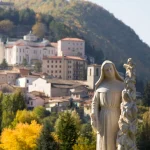
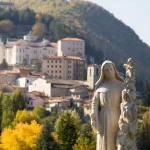
The saint who settled a violent conflict #Catholic – The little town of Cascia, Italy, in the mountainous region of Umbria, is a pilgrimage destination for those wishing to visit the relics of St. Rita of Cascia. Today, St. Rita’s incorrupt remains are housed in the Basilica that bears her name and which was built in the early 20th century. But the town of Cascia has been a destination for pilgrims ever since her death on May 22nd, 1457, and we now celebrate her feast day on May 22nd.
Pilgrims continue to visit Cascia to pray for St. Rita’s intercession just as they have for hundreds of years. Carved into the holy door and façade of the basilica are scenes from her life. Many turn to her in difficult circumstances because she is a patron of impossible causes.
St. Rita wanted to become a nun from a young age but was given in marriage to a violent man embroiled in feuding that consumed Cascia. She worked tirelessly to convert her husband—and there are reports that she succeeded to a degree. But he eventually died a violent death at the hands of his enemies. Rita’s sons took up their father’s feud but later died of illness before they could exact revenge.
Having publicly forgiven her husband’s killers, Rita was happy to see her sons follow in her footsteps on their deathbeds by renouncing their feud and offering forgiveness. She mourned the loss of her sons but hoped to meet them again in heaven, confident in the state of their souls as they passed.

Click here to subscribe to our weekly newsletter.

At the age of 36, Rita decided to pursue her childhood dream of becoming a nun. But the Augustinian convent in Cascia she sought to enter was wary of her association with the feuding families of the town, so the nuns made a stipulation: “Bring peace to Cascia and you may enter the convent.”
What Rita accomplished next earned her the title “Peacemaker of Cascia.” To many, it seemed almost miraculous that she was able to intercede with factions at the center of the conflict to bring peace to the town and earn acceptance into the convent. Some also considered it a near miracle that Abbess Maria Teresa Fasce, head of the Augustinian convent in Cascia from 1920 to 1947, succeeded in having a basilica built to honor the enduring impact of St. Rita’s life.
But those who have shared a devotion to St. Rita throughout the centuries have always understood the importance of her example and her worthiness of such an honor. When St. Rita passed away in 1457, a local carpenter who had been partially paralyzed lamented the simple preparations for burial being made for her.
“If only I were well,” he said, “I would have prepared a place more worthy of you.” The moment he spoke those words, the carpenter was healed, and he crafted a beautiful coffin for her.
Today, the Basilica of St. Rita of Cascia displays her incorrupt body behind glass, where pilgrims can glimpse the miraculous and meditate upon the hope of being restored and reunited in peace with those we love.
The life story of St. Rita of Cascia demonstrates the immense influence we have on the world when we devote ourselves to cultivating peace. St. Rita made such a profound mark that she continues to inspire devotion. May she intercede on behalf of all those who turn to her, especially those in trying circumstances seeking help from God with the most impossible causes.
For free copies of the Christopher News Note NURTURING SEEDS OF FAITH AND HOPE, write: The Christophers, 264 West 40th Street, Room 603, New York, NY 10018; or e-mail: mail@christophers.org
 
The saint who settled a violent conflict #Catholic - <img width="150" height="150" src="https://beaconnj.org/wp-content/uploads/2026/05/vpt_SantaRita-1-150x150.webp" class="attachment-thumbnail size-thumbnail wp-post-image" alt="" decoding="async" srcset="https://beaconnj.org/wp-content/uploads/2026/05/vpt_SantaRita-1-150x150.webp 150w, https://beaconnj.org/wp-content/uploads/2026/05/vpt_SantaRita-1-480x480.webp 480w" sizes="(max-width: 150px) 100vw, 150px" /><p><strong>The little town of Cascia, Italy,</strong> in the mountainous region of Umbria, is a pilgrimage destination for those wishing to visit the relics of St. Rita of Cascia. Today, St. Rita’s incorrupt remains are housed in the Basilica that bears her name and which was built in the early 20<sup>th</sup> century. But the town of Cascia has been a destination for pilgrims ever since her death on May 22<sup>nd</sup>, 1457, and we now celebrate her feast day on May 22<sup>nd</sup>.</p> <p>Pilgrims continue to visit Cascia to pray for St. Rita’s intercession just as they have for hundreds of years. Carved into the holy door and façade of the basilica are scenes from her life. Many turn to her in difficult circumstances because she is a patron of impossible causes.</p> <p>St. Rita wanted to become a nun from a young age but was given in marriage to a violent man embroiled in feuding that consumed Cascia. She worked tirelessly to convert her husband—and there are reports that she succeeded to a degree. But he eventually died a violent death at the hands of his enemies. Rita’s sons took up their father’s feud but later died of illness before they could exact revenge.</p> <p>Having publicly forgiven her husband’s killers, Rita was happy to see her sons follow in her footsteps on their deathbeds by renouncing their feud and offering forgiveness. She mourned the loss of her sons but hoped to meet them again in heaven, confident in the state of their souls as they passed.</p> <hr> <h6 style="text-align: center;"><a href="https://beaconnj.org/subscribe/" target="_blank" rel="noopener"><span data-olk-copy-source="MessageBody">Click here to subscribe to our weekly newsletter.</span></a></h6> <hr> <p>At the age of 36, Rita decided to pursue her childhood dream of becoming a nun. But the Augustinian convent in Cascia she sought to enter was wary of her association with the feuding families of the town, so the nuns made a stipulation: “Bring peace to Cascia and you may enter the convent.”</p> <p>What Rita accomplished next earned her the title “Peacemaker of Cascia.” To many, it seemed almost miraculous that she was able to intercede with factions at the center of the conflict to bring peace to the town and earn acceptance into the convent. Some also considered it a near miracle that Abbess Maria Teresa Fasce, head of the Augustinian convent in Cascia from 1920 to 1947, succeeded in having a basilica built to honor the enduring impact of St. Rita’s life.</p> <p>But those who have shared a devotion to St. Rita throughout the centuries have always understood the importance of her example and her worthiness of such an honor. When St. Rita passed away in 1457, a local carpenter who had been partially paralyzed lamented the simple preparations for burial being made for her.</p> <p>“If only I were well,” he said, “I would have prepared a place more worthy of you.” The moment he spoke those words, the carpenter was healed, and he crafted a beautiful coffin for her.</p> <p>Today, the Basilica of St. Rita of Cascia displays her incorrupt body behind glass, where pilgrims can glimpse the miraculous and meditate upon the hope of being restored and reunited in peace with those we love.</p> <p>The life story of St. Rita of Cascia demonstrates the immense influence we have on the world when we devote ourselves to cultivating peace. St. Rita made such a profound mark that she continues to inspire devotion. May she intercede on behalf of all those who turn to her, especially those in trying circumstances seeking help from God with the most impossible causes.</p> <p style="text-align: right;"><em>For free copies of the Christopher News Note NURTURING SEEDS OF FAITH AND HOPE, write: The Christophers, 264 West 40<sup>th</sup> Street, Room 603, New York, NY 10018; or e-mail: <a href="mailto:mail@christophers.org">mail@christophers.org</a></em></p> <p> </p> - <img width="150" height="150" src="https://beaconnj.org/wp-content/uploads/2026/05/vpt_SantaRita-1-150x150.webp" class="attachment-thumbnail size-thumbnail wp-post-image" alt="" decoding="async" srcset="https://beaconnj.org/wp-content/uploads/2026/05/vpt_SantaRita-1-150x150.webp 150w, https://beaconnj.org/wp-content/uploads/2026/05/vpt_SantaRita-1-480x480.webp 480w" sizes="(max-width: 150px) 100vw, 150px" />The little town of Cascia, Italy, in the mountainous region of Umbria, is a pilgrimage destination for those wishing to visit the relics of St. Rita of Cascia. Today, St. Rita’s incorrupt remains are housed in the Basilica that bears her name and which was built in the early 20th century. But the town of Cascia has been a destination for pilgrims ever since her death on May 22nd, 1457, and we now celebrate her feast day on May 22nd. Pilgrims continue to visit Cascia to pray for St. Rita’s intercession just as they have for hundreds of years. Carved

The little town of Cascia, Italy, in the mountainous region of Umbria, is a pilgrimage destination for those wishing to visit the relics of St. Rita of Cascia. Today, St. Rita’s incorrupt remains are housed in the Basilica that bears her name and which was built in the early 20th century. But the town of Cascia has been a destination for pilgrims ever since her death on May 22nd, 1457, and we now celebrate her feast day on May 22nd.

Pilgrims continue to visit Cascia to pray for St. Rita’s intercession just as they have for hundreds of years. Carved into the holy door and façade of the basilica are scenes from her life. Many turn to her in difficult circumstances because she is a patron of impossible causes.

St. Rita wanted to become a nun from a young age but was given in marriage to a violent man embroiled in feuding that consumed Cascia. She worked tirelessly to convert her husband—and there are reports that she succeeded to a degree. But he eventually died a violent death at the hands of his enemies. Rita’s sons took up their father’s feud but later died of illness before they could exact revenge.

Having publicly forgiven her husband’s killers, Rita was happy to see her sons follow in her footsteps on their deathbeds by renouncing their feud and offering forgiveness. She mourned the loss of her sons but hoped to meet them again in heaven, confident in the state of their souls as they passed.


Click here to subscribe to our weekly newsletter.

At the age of 36, Rita decided to pursue her childhood dream of becoming a nun. But the Augustinian convent in Cascia she sought to enter was wary of her association with the feuding families of the town, so the nuns made a stipulation: “Bring peace to Cascia and you may enter the convent.”

What Rita accomplished next earned her the title “Peacemaker of Cascia.” To many, it seemed almost miraculous that she was able to intercede with factions at the center of the conflict to bring peace to the town and earn acceptance into the convent. Some also considered it a near miracle that Abbess Maria Teresa Fasce, head of the Augustinian convent in Cascia from 1920 to 1947, succeeded in having a basilica built to honor the enduring impact of St. Rita’s life.

But those who have shared a devotion to St. Rita throughout the centuries have always understood the importance of her example and her worthiness of such an honor. When St. Rita passed away in 1457, a local carpenter who had been partially paralyzed lamented the simple preparations for burial being made for her.

“If only I were well,” he said, “I would have prepared a place more worthy of you.” The moment he spoke those words, the carpenter was healed, and he crafted a beautiful coffin for her.

Today, the Basilica of St. Rita of Cascia displays her incorrupt body behind glass, where pilgrims can glimpse the miraculous and meditate upon the hope of being restored and reunited in peace with those we love.

The life story of St. Rita of Cascia demonstrates the immense influence we have on the world when we devote ourselves to cultivating peace. St. Rita made such a profound mark that she continues to inspire devotion. May she intercede on behalf of all those who turn to her, especially those in trying circumstances seeking help from God with the most impossible causes.

For free copies of the Christopher News Note NURTURING SEEDS OF FAITH AND HOPE, write: The Christophers, 264 West 40th Street, Room 603, New York, NY 10018; or e-mail: mail@christophers.org


The saint who settled a violent conflict #Catholic –

The little town of Cascia, Italy, in the mountainous region of Umbria, is a pilgrimage destination for those wishing to visit the relics of St. Rita of Cascia. Today, St. Rita’s incorrupt remains are housed in the Basilica that bears her name and which was built in the early 20th century. But the town of Cascia has been a destination for pilgrims ever since her death on May 22nd, 1457, and we now celebrate her feast day on May 22nd.

Pilgrims continue to visit Cascia to pray for St. Rita’s intercession just as they have for hundreds of years. Carved into the holy door and façade of the basilica are scenes from her life. Many turn to her in difficult circumstances because she is a patron of impossible causes.

St. Rita wanted to become a nun from a young age but was given in marriage to a violent man embroiled in feuding that consumed Cascia. She worked tirelessly to convert her husband—and there are reports that she succeeded to a degree. But he eventually died a violent death at the hands of his enemies. Rita’s sons took up their father’s feud but later died of illness before they could exact revenge.

Having publicly forgiven her husband’s killers, Rita was happy to see her sons follow in her footsteps on their deathbeds by renouncing their feud and offering forgiveness. She mourned the loss of her sons but hoped to meet them again in heaven, confident in the state of their souls as they passed.


Click here to subscribe to our weekly newsletter.

At the age of 36, Rita decided to pursue her childhood dream of becoming a nun. But the Augustinian convent in Cascia she sought to enter was wary of her association with the feuding families of the town, so the nuns made a stipulation: “Bring peace to Cascia and you may enter the convent.”

What Rita accomplished next earned her the title “Peacemaker of Cascia.” To many, it seemed almost miraculous that she was able to intercede with factions at the center of the conflict to bring peace to the town and earn acceptance into the convent. Some also considered it a near miracle that Abbess Maria Teresa Fasce, head of the Augustinian convent in Cascia from 1920 to 1947, succeeded in having a basilica built to honor the enduring impact of St. Rita’s life.

But those who have shared a devotion to St. Rita throughout the centuries have always understood the importance of her example and her worthiness of such an honor. When St. Rita passed away in 1457, a local carpenter who had been partially paralyzed lamented the simple preparations for burial being made for her.

“If only I were well,” he said, “I would have prepared a place more worthy of you.” The moment he spoke those words, the carpenter was healed, and he crafted a beautiful coffin for her.

Today, the Basilica of St. Rita of Cascia displays her incorrupt body behind glass, where pilgrims can glimpse the miraculous and meditate upon the hope of being restored and reunited in peace with those we love.

The life story of St. Rita of Cascia demonstrates the immense influence we have on the world when we devote ourselves to cultivating peace. St. Rita made such a profound mark that she continues to inspire devotion. May she intercede on behalf of all those who turn to her, especially those in trying circumstances seeking help from God with the most impossible causes.

For free copies of the Christopher News Note NURTURING SEEDS OF FAITH AND HOPE, write: The Christophers, 264 West 40th Street, Room 603, New York, NY 10018; or e-mail: mail@christophers.org