Complaint

Philippine court dismisses case against bishop involved in mining dispute #Catholic A court in the northern Philippines has dismissed a forcible entry case against a Catholic bishop, a priest, and several community leaders involved in a dispute over a mining exploration project in Nueva Vizcaya province.Bishop Jose Elmer Mangalinao of Bayombong welcomed the June 24 ruling, which dismissed a complaint linked to barricades established by residents in Kasibu town against exploration activities by North Luzon Mineral Resources Corporation (NLMRC).“This outcome is not only a legal victory. It is a victory for truth, justice, and the collective efforts of communities who courageously stand to protect our land, water, and future generations,” Mangalinao said in a statement.The complaint named Mangalinao, Father Christian Dumangeng, and several community leaders allegedly involved in maintaining the barricades. The case drew national attention after a Catholic bishop and priest were included among the defendants.The dispute stems from opposition to a 4,456-hectare (11,011 acres) mining exploration project being undertaken by NLMRC in several villages in Kasibu, a municipality in Nueva Vizcaya, a mountainous province on the island of Luzon north of Manila.Residents, church groups, and some Indigenous leaders have raised concerns about the project’s potential effects on watersheds, local livelihoods, and nearby communities.Residents established barricades in May to block the movement of fuel, equipment, and mineral samples linked to NLMRC’s exploration activities, according to community groups.The complaint was filed by Rosario Camma, who identified himself as the overall chieftain of the Bugkalot-Ilongot Indigenous Cultural Communities. Some members of the Bugkalot-Ilongot Indigenous communities have joined opposition to the project, citing concerns about its possible effects on their communities and surrounding resources.In a nine-page decision obtained by EWTN News, the local court said the plaintiff failed to establish a clear legal right warranting injunctive relief and ruled that it lacked jurisdiction over the action. The court found that the relief sought was more consistent with an injunction case than a forcible entry action.The decision also cited a certification from the Philippine government’s Indigenous affairs agency stating that the exploration permit area falls outside officially recognized ancestral domain lands. Opponents of the project, however, have argued that the controversy extends beyond ancestral domain claims and includes concerns over environmental impacts and consultation requirements.The court further held that the complaint sought to stop activities related to the barricades rather than recover possession of property, a key element in forcible entry cases.Mangalinao has defended his involvement in the issue, saying his presence at the barricades was part of his pastoral responsibility. Earlier this week, he said he visited the communities to celebrate Mass and accompany residents concerned about the future of their land and water sources.“I went as their bishop to offer the Holy Mass, to pray with them, and to remind them that their concern for the land, the water, and their children’s future is one the Church shares and blesses,” he said.In his homily on June 21, the prelate said the dispute is an issue of environmental stewardship and concern for communities affected by development projects.“I could have chosen not to speak up, but if I do not speak up, my sin would be great before God,” he said.The bishop said the ruling would strengthen continuing efforts to defend the environment and communities affected by extractive projects.“Let this moment remind us that defending our watersheds, our environment, and our people’s livelihood is not a crime: it is a shared moral responsibility,” he said.“We believe, as the Church has always taught, that the earth is not ours to exhaust but ours to steward,” he added.

Philippine court dismisses case against bishop involved in mining dispute #Catholic A court in the northern Philippines has dismissed a forcible entry case against a Catholic bishop, a priest, and several community leaders involved in a dispute over a mining exploration project in Nueva Vizcaya province.Bishop Jose Elmer Mangalinao of Bayombong welcomed the June 24 ruling, which dismissed a complaint linked to barricades established by residents in Kasibu town against exploration activities by North Luzon Mineral Resources Corporation (NLMRC).“This outcome is not only a legal victory. It is a victory for truth, justice, and the collective efforts of communities who courageously stand to protect our land, water, and future generations,” Mangalinao said in a statement.The complaint named Mangalinao, Father Christian Dumangeng, and several community leaders allegedly involved in maintaining the barricades. The case drew national attention after a Catholic bishop and priest were included among the defendants.The dispute stems from opposition to a 4,456-hectare (11,011 acres) mining exploration project being undertaken by NLMRC in several villages in Kasibu, a municipality in Nueva Vizcaya, a mountainous province on the island of Luzon north of Manila.Residents, church groups, and some Indigenous leaders have raised concerns about the project’s potential effects on watersheds, local livelihoods, and nearby communities.Residents established barricades in May to block the movement of fuel, equipment, and mineral samples linked to NLMRC’s exploration activities, according to community groups.The complaint was filed by Rosario Camma, who identified himself as the overall chieftain of the Bugkalot-Ilongot Indigenous Cultural Communities. Some members of the Bugkalot-Ilongot Indigenous communities have joined opposition to the project, citing concerns about its possible effects on their communities and surrounding resources.In a nine-page decision obtained by EWTN News, the local court said the plaintiff failed to establish a clear legal right warranting injunctive relief and ruled that it lacked jurisdiction over the action. The court found that the relief sought was more consistent with an injunction case than a forcible entry action.The decision also cited a certification from the Philippine government’s Indigenous affairs agency stating that the exploration permit area falls outside officially recognized ancestral domain lands. Opponents of the project, however, have argued that the controversy extends beyond ancestral domain claims and includes concerns over environmental impacts and consultation requirements.The court further held that the complaint sought to stop activities related to the barricades rather than recover possession of property, a key element in forcible entry cases.Mangalinao has defended his involvement in the issue, saying his presence at the barricades was part of his pastoral responsibility. Earlier this week, he said he visited the communities to celebrate Mass and accompany residents concerned about the future of their land and water sources.“I went as their bishop to offer the Holy Mass, to pray with them, and to remind them that their concern for the land, the water, and their children’s future is one the Church shares and blesses,” he said.In his homily on June 21, the prelate said the dispute is an issue of environmental stewardship and concern for communities affected by development projects.“I could have chosen not to speak up, but if I do not speak up, my sin would be great before God,” he said.The bishop said the ruling would strengthen continuing efforts to defend the environment and communities affected by extractive projects.“Let this moment remind us that defending our watersheds, our environment, and our people’s livelihood is not a crime: it is a shared moral responsibility,” he said.“We believe, as the Church has always taught, that the earth is not ours to exhaust but ours to steward,” he added.

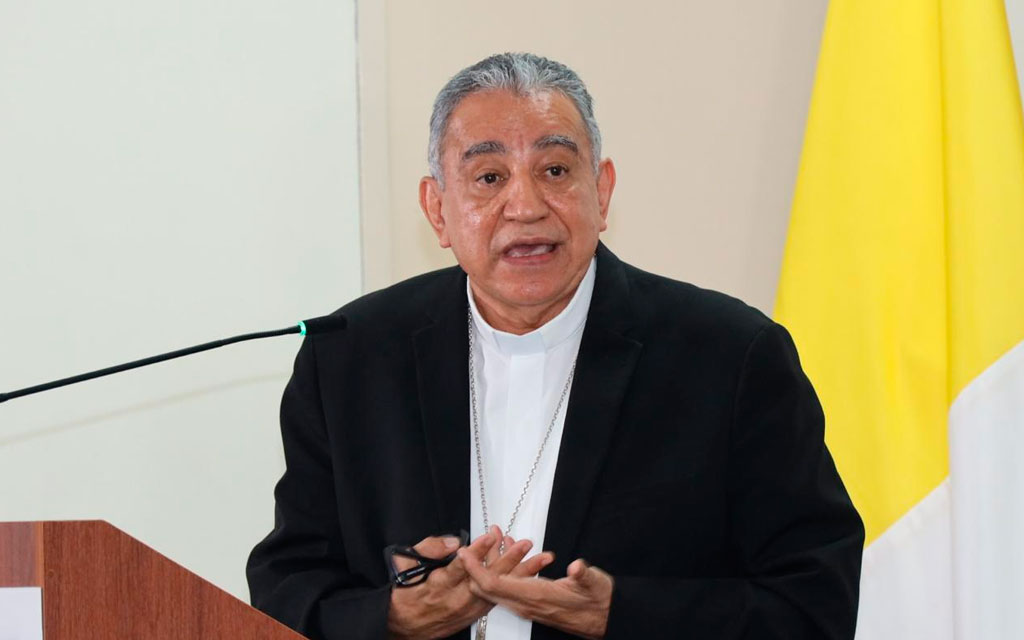
Bishop Jose Elmer Mangalinao of Bayombong welcomed the June 24 ruling, which dismissed a complaint against him, another priest, and community leaders related to a mining exploration project.

Read More
Indian Catholics denied bail after confronting mob that disrupted Mass #Catholic UDAIPUR, India — Nine Catholics have been behind bars for more than two weeks after parishioners chased out more than a dozen people who barged into a village church during Mass, shouting accusations of conversion, in a remote village in Indiaʼs desert state of Rajasthan.“We feel frustrated that our people were denied bail a second time today on the false allegation of conversion,” Bishop Devprasad John Ganawa of Udaipur, a Divine Word missionary, told EWTN News on May 12.“When the hooligans disrupted the Mass on May 1 shouting ‘conversion,’ our people forced them out. Instead of registering a criminal case against the intruders, the police have charged our people with ‘conversion and attempt to murder’ and arrested nine Catholics of Bandaria Parish,” Ganawa explained.‘They took out a knife’“I was saying the evening Mass at the substation of my parish at Kalinjara village when the incident happened,” Father Arvind Amliyar recounted to EWTN News.“During the Communion time over a dozen people stormed into the church, shouted ‘conversion,’ and started filming with cameras. When one of them took out a knife, our people snatched it and chased them out,” Amliyar said.“Soon police came and what happened then shocked me. Instead of finding out what had happened, they arrested four Catholics the same night,” the priest said.A Hindu mob then staged a protest outside the police station and demanded action against the parishioners, according to Amliyar. Police turned away Catholics who went to them twice, including at midnight the same day and the next day, refusing to register their complaint.Police came knocking on May 4 at 2:30 a.m. and arrested five more parishioners, including Anil Rawat, 70, a retired headmaster of a government school who now runs a private school in the village.Bail denied twiceThe local magistrate court rejected the parishioners' bail application the next day, as they were charged with “serious crimes”: conversion and attempted murder. Church lawyers then moved the case to the Banswara district court, which denied bail again on May 12.“Now, we have to go to the High Court with senior lawyers,” Amliyar said of the challenging situation facing the village church, which serves about 70 Catholic families. About 70 people were attending Mass when the intruders stormed in.“I cannot understand what is going on. The police bluntly refused to register the complaint of our people and have filed a serious charge of conversion against our people and imprisoned them,” Ganawa said of the first case of alleged conversion in Udaipur Diocese, where he has served as bishop for 13 years.Anti-conversion laws ‘reduced to a tool to harass minorities’“This is another typical case of the widespread abuse of anti-conversion laws against Christians in several states, most of them ruled by the BJP [Bharatiya Janata Party],” A.C. Michael, a Catholic and national coordinator of the United Christian Forum, which monitors atrocities against Christians, told EWTN News from New Delhi.Under the Indian criminal system, the burden of proof lies with the prosecution. However, under recently enacted or amended anti-conversion laws, Michael said, the burden of disproving the charge of conversion is shifted to the accused, making it difficult for defendants to secure bail from trial courts quickly, even in fraudulent cases.Under the Rajasthan Prohibition of Unlawful Conversion of Religion Act, enacted in 2025, the burden of disproving the allegation of conversion falls on the accused.As a result, Michael said, hundreds of Christians are languishing in jails in BJP-ruled states while protracted legal challenges drag on in higher courts.“The shocking reality is that there has been hardly any conviction in so-called conversion cases. That is why the churches and Christian groups have moved the Supreme Court for abolishing the anti-conversion laws that have been reduced to a tool to harass minorities,” Michael said.He noted that the Supreme Court in May 2024 observed that certain provisions in anti-conversion laws may be in violation of Article 25 of the Indian Constitution, which guarantees the right to freely profess, practice, and propagate oneʼs religion.The Feb. 4–10 biennial assembly of more than 200 bishops in India in Bangalore also reiterated this concern in its final statement: “As many innocent individuals are incarcerated based on unfounded allegations of forceful religious conversions, we strongly demand the repealing of legislations which are inconsistent with religious freedom and right to privacy.”

Indian Catholics denied bail after confronting mob that disrupted Mass #Catholic UDAIPUR, India — Nine Catholics have been behind bars for more than two weeks after parishioners chased out more than a dozen people who barged into a village church during Mass, shouting accusations of conversion, in a remote village in Indiaʼs desert state of Rajasthan.“We feel frustrated that our people were denied bail a second time today on the false allegation of conversion,” Bishop Devprasad John Ganawa of Udaipur, a Divine Word missionary, told EWTN News on May 12.“When the hooligans disrupted the Mass on May 1 shouting ‘conversion,’ our people forced them out. Instead of registering a criminal case against the intruders, the police have charged our people with ‘conversion and attempt to murder’ and arrested nine Catholics of Bandaria Parish,” Ganawa explained.‘They took out a knife’“I was saying the evening Mass at the substation of my parish at Kalinjara village when the incident happened,” Father Arvind Amliyar recounted to EWTN News.“During the Communion time over a dozen people stormed into the church, shouted ‘conversion,’ and started filming with cameras. When one of them took out a knife, our people snatched it and chased them out,” Amliyar said.“Soon police came and what happened then shocked me. Instead of finding out what had happened, they arrested four Catholics the same night,” the priest said.A Hindu mob then staged a protest outside the police station and demanded action against the parishioners, according to Amliyar. Police turned away Catholics who went to them twice, including at midnight the same day and the next day, refusing to register their complaint.Police came knocking on May 4 at 2:30 a.m. and arrested five more parishioners, including Anil Rawat, 70, a retired headmaster of a government school who now runs a private school in the village.Bail denied twiceThe local magistrate court rejected the parishioners' bail application the next day, as they were charged with “serious crimes”: conversion and attempted murder. Church lawyers then moved the case to the Banswara district court, which denied bail again on May 12.“Now, we have to go to the High Court with senior lawyers,” Amliyar said of the challenging situation facing the village church, which serves about 70 Catholic families. About 70 people were attending Mass when the intruders stormed in.“I cannot understand what is going on. The police bluntly refused to register the complaint of our people and have filed a serious charge of conversion against our people and imprisoned them,” Ganawa said of the first case of alleged conversion in Udaipur Diocese, where he has served as bishop for 13 years.Anti-conversion laws ‘reduced to a tool to harass minorities’“This is another typical case of the widespread abuse of anti-conversion laws against Christians in several states, most of them ruled by the BJP [Bharatiya Janata Party],” A.C. Michael, a Catholic and national coordinator of the United Christian Forum, which monitors atrocities against Christians, told EWTN News from New Delhi.Under the Indian criminal system, the burden of proof lies with the prosecution. However, under recently enacted or amended anti-conversion laws, Michael said, the burden of disproving the charge of conversion is shifted to the accused, making it difficult for defendants to secure bail from trial courts quickly, even in fraudulent cases.Under the Rajasthan Prohibition of Unlawful Conversion of Religion Act, enacted in 2025, the burden of disproving the allegation of conversion falls on the accused.As a result, Michael said, hundreds of Christians are languishing in jails in BJP-ruled states while protracted legal challenges drag on in higher courts.“The shocking reality is that there has been hardly any conviction in so-called conversion cases. That is why the churches and Christian groups have moved the Supreme Court for abolishing the anti-conversion laws that have been reduced to a tool to harass minorities,” Michael said.He noted that the Supreme Court in May 2024 observed that certain provisions in anti-conversion laws may be in violation of Article 25 of the Indian Constitution, which guarantees the right to freely profess, practice, and propagate oneʼs religion.The Feb. 4–10 biennial assembly of more than 200 bishops in India in Bangalore also reiterated this concern in its final statement: “As many innocent individuals are incarcerated based on unfounded allegations of forceful religious conversions, we strongly demand the repealing of legislations which are inconsistent with religious freedom and right to privacy.”

Nine parishioners face conversion and attempted murder charges after forcing out intruders who stormed a village church during Mass in Rajasthan.

Read More