Czech Republic

Czech court clears archbishop persecuted by communist regime #Catholic The district court in Olomouc, Czech Republic, has rehabilitated Josef Karel Matocha, the city’s former archbishop, recognizing his internment under the communist regime as unlawful more than six decades after his death.The court’s decision, based on the Judicial Rehabilitation Act, confirms that the prelate was a victim of unlawful deprivation of liberty in the 1950s by the communist regime in what was then Czechoslovakia. He was not formally convicted, yet he was forced to remain in the archbishop’s palace under surveillance by the State Security, and this was recognized as imprisonment.The current archbishop of Olomouc, Josef Nuzík, said he is “very happy that after so many years we have managed to complete this procedural step and achieve justice” in civil law as well.Matocha is “constantly present in our palace and in the hearts of believers,” and guests “are often moved when they realize that these beautiful spaces were his prison,” said Nuzík, who is also president of the Czech Bishops’ Conference.
 
 U.S. bishop joins Slovaks honoring blessed bishop tortured by communists
 
 The rehabilitation is an important sign “also for the entire society,” he added, one that shows “the heroism and suffering of people who did not let themselves be broken must not be forgotten.”Ladislav Müller filed the initial motion for rehabilitation at the request of Jan Kratochvil, director of the Museum of Czech, Slovak, and Ruthenian Exile of the 20th Century in Brno.Decades of isolationMatocha, who held doctorates in philosophy and theology, was appointed archbishop of Olomouc by Pope Pius XII in 1948. He was deeply dedicated in his pastoral visits, initiated the beatification process of Archbishop Antonín Stojan, and secretly ordained František Tomášek as a bishop, who later became a cardinal and archbishop of Prague, according to the Archdiocese of Olomouc.After his internment in 1950, he could not read newspapers or listen to the radio, and visits to the garden were permitted only sporadically. The isolation lasted until his death from a heart attack in 1961, which was also due to the denial of medical care. In 1999, then-Czech President Václav Havel posthumously awarded Matocha the first class of the Order of Tomáš Garrigue Masaryk for outstanding services to democracy and human rights.The press office of the Archdiocese of Olomouc told EWTN News that no special event regarding Matocha is planned at present, but it noted that a rehabilitation process is underway for Cardinal Štěpán Trochta. Trochta also suffered internment as the bishop of Litoměřice, but “we consider him ours,” the press office said, because he was born within the Archdiocese of Olomouc.A wider reckoningThe unjust treatment of two other churchmen by the communist regime in Czechoslovakia has recently been recognized. Cardinal Josef Beran, the former archbishop of Prague, who was interned in several locations, was rehabilitated in February, the District Court of Prague confirmed to EWTN News. In 2024, the regional court in Hradec Králové rehabilitated the priest Josef Toufar, who was illegally arrested and tortured to death.

Czech court clears archbishop persecuted by communist regime #Catholic The district court in Olomouc, Czech Republic, has rehabilitated Josef Karel Matocha, the city’s former archbishop, recognizing his internment under the communist regime as unlawful more than six decades after his death.The court’s decision, based on the Judicial Rehabilitation Act, confirms that the prelate was a victim of unlawful deprivation of liberty in the 1950s by the communist regime in what was then Czechoslovakia. He was not formally convicted, yet he was forced to remain in the archbishop’s palace under surveillance by the State Security, and this was recognized as imprisonment.The current archbishop of Olomouc, Josef Nuzík, said he is “very happy that after so many years we have managed to complete this procedural step and achieve justice” in civil law as well.Matocha is “constantly present in our palace and in the hearts of believers,” and guests “are often moved when they realize that these beautiful spaces were his prison,” said Nuzík, who is also president of the Czech Bishops’ Conference. U.S. bishop joins Slovaks honoring blessed bishop tortured by communists The rehabilitation is an important sign “also for the entire society,” he added, one that shows “the heroism and suffering of people who did not let themselves be broken must not be forgotten.”Ladislav Müller filed the initial motion for rehabilitation at the request of Jan Kratochvil, director of the Museum of Czech, Slovak, and Ruthenian Exile of the 20th Century in Brno.Decades of isolationMatocha, who held doctorates in philosophy and theology, was appointed archbishop of Olomouc by Pope Pius XII in 1948. He was deeply dedicated in his pastoral visits, initiated the beatification process of Archbishop Antonín Stojan, and secretly ordained František Tomášek as a bishop, who later became a cardinal and archbishop of Prague, according to the Archdiocese of Olomouc.After his internment in 1950, he could not read newspapers or listen to the radio, and visits to the garden were permitted only sporadically. The isolation lasted until his death from a heart attack in 1961, which was also due to the denial of medical care. In 1999, then-Czech President Václav Havel posthumously awarded Matocha the first class of the Order of Tomáš Garrigue Masaryk for outstanding services to democracy and human rights.The press office of the Archdiocese of Olomouc told EWTN News that no special event regarding Matocha is planned at present, but it noted that a rehabilitation process is underway for Cardinal Štěpán Trochta. Trochta also suffered internment as the bishop of Litoměřice, but “we consider him ours,” the press office said, because he was born within the Archdiocese of Olomouc.A wider reckoningThe unjust treatment of two other churchmen by the communist regime in Czechoslovakia has recently been recognized. Cardinal Josef Beran, the former archbishop of Prague, who was interned in several locations, was rehabilitated in February, the District Court of Prague confirmed to EWTN News. In 2024, the regional court in Hradec Králové rehabilitated the priest Josef Toufar, who was illegally arrested and tortured to death.

More than six decades after Archbishop Josef Karel Matocha died under communist internment, a Czech court has formally recognized his imprisonment as unlawful.

Read More
Former Russian Orthodox ‘foreign minister’ freed after Czech drug probe #Catholic Czech police arrested Metropolitan Hilarion, a prominent clergyman of the Russian Orthodox Church, on suspicion of drug possession during a vehicle stop on May 24. Officers acted “on anonymous information” about the alleged “transportation of narcotics and psychotropic substances.”A few grams of an unidentified substance were found in the vehicle, though the discovery “does not answer the central question: how the items ended up in the vehicle,” Hilarion said, denying “any involvement in the illegal possession or transportation of prohibited substances.”He was released May 26 after protests from the Russian Ministry of Foreign Affairs, which called the detention a “deliberate, orchestrated provocation” and summoned a Czech diplomat in Moscow. The Russian Orthodox Church likewise defended him, saying the incident “looks like a classic farce” since drug smuggling is often used by “unscrupulous police officers around the world.”No charges have been brought, and Hilarion is free without restrictions while the investigation continues, according to a statement on his Telegram account. His team also called the arrest “a provocation,” claiming he had received anonymous death threats demanding he leave the country.Who is Hilarion?Metropolitan Hilarion, whose secular name is Grigory Alfeyev, headed the Moscow Patriarchateʼs Department for External Church Relations from 2009 to 2022, a role often described as the Russian Orthodox Churchʼs “foreign minister.” He was widely regarded as a close ally of Patriarch Kirill and a possible successor.In June 2022, he was removed from the post and appointed to the Budapest diocese, a move widely interpreted as a demotion. During Pope Francis' apostolic trip to Budapest in April 2023, the two held a private meeting at the apostolic nunciature.In July 2024, Hilarion was accused of sexual harassment by George Suzuki, a former personal attendant. Hilarion denied the allegations. The Holy Synod of the Russian Orthodox Church subsequently declared “the inconsistency of the nature of his relations with his immediate environment and his life with the image of a monk and clergyman” and removed him from the Budapest diocese on Dec. 27, 2024. He has since been serving at the Church of Sts. Peter and Paul in Karlovy Vary, a spa town in western Czech Republic.Rising tensions over the Russian Orthodox Church in Czech RepublicSergei Chapnin, a Russian church affairs scholar at Fordham University and former employee of the Moscow Patriarchate, offered two possible explanations for the incident. First, Hilarion may serve “as a high-level courier” who “moves sensitive documents and other items around Western Europe” since “Russian diplomats are closely monitored and constrained in their movements.” Second, Hilarion was operating “inside a very rough political and ecclesiastical game … over assets and influence” involving local Orthodox communities.The Church of Sts. Peter and Paul was recently registered under the Russian Orthodox Church in Hungary to prevent Czech authorities from freezing Russian assets. Patriarch Kirill, the churchʼs head, is personally listed on the Czech national sanctions list for his support of Russiaʼs invasion of Ukraine.Concerns about the churchʼs role in Czech Republic have been escalating. The Czech security agencyʼs annual report said the Russian Orthodox Churchʼs local representatives are loyal to the Moscow leadership and their “support for the Russian official line is evident.”A study titled “Security Risks of the Orthodox Church,” published by the Czech Academy of Sciences in 2025, called for systematic monitoring of the Russian Orthodox Church in the country. The authors recommended investigating “activities with regard to the danger of money laundering, purposeful export of funds and property, smuggling of goods and people, passing information to the enemy, for example the Russian side, [and] influencing the opinions of Czech society through social networks.”The study also noted that the Church of Sts. Peter and Paul in Karlovy Vary allegedly hosted meetings involving Russian military intelligence (GRU) officials.In a related case, a Prague court recently convicted former Orthodox abbess Taťána Hanhur for the unauthorized transfer of a monastery and property worth 73 million Czech crowns (approximately $3.2 million). The property had belonged to the autocephalous Orthodox Church of the Czech Lands and Slovakia.

Former Russian Orthodox ‘foreign minister’ freed after Czech drug probe #Catholic Czech police arrested Metropolitan Hilarion, a prominent clergyman of the Russian Orthodox Church, on suspicion of drug possession during a vehicle stop on May 24. Officers acted “on anonymous information” about the alleged “transportation of narcotics and psychotropic substances.”A few grams of an unidentified substance were found in the vehicle, though the discovery “does not answer the central question: how the items ended up in the vehicle,” Hilarion said, denying “any involvement in the illegal possession or transportation of prohibited substances.”He was released May 26 after protests from the Russian Ministry of Foreign Affairs, which called the detention a “deliberate, orchestrated provocation” and summoned a Czech diplomat in Moscow. The Russian Orthodox Church likewise defended him, saying the incident “looks like a classic farce” since drug smuggling is often used by “unscrupulous police officers around the world.”No charges have been brought, and Hilarion is free without restrictions while the investigation continues, according to a statement on his Telegram account. His team also called the arrest “a provocation,” claiming he had received anonymous death threats demanding he leave the country.Who is Hilarion?Metropolitan Hilarion, whose secular name is Grigory Alfeyev, headed the Moscow Patriarchateʼs Department for External Church Relations from 2009 to 2022, a role often described as the Russian Orthodox Churchʼs “foreign minister.” He was widely regarded as a close ally of Patriarch Kirill and a possible successor.In June 2022, he was removed from the post and appointed to the Budapest diocese, a move widely interpreted as a demotion. During Pope Francis' apostolic trip to Budapest in April 2023, the two held a private meeting at the apostolic nunciature.In July 2024, Hilarion was accused of sexual harassment by George Suzuki, a former personal attendant. Hilarion denied the allegations. The Holy Synod of the Russian Orthodox Church subsequently declared “the inconsistency of the nature of his relations with his immediate environment and his life with the image of a monk and clergyman” and removed him from the Budapest diocese on Dec. 27, 2024. He has since been serving at the Church of Sts. Peter and Paul in Karlovy Vary, a spa town in western Czech Republic.Rising tensions over the Russian Orthodox Church in Czech RepublicSergei Chapnin, a Russian church affairs scholar at Fordham University and former employee of the Moscow Patriarchate, offered two possible explanations for the incident. First, Hilarion may serve “as a high-level courier” who “moves sensitive documents and other items around Western Europe” since “Russian diplomats are closely monitored and constrained in their movements.” Second, Hilarion was operating “inside a very rough political and ecclesiastical game … over assets and influence” involving local Orthodox communities.The Church of Sts. Peter and Paul was recently registered under the Russian Orthodox Church in Hungary to prevent Czech authorities from freezing Russian assets. Patriarch Kirill, the churchʼs head, is personally listed on the Czech national sanctions list for his support of Russiaʼs invasion of Ukraine.Concerns about the churchʼs role in Czech Republic have been escalating. The Czech security agencyʼs annual report said the Russian Orthodox Churchʼs local representatives are loyal to the Moscow leadership and their “support for the Russian official line is evident.”A study titled “Security Risks of the Orthodox Church,” published by the Czech Academy of Sciences in 2025, called for systematic monitoring of the Russian Orthodox Church in the country. The authors recommended investigating “activities with regard to the danger of money laundering, purposeful export of funds and property, smuggling of goods and people, passing information to the enemy, for example the Russian side, [and] influencing the opinions of Czech society through social networks.”The study also noted that the Church of Sts. Peter and Paul in Karlovy Vary allegedly hosted meetings involving Russian military intelligence (GRU) officials.In a related case, a Prague court recently convicted former Orthodox abbess Taťána Hanhur for the unauthorized transfer of a monastery and property worth 73 million Czech crowns (approximately $3.2 million). The property had belonged to the autocephalous Orthodox Church of the Czech Lands and Slovakia.

Metropolitan Hilarion, once tipped as successor to Patriarch Kirill, was released without charges after Czech police found an unidentified substance in his vehicle.

Read More
‘Truthful, respectful’: Czech bishop backs Sudeten German gathering in Brno #Catholic For the first time, the Sudeten German Association, uniting descendants of those expelled from Czechoslovakia after World War II, will gather in Brno, the second-largest city in modern-day Czech Republic. They were invited by the cultural festival Meeting Brno for part of its multiday program in late May. Both entities will discuss reconciliation and commemorate the victims of the Shoah.German Interior Minister Alexander Dobrindt is expected to come, too. The gathering is titled “All Life Is Meeting.”A reconciliation Mass will be celebrated at the Brno Exhibition Centre as part of the gathering.Ulrike Scharf, Bavarian state minister for family, labor, and social affairs, told EWTN News that the event “shows that we are reconciled, that we have become friends.”Scharf, whose agenda includes Sudeten Germans in Bavaria, stressed that reconciliation is “the essence of Europe.” In this “wonderful” European community, “it is crucial that we meet in friendship,” the politician explained.
 
 Pope Leo names reconciliation champion as new archbishop of Prague
 
 Yet the decision created a polemic in Czechia, with public figures weighing in and a series of protests, one of which was attended by the speaker of the Chamber of Deputies, Tomio Okamura. Rather than reconciliation, they see the gathering as a provocation and relativization of history.The critique came also from Miloš Zeman and Václav Klaus, who served as presidents as well as prime ministers of Czechia. “We have nothing to reconcile with the Germans,” Klaus said, clarifying that he does “not feel not reconciled” with them.“We did not trigger two world wars” and “are not the cause of tens of millions of victims” of World War II, Klaus explained, arguing that as prime minister in 1997, he signed, together with German Chancellor Helmut Kohl, the Czech-German Declaration on Mutual Relations and Their Future Development.Wounds that remainHowever, the bishop of Brno, Pavel Konzbul, welcomed “every initiative that leads to the meeting of people, to dialogue, and to overcoming historical injustices,” he underscored for EWTN News."Reconciliation between nations and individuals," the prelate continued, "does not happen by denying or simplifying the past but by "talking about it truthfully and with respect."Thus, he sees “the presence of the descendants of the Sudeten Germans” in his diocese “primarily as an opportunity for such a meeting,” provided “it takes place in a spirit of respect, without mutual accusations or spreading false slander, and with openness to the other.”The local bishop appealed to participants, residents, and critics to act with “calm, respect, and to a willingness to look for what can unite us.”Only “such attitudes are the basis of true and lasting peace,” the bishop underlined.When the new archbishop of Prague, Stanislav Přibyl, was the bishop of Litoměřice a few months ago, he proclaimed 2026 a Year of Reconciliation to address wounds that remain from World War II and its aftermath.Nazi Germany annexed the Sudetenland, the majority-German region in Czechoslovakia, in 1938 and later established the Protectorate of Bohemia and Moravia in the country. Following Germanyʼs defeat, Czechoslovakia expelled approximately 3 million ethnic Germans.

‘Truthful, respectful’: Czech bishop backs Sudeten German gathering in Brno #Catholic For the first time, the Sudeten German Association, uniting descendants of those expelled from Czechoslovakia after World War II, will gather in Brno, the second-largest city in modern-day Czech Republic. They were invited by the cultural festival Meeting Brno for part of its multiday program in late May. Both entities will discuss reconciliation and commemorate the victims of the Shoah.German Interior Minister Alexander Dobrindt is expected to come, too. The gathering is titled “All Life Is Meeting.”A reconciliation Mass will be celebrated at the Brno Exhibition Centre as part of the gathering.Ulrike Scharf, Bavarian state minister for family, labor, and social affairs, told EWTN News that the event “shows that we are reconciled, that we have become friends.”Scharf, whose agenda includes Sudeten Germans in Bavaria, stressed that reconciliation is “the essence of Europe.” In this “wonderful” European community, “it is crucial that we meet in friendship,” the politician explained. Pope Leo names reconciliation champion as new archbishop of Prague Yet the decision created a polemic in Czechia, with public figures weighing in and a series of protests, one of which was attended by the speaker of the Chamber of Deputies, Tomio Okamura. Rather than reconciliation, they see the gathering as a provocation and relativization of history.The critique came also from Miloš Zeman and Václav Klaus, who served as presidents as well as prime ministers of Czechia. “We have nothing to reconcile with the Germans,” Klaus said, clarifying that he does “not feel not reconciled” with them.“We did not trigger two world wars” and “are not the cause of tens of millions of victims” of World War II, Klaus explained, arguing that as prime minister in 1997, he signed, together with German Chancellor Helmut Kohl, the Czech-German Declaration on Mutual Relations and Their Future Development.Wounds that remainHowever, the bishop of Brno, Pavel Konzbul, welcomed “every initiative that leads to the meeting of people, to dialogue, and to overcoming historical injustices,” he underscored for EWTN News."Reconciliation between nations and individuals," the prelate continued, "does not happen by denying or simplifying the past but by "talking about it truthfully and with respect."Thus, he sees “the presence of the descendants of the Sudeten Germans” in his diocese “primarily as an opportunity for such a meeting,” provided “it takes place in a spirit of respect, without mutual accusations or spreading false slander, and with openness to the other.”The local bishop appealed to participants, residents, and critics to act with “calm, respect, and to a willingness to look for what can unite us.”Only “such attitudes are the basis of true and lasting peace,” the bishop underlined.When the new archbishop of Prague, Stanislav Přibyl, was the bishop of Litoměřice a few months ago, he proclaimed 2026 a Year of Reconciliation to address wounds that remain from World War II and its aftermath.Nazi Germany annexed the Sudetenland, the majority-German region in Czechoslovakia, in 1938 and later established the Protectorate of Bohemia and Moravia in the country. Following Germanyʼs defeat, Czechoslovakia expelled approximately 3 million ethnic Germans.

Bishop Pavel Konzbul of Brno, Czech Republic, is backing the late-May gathering despite a public backlash led by former Czech presidents Václav Klaus and Miloš Zeman.

Read More
Picture of the day


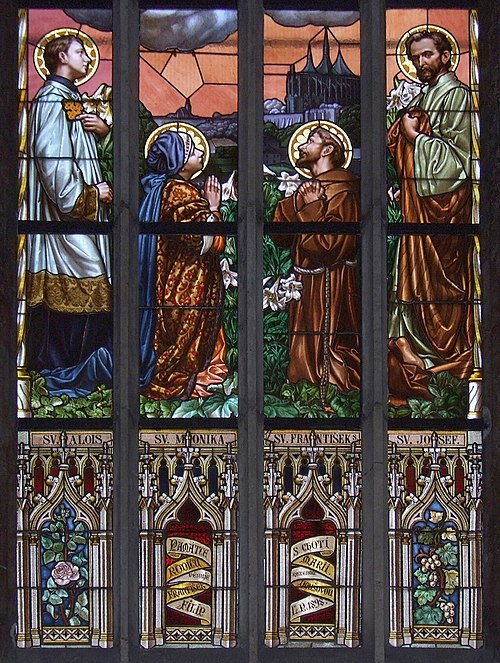
Detail of a stained glass window in St. Barbara’s Church (Kutná Hora, Czech Republic). The window depicts St. Aloysius, St. Monica, St. Francis of Assisi, and St. Joseph in prayer. Today is All Saints’ Day.
 #ImageOfTheDay
Picture of the day
Detail of a stained glass window in St. Barbara’s Church (Kutná Hora, Czech Republic). The window depicts St. Aloysius, St. Monica, St. Francis of Assisi, and St. Joseph in prayer. Today is All Saints’ Day.
Read More