
![Inaugural edition of Sheen Awards honors Mother Angelica #Catholic On Sept. 25, one day after the beatification of Archbishop Fulton Sheen, members of the media and entertainment world as well as the Church at large gathered in Peoria, Illinois — the hometown of now-Blessed Fulton Sheen — for the inaugural Sheen Awards.Among the notable figures in attendance were Bishop Louis Tylka of the Diocese of Peoria; Bishop John Barres of the Diocese Rockville Centre, New York; Bishop Robert Barron of the Diocese of Winona-Rochester, Minnesota; Jonathan Roumie, who plays Jesus in “The Chosen”; David Henrie, host of EWTN’s travel series “Seeking Beauty”; and Siobhan Fallon Hogan, host of the EWTN podcast “Catholics and Cappuccinos.” Seven awards were presented including the Radio and Podcast Impact Award, the Evangelization Impact Award, the Mission and Humanitarian Impact Award, the Innovation Impact Award, the Digital Creator Impact Award, the Television and Streaming Impact Award, and the Archbishop Fulton J. Sheen Lifetime Achievement Award.Mother Angelica, EWTN’s foundress, posthumously received the inaugural Lifetime Achievement Award. The award was bestowed on Mother Angelica in recognition of her lifetime of service to the Church and her pioneering use of television to proclaim the Gospel through the Eternal Word Television Network. EWTN Studios President Peter Gagnon accepted the award on her behalf.“On behalf of Michael Warsaw, CEO, and myself, we want to thank Bishop Tylka and the Archbishop Sheen Foundation for honoring Mother Angelica with this award,” Gagnon said in his acceptance speech. Gagnon worked with Mother Angelica for many years and pointed out that “one of her favorite expressions was to say, ‘This is awesome!’”He said: “When there would be a papal event, she would say, ‘Wasnʼt that awesome?’ … I think tonight she would say, ‘This is awesome.’”A little over one year after the death of Sheen — on Dec. 12, 1980 — EWTN was officially incorporated by Mother Angelica. Reflecting on this, Gagnon said: “I donʼt think itʼs a coincidence.”“Mother Angelica took the torch from Archbishop Sheen because she saw the power of reaching people through the media, through television,” he said. “She, like Archbishop Sheen, could reach through that camera lens and talk to you. And when she was talking to you, she was talking to you directly.”Gagnon added: “Also like him [Sheen], she had just an incredible love for the Church and a zeal for souls. I never knew anyone who loved Our Lord as much as Mother Angelica did. Her impact on many throughout the world is truly humbling and amazing.”EWTN has aired “Life Is Worth Living,” Sheen’s popular television show, for over 20 years. Gagnon emphasized that the network is “proud to share his words and message throughout the world.”In an additional statement commenting on the significance of the award, Michael Warsaw, chairman and CEO of EWTN Global Catholic Network, noted: “Among the great Catholic evangelists of the 20th century, Blessed Archbishop Fulton J. Sheen, and our own Mother Angelica, stand out for the extraordinary ways they embraced media to proclaim the Gospel, defend the dignity of the human person and speak the truth to a world desperately in need of Jesus Christ.” “It is especially meaningful to see Mother Angelica honored in the name of Archbishop Sheen, whose pioneering use of radio and television demonstrated the power of media in service of the Gospel,” Warsaw pointed out. He said the recognition is “particularly poignant as we mark the 10th anniversary of Mother Angelica’s passing.”
EWTN Studios President Peter Gagnon accepts the Lifetime Achievement Award on behalf of Mother Angelica at the Sheen Awards on Sept. 25, 2026. | Credit: Nellie Gould, Archbishop Fulton J. Sheen Foundation
“She would have been deeply honored to be recognized at the inaugural Sheen Awards and counted among the innovators and communicators carrying forward Archbishop Sheen’s legacy,” Warsaw added.Broaching the topic of Mother Angelica’s own potential cause for canonization, Warsaw indicated: “While I remain mindful of the Church’s careful discernment regarding any potential cause for sainthood, I can say personally that I pray and hope that one day Mother Angelica might be numbered among the saints of the Church she loved and served so faithfully.”Warsaw concluded: “On behalf of the entire EWTN family, I am profoundly grateful for this recognition of Mother Angelica and, more importantly, for the opportunity to remember what animated both Mother Angelica and Blessed Fulton Sheen: the desire to bring souls to Jesus Christ. May their example inspire us all to use the gifts God has given us to proclaim the Gospel with courage, creativity and joy.”Additional Sheen Award recipients included Katie McGrady, who received the Radio and Podcast Impact Award; Roumie, who received the Television and Streaming Impact Award; and Barron, who received the Evangelization Impact Award.The Mission and Humanitarian Impact Award went to the Pontifical Mission Societies in the United States, while Hallow received the Innovation Impact Award. Paul J. Kim was awarded the Digital Creator Impact Award.Watch EWTN’s livestream of the red carpet at the Sheen Awards here.](https://unitedyam.com/wp-content/uploads/2026/10/inaugural-edition-of-sheen-awards-honors-mother-angelica-catholic-on-sept-25-one-day-after-the-beatification-of-archbishop-fulton-sheen-members-of-the-media-and-entertainment-world-as-well-as-the-scaled.jpg "Inaugural edition of Sheen Awards honors Mother Angelica #Catholic On Sept. 25, one day after the beatification of Archbishop Fulton Sheen, members of the media and entertainment world as well as the Church at large gathered in Peoria, Illinois — the hometown of now-Blessed Fulton Sheen — for the inaugural Sheen Awards.Among the notable figures in attendance were Bishop Louis Tylka of the Diocese of Peoria; Bishop John Barres of the Diocese Rockville Centre, New York; Bishop Robert Barron of the Diocese of Winona-Rochester, Minnesota; Jonathan Roumie, who plays Jesus in “The Chosen”; David Henrie, host of EWTN’s travel series “Seeking Beauty”; and Siobhan Fallon Hogan, host of the EWTN podcast “Catholics and Cappuccinos.” Seven awards were presented including the Radio and Podcast Impact Award, the Evangelization Impact Award, the Mission and Humanitarian Impact Award, the Innovation Impact Award, the Digital Creator Impact Award, the Television and Streaming Impact Award, and the Archbishop Fulton J. Sheen Lifetime Achievement Award.Mother Angelica, EWTN’s foundress, posthumously received the inaugural Lifetime Achievement Award. The award was bestowed on Mother Angelica in recognition of her lifetime of service to the Church and her pioneering use of television to proclaim the Gospel through the Eternal Word Television Network. EWTN Studios President Peter Gagnon accepted the award on her behalf.“On behalf of Michael Warsaw, CEO, and myself, we want to thank Bishop Tylka and the Archbishop Sheen Foundation for honoring Mother Angelica with this award,” Gagnon said in his acceptance speech. Gagnon worked with Mother Angelica for many years and pointed out that “one of her favorite expressions was to say, ‘This is awesome!’”He said: “When there would be a papal event, she would say, ‘Wasnʼt that awesome?’ … I think tonight she would say, ‘This is awesome.’”A little over one year after the death of Sheen — on Dec. 12, 1980 — EWTN was officially incorporated by Mother Angelica. Reflecting on this, Gagnon said: “I donʼt think itʼs a coincidence.”“Mother Angelica took the torch from Archbishop Sheen because she saw the power of reaching people through the media, through television,” he said. “She, like Archbishop Sheen, could reach through that camera lens and talk to you. And when she was talking to you, she was talking to you directly.”Gagnon added: “Also like him [Sheen], she had just an incredible love for the Church and a zeal for souls. I never knew anyone who loved Our Lord as much as Mother Angelica did. Her impact on many throughout the world is truly humbling and amazing.”EWTN has aired “Life Is Worth Living,” Sheen’s popular television show, for over 20 years. Gagnon emphasized that the network is “proud to share his words and message throughout the world.”In an additional statement commenting on the significance of the award, Michael Warsaw, chairman and CEO of EWTN Global Catholic Network, noted: “Among the great Catholic evangelists of the 20th century, Blessed Archbishop Fulton J. Sheen, and our own Mother Angelica, stand out for the extraordinary ways they embraced media to proclaim the Gospel, defend the dignity of the human person and speak the truth to a world desperately in need of Jesus Christ.” “It is especially meaningful to see Mother Angelica honored in the name of Archbishop Sheen, whose pioneering use of radio and television demonstrated the power of media in service of the Gospel,” Warsaw pointed out. He said the recognition is “particularly poignant as we mark the 10th anniversary of Mother Angelica’s passing.”
EWTN Studios President Peter Gagnon accepts the Lifetime Achievement Award on behalf of Mother Angelica at the Sheen Awards on Sept. 25, 2026. | Credit: Nellie Gould, Archbishop Fulton J. Sheen Foundation
“She would have been deeply honored to be recognized at the inaugural Sheen Awards and counted among the innovators and communicators carrying forward Archbishop Sheen’s legacy,” Warsaw added.Broaching the topic of Mother Angelica’s own potential cause for canonization, Warsaw indicated: “While I remain mindful of the Church’s careful discernment regarding any potential cause for sainthood, I can say personally that I pray and hope that one day Mother Angelica might be numbered among the saints of the Church she loved and served so faithfully.”Warsaw concluded: “On behalf of the entire EWTN family, I am profoundly grateful for this recognition of Mother Angelica and, more importantly, for the opportunity to remember what animated both Mother Angelica and Blessed Fulton Sheen: the desire to bring souls to Jesus Christ. May their example inspire us all to use the gifts God has given us to proclaim the Gospel with courage, creativity and joy.”Additional Sheen Award recipients included Katie McGrady, who received the Radio and Podcast Impact Award; Roumie, who received the Television and Streaming Impact Award; and Barron, who received the Evangelization Impact Award.The Mission and Humanitarian Impact Award went to the Pontifical Mission Societies in the United States, while Hallow received the Innovation Impact Award. Paul J. Kim was awarded the Digital Creator Impact Award.Watch EWTN’s livestream of the red carpet at the Sheen Awards here.")


Pope Leo XIV titled this year’s observance of World Day of Migrants and Refugees “Even Just One of These Children,” citing Matthew 18:5: “Whoever welcomes one such child in my name welcomes me.”

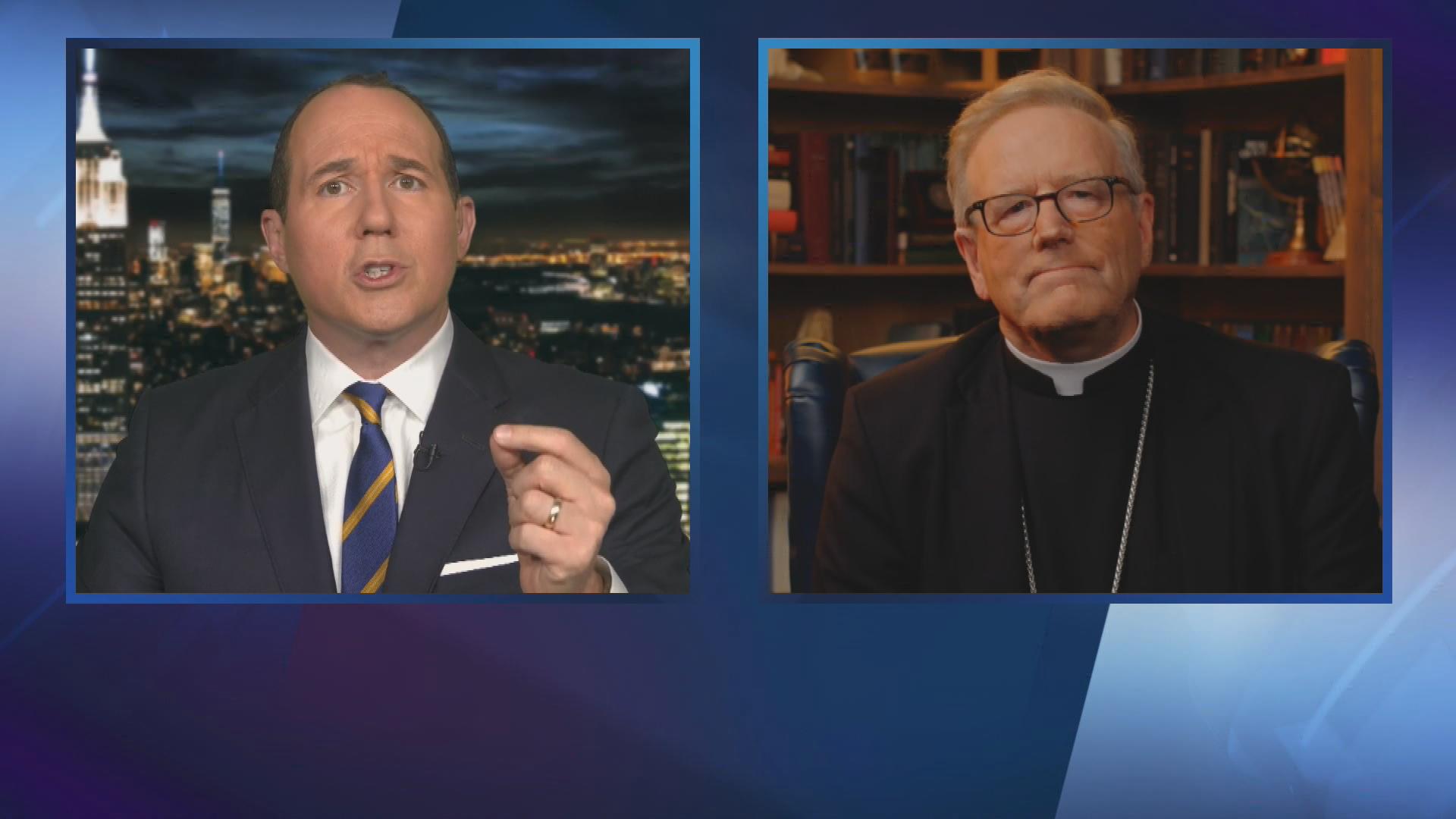
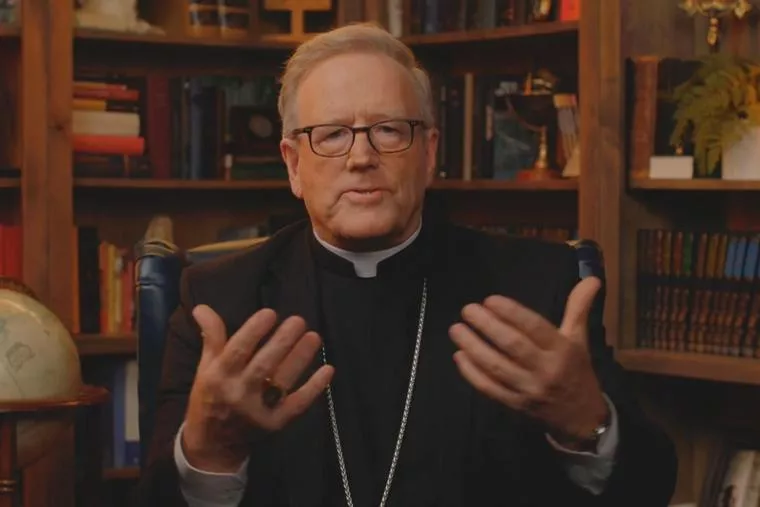
The Word on Fire founder clarifies the call to evangelize, defends his nonpartisan advisory role on religious liberty, and warns of resurgent communism.
![Oregon officials back off ‘gender ideology mandate’ for mom seeking to adopt #Catholic Oregon officials have agreed they will not “categorically disqualify” a Christian woman from adopting or fostering children based on her religious beliefs about gender and human sexuality, which settles a three-and-a-half-year legal battle.The Oregon Department of Human Services (ODHS) agreed to a legal settlement with Jessica Bates, who was represented by Alliance Defending Freedom (ADF). It affirms the department will not consider her religious beliefs when evaluating her application for a certification to adopt children and will not attempt to regulate her speech about gender and sexuality.“Every child deserves a loving home, and children suffer when the government excludes people of faith from foster care because of the state’s own ideological crusade,” ADF Senior Counsel Johannes Widmalm-Delphonse said in a statement following the Sept. 9 settlement.“Oregon officials turned Jessica away just because of her common-sense belief that parents should help children become comfortable with who they are instead of pushing them down a path of confusion and medicalization,” he said. “We believe this settlement is a win-win that protects constitutional rights and puts children’s interests first.”In September 2022, the ODHS denied Bates’ application because she would not comply with a state policy that requires applicants to agree they will “respect, accept and support the … sexual orientation, gender identity [and] gender expression … of a child or young adult” who is placed in the home, which ADF has characterized as a “gender ideology mandate.”Bates sued ODHS in March 2023, arguing that the policy violated her First Amendment rights to free speech and the free exercise of religion. The lawsuit stated she told the certification officer she would love any child as her own but would not facilitate a child’s gender transition through hormone therapy, use pronouns inconsistent with a child’s biological sex, or encourage gender expression inconsistent with the child’s biological sex or same-sex attraction.A federal district court initially ruled in favor of ODHS in December 2023, but an appellate panel of judges ruled in July 2025 that ODHS likely violated her constitutional rights and blocked the department from enforcing the rules against her while the lawsuit continued.Legal settlementPer the legal agreement, ODHS will allow Bates to apply for a certification and will not consider her religious views in any way.It states ODHS will not deny the application “because of her religious beliefs that sexual activity should occur only within the confines of a marriage between one man and one woman, and a person should identify and seek to live consistent with his or her biological sex.”The settlement adds that this extends to her “desire to respectfully speak about, live out, parent, and make day-to-day caregiving decisions consistent with these sincerely held religious beliefs.”Under the agreement, ODHS also cannot require her to “agree to use prescribed words or language, including chosen pronouns, to express views about sexual orientation, gender identity, or gender expression inconsistent with her religious beliefs described above as a condition of certification.”“[The] ODHS may not enforce any per se standard, rule, or policy that precludes Bates from being considered for any particular placement, based in whole or in part based on her religious belief,” the settlement agreement states.It further prohibits ODHS from disqualifying Bates from consideration for any particular child placement based on her religious beliefs.Yet, the settlement does not prevent ODHS from “deciding a child’s placement based on its individualized consideration of the child’s needs and of a foster parent’s concerns or limitations (including where religiously motivated) on their ability or willingness to meet the child’s specific needs, including with regard to their sexual orientation, gender identity, and gender expression.”The Oregon attorney general’s office referred EWTN News to the Oregon Department of Human Services for comment. The department did not respond to a request for comment.](https://unitedyam.com/wp-content/uploads/2026/09/oregon-officials-back-off-gender-ideology-mandate-for-mom-seeking-to-adopt-catholic-oregon-officials-have-agreed-they-will-not-categorically-disqualify-a-christian.jpg "Oregon officials back off ‘gender ideology mandate’ for mom seeking to adopt #Catholic Oregon officials have agreed they will not “categorically disqualify” a Christian woman from adopting or fostering children based on her religious beliefs about gender and human sexuality, which settles a three-and-a-half-year legal battle.The Oregon Department of Human Services (ODHS) agreed to a legal settlement with Jessica Bates, who was represented by Alliance Defending Freedom (ADF). It affirms the department will not consider her religious beliefs when evaluating her application for a certification to adopt children and will not attempt to regulate her speech about gender and sexuality.“Every child deserves a loving home, and children suffer when the government excludes people of faith from foster care because of the state’s own ideological crusade,” ADF Senior Counsel Johannes Widmalm-Delphonse said in a statement following the Sept. 9 settlement.“Oregon officials turned Jessica away just because of her common-sense belief that parents should help children become comfortable with who they are instead of pushing them down a path of confusion and medicalization,” he said. “We believe this settlement is a win-win that protects constitutional rights and puts children’s interests first.”In September 2022, the ODHS denied Bates’ application because she would not comply with a state policy that requires applicants to agree they will “respect, accept and support the … sexual orientation, gender identity [and] gender expression … of a child or young adult” who is placed in the home, which ADF has characterized as a “gender ideology mandate.”Bates sued ODHS in March 2023, arguing that the policy violated her First Amendment rights to free speech and the free exercise of religion. The lawsuit stated she told the certification officer she would love any child as her own but would not facilitate a child’s gender transition through hormone therapy, use pronouns inconsistent with a child’s biological sex, or encourage gender expression inconsistent with the child’s biological sex or same-sex attraction.A federal district court initially ruled in favor of ODHS in December 2023, but an appellate panel of judges ruled in July 2025 that ODHS likely violated her constitutional rights and blocked the department from enforcing the rules against her while the lawsuit continued.Legal settlementPer the legal agreement, ODHS will allow Bates to apply for a certification and will not consider her religious views in any way.It states ODHS will not deny the application “because of her religious beliefs that sexual activity should occur only within the confines of a marriage between one man and one woman, and a person should identify and seek to live consistent with his or her biological sex.”The settlement adds that this extends to her “desire to respectfully speak about, live out, parent, and make day-to-day caregiving decisions consistent with these sincerely held religious beliefs.”Under the agreement, ODHS also cannot require her to “agree to use prescribed words or language, including chosen pronouns, to express views about sexual orientation, gender identity, or gender expression inconsistent with her religious beliefs described above as a condition of certification.”“[The] ODHS may not enforce any per se standard, rule, or policy that precludes Bates from being considered for any particular placement, based in whole or in part based on her religious belief,” the settlement agreement states.It further prohibits ODHS from disqualifying Bates from consideration for any particular child placement based on her religious beliefs.Yet, the settlement does not prevent ODHS from “deciding a child’s placement based on its individualized consideration of the child’s needs and of a foster parent’s concerns or limitations (including where religiously motivated) on their ability or willingness to meet the child’s specific needs, including with regard to their sexual orientation, gender identity, and gender expression.”The Oregon attorney general’s office referred EWTN News to the Oregon Department of Human Services for comment. The department did not respond to a request for comment.")
The legal settlement ensures that Jessica Bates’ religious views will not be a factor in determining whether she can adopt children.

![Venezuela: Talks with opposition, oil deal, Delcy Rodríguez in New York, and the Church’s stance #Catholic Sept. 15 marked the start of the second round of negotiations between a Venezuelan opposition delegation and the country’s ruling socialist regime, a process promoted and driven by the U.S. government with an eye toward potential presidential elections in the South American nation.Dinorah Figuera, who leads the opposition delegation, arrived in Venezuela on Sept. 13 and before national and international media explained that once this weekʼs discussions conclude, the country could expect an announcement regarding the agreements reached.Meanwhile, Jorge Millán, who is also part of the opposition delegation, stated that they would continue “pursuing a Supreme Court of Justice with honorable, independent, and impartial judges capable of providing Venezuela with an upstanding judicial system after so many years. At the end of the cycle [of talks], we will present clear and verifiable objectives.”He also stated that this round of negotiations would also address the status of political parties, political guarantees, and “the dismantling of the repressive apparatus” established by Chavismo (the socialist government established by President Hugo Chávez and continued by President Nicolás Maduro) for over two decades. The state of freedom of expression in Venezuela will also be one of the items on the agenda.“The foundation for achieving a full democracy requires creating the conditions for elections to be held in Venezuela as soon as possible, as quickly as possible. We are laying the groundwork to reach those important areas that will enable all Venezuelans to elect our leaders very soon, with the speed we desire but also allowing for the time this will take,” Millán added.Concerns and proposals from the Catholic ChurchLast week, Cardinals Baltazar Porras and Diego Padrón, together with Bishop Emeritus Ramón Ovidio Pérez Morales, once again spoke out regarding the political and social situation in Venezuela. The prelates had previously raised their voices at the start of negotiations, offering to serve as guarantors of the process.On this occasion, they addressed the state of “indeterminacy, confusion, and uncertainty” prevailing in the country, offering “certain opinions, judgments, and proposals” that seek to “open the way” to help overcome the current crisis and achieve solid institutional stability and the national common good.Following the capture and extradition of President Nicolás Maduro and his wife, Cilia Flores, by U.S. forces on Jan. 3, the prelates noted that “changes have occurred, yet neither the desired and expected change nor a shift toward the structuring and functioning of the country in line with the preamble and fundamental principles of the 1999 Constitution is perceptible.”The cardinals and the bishop cite as examples of this lack of change that there are still political prisoners and a climate of repression as well as a state monopoly on the media and the continued centralization of power. Although these issues have been placed on the negotiating tableʼs agenda, the prelates maintain that these talks “operate within a framework of limited scope and authority.”In this regard, they pointed out that the state is operating on “shaky and legally undefined ground,” while the executive branch is “illegitimate regarding both its origins and its exercise of power.” Consequently, they emphasized the urgent need to call for elections soon.Oil deals with few detailsA few weeks ago, the Trump administration and the Chavista regime signed a massive energy deal granting the United States effective control over approximately one-third of Venezuelan oil, some 65 billion barrels of proven reserves.Beyond the economic aspects, the agreement has sparked particular controversy by including Venezuelan businessman Alejandro Betancourt López as an intermediary. He has been the subject of several investigations regarding alleged corruption, inflated prices in electricity contracts, and money laundering linked to the oil sector.Within Venezuela, Betancourt is singled out as one of the key figures responsible for the serious deterioration of the electrical grid, which has led to daily, hourslong blackouts across the country for years, severely impacting the populationʼs daily lives and even resulting in loss of life due to various causes.While acknowledging they are not experts in the field, Porras, Padrón, and Pérez Morales call for greater transparency in the negotiations and recommend “prudence and a gradual approach regarding commitments.” This, they state, reflects the prevailing sentiment among the Venezuelan people, who are concerned about the fate and use of the “vast sums of money” the state is set to receive.Greater emphasis on the need to call electionsIn light of the foregoing, the cardinals and the bishop underscored the priority of allowing the sovereign people of Venezuela to have a “a defined and clear mandate” regarding the nation’s future, a step that would also offer a sure path toward “encounter, social reconciliation, and peace.”“God has given us this country as a setting in which to build a ‘new society,’ the ideal of the civilization of love. We Venezuelans, through our own efforts and by invoking divine assistance, must keep hope alive and continue working on this compelling task, striving to reap its fruits of peace, freedom, justice, and fraternity,” the prelates stated.Delcy Rodríguez in New York?According to a Sept. 14 Bloomberg report, Venezuelaʼs interim president, Delcy Rodríguez, is considering a trip to New York to attend the United Nations General Assembly, which takes place next week.If the trip goes ahead, Rodríguez would be in the same city where Nicolás Maduro and Cilia Flores are in U.S. custody. When asked about a possible meeting with the Chavista leader, President Donald Trump simply replied: “Maybe, maybe.”Meanwhile, U.S. Secretary of State Marco Rubio indicated that an in-person meeting “probably will happen” if the presence of the interim regimeʼs president is confirmed.Rodríguezʼs presence on U.S. soil would mark a milestone in relations between Washington and Caracas, following more than two decades of tension and discord. Within Venezuela, the growing rapprochement between the U.S. government and the remnants of Chavismo is fueling concern and uncertainty regarding the possibility of real political change.This story was first published by ACI Prensa, the Spanish-language sister service of EWTN News. It has been translated and adapted by EWTN News English.](https://unitedyam.com/wp-content/uploads/2026/09/venezuela-talks-with-opposition-oil-deal-delcy-rodriguez-in-new-york-and-the-churchs-stance-catholic-sept-15-marked-the-start-of-the-second-round-of-negotiations-between-a-venezuelan-op.jpg "Venezuela: Talks with opposition, oil deal, Delcy Rodríguez in New York, and the Church’s stance #Catholic Sept. 15 marked the start of the second round of negotiations between a Venezuelan opposition delegation and the country’s ruling socialist regime, a process promoted and driven by the U.S. government with an eye toward potential presidential elections in the South American nation.Dinorah Figuera, who leads the opposition delegation, arrived in Venezuela on Sept. 13 and before national and international media explained that once this weekʼs discussions conclude, the country could expect an announcement regarding the agreements reached.Meanwhile, Jorge Millán, who is also part of the opposition delegation, stated that they would continue “pursuing a Supreme Court of Justice with honorable, independent, and impartial judges capable of providing Venezuela with an upstanding judicial system after so many years. At the end of the cycle [of talks], we will present clear and verifiable objectives.”He also stated that this round of negotiations would also address the status of political parties, political guarantees, and “the dismantling of the repressive apparatus” established by Chavismo (the socialist government established by President Hugo Chávez and continued by President Nicolás Maduro) for over two decades. The state of freedom of expression in Venezuela will also be one of the items on the agenda.“The foundation for achieving a full democracy requires creating the conditions for elections to be held in Venezuela as soon as possible, as quickly as possible. We are laying the groundwork to reach those important areas that will enable all Venezuelans to elect our leaders very soon, with the speed we desire but also allowing for the time this will take,” Millán added.Concerns and proposals from the Catholic ChurchLast week, Cardinals Baltazar Porras and Diego Padrón, together with Bishop Emeritus Ramón Ovidio Pérez Morales, once again spoke out regarding the political and social situation in Venezuela. The prelates had previously raised their voices at the start of negotiations, offering to serve as guarantors of the process.On this occasion, they addressed the state of “indeterminacy, confusion, and uncertainty” prevailing in the country, offering “certain opinions, judgments, and proposals” that seek to “open the way” to help overcome the current crisis and achieve solid institutional stability and the national common good.Following the capture and extradition of President Nicolás Maduro and his wife, Cilia Flores, by U.S. forces on Jan. 3, the prelates noted that “changes have occurred, yet neither the desired and expected change nor a shift toward the structuring and functioning of the country in line with the preamble and fundamental principles of the 1999 Constitution is perceptible.”The cardinals and the bishop cite as examples of this lack of change that there are still political prisoners and a climate of repression as well as a state monopoly on the media and the continued centralization of power. Although these issues have been placed on the negotiating tableʼs agenda, the prelates maintain that these talks “operate within a framework of limited scope and authority.”In this regard, they pointed out that the state is operating on “shaky and legally undefined ground,” while the executive branch is “illegitimate regarding both its origins and its exercise of power.” Consequently, they emphasized the urgent need to call for elections soon.Oil deals with few detailsA few weeks ago, the Trump administration and the Chavista regime signed a massive energy deal granting the United States effective control over approximately one-third of Venezuelan oil, some 65 billion barrels of proven reserves.Beyond the economic aspects, the agreement has sparked particular controversy by including Venezuelan businessman Alejandro Betancourt López as an intermediary. He has been the subject of several investigations regarding alleged corruption, inflated prices in electricity contracts, and money laundering linked to the oil sector.Within Venezuela, Betancourt is singled out as one of the key figures responsible for the serious deterioration of the electrical grid, which has led to daily, hourslong blackouts across the country for years, severely impacting the populationʼs daily lives and even resulting in loss of life due to various causes.While acknowledging they are not experts in the field, Porras, Padrón, and Pérez Morales call for greater transparency in the negotiations and recommend “prudence and a gradual approach regarding commitments.” This, they state, reflects the prevailing sentiment among the Venezuelan people, who are concerned about the fate and use of the “vast sums of money” the state is set to receive.Greater emphasis on the need to call electionsIn light of the foregoing, the cardinals and the bishop underscored the priority of allowing the sovereign people of Venezuela to have a “a defined and clear mandate” regarding the nation’s future, a step that would also offer a sure path toward “encounter, social reconciliation, and peace.”“God has given us this country as a setting in which to build a ‘new society,’ the ideal of the civilization of love. We Venezuelans, through our own efforts and by invoking divine assistance, must keep hope alive and continue working on this compelling task, striving to reap its fruits of peace, freedom, justice, and fraternity,” the prelates stated.Delcy Rodríguez in New York?According to a Sept. 14 Bloomberg report, Venezuelaʼs interim president, Delcy Rodríguez, is considering a trip to New York to attend the United Nations General Assembly, which takes place next week.If the trip goes ahead, Rodríguez would be in the same city where Nicolás Maduro and Cilia Flores are in U.S. custody. When asked about a possible meeting with the Chavista leader, President Donald Trump simply replied: “Maybe, maybe.”Meanwhile, U.S. Secretary of State Marco Rubio indicated that an in-person meeting “probably will happen” if the presence of the interim regimeʼs president is confirmed.Rodríguezʼs presence on U.S. soil would mark a milestone in relations between Washington and Caracas, following more than two decades of tension and discord. Within Venezuela, the growing rapprochement between the U.S. government and the remnants of Chavismo is fueling concern and uncertainty regarding the possibility of real political change.This story was first published by ACI Prensa, the Spanish-language sister service of EWTN News. It has been translated and adapted by EWTN News English.")
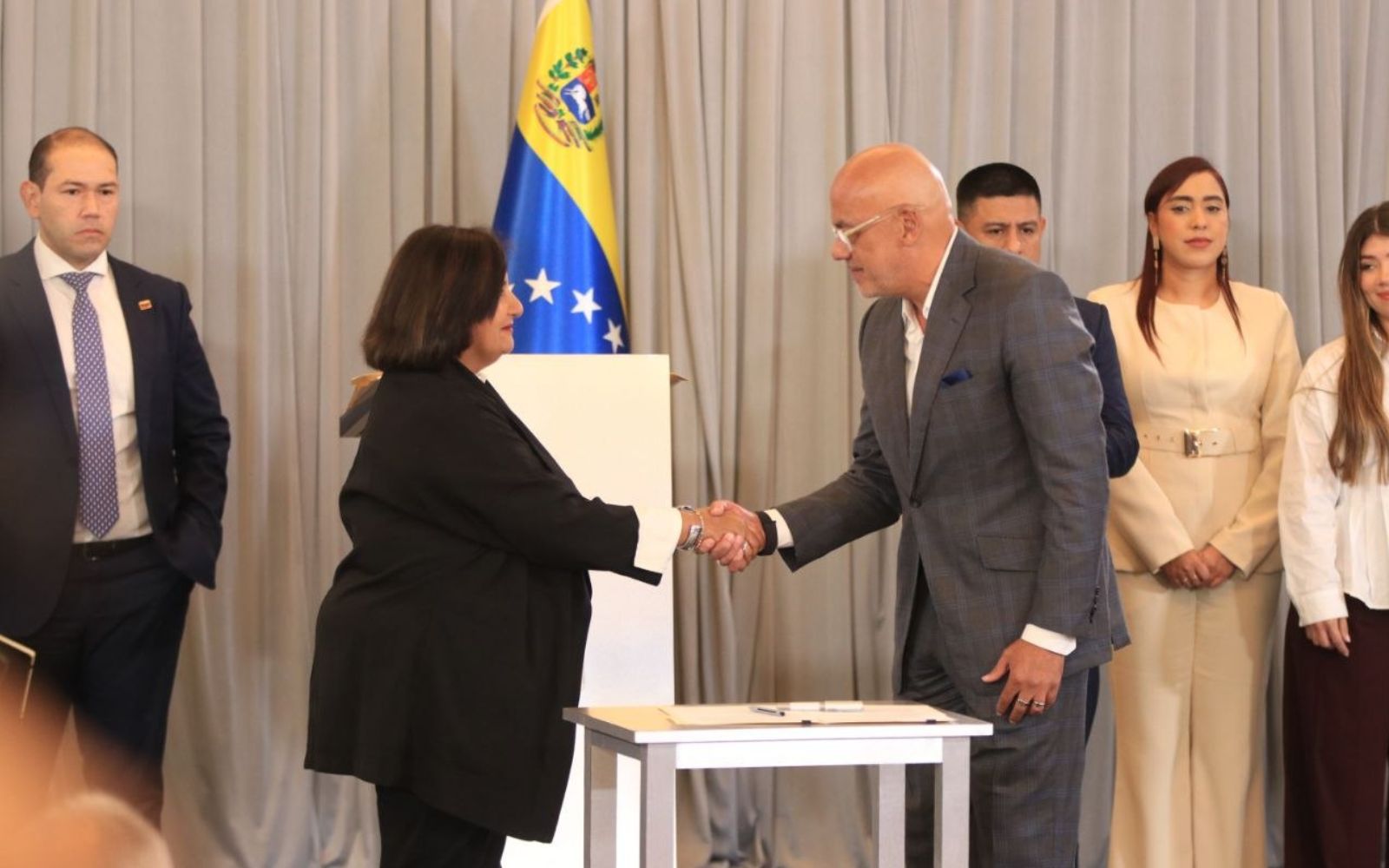
Ongoing talks between the socialist regime and the opposition in Venezuela are making some progress while the Church is trying to contribute to the transition to democracy and freedom.

A recent study highlights that when women are coerced or pressured into abortion, they are at high risk for negative outcomes — but abortion prviidess rarely screen for abortion coercion.

![Vatican vegetable garden goes 100% organic #Catholic A vegetable garden and orchard inside the Vatican walls, which historically provided food for the pope’s household, is now cultivated using exclusively organic farming techniques.The private garden covers almost a tenth of an acre of cultivable land inside the Mater Ecclesiae Monastery property, where Pope Benedict XVI lived during his retirement and now reside cloistered Benedictine nuns from the Abbey of St. Scholastica in Victoria, Argentina.Sometimes known as “the pope’s garden,” the vegetable plot “has always been a defining feature of the Vatican Gardens because, in fact, the Vatican Gardens were originally created primarily for that purpose — to provide sustenance for the [Apostolic] Palace,” Stefano Giampaolo, a forestry expert and head of the Gardens and Environment Service of the Vatican, told EWTN News.Giampaolo explained that now the plot is more accurately understood as the vegetable garden of the Vatican Gardens — an area that covers roughly half of Vatican City at 57 acres.
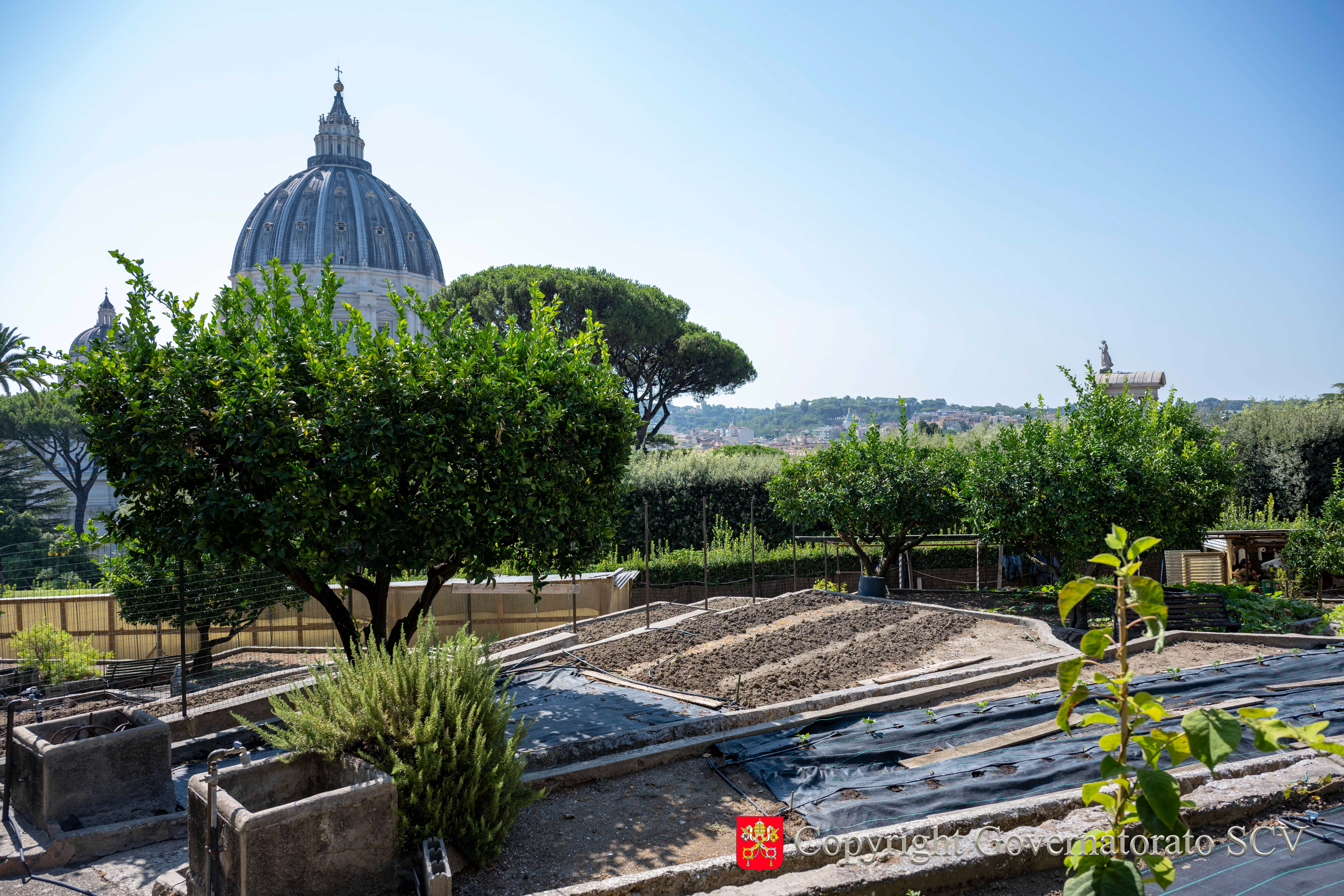
Mater Ecclesiae Monastery, built inside Vatican City in the 1990s to house nuns who support the ministry of the pope through prayer, has an adjoining vegetable garden and orchard. | Credit: Hannah Brockhaus/EWTN News
The Benedictine nuns at Mater Ecclesiae Monastery, who pray for the pope, eat the fruit and vegetables grown in the garden and use them to make jams and other food preserves. The excess produce is given to a Vatican soup kitchen run by the Missionaries of Charity.The move to biological farming techniques has been underway for several years, partly in response to Pope Francis’ 2015 encyclical Laudato Si’, Giampaolo said.The challenges of organicAccording to Gilberto Bianchi, the gardener responsible for the orchard and vegetable patch since 2008, the Vatican has a “desire to respect nature” in how it cares for the plants and trees on its land.But it’s far from easy.“Clearly, running a completely organic vegetable garden presents challenges, partly because insects are aggressive, and we use natural predators in the soil to control them,” Bianchi said. “No chemical fertilizers or insecticides are used.”He added that soil drainage and water conservation are also challenges.“This type of soil drains very well, so to conserve water, we add coconut fiber to retain moisture. And it’s watered with a drip irrigation system specifically to target the plants and avoid wasting water,” he said.Part of an organic agriculture also means respecting the seasons, he said. “Right now, the winter crops are being planted, while the summer crops are being harvested.”
The fresh produce grown in the vegetable garden and orchard in Vatican City feeds the Benedictine nuns living in the Mater Ecclesiae Monastery and supports the nearby Missionaries of Charity-run soup kitchen. | Credit: Governorate of Vatican City State
The end-of-summer harvest includes tomatoes, eggplants, green beans, zucchini, cucumbers, and peppers, while the fall and winter crop has broccoli, spinach, lettuce, and pumpkins.According to Vatican Media, the garden also includes garlic, basil, and a Peruvian variety of chili peppers known for its intensity. Kiwi plants were also added recently at the request of the Argentinian nuns.Next to the garden is a small orchard of around 15 citrus trees, some of which are 150 years old.“At this time, we’re planting savoy cabbage,” Bianchi said. “In short, whatever is in season. … So whatever is planted is because nature dictates it at that moment. The plants are grown from seed. We don’t use lab-grown plants.”A historic collection of gardensBianchi, who has worked for more than three decades in the Vatican Gardens, “is the one with the most expertise in this field, and he is now passing that knowledge on to a new gardener,” Giampaolo said.The expert gardener is part of a team of around 35 gardeners and administrators who oversee the Vatican’s green spaces and provide the flower arrangements for papal ceremonies.
Stefano Giampaolo, left, head of the Gardens and Environment Service of Vatican City, and expert gardener Gilberto Bianchi, right, the main caretaker of the orchard and vegetable garden commonly known as “the pope’s garden,” share their expertise with EWTN News in the Vatican Gardens on Sept. 9, 2026. | Credit: Hannah Brockhaus/EWTN News
“People expect to see a single garden, but in reality, as the name suggests, they are the Vatican Gardens — a collection of gardens,” Giampaolo said.The Gardens date to the mid-13th century, when Pope Nicolas III moved the papal residence from the Lateran Palace to the Vatican, had the city state’s walls built, and ordered the creation of a lawn, orchard, and “viridarium” — a Roman-style garden with flowerbeds and a fountain.Today, Giampaolo said, “there are countless different species, both trees and flowers. This is because, over time, the gardens have been enriched by donations and the search for specific botanical material, to the point of becoming a true botanical garden.”“Visitors are often struck by the diversity of the spaces — so many different gardens contained within this small area.”Ultimately, he said, the gardeners hope to one day eliminate all synthetic fertilizers and pesticides from their care of the entire Vatican territory.“It’s a process — the transformation of all the Gardens into organic ones,” he said.](https://unitedyam.com/wp-content/uploads/2026/09/vatican-vegetable-garden-goes-100-organic-catholic-a-vegetable-garden-and-orchard-inside-the-vatican-walls-which-historically-provided-food-for-the-popes-household-is-now-cultivated-using-scaled.jpg "Vatican vegetable garden goes 100% organic #Catholic A vegetable garden and orchard inside the Vatican walls, which historically provided food for the pope’s household, is now cultivated using exclusively organic farming techniques.The private garden covers almost a tenth of an acre of cultivable land inside the Mater Ecclesiae Monastery property, where Pope Benedict XVI lived during his retirement and now reside cloistered Benedictine nuns from the Abbey of St. Scholastica in Victoria, Argentina.Sometimes known as “the pope’s garden,” the vegetable plot “has always been a defining feature of the Vatican Gardens because, in fact, the Vatican Gardens were originally created primarily for that purpose — to provide sustenance for the [Apostolic] Palace,” Stefano Giampaolo, a forestry expert and head of the Gardens and Environment Service of the Vatican, told EWTN News.Giampaolo explained that now the plot is more accurately understood as the vegetable garden of the Vatican Gardens — an area that covers roughly half of Vatican City at 57 acres.
Mater Ecclesiae Monastery, built inside Vatican City in the 1990s to house nuns who support the ministry of the pope through prayer, has an adjoining vegetable garden and orchard. | Credit: Hannah Brockhaus/EWTN News
The Benedictine nuns at Mater Ecclesiae Monastery, who pray for the pope, eat the fruit and vegetables grown in the garden and use them to make jams and other food preserves. The excess produce is given to a Vatican soup kitchen run by the Missionaries of Charity.The move to biological farming techniques has been underway for several years, partly in response to Pope Francis’ 2015 encyclical Laudato Si’, Giampaolo said.The challenges of organicAccording to Gilberto Bianchi, the gardener responsible for the orchard and vegetable patch since 2008, the Vatican has a “desire to respect nature” in how it cares for the plants and trees on its land.But it’s far from easy.“Clearly, running a completely organic vegetable garden presents challenges, partly because insects are aggressive, and we use natural predators in the soil to control them,” Bianchi said. “No chemical fertilizers or insecticides are used.”He added that soil drainage and water conservation are also challenges.“This type of soil drains very well, so to conserve water, we add coconut fiber to retain moisture. And it’s watered with a drip irrigation system specifically to target the plants and avoid wasting water,” he said.Part of an organic agriculture also means respecting the seasons, he said. “Right now, the winter crops are being planted, while the summer crops are being harvested.”
The fresh produce grown in the vegetable garden and orchard in Vatican City feeds the Benedictine nuns living in the Mater Ecclesiae Monastery and supports the nearby Missionaries of Charity-run soup kitchen. | Credit: Governorate of Vatican City State
The end-of-summer harvest includes tomatoes, eggplants, green beans, zucchini, cucumbers, and peppers, while the fall and winter crop has broccoli, spinach, lettuce, and pumpkins.According to Vatican Media, the garden also includes garlic, basil, and a Peruvian variety of chili peppers known for its intensity. Kiwi plants were also added recently at the request of the Argentinian nuns.Next to the garden is a small orchard of around 15 citrus trees, some of which are 150 years old.“At this time, we’re planting savoy cabbage,” Bianchi said. “In short, whatever is in season. … So whatever is planted is because nature dictates it at that moment. The plants are grown from seed. We don’t use lab-grown plants.”A historic collection of gardensBianchi, who has worked for more than three decades in the Vatican Gardens, “is the one with the most expertise in this field, and he is now passing that knowledge on to a new gardener,” Giampaolo said.The expert gardener is part of a team of around 35 gardeners and administrators who oversee the Vatican’s green spaces and provide the flower arrangements for papal ceremonies.
Stefano Giampaolo, left, head of the Gardens and Environment Service of Vatican City, and expert gardener Gilberto Bianchi, right, the main caretaker of the orchard and vegetable garden commonly known as “the pope’s garden,” share their expertise with EWTN News in the Vatican Gardens on Sept. 9, 2026. | Credit: Hannah Brockhaus/EWTN News
“People expect to see a single garden, but in reality, as the name suggests, they are the Vatican Gardens — a collection of gardens,” Giampaolo said.The Gardens date to the mid-13th century, when Pope Nicolas III moved the papal residence from the Lateran Palace to the Vatican, had the city state’s walls built, and ordered the creation of a lawn, orchard, and “viridarium” — a Roman-style garden with flowerbeds and a fountain.Today, Giampaolo said, “there are countless different species, both trees and flowers. This is because, over time, the gardens have been enriched by donations and the search for specific botanical material, to the point of becoming a true botanical garden.”“Visitors are often struck by the diversity of the spaces — so many different gardens contained within this small area.”Ultimately, he said, the gardeners hope to one day eliminate all synthetic fertilizers and pesticides from their care of the entire Vatican territory.“It’s a process — the transformation of all the Gardens into organic ones,” he said.")
The move to biological farming techniques has been underway for several years in response to Pope Francis’ 2015 encyclical Laudato Si’.
![Catholic professor calls families to reclaim the home in a technological age #Catholic John Cuddeback, a professor of philosophy at Christendom College, says families today don’t often know how to achieve what they desire in their homes and family life. As a remedy, drawing from both ancient and modern thinkers, he has released "The Intentional Household: Living as if People Matter,” a book that outlines eight pillars for reclaiming the home as a place of human flourishing. “Families today are struggling to achieve what they so badly want: to have the kind of relationships we’re made for, beginning in the home, especially between spouses and between parents and children,” Cuddeback said. “They know they want something different, something better, but they feel hamstrung. In a culture that works against them in many ways, they are frustrated because they lack clear vision and examples to pattern themselves after.”
“The Intentional Household: Living as if People Matter” by Christendom College professor John Cuddeback. | Credit: Ken Oliver-Méndez/EWTN News
Cuddeback, who teaches a course on family and household and is also the author of “True Friendship,” spoke to EWTN News about how he hopes his book conveys that “[a]nyone can choose to be intentional about their household and make real progress with dramatic fruits in the lives of those we love most.” EWTN News: What do you see as the biggest challenge to building and maintaining an intentional home?Cuddebach: It all begins with priorities. As a society we have turned away from the intense focus that our household requires — and this is evident in how we struggle in marriage, raising children, and relating to the elderly. Even many traditionally-minded folks struggle to realize and enact the demanding, even while ordinary, aspects of God’s plan for our homes.Aristotle says that a society tends to produce the kind of people it honors. We do not honor those who prioritize home life — either women or men. This means that many of the structures, practices, and assumptions of our age are at odds with the real good of home life. This is especially evident in our obsession with the latest technologies.This book is a call to all of us to do something radically different and profoundly better — while always recognizing we must be people of our time and place. It calls us to discover that looking first to what our children and our elderly really need is the high road to deeper fulfillment for all of us.How has Pope Leo XIV’s encyclical Magnifica Humanitas influenced your thought on how technology should be incorporated in the home?Pope Leo makes clear that we have come to a crisis point. The time is now to be honest, serious, and persistent in examining our use of technology in view of real human flourishing. This must start in the home. No one else is going to do this for us.But as the pope makes clear, right practice must flow from an understanding of who we are and what we’re made for. “The Intentional Household” offers the rich and positive view of daily life in the home that grounds such an examination. It gives the “yes” that strengthens the “nos” we need to say. It gives direction for rising to the challenges of our age, including how to channel technology to true human flourishing.Approaching homelife intentionally — especially attending to the ordinary in good work and true leisure as essential to our relationships — we can take real steps to become those biblical good stewards so honored by the Lord.How does this apply to those across all walks of life, including single people, married couples without children, those who are divorced or separated?The principles of a vibrant home life are both perennial and flexible. Wherever we find ourselves we can discover how the plan that God wrote into human nature is much better than we have realized.Brokenness and suffering today are widespread. God’s plan encompasses these realities. By the grace of God, anyone who is humble and willing to take an intentional approach can affect real, and indeed dramatic change by applying the book’s eight principles. We can all take real steps to make our homes a place of vibrant life, with deep belonging, connection, and presence.One of the thinkers you cite in your book is Wendell Berry. In light of his recent passing can you speak to his influence on your life and thinking?Wendell Berry saw clearly how the loss of activities of work and leisure in the home has led to our experience of disconnection and isolation. Home should be a place of deep connection: between us and loved ones and neighbors, between soul and body, between us and the earth.One of Berry’s pivotal insights is the key role of a certain kind of work in the home. Berry has pointed out that the work of traditional home arts is much more important than we have realized. He argues that as the breakdown of home life came especially through the loss of good work, the renewal will likewise come through a rediscovery of work that connects us to one another as it connects us to our bodies and to the earth, and ultimately to God.Wendell Berry was a prophet of the extraordinary beauty and importance of the ordinary. Making our home an intentional household means rediscovering the power of ordinary things, such as mealtimes with the whole household, shared work in the kitchen and other home arts, and “porch time” and other such leisure times. Attention to these things can transform our marriage, parenting, and other key relationships.](https://unitedyam.com/wp-content/uploads/2026/09/catholic-professor-calls-families-to-reclaim-the-home-in-a-technological-age-catholic-john-cuddeback-a-professor-of-philosophy-at-christendom-college-says-families-today-dont-often-know-ho.jpg "Catholic professor calls families to reclaim the home in a technological age #Catholic John Cuddeback, a professor of philosophy at Christendom College, says families today don’t often know how to achieve what they desire in their homes and family life. As a remedy, drawing from both ancient and modern thinkers, he has released \"The Intentional Household: Living as if People Matter,” a book that outlines eight pillars for reclaiming the home as a place of human flourishing. “Families today are struggling to achieve what they so badly want: to have the kind of relationships we’re made for, beginning in the home, especially between spouses and between parents and children,” Cuddeback said. “They know they want something different, something better, but they feel hamstrung. In a culture that works against them in many ways, they are frustrated because they lack clear vision and examples to pattern themselves after.”
“The Intentional Household: Living as if People Matter” by Christendom College professor John Cuddeback. | Credit: Ken Oliver-Méndez/EWTN News
Cuddeback, who teaches a course on family and household and is also the author of “True Friendship,” spoke to EWTN News about how he hopes his book conveys that “[a]nyone can choose to be intentional about their household and make real progress with dramatic fruits in the lives of those we love most.” EWTN News: What do you see as the biggest challenge to building and maintaining an intentional home?Cuddebach: It all begins with priorities. As a society we have turned away from the intense focus that our household requires — and this is evident in how we struggle in marriage, raising children, and relating to the elderly. Even many traditionally-minded folks struggle to realize and enact the demanding, even while ordinary, aspects of God’s plan for our homes.Aristotle says that a society tends to produce the kind of people it honors. We do not honor those who prioritize home life — either women or men. This means that many of the structures, practices, and assumptions of our age are at odds with the real good of home life. This is especially evident in our obsession with the latest technologies.This book is a call to all of us to do something radically different and profoundly better — while always recognizing we must be people of our time and place. It calls us to discover that looking first to what our children and our elderly really need is the high road to deeper fulfillment for all of us.How has Pope Leo XIV’s encyclical Magnifica Humanitas influenced your thought on how technology should be incorporated in the home?Pope Leo makes clear that we have come to a crisis point. The time is now to be honest, serious, and persistent in examining our use of technology in view of real human flourishing. This must start in the home. No one else is going to do this for us.But as the pope makes clear, right practice must flow from an understanding of who we are and what we’re made for. “The Intentional Household” offers the rich and positive view of daily life in the home that grounds such an examination. It gives the “yes” that strengthens the “nos” we need to say. It gives direction for rising to the challenges of our age, including how to channel technology to true human flourishing.Approaching homelife intentionally — especially attending to the ordinary in good work and true leisure as essential to our relationships — we can take real steps to become those biblical good stewards so honored by the Lord.How does this apply to those across all walks of life, including single people, married couples without children, those who are divorced or separated?The principles of a vibrant home life are both perennial and flexible. Wherever we find ourselves we can discover how the plan that God wrote into human nature is much better than we have realized.Brokenness and suffering today are widespread. God’s plan encompasses these realities. By the grace of God, anyone who is humble and willing to take an intentional approach can affect real, and indeed dramatic change by applying the book’s eight principles. We can all take real steps to make our homes a place of vibrant life, with deep belonging, connection, and presence.One of the thinkers you cite in your book is Wendell Berry. In light of his recent passing can you speak to his influence on your life and thinking?Wendell Berry saw clearly how the loss of activities of work and leisure in the home has led to our experience of disconnection and isolation. Home should be a place of deep connection: between us and loved ones and neighbors, between soul and body, between us and the earth.One of Berry’s pivotal insights is the key role of a certain kind of work in the home. Berry has pointed out that the work of traditional home arts is much more important than we have realized. He argues that as the breakdown of home life came especially through the loss of good work, the renewal will likewise come through a rediscovery of work that connects us to one another as it connects us to our bodies and to the earth, and ultimately to God.Wendell Berry was a prophet of the extraordinary beauty and importance of the ordinary. Making our home an intentional household means rediscovering the power of ordinary things, such as mealtimes with the whole household, shared work in the kitchen and other home arts, and “porch time” and other such leisure times. Attention to these things can transform our marriage, parenting, and other key relationships.")
Christendom College professor John Cuddeback spoke to EWTN News about his new book “The Intentional Household: Living as if People Matter,” and treating our homes as places of human flourishing.
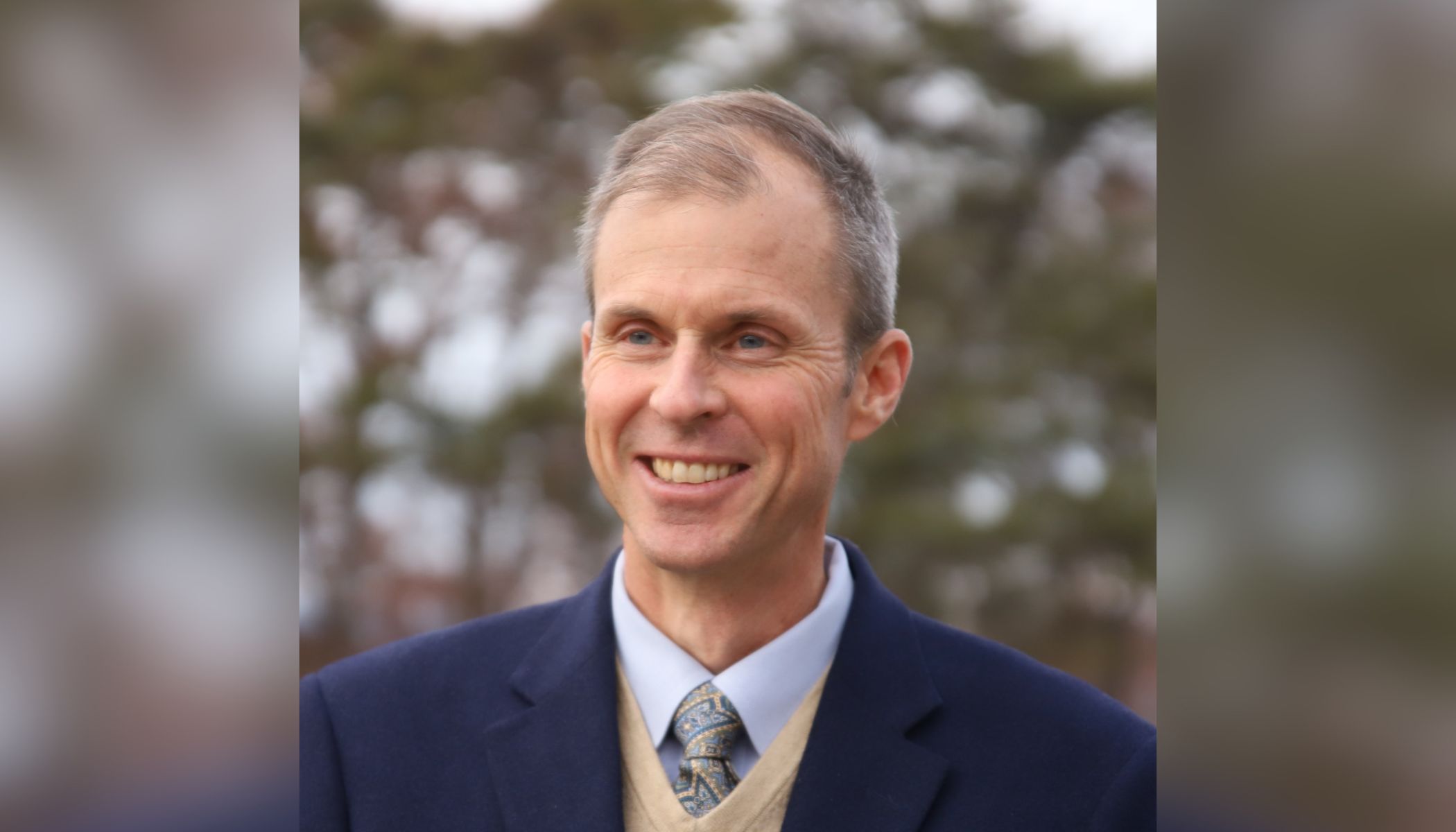
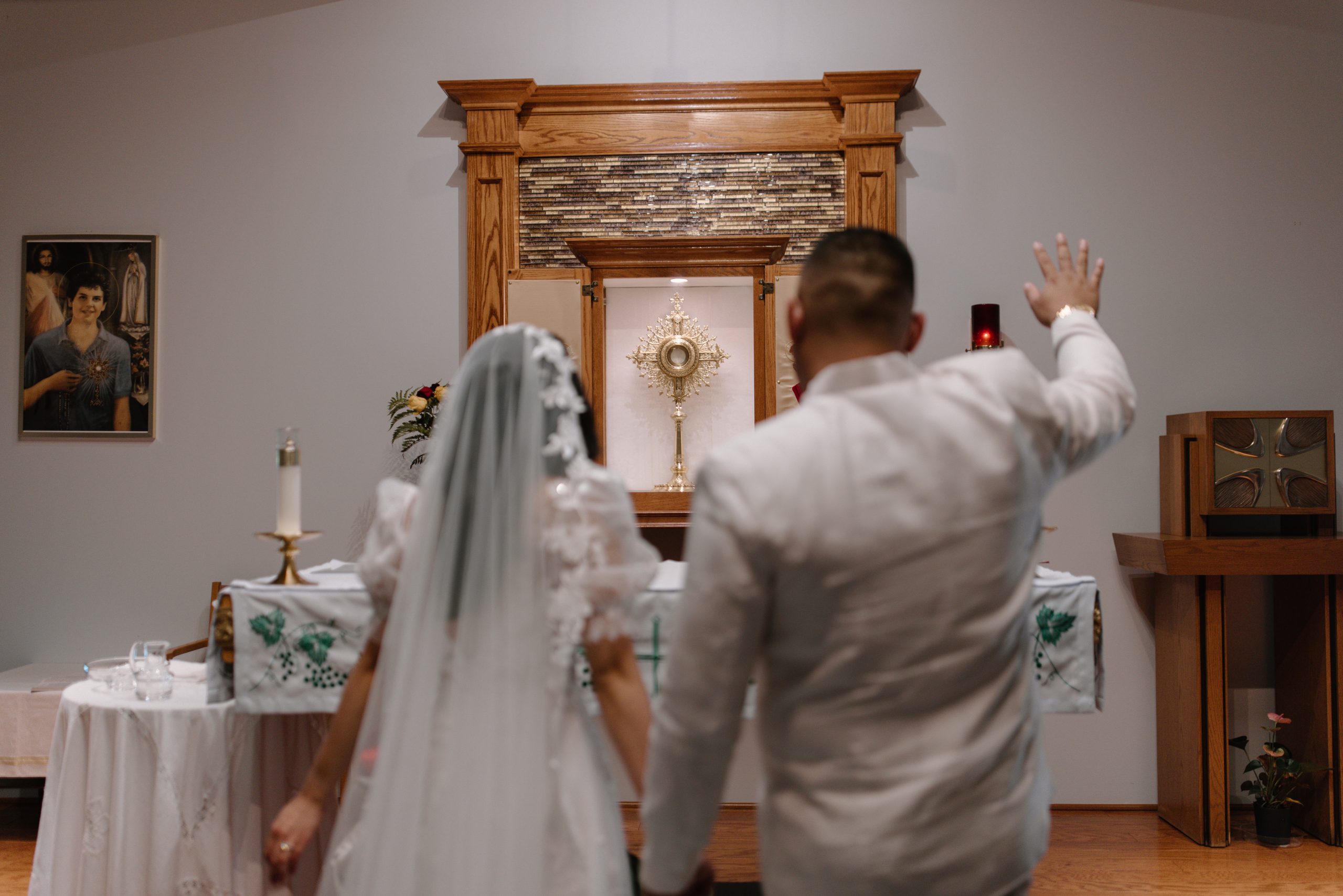
“Catholic and Christian couples don’t just have to register for their home goods,” but can “also register for sacred arts, sacred jewelry, beautiful wall mounts, and icons,” James Reichert said.