festive

Historic parish in Toronto Archdiocese to finally break ground on new church #Catholic After well over a decade of prayer, planning, and perseverance, a historic parish in the Archdiocese of Toronto, St. Patrick’s Parish in Brampton, Ontario,  Canada, will officially break ground on its new church May 24.For many, the project’s next — and most important — step marks a joyous continuation of a dream long held by generations of parishioners and clergy alike.Celebrations will take place on Pentecost Sunday with Mass at the current St. Patrick’s Church, followed by a procession to the new site located at 150 Martin Byrne Dr. for the formal blessing and groundbreaking ceremony. There, Toronto Auxiliary Bishop Ivan Camilleri will preside, joined by parishioners, major donors, local mayors, and councillors. The day will conclude with a festive barbecue, live music, games, and family activities back at St. Patrick’s.Monsignor Owen Keenan, pastor of St. Patrick’s, the archdiocese’s second-oldest parish, said the long-awaited moment is deeply meaningful for all. He spoke to Canadaʼs The Catholic Register about the parish communityʼs vision for a larger church, dating back to the 1980s, with planning truly intensifying in 2015 under the late Father Vito Marziliano. Unfortunately, misfortune befell the project even in its earliest stages.“ First, our architect Renzo Pianon died at 47, and then COVID hit us hard with the drop in attendance and various fundraising challenges before Father Vito left us far too young,” Keenan said. “There were moments of asking what is next? How much more can the community endure?”Still, the community persisted through Marziliano’s Loaves and Fishes Campaign — a project solely dedicated to St. Patrick’s mission of building a new, larger church property to serve a growing local population.
 
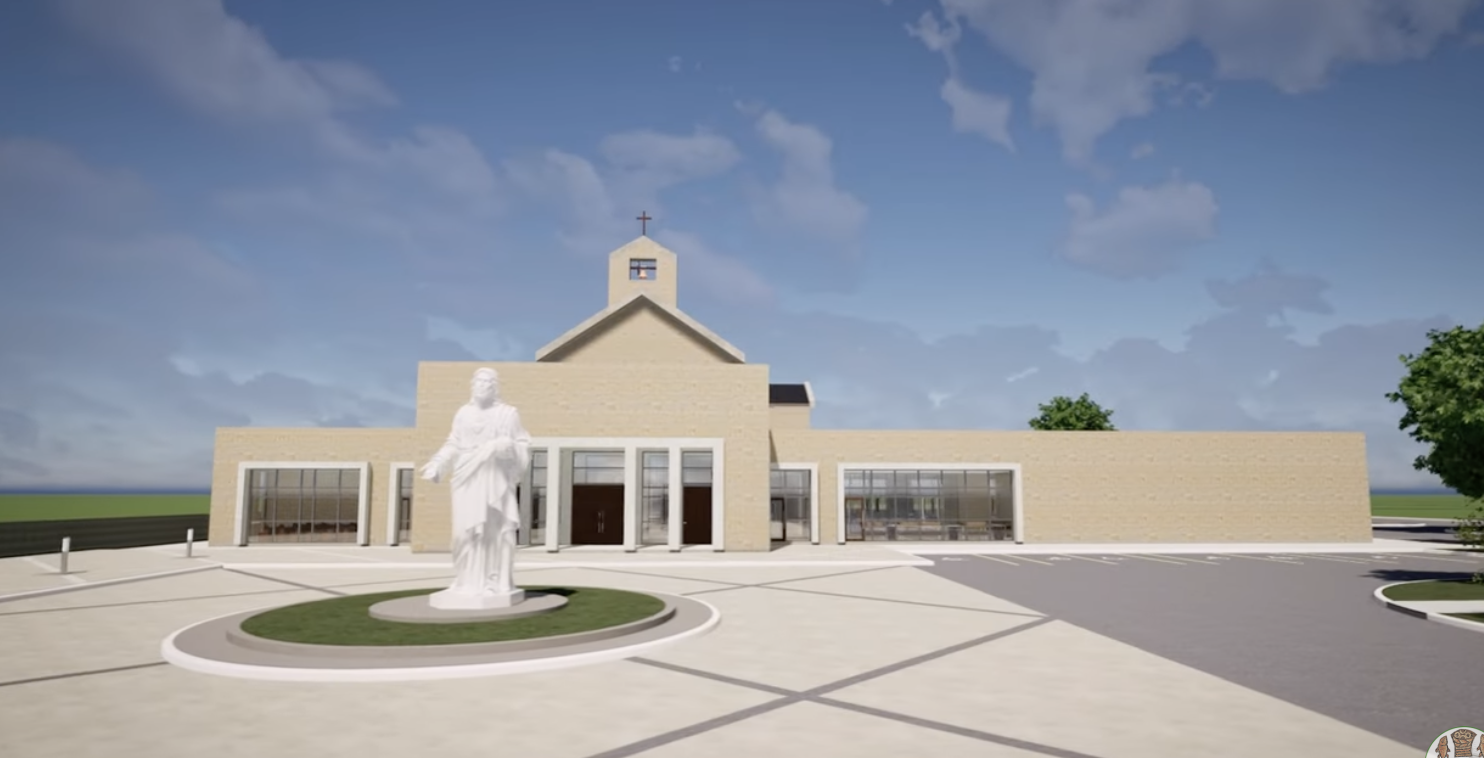
 A rendering of the front of the new St. Patrick’s Parish in Brampton, Ontario, Canada. Construction on the new church is scheduled to begin May 24, 2026. | Credit: Screenshot from St. Patrick promo video
 
 Speaking to The Catholic Register in October 2025, Keenan revealed that the City of Brampton, Region of Peel, and the City of Caledon anticipated an increase of between 50,000 to 60,000 people within the confines of the parish in the next 15 to 20 years. He also shared the growing interest from parishioners — and pledges of  million to be paid upon the start of construction and an additional  million in bequests from an anonymous parishioner and an area business, respectively.While the community has continued to rally behind the cause — including a promising showing and fundraising efforts at last year’s gala in October —Keenan concedes that a sense of restlessness has been creeping in.“ Weʼve managed to maintain and reestablish a good level of fundraising after COVID, but weʼve run out of runway — people are only going to throw money at a question mark for so long. Thus far, we have around 0,000 worth of new donations already, with more expected as we go and as we break ground,” he said.In total, the project has amassed several million dollars for the project.Despite the impressive figures, Keenan reiterated that rising prices have played a role in the project’s delay. Even as the market shows itʼs a good time to build, a 32,000-square-foot project in 2018 was estimated to cost .9 million, but by 2024, a reduced 28,000-square-foot building was estimated to cost as much as .5 million, leading the parish to scale its operation back from wants to needs.Still, the new church itself is set to be Marziliano’s swan song and become something truly unique as his original vision promised.“He was quite an artist, and so the design for the new church will be based on a 19th-century reconstruction of a sixth-century church in the Holy Land, specifically the Church of the Multiplication of the Loaves and Fish in Tabgha, Israel,” Keenan said.The extensive project involves building a bigger version that remains faithful to the original design, complete with a traditional Romanesque style, rounded apse, cruciform shape, and pillars up the aisles.Now, the project that required a true test of the communityʼs resiliency, patience, and faith will reach its most defining moment with May 24’s first dig.Looking back on the multigenerational effort, Keenan is grateful for the patience and steadfast support of parishioners who have sacrificed for this new church over a decade.“ We are all very excited, and I canʼt say enough about the good people of this parish who have been wanting this for so long. There are lots of good people for whom weʼre enormously grateful,” he said.“We want a place for families who are stressed to be able to come together to appeal to the Lord. Letʼs find our identity in Christ, as St. Paul says, and letʼs truly rejoice together.”This story was first published in Canadaʼs The Catholic Register and has been adapted by EWTN News. It is reprinted here with permission.

Historic parish in Toronto Archdiocese to finally break ground on new church #Catholic After well over a decade of prayer, planning, and perseverance, a historic parish in the Archdiocese of Toronto, St. Patrick’s Parish in Brampton, Ontario,  Canada, will officially break ground on its new church May 24.For many, the project’s next — and most important — step marks a joyous continuation of a dream long held by generations of parishioners and clergy alike.Celebrations will take place on Pentecost Sunday with Mass at the current St. Patrick’s Church, followed by a procession to the new site located at 150 Martin Byrne Dr. for the formal blessing and groundbreaking ceremony. There, Toronto Auxiliary Bishop Ivan Camilleri will preside, joined by parishioners, major donors, local mayors, and councillors. The day will conclude with a festive barbecue, live music, games, and family activities back at St. Patrick’s.Monsignor Owen Keenan, pastor of St. Patrick’s, the archdiocese’s second-oldest parish, said the long-awaited moment is deeply meaningful for all. He spoke to Canadaʼs The Catholic Register about the parish communityʼs vision for a larger church, dating back to the 1980s, with planning truly intensifying in 2015 under the late Father Vito Marziliano. Unfortunately, misfortune befell the project even in its earliest stages.“ First, our architect Renzo Pianon died at 47, and then COVID hit us hard with the drop in attendance and various fundraising challenges before Father Vito left us far too young,” Keenan said. “There were moments of asking what is next? How much more can the community endure?”Still, the community persisted through Marziliano’s Loaves and Fishes Campaign — a project solely dedicated to St. Patrick’s mission of building a new, larger church property to serve a growing local population. A rendering of the front of the new St. Patrick’s Parish in Brampton, Ontario, Canada. Construction on the new church is scheduled to begin May 24, 2026. | Credit: Screenshot from St. Patrick promo video Speaking to The Catholic Register in October 2025, Keenan revealed that the City of Brampton, Region of Peel, and the City of Caledon anticipated an increase of between 50,000 to 60,000 people within the confines of the parish in the next 15 to 20 years. He also shared the growing interest from parishioners — and pledges of $1 million to be paid upon the start of construction and an additional $1 million in bequests from an anonymous parishioner and an area business, respectively.While the community has continued to rally behind the cause — including a promising showing and fundraising efforts at last year’s gala in October —Keenan concedes that a sense of restlessness has been creeping in.“ Weʼve managed to maintain and reestablish a good level of fundraising after COVID, but weʼve run out of runway — people are only going to throw money at a question mark for so long. Thus far, we have around $350,000 worth of new donations already, with more expected as we go and as we break ground,” he said.In total, the project has amassed several million dollars for the project.Despite the impressive figures, Keenan reiterated that rising prices have played a role in the project’s delay. Even as the market shows itʼs a good time to build, a 32,000-square-foot project in 2018 was estimated to cost $12.9 million, but by 2024, a reduced 28,000-square-foot building was estimated to cost as much as $26.5 million, leading the parish to scale its operation back from wants to needs.Still, the new church itself is set to be Marziliano’s swan song and become something truly unique as his original vision promised.“He was quite an artist, and so the design for the new church will be based on a 19th-century reconstruction of a sixth-century church in the Holy Land, specifically the Church of the Multiplication of the Loaves and Fish in Tabgha, Israel,” Keenan said.The extensive project involves building a bigger version that remains faithful to the original design, complete with a traditional Romanesque style, rounded apse, cruciform shape, and pillars up the aisles.Now, the project that required a true test of the communityʼs resiliency, patience, and faith will reach its most defining moment with May 24’s first dig.Looking back on the multigenerational effort, Keenan is grateful for the patience and steadfast support of parishioners who have sacrificed for this new church over a decade.“ We are all very excited, and I canʼt say enough about the good people of this parish who have been wanting this for so long. There are lots of good people for whom weʼre enormously grateful,” he said.“We want a place for families who are stressed to be able to come together to appeal to the Lord. Letʼs find our identity in Christ, as St. Paul says, and letʼs truly rejoice together.”This story was first published in Canadaʼs The Catholic Register and has been adapted by EWTN News. It is reprinted here with permission.

St. Patrick’s Parish in Brampton, Ontario, is bursting at the seams. Now, on May 24, it will break ground on its long-awaited new church.
Read More
New York City street renamed for religious sister’s decades of service #Catholic A New York City street acquired a new name this past weekend honoring a Catholic sister’s decades of dedication to the East Harlem community.On Saturday, April 25, more than 100 people gathered to celebrate the newly named street — Sister Susanne Lachapelle Way — named for the life and legacy of Lachapelle and her contributions as a registered nurse, advocate, and Little Sister of the Assumption (LSA).“With a heart rooted in justice, she dedicated herself to serving the vulnerable through home visits, healthcare, and tireless advocacy, both locally and globally,” Rosario Jimenez, director for LSA Family in Mission, told EWTN News.The event and street naming flowed from Lachapelleʼs work with Little Sisters of the Assumption Family Health Service, a community-based nonprofit based in East Harlem. Founded by the Little Sisters, the organization offers numerous programs to help vulnerable families and children meet their basic needs.
 
 Crowd celebrates the unveiling of the Sister Susanne Lachapelle Way street sign in East Harlem, New York, on April 25, 2026. | Credit: Photo courtesy of Alysa Jette and Grace Ayres-Doyle
 
 The group has been in the city for almost 70 years and Lachapelle “really helped to set the trajectory for the organization,” Ray Lopez, chief program officer of LSA Family Health Service, told EWTN News.She was “a foundational visionary staff person and a leader who really, to this day, has a very profound impact on many of us who are on the staff and worked shoulder to shoulder with her, learning from her,” he said.“Since her passing, weʼve all … redoubled our efforts to find a way to keep LSAʼs original mission and vision going in this current environment,” Lopez said. “We really wanted to find ways to keep her name out there and the legacy going.”The street is on the southeast corner of East 115th Street and First Avenue. "Itʼs almost the exact midpoint of where Sister Susanne Lachapelle lived in the Little Sisters of the Assumption brownstone and where the LSA Family Health Service … center is located,” Lopez said.“She walked there every day for at least two decades,” he said. “We thought it was the appropriate place.”Sister Susanne and the Little Sisters: ‘Unsung heroes’Lachapelle entered the LSA order in 1962 and took the religious name Sister Susanne Mary of the Sacred Heart. She made her final vows in 1971.
 
 Sister Susanne Lachapelle. | Credit: Photo courtesy of LSA Family in Mission
 
 In her 60 years of religious life, she served in numerous areas and worked with many ministries. But for 45 years she made the community of East Harlem her home, helping to spearhead the LSA Family Health Service’s programs.As a nurse, Lachapelle conducted home visits, which “was a foundational program of LSA Family Health Service,” Lopez said. “All of the programs grew out of those interactions, those early interactions of nurses going into the homes to treat the sick and poor and really seeing conditions firsthand, sitting with families at their kitchen table, hearing their stories.”“Sister Susanne and the rest of the leadership created other programs to really provide wraparound services for families,” he said. "The Little Sisters set up a food pantry and a thrift store just to make sure that people had the very basics.”“From there, the services were about connecting people with public benefits, providing support around education, education enrichment, education navigation. A lot of … programs focused on maternal child health and early childhood development.”Along with her support for health and families, Lachapelle also had a passion for protecting the environment through her commitment to Pope Francis' Laudato Si', a call to protect our common home.
 
 Sister Susanne Lachapelle. | Credit: Photo courtesy of LSA Family in Mission
 
 Lachapelle decided to initiate “an environmental health component to the work that the Little Sisters were doing,” Lynn Tiede, a volunteer for LSA Health Service who worked with Lachapelle, told EWTN News.“She worked with the families and saw problems like asthma and other debilitating health things, she realized that … itʼs mold, itʼs the air quality, itʼs these other things that are really at the root of these health problems.”“Everybody was just so inspired … to see her traipsing into rough, rough buildings and just without any hesitation,” Tiede said. “If you went into a home and people were dealing with asthma, you … send in the environmental health team and then they try to work to get the building management to actually address those things.”With the success of her work, she even collaborated with the human rights group and nongovernmental organization Vivat International, where she helped bring voices and environmental issues to the United Nations, but she always remained “very, very humble,” Tiede said.Due to her humility “there were a few people who were against [the street-naming] when we proposed it, because they thought she would hate it — because she was so humble,” Tiede said.
 
 Sister Susanne Lachapelle Way in East Harlem, New York. | Credit: Photo courtesy of LSA Family in Mission
 
 Ultimately they chose to honor Lachapelle and the Little Sisters because they are “unsung heroes — these quiet heroes,” Tiede said.The process to get the street renamed began in 2024 and it was found to be an easier process than expected, as the city council was eager to acknowledge Lachapelle and the Little Sisters.Sister Susanne’s lasting impactAt the street naming celebration organizers “were expecting around 80 participants, but I think it was maybe 150 or a little bit more,” Jimenez said. “There were community members, families that she served, youth that she served, … volunteers, and of course, our board members and benefactors.”It honored her “simplicity and the way that she used to be a leader,” which was “was grounded in integrity, purpose, love,” Jimenez said. “Having a street named after her will honor all of that.”Reflecting on the event, Lopez said: “[It] feels like a dream because so many people came that worked with her in the past.”Despite having to move the event inside to avoid the cold and rain, the crowd of people stayed to celebrate. It “was crowded with people, and our center lobby was filled completely,” Lopez said. “It was just a very festive atmosphere.”He added: “It was really moving to have so many people there from so long ago that still feel it in their hearts, [how] the work here in East Harlem impacted their careers, impacted their lives, and that itʼs still a very significant thing for them,” he said.

New York City street renamed for religious sister’s decades of service #Catholic A New York City street acquired a new name this past weekend honoring a Catholic sister’s decades of dedication to the East Harlem community.On Saturday, April 25, more than 100 people gathered to celebrate the newly named street — Sister Susanne Lachapelle Way — named for the life and legacy of Lachapelle and her contributions as a registered nurse, advocate, and Little Sister of the Assumption (LSA).“With a heart rooted in justice, she dedicated herself to serving the vulnerable through home visits, healthcare, and tireless advocacy, both locally and globally,” Rosario Jimenez, director for LSA Family in Mission, told EWTN News.The event and street naming flowed from Lachapelleʼs work with Little Sisters of the Assumption Family Health Service, a community-based nonprofit based in East Harlem. Founded by the Little Sisters, the organization offers numerous programs to help vulnerable families and children meet their basic needs. Crowd celebrates the unveiling of the Sister Susanne Lachapelle Way street sign in East Harlem, New York, on April 25, 2026. | Credit: Photo courtesy of Alysa Jette and Grace Ayres-Doyle The group has been in the city for almost 70 years and Lachapelle “really helped to set the trajectory for the organization,” Ray Lopez, chief program officer of LSA Family Health Service, told EWTN News.She was “a foundational visionary staff person and a leader who really, to this day, has a very profound impact on many of us who are on the staff and worked shoulder to shoulder with her, learning from her,” he said.“Since her passing, weʼve all … redoubled our efforts to find a way to keep LSAʼs original mission and vision going in this current environment,” Lopez said. “We really wanted to find ways to keep her name out there and the legacy going.”The street is on the southeast corner of East 115th Street and First Avenue. "Itʼs almost the exact midpoint of where Sister Susanne Lachapelle lived in the Little Sisters of the Assumption brownstone and where the LSA Family Health Service … center is located,” Lopez said.“She walked there every day for at least two decades,” he said. “We thought it was the appropriate place.”Sister Susanne and the Little Sisters: ‘Unsung heroes’Lachapelle entered the LSA order in 1962 and took the religious name Sister Susanne Mary of the Sacred Heart. She made her final vows in 1971. Sister Susanne Lachapelle. | Credit: Photo courtesy of LSA Family in Mission In her 60 years of religious life, she served in numerous areas and worked with many ministries. But for 45 years she made the community of East Harlem her home, helping to spearhead the LSA Family Health Service’s programs.As a nurse, Lachapelle conducted home visits, which “was a foundational program of LSA Family Health Service,” Lopez said. “All of the programs grew out of those interactions, those early interactions of nurses going into the homes to treat the sick and poor and really seeing conditions firsthand, sitting with families at their kitchen table, hearing their stories.”“Sister Susanne and the rest of the leadership created other programs to really provide wraparound services for families,” he said. "The Little Sisters set up a food pantry and a thrift store just to make sure that people had the very basics.”“From there, the services were about connecting people with public benefits, providing support around education, education enrichment, education navigation. A lot of … programs focused on maternal child health and early childhood development.”Along with her support for health and families, Lachapelle also had a passion for protecting the environment through her commitment to Pope Francis' Laudato Si', a call to protect our common home. Sister Susanne Lachapelle. | Credit: Photo courtesy of LSA Family in Mission Lachapelle decided to initiate “an environmental health component to the work that the Little Sisters were doing,” Lynn Tiede, a volunteer for LSA Health Service who worked with Lachapelle, told EWTN News.“She worked with the families and saw problems like asthma and other debilitating health things, she realized that … itʼs mold, itʼs the air quality, itʼs these other things that are really at the root of these health problems.”“Everybody was just so inspired … to see her traipsing into rough, rough buildings and just without any hesitation,” Tiede said. “If you went into a home and people were dealing with asthma, you … send in the environmental health team and then they try to work to get the building management to actually address those things.”With the success of her work, she even collaborated with the human rights group and nongovernmental organization Vivat International, where she helped bring voices and environmental issues to the United Nations, but she always remained “very, very humble,” Tiede said.Due to her humility “there were a few people who were against [the street-naming] when we proposed it, because they thought she would hate it — because she was so humble,” Tiede said. Sister Susanne Lachapelle Way in East Harlem, New York. | Credit: Photo courtesy of LSA Family in Mission Ultimately they chose to honor Lachapelle and the Little Sisters because they are “unsung heroes — these quiet heroes,” Tiede said.The process to get the street renamed began in 2024 and it was found to be an easier process than expected, as the city council was eager to acknowledge Lachapelle and the Little Sisters.Sister Susanne’s lasting impactAt the street naming celebration organizers “were expecting around 80 participants, but I think it was maybe 150 or a little bit more,” Jimenez said. “There were community members, families that she served, youth that she served, … volunteers, and of course, our board members and benefactors.”It honored her “simplicity and the way that she used to be a leader,” which was “was grounded in integrity, purpose, love,” Jimenez said. “Having a street named after her will honor all of that.”Reflecting on the event, Lopez said: “[It] feels like a dream because so many people came that worked with her in the past.”Despite having to move the event inside to avoid the cold and rain, the crowd of people stayed to celebrate. It “was crowded with people, and our center lobby was filled completely,” Lopez said. “It was just a very festive atmosphere.”He added: “It was really moving to have so many people there from so long ago that still feel it in their hearts, [how] the work here in East Harlem impacted their careers, impacted their lives, and that itʼs still a very significant thing for them,” he said.

For 45 years, Sister Susanne Lachapelle made the community of East Harlem her home, helping to spearhead the LSA Family Health Service’s programs to help the most vulnerable.

Read More